



Abstract
This article conceptualizes the field of ‘visual communication and mental health’, prioritizing the question of how visual imagery is experienced. Taking as its starting point the challenge of overcoming stigma and the limitations of visual clichés of depression and mental illness, the author argues for a dynamic, relational model of communications, foregrounding lived experience. To illuminate the psychosocial impacts and potential benefits of creative engagement with visual media, she draws on understandings of symbolic communication, derived in particular from the work of DW Winnicott and the British Independent tradition of psychoanalysis. The imagery discussed includes stock and campaign imagery, conceptual/expressive artwork and a virtual reality (VR) production that extends an innovative approach to mental health literacy by First Nations artists.
Keywords
visual elements are carved out of the amorphous sensory chaos to conform not with names and predications, like the data of practical cognition, but with biological feeling and its emotional efflorescence, ‘life’ on the human level. (Langer 1953: 62)
‘If I Google “depression”, I am met by a sea of monochrome figures often with their head in their hands. Anxiety is at least more colourful but still there are [sic] an awful lot of head-clutching’, wrote the Wellcome Trust’s head of mental health on launching the Wellcome’s Photography Prize in 2019 [see Figure 1] (Wolpert, 2019). Psychologist Miranda Wolpert’s blog calls for photographers to move beyond the persisting focus on the head or brain in images of mental health, to explore more nuanced individual experience and the dynamic of moving through, as well as living with, mental health problems. This push for more innovative and dynamic visual communication reflects concern in the sector that clichéd images serve to entrench stigma and misconception. As a result, ‘people who are developing a mental illness don’t identify with the images that are portrayed in media or mass communications or popular culture’, argues Marc Bryant from Mindframe, an Australian Government-funded initiative to educate media about accurate portrayals of mental illness (quoted in Stanton, 2016).

Stock image of head-clutcher [iStock.com/boana].
Bryant and others rightly argue that the head-in-hands gesture expresses a feeling of despair rather than any more complex mental health condition. The sign that equates depression with the look of despair thereby reduces the person to the symptom – and the symptom itself to a visual cipher. The Australian mental health charity SANE recommends instead the depiction of human experience; images (like the head-clutcher) representing isolation or pain should ideally be used alongside ‘other types of images to show the diversity of experience of mental illness’ (SANE Australia, 2016). SANE’s recommendations were formulated in response to data from a survey of 5000 respondents (of which 70% reported lived experience), undertaken in partnership with Getty iStock, one of the leading stock image collections. With the goal of improving the representation of mental health in the iStock collection, respondents were shown six stock images, each representing familiar tropes of mental illness, and they were asked which of these were ‘fair and accurate’.
Notwithstanding the practical value of this targeted intervention, a theorist of visual communication and mental health might question what is involved in a judgement of fairness and accuracy. A sign might, for example, ‘accurately’ convey a feeling of despair associated with the experience of depression. But the same sign may not inspire reflection, hope, or movement beyond the entrenched feeling of despair, serving only to promote the association with negative affect. Circulating as a metonymic signifier of mental illness, it may also reinforce stereotyping and stigma.
How then do we distinguish the sign of suffering from the image that enables something more than its direct expression; that is, from the image that promotes a productive conceptualizing of mental health, beyond the isolated symptom or affect? In this regard, I will draw on a distinction made by the philosopher Susanne Langer (1953), further elaborated by Kenneth Wright (2009) within a psychoanalytic theory of communications. For Langer, the sign expresses the immediate presence of an object or an affect – in contrast to the ‘presentational symbol’ which allows for something akin to processing or ‘elaboration’ of experience. Embodying a one-to-one relation, in which denotation prevails over connotation, the sign in this formulation manifests the tensions and energies of the feeling state. In behavioural terms, screaming and remonstrating is a sign of anger; conveying anger in more subtle ways sends a symbolic message about one’s emotional state (Wright, 2009: 19). A visual sign may, then, convey (authentically or otherwise) the direct experience of despair but its frame and valence are limited; it may not encompass the modulations or changes in tone and intensity that occur over time and which prompt associations and reflection. The presentational symbol, by contrast, ‘shows forth’ rather than denotes – and may be understood to have other functional attributes or affordances. These are discussed below in terms of holding and containing, movement, competing affects and visceral attention.
Conceptualization of the function of imagery within what I will specifically term here the field of ‘visual communication and mental health’ entails theorizing visual communication through the lens of lived experience of mental health and vice versa. To this end, I draw on understandings of symbolic communication, which attend to the emotional and psychosocial dimensions of communication, derived in particular from the work of DW Winnicott and the British Independent tradition of psychoanalysis. This tradition is itself characterized by a shift in focus from the interpretation of symbols to the relational dynamics of communication (Bollas, 2018[1987]; Winnicott 1982[1967]; Wright, 2009). Within such a relational framework, the alternative to stereotypical images of mental health is not merely an expanded repertoire of ‘positive’ or less harmful depictions but an imagery that generates a greater potential for action.
Elizabeth El Refaie (2014:151) has observed that the dominant metaphors characterizing popular imagery of mental health ‘become so entrenched that they are impossible to escape’. In other words, they become clichés with a deadening effect rather than creative expressions offering the potential for transformative engagement. Insofar as they limit options and entrench stigma, they may compound feelings of low self-worth (or ‘spoiled identity’ as Goffman, 1963, defined the effects of stigma). Critical engagement, by contrast, entails an active intervention that restores agency, thereby creating opportunities for action and ‘escape’. Both these pathways imply not only the reading or interpreting an image but the potential to be affected by it, through a process of internalization.
Certain ‘anti-stigma’ initiatives have focused on critical intervention in this vein; a (2005) UK campaign by Time to Change, for example, activated the hashtag #GoodbyeHeadClutcher, along with a promotional image of a smiling Stephen Fry, parodying the gesture of head-clutching. The campaign elicited a range of social media posts in which people with lived experience represented themselves with no visible signs of depression. As with the British artist Gillian Wearing’s playfully titled series, ‘Signs that say what you want them to say and not Signs that say what someone else wants you to say’ (Figure 2), the collective effect of these debunking images called into question the presumption that mental ill-health can ever be usefully or meaningfully condensed into a single visual cipher. In both cases, cliché is displaced by imagery that directly restores agency – by people as agents of self-representation, playing with images and audience perceptions.
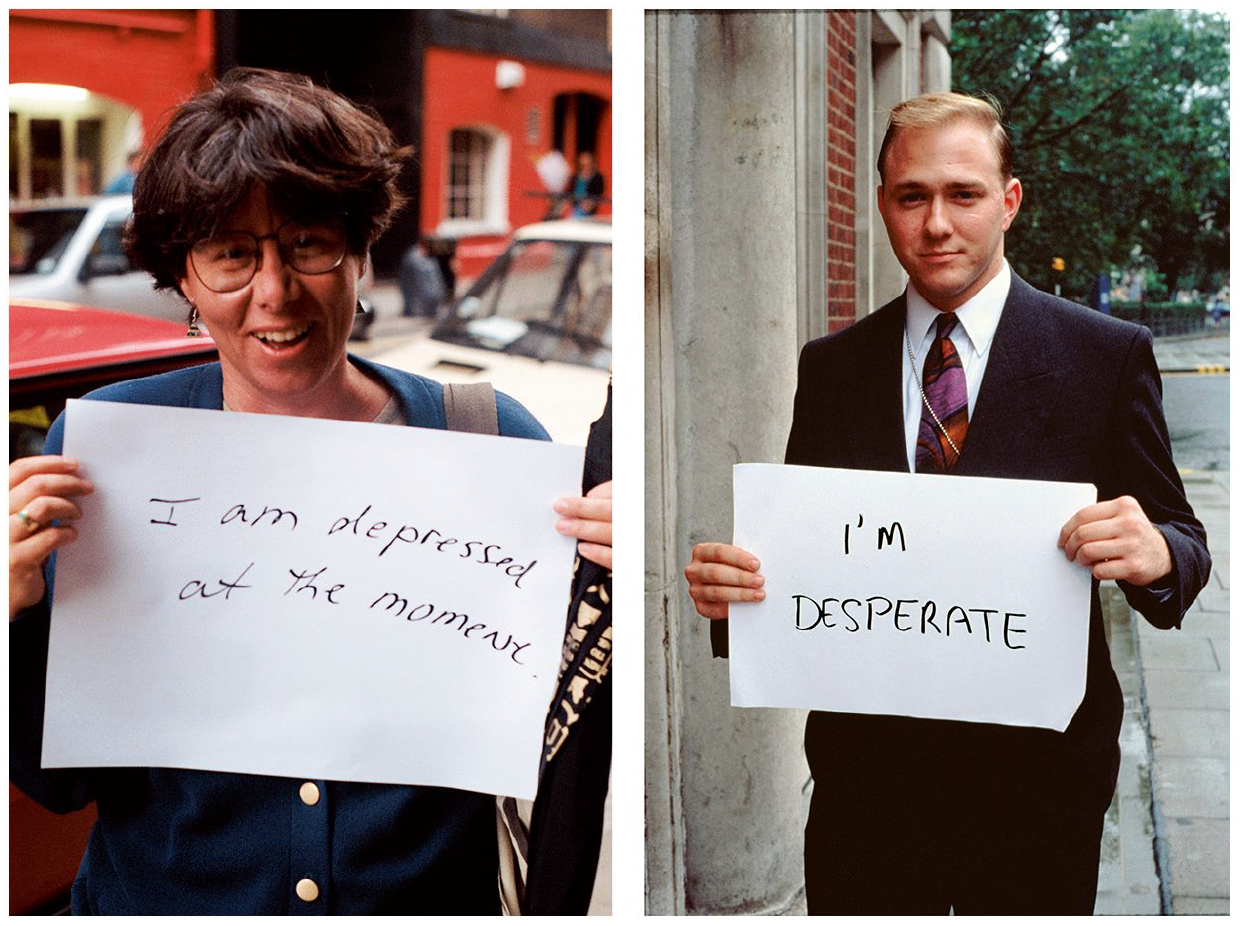
Gillian Wearing: Signs that say what you want them to say and not Signs that say what someone else wants you to say (I am depressed at the moment) 1992–3 C-type print © Gillian Wearing, Courtesy Maureen Paley, London; Regen Projects, Los Angeles; and Tanya Bonakdar Gallery, New York. Copyright Agency, 2022. Artists Rights Society [ARS]. Reproduced with permission.
Lived Experience
The World Health Organization estimates that up to 80 percent of those with mental health needs may not seek help, the figure being far higher in disadvantaged populations. This has turned the attention of researchers to the question of how emotional distress is understood and managed in everyday life-worlds, and thereby to the potential for imagery to resonate with lived experience.
The term ‘lived experience’ or ‘living experience’ refers to the subjective and interpersonal experiences of ‘service users’ or ‘consumers’ (or indeed of those who don’t access services) which underlie and go beyond the clinically defined symptomatology and behaviour that is the focus of diagnostics. Historically, lived experience was devalued within the Western medical model of mental health. Michel Foucault (1967) famously dates its suppression to the end of the 18th century. From this point in time, Foucault argues, ‘Modern man no longer communicates with the madman’ whose expressions are silenced; ‘The language of psychiatry, which is a monologue of reason about madness, could only have come into existence in such a silence’ (p. xii, ). By this logic, the ‘decolonizing’ of such excluded experience can only occur outside or alongside the established language of psychiatry and through a genuine proliferation of discourses of experience. Moreover, if the field of mental health is to promote communications that resonate with experience beyond the parameters of its own language, it must envisage communications that are generative of new forms of experience-based knowledge rather than simply didactic ones.
The acknowledgement that crucial knowledge about ‘madness’, ‘mental health’ or emotional distress comes from lived experience thus represents a marked shift away from a top-down model of health communication toward a dialogical one that makes space within the mental health sector for emergent languages of experience – in other words, for forms of expression like those now elicited through the above-mentioned campaign initiatives that do not readily map onto preformed linguistic or medical concepts or ‘conform with names and predications, like the data of practical cognition’ in Susanne Langer’s (1953: 62) words.
Visual imagery has long been understood as a means to register traumatic memories, which are by nature ‘non-declarative’, involving embodied, felt responses that lie outside verbal–semantic–linguistic representation (Bennett, 2005: 23; Van der Kolk, 2014). A visual expression of trauma may capture and convey ‘unthought’ experience as a sense impression before such experience is transformed into narrative. Source material within this framework is not conceptual but sensory and embodied; it is the sense impression (the ‘encountered sign’ in Deleuze’s, 2008: 64, formulation) that leads to thought.
For Langer (1953: 400) art ‘gives form to feeling’. In turn, viewing an artwork does something to us, not merely by stimulating emotions and moods: ‘What it does to us is to formulate our conceptions of feeling . . . it clarifies and organizes intuition itself.’ It is for this reason, Langer argues, that art or visual communication has the force of a revelation, even as it requires no conscious intellectual work or reasoning. Thus an aesthetic (sensory-affective) experience reveals something about inner life that remains incoherent until it is given form.
Containing and Holding
The process described by Langer whereby internal experience is clarified and organized implies an evolving interaction: a connection that supports intercommunication rather than simply one-way information delivery. The presentational symbol is not merely a trigger of affect, inducing feeling as an endpoint, but it also functions as an effective container for experience. Containment in this respect entails the creation of a structure for feeling and reflection.
Such a transaction evokes the deepening, sustained engagement that may be facilitated on occasion through attentive viewing of an artwork, whereas it may be argued that much visual communication is conceived with the simpler goal of getting a message across in a fleeting engagement. In mental health communications, however, the challenge is often to connect with difficult, unspoken experience – to recognize, ‘clarify and organize’ experience in a context where its naming and labelling may be counterproductive. The didactic image that interpolates a viewer as the potential target of clinical support may not connect with people who ‘don’t identify’ or perceive mental health terms to carry stigma (Bathje and Marston, 2014). In objectifying without validating experience it fails to ‘see’ the person looking.
Winnicott sums up the implications of the secure attachment that arises from being ‘seen’ as a child: ‘When I look, I am seen, so I exist’ (Winnicott 1982[1967]: 114). Such a dictum echoes the structural relationship with the consumer created through advertising; but here of course we are not concerned with the allure of a product that promises to confer or enhance identity but with the capacity of the image to see the person, to recognize internal feeling and to offer, in the first instance, secure containment. Wright (2009: 116) elaborates such a concept of containment both as a function of the symbol and of creative thought: Containment in adult life involves a growing capacity to generate (or find) containing structures (symbols) for oneself, and sustain oneself within their forms. This is a way of describing the capacity for imaginative, creative thought. However, such thought can be described in communicational terms as a type of thinking in which there is lively communication between the experiential substrate and representing form; the basic unit of imaginative thought is a dyadic structure of intercommunicating, resonating elements.
Creative thought, then, may arise in response to an image when elements within it resonate with felt experience, and when this creates sufficient traction to contain feeling and afford space for reflection and change.
The question of how an image holds rather than simply grabs attention – of how it touches and interests us, of how we are open to taking it in, rather than closed and disinterested – invites an expansive, psychodynamic conceptualization of ‘holding’ (Winnicott, 1960). Psychotherapists speak of ‘holding space’ in the sense of creating a container in which internal experience may be felt, shared and examined without judgement. This demarcation of a holding space for what is otherwise difficult to surface in everyday settings is palpably envisaged in The Nue Co.’s 2019 billboard campaign in New York and Los Angeles, ‘How Are You, Really?’ (Spiller, 2020; see Figure 3). The address rests on a shared understanding that the reflexive ‘fine’ or ‘good’, uttered in response to a casual ‘how are you?’ leaves troubling feelings unacknowledged. The perspicacious billboard or wall sign plays on the stark iconography of surveillance, purporting to see more from its elevated vantage point, to look at us attentively and (ironically for a two-dimensional street sign) to invite a deeper human response. The encompassing blank space is, as a result, oddly warm and inviting. Standing ready to absorb the answer, it may offer what Christopher Bollas (2018[1987]: 17) describes as ‘the uncanny pleasure of being held by a poem, a composition, a painting . . .any object’, an experience where ‘self-fragmentations will be integrated through a processing form.’
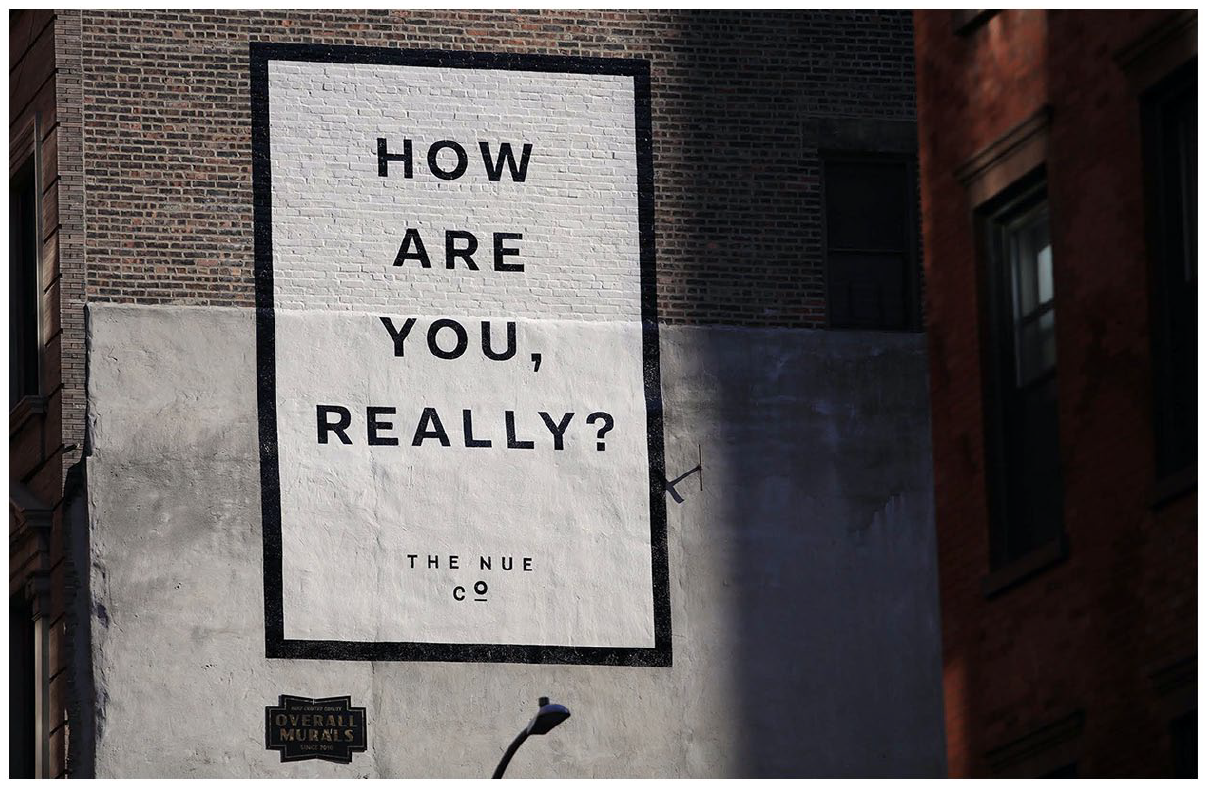
The Nue Co., How Are You, Really? billboard campaign. Image credits: Overall Murals, Inc NYC. Reproduced with permission.
Bollas, along with Wright, has advanced understandings of the aesthetics of communication grounded in the work of Winnicott and the British Independent tradition of psychoanalysis, which is particularly associated with the holding stance. Winnicott notably contrasts holding and interpretation – interpretation being the verbal message that conveys information, holding a more subtle process, less dependent on verbal explanation (Winnicott, 1960; Wright, 2009: 31).
For Winnicott, a primary goal was to make experience feel real through recognition. The ‘hole in experience [associated with trauma or depression] implies deficient containing structures’ whereby experience is never matched by resonating forms (Wright, 2009: 139). The model for this matching by resonating form is the interaction of a baby with the face of a mother/caregiver who ‘sees’ and thereby validates a child’s experience, and whose absence or neglect impairs the development of internal containment structures. The therapeutic process, for Winnicott, was essentially modelled on this transaction. This, in turn, opens up consideration of the broader landscape of resonating forms, and of the material role of visual culture in ongoingly promoting feelings of being seen/overlooked, secure/insecure, soothed/distressed and so forth. Such a framework provides particular insight for the field of visual communication in mental health, where a communications strategy might take as a starting point the ‘deficient containing structures’ of the self that leave us feeling empty, depressed or alone – and the proposition that such experience may be productively met or matched by resonating forms.
If (as is often argued) 1 advertising imagery reconstitutes a lack or ‘hole in experience’ with the promise of fulfilment, it is a more complex proposition to actively constitute a container in which to hold the viewer in an experience where the fragmented self may be integrated through a visual form. Such containment facilitated by a cultural object, as Noreen Giffney (20201: 125) notes, has a specific function, unlike the analogous containment by another person; it is ‘containment by the patient’s own mind, performing two functions at once: projector and container’. It induces in a viewer a form of creative thought with the force of revelation, opening up an experience rather than merely conveying information.
Metaphors
The escape from the ‘entrenched’ metaphor is not, then, enabled by an image with which one has full identification but rather in the potential for free-play facilitated by the container–contained structure and the activation of intercommunicating, resonating elements. In her work on graphic memoirs of depression, El Refaie (2014) likewise notes that the choice for artists is not between simply recycling dominant cultural metaphors and avoiding figurative language – but is ‘to use metaphors in a creative way, thereby exploiting the communicative benefits they offer, while avoiding the danger of being trapped in damaging unconscious thought processes’ (p.151). Actively extricating oneself from this danger itself entails creative agency – and the potential for working with metaphor to transform a symptom through symbolic elaboration (Wright, 1976). In this sense, a metaphor is not a given – a denotative sign with fixed meaning – but an image used in a process of meaning making.
Such a focus on the psychosocial use of metaphor is not at odds with the ‘experientialist’ aspect of conceptual metaphor theory [CMT] (Lakoff and Johnson, 1980), which holds that metaphor is ‘not merely a matter of language’ but of conceptual structure, which involves all the ‘dimensions of our experience, including aspects of our sense experiences: colour, shape, texture, sound etc’. Artworks for Lakoff and Johnson ‘provide new ways of structuring our experience in terms of these dimensions’; aesthetic experience (in both art and everyday life) thus gives rise to ‘new coherences that are not part of our conventionalised mode of perception of thought’ (pp. 235–236). But how then do we track the emergence of new coherences within the domain of popular imagery, where stereotypes and clichés may be hard to dislodge?
A recent study in this journal uses a CMT framework to survey the range of metaphors arising in online visual representations of depression (Poppi and Kranvanja, 2021). The authors construct their sample from a Google search on the term ‘depression’, using raters to determine which 30 images, from an original 50 sourced via the search, are most functional/effective in visually representing depression and its causes/effects, The raters in this case were university students rather than stakeholders with lived experience. As such, ‘functional/effective’ is not an index of resonance with personal experience but of correspondence with popular conceptions of depression. In other words, the rating favours established meaning and currency rather than the creation of ‘new coherences’ that depart from convention (Lakoff and Johnson, 1980: 235–236). Using a CMT method, the 30 images were found to conform to the most commonly found linguistic metaphors of depression – such as those related to ‘going down’ or darkness – but also include ‘creative metaphors’ or visual adaptations of ‘more standard metaphors’ (e.g. DEPRESSION IS BEING TRAPPED; DEPRESSION IS A SHADOW), and others that ‘likely represent the abstraction of symptoms of depression’ (e.g. DEPRESSION IS BEING MUTED). Applied in this fashion, however, the method of classification commits rigidly to one metaphor per image.
Within the Wellcome Photography Prize (explicitly positioned as an opportunity to think beyond the clichés and standard tropes arising from a Google search) we might expect to find a greater emphasis on ‘new coherences’ (Lakoff and Johnson, 1980: 235–236) than this sample and its mode of analysis reveal. In Head in Hole (Figure 4), for example, Dulcie Wagstaff plays on overtones of dominant metaphors of depression such as ‘going down’ or darkness. The image at first glance evokes feelings of being stuck, buried, falling into a hole, having one’s head contained, being invisible; and, conversely, of planting, summer, growth. In other words, it immediately prompts a host of rich and contradictory associations rather than a singular classification in the ‘A IS B’ formulation of ‘depression is descent’. It is also funny, stylized and self-parodic – that is to say, it manifests a layer of subjective and creative agency in its playful reworking of hackneyed metaphors. The gloss provided on the Wellcome website (2021) explains: To help with her depression, Dulcie Wagstaff works in her garden . . . she confronted the cold with a summery floral dress and imagined burying herself, ‘connecting with the earth while hiding from the world above’. She says: ‘Gardening in winter is a defiant act . . . a lifeline, in search of light, connection, movement and purpose.’ (Wellcome Photography Prize, 2021)
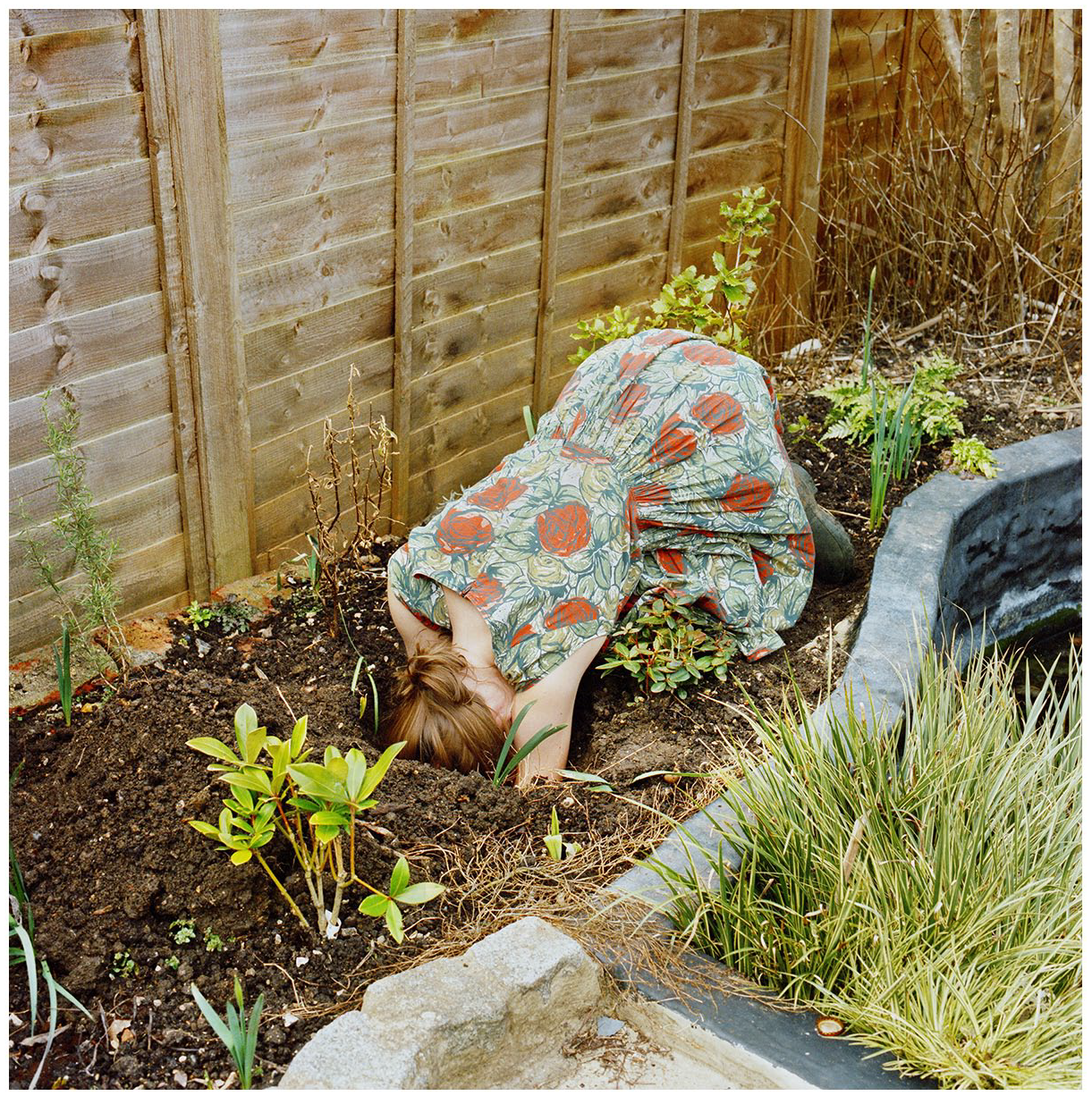
Dulcie Wagstaff, Head in Hole, Wellcome Photography Prize, 2021. © Dulcie Wagstaff. Reproduced with permission.
Movement
Langer (1953: 66) explains, ‘What we call “motion” in art is not necessarily change of place, but is change made perceivable, i.e. imaginable, in any way whatever.’ What is at stake here is not the depiction of motion in an image but precisely this activation of connection and movement in the viewer’s interaction with it. The implication, then, is that ‘feeling finds form’ but not fixity; a viewer may recognize notes of despair, even a literal descent but also the counterpoint of light and an enactment of defiance and purpose. This free-play within the structure of the presentational symbol is the key to perceiving change.
That Wagstaff’s image arises in the ‘alternate’ space of a photography prize, rather than in a stock image collection or Google search on depression underlines the value of making space for critical reflective work. But responses to the SANE survey (assessing six stock images) may also reveal a similar inclination toward more open, less definitive images. The most widely accepted image in the survey was a ‘multi-face’ image (Figure 5). Nearly two thirds of the survey participants agreed or strongly agreed that this was a fair and accurate representation of mental illness (people with lived experience reported the highest level of agreement at 71%). In the CMT ‘A IS B’ formulation, this image might be classified as ‘Depression IS a mask’– an association recognized by some respondents. But such a formulation is at odds with other accounts of its appeal. Jack Heath, then CEO of SANE, summarizes as follows: ‘What it showed was a person with a normal expression. But behind it there’s grief, excitement and rage. This sense of a diversity of experience for an individual’ (Stanton, 2016). Seen in context of the six, the image stands out as the only one representing the multidimensionality of human experience.

iStock image used in the SANE Australia Survey. [iStock/Astova].
In this regard, the semantic convention of formulating metaphors in the form ‘A IS B’ is unhelpfully definitive. Forceville and Paling (2018) have noted that ‘the The same form may have more than one import; and, whereas the assignment of meaning to an acknowledged symbol (e.g. of literal or accepted hyperbolic meaning to a word) precludes other possibilities in its given context, the significance of a pure perceptible form is limited by nothing but the formal structure itself. Consequently references that could be rationally taken only as alternatives are simply co-present as ‘the import’ in art. This makes it possible to fuse even two contradictory affects in one expression.
Contradictory Affects
This fusion of co-present affects provides a means to register the experience of ‘moving through’, proposed by Wolpert (2019) as an important counterpart to presenting the experience of ‘living with’ mental health problems. Moving through is not a linear proposition – resolved by a before and after image in neat progression. Like the concept of ‘positive’ imagery of mental health, it cannot be envisaged at the cost of avoiding difficult feelings; nor can a representation of mental health or trauma afford to over-engineer the pathway toward a good end, parting faith with the reality of lived experience. From Susan Sontag’s Illness as Metaphor (1978) to theatre maker Bryony Kimmings’ satirical musical, A Pacifist’s Guide to the War on Cancer, many have critiqued the triumphalist metaphors of illness and the patient’s ‘journey’ or ‘battle’. If the cancer musical and its iconography – a fusion of pathos, horror and whimsical humour – is uplifting, it is by virtue of resonating with a dynamic range of affect (and licensing humour in relation to a sensitive subject), collapsing the opposition of positive and negative, triumph and despair: ‘Where there is no exclusion of opposites, there is also, strictly speaking, no negative’, Langer (1953: 242) tells us.
The presence of multiple competing affects is not only ‘fair and accurate’ but modulation of affect enables greater tolerance of images of pain. If humour is a ‘benign violation’ that happens when something threatening or violating is simultaneously safe and benign (McGraw and Warren, 2010), its use can widen the ‘window of tolerance’ for difficult experience, thereby assisting recovery from trauma in a clinical sense (Wagenseller, 2017: 2). Likewise humour, laughter or lightness within a representation of trauma or distress allows a viewer to tolerate (and relieve) discomfort. Arguably, then, a greater depth and intensity of negative affect may be represented and tolerated where there is contrast and movement, rather than unrelenting distress. The role of the presentational symbol is thus to hold complex and contradictory feelings that are authentic but in motion.
Such a contrast is orchestrated in Yoga for Weepers (Figure 6), an image from UK artist Bobby Baker’s ‘Diary Drawings: Mental Illness and Me’, which has also been reproduced on posters for events such as World Mental Health Day. Its combination of a contorted, back-bending body and an overarching tsunami of tears reads simultaneously as the impressive feat of a supple yogic body and a stylized outpouring of emotion, animated by the flow of both body and tears. Like Wagstaff’s image, Baker’s is funny, somewhat self-parodic and ironic. The antithesis of the body withdrawn in despair, this one springs to action, exhibiting technique and control, counterpointed by the equally hyperbolic gush of tears, given undue prominence as a kind of performative feat in itself. Competing affects are here carried in a counterintuitive form, so that the viewer experiences the energy and dynamism of the image almost before discerning its content. Confounding gravity as well as the force of the metaphor ‘depression is descent’, the arc of tears conveys an uplift even as they threaten to overwhelm.

Bobby Baker, Image 320: Yoga for Weepers, in ‘Diary Drawings: Mental Illness and Me’, Wellcome Collection, 2010. © Bobby Baker. The Design and Artists Copyright Society [DACS]/Copyright Agency, 2022. Reproduced with permission.
Form and Composition
To underline how form is experienced in advance of conceptual categorization, Langer (1953: 83) quotes a passage from Henri Matisse, in which the painter explains that when he sees the Giotto frescoes in Padua he does not trouble to recognize which scene of the life of Christ is before him, but simply ‘perceive[s] instantly the sentiment which radiates from it and which is instinct in the composition in every line and color’. A subsequent glance at the title merely confirms this impression for him. Likewise, the more playful Yoga for Weepers.
Sentiment or affect radiates from a composition – an effect not only of a figure’s expression but of interanimating elements. In other words, we may be moved by more than just a ‘theory of mind’ – an evaluation of a facial expression, action or behavioural characteristic to which we impute a mental state (in psychology ‘theory of mind’ refers to the way in which, in the course of everyday interactions, we ascribe internal states to others – rightly or wrongly – based on outward signs) (see Apperly, 2012). Visual artworks of complexity and depth often confound superficial ‘theory of mind’ judgements – in part because the faces and expressions they capture are subtle and ambiguous, open to different readings and projections (Gillian Wearing’s images in Figure 2 debunk the reliance on decoding surface information head-on); but also because the emotions they inspire arise from a combination of elements (as in Yoga for Weepers) rather than merely from the figurative representation of an emotional person.
Taken as a whole, the field of interanimating elements might be thought of as a scenic composition. The term ‘scenic’ is used by the psychoanalyst Alfred Lorenzer (2016[1983]) to describe symbolization as a sensory and affective process, in which (as in real life) objects are never encountered in isolation. Desymbolized language, such as scientific or medical discourse, loses its scenic character to the extent that it is de-sensualized, or has lost its connection to sensual and affective experience. Signs (clichés, reductive stereotypes, unprocessed symptoms) which are desymbolized in this way can, however, be brought to a scenic understanding by transforming them back into a symbolic interaction form, infused with the vitality of experiential links (Bennett et al., 2019: 19; Hoppe, 1977: 58). In a scenic composition, as with the presentational symbol, the non-discursive formal elements of an image together compose a dynamic pattern of feeling – but ‘the rhythm of attention is an interesting link among them all’ (Langer, 1953: 241).
Literacy
At stake here is a complex form of what amounts to emotional or ‘mental health literacy’ grounded in finding form for feelings. Literacy remains a focus of the mental health sector amid concerns that ‘only a minority or people who meet diagnostic criteria for a mental disorder seek professional help’ (Jorm, 2000). But within the Western medical model, mental health literacy is conceived narrowly and in cognitive terms, focusing on ‘knowledge and beliefs about mental disorders’ (Jorm, 2020). Such terms, its own exponents note, are limited since ‘the concept assumes the superiority of expert psychiatric knowledge over lay beliefs’ and ‘could be criticised for seeing the sufferer's interpretation of his or her condition as less valid’.
A radically different approach to mental health literacy, grounded in finding form for feelings, has been developed by Uti Kulintjaku, an initiative of the Ngaanyatjarra Pitjantjatjara Yankunytjatjara Women’s Council (NPYWC) in Central Australia. Uti Kulintjaku (meaning ‘to think and understand clearly’ in Pitjantjatjara) draws on the knowledge systems of both Aṉangu (First Nations people of the NPY lands) and non-Aboriginal health professionals (Togni, 2017) to create programs and visual resources.
One of the group’s most successful resources, the poster, Words for Feelings (Figure 7) contains Pitjantjatjara or Ngaanyatjarra and English words for feelings and emotions. These are not terms specific to clinical or psychiatric knowledge systems but descriptors that make up an embodied vocabulary of emotion. The visualization too departs from the individualized personification of illness, creating instead a lexicon of embodied experience, distributed across a community setting, itself a kind of container for emotional life and its transactions. The goal of such resources is not specifically to facilitate translation but to focus on the meaning of experience and on the process of discussion within culturally safe environments (p. 272).
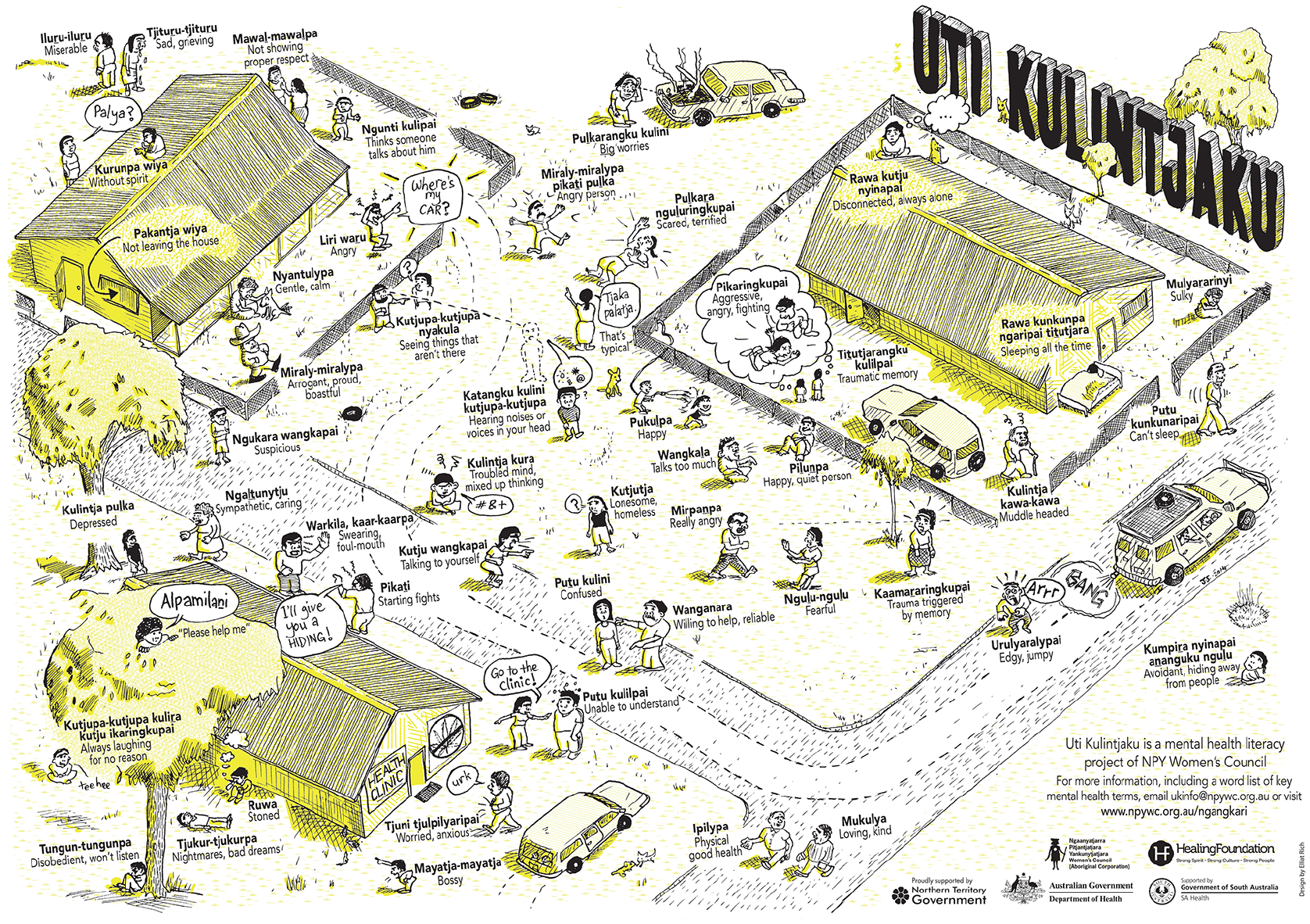
Kulintjaku, Words for Feelings. Reproduced courtesy of NPY Women’s Council.
Uti Kulintjaku are artists and ngangkari (traditional healers); they work with visual media and with something akin to a scenic understanding – a working understanding of symbolization grounded not only in sensory and affective experience but in connection to Country. Concepts of wellbeing for First Nations Australians extend far beyond the confines of the medical model, taking account of ‘the importance of connection to land, culture, spirituality, ancestry, family and community, [and] how these connections have been shaped across generations’ (Dudgeon et al., 2014: 4, cited in Togni, 2017). Moreover, wellbeing is profoundly impacted by a history of colonial violence, encompassing the forced removal of children, dispossession of land, social inequity, poverty, racism, grief and loss, intergenerational trauma, and the loss of culture and identity (Togni, 2017). The sense of an ‘inner landscape’, and its connection to wellbeing, is therefore linked to ‘understanding Country’ (Wobcke and Bennett, 2022), as well as to acknowledgement of ongoing trauma.
Man in the Log
In 2019, Uti Kulintjaku approached my lab (fEEL: Felt Experience & Empathy Lab) to collaborate on the production of immersive media tools to extend their mental health literacy work. They wanted, in their words, ‘to create virtual reality [VR] versions of traditional stories that address cycles of trauma, substance abuse and associated mental health challenges in Anangu communities’. 2 Their interest in VR – and its strength as a medium – relates to its strongly experiential character, whereby a viewer might be located within a scene.
In a workshop in Alice Springs they told us the traditional story of Tupul-Tupul, about a man who goes out hunting and becomes trapped in a hollow log while chasing an animal – a metaphor they have revived and imbued with contemporary meaning. Pantjiti Unkari McKenzie explains how the man’s two wives go searching for him: They could hear his voice, but couldn’t work out where it was coming from . . . when they realised, they were really upset . . . he told them, ‘Something really bad has happened to me, I’ve become trapped in this log.’ And the women were devastated . . . they fell to the ground in grief and wailed for him . . . They desperately wanted to be able to give him some food and some drink, but they weren’t able to. He was too trapped inside . . . they called out to him, ‘Are you all right in there?’ But he’d wasted away and he couldn’t answer.
3
Chipping away at the bark, the women manage to make an opening so the man can see out. Eventually, a ngangkari is found with the power to strike open the tree; when it finally splits open the wasted man falls to the ground, where he is given water and tended by the women. In the VR experience (Figure 8), the action unfolds from the point of view of the man in the log; hence viewers find themselves trapped – encased in a cylindrical bark form, looking out onto Country (a 360-degree view of the red desert landscape). 4
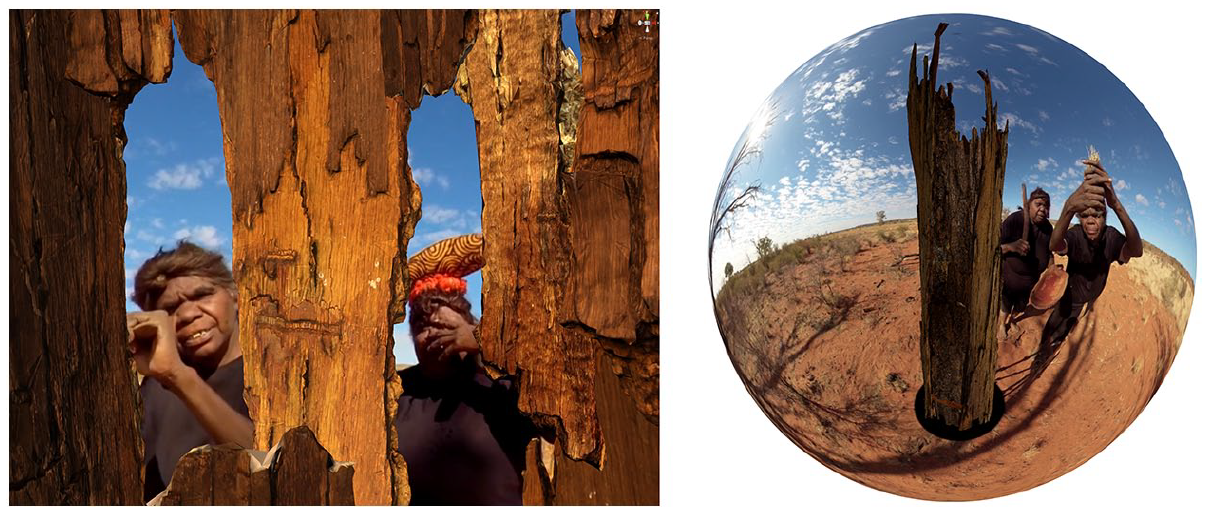
Uti Kulintjaku with fEEL, stills from virtual reality experience, Waumananyi: The Song on the Wind, 2019. Reproduced courtesy of the artists/author’s own image.
‘This story is talking to all our grandsons. This is a really big story’, says McKenzie. As Kim Mahood (2018) writes, the man in the log story ‘provides a psychological traction that’s missing from Western approaches to Aboriginal mental health’ – and arguably missing also in Western approaches to Aboriginal visual culture, which often rest at the level of identifying the denotative meaning of symbols in paintings and images of traditional stories (Biddle, 2007). In our workshop, the women explained how the metaphor of the log conveys a feeling of entrapment, of being stuck and unable to move forward. This, they suggest, is something people may experience when institutionalized, incarcerated, or removed from Country – or when they are internally isolated: For a long time our spirits have been crying for our children, across our communities. Many are stuck, confused, they cannot recognise their position in their families. They are isolated and in personal difficulties. We are deeply miserable inside our spirits about what to do about this. (Ilawanti Ken, quoted in Lewis et al., 2022)
If the VR piece is conceived to evoke the embodied experience of being ‘stuck’, this is understood to unfold as a dynamic psychosocial experience as the trapped man is compelled to witness his loved ones bereft and distraught. His distress is thereby compounded as he remains incapacitated and unable to receive the love, care and sustenance they seek to offer. A narrative of ‘moving through’ is realized as the metaphor of entrapment transforms experientially into one of holding and containment, facilitated by the women’s enactment of care, and the man’s ultimate release into the arms of the community – all of this experienced by the viewer from the first-person point-of-view of the man in the log.
Uti Kulintjaku understood implicitly how the experience of being stuck (itself resonant with depression and emptiness) could in effect be resymbolized in terms of ‘scenic interaction forms’ (Lorenzer, quoted in Froggett and Hollway, 2010). In VR, interactions may be directly experienced as an unfolding, embodied encounter. In this process, ‘interaction forms’ associated with past experiences (including unsymbolized traumatic experience) may be brought into new scenic conjunctions and thereby potentially transformed. Entering into the scene, viewers may therefore experience new connections enabling them ‘to generate containing structures (symbols) and sustain [themselves] within their forms’ (Wright, 2009: 116).
But, as artist/performer Rene Kulitja perceives, when we enter the scene – when we find ourselves on Country – the scene itself enters the body: It’s an experiential learning process, that someone might see with their own eyes and be deeply touched by. And then this will give rise to someone’s capacity to comprehend, and contribute to solutions to the issues it describes. It’s a very comprehensive experience. When I look at that VR picture, the scene is really entering my whole body. It’s inside my head. As I am looking at this picture, it’s lodging in my mind and my spirit; in my body. It’s a full body experience. (Lewis et al., 2022)
Visceral Attention
The psychoanalyst Maia Kirchkheli has coined the term ‘visceral attention’ to describe such a mode of corporeal engagement, when as Kulitja puts it, ‘the scene is entering my whole body’ (Kirchkheli, 2021). Inspired by Marion Milner’s notion of how an analyst mobilizes a ‘concentration of the body’, Kirchkheli suggests that ‘Visceral attention through in-dwelling in our own bodies comes as a part of the technique that is available to facilitate holding the self and the other.’ For an analyst attending to the experience of another, this is ‘a corporal counterpart of “free-floating attention”’ – the open, non-judgemental stance that may support reverie and the making of new connections, which also characterizes engagement with aesthetic form. Such a characterization may be equally useful in conceptualizing the way in which we engage with immersive visual media, which not only depicts but places us inside an experience. VR exponents have been quick to elide this property with empathy, and empathy in turn with identification, enabled by ‘seeing through the eyes of another’ (Kenning et al., 2022). But does placing us at the scene necessarily entail this imaginative switch and, if so, by what mechanism does this occur?
Visceral attention is not so much a function of being in the position of another as of awareness and dwelling in one’s own body, which in turn supports openness to experience. Within the frame created by an analytic session, both analyst and client are enabled to be with felt experience; but as Milner (1988[1952]: 82) describes, one ‘has to wait in very active present mindedness and be content with being a frame, holding the empty space if something new is to emerge, something that has never been before.’
If the log is a metaphor for the experience of entrapment, it also activates the potential for holding and being held, and this experience of being present as a frame, waiting for something to emerge. In other words, it establishes the conditions for attending to one’s experience in a space that ensures psychological and cultural safety. It is here that the intersection of the aesthetic and therapeutic is vividly realized as the work facilitates a space in which experience can be felt and potentially transformed.
This work’s primary audience is Aṉangu. The dialogue is in Pitjantjatjara rather than English, and Uti Kulintjaku conceived it as a tool for use in remote communities – especially with young men who might not talk readily about feelings. But, at the same time, it is widely exhibited and accessed by non-Aṉangu audiences, its metaphors directly experienced rather than translated or verbally explained. During the exhibition of the VR experience in 2019 in Sydney we conducted an audience evaluation of a culturally mixed non-Aboriginal audience using the visual matrix, a psychosocial method, designed to capture sensory-affective experience. 5 In the first part of a visual matrix participants are asked for immediate ‘impressions’ following their viewing. Impressionistic responses such as the following conveyed a sense of ‘holding’:
– being cared for but not being able to say thank you . . .
– a sense of hope and a strong image of being looked after . . .
– I haven’t moved, but I’m definitely changing. I can feel things shifting well.
Rather than appropriating the depicted experience of Aṉangu, participants appeared to make use of the imagery to discuss their own experiences of trauma. There was, in other words, evidence of a felt sense of the body, and of the care enacted – but also of a felt sense of a frame, created for manifesting such feeling at the same time as maintaining a palpable boundary. This powerfully experiential piece, unfolding around a body in a space of temporary confinement and containment, does not allow for a colonization of Aṉangu experience, which visitors remain alongside, surrounded by, able to sense but not fully interpret.
Conclusion
Much has been made of VR’s capacity for engaging a viewer with the experience of another, less of its capacity for engaging with internal experience – and with the complex psychosocial dynamics connecting internal experience with external worlds (see Kenning et al., 2022: 85). It is not surprising that such an exploration is pioneered within an Aṉangu-led program where both visual communication and concepts of mental wellbeing are profoundly imbricated with embodied experience and with culture and community. The scope and ambition of Uti Kulintjaku’s visual resources – their focus on what images do (how they resonate with experience, rather than simply encode meaning) – is a model for rethinking visual communications in mental health beyond stereotypical representation and top-down messaging.
The aim of this article has been to shift the framework of analysis for ‘visual communication and mental health’ toward a focus on lived experiences, and the question of how feelings find resonant form. This in turn opens-up the question of how visual images themselves might validate a viewer’s experience and even provide material support for processing mental and emotional distress. These questions are fundamental to visual communications in a field where didactic messaging is of limited reach and impact, and where experience is still insufficiently acknowledged.
Through a health and medical lens, visual communication has been largely understood as instrumental, a bridge to information and services. But, as the field moves toward greater recognition of lived experience, the functions of communications come into focus. If images do not proffer or point to a solution, they may play a far more subtle and complex part in a communications process, creating the conditions under which people themselves can move through experience and (as Kulitja observes) ‘contribute to solutions’.
Footnotes
Acknowledgements
Special thanks to the anonymous reader who highlighted the salience of waiting in Waumananyi – as well as to the artists of Uti Kulintjaku for their leadership and generosity.
Funding
Research for this article was supported by the Australian Research Council under the Laureate program.

Notes
Biographical Note
Address: University of New South Wales, Cnr Oxford St & Greens Rd, Paddington, Sydney, NSW 2021, Australia. [ email: