



Abstract

Background
Is it any wonder that the 30 ft-high stone relief of Martin Luther King Jr. (see Figure 1), centerpiece of the recently unveiled memorial to him in Washington’s West Potomac Park near the National Mall, bears more than a passing likeness to the gigantesque sculptures of Mao Zhedong that were ubiquitous in China during the years of his leadership and still continue to grace selected public places there? The resemblance to Chairman Mao should be no surprise since the figure of Dr. King was created by Lei Yixin, a Chinese artist with considerable experience producing sculptures of comparable magnitude – a number of them portrayals of Mao Zedong and other Communist leaders.
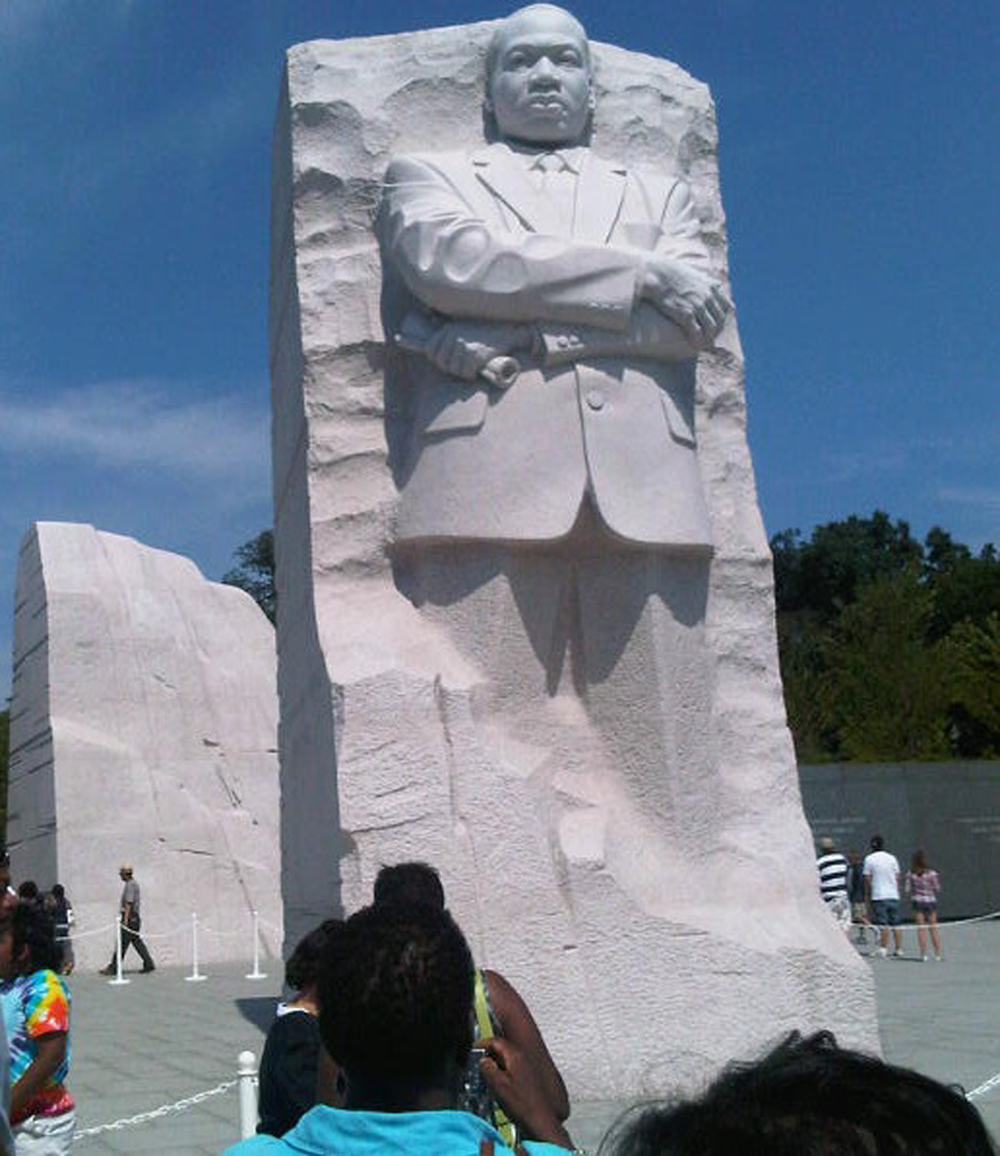
King Memorial: Stone of Hope.
Officials of the Martin Luther King, Jr. National Memorial Project Foundation, the organization that cooperated with the US Government to realize the memorial, discovered Lei Yixin in St. Paul, Minnesota, where Public Art St. Paul had invited him, along with other international artists, to carve sculptures made of Minnesota stone in an open-air studio. Li created a head of an Asian woman that rested on one of her hands. Installed in a St. Paul park, it is a kitsch version of a French Art Deco figure from the 1930s. 1
To argue against the choice of Lei Yixin on the grounds that he comes from a country with a repressive regime makes no sense in the abstract since any American artist might just as well be rejected for a commission because of the outrageous and socially offensive actions that occur in the United States Congress. 2 Certainly, internal Chinese politics have been no obstacle for Western museums, galleries, and collectors who have embraced China’s contemporary art with a passion. In order to survive, most artists in China produce art that fits the parameters of the international art market, thus suggesting to the world that they operate without social constraints, despite their government’s history of cracking down on any artist or civil rights activist who pushes free speech too far. They have learned to work within the red line of Party tolerance, recognizing the potentially dire consequence of straying out of bounds.
In contrast to the choice of Lei Yixin, a conservative sculptor who collaborates extensively with the Chinese Government, it would have been impossible to have commissioned the design of the King memorial from an outspoken Chinese artist like Ai Weiwei, who recently served a short and brutal spell in jail for his public criticism of China’s repressive regime. There is, in fact, a separation in China today between artists who work within a discursive framework that the Communist Party tolerates and those like Ai Weiwei who risk everything to defy the Party’s restrictions on art that criticizes its policies and practices. For a time, Ai Weiwei was able to operate without serious consequences and, in fact, created a number of conceptual works abroad that the regime accepted but at a point he crossed the red line and was quickly arrested.
There are considerable similarities between the careers of Ai Weiwei and Martin Luther King, whose status as a civil rights leader was predicated on his crossing multiple restrictive lines that negated African-American access to the same rights that all Americans are due. King also served time in jail on several occasions because of his civil rights activism. Therefore, if Ai Weiwei had been selected to create the King memorial, there would at least have been a recognition of compatibility between the artist and his subject, thus a stronger rationale for choosing someone from China. This does not mean that Ai Weiwei would have been a better choice for the monument than an American or African-American artist, but it would at least have made sense when comparing his principled actions with those of Dr. King.
Lei Yixin’s experience as a creator of Chairman Mao statues (see Figure 2) contradicts the narrative of Dr. King’s life. Unfortunately, the King Memorial Project Foundation committee did not take into account the importance of aligning the story of how the memorial was produced with the perception of its ultimate meaning. Even when an artist’s personal values are difficult to discern in a work of art, scholars find them to be relevant and thus examine the relation between the two. Such a relation is unquestionably relevant when the art itself reveals something explicit about the artist’s values or behavior, as is the case of art that clearly depicts political subjects. It is also relevant, although less directly so, when the art embodies formal qualities that are associated with a particular political ideology. This is the case of sculptural monumentalism, the style of the King memorial. It is indicative of Socialist Realism, which originated as the state aesthetic in the Soviet Union during Joseph Stalin’s reign and continued for years afterwards. 3

Statue of Mao Zedong.
Socialist Realism as an Influence
The intention of Socialist Realism was to overwhelm the viewer with a scale that was larger than life, whether embodied in an author’s literary narrative or in a sculptural likeness of Lenin or Stalin. During the years that the two were in power, statues of both men populated public squares throughout the Soviet Union until the fall of Communism. After the Chinese Communist Party came to power in 1949, Soviet Socialist Realism became the major influence on Chinese art. Just as Chinese artists adopted the Soviet visual rhetoric for their political posters during the time Mao led the Party, so did heroic Soviet sculpture become the model for depictions of Chairman Mao and for other sculptures like the groupings of Chinese workers with raised fists and banners that stand in front of the Mao Memorial Hall in Beijing’s Tienanmen Square.
Sculpture based on the tenets of Socialist Realism was adopted as well by authoritarian leaders around the world as the most appropriate representation of their power. Statues of Kemal Atatürk, the first President of the Republic of Turkey began to populate public spaces throughout the country after Turkey became a nation in 1923 and they continue to do so today, perpetuating Atatürk’s status as the Republic’s founder. By contrast, similar sculptures intended to memorialize Saddam Hussein were pulled down after the United States began bombing Iraq (see Figure 3). An iconic image of the Iraq war, in fact, portrays an angry mob toppling Saddam’s giant replica in Baghdad, aided by the US Marines. 4

Statue of Saddam Hussein.
As political conditions changed in China, the Communist Party remained in control but the imagery of Mao was no longer so closely equated with the power of repression that had previously compelled its acceptance. There was no movement to tear down the statues of Mao but, in the 1980s, a few years after his death, when Western art styles began to infiltrate China, artists like Li Shan, Yu Youhan, and Wang Guangyi were painting images of Mao with a Pop Art aesthetic, signifying that the traditional iconic representations of the Chairman were no longer regarded with the reverence due to them when he was alive. 5 While the deconstruction of Maoian iconography was evident in the formal changes to the Social Realist images, the shift of political context in which audiences viewed the Pop paintings was also a significant element.
Reading the King Memorial
To the degree that viewers recognize a similarity between the sculpture of Dr. King and the Social Realist statues of the former Soviet Union or the Maoist era in China, Dr. King’s legacy is inappropriately represented. The Social Realist style is associated with the authoritarian exercise of power, which is antithetical to the values for which Dr. King stood. However, the decision to represent him in such a monumental form was not that of the artist. It was central to his brief from the King Memorial Project Foundation. The brief should have specified a more human scale to signify Dr. King’s closeness to the people whose rights he was fighting for. The point of being ‘with’ the people rather than ‘above’ them was missed, hence the search for an artist with the experience of working at a gigantic scale. Another problem with the brief – or at least with the approval process – is that the artist depicted Dr. King with his arms folded, suggesting an imposing and removed stance rather than an open and inclusive one.
It may be germane to compare Lei Yixin’s sculpture with the cast bronze figure of Mahatma Gandhi that Indian sculptor Ram Vanji Sutar made for the Martin Luther King Jr. Center for Nonviolent Social Change in Atlanta, Georgia (see Figure 4). Instead of an aloof leader, Gandhi is portrayed as a humble man, modestly depicted at human scale, striding forward wearing only his dhoti and a pair of sandals. Appropriately, Sutar is an Indian as was Gandhi, and his contribution to the public space at the King Center is an extension of his commitment to sustaining Gandhi’s memory through sculptures and memorials dedicated to him. 6
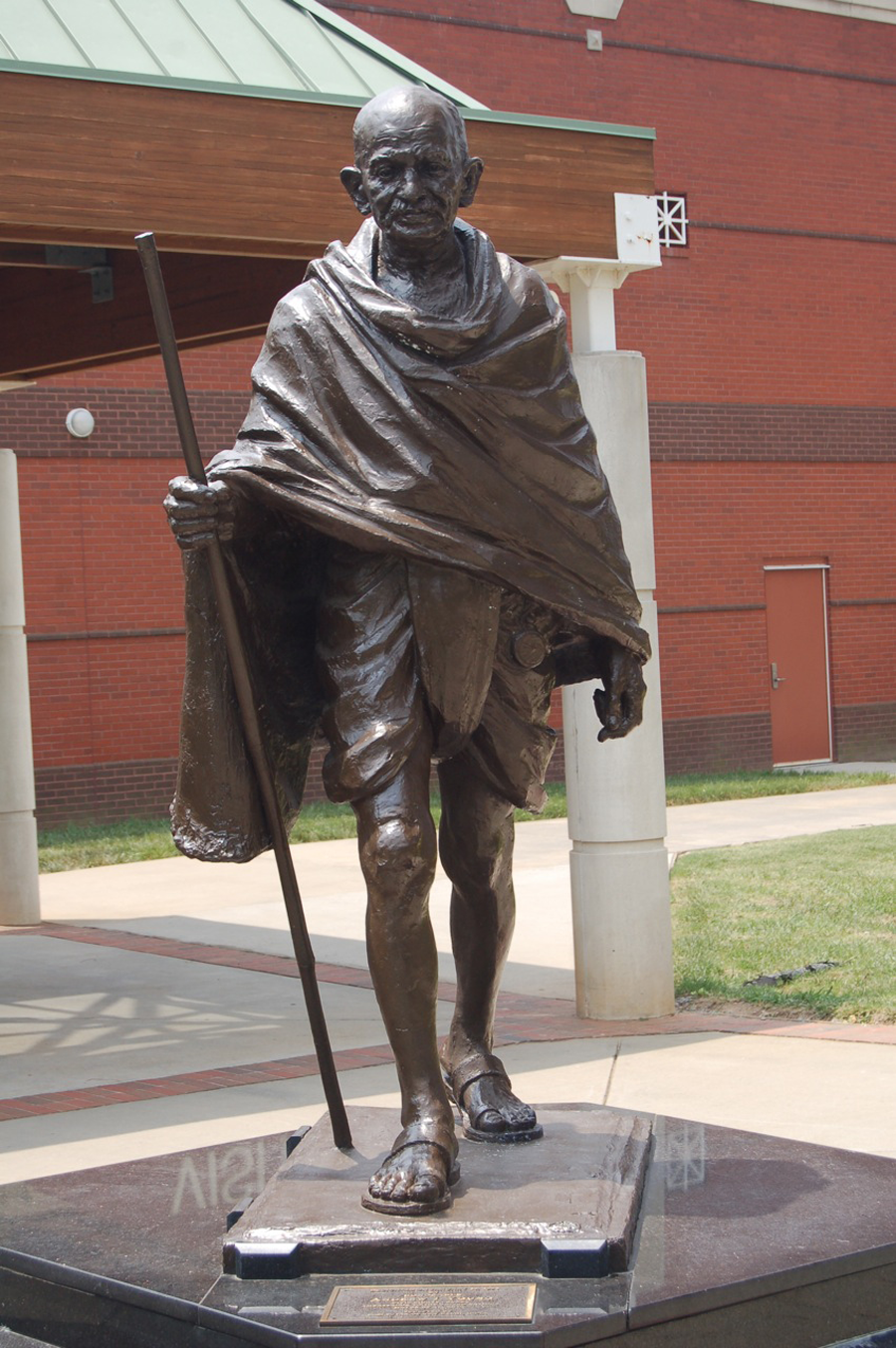
Statue of Mahatma Gandhi.
By contrast, the King Memorial in Washington conveys anything but humility. Its magnitude summons images of the massive rock temples at Abu Simbel in Egypt that the pharaoh Ramesses II had carved out of a mountainside to commemorate himself and his queen Nefertari (see Figure 5). This analogy is reinforced by the King Memorial’s imposing stone entryway, called the Mountain of Despair (see Figure 6), through which visitors walk to approach the Stone of Hope, the name given to the large hunk of Chinese granite from which the image of Dr. King was carved. 7 The fact that the image of Dr. King is turned away from the Mountain of Despair suggests a confused metaphor. In fact, King should have been facing the entryway to confront the despair. Had this been the case, visitors would have approached his image as they were leaving the representation of despair behind them. The way the memorial was designed conveys the metaphor that King has turned his back on despair, while actually obliging visitors to walk farther around the Stone of Hope to encounter him.
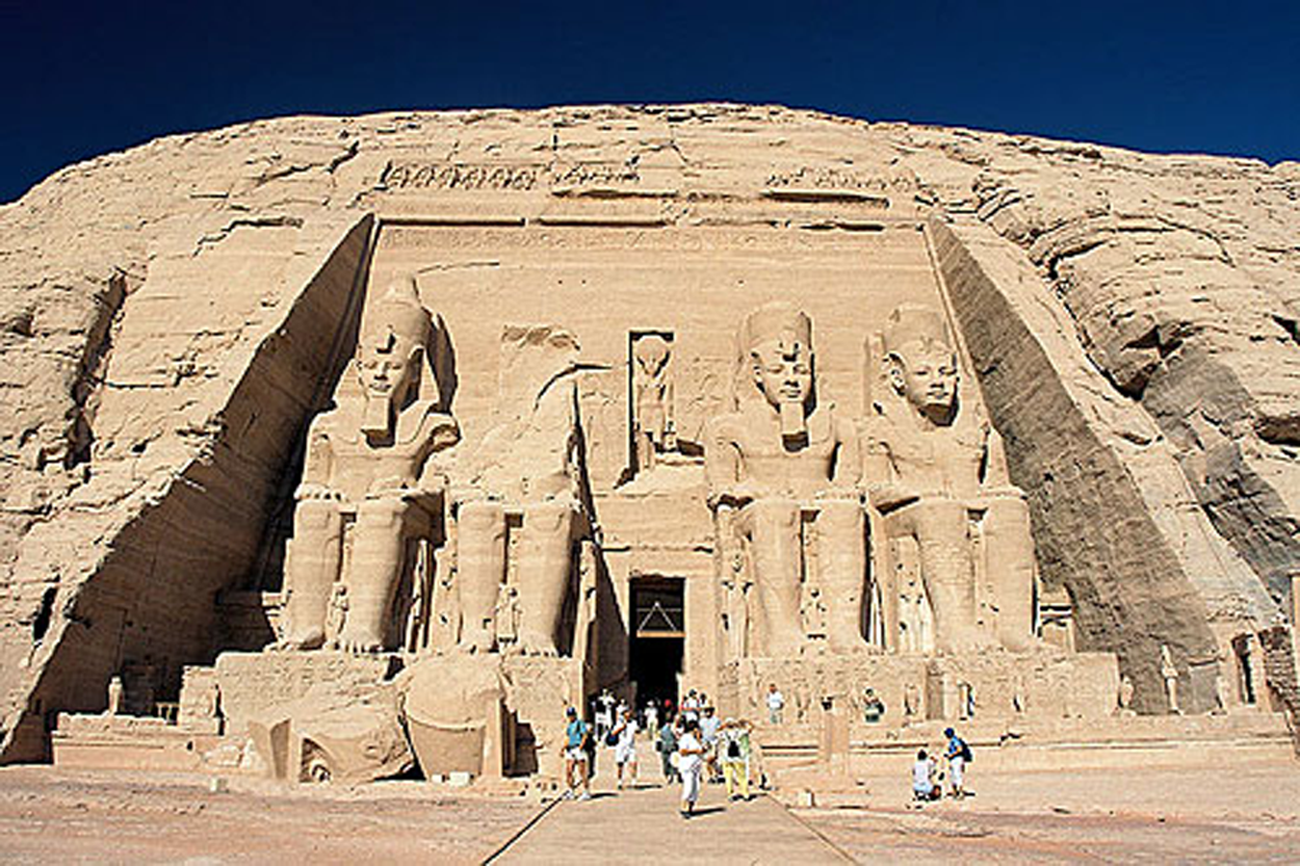
Abu Simbel.
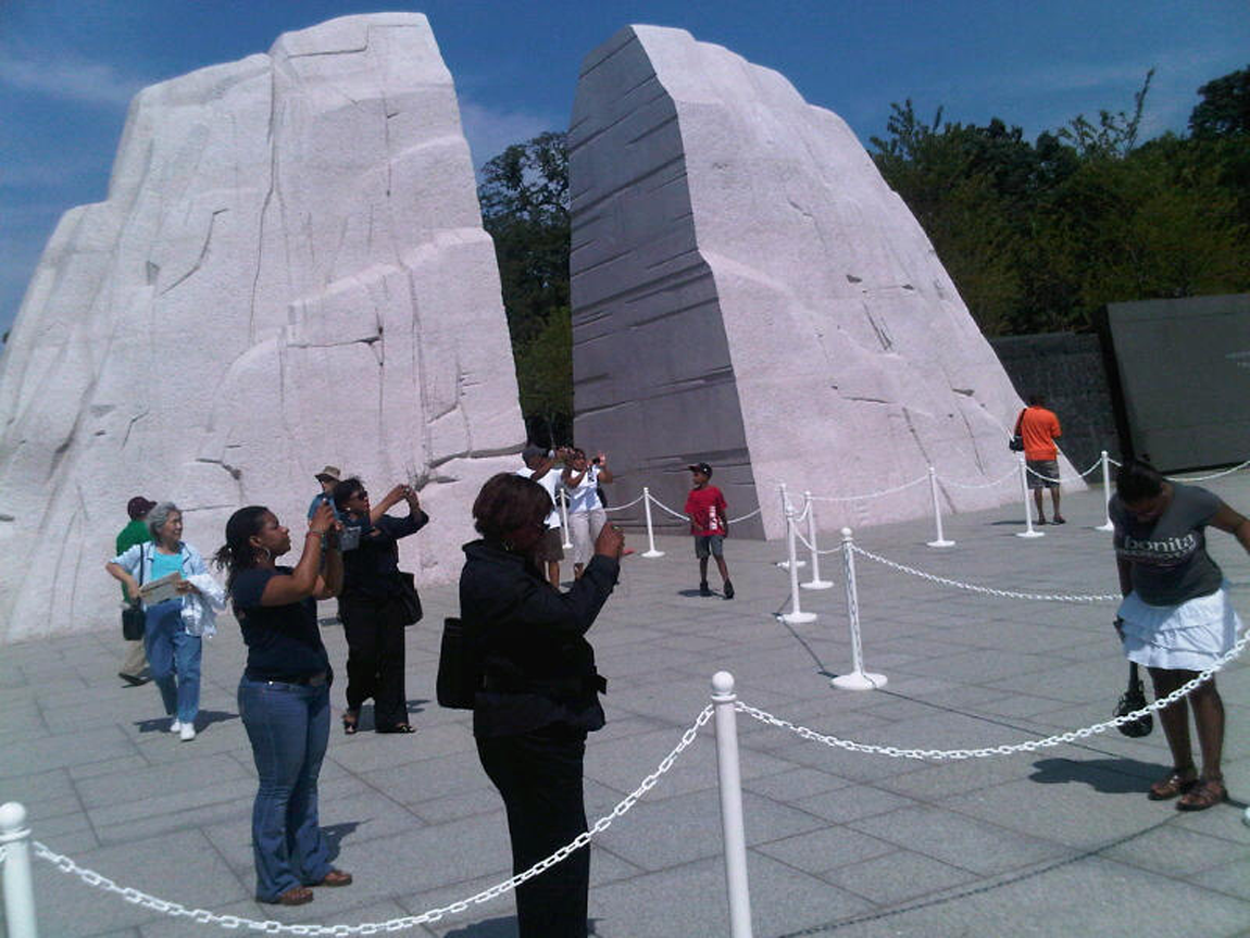
Statue of Mountain of Despair.
The monumental style of the Stone of Hope and its origin in Socialist Realism undermine Dr. King’s legacy by inviting inappropriate aesthetic associations. Dr. King accrues an unflattering comparison to the public political sculptures that Lei Yixin has completed in China. The political contradictions of the commission were clearly ignored by the King Memorial Project Foundation, whose members were more preoccupied with an early model of the Stone of Hope in which Dr. King looked too much like an Asian than with the contextual references to China’s repression of outspoken artists as well as the issue of outsourcing that precluded American workers from participating in the monument’s creation. 8
Of course, the other issue is that a black artist was not selected to design and create the monument. There is no shortage of black artists who could have executed the commission. Consider, for example, sculptor Bernard Jackson’s cast bronze figures of chained slaves that the artist intended as part of a large installation. The choice of a black artist would have had metaphorical significance in that a major issue of black history is the earlier exclusion of black workers from good jobs as well as the exclusion of black artists from the art world. A further irony is the fact that most furniture and other decorative objects that were produced for plantation owners in the South before the abolition of slavery were by black slave artisans, another reason to have resolved that contradiction by awarding the commission for the King Memorial to a black artist. Such a decision would have created continuity between the legacy of Dr. King and a black artist’s creation of his monument.
What makes the Martin Luther King Jr. Memorial most problematic in the end is the inability of the Martin Luther King, Jr. National Memorial Project Foundation to understand the parameters within which its meaning is and will continue to be determined. A major advance in art history is the recognition that formalism alone does not determine a work’s meaning (and in the memorial’s case the inappropriateness of the formal design is a big part of the problem) but that the totality of meaning depends on a relation between the work’s appearance and the conditions of its production – who made it, how was it funded, what were the intentions behind it and all the other factors that, in this case, contradict the spirit of Martin Luther King Jr.’s life and what he fought for.