



Abstract
As Hegel once said, in Byzantium, between homoousis and homoiousis, the difference of one letter could decide the life and death of thousands. As this article seeks to argue, Byzantine thinking was not only attentive to conceptual differences, but also to iconic ones. The iconoclastic controversy (726–842 AD) arose from two different interpretations of the nature of images: whereas iconoclastic philosophy is based on the assumption of a fundamental ‘iconic identity’, iconophile philosophy defends the idea of ‘iconic difference’. And while the reception in the Latin West of the controversies over the image as a mere problem of referentiality of the letter explains why its originality has remained underestimated for centuries, re-examining Byzantine visual thinking in the light of today’s ‘pictorial turn’ reveals its striking modernity.
Keywords
1. The Deadly Iota: Hegel and Byzantium

Miniature from the Chludov Psalter, fol. 83, middle of the 9th century, Moscow, State Historical Museum. © Moscow, State Historical Museum.
In his Aesthetics, Hegel famously stated that in front of a devotional image or icon, ‘we bow the knee no longer’ (Hegel 1988[1820s], Vol. I: 103): in the era of art, images count for their aesthetic value, not for their cultic function. But if Hegel proves to be the thinker of secularization, he has also anticipated the so-called ‘end of art’ with his no less famous statement that ‘the form of art has ceased to be the supreme need of spirit’ (p. 103). At a time when the autonomy of the artistic realm is being questioned and new forms of image that cannot be subsumed under aesthetic categories are coming into focus, a strange mirror effect occurs, epitomizing striking analogies between an era of post-artistic images and what Hans Belting (1994) has provocatively suggested naming the ‘era of images before art’. At both ends of the historical spectrum, a kind of image emerges that cannot be properly addressed by the notion of aesthetic judgment and not even by their referentiality; what they demand is a reflection on their visual efficacy. Not by accident, Hegel – always keen to remind us that the German word for reality (Wirklichkeit) does not so much refer to what is the case (real) but to what is efficient (wirkend) – is fascinated with the Byzantine quarrels around images which, despite all the bewilderment, he reads as a quarrel around the efficacy (Wirksamkeit) of an appearance. Devotion toward these images, Hegel (1969[1822–1823]: Vol. 2, 410, trans. 340) says, ‘occasioned the most violent struggles and storms’. In defense of the bleeding icons, quite literally ‘streams of blood flowed as the result’ (409, trans. 339).
Hegel finds accounts of those magical icons, which allegedly possess healing powers and engage in critical interventions in battles. Despite the mindless sophistry, which Hegel sees as inherent in the absolute devotion towards these baser powers of passion, the new image type, emerging in the 5th and 6th century, conforms to the disengagement from mimetic depiction advocated by Hegel; the new images resolutely break away from the mimetic portraits of the Roman effigies as they are considered to be acheiropoieta, images not manufactured by the human hand (cheir), but literally acheiropoieta: ‘non-hand-made’ images of divine origin. The aspiration is not to produce a more or less accurate imitation; the acheiropoieton is measured by its efficacy.
The chronicles (see Kitzinger, 1954, for an overview for the preiconoclastic era) give accounts of icons, which, when placed on a pedestal, had the power to crush the surrounding pagan statues, yet heal the faithful believers. In one of the miracles of St Artemius, a diseased member is healed by applying the melted wax of a seal displaying the Saint’s face. In his Spiritual Meadow, one of the richest sources of the period which also reads like a 7th-century pilgrim’s Baedeker guide, John Moschos refers to the story of a woman who obtained water from a dried-up well by lowering a specifically ordered portrait of the abbot Theodore into the depths of the pit. Other texts tell about icons secreting oil, blood or dew drops which fall directly into the mouths of praying devotees. Some women seemed to have grown impatient while waiting for the miracle to come about and directly scraped off pigments of colour from sacred images, diluted them in water and drank the mixture until they were cured. But the miraculous icons were not only used for individual purposes, they also had apotropaic qualities when protecting entire armies, as in Heraclitus’s use of a portrait of the Virgin for his navy in the Persian campaign. During the siege of Constantinople in 626 by the Avars, the patriarch had holy countenances painted on all the gates of the Western city and he himself carried magical icons of the Virgin around the city walls which actively saved the city from being consumed by fire. ‘The more streams of tears you shed’, reads the eulogy by George the Pisidian addressing the Mother God right after the end of hostilities, ‘the more rivers of blood you cause [among your enemies]’ (Bellum Avaricum, quoted after Belting, 1994: 497). The miraculous images used during the wars then take their definitive seat in the basilica or at the palace, such as the famous Sudarium from Camulia, which was transported by ship around the Golden Horn for the purpose of displaying it in the palace of Constantinople as a protective Palladium for the kingdom.
If Hegel does not concede to a Weltgeist of the sea, he does, however, acknowledge that the Byzantines had a distinct form of intellectuality. In a lecture, Hegel calls upon a source from late antiquity:
Gregory Nazianzus says somewhere: ‘This city (Constantinople) is full of handicraftsmen and slaves, who are all profound theologians, and preach in their workshops and in the streets. If you want a man to change a piece of silver, he instructs you in what consists the distinction between the Father and the Son: if you ask the price of a loaf of bread, you receive for answer that the Son is inferior to the Father; and if you ask whether the bread is ready, the rejoinder is that the genesis of the Son was from nothing.’
In contrast to his usual citation practice, Hegel does not quote directly from memory here but verbatim from Gibbons’ Decline and Fall (1776–1788, chap. XXVII, Vol. III: 88). The passage cited by the English historian, however, could hardly have been found in Gregory of Nazianzus since it originated with a different Cappadocian church father, Gregory of Nyssa. Leaving aside the question of the original sources at this point, 1 it is worth delving into Hegel’s significant ambivalence towards the Byzantine world. Apart from this anecdote in terms of the history of ideas, Hegel’s significant ambivalence towards the Byzantine world is revealing. On the one hand, the account from late antiquity ends with the sentence: ‘The idea of spirit ... was thus treated in an utterly unspiritual manner’ (Hegel, 1969[1822–1823]: Vol. 2: 409, trans. 339). On the other hand, Hegel seems quite enthusiastic about the theological work on the term that emerged from the controversies over the image dispute. The term is ‘real’ in the Hegelian sense of the word wirklich (as opposed to the German word real): it is ‘efficient’. Even the shift of one iota means a shift in reality: ‘In the contest on the question whether Christ were homoousis or homoiousios – that is of the same or of similar nature with God – the one letter ι cost many thousands their lives’ (409, trans. 339) (Figure 2).

Miniature from the Chludov Psalter, fol. 34, middle of the 9th century, Moscow, State Historical Museum. © Moscow, State Historical Museum.
*
Hereafter, the question will be explored to what extent, in Byzantium of the 8th and 9th century – and perhaps for the first time in Western thinking – a consistent and comprehensive image concept has been developed, which at the same time unfurls a tremendous historical efficacy. From a historical perspective, the origins of the Byzantine image dispute have been traced back to multiple causes (Brown, 1973; Gero, 1977; Ladner, 1940; Yannopoulos, 1997; for an overview of the historic-political background, see Auzépy, 1990; Brubaker, 1999; Schreiner, 1988; Stein, 1980; Thümmel, 1991, and now the decisive synthesis in Brubaker and Haldon, 2011). The following reflections seek to reactualize an hypothesis that Georgiye Ostrogorsky postulated in his seminal essay from 1929. According to this hypothesis, the manifold theological, ideological and socio-political differences can be explained by a fundamentally different perception of what images are and what they should be (Ostrogorsky, 1929: 40 ff). It becomes apparent that the iconoclastic as well as the iconophilic theories (both positions establish elaborate systems of thought about images) in the end differentiate themselves by the degree of sovereignty they attribute to the iconic. The iconoclasts would then be on the side of Hegel’s absolute spirit; for him it is the purpose of the spirit to annul the outwardness and inauthenticity of the image (‘The image is killed off, and the word substitutes for the image’, Hegel, 1969[1808], part C, §159, Vol. 4: 51) while the iconophiles, at the same time, are on the side of a Hegelian concept of finitude and sensibilization in the sense of Feuerbach; in such a concept the image is not only a necessary moment of passage but also a means of incarnation that is not completely transferable to the Logos. While thought – as Hegel always stressed – sets in only belatedly: in the late antiquity of Byzantium the images had already found their way into ‘ethical life’ (Sittlichkeit), even before a reflection upon their morality (Moralität) set in and the image itself became an object of inquiry.
2. The True Image
The growing significance of images in the intellectual cosmos of late antiquity is a testimony to the alteration that took place in the reporting of the siege of the Persian fleet in 544 on the Syrian coastal city of Edessa. According to the chronicler Procopios, who shortly thereafter goes on to describe the course of the siege, a letter from Jesus saved the city. But already half a century later the account changes and, according to the chronicler Evagrius, Edessa was not saved by a letter but by a thaumaturgic Christ-image (Evagrius Scholasticus, 2000[c. 600]: 225–228). The miraculous icon was brought into contact with water; the water changed into a flammable liquid and scorched the war machinery of the Persians (p. 226).
The story bears witness to the fact that, at the latest from the 7th century onwards, images had become proper historical protagonists, and yet, at the same time, the interpretation of these images grew exceedingly precarious. Evagrius’s description of a painting as not made by human hands (theoteuktos) undergoes a further medial transition in the traditional legend: according to a version that established itself in later centuries, the story no longer speaks of a painting but a linen cloth (mandil), in which, according to the legend, the body of Christ left an imprint. The icon conserved at the Monastery of St. Catherine illustrates this last version magnificently (see Figure 3). Arguably, on this point the painter has consulted John of Damascus, who is among the first authors to use this example as an argument in the iconoclastic dispute of the 8th century (John of Damascus, 1973[c. 730]: 51–56). In the media transfer from painting to the imprint on the cloth, we may witness a subtle transformation from the symbolic iconology of the Early Church to what could be called, borrowing a term from Georges Didi-Huberman (2008: 320–325), an ‘ichnology’, composed from ichnos, the Greek word for trace: referential, symbolic representation is being replaced by an image concept of a pure, non-arbitrary imprint. In competition with the Byzantine Mandylion, the tradition of the Veil of Veronica develops in the West. As its anagram, the Veronica easily turned into the vera icon or ‘true image’, such as depicted by Francisco Zurbarán (see Figure 4) (on the Veronica, the Mandylion and other Holy Faces, see Wolf and Kessler, 1998, as well as Wolf et al., 2004).

King Abgar with the Mandylion, Tempera on Wood, 34.5 x 25 cm, around 940, Sinai (Egypt), St Catherine Monastery (after Il volto di Cristo, ed. Giovanni Morello and Gerhard Wolf, Milan: Electa, 2000: 92).

Francisco de Zurbarán, The Holy Face, ca. 1631, Oil on Canvas, 70 x 51.5 cm, Stockholm, National Museum, NM 5382. © Photo: Nationalmuseum, Stockholm.
Images as tactile relics: shortly before the eruption of the image dispute, sources seem to compete with each other in the description of magical images. Whatever left an imprint on the material undoubtedly existed, and the visible trace became a witness to a materialized theophany. At the same time, paintings attributed to Luke emerged, which were unconventional types of portraits. The theory of these pictures was apparently only brought forth subsequently in the 8th century (Belting, 1994: 57–59; Cormack, 1985: 261): according to this newly developed legend, it was St Luke who painted a portrait of the Virgin Mary herself with child, a spatiotemporal simultaneity serving the expressed purpose to once again verify the pictorial authenticity (see Figure 5). Although, according to Paul, worldly existence only offers a vision in speculo et aenigmate, these ‘true images’, even though conveyed through a medium, allow a seeing from face-to-face and, thereby, become prolepses of the time after the end of time.

St Luke Portraying the Mother of God, early 15th century, Tempera on Wood, 26.4 × 18.3 cm (Inv. Nr. 424), Recklinghausen, Ikonenmuseum. © Ikonen-Museum Recklinghausen.
The voluntary posing of Christ for a portrait testifies to a real desire to be seen, which becomes a central argument in the iconoclastic controversy of the 8th and 9th centuries. There is, however, an explicit expression in this event, something that popular image practices had internalized long ago, i.e. the concept of a divine figure, progressively gaining visibility. It is not the perceived similarity that legitimizes the images but their alleged indexical character: these images have a form (typos) that reproduces itself and leaves an imprint on any material that comes into contact with it (Vikan, 1989); the images repeat and substantiate the fact that a deity took on a sentient form. The Keramion or ‘brick image’ becomes the object of the people’s veneration; it receives its justification in a later source: the celebratory speech for the successful translatio of the Mandylion of Edessa to Constantinople in 944 speaks of an event, in which the face in the linen cloth was temporarily buried under bricks and left an imprint upon them (Ps. Constantine Porphyrogenitus, 2007[c. 900]: 272). The Christ-depiction paradox finds an expression in the semantical game with the term graphein when the text says that the miracle shows how, for humans, an ‘indescribable figure’ (agraphou morphes) may nonetheless update and transfer itself (metagraphein) without any outward interference.
In this self-replication without loss of form, an economy of visibility expresses itself, which seems to veer away from the image proscription of the Old Testament since it lies beyond human endeavours of illustration. Each copy is – mutatis mutandis – also an original. Along with the acheiropoieta, the age of mechanical reproduction of the image commences: yet, the ability to reproduce is in this respect not a loss but, in fact, guarantees the aura. On the outer frame of what is considered the icon kept at San Bartolomeo degli Armeni in Genova (Genes) and which is considered to be either the original Mandylion or one of its ‘copies’, the scene is depicted: a priest walks down the ladder leading to the Mandylion placed on top of a pillar, cautiously carrying one of the many self-replicas the acheiropoieton has supposedly produced (Figure 6). But how can these magical images be reconciled with the Scriptures? What kind of relationship exists between the miraculous images and the painted icons? Is there something beyond the iridescent variety of their form that is common to all images?
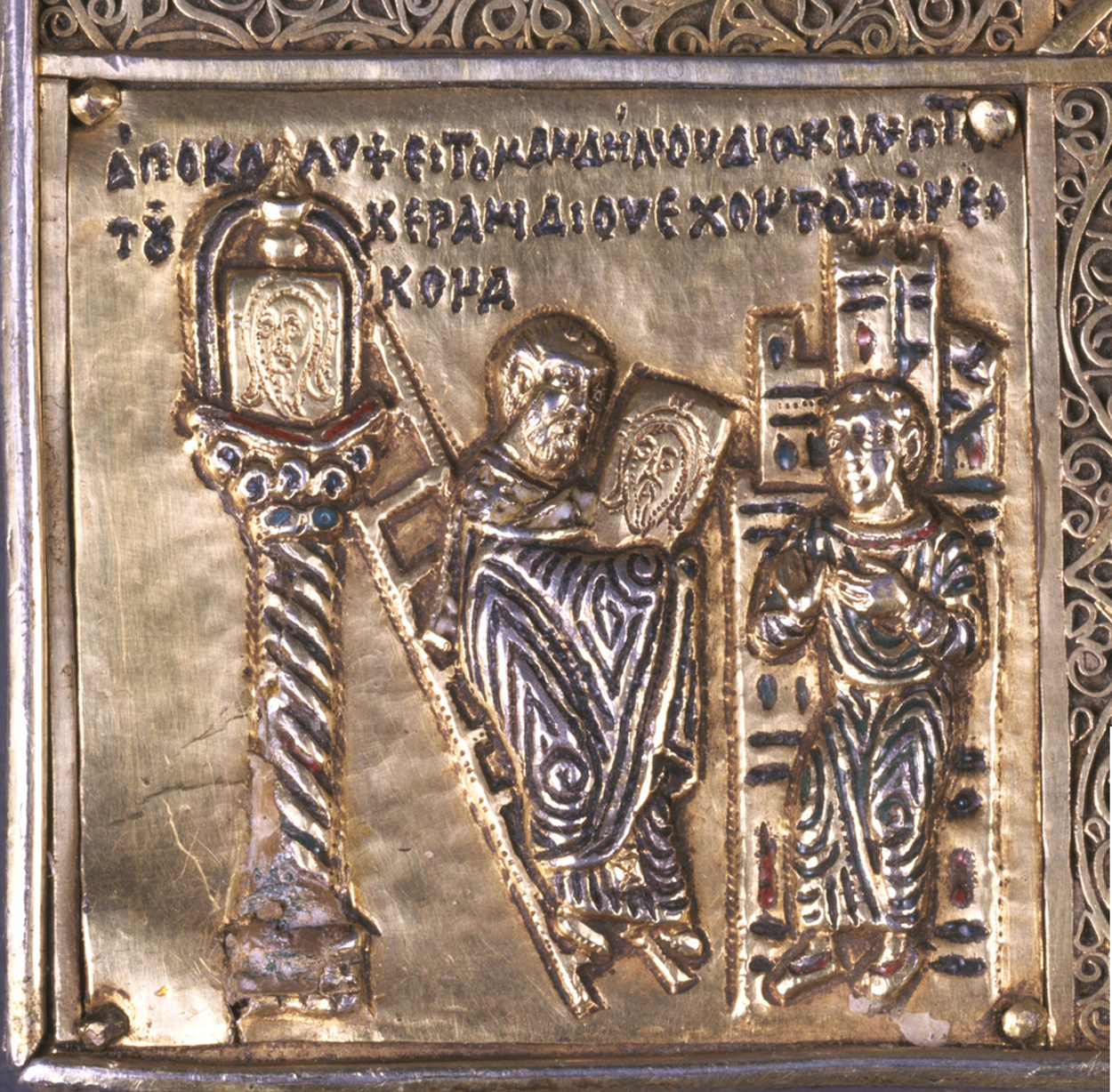
Detail of The Mandylion Legend: The Miraculous Self-Replication, around 1320. Gilded silver on wood, Genes, San Bartolomeo degli Armeni. © Genes, San Bartolomeo degli Armeni.
As sources suggest, the image contemplation, in a Hegelian fashion, sets in late, almost as if theology and philosophy were trying to catch up with an already widely-spread image practice (the attempt to clearly distinguish philosophy from theology at this point would, of course, be in vain, considering the fact that, for example, John of Damascus, 1982[c. 730]: 89 ff, translated the antique term philosophia as the ‘love of wisdom from God’). Yet, in spite of being a reaction to a specific historic situation, the Byzantine theorization of images exhibits an extraordinary argumentative richness which, in terms of its complexity and range, greatly exceeds the contemplation of classic Attic philosophy. In a time that asks about the ‘lives and loves of images’ (Mitchell, 2005) and studies how ‘images act’ upon us (Bredekamp, 2010), it would be more than useful to revisit a culture which ultimately turns out to be closer to ours than we had ever thought. A reflection upon the performativity of the image and its perlocutionary effects (Alloa, 2011) cannot avoid confronting the Byzantine formulations of the question. In what follows, an attempt is made to reconstruct some of the positions of the Byzantine image dispute (726–843) in order to establish whether it can be affirmed that the ‘pictorial turn’ which has been diagnosed for the late 20th century (Mitchell, 1992) actually found an earlier stage more than a millennium earlier, during the Byzantine Empire.
2. Basic Elements of the Iconoclastic Image Theory
The fact is well known: history is always written from the viewpoint of the victorious. While the iconoclasts destroyed the images of the image-friendly iconodulists (literally the ‘servants of images’), the iconodulists in turn destroyed the written manuscripts of the iconoclasts. On account of this damnatio memoriae, none of the image-hostile texts have survived in full; at best, the arguments can be extrapolated from what is quoted by their antagonists (as a survey has been compiled by Hennephof, 1969; cf. also Brubaker and Haldon, 2001). From these fragments, a contemplation in regard to the nature of imagery ensues, which belies the prejudice that the iconoclasts only approached the images with brute force (Anastos, 1954). In addition to this, newer research proves that the elaborate, image-hostile position was not only, as assumed for a long time, a reaction to the iconophilic writings of John of Damascus, but that, on the contrary, a reflected anti-image position existed before the emergence of the first iconoclastic crisis around 730, to which the image-hostile emperor Constantine V and his court theologians could appeal (Baranov, 2002).
Lifeless idols
At first glance, the Byzantine iconoclasts of the 8th century seem to merely repeat the arguments of the first church fathers who denounced every form of idol worship. Nevertheless, the focus had changed: while Origen and Tertullian at best dealt with the image question as a corollary of the worship problem, this approach takes a back seat to the question of what a picture is in the first place. In order to use the tradition of early patristics against the image defenders, the iconoclasts felt compelled to annul the canonical differentiation between eikon (image) and eidolon (idol), which the early Church, professing creation in the image of God, attempted to use in order to distance itself from idol-worshipping heathens. The answer to the question: ‘What is an image?’ is then quite simply: an idol. The term eidola, the root of which can be derived from the Indo-Germanic *id (‘to see’), is used throughout the Septuagint to translate different terms, which in Hebrew belong to the semantical field of sculptures ‘carved, hewn by hand’ (pessel, semel, sabbim) (Habakkuk 2: 18–20; Jeremias 10: 8–16; Psalm 115: 4–8). In this sense, the second commandment is less concerned with the visibility of God, but above all opposes the manufacturing of a second, physical God (Exodus 20: 4; cf. also Deuteronomy 4: 8, 27: 15). The massive idol is always – using the Portuguese word, derived from factum (‘made’) – a fetish (fetiço), which instead of enabling it, blocks access to the divine (Alloa, 2010).
The idolatrous image presumes to be a depiction of the living God; in reality it consistently remains ‘soulless and without a voice’ (apsychos kai anaudos), as the Council of Hieria set down in the 16th conviction (Mansi XIII: 345C). It is a common practice in the image-hostile fragments to reduce the image to its bare materiality. A physical strategy corresponds to this rhetorical one: image worshippers, such as St Anthousa of the Mantineon Monastery, were martyred using the smouldering ashes of previously torched iconic tablets, as if to prove to the female martyrs that paintings can also be used to produce an altogether different effect (Talbot, 1998: 18).
Against describing the indescribable
In contrast to the word, which, according to the gospel of John, on account of its potential infinitude, marks the beginning of creation (i.e. the Logos becomes finite), the image is, for the defenders of the word, a desperate attempt to catch up with the infinite – in a temporal as well as spatial sense. While apophatic (‘negating’) theology may express something about the limitless nature of God via the word ex negativo, images operate exclusively in an affirmative fashion. However, the second commandment on the tablets brought down from Mount Sinai by Moses is not so much a prohibition of the depiction of God, but rather marks the impossibility of a divine portrayal, since ‘no one has ever seen God’ (John 1:18; cf. also 6: 46). Nonetheless, from the viewpoint of the iconoclasts, the painter by use of lines and brush strokes tries to capture the ‘impalpable’ on the surface of a canvas. Yet, since the divine nature by definition cannot be encased (aperigraptos), every attempt of a preconceived painting (perigraphein) must be either in vain or depict something that is simply erroneous (PG 100, 216, 225, 228, 236). The only true image, as set down by the Council of Hieria, is the Eucharist (Mansi XIII: 264).
Unity vs duality
In regard to the scandalous presence of the two opposing natures within Jesus Christ, the Council of Chalcedon in 451 laid down conclusively – thereby putting an end to centuries of inner turmoil within churches – that Christ had two natures, which were neither separate nor joined. In 754 at Hieria, the iconoclasts accuse the iconodulists of falling back into pre-Chalcedonian heresies, i.e. into the Arian-Monophysitic as well as the Nestorian heresies. Arianism and Monophysitism share the idea of a doctrinal unity: for the devotees of Arius, Christ is solely human; for the Monophysites, he possesses a unified nature, in which the divine and human nature are unseparated. Nestorianism on the other hand, advocates a doctrine of radical dual-naturedness: the divine and human nature consistently remain unjoined so that the Son of God and the Messiah must be two different persons. In Hieria, this Trinitarian controversy is applied to the issue of depiction:
1(a) If the painters assert that they only depict the human side of Christ, how does it differ from paintings of pagan prophets?
1(b) Yet, whosoever clings to a divine nature that goes beyond the depiction of a human nature, denies the Trinity and creates a ‘monster consisting of 4 persons’ (Mansi XIII: 260).
(2) If the painters claim the divine nature is already contained within the physical body, they are suspected to be Monophysites who do not recognize the ‘unmixability of the natures’. One may think here of the curious late mediaeval attempts of representing the trinity in the West, which were ultimately abandoned with the Counter-Reformation (Figure 7).

Three-headed deity (‘Vultus trifrons’), around 1500, Painted Wood, 15 x 21 x 4 cm, Lucerne, Historisches Museum. © Lucerne, Historisches Museum. Reproduced with permission.
Victor V Byčkov (1980: 61) has encapsulated this double-reasoning:
The logic of this paradoxical accusation is in itself antinomical since at the base of it lies the aspiration to convict the original dogma of an antinomy that denies the thesis as well as the antithesis. Consequentially, a form of reversed antinomy develops, which confirms precisely that, which was supposed to be refuted.
The intention was to prove that the image worshippers at the same time separate and join the two natures: ‘From a philosophic–religious viewpoint, the iconoclasts unwillingly proved, even more convincingly than their adversaries, the veracity of their opponents’ position (p. 61).’
Iconic identity
In summary, the image destroyers, therefore, demand much more from images than their adversaries. The image is not permitted to be deficient or be assigned some secondary subordination, but it must retain, to use the words of the image-hostile Emperor Constantine V, the ‘totality of the archetypical image’ (PG 100, 225 ff). Constantine V avails himself of the formula here that his predecessor Constantine the Great had used to put an end to the Trinitarian debate of the first Nicaean Council (325) – the doctrine of homoousis – and applies it to images: in the same way Christ is consubstantial with the Father, so the image is consubstantial (homoousios) with the depicted object.
In a remarkable fragment by the ideologue of the second iconoclasm, John Grammaticus, the doctrine of homoousis is explained through Aristotelian logic. The iconodulists favoured the reference to the formula of Basilios of Christ as a ‘living image’ (PG 29, 552B). But even if Christ became human, it is not conversely true that a depiction of Christ as man is necessarily Christ himself. If man is defined (according to Aristotle) as ‘a mortal being, endowed with reason’ (Topics, 128b35f, Aristotle) ‘how can one demand that spiritless and immovable beings possess vital movement, through which all things, endowed with reason, are as they are due to the creator? If we adhere to reason, how can the worshippers of the word describe this colourful monster as ‘mortal’ and claim that it be capable of retaining a mind or knowledge?’ (Gouillard, 1966: 174).
In order to truly be ‘alive’ the image would have to have all the properties of the depicted object. As the Council of Hiereia states: the only true image is the Eucharist (Mansi, 1960[1766–1767], XIII: 264), that is, with lively, ‘real presence’. But by this maximum definition of image, the icons, regarded as sacred by the iconophilists, are disqualified as ‘true’ images. Solely on the basis of materiality (icons are material, yet the archetypical image is immaterial) a difference in nature exists. This positive assigning of the ‘identicality’ of a depiction and the archetypical image may abruptly turn into the negative opposite: the icon is only that, which can be seen, even though it presumes to be part of the invisible. In the same way as the idol, the icon presumes to be something other than wood and paint and yet it is not – the Vita of St Andrew, the Holy Fool, also suggests the same (PG 111: 781). As opposed to what Gottfried Boehm (1994) has conceptualized as the ‘iconic difference’, we are confronted with what could be termed ‘iconic identity’: only by defining the image as autarchic and self-contained, can it be labelled as idolatrous. The proclamation of anathema over the iconophilic Patriarch Germanos by the Council of Hieria is revealing: on the one hand, the patriarch is accused of stupidity for being a ‘worshipper of wood’; on the other hand, he is accused of ambiguity (dignomia) because he strives to find more in an image than can be found there (Mansi, 1960[1766–1767], XIII: 356A).
4. Basic Elements of the Iconophilic Image Theory
The image apologists indeed make an ‘ambiguous’ argument since they make the Janus-faced character of the image their starting point. ‘How can one be so imprudent to interpret truth and its shadow, the archetype and its depiction, the cause and the result as identical in nature?’ Theodore Studite asks (PG 99, 1220A). The identificatory image definition of the iconoclasts is not discredited by an opposing, uniform definition but by an affirmation of its relational diversity. As Hegel had already emphasized, the christological differentiation between homoousia (consubstantiality) and homoiousia (likeness of nature) is transferred to the image problem. The differential iota is injected into the determinate unity of the homoousia-doctrine, which, thereby, seems to undermine the apparent opaque consistency of the iconophobic doctrine: instead of homoousia (consubstantiality) the correlation between depiction and archetypical image is a homoiosis, i.e. a ‘likeness of nature’. Likeness is conceived of as a mode to denote affiliation and difference in the visible realm.
It is precisely this multi-pronged strategy, which opposes the unitary image concept that makes it possible to speak of an actual ‘iconophilosophy’ in Byzantium from the 8th to the 10th century. The image adversaries are accused of not being rightfully able to even raise the image question since from the beginning they had subjected it to political interests. In the meantime, orthodox theology legitimizes their image defense by deliberately abstaining from prescriptive dogmatics in order to leave the field to argumentative examination. Prior to every decision on whether images were admissible and to what extent, a propaedeutic had to take place. Accordingly, John Damascenus (1975[c. 730]: 125), in his third Discourse Against Those Decrying the Images arrays a catalogue of questions that iconophilic visual studies will have to deal with.
Firstly: what is an image? secondly: why is an image produced? thirdly: how do images differ? fourthly: what can and what cannot be portrayed? fifthly: who was the first to make an image?
Not all images are the same; in the same way, not everything can be image. If the image and the depicted object are identical, then it is but the depicted object itself and not its depiction.
Iconic difference
Damascenus’s reply to the first question (What is an image?) is decisively relevant for the apologetic image position as a whole and certainly for the second phase of iconoclasm – or of ‘iconomachy’, as the Byzantines themselves referred to it. The image (eikon) is ‘an imitation, which portrays a prototype in such a fashion that a difference [diaphora] exists’ (p. 83). Patriarch Nikephoros later repeats the argument: ‘If the image does not differ in some way, it is not an image’ (PG 100, 277A). In the early 1990s, and mirroring WJT Mitchell’s diagnostics of the ‘pictorial turn’, Gottfried Boehm has diagnosed a widespread ‘iconic turn’ (for a summary, see Boehm and Mitchell, 2009) which, in his opinion, indicates an awareness for what he has suggested to name, in adaptation of Martin Heidegger’s ontological difference, the iconic difference. Now if iconic or pictorial turns coincide with this discovery of the iconic difference, then Byzantium of the 8th and 9th centuries is definitely the stage of such a turn. Much before the theory of the ‘iconic difference’ was conceptualized by Boehm, Horst Bredekamp (1975: 144) had already anticipated this insight in offering the following interpretation of Byzantine image wars:
The arguments of the image adversaries are only then valid if they assume an identicality of image and depiction while the image proponents operate with the concept that neither the accusation of idol worship is valid nor the suspicion that a depiction of God deifies matter in a blasphemous way since a principal difference between image and depiction is given from the outset.
The articulation of the ‘difference of the icon’ is twofold:
(1) The difference between visible objects and matter: for John Damascenus the iconoclastic polemics against image veneration as idolatry is not valid because it neglects the simultaneous affiliation and difference between image appearance and image carrier. The idol is optionally worshipped as something solely material (stone, wood, fetish, etc.) or else presumes to be suspended beyond any earthly foundation (one may think of the early Christian apologetics against unreal creatures, such as humans with dog heads or fish bodies). Either the idol is too worldly, or else – as Paul said – ‘nothing at all in the world’ (1 Corinthians 8:4). Contrarily, John of Damascus (1975[c. 730]: 90) laconically states: ‘Do not malign the material!’. Even if every image requires a material carrier, it would, nonetheless, be foolish to assume the image carrier is already the image itself.
In the florilegium, which in John of Damascus’s Discourse takes a supporting role as a legitimizing source collection, the following quote from Bishop Leontius of Neapolis († ca. 650) is found:
If we worshipped the wood of images as a deity, then we would be willing to also worship other kinds of wood, and we would not burn the images with fire, as it often occurs, if the figures had become impregnated into it. (PG 93, 1297C)
The image, therefore, is consistently a momentary meeting of physical medium and visible figure, an imprint in which that which meets during the imprinting (sphragis) always remains separate in nature (on the imprint-sphragis in a performative perspective, cf. Pentcheva, 2006). Whosoever does not accept this difference has not recognized the reality of the image and remains in a state of idolatrous religiosity. In a surprising volte-face, John turns the argument of the iconoclasts against themselves: ‘And thus, image and idol may be distinguished from each other by rightfully calling those who do not recognize their difference (diaphora) idol worshippers’ (PG 100, 277 B).
(2) Difference between visible and invisible prototypes: just as in the case of the idol, the carrier and the appearing image are unseparated, so the idol also does not have a prototype that exceeds it. However, icons, when viewed individually, are deficient since they are meaningless without the prototype that gains visibility through them. Between the archetypical image (archetypos) or the prototype (prototypos) and the depiction (typos), there is a correlation of generative imprinting. Now it is crucial that John not only distinguishes the invisible prototype from the visible type but that he transposes the difference between the two into the realm of the visible: ‘the image is one thing and its depiction another; a difference can always be seen between the two [pantos horatai diaphora]’ (John of Damascus, 1975[c. 730]: 125).
Accordingly, the following constellation results: the image is substantiated in the visible realm as a point of separation. The separation must on the one hand be comprehended as the difference, separating the visible from the invisible; on the other hand, however, it must also be comprehended as the link between the visible and the invisible, which, in the visible realm, occurs through the incarnation. Both moments are not contrary but represent two sides of the same coin: in the words of Maximus Confessor: ‘While the linkage annuls the separation, the difference is, however, not diminished by it’ (PG 91, 1056C ). This separating-linking division by which the invisible prototype must separate itself from itself in order to establish a new communion with the imprinted, presupposes that in the visible realm the division between the visible and the invisible is negotiated anew.
Visible flesh
While the iconoclasts primarily appeal to the tradition of the Old Testament, the image-affirming line of argument is founded on the incarnation event of the New Testament. The point of origin for both is the verse in the Book of Genesis (1: 27), where God is said to have created humans ‘in his own image and likeness’. The much discussed paradoxical doubling of image and likeness seems to imply that the criterion of likeness does not already apply to every image. More than that, it becomes plausible how humans, on account of the Fall, have forfeited this likeness but not the relational image of filiation and how, from a christological perspective, via the incarnation of the Son of God, the same path is trodden again to restore humankind to the prototype.
In as much as the iconophilists try on the one hand to save the specific difference of the images, so they also require the dispositive of incarnation in order to guarantee congruence with the prototype and, consequentially, with the dogma. As set down by the Council of Chalcedony, the nature of Christ as ‘an inhabitant of two worlds’ legitimizes the double nature of the image as being, at the same time, corporeal and incorporeal, present as well as absent. In the examined phase, Christology and iconology are interwoven beyond recognition. Christ as ‘a corporeal image’ or as ‘a living image of the invisible God’ (PG 99, 501D; John of Damascus, 1975[c. 730]: 108) testifies to the legitimacy of his depictions but also to the legitimacy of all other images. Whosoever does not accept the images – thus is the recurring argument – denies the event of incarnation.
In the work attributed to Theodore Studite with the title The Synax of Divine Armies, the incarnation (ensarkosis) represents the historical caesura between a privileged seeing of the divine, which previously was at best reserved for angels and other mediating figures, and the extraordinary visions of the prophets as well as a seeing, now given universally, where ‘the being, previously invisible even for incorporeal beings is visible for [all] corporeal beings’(PG 99: 736D). The visible appearance has made humans ‘multi-eyed’ (polyommaton), just like the heavenly beings (PG 99: 737D). If previously the material (hyle) was a hindrance, it has been ennobled in the reality of the incarnation by the Son of God taking on the nature (physis), the density (pachos), the figure (schema) and the colour (chroma) of our flesh (John of Damascus 1975[c. 730]: 72). Not only may this flesh be depicted, as any other visible thing, but it becomes, in a sense, the evidence for the ‘will [of the deity] to be depicted’. Something passes over from the Passion of Christ to the observer if the person allows himself or herself to be affected by the pathos of the image; meanwhile the anthropomorphic purpose of the image has in turn resulted in the image itself becoming passible, as attested to by the anti-iconic violence of the iconoclasts.
In this iconophilic miniature of the Chludov Psalter (Figure 8), the iconographic motif of the torment of Christ on the cross is introduced into the image dispute via the lance of Longinus. The (eyeless) iconoclasts coat over the Christ images with tar and pierce his face so that the saviour must endure the passion of the cross yet again ‘in the image’.

Miniature from the Chludov Psalter, fol. 67, middle of the 9th century, Moscow, State Historical Museum. © Moscow, State Historical Museum.
For Damascenus, who cites a passage from Pseudo-Basil of Caesarea, the images are the means by which the battle between good and evil is fought:
As [the devil] saw man in the image of God and in His likeness, he turned, since he could not oppose God, his malice against the image of God: in the same way an angry man, since he cannot hit the king, strikes his image with rocks by striking the wood that bears its likeness. (PG 31, 1456C)
Image economy
The coming into the flesh and the coming into the image have always led to the possibility of conflict: by materializing in a concrete, spatiotemporal form, the prototype unleashes a force that can never be thoroughly controlled. From the tireless efforts of the image apologists to distinguish icons from idols, one can see how closely related demonology and soteriology are at times. Plato, who had realized the problem of the uncontrollability of images, did not take the risk of allowing them entrance into his ideal state; for the Byzantine state philosophers, the descent of the divine into this world has irrevocably anchored their presence in the political order. The law of ‘the taking place’ of the Trinity in the worldly realm can be described with one word, which Saint Paul elevates to a synonym for the incarnation: oikonomia. In the so-called Oikonomika, anciently attributed to Aristotle himself, oikonomia is delimited from politics by the notion that it is not made up of an equitable negotiation of opinions in the public sector of the polis but consists of the ‘law of the house (oikos)’, which regulates how the house father distributes goods to unequal persons (wife, children, slaves). In the case of Paul, Tertullian, Hyppolytos and Irenaeus, the term is on the one hand transferred to the sphere of dogmatics in order to explain the relationship of the three non-identical yet consubstantial persons of the Trinity (patristics again refers to a Trinitarian economy); on the other hand, oikonomia becomes the connecting link between the sphere of theology and politics. The problem of genealogical ancestry from one as well as the distribution of the divine grace to many is reconciled in Christ by the dispositive of the incarnation: the dispositive guarantees the order (dispositio) as well as the distribution (dispensatio).
Marie-José Mondzain (2004), in her compelling interpretation of the Byzantine image dispute, has been able to prove that the term oikonomia is foundational for the political-societal legitimization of the image. The equalization of economy and iconomy by the iconophilists, especially by Nikephoros, makes it clear that there cannot be a pure image theory beyond the factual, historical conditions. The economy of the icon is not merely a depiction of the one who creates, it must – as a mediator – reckon with the respective forces of that which is different or contrary in the same way as any instantiation of the law requires the force of the executive, which in turn may generate antagonistic violence.
Relational logic
The concept of oikonomia presents a hypothesis on how a relationship of inequivalence between archetypical and depicting image may be conceived of, but it does not degrade the depiction to a purely deficient mode. Oikonomia once again refers to a relational logic, inspired by Aristotle (Alloa, 2013) that, for the most part, has been overlooked because of a history of reception, which has mainly aligned itself with neo-Platonism. The history of reception and the Neo-Platonic image concept, connected to it, has led to the fact that the unique Aristotelian pictorial thought concepts of the theorists of the second phase of the image dispute (even including an image antagonist such as John Grammaticus) rarely ever became a topic of their own. New studies have corrected the state of facts (Anton, 1994; Barber and Jenkins, 2009; Baudinet[-Mondzain], 1978; Oehler, 1968; Parry, 1996), but Kenneth Parry’s (1996: 52) verdict is still valid: ‘The history of Aristotelianism in Byzantium has yet to be written.’
In order to characterize iconicity, Theodore Studite, for example, refers back to the Aristotelian category of relation: ‘The prototype and the image belong to the category of relational things [ton pros ti estin], just like a double and a half’ (PG 99, 341C). The question of John of Damascus about the nature of the image now receives a logical emphasis with Theodore Studite and the Patriarch Nikephoros. It can validly be said in opposition to the iconoclasts that image and archetypical image are not consubstantial but are even, according to Nikephoros, different in nature (kat’ousian) (PG 100, 277A). Although the relation of commonality between image and archetypical image is described with the term methexis or ‘participation’, this participation must itself be understood as a participation in the form and not as a participation in the essence (PG 99, 344C; cf. also Barber, 2002, ch. 5). In other words, the category of methexis serves to epitomize the fact that the image is neither of the same essence as the thing it represents nor is it another thing altogether. This also provides a criterion for distinguishing image and idol: the image differs from the idol because it does not stand for itself. ‘Whosoever claims, the image exists outside of a relation, can no longer claim that it is an image of something’ (PG 100, 277D). Idolatry can, therefore, be condemned by the following logical path: the idol is not a true image because it is monadic (idol [x]) while the hypostatic image as a relative variable consistently forms a two-place predication (image [x,y]: ‘x is an image of y’).
However, does the statement that the image is something substantially relative not contradict the fundamental assertion of the categorical theory of Aristotle that the nature (ousia) excludes the comparative, the relative (pros ti) (Categories 8b, 20)? Here Nikephoros avails himself of the exception, acknowledged by Aristotle, which is illustrated by an example from the sphere of the oikonomia in the category-teachings: the nature of the slave is his relational dependency on the master (Categories 7a, 28). Nikephoros transfers this asymmetrical relation to the relationship between the depicted object and the depicter. In this respect it is important that the image concept – in contrast to, for example, the concept of likeness – is asymmetrical, i.e. that the order of x and y is not arbitrary. ‘Thus, one could say a man’s depiction does not resemble him but that he resembles his depiction’ while, alternatively, one speaks of ‘the image of man’ but not of the ‘man of an image’ (PG 100, 229A).
The decisive differentiation by Nelson Goodman (1972[1970]) between likeness and image relation finds its predecessors here. Instead of a symmetrical likeness, both propose a reflexive relation between the depicter and the depicted. However, there is a significant difference: for the symbol theory of Goodman, imagery belongs to the general class of conventional, non-essential representations; for the church fathers, the image relation is a substantial relationality. The tension between corporealness and relationality must then be conceived of dynamically: the depicter does not once and for all represent the other part of the depicted but aspires to it as a stochasma, as an objective to be reached. So the relationship does not consist in keeping apart two substances but in a movement of the one towards the other which, however close they may come, will always leave a gap (paraplesios). The dynamic relationship (schesis) is independent of the real existence: just as the son is still a son, even after the father dies, the image remains the depiction, Nikephoros argues, even if the depicted person no longer lives (PG 100, 280A). What remains is an image concept that initiates a continuous game of deception between presence and absence.
*
In many regards, the disputes of the 8th and 9th century in Byzantium may represent something like a primary scene of contemporary visual studies. In contention with the reductionist (i.e. maximalist) image theory of the iconoclasts, the advocates of the image develop a highly complex iconophilosophy, which conceptualizes a concept of the image on the one hand against the shortening of the image to material objecthood (to the identity of idol and icon) and on the other hand against the reduction to what it refers to (to the identity with the prototype). The specific visibility of the icon cannot be deduced from its referentiality nor from its thingness, although the iconophiles continuously stress that the epiphany of the icon only repeats the epiphany of Christ who, in order to be seen by the eyes of men, had to become flesh.
5. From Reverence to Reference: The Reception of the Image Dispute in the West
This reconstruction of some basic conceptual moments of iconoclasm will likely indicate how much theoretical relevance still lies in the Byzantine texts for the contemporary discussion about image criticism. The fact that this potential has long been overlooked is, last but not least, due to the unique reception of the image dispute in the Latin Middle Ages. The translation of the image problem into a merely semiotic problem, which can be observed in the Latin West (for a more detailed account, see Feld, 1990, and Noble, 2009), may be a reason why it was possible that the range of the question about the visibility of the image in the Western tradition had for so long been dealt with as a subchapter of symbolic reference: it happened because the papal legates, present at the second Nicaeanum, had brought a Latin transcript of the files to Rome. On the basis of these erroneous and incomplete files (today they are lost altogether), Charlemagne ordered the drafting of the so-called Libri Carolini (ed. Bastgen, 1924), which is considered to be the Western response to the Byzantine image dispute. In turn, these books by Charlemagne (though most likely the court intellectuals Alcuin and Theodulf of Orléans and not Charlemagne himself were the authors) form the foundation of the Synod of Frankfurt in 794, which further confirms the rejection of any excesses in regard to images (Werminghoff, 1906: 165–171). The concluding Horos of Nicaea II clearly delimits the idolatrous worship latreia (from which ‘idolatry’ was derived) from bowing (proskynesis) or paying homage (timé) to an image. The image is neither a common object, whose glorification would be peculiar, nor a symbol that no longer has any more influence on the described but a medium through which – according to the formula of Basil – ‘honor passes over (diabainei) to the prototype’ (PG 32, 149C).
The conceptual difference is cancelled by the Latin translation when not only latreia but also timé and proskynesis are translated altogether as adoratio. Images, according to the authors of the Libri Carolini, neither deserve destruction nor worship (nec destruimus nec adoramus) since they are only unclear indications of something that expresses itself more clearly in scripture. Holiness is a criterion that can be established for scripture as well as for relics, which consistently display a physical causality, but not for images, which are never holy but at best more or less felicitous in terms of their resemblance. As an example, the Libri Carolini invokes the depiction of two women. The observer cannot determine which one of them is Maria and which one Venus. Only the titulus, the inscription, is able to clearly distinguish between the holy and the profane (Bastgen, 1924: 204). When, however, the image is dependent upon the word, it can in turn also serve its purposes. The traditional argument by Pope Gregory the Great states that images are ‘books for people, uninformed by scripture’ so that they may ‘at least, looking toward the church walls, read what they cannot read in the books’ (PL 77: 1006). The argument becomes, by readmission to the Libri, the basic model of the Western image concept of the Middle Ages.
The translatio of the Byzantine image concept into a discursive definition in the West is also not diminished where there is an affirmative reference to the transitory definition: when Thomas Aquinas adopts the quote from John of Damascus in the Summa Theologia (‘the honor of the depiction passes over to the prototype’, which itself has firstly been formulated by Basil the Great), he is not necessarily concerned with the image question but with the worship of Christ (there is a reason why the quaestio has the title De adoratione Christi – Aquinas 1956: pars III, q. 25). Thomas does not extract the passage from the Damascene Discourse Against Those Decrying the Images – they remain unknown in the Latin West until the 16th century – but from their dogmatic treatise De fide orthodoxa. Unaware of the image–philosophical background, Thomas not only misunderstands the author’s intention, he even turns it into the opposite. For the Syrian theologian every image refers back to the honour of the archetypical image: the honour of the servant passes over to the master, in the same way the honour of the Virgin passes over to Christ (PG 94, 1171C-1173A), for the Aquinian on the other hand – as exposed by Umberto Eco (1982[1956]: 158) – referentiality is not a property inherent to the image but to the sign.
Thomas now applies the sign concept – subdivided into the description of something material and something immaterial – to the image problem and for that purpose, he draws on Aristotle’s concept of intentionality outlined in De memoria et reminiscentia. The orientation of the spirit toward the images is twofold (motus animae in imaginem): the first mode of perception sees the images as a concrete thing (res quaedam) in their materiality (such as carved or painted wood); the second mode of perception, alternatively, is directed towards images, insofar as they are depictions of other things (imago alterius). The movement (motus) of the spirit has only a passing moment in the material image to reach the depicted object. If then the depicted object in the image is identical with the ‘other’, the prototype, then the image receives the same honour (reverentia) as the depicted object (Thomas Aquinas, 1956: pars III, q. 25, a. 3, 4). The reverence is not a problem of image quality but of the state of being of the depicted: hence, reverence aligns itself according to the reference. Thus, if an image is in actuality a referential sign, then even depictions of heathen deities lose all magical peril. The differentiation between sacred images and false images is lapsed, the image, now understood as the finestra aperta (Alberti), may now open itself up to virtually everything.
The unique paths of the reception of the image dispute in the West prove that the history of visual thinking has to be written anew. Whether we like it or not, our civilization is a Video-Christian civilization. After Hegel, it was Feuerbach (1841: 149, trans. 77) who was adamant in stressing that the Byzantine ‘contention concerning homoousis and homoiousis was not an empty one, although it turned upon a letter’. This controversy about the nature of the Second person of the Trinity is – just as in the controversy about the nature of the icon – nothing peripheral, as it touches the essence of what mediation anthropologically stands for. Christology and iconoclasm meet in their acknowledgment that the controversy is not about the nature of the transcendent, but about the nature of the sensible ‘medium’ or ‘mediator’ (Mittler). In a way the Christian religion itself has invented a world without a God (or, as one could formulate with Nietzsche: Christianity is the religion of the death of God). God, affirms Feuerbach, is no object for Christianity, only his mediator is; it is to remove this abstract God ‘to a distance, to negate it, because it is no object for religion, that the Mediator interposes’ (trans. 78).
When taking a new look at the modern debate about the arbitrariness or the non-arbitrariness of the sign, it is the very modernity of this debate that turns out to be far from certified. The Reformatory iconoclasts of the 16th century had actualized the Byzantine arguments in their own fashion, just as the semiology of Port-Royal and the Counter-Reformation did. John Calvin, who had dismissed the sensible image as a legitimate medium for Christianity, had instead defended the word and its capacity of abstracting from the sensible: ‘Take away the Word, and no faith will remain’ (Institutiones Christianae III.2.6). Feuerbach (1841: 4) replies in the preface to the first edition of The Essence of Christianity from 1841: ‘Take away the image from religion, and you take away its thing’ (not included in the English translation).
At any rate, and to whatever point of modernity or postmodernity one wants to carry this discussion about media and the transcendence of referentiality, the thesis of ‘mindlessness’, which Hegel attested for the Byzantine quarrels, clearly does not hold water. On the contrary: it almost seems as if the pictorial turn, which today covers all disciplines – and, thus, also philosophy – had an early predecessor in Byzantium. Today’s visual studies make the following clear: the questions John of Damascus addressed to his contemporaries (What is an image? Why is an image produced? How do images differ? What can and what cannot be portrayed?) are also – and still – our own.
Footnotes
Notes
Address: Universität St. Gallen, School of Humanities and Social Sciences, Faculty of Philosophy, Tannenstrasse 19, CH 9000 St. Gallen, Switzerland. [email: