



Abstract
Ai Weiwei’s Sunflower Seeds (2010) and Margarita Cabrera’s Florezca (2011) are two performative works that exemplify a change in priorities in terms of the ways in which art conveys beauty and truth within the conditions of precarious life. In these works, the subject of the artisan/labourer is staged to complicate the mainstream views of China and Mexico as the derogated zones of labour, whereby the outsource worker and the undocumented worker are perpetually blamed for the loss of jobs in the United States. Ai’s production of millions of ceramic sunflower seeds exported from the ‘porcelain capital’ of Jingdezhen, and Cabrera’s thousands of copper butterflies, created by volunteers enlisted to work in her makeshift maquiladora, depict an ‘affective labour’ that has real consequences. The perspective from the new dialectics of precarity – intervening in art, labour and life – can be viewed in association to Lauren Berlant’s return to ‘affirmative culture’, adapted from Herbert Marcuse’s cultural ideal for happiness, goodness, and solidarity that coexisted with its negation by the material processes of life. Berlant’s emphasis on the ‘sociality of emotion’ as a form of ‘optimism of critical thought’ aligns with the idea that, amidst the oppression of global empire, precarity offers the potential for new socialities and subjectivities.
The artists Ai Weiwei and Margarita Cabrera recently presented two different performative collaborations that extol the virtues of performance art’s human subject caught in the ‘act of self-creation’. Ai’s Sunflower Seeds (2010) and Cabrera’s Florezca (2011) are projects that challenge the mainstream American views toward the derogated zones of labour, whereby the outsource worker of China and the undocumented worker of Mexico function perpetually as figures of blame for the loss of jobs in the United States. At the same time, these expressions affect the actual livelihood of the Chinese and Mexican communities to which they belong. Exhibited at the Tate Modern in London, the Sunflower Seeds installation filled the Turbine Hall with millions of ceramic replicas of tiny sunflower seeds. Each individually crafted shell was intricately painted by artist labourers working in Jingdezhen, the antiquated ‘porcelain capital’ that had supplied the wares for the dynastic court since the Han dynasty (206 BCE to 220 CE). But the conceptual meaning of Sunflower Seeds is performed by Ai’s ‘contract labour’ of over 1600 workers as they reveal the current type of estrangement under corporate modes of production in globalization. In the video on the website accompanying the Tate Modern exhibition, Ai presents the meticulous process in the time-honored tradition, from the quarrying of the porcelain materials, to the casting and firing of the ceramic sunflower seeds, and finally to the hand painting of the tiny individual sculptures. ‘China is blindly producing for the demands of the market’, Ai suggests, and his porcelain painters, some of whom are women who bring ceramic seeds home to paint between cooking and childrearing, re-enacts the ‘blind production of things’ (Interpretation text, The Unilever Series: Ai Weiwei Sunflower Seeds). Ai presents a complex model of resistance against the system of exploitation in which outsource workers are underpaid and overworked. His staging of the Jingdezhen artisan provides an image of the ‘precariat’ as the new figure of subjectivity who literally embodies the traces of the old proletariat as a representative of the ‘precarious life’ of global capitalism.
Viewing this figure in Cabrera’s project entitled Florezca (2011) compels the performative action of transforming the Mexican worker into a corporate shareholder. Cabrera subverts the system that circumscribes the Mexican laborer to filling the role of either the migrant or maquiladora worker. She collaborates with members of migrating communities from Mexico by creating projects such as her 2010 Space in Between performance/installation for Houston’s Interfaith Center. The nine artisans of Space in Between came together for a sewing and embroidery workshop, and they reconstructed narrative imagery inspired by the mural tradition from Hidalgo, Mexico. Fashioned into plant-like sculptures, the textile pieces were recycled from border patrol uniforms once worn by the Texas security forces. The Space in Between project inspired Cabrera to share all the monetary proceeds with the artisans, and through this initial experience, she established Florezca to serve as a multinational artists’ corporation in order to gain legal protection, identification, and profit-sharing capability. The advantages usually reserved for corporate officers are not simply monetary in value but involve the validation of the identity and self of the corporate shareholder. Florezca aims to acknowledge the new corporate privilege by using it to represent the non-entity and invisible self of the objectified migrant labourer.
Together, Sunflower Seeds and Florezca are works that re-define the ‘performative’ in the arts. The pun in presenting millions of tiny ceramic objects in the Tate’s vast Turbine Hall is in reference to the theatricality of Minimalist sculpture. Performativity as a condition of theater (in the Michael Fried tradition) was based on disrupted subject – object roles – the viewer is made to be a self-reflexive and participating viewer of a work of human scale (canonically, of Tony Smith’s Die, 1962). The sea of sunflower seeds suggests a hyper-minimal object that engulfs the viewer performatively. Florezca on the other hand revives the performative ‘gesture’ that emerged in the seminal 1970s of performance art history, described by Roselee Goldberg (1984: 45) as the ‘period when the medium grew from an array of eccentric gestures … aimed at unsettling the art establishment’. And although the Situationist International dismissed the performance art and happenings that were contemporary to their constructed ‘situations’, they shared the same objective in which the spectator is no longer passive in the ‘art of sharing and participation’, explains Vincent Kaufmann, ‘if, that is, the term “art” were not a portal through which the spectacular regime might reassert itself’ (Kaufmann and Goodman, 1997: 59). Kaufmann’s explanation of Situationist transcendence focuses on the ideal artistic means for a potential classless society, one that shares an affinity with Florezca’s performative objectives. Based on the belief that it is the proletariat who should realize art, the Situationists produced a gestural event for creating a situation in which ordinary people become artists. But the Situationists never ‘staged’ a spectacle since their objective was to address the way in which society was subjected to the spectacle.
In this way, the performative concepts in Sunflower Seeds and Florezca can be perceived as expressing the idea of the ‘precarious’ through the double meaning that the neologism has come to represent. Rosalind Gill and Andy Pratt (2008: 3) articulated the ways in which ‘precariousness, precarity and precarization have recently emerged as novel territory for thinking – and intervening in – labour and life’ – the general rhetorical sense is understood as the oppressive processes of new global economic conditions, manifested by ‘all forms of insecure, contingent, flexible work – from illegalized, casualized and temporary employment, to homeworking, piecework and freelancing.’ But at the same time, precarity’s distinctive performance of meaning emerges from the impact of the 2001 event described by Gill and Pratt as the ‘powerful body of work associated with autonomist Marxist intellectuals in Italy and France’, the ‘post-operaist political activism’ of the EuroMayday mobilizations. The activism leading to the establishment of the new Euro Mayday of 29 February 2001 was a turn-of-the-millennium event that has come to be seen as a re-play of 1960s–1970s motivations and mobilizations – particularly those attributed to the Situationists and the May 1968 uprising in France.
The concept of ‘precarity’ reflects the old and new politics of labour and aesthetics, related to the actions of the Italian and French who established ‘Precarity Day’ in 2001. However, the consortium of movements occurring 10 years later, from the demonstrations in Iran, Tunisia, Egypt, and Syria to the ‘Occupy Wall Street’ movement in the United States would echo more loudly the May 1968 events insofar as the contribution of organized labourers was included among all the disparate groups coming together. 1 The activists-taking-to-the-streets occupying cities all around the world in protest of inequities and injustices sustained by crumbling regimes and the capitalist 1 per cent appear as a reprise of political incitements from which the 1960s–1970s Happenings and Actions were first instigated. As catalogued by its charter member Lucy Lippard (1997), the revolutionary free-for-all of the era of the ‘Civil Rights Movement, Vietnam, the Women’s Liberation Movement, and the counter-culture’ instituted the model for activist performance/body art – the emblematic example is Yayoi Kusama’s 1968 Anti War Naked Happening and Flag Burning at Brooklyn Bridge. The expectation is for a renewal of an activist art, one that reflects the general deja-vu of the instability of human life amidst precarious economic, political, and social conditions at the end of the 2010 decade.
As my analysis of Ai and Cabrera will show, the innovation of the old performative process fulfils what Gill and Pratt (2008: 3) describe as a precarity ‘seen not only as oppressive but also as offering the potential for new subjectivities, new socialities and new kinds of politics.’ The novel territory for thinking and intervening into labour and life is indeed the domain of 21st-century performativity and global artworks. Here, the temporality of activism alludes to affect, solidarity and subjectivity, which I argue can be conceived as the new precarity terms for the old concept of ‘affirmative culture’. As Herbert Marcuse (1968: 88) wrote in his essay ‘The Affirmative Character of Culture’, in their ‘struggle for existence, men need the effort of knowledge, the search for truth, because what is good, beneficial and right for them is not immediately evident’. Beauty, truth and pleasure were objects of knowledge which were too easily abandoned to the false ‘materialism of bourgeois practice’ or to an empty preservation of an unattainable ‘culture’. Peter Bürger’s (1984) interpretation of Marcuse is perhaps more recognizable as the old problem of the autonomy of art and its integration into popular culture: ‘art no longer distinct from the praxis of life but wholly absorbed in it will lose the capacity to criticize it’ (p. 50). But Marcuse (1968) argued that man in his particular activities of labour ‘must have correct knowledge in his field in order to be capable of acting as the changing situation demands’ (p. 88). The complexity of understanding what is ‘good’ in respect of aesthetic truth can be viewed through Ai’s focus on artistic estrangement, exposing the contradictions of a system that fetishizes the worker, and also through Cabrera’s co-optation of the corporate system, re-inscribing the identity and value of the worker.
Lauren Berlant’s (2004) re-interpretation of Marcuse might be more optimistically plaintive for the present moment of precariousness: ‘How is it that the “bad life” appears to so many as the good life yet unrealized? What relation is there between this mode of optimistic negativity or deferral and the pleasurable distances of aesthetic self-cultivation?’ (p. 449). Now that all of human existence is reshaped to serve the most powerful economic interests in the successive stages of global capitalism, one could say that the state of estrangement is entirely fulfilled and reification is complete. What model of resistance can actually make a difference in a neoliberal capitalist system that is fully entrenched? The answer appears to lie in the depressing acceptance that the project of negating capitalism has failed, even whilst still hoping to create a more just social system. Not unlike the dialectical nature of precarity, Berlant’s update defines optimism as a mode of ‘collective attachment’, one that is realistic in its acknowledgement of the anxieties within the entire field of negative emotion. In this new perspective of affirmative culture, the performativity of emotion functions more politically in the work of art.
Sunflower Seeds and Florezca can therefore be situated in this particular moment when the performative has developed into an effective expression of the human subject by way of affect, solidarity and subjectivity, as something different but also bequeathed from the 60s–70s revolutionary artistic and political ideals. The major difference from the Marcusian model of 1960s resistance is the way in which his advocacy for the sensory affect of art was based on established philosophical notions for the universal subject. Berlant describes Marcuse’s presumptions as the objective ‘clarity of the senses and their phenomenological and historical place in world building’ (p. 448). These Hegelian premises for the phenomenology of the spirit have for so long upheld the concept of the absolute – and thus established the origin myth and the metaphysical subject that in the 21st century have been thoroughly deconstructed. In life as in art, all experiences are subjective and contingent on the processes of the particular human subject, which is why Time magazine’s selection of ‘the Protester’ as the singular but heterogeneous 2011 Person of the Year resonates so powerfully.
Marcuse’s ideal in the 1960s was for the triumph of critical thought on behalf of universal human experiences that are determined by class relations that affect everyone. Kurt Andersen (2011), who wrote the Time magazine article, suggests that the 2011 protests signal a return to the ideal of ‘a new social contract’ in the aftermath of the ‘failure of hell-bent megascaled crony hypercapitalism’ whilst acknowledging the ‘final failure and abandonment of communism’ that occurred 20 years ago. Not unlike the diverse class of protesters in the 60s, the revolutionaries in Egypt and Tunisia who Andersen interviewed include ‘M.B.A.s, physicians and filmmakers as well as the young daughters of a provincial olive picker and a supergeeky 29-year-old Muslim Brotherhood member carrying a Tigger notebook’. Anderson concludes that the 2011 protests all over the world were galvanized by the shared belief ‘that their countries’ political systems and economies have grown dysfunctional and corrupt — sham democracies rigged to favor the rich and powerful and prevent significant change’. The sense of complicity and responsibility underlying the individual revolutions shares affinity with the recent studies on aesthetic ‘emotionality’ described by Berlant (2004: 448) as the ‘optimism of attachment, the sociability of persons across things, spaces, and practices’. And it is the critical work of the ‘sociality of emotion’ that compels Berlant to argue for the relevance of Marcuse’s affirmative culture.
Still resonant, Marcuse’s ontological reading of Marx would herald labour as ‘man’s act of self-creation, the activity through and in which man really first becomes what he is by his nature as man’ (Marcuse, 1972: 13). The very foundation of historical materialism is the site of the worker himself or herself since capitalist society does not merely produce commodities but also produces ‘itself and the worker as a commodity’, the worker becoming ‘an ever cheaper commodity the more commodities he creates’ (Marx, 1970[1844]: 107). Labour has become hyper-alienated in global capitalism. The outsource worker outside the United States and the undocumented worker inside the country fulfils the exact prototype of what Marcuse (1972: 9) describes as the status of ‘non-people’ in the inhumane world of objects and commodities since reification prevents the ability to ‘see man and who is its real subject’. The performative subjects of both Sunflower Seeds and Florezca are expressed by their references to the embodied human being, their attempt to envision the ‘real subject’, however fleeting she or he may seem to appear in the vanishing present of global capitalism.
Jingdezhen
The aura of Jingdezhen and the historical entity of porcelain workers are central to Sunflower Seeds’s performative context. The industry has been in a state of decline since the end of the Qing dynasty (1913), but the ceramic workshops continued into the era of state-organized production in Mao Zedong’s socialist economy. The ‘porcelain capital’ diminished greatly when the state withdrew support after Deng Xiaoping’s reforms in the 1980s. The counterfeit market for antique porcelains is now a major source of revenue. Many workshops were nonetheless disbanded when companies in other provinces specializing in cheaper wares received the multinational accounts (see Jervis, 2011). In the new economy, the cheap labour model became the Chinese norm for manufacturing, replacing the work units of the past. By 2009, the average wage of the Chinese worker in the Walmart shoe factory was 51 cents (US$) per hour and her or his work schedule averaged 77 hours per week (Chan and Siu, 2010, fn. 18). At the Foxconn factory in Chengdu, workers at the Apple contractor can make US$22 a day working overtime but the 18 suicide attempts by employees from 2008 to 2010 created the scandal that has come to be associated with the manufacturers of iPads (Duhigg and Barboza, 2012). As early as the mid-1990s, newspaper headlines reveal the outcry of labour abuses in the aftermath of China’s export economy, stating ‘Give me back my dignity’ (Jiang Shengyang and Li Iuling, 1995). These expressions refer to something more than working conditions, they defer instead to the existential crisis of the ‘essence and reality of man as “man”’, as defined by Marx in 1844 (Marx 1970[1844]: 108). Against the rhetoric of the anti-bourgeois campaigns that distinguished China’s socialist revolution, the Chinese worker is now viewed as a commodity himself rather than a human subject.
But exploitation and resistance are constant processes in Jingdezhen’s long history, as confirmed by the record of strikes and labour disputes during the early part of the 20th century. The town’s labour coalitions and uprisings played a critical role in the socialist movement in China. Before mechanization, ceramic manufacturing consisted of back-breaking hard work in which the mining of the china stone and clay was all done by hand. Workers existed in extraordinarily poor living and working conditions, although kiln operators and trade specialists worked in various capacities and in different wage levels. By 1928, workers in Jingdezhen carried out nine strikes demanding increased wages and subsistence beyond two rice meals a day and meat just twice a month (Dillon, 1992: 578). The strikes culminated in providing a political advantage for the Communist party who emerged victorious in 1949 over the Republican Nationalists in China’s civil war. Jingdezhen is located in Jiangxi province where the Communists established a base for recruiting from the peasantry who had long fought against the local warlords. By 1930, the Communists had eradicated the Nationalists in Jingdezhen. But the town was destroyed, all ceramic production and trade was disrupted, and the workers either fled or joined the Communist Army (p. 583). The porcelain industry did not recover until after the Japanese occupation, in 1949, when Mao Zedong reorganized the workshops and introduced mechanization.
Between 1966 and 1971, Jingdezhen porcelain centers such as Jiangxi Jingdezhen Red Star No. 4 Factory were enlisted to produce ceramic badges, worn during the Cultural Revolution as the proper accessory for expressing loyalty to Mao – not wearing the badge meant denunciation by the Party (Wang, 2008: 24). Most of the badges (see Figure 2) depicted Mao’s portrait replicated from several well-known photographs, such as the profile of the Chairman and the ‘red sun’ as metonymic of Mao being the center of all living things. His depiction would therefore represent the xiangrikui ‘sunflower’ which literally means ‘the flower that turns to face the sun’ (p. 30) (Figure 3). The people of the party became the ‘seeds’ of Mao’s campaigns. Although they were made from materials of porcelain, bamboo, plastic, aluminium, and even gold, the badges were never considered as commodities since they were traded or distributed but never ‘bought and sold’ in the usual sense. Helen Wang suggests that one had to ‘request’ (qing) the badges from special stores (available only two at a time) through an exchange that is ‘traditionally associated with obtaining Buddhist statues’ (p. 20). The ceramic badge was a cult object, notwithstanding the fact that over five billion Mao badges were manufactured in China.
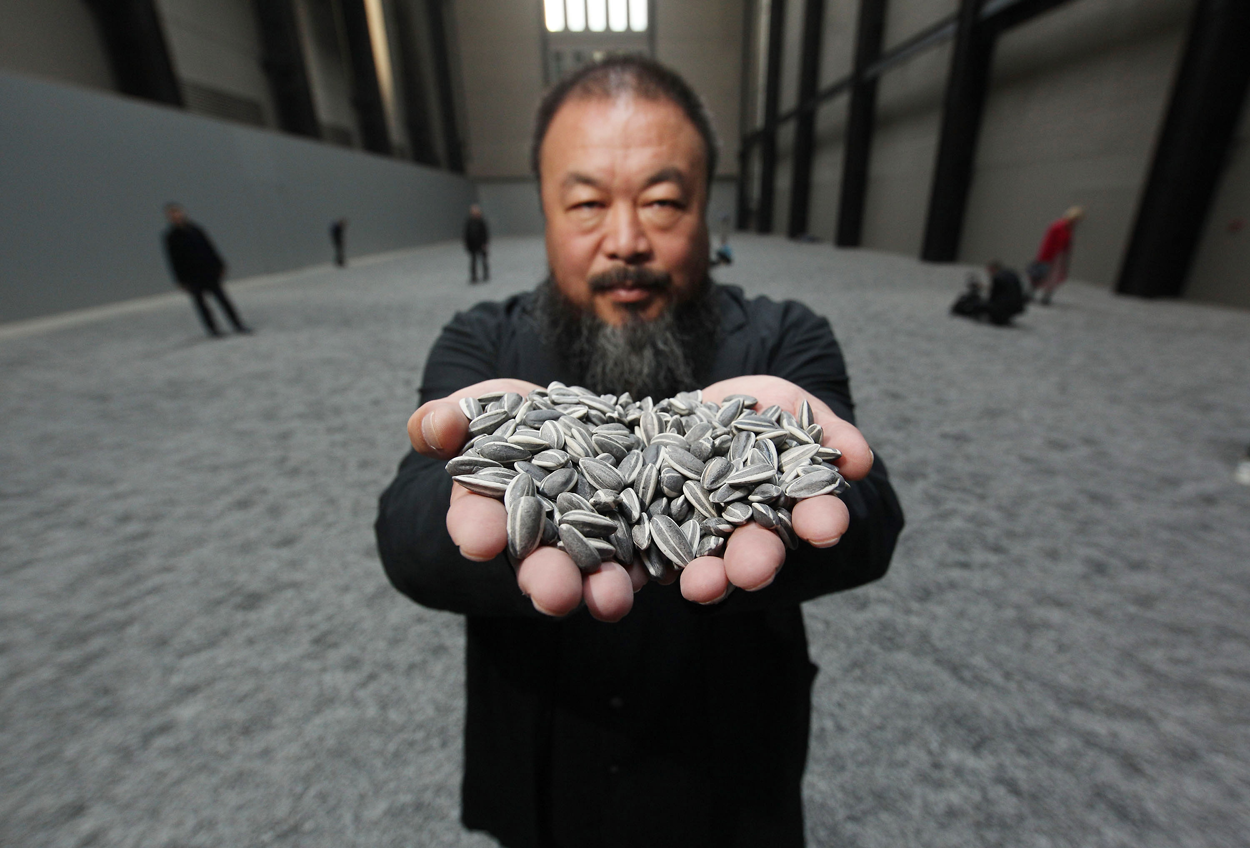
Ai Weiwei, Sunflower Seeds, installation, Tate Modern, Turbine Hall, 2010. © Photography by Peter Macdiarmid, Getty Images.

Badge with color portrait of Mao (head and shoulders) wearing white-collared shirt (unfastened) and straw hat tied below his chin with inscription: 敬祝毛主席万寿无疆 / 中国景德镇 (‘Respectfully wishing Chairman Mao an eternal life/Jingdezhen, China’) porcelain, 51mm. Photo courtesy of The British Museum. © The Trustees of the British Museum.

Sunflower-shaped badge presenting profile of Mao Zedong (head and collar with red tabs) on striated red banner. Below Mao is the sun and underneath are eight sunflowers, hammer and sickle insignia. Inscription: 毛主席革命文艺路线胜利万岁 (Long live the victory of Chairman Mao’s revolutionary path for art and literature), 38mm, aluminum. Photo courtesy of The British Museum. © The Trustees of the British Museum.
Jingdezhen porcelain workers such as Feng Shangsong have lived through the reforms of the industry. Under Mao in 1956, Feng had helped to eradicate labour inequalities and exploitative work practices. State-run porcelain factories became small societies, offering steady employment, an education system, medical clinics, and retirement support. But Feng also experienced the reversals of the capitalist reforms begun by Deng Xiaoping in the 1980s. According to Maris Gillette (2010: 370), very quickly, by the mid-1990s, ‘twenty nine porcelain factories closed and seventy thousand people were out of work’, and by 1998, ‘the reform era government closed the last ceramic factory operated or managed by the central, provincial, or city governments, leaving the ceramics industry to private entrepreneurs’. Today’s reconfigured small workshops are often comprised of extended family members, their commissions are mostly private orders and the occasional institutional order from museums such as Beijing Palace Museum (p. 373). Ai’s collaboration with the artisans of Jingdezhen took two and a half years to complete. Jingdezhen wages are paid according to the specific task; for instance, painters of inscriptions earn two to three thousand yuan (US$250 to 375) per month, the same amount that the young painter in Ai’s video said she earned. Ai suggests his commission was unlike any other that came before in Jingdezhen, and the skills required to design and cast the sunflower seeds would be comparable to the specialized tasks of ceramic-making. Since traditional vessels continue to dominate the ceramic market, artisans who have expertise in designing and building them command at least five times the wages of the painter (p. 368). 2
Even in its decline, Jingdezhen labour reveals a stark contrast to the new norm exemplified by the 70-hour workweek of the Walmart shoe factory worker making US$150 dollars per month. In Ai’s video, the artistic labour of Sunflower Seeds appears as a metaphor for the ‘object of labour’ lost to Walmart commodity production and capitalist estrangement. Jingdezhen workers are shown in the video as fulfilling the various roles of tradition, most poignantly by the elderly woman whose kitchen table is covered with a tidy progression of seeds waiting to be painted. Ai is chatting to her, asking if she ever made anything for Mao during her lifetime in Jingdezhen, to which she answered that she had been a worker there for over 30 years. The video depicts the tradition of place that is also an example of affective labour that heralds the human subject – conceived originally by Marx as ‘man’s act of self-creation … life activity, productive life itself’ (Marcuse, 1972: 13). Ai’s video narrativization of Sunflower Seeds performs the effort to transcend the current state of capitalism with Chinese characteristics and the hollowing out of Marxist philosophy by the repressive Communist regime.
These deceptive conditions were revealed in a dramatic way during the Tate exhibition in 2011 when Ai, the outspoken critic of China’s authoritarian policies, was arrested and charged with the crime of tax evasion. His three-month detainment was simply another in the series of persecutions following a police beating in 2009 and the demolition of his studio in 2011. Ai considers his dealings with the Party as a form of performance art – his US$2.4 million dollar tax fine was foreshadowed when he named his company the Beijing Fake Cultural Development Ltd. The penalty is a thinly-veiled reprimand for speaking out against the government corruption that led to the death of schoolchildren in the 2008 Sichuan earthquake and for speaking openly on behalf of imprisoned dissident Liu Xiaobo who won the Nobel Prize in 2010 (Ai Weiwei, Times topics, 2011).
But Beijing Fake refers also to the lucrative market in counterfeit antique porcelains. The highest price ever paid for a work of Asian art was the 14th-century Yuan dynasty vessel sold at Christies for 27 million dollars in 2005 (Gillette, 2010). Gillette asserts that since then, Jingdezhen’s market in counterfeits is a major support of the workshops since deceptive practices are still unregulated. Jingdezhen artisans have the ability to reproduce the highest guan standards from either the Kangxi, Qianlong, or Yongzheng periods of aesthetic authority. Ai raises the question:
If they are fake, then how do they differ from authentic period pieces when they are exact replicas with no recognizable differences? If there is no recognizable difference between this piece and an authentic period piece then what does this do to the value of the original period piece, or for that matter, the modern replica? (Ai Weiwei, 2010: 42)
In his 1995 performance, Dropping the Urn, Ai drops a 2000-year old Han dynasty urn to its inevitable ruin. The viewer is confronted with the destruction of a valuable thing, but is value today based on the unique aesthetic, the one-of-a-kind historical object, or on the appraised money worth? 3 The counterfeit copy and the destruction of an urn serve as specific kinds of resistance against neoliberal concepts for the new China. Philip Tinari suggests that ‘both offer a way of declaring one’s independence (in the Western liberal tradition) or ‘unwillingness to cooperate’ (in the Chinese jianghu tradition)’, Ai Weiwei, 2010: 44). The contradictions of capitalist labour run by an authoritarian regime are manifested by a fake socialist system, and in this acknowledgement, Ai’s ceramic objects that look so much like real sunflower seeds become a metaphor for the superficial and the ‘real’ of the economic conditions of the ‘new China’.
Overall, Jingdezhen’s old processes for art manufacturing shine a light on China’s labour exploitation. China’s growth in becoming a dominating world economic power would surely have the goal of lifting the lowest-paid Chinese worker out of poverty. But the average Wal-Mart laborer hopes to succeed in the new China by accepting excessively low wages and long work hours in what is now called the ‘race to the bottom’ in the suppression of workers’ rights on behalf of winning the global competition for corporate profits among nations. Often compared with Mexico, China’s 34 percent share of 2008 apparel US imports overtook Mexico’s 6 percent share of the market. Mexico is losing the ‘race to the bottom’, although average wages paid are only one-tenth of those paid in the United States (Robinson, 2010: 51). In viewing the global competition, there is no longer the pretense of advocating basic human rights as government officials and business pundits are now suggesting that Mexican labourers are paid too much. The global administrator is the World Bank who asserts that ‘Mexico’s labour law must be reformed to eliminate severance pay and other provisions that make Mexican labour too expensive and ‘inflexible”’. And while China’s wages are actually higher than Mexico’s, when factoring in the value of the countries’ currencies, China appears to have followed the dictates of the World Bank by establishing ‘industrial clusters’ and developing a ‘highly efficient and skilled labour force, and infrastructure systems are able to offset the disadvantage of rising [labour] costs’ (as described by Pansy Yau, deputy chief economist of the Hong Kong Trade Development Council) (p. 53). Recent research conducted by Anita Chan (Chan and Kaxton Siu, 2010), however, reveals the way in which ‘improvements’ in efficiency made by the Chinese in manufacturing consist of increased quotas and reduced time allotted for workers to meet the quotas (p. 169). The hyper-objectification of the export labourer exemplifies the distancing of the sense of humanity in what Maurizio Lazzarato describes as the ‘intensification of exploitation brought about by the acceleration of information, and by Empire’s search for ways of realizing ‘unmediated command over subjectivity itself’ (Gill and Pratt, 2008: 8). In their book Commonwealth (2009: 55), Hardt and Negri expound on poverty and the multitudes by explaining that
exploitation today tends to be no longer a productive function but rather a mere instrument of domination. This corresponds to the fact that, in different ways in various contexts around the world, as modes of life and work characterized by mobility, flexibility, and precarity are ever more severely imposed by capitalist regimes of production and exploitation, wage labourers and the poor are no longer subjected to qualitatively different conditions but are both absorbed equally into the multitude of producers. The poor, whether they receive wages or not, are located no longer only at the historic origin or the geographical borders of capitalist production but increasingly at its heart – and thus the multitude of the poor emerges also at the center of the project for revolutionary transformation.
As the 2010–2011 protest movements continue, the ‘occupy’ vocabulary of demonstration once again represents the rights of individuals who have no means of representation other than their own activist bodies. The new resistance of precarity harkens back to Marcuse’s (1968: xv) explanation of negation:
Faced with a society in which affluence is accompanied by intensified exploitation, militant materialism remains negative and revolutionary … Its idea of happiness and of gratification can be realized only through political practice that has qualitatively new modes of human existence as its goal.
As such, the most important work of Ai’s artistic labour is in creating a contrast to the accepted processes of dehumanized export labour. An ‘affective labour’ validates the subjectivity of both the artisan and the viewer, and places emphasis on ‘the significance to capitalism of the production and manipulation of affect’, as Gill and Pratt (2008: 8) describe for precarious conditions. The millions of sunflower seeds were not made to be counted as commodities for profit, nor to serve in the capacity of the repressive Communist regime. Rather, they function as affective objects to be walked on, touched, tossed about, and ultimately shared by all the visitors to the Turbine Hall in the Tate Modern. Thousands of visitors experienced this sense of play when the exhibition opened on 12 October 2010. As Ai (Interpretation text, 2010) explains: ‘In China, when we grew up, we had nothing … But for even the poorest people, the treat or the treasure we’d have would be the sunflower seeds in everybody’s pockets.’ Ironically, by 15 October, the Tate had to close the exhibition because the ‘enthusiastic interaction of visitors … resulted in a greater than expected level of dust’, proving to be a potential health hazard. Visitors thereafter were directed to view the work from the building’s bridge. The ‘authentic’ affective experience would be supplanted by the ‘fake’ once again, and ultimately, the fragility of the porcelain had come to represent the fragility of humanity itself. Jonathan Jones (2010) in The Guardian describes the viewing experience as reflexive of ‘the ocean of humanity, the incalculable numbers of people on this earth – and their fragility underfoot.’ Left to perception only, the evocation of Hardt and Negri’s ‘multitudes’ becomes the central concept as the focus turns to the vast Turbine Hall, the exhibition space that once served as the Bankside Power Station that generated electricity from 1952 to 1981. The spectral inhabitants of labouring bodies can be felt by the station’s industrial history, which is now associated with Jingdezhen’s export of its formidable history of porcelain production. The viewer experiences the objects and the makers of objects through the visual performance of meaning.
Florezca
In contrast, Cabrera’s performative work addresses the significance of border-crossing as an existential premise for the migrant and the maquiladora subject. The instability of the transitory ‘place’ of Mexican labour is central to old and new border relationships that have long been held by the migrant who travels to work in the fields and conversely by the export-zone worker of the Mexican maquiladora assembly plant, whose corporate boss is located in the United States (Hu-Dehart, 2003). 4 The border is the abstract but arbitrary determinant for criminalizing the migrant worker on the one hand and for sanctioning the exploitation of the maquiladora worker on the other. All of Cabrera’s projects seem to address the inextricable nature of these two detrimental roles for the Mexican worker. The title of Cabrera’s 2010 project Espacio entre Culturas (Space between Cultures) refers in meaning to ‘the space in the middle’ as inspired by the word Nepantla from the Nahuatl Aztec language and the strategy of resistance and survival. The Nepantla metaphor conveys the hopefulness of relinquished binaries and is conceivable as precarity’s potential for new socialities characterized in Berlant’s ‘optimism of critical thought’, and Marcuse’s ‘affirmative character’. Thus, the title translated into English by Cabrera as ‘Space in Between’ signifies for the migrant worker and the maquiladora worker the way in which the borderless space of life itself is shared by all living people and things, represented by the desert cactus indigenous to the southwest. The sculptural depiction of this desert plant was the final product of the nine artisans of the Space in Between sewing workshop. The border patrol uniform that was disassembled and re-used as material for the sculpture was once worn by an officer whose own labour was to arrest the migrant whose only offense was to cross the border.
In Cabrera’s performance, the touch of materials – sewn by someone, re-sewn into a work of art, connects to the historical vocabulary of performance’s phenomenology. The bodies of the performing women themselves express artistic meaning, as defined and established by Amelia Jones (1998: 13) for body art: ‘the elusive marker of the subject’s place in the social … the implication of the body … the ‘body/self’, as their artistic expression is redoubled in their sewing and their activity of labour. While their labour is in reconstructing the official uniform symbolizing the state of Texas, their performance is about the process of handling, touching the materials that signify surveillance and incarceration under the authority of the uniform. The poignancy of these actions comprises an aesthetic that is utterly human as distinguished in Berlant’s sociality of emotion. Cabrera enables the legitimation of the labourers whose artistry is in their domestic labour of sewing as well as in the poetic portrayal of the body/self as the subject of immigrant labour. She shows the antithesis to their alien status through the signifying act of changing the labourer into an artist, transforming ultimately into the corporate shareholder.
The commodity status of the Mexican migrant labourer is extraordinary in that the determination of one’s entire self and existence is reduced to identification papers. Marcuse (1972: 10) points to the worker’s abstraction in reification: the ‘worker not only loses the product of his own labour and creates alien objects for alien people … he even has to “sell himself” and his human identity’, i.e. he must himself become a commodity in order to exist as a physical subject.’ The alienated object of domestic labour becomes a gendered inscription of Mexican women in the United States. While Space in Between may seem to be purely an act of political sewing/embroidery, Cabrera has actually re-identified the labourer as artist in a work of art that comprises the act of identification. The problem of race and class is inseparable when dealing with immigration and labour. The targeting of racial groups is the norm of American history and there is no mistaking who is invoked by the epithet of the ‘illegal immigrant’, another rendition of Gayatri Spivak’s (1999: 6) ‘name for that mark of expulsion from the name of Man – a mark crossing out the impossibility of the ethical relation’. 5 At this very moment, migrant labourers across Arizona and Alabama are subjected to racial profiling and presumed to be criminals whether or not the Hispanic or Latina can present the legitimating document.
In 2011, Cabrera introduced the concept of transforming the Mexican art laborer into a shareholder at the Florezca Board of Directors: Performance as an event at the Culver Center of the Arts, Sweeney Art Gallery, University of California, Riverside. The first meeting of the Florezca board of directors was therefore considered a public artwork which included Cabrera and potential Dream Act participants from the community. (Signed into state law in 2001, California Dream Act, Assembly Bill 540, provides a way for undocumented immigrant students to become eligible to apply for college admission and financial aid.) 6 The meaning of the term ‘corporation’ is premised on a ‘body’, created for the function of governing a group of people acting as one entity, one voice, having its own privileges, rights, and liabilities as distinct from its individual members (http://www.thefreedictionary.com/). Mitt Romney, the Republican candidate for president, recently asserted that ‘corporations are people, my friend … of course they are. Everything corporations earn ultimately goes to the people. Where do you think it goes? Whose pockets? … People’s pockets. Human beings my friend’ (Mitt Romney heckled, 2011). In the multinational corporate system overseeing about 3,000 maquiladoras in Mexico, the pockets of the shareholder are filled, not the 66 percent of the 2010 population considered to be impoverished in a country whose median household income in 2008 was US$716 per month (Cypher, 2011: 64). Cabrera’s use of the corporate strategies of global capitalism is hardly in sync with the negation of the system; but Florezca’s support of labour, immigration, and citizenship is hardly commensurate with Wall Street greed. Cabrera’s literal interpretation of the corporate ‘corpus’ would eventually make every artisan working in Florezca into a shareholder. Her goal is ambitious as she aims to organize a legitimate global franchise that can serve in artistic manufacturing and adopt legal pathways for distributing artistic works.
The Florezca Board of Directors: Performance at the University of California, Riverside was only part of a daylong series of events on 5 March 2011, which included an oral history exhibition allowing visitors to listen to Dream Act narratives solicited from undocumented students across Southern California campuses. Performers were enlisted from the student body and from activist groups in support of California’s AB540, the federal DREAM act to contribute to Cabrera’s Pulso y Martillo (Pulse and Hammer) performance. The highlight of the day’s events, performers were led altogether into the Center Atrium Gallery and given sledgehammers to beat a 3 by 8 ft sheet of heavy gauge copper fitted onto a specially built wood platform. Through the participants’ act of pounding in a ritualistic rhythm, Pulso y Martillo expresses the ‘progressive molding and changing of negative preconceptions about immigrants through the use of a traditional craft material’ (UCR Sweeney Art Gallery press release, 2011). The performance then moves to the North Atrium Gallery where 1,000 copper butterflies were installed, works that were originally created for Cabrera’s 2008 project The Craft of Resistance. In this highly symbolic expression, as explained by Emily Morrison, the ‘monarch butterfly is known for its lengthy annual migration, which spans North America, from Canada to sanctuaries in Michoacán’ and the ‘perseverance of these insects draws a direct parallel to the perilous journey of thousands of Mexican immigrants to the United States’ (http://www.margaritacabrera.com/).’ Most importantly, the performance re-enacts the group laboring required for continuing the traditional Mexican copper craft technique.
The Craft of Resistance project, produced and exhibited at ArtPace in San Antonio in 2008, was another performative installation that began with the staging of a makeshift maquiladora factory (Figure 4). The ArtPace studio was divided into 12 separate cubicles to emulate the work space of the maquiladora, complete with florescent lighting over long workbenches. Cabrera enlisted a team of local volunteers who were led into the assembly-line process for fabricating 2,500 copper monarch butterflies. Cabrera had travelled to Santa Clara del Cobre, Michoacán, Mexico, to learn the traditional craft technique. Working with artists at the El SECATI school for craft, she was trained in the time-honored process of sculpting copper. Each sculpture is inscribed with the pattern of the monarch butterfly on one side, while the reverse shows the image of a copper penny. Once the sculptures were completed by the ArtPace volunteers, they were boxed and exported to a private residence in San Antonio where they were installed throughout the display of the home – alighting on furniture, appliances, walls, and ceilings. For the ArtPace exhibition, photographs of the installation instead of the actual copper sculptures in the private residence were displayed in the gallery. Cabrera explains that the
presentation of the insects in an area separate from the gallery symbolizes the disparity between the production of goods in maquiladoras and the consumption of Mexican-made products in the United States. Similarly, the swarm represents the manic transformation of the Mexican economy, expressing the threats posed by an oversaturated market (complicated by competitive Chinese labour) and the flight of the younger generation from rural to urban centers on both sides of the border.
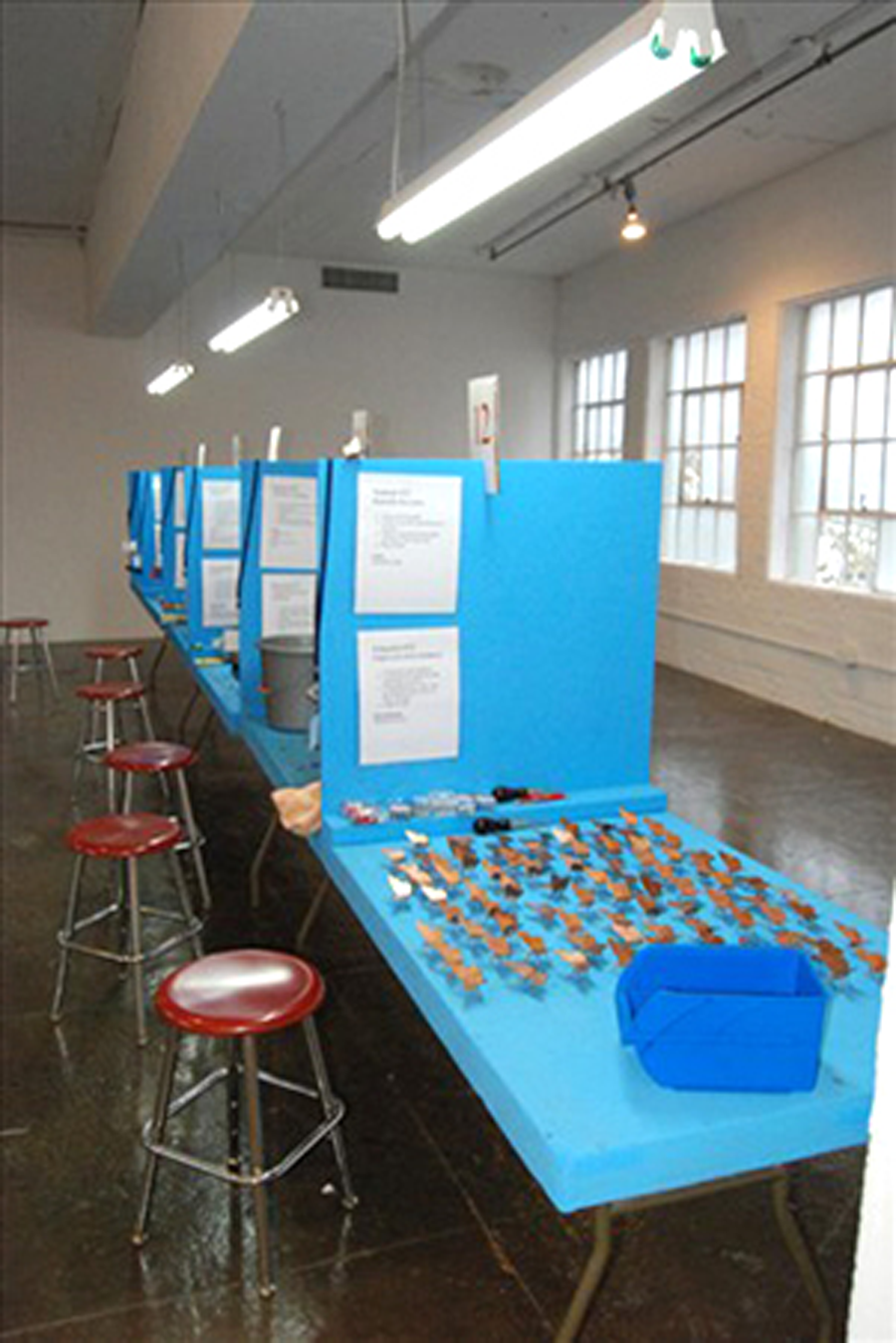
Margarita Cabrera, The Craft of Resistance, 2008, mixed-media installation, dimensions vary, originally produced and commissioned by Artpace San Antonio. © Photograph by Todd Johnson.
Cabrera’s objective is to be able to continue producing through artists workshops such as Pulso Y Martillo and Space in Between to transform the patronage system. Her performances show the impact of globalization on Mexican existence, and also how the marketing system for art can serve as a political form of validation, empowerment, and identification. Her social interpellatives fall into the category of the legal performative in which corporatization can be viewed as a contractual ritual that is as powerful as the ritual process for obtaining citizenship.
Berlant (2004: 449) points out that
aesthetics and critical works that seek to promote overcoming what are called the immediate gratifications of mass society are, mainly, in perfect consonance with its modes of privilege even as they remain a marker of a different, or better, pace for living.
Cabrera’s understanding of the artist’s privilege within the globalized market becomes clear to the viewer as Florezca’s corporatization of the artist is really an act of complicity with the system of global power. Florezca relinquishes the Marcusian ideal for overcoming the gratifications of mass society in acknowledgement of the passing of the bourgeois concept in which Berlant argues that ‘the aesthetic of modernity always involves a market, even if the name of the value it gives its objects of exchange is merit.’ Identity, immigration, passports, and visas constitute the merit of the object of exchange in the global economy. By presenting the laborer himself or herself as the subject/object of art, Cabrera and Ai confirm the evolution of a performative art that challenged Marcuse’s (2007: 104) notion that art ‘does not have to be “realistic,” for man is at stake, not his occupation or status.’ It might be the right time to assert the success of performance’s triumph over modernist objecthood – the latter defined as ‘useless’ art in the function of aesthetics against bourgeois commodification in the old artistic order. And yet, in some measure, performance has succeeded in fulfilling the potential for art that Marcuse idealized when he advocated for the ‘fusion of material and intellectual production, the mutual penetration of socially necessary and creative labor, of practicality and beauty, of use value and value’ (p. 129, emphasis in original). Performance art has attained these ideals by disturbing the old concepts of artistic illusion whilst maintaining the unrealistic theatrical space that is oddly pitted against alienation and reification.
But the success in which the performative is now common to artistic vocabulary seems to have arrived when the very use of theory has come into a sort of impasse – when feminism and cultural studies appear as having passed an apex in discourse. As Berlant (2004: 445) argues:
class inequality and labour-related subjectivities … are now increasingly embedded in capitalism and globalization … critical race, feminist, and queer studies concerns are covered, covered over, or articulated in more general conceptualizations of embodiment, a term that designates the closeness to the body of social, experiential, and aesthetic affect.
Berlant’s remarks suggest that identity discourses are now subordinate to overarching theoretical practices because they tend to engage through an uncomfortable subjective closeness – the hallmark of rigorous theory was always objective distance which is considered as the more elegant form of philosophizing. In this way, theory itself is an aesthetic practice, established by the Kantian ideal for ‘reason’ as connected to ‘objective’ beauty, under the notion that ‘unaffected judgment’ comprises the aesthetic activity. Distance from the subjective was therefore rational and tasteful – not emotional and messy.
In this article, I have argued that Ai and Cabrera’s performative works exemplify a change in priorities in terms of the ways in which art conveys beauty and truth. The aesthetics of Sunflower Seeds and Florezca are meant to implicate the viewer in the prominent issues of Ai’s political labour and Cabrera’s subversions on behalf of immigration. In overt fashion, these performative engagements engender an uncomfortable subjective ‘closeness’ for the very purpose of arousing the viewer’s feelings of complicity over issues that are usually kept at a safe distance. The legibility of these works require the acknowledgement that artistic practice and theory have been transformed by the civil rights era and also by Critical Theory. The point to be taken is that the present-day usefulness of the new dialectics of precarity can be thus conceived as Berlant’s optimistic continuity of critical thought – Marcuse’s affirmative culture – that instigated a different approach for assessing art and truth. Berlant undertakes the same subjective/objective questions in reviewing the historical discrepancies between liberal institutions and social movements. She suggests that ‘theory and practice requires a more dynamic perspective’. And her return to the Marcusian model of ‘affirmative culture’ emphasizes the ‘sociality of emotion’ as a form of ‘optimism of critical thought’. The logic is dialectical – Berlant views optimism as a ‘way of describing a certain futurism that implies continuity with the present’, and ultimately, critical theory’s contribution is important for its ‘investment in cultivating consciousness’. Optimism is emotional as it looks forward to future efforts once the injustices of the past have been acknowledged. The emotional sense of precariousness in Ai and Cabrera’s performative actions could express a theory and practice that are firmly established in both critical thought and historical realities.
Footnotes
Acknowledgements
A version of this article was first presented at the ‘Critical Refusals’ conference, 27 to 29 October 2011 at the University of Pennsylvania. I want to thank Margarita Cabrera, Ai Weiwei, Amelia Jones, Marquard Smith, and Mark Little for their invaluable contributions to this article.
Notes
Address: 2700 Bay Area Blvd, Bayou 2121-09, Houston, TX 77058-1098, USA. [email: