



Abstract
As an architect with the London County Council (LCC), a newspaper columnist, friend of artists and an incipient collector, Colin St John Wilson is a fascinating figure in the interacting circles of 1950s London. It was Wilson’s sketch-plan that ordered the ‘market-stalls’ of the This is Tomorrow exhibition and – in the opinion of Theo Crosby – the display he created with architect Peter Carter, engineer Frank Newby and sculptor Robert Adams most closely achieved the exhibition’s original aim of an anonymous synthesis of the arts. In this article, the author interprets Wilson’s life, work and theory as both critique and commentary in an examination of three pertinent issues within the Independent Group: the possibilities of artistic collaboration in architecture; the creative tension in architecture between science/technology and art/humanism; and the potential for a deeper psychologising of space – linked to psychoanalytical debates of the time. Interrogating these concerns is of importance, the author proposes, as they were so central to the discourses and form-making of architecture both at the time and in the immediate futures of the 1960s, the 1970s and afterwards.
Keywords
Two Figures in an Interior
Two figures stand in an interior. A photograph (Figure 1) of c. 1960 shows the architect Colin St John Wilson (1922–2007) – one of the key actors in the interacting circles of the 1950s and the Independent Group – within the transparent link element between the old Scroope Terrace building and the new extension he designed for the Cambridge School of Architecture (working with lecturer Alex Hardy) in 1957–1958. Le Corbusier’s Modulor proportions govern this austere block, as the framing hand-gestures of the leather-coated Wilson appear to demonstrate. Wilson had seized Leslie Martin’s offer of a job in 1956 on the latter’s appointment as Cambridge Professor of Architecture, where one of the most urgent first tasks had been to provide the School of Architecture with a new lecture room, ‘crit’ spaces and staff facilities. Reyner Banham’s The New Brutalism (1966) includes this building under the ‘Brick Brutalists’ as a forerunner to the Cambridge movement in architectural design. Appropriately for students it carries a raw manifesto charge and – if not fully Brutalist – it is the roughest of Wilson’s projects. For Banham, ‘into this relatively small building were poured most of the intellectual aspirations of the Wilson, Smithson generation; it is one of the most eclectic designs ever to be packed into an anonymous-looking brick box’ (p. 126). His defining essay on ‘The New Brutalism’ in the December 1955 Architectural Review lists three characteristics of: ‘1, Memorability as an Image; 2, Clear exhibition of Structure; and 3, Valuation of Materials “as found”’; but, added to all this, perhaps the most important ingredient is ‘precisely its brutality … its bloody-mindedness’ (Banham, 1955: 361, 357).

Colin St John Wilson in the stair-link, School of Architecture extension, Cambridge, c. 1960. Roger Hill © Wilson estate. Reproduced with permission.
Following Banham’s recognition, the school extension is often included in the Brutalist canon as in Claude Lichtenstein and Thomas Schregenberger’s (2001) important documentation of it in their book, As Found: The Discovery of the Ordinary. And – remembering Banham’s first characteristic – it certainly conveys a potent, four-square ‘memorability as an image’. As for his third attribute, the ‘as-found’ bricks of which it is made are fairfaced second-hand Cambridge stocks (these are loadbearing 9” brick internally, and externally formed as a brick cavity wall of two 4½” leaves). Thus the walls are satisfyingly thick, and present a frank expression of structure and material both inside and out. Moreover, it is as raw and bloody-minded as Wilson ever went in an architectural expression usually more moderated by his innate humanism.
The second figure in an interior is found in Richard Hamilton’s Interior Study (c) (c. 1964) – from Wilson’s own collection now on loan to Pallant House, Chichester (Van Raay et al., 2004: 105). Hamilton shows a young woman striding towards the black-and-white Brutalist future of the very same Cambridge School link element, in rejection of a foreground bourgeois scenery of gilt frames and high-backed dining chairs, already challenged by Hamilton’s introduction of an abstract rug and a lipstick-like smear of red oil-paint. Hamilton’s involvement with the domestic interior began with his Just What Is It That Makes Today’s Homes So Different, So Appealing – shown in the catalogue entry for Pavilion 2 of This Is Tomorrow (with McHale and John Voelcker) – where he has listed the items he then ‘deemed of importance’ in 1956 as: ‘man, woman, humanity, history, food, newspapers, cinema, TV, telephone, comics, words, tape recording, cars, domestic appliances, space’ (Hamilton, 2006: 11).
The ‘high culture’ of the carefully wrought Le Corbusier proportions, structure and plan of Wilson’s building (despite its ‘as-found’ and ‘everyday’ aspects), and the ‘low culture’ of mass consumption that attracts Hamilton, already demonstrate one of the plethora of binary descriptors that confine discussions of the interacting circles of the 1950s, of the Independent Group (IG), and This Is Tomorrow’s participants.
A photograph of the time shows our protagonist as ‘angry young man’ – ribbed pullover, cigarette in hand – posed in his black-ceilinged flat on Oppidans Road, Primrose Hill. Here, in 1951, he was excited to discover Reyner and Mary Banham as neighbours; as Mary Banham recalls, Peter (Reyner) and Sandy met and ‘it was obvious the talk was never going to stop’ (Menin and Kite, 2005: 38). The Banhams’ flat became a regular Sunday morning salon for progressive young architects and artists such as James Stirling, Alison and Peter Smithson, Richard Hamilton, Eduardo Paolozzi, Robert Maxwell, Alan Colquhoun, Nigel Henderson, Sam Stevens and Wilson himself. Banham valued these meetings as:
an invisible college of a remarkable kind …. These people were a big part of my education … most of my indoctrination into the Modern Movement in architecture came from the Sam Stevens/Bob Maxwell/Jim Stirling/Sandy Wilson network. That was a fantastic body of conversation – the whole period of constant competitions, from Coventry Cathedral to Sydney Opera House. (Whiteley, 2002: 10–11)
Visitors valued the combative conversation, as well as the chance to glean information from the latest architectural magazines which Banham acquired as a staff member of The Architectural Review. ‘On weekends’, as Wilson remembers, the Banhams’ ‘shared honours with the “French Pub” [The York Minster, Dean Street, Soho] as a rendezvous for our gang: Saturday morning the pub, Sunday morning the Banhams’ (Robbins, 1990: 196).
Wilson’s life, work and theory enable the examination of three pertinent issues among these friends and sparring partners who constituted the IG: the possibilities of artistic collaboration in architecture; the creative tension in architecture between science/technology and art/humanism; and the potential for deeper psychologies of space. It is important to interrogate these matters as they were central to the discourses and form-making of architecture, both at the time and in the immediate futures of the 1960s, the 1970s and beyond. Take Wilson’s case: working with Leslie Martin and others, he went on to shape the architectural language of the so-called Cambridge School with its peculiarly British synthesis of a rationalism of grid-plan, brick and concrete infused with humanisms borrowed from Scandinavia, the Picturesque and psychology. This is an approach whose ultimate gesamkunstwerk is Wilson’s British Library, London (1974–1997). Other very different manifestations include the ideas of ‘Archigram’, influential on projects such as Renzo Piano and Richard Rogers’ Centre Pompidou, Paris (1971–1977) – a building as unlike in image and approach as possible to the British Library but still an attempt to equate the rationalisms of technology with the human need for varied places of interaction.
Challenging Binaries
Surveying the This Is Tomorrow exhibition, Lawrence Alloway categorised ‘the formal and the popular’, while Theo Crosby saw, on the one hand, sections deriving from the Constructivists and, on the other, those who took their cue from Dadaism and Surrealism. Fierce disputes broke out among the London County Council (LCC) architects, between another variant of the ‘formal’ and the ‘popular’; between the followers of Le Corbusier at his most rational – which included Wilson at this time – and the Scandinavian inspired ‘New Empiricism’.
Theo Crosby describes this latter fusion of English Romanticism, Arts and Crafts and Swedish sensibility as: ‘rarified and pure, but somehow emasculated; it lacked the energy and directness of Le Corbusier’s postwar buildings, their acceptance of “poor” materials, their bright colouration’ (Robbins, 1990: 199). Compare the gently ‘empiricist’ picturesque Alton East Estate, Roehampton, with the direct homage to Le Corbusier’s Unité realised by Wilson (working with Peter Carter and Alan Colquhoun) at Bentham Road, Hackney (1950–1955). These Hackney slab-blocks also boldly emulated Le Corbusier’s apartments with their maisonettes of an extremely narrow 12’3” (3.7 metres) frontage.
Wilson had another unique podium as one of the first architecture columnists on a major newspaper, The Observer. Echoing Crosby’s emasculation point, he used its pages to attack the Festival of Britain’s empiricist live architecture exhibition at Lansbury in Poplar, London, for its:
extraordinary effeminacy [that] promises to convert London into the most overblown and ‘tasteful’ village in the world: three and six-storey blocks of flats with the pitched roofs, peep-hole windows and ‘folky’ details of the current Swedish revival, picturesquely sited around market-places [that] have been offered to us in the name of ‘live architecture’. (Wilson, 1952)
The diagram (Figure 2) utilises semiotician Algirdas Greimas’s Semiotic Square as one way of interrogating the rudimentary binaries commonly invoked in IG arguments. So here the ‘high–hard culture’ of the Formalist–Rationalist (top-left) position is placed in opposition to the ‘soft’ New Empiricism (top-right). In his ‘New Brutalism’ paper for The Architectural Review – despite its characteristics of ‘formal legibility of plan’, ‘clear exhibition of structure’ and ‘valuation of materials for their inherent qualities “as found”’ – Banham (1955: 357) could not see New Brutalism as mapping directly onto many Formalist–Rationalist productions affiliated to CIAM (Congrès International d’Architecture Moderne, 1928–59) save ‘with the possible exception of [Corbusier at] Marseilles’.
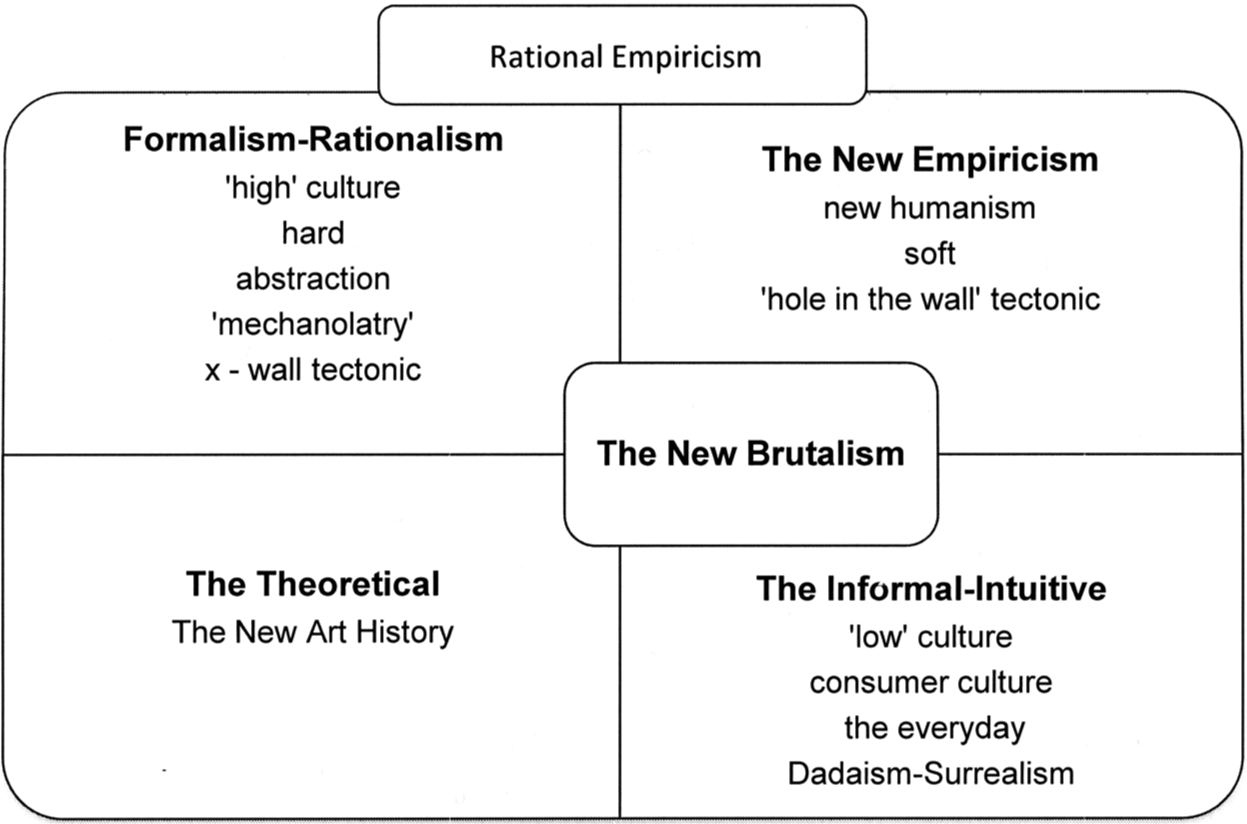
Independent Group – analysis diagram of ‘binaries’. Reproduced with permission.
Accordingly, in this diagram, New Brutalism occupies a fascinating in-between territory that overlaps both the Formal and the Not-Formal (namely the ‘informal–intuitive’) in its fusion of the rationalist and the everyday, high and low culture. It is also empirical in its specific engagement with place – very different to Buckminster Fuller’s placeless Dymaxion House (1929) for example. For completeness, the diagram postulates the highly theorised ‘The New Art History’ as the ‘Not-Empirical’ at bottom left. The only attempt to expand on this last aspect here is to quote Banham from his opening paragraphs to ‘The New Brutalism’ (1955: 355):
One cannot begin to study the ‘New Brutalism’ without realising how deeply the New Art-History has bitten into progressive architectural thought, into teaching methods, into the common language of communication between architects and between architectural critics.
Banham foresees here the later impact that critical theory would have on the then rather gentlemanly practice of architectural history, especially from the 1980s onwards.
Against ‘Mechanolatry’
In an otherwise fond obituary to Banham, written in 1988, Wilson comments: ‘Theory and Design in the First Machine Age [1960] was written for us – the dedication says so – and much of it was hot from the anvil. My copy is smothered in notes of protestation. (He dared to pit Bucky Fuller against Corbu!)’ (p. 20, emphasis in original); that is to place Fuller’s vision of architecture as a rootless technocratic piece of lightweight product design against Corbusier’s massive authenticity. For Wilson – as the figure in an interior standing in the link at the Cambridge school – was already growing sceptical of a placeless, extremely abstracted technology. On 11 June 1959, he showed Le Corbusier around the Cambridge architecture school extension at the time the Swiss-French master received an honorary degree from Cambridge University, and he remembers not being surprised when Corbusier said to him: ‘“We used to think buildings ought to look like aeroplanes. That is stupid – buildings do not fly”’; and Wilson continues, ‘when our next visitor to the school, Buckminster Fuller, produced his customary question “How much does your building weigh?” I greatly regretted that I did not know the figure – so that I could double it!’ (Wilson, 1994–1995: 2).
A turning point came:
The project that I made for Coventry Cathedral with Peter Carter in 1951 was an extreme attempt to marry symbolism and advanced technology – ‘High Tech’ had not yet been invented. Shortly afterwards I became immersed in the writings of Adrian Stokes [1902–72] and very moved by some recent buildings of conspicuous mass – Aalto’s Saynatsalo, and Baker House at MIT, Lewerentz’ St Mark’s Church and Le Corbusier’s Jaoul Houses. As a result I underwent a certain reaction against mechanolatry. (p. 1)
This embrace of brick, and the humanism of Alvar Aalto’s vision of an architecture ‘organically suited to the little man in the street’, moved Wilson by a long way into territory that he would previously have scorned as ‘New Empiricist’ – and there will be much to say on the Adrian Stokes influence. Be that as it may, there is much in what has become known as the ‘Cambridge School’ of architectural design – associated with Leslie Martin, Wilson, Patrick Hodgkinson and others – that remains strongly Formalist–Rationalist. For example, the Harvey Court building for Gonville and Caius College of 1957 is striking for its order and geometry, its mathematics, its love of the grid and its systematic analysis of programme – despite the undoubtedly deep cognisance of Aalto. Perhaps another category should be inserted into the diagram labelled ‘Rational Empiricism’?
A Final ‘Walk-Through’
How did these themes of rationalism, empiricism, theory and intuition play out in the This Is Tomorrow exhibition itself? Some accounts present a more orchestrated event than the argumentative process that actually occurred; thus, in the Autumn 2000 issue of the academic journal October, Mark Wigley (2000: 52) writes laconically of ‘Theo Crosby, who also coordinated the group’s This Is Tomorrow exhibition’. It followed the rejection of Paule Vezelay’s idea for a Groupe Espace exhibition at the Royal Festival Hall by a group including both abstractionists like Victor Pasmore and IG affiliates such as Wilson himself. (Vezelay wanted to include applied arts such as fabrics and tiles but these objectors said ‘We’re not interested in little abstract tiles’.) Wilson’s recollections from typescript notes he made in 8 February 2001 are worth giving in detail:
My next most vivid memory is of a meeting in the studio of Adrian Heath in Charlotte Street. Theo [Crosby] had put about the idea that there would be an exhibition about ‘collaboration between architect, painter and sculptor’ and that Bryan Robertson had offered the Whitechapel. Collaboration was an idea very much in the air – Le Corbusier was always talking about ‘le syntheses des arts’ – and that’s when the whole gang converged on Adrian Heath’s place. It started with a rabble, everybody talking at once, and then at a certain point Roger Hilton … suddenly stood up and looking at Alloway and Banham said ‘Get these effing word men out of here! This is a discussion for artists, not word people.’ There was a deadly silence and Banham and Alloway, white-faced, disappeared. It then became very pragmatic and someone suggested that each of us write down a list of the people we’d like to collaborate with. We then gathered the lists together and agreed that each group should have the equivalent of a stall-space in a market in which they could do their own thing … It was a complete free-for-all. So there was a very disparate bunch. I can’t quite remember how the different spaces were allocated except that it made sense that the first two on entering were ‘walk-throughs’ and so was the last (my group) on exiting. Anyway I was given the job of drawing up the overall layout … Everybody had their own booth, as it were, in a big fair, and could do their own thing. (Wilson, 2001; see also Grieve, 1994: 226)
Accordingly, Wilson’s plan – based on the survey of the Whitechapel space he did with Peter Carter, his Coventry Cathedral collaborator – shows the entry walk-through ‘No 1’ of Crosby, William Turnbull, Edward Wright and Germano Facetti – and the final walk-through ‘No 10’ which Wilson did in collaboration with Peter Carter, Robert Adams (sculptor) and Frank Newby (engineer). Wilson agrees with many commentators that the ‘two absolutely polar exhibits’ were ‘No 2’ – the one by Hamilton (with John McHale and Magda Cordell) – and ‘No 6’ by Eduardo Paolozzi, Nigel Henderson and Alison and Peter Smithson. These contrasts of approach appeared in the earlier discussion of the figures in an interior.
Many of these simmering issues came to the fore in a lively BBC Radio 3 broadcast on 17 August 1956 in which Peter Smithson, Colin St John Wilson, William Turnbull and Richard Hamilton were in discussion with Theo Crosby and David Piper. Smithson claimed ‘we’re not, as it were, purely concerned with aesthetics. We’re concerned with man himself’; but Wilson objected to ‘the distinction that Smithson implied between an aesthetic and life’, seeing their pavilion ‘No 6’ as:
… sold out to the picturesque idea … We are in fact getting the same old mish-mash of picturesque clobber like an antique shop in which any objects from the past or from your life are allowed to hang around and gather dust and stare at you, and suggest whatever mesmerically they do suggest to you. Neither Smithson with his ludicrously antediluvian objects, nor Hamilton with his ludicrously streamlined pop art are in fact making a constructive statement at all. They are merely lumping together formless phenomena. (Wilson et al., 1956)
In Wilson’s view, their walk-through pavilion ‘No 10’ aimed to meet the original aims of the exhibition. It
was absolutely straightforward in exploring the language of architecture, the language of sculpture, and whether there could be a real collaboration between an architect and sculptor, doing something that they wouldn’t have done unless they were working together. (quoted in Menin and Kite, 2005: 58) (see Figures 3 and 4)

Model of the Group Ten pavilion. © Wilson estate. Reproduced with permission.
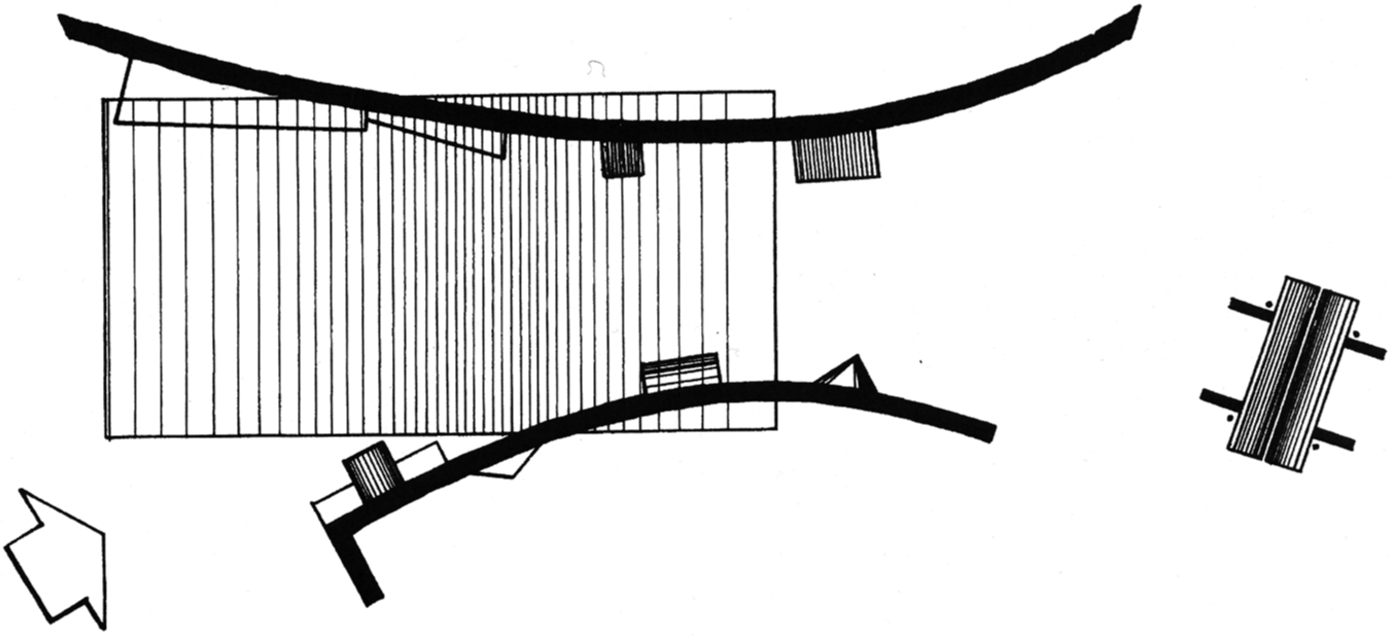
Plan of the Group Ten Pavilion. © Wilson estate.
This argument was accepted by Theo Crosby who in Architectural Design of October 1956 considered Group Ten’s ‘piece of sculptural architecture’ as ‘the nearest in result to the original aim of the exhibition’. For ‘here no individual work is shown: each person contributed to the total, ultimately anonymous work’ (Crosby, 1956: 336). As something of an artist manqué – already a compulsive collector of art, friend of artists and lover of literature – Wilson was naturally collaborative in his relationship with artists, as evidenced by his British Library, with its Paolozzi sculpture, Kitaj tapestry and so forth. An attitude in marked contrast to that of his friend James Stirling who even in the This Is Tomorrow catalogue statement for ‘8’ complained: ‘Why clutter up your building with “pieces” of sculpture when the architect can make his medium so exciting that the need for sculpture will be done away with?‘ (Stirling, 2011[1956]). Whereas in Group Ten’s ‘“funnel” walk-through’, sculptor Robert Adam made an integral contribution – not only to the climactic totem of counter-curved aluminium-faced sheets, but to the relief forms of blades, pipes and projections that articulate the primary architectonic curves.
Oneness and Distinctness
Despite its evident qualities, this pavilion has been less discussed than some of the others. Perhaps its very success in synthesis make it – on the face of it – less striking a subject than the ‘polar’ extremes of pavilions 2 and 6. Yet Banham, in a review of This Is Tomorrow in the Architectural Review of September 1956, found:
… a note of ambiguity [which] appears in the composition of curved planes … Normal scale-effects are reversed, and that part which is large enough to admit a standing man is clearly sculptural in feeling, while the manifestly structural element beyond is sited and displayed like a free-standing statue. (p. 187)
Ambiguities of scale and form are matched by spatial ambiguities between what – in a borrowing from Adrian Stokes – might be broadly termed those between feelings of ‘oneness and distinctness’. Wilson confessed his immersion in the writings of Stokes in this period in relation to the Coventry Cathedral competition; his spatial working out of these ideas links to debates in the English object–relations school of psychoanalysis which aimed to formulate an aesthetics of art and architecture based on the theories of Melanie Klein (1882–1960). Stokes was key in giving coherence to such aesthetics along with other important thinkers such as Hanna Segal and Marion Milner. There is fertile territory for further research here, exploring the intricate terrains linking such psychologisings of space and surface to the making and reading of art and architecture in the 1950s and onwards – much like, for instance, how others have examined the impact of the work of Anton Ehrenzweig. 1
Wilson was certainly not backward in sharing his enthusiasms for Stokes among his acquaintances in London and, from 1956, at the Cambridge School of Architecture. Later, he would present a lucid interpretation of Stokes’s spatiality, for his peer audience, in his article ‘The Natural Imagination. An Essay on the Experience of Architecture’ published in Architectural Review in January 1989 (Wilson, 1989). ‘Oneness’ or envelopment – Klein’s ‘paranoid-schizoid’ position – ‘is identified as an all-embracing envelopment with the mother … a kind of fusion which is most sheltering’ (p. 66). That would certainly be the case for the idealised mother’s breast, among the part-objects that people the infant’s world in this period from birth up to four to six months – though there are other part-objects that instil fear. This position is succeeded by traumatic transition to that of distinctness – Klein’s ‘depressive’ position – ‘a shocking change to the contrary position of Exposure or Detachment – of an otherness in which the infant becomes aware both of its own separate identity from the mother and from all other objects out there’ (Wilson, 1989: 66). This position is also associated with a need to make reparation.
The orthodox Kleinian position is most clearly expressed in Hanna Segal’s paper ‘A psychoanalytic approach to aesthetics’, first presented in 1947, which roots the ‘wish to create’ in the need of the early depressive position to re-create a lost and ruined whole; creativity is a mature act in which infant positions play little role. But in a significant postscript of 1980 Segal adds:
I should … now emphasize more the role of the idealisation arising from the paranoid-schizoid position. I am in agreement here with Adrian Stokes (1965), who says that the artist seeks the precise point at which he can maintain simultaneously an ideal object merged with the self, and an object perceived as separate and independent, as in the depressive position. (Segal, 1998[1945]: 220)
Despite some anxiety at disloyalty to the Kleinian mainstream, Stokes, along with Marion Milner, increasingly stressed the role of the first position in creativity along with the second as in his paper ‘Form in Art’ published in 1955 arguing that the infant ‘homogeneity associated with idealisation (the inexhaustible breast), is harnessed by the work of art to an acute sense of otherness and actuality’ (Stokes, 1955: 414). The same paper also shows that interest in the ‘vitality and rhythm’ of children’s drawings, and in ‘primitive’ art which is widespread in the thinking and exhibitions of the Independent Group. Many – including the otherwise radical Reyner Banham – had difficulties at the time in grappling with the part-objects of Jackson Pollock’s work – to take just one example of art autre. If these problems are not necessarily expressed in terms of Kleinian psychoanalytical aesthetics, there is a shared fascination and angst with the role of the primordial in creativity and expression. As a champion of ‘carving’ artists, like Barbara Hepworth, Stokes also took time to integrate the Abstract Expressionism of Pollock but by The Painting of our Time (1961) could praise its enveloping dematerialisation as ‘undoubtedly excellent art’; Pollock’s aim, he wrote, ‘was to get inside his own paintings rather than that his paintings should represent what was inside him’ (Gowing, 1978b: 169).
Returning to Wilson’s ‘Natural Imagination’ article he finds in Stokes the
extraordinary conclusion: that it is uniquely the role of the masterpiece to make possible the simultaneous experience of these two polar modes; enjoyment at the same time of intense sensations of being inside and outside, of envelopment and detachment, of oneness and separateness. (Wilson, 1989: 66, emphasis in original)
Despite some inter-war enthusiasms for Modernist architecture (in 1934 he had even taken rooms in Wells Coates’s landmark Isokon Flats in Hampstead) Stokes was essentially disenchanted with the harshness of the post-industrial urban scene and he saw the role of much modern painting and sculpture, from the Impressionists onwards, to provide those reassuring surfaces once offered by everyday streets. But in a rare commentary on a post World War Two building, written in a notebook entry of 31 July 1953, there is praise for the major British public building of the period, the Royal Festival Hall, opened in May 1951, and realised by the design team led by Leslie Martin and Peter Moro (remembering it was Martin who invited Wilson, in June 1956, to work and teach with him at Cambridge when he took up his post as Chair of Architecture at Cambridge University):
The creation of space & smooth-&-rough is the whole of the Festival Concert Hall. At last, space in London, with the surround & river. Hardly necessary to go to Italy for it. The great silent corridors with glass walls beyond which the electric trains are seen to slink on the bridge though they cannot be heard. What is this space psychologically, the essence of architecture & all visual art. It provides both the feeling of oneness & distinctness. (Quoted in Menin and Kite, 2005: 203)
As a collaborator there is a Formalist–Rationalist aspect to Robert Adams (1917–1984). Adams had taught with Pasmore at the Central School of Art and Design, and was closely involved with him in the advance to that abstract art, identified with the wider Constructivist project – labelled as ‘Constructionist’ – along with others such as Adrian Heath, Anthony Hill and Kenneth and Mary Martin with whom he exhibited from 1951–1956 (Curtis et al., 2003: 148; Grieve, 1994: 231). On the other hand, as the readings of Stokes already intimate, the Constructionist aim of a completely non-subjective abstract art, geometrically based and using industrial materials, can only be part of the equation in understanding the experiential power of the sculpture–architecture of Pavilion 10. And Adams also showed at the 1952 Venice Biennale with artists of a more phenomenological turn, like Kenneth Armitage and Reg Butler, whose works of ‘pitted and encrusted surfaces, and scarred and distressed patinas, evoked aged or worn human skin’ (see Curtis et al., 2003: 169).
Grieve (1994: 231) stresses the experiential aspect of Pavilion 10:
More than any other section, theirs was a formal spatial experience through which spectators were directed. Two converging convex walls and a swooping, detached ceiling funnelled spectators past projecting segments of basic shapes – cylinder, disc, cone, rectangle, triangle. After narrowing, the space belled out and lightened and here stood a tall, free-standing construction of paired, curved planes, made of board faced with polished aluminium so that they gleamed at the end of the funnel …
Even the anti-collaborative Stirling had to admit that ‘10’s’ piece was ‘just right for that moment because Ronchamp had recently been built … and we were still coming to terms with the shift in Le Corbusier’s work’ (quoted in Robbins, 1990: 195). Significantly, Banham’s ‘New Brutalism’ of December 1955 opens with a photo-spread on ‘one of the most personal and surprising buildings of [Le Corbusier’s] career’. Obviously the installation is in part a homage to Le Corbusier but, notwithstanding the organic Ronchamp-like geometries, Group 10’s work is still Formalist–Rationalist in its tight control. ‘It was pretty rigorous formally’, recalls Wilson:
I was tremendously into proportional systems in those days. We made the suspended canopy sheet in Frank Newby’s apartment where he calculated the interval of the cuts that allowed it to follow the curve we wanted. It was mostly hardboard, though some of it had aluminium on one side, so it was shiny, and some was matt, sprayed as roughly as possible. (Wilson, 2001)
Yet it also opened the door to a shock of recognition, shared by many in this generation, at the real plurality of Corbu’s imagination interweaving the rational and intuitive. Some of this had begun to dawn on Wilson back in the spring of 1953 when he had had the privilege of meeting the master in his roof-top apartment studio, and seeing the ‘alchemical figures’ of his Taureau series of paintings. At the same time it must be admitted that Wilson and Carter’s contribution to the 1956 CIAM in Dubrovnik is straightforward ‘vertical-city’ in expression, complete with the full apparatus of technology including Helicopter Roof Stations.
In his immersion in Stokes’s writings in the 1950s, a ‘terribly important’ book for Wilson was Smooth and Rough of 1951 where Stokes:
in employing smooth and rough as generic terms of architectural dichotomy, [is] better able to preserve both the oral and tactile notions that underlie the visual … Architecturally, we experience the beloved as the provident mother. The building which provokes by its beauty a positive response, resuscitates an early hunger or greed in the disposition of morsels that are smooth with morsels that are rough, or of wall space with the apertures … (Gowing, 1978a: 243)
Accordingly Smooth and Rough is illustrated with images of Renaissance architecture rich in wall-significance. Against urban scenes that serve no inner needs – Stokes lists London sites like ‘Tottenham Court Road’, ‘the terracotta monstrosity of Baron’s Court or the wastes of Kensington’ (Gowing, 1978a: 239) – his Chapter 6 describes architecture, as in the passage above, that provides ‘The Sense of Rebirth’, and is rich in womb and birth imagery as when he writes:
A house is a womb substitute in whose passages we move with freedom. Hardly less obviously the exterior comes to symbolise the post-natal world, the mother’s divorced original aspects or parts smoothed into the momentous whole. (Gowing, 1978a: 241)
Latent in the spaces and imagery of Pavilion 10 are moments both as contemporary as Le Corbusier’s recent Ronchamp experiments, and as archaic as a passage-tomb chamber. So Group 10 aimed to offer a genuinely experiential and spatial experience, not a conceptual or over-theorised aesthetic like some of the others, as David Piper found in the same 1956 Radio 3 broadcast: ‘It gave me a sensation that I didn’t get anywhere else in this exhibition. It was one of really sheer spectacle and almost a heroic scale … This seemed to me a most exhilarating act’ (Wilson et al., 1956).
Through the spatial archetype of the four-column ‘primitive hut’ (or aedicule) Wilson would continue to develop these psychologised spaces – enriching especially the ambiguities of in-betweenness – as in the house he created for Christopher Cornford at Cambridge in 1965–1966. Of this house he wrote:
The house itself for me has always been an epitome of one of my most passionately held interests in architecture … to do with a matter of playing enclosed space against exposure, ‘insideness’ and ‘outsideness’, and the whole of the partly subconscious psychological response that one has to the business of being ‘enveloped’ or ‘released’, to being ‘exposed’ and put on the spot, or invited and ‘embraced’ which is an idea I’ve pursued at some length, and been helped to do so by Adrian Stokes. (quoted in Menin and Kite, 2005: 117)
Evident in a number of the This Is Tomorrow installations is this turn from a rather abstracted space to more of an experiential place, representing an enriching spectrum of interests in anthropology, in architectures without architects, in vernacular settlement patterns, all overridden by an unease with the extremely technocratic. For Wilson, all this shift to the empirical and the new humanism would only be confirmed the following year when he heard Alvar Aalto speak at the RIBA on being awarded the Gold Medal on 10 April 1957. Without naming names, Aalto spoke out against the Corbusian rationalist dictatorship that he felt the Modern Movement had become, he spoke for humanity in architecture and for a module of ‘one millimetre or less’:
The architectural revolution is still going on, but it is like all revolutions: it starts with enthusiasm and it stops with some form of dictatorship. It runs out of the track … There are only two things in art, humanity or not. The mere form, some detail in itself does not create a good humanity. We have today enough of superficial and rather bad architecture which is modern. (Aalto, 1957: 258)
One final ironic contradiction: ‘It was fun – at the opening “Robbie the Robot” walked through it [Pavilion 10]’ (Wilson, 2001). So the most famous ‘experiencing subject’ of these psychologised spaces was Robotic.
Conclusion
Wilson cuts an ‘angry young man’ figure in his leather jacket in the béton-brut and exposed brick of the neo-Brutalist link element to his extension block of the Cambridge School of Architecture. At the same time, the still pose and measured hand-gestures of this first of our opening ‘figures in an interior’ reveal the rationalising control that ordered the Corbusian Modulor proportions of this project. The young woman of Hamilton’s Interior Study seems equally decisive as she strides from a bourgeois world of gilt frames towards the raw ‘as-found’ everyday environment of the very same building. In this image, Hamilton is again enthralled by the psychologies of the interior, and by the erotic interplay of woman and mechanisation, dramatised here by a slosh of lipstick red that threatens the bare brick walls.
Through these interiors, Banham’s definitions of Brutalism, the intellectual battles within the LCC, and other meeting places of 1950s London, the rudimentary dichotomies that inflamed debates among the IG, and related actors, are opened up and interrogated to locate zones of ambiguity and in-betweenness. ‘The New Brutalism’ itself is seen to occupy a zone that laps ‘high’ discourses of a priori rationalism, ‘low’ informal cultures, empirical world-views, critical theory and so forth.
A reading of the less-discussed Pavilion 10 of Wilson, Carter, Adams and Newby probes these and further ambiguities. Through Wilson’s spatial experiments here, and his known studies of Adrian Stokes, fascinating links can be made to the English object–relations school of psychoanalysis and the working out of a Kleinian aesthetics. Here Wilson and his collaborators – in a genuine synthesis of art, architecture and science unique to the Whitechapel show – realised intensely psychologised spaces through modes of form-finding and making that were, at the same time, highly considered and rational. Wilson’s more fertile exercises in in-betweenness lie beyond these pages; but here was a moment for real testing, when he had a beginner’s enthusiasm for Stokes’s theories, and an opportunity for independent architectonic space-making with artist friends – free of the issues of budget, client and function that impede real-world architectural experiment.
Footnotes
Acknowledgements
While I am responsible for the contents of this article, I wish to warmly acknowledge those aspects of the joint research into the life and work of Colin St John Wilson that are partly embodied in An Architecture of Invitation: Colin St John Wilson by Sarah Menin and myself, and our other research papers. I am especially grateful to MJ Long for kind permission to use texts and images from the Colin St John Wilson estate.
Notes
Address: Welsh School of Architecture, Cardiff University, Bute Building, King Edward VII Avenue, Cardiff, CF10 3NB, Wales, UK. [email: