



Abstract
Georges Didi-Huberman argues that with the Museum Without Walls, André Malraux invented a new type of art book based on the concept of the family album. Here, the family – with its resemblances, dissemblances, portraits in beauty and monstrosity – is Malraux’s attempt to encompass art from the world over. If he was largely successful in this endeavor, it was not only because Malraux had a broad vision honed in the heyday of collage and montage, but also because he knew how to assemble a peerless team of technicians to help him realize the vast project. Despite their extremely divergent idioms, the explorations of Walter Benjamin and André Malraux met at several surprising points: Didi-Huberman identifies yet another of these affinities by showing the parallels between the Museum Without Walls project writ large and the general theory of the creator in Benjamin’s ‘author as producer’.
André Malraux created a new type of art book: not the atlas, but the photographic album from which, obviously, the very notion of a ‘museum without walls’ seems inseparable. To see this, one needs only to browse any of the great trilogies that Malraux composed: The Psychology of Art (1947–1950), The Voices of Silence (1951), Museum Without Walls (1952–1954), or The Metamorphosis of the Gods (1957–1976). And yet, as with the word museum, André Malraux first sought to distinguish between his own invention and an album of reproductions in the traditional sense. The latter, he writes, is only a ‘world in itself’ as in the case, for example, of the album containing Rubens’ entire oeuvre: ‘the album, like the exhibition, renders any comparison impossible’ when it only forms a corpus out of a certain number of similar works, related by author, style, or location (Malraux, 1996[1947]: 91–92; Gilbert, 1979: 79–80). The album, with the help of photography, nevertheless breathes life into the distinctive artistic styles: ‘A portfolio of Baroque art constitutes a rehabilitation, since it separates the Baroque from its relation to the classical’ (p. 94; Gilbert, 1979: 81).
Museum Without Walls hence marks the birth of a new type of album: an album of the ‘extended family’ of art. It is a family the size of the world itself, a gigantic family marked by countless differences, which converge but do not merge despite their number. They never amount to formlessness or to chaos, being joined by the grace of their common unity, by their ‘family trait’, which is art itself, as Malraux understood it, preliminarily at first, then with authority; this literary authority lends an inimitable style to the illustrated prose of Museum Without Walls.
That Malraux was a great creator of albums is immediately clear from one of his most well-known photographic portraits: an image from 1953, taken by Maurice Jarnoux for the weekly Paris-Match (Figure 1. p. 27 in original). Here we are meant to see Malraux hard at work on the second volume of his Museum Without Walls. In reality, the image is less an attestation of his iconographic work than an ‘official’ portrait, carefully staged in order to suggest the magnitude of the project as well as the authority of the writer over the visual material displayed at his feet. The author, dressed in an elegant, dark suit, cigarette in mouth, leans casually on what a hasty glance would take for a work table, when it is actually a grand double piano. On it stands a beautiful Khmer head, stolen from some temple but henceforth impeccable on its bourgeois pedestal. We are in a living room with large bay windows, not in a work office. There is not a single book in the room.

Maurice Jarnoux, André Malraux at home, 1953 (Paris-Match, 1953: 27).
At Malraux’s feet, near the potted plant, one also observes great photographic reproductions. Most visible before us is the unfinished head of Michelangelo’s Medici Madonna as seen – though in reduced form – in the first volume of Museum Without Walls, published the year prior (Malraux, 1952: fig. 630). 2 Here the image serves as promotional material. As for some 200 odd images arranged on the floor, they come from proofs of illustrations, already printed, of the book in its final production phase. Their ‘assemblage’ before our eyes is of no significance, since it corresponds to the layout of notebooks, not to that of the book itself. Malraux surveys them from above, of course, but does not actually bother looking at them. Incidentally, the images are – always for the purpose of the mise en scène – oriented towards the spectator, thus forming a sort of ‘preview’ of the upcoming book.
It is clear that the great trilogies of the Museum Without Walls are less the work of an isolated writer than of a vast editorial enterprise, of which Malraux is both the contractor and the stage director. What appears today under his name alone was, in fact, a collective work, in which many experts participated. If we consider the Museum Without Walls trilogy alone, the specialists involved were Raymond Lantier (for prehistory and ‘barbaric’ arts), André Parrot (Oriental antiquities), Jacques Vandier (Egyptian art), Jean Charbonneaux (Greek and Roman art), Vadime Élisséef (Asiatic art), Jacques Soustelle (American art), Denise Paulme-Schaeffner (African art), Françoise Girard (Oceania), and Marcel Aubert (European sculpture – medieval, renaissance, and modern). And besides these collaborators, there was also the fundamental work – indicated as ‘technical collaboration’ in the colophon – of Albert Beuret and of Roger Parry, who, with their iconographic choices, framings, printings, and touch-ups, lent the albums in Museum Without Walls their specificity as well as their powerful and distinctive visual style.
Nonetheless, André Malraux doubtlessly remained solely responsible for this complex enterprise: he governed every technical decision, ordered the resulting ‘visual style’, and served as guarantor for the theoretical framework in which the literary genre of Museum Without Walls was conceived. In this article, remarks on the collective nature of the enterprise are meant to illuminate the practical – technical and artistic – dimensions of the work of Malraux who, in a certain way, embodies the Benjaminian notion of ‘author as producer’ (see Benjamin, 2003[1934]: 122–144). For it was by modifying and mastering from one end to the other the production conditions for his albums – as well as the relationship established there between text and image, arranged opposite each other – that André Malraux created an original work. Before considering the philosophical tenets and literary accomplishments of the Museum Without Walls, we must first recognize in its author a practical man – a man of action rather than a ‘thinker’, an organizer rather than an ‘artist’.
Strictly speaking, Malraux was technically the ‘artistic director’ of all his editorial enterprises: it was, in fact, in that official capacity that he was paid by Gallimard Editions (and already, before, starting in 1920, by Sagittarius Editions) where he directed the collection that published his own work, ‘The Gallery of the Pleiad’, after having served as director (‘commissioner’, indeed the broker) of an art gallery of the same name. Christiane Moatti (2006) and Louise Merzeau (2006) have accurately described André Malraux’s various roles in the production of his works: he was at once author and publisher, photo editor and graphic designer. Malraux thus composed his Museum Without Walls trilogies not only by reading and writing, but also by cutting and cropping illustrations, by researching their provenances, by experimenting with new techniques (see Malraux, 1951: 1228–1229), by ordering new versions, initiating new photographic campaigns, having images retouched, and then proceeding to arrange, assemble and format them, going as far as to sketch out figure placement, which sometimes entailed later shifts in his own text in order to maintain the visual balance of the mock-up (see Merzeau, 2006: 67). As a result, there are, for example, no less than two different mock-ups for the original edition of Museum Without Walls, one named by Malraux the ‘farfelu mock-up’, 3 the other the ‘real mock-up’, the former having been carefully composed by cutting text that had already been printed (see Moatti, 2006: 1375–1376). Moreover, for each successive edition, Malraux continued to introduce variations or improvements of these models.
Now it is precisely this practical knowledge that will lend credence to Malraux’s theoretical position regarding the ‘museum without walls’ – a notion articulated in conjunction with the technical powers of photography: ‘For the past hundred years (if we except the activities of specialists), the history of art has been the history of that which can be photographed’ (Malraux, 1952: 123; Gilbert, 1979: 111). This is an accurate position, even if his parenthetical polemic against ‘specialists’ – something I will return to later – reveals his characteristic bad faith. The fact remains that the camera restored to the eye a myriad of things that would have otherwise remained hardly visible or accessible: that is the crux of his argument. In this way, Museum Without Walls introduced art history to new objects, territories, and horizons for thought. Objects not on display in the Louvre – such as stained glass, tapestries, and frescos – can be reintegrated into the ‘museum without walls’ (pp. 141–158). Objects previously hidden from sight – seals, intaglios, and coins, for example – now bear the qualities of artworks. And then there is the immense non-Western production, which Malraux claims – with great exaggeration, needless to say – to have restored to the world of universal art.
Compared to the traditional museum, the ‘museum without walls’ thus owes its great fecundity to its practical, technical capacity to have objects that are distant in space or time from each other to come into contact with each other. ‘The museum was a statement, the museum without walls is a question’ (p. 176) – an interrogation to which Malraux will not hesitate to provide all the answers – not only by writing up the textual account of his vast experience with universal art, but also by producing the experimental visual montage for the Museum Without Walls. Thus he makes use of all of photography’s resources – both formal and rhetorical – in order to transform its nature as document, collection or record into a genuine tool for revelation, persuasion or certainty.
To that end, what is needed is an appropriate montage. What characterizes André Malraux’s albums, first of all, is a strategy for the succession of images – a manner, for example, of rotating around the same object, like in a film sequence with the camera moving around some artwork. It is in this way that one observes, in the Museum Without Walls, several areas or details from a group of sculptures by Michelangelo for the tomb of Giuliano de’ Medici of Florence, or the front and back of a single Perseus sculpture by Benvenuto Cellini, also at Florence (see Figures 2 and 3; Malraux, 1952: 628–629, 634–635, pp. 34–37 in original). In the second part of The Voices of Silence, just one more example among many, Malraux will show us the Visitation at Reims cathedral, followed by two different angles of the face of the Virgin (see Figure 4; Malraux, 1951: 455–457, pp. 38–39 in original).

Michelangelo, Tomb of Giuliano de’ Medici (Malraux, 1952: Figs 628–629).

Benvenuto Cellini, Perseus (Malraux, 1952: Figs 634–635).

Visitation of the Virgin, Reims (Malraux, 1951: 244–245).
This is a way of using photographic reproductions to pass from the one to the same: not only the same object explored in parts, but also the same style or time period within ‘art history’. Malraux (1951: 240; Gilbert, 1979: 46) writes: ‘The proximity and unbroken sequence brings a style to life, much as an accelerated film makes a plant live before our eyes.’ This is what we see, for example, in certain sequences from Museum Without Walls, which present concurrent facets of island styles from Archaic Greece (Cyprus, Cyclades), Mayan art, art of the Pacific Islands (Solomon, New Hebrides), and the Tempyo style of 18th-century Japan (Figures 5–8; Malraux, 1952: 86–87, 318–319, 336–337, 430–431, pp. 42–49 in original). This last example is significant because it introduces not only difference within the same (the same plastic style is interpreted in different ways) but also a sort of psychological dialogue between the impenetrable face of Kichitojen (the Buddhist goddess of beauty) and the grimacing, threatening, irate face of a character (a temple guardian) who faces her from the double page of the album (see Figure 8). One often finds this type of dialogue in the Museum Without Walls, as in the face-to-face – reminiscent of cinema’s reverse-shot – of the Virgin with a dead Christ, two sculptures that are almost contemporaneous with those of Gothic Germany (see Figure 9: pp. 562–563, pp. 52–53 in original).

Cypriot art, Fertility; art of the Cyclades, Feminine idol (Malraux, 1952: Figs 86–87).

Mayan art, Embellishment of the ceremonial staff; Mayan art, Figurine (Malraux, 1952: figs 336–337).

Solomon Islands, Head of an ancestor; New Hebrides, Face adorning a spear (Malraux, 1952: figs 430–431).

Kichijoten, Todaiji, Nara; Temple Guardian, Shinyakushiji, Nara (Malraux, 1952: figs 318–319).

Virgin, Calogne Cathedral; Crucifix, Augustinian Chapel of Rastibonne (Malraux, 1952: figs 562–563).
Thus a certain notion of the montage is clearly at work in Malraux’s entire body of work, from The Psychology of Art to The Metamorphosis of Gods. Yet, given the specific economy of his medium, the book, Malraux had to grant the double page a strategic position of privilege: it is within this space of reading and confrontation – left, right – that all of the dramatic art in the ‘museum without walls’ is organized. Malraux could only hope to achieve his goal – understanding universal art in the expansion of its differential field and in the very unity of that field – by means of this solitary spatial and technical condition allowed. Photographs and page layout of the technical apparatus of the ‘museum without walls’ ensure that ‘works are in direct dialogue’ (Malraux, 1952: 138). The double page allows Malraux, as I have said, to introduce difference within the same, as when an ephebe and a kore, or a Hermes and a Greek charioteer, are placed face to face with one another (see Figure 10: Malraux, 1951: 274–275, 280–281, pp. 54–55 in original). Malraux thinks nothing of reversing a shot of Filippo Lippi’s Nativity in order to make it fit better with Botticelli’s (p. 632–633). All of these choices are guided by a desire to help us understand the unity – or else the evolution of styles – between, for example, depictions of The Damned by Signorelli and by Michelangelo, The Firing Squad by Goya and by Manet, and a Carcass of Beef by Rembrandt and by Soutine (pp. 300–301, 548–549, 866–867).
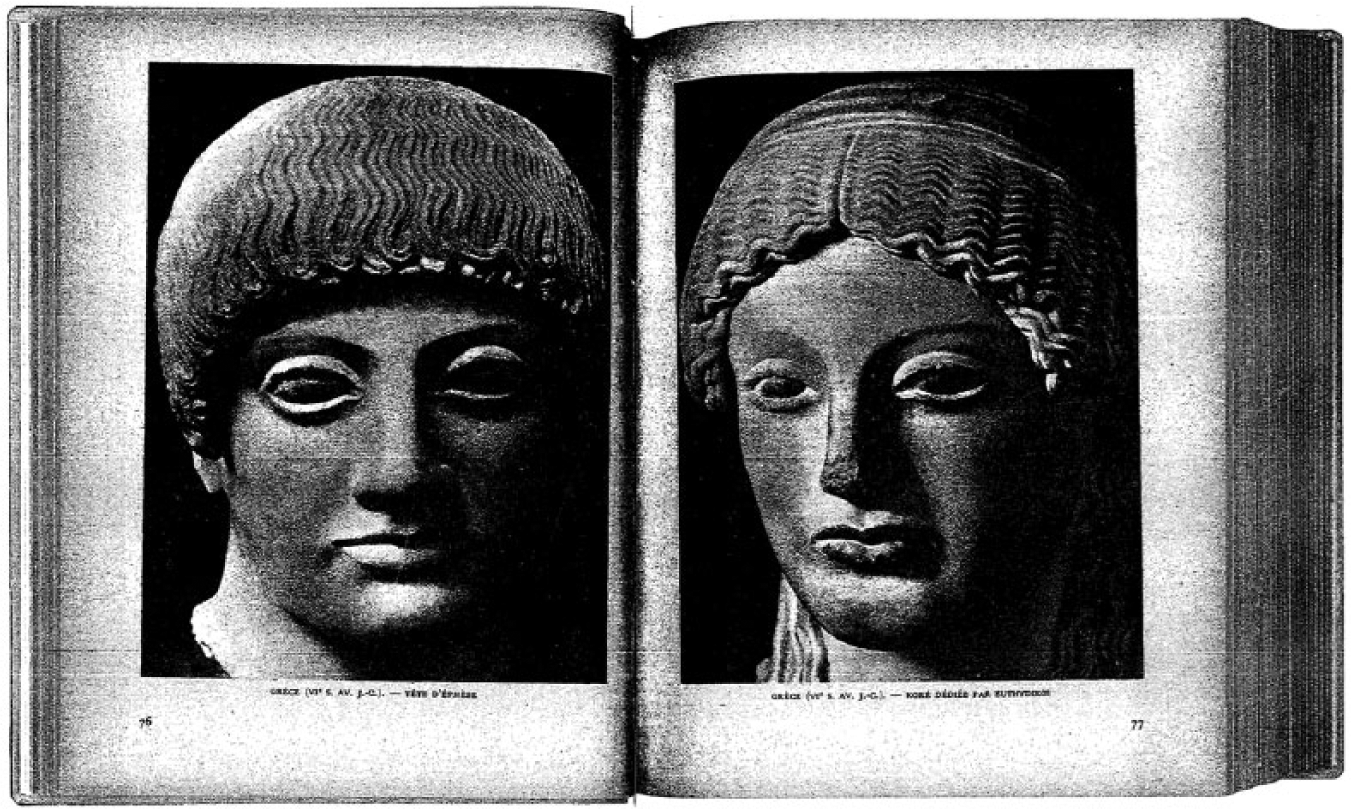
Ephebe Head, Greece; Korê, Greece (Malraux, 1951: 76–77).
But Malraux wanted to go further and put into practice a genre of montage where an inassimilable pulsation of difference would prevail – a montage in which differences never cease responding to one another or competing with other differences: contrasts in mutual attraction, formal disparities, and heterogeneities of space and time. This is Malraux in the school of Eisenstein, whom he knew and with whom he had briefly entertained the idea of a film adaptation of Man’s Fate. He evokes Eisenstein in a speech of 1936, just before referencing Benjamin’s theses, when he conceives of cinema in these terms: ‘It is film that encounters the entirety of a civilization, comic with Chaplin in the capitalist countries, tragic with Eisenstein in communist countries’ (Malraux, 1976: 1194). There can be little doubt that one of the main aesthetic and thematic sources of the Museum Without Walls was Eisenstein’s famous cinematographic montage in October of religious statues (Christian and Buddhist, Inuit and African, etc.) (see Figures 11 and 12; Malraux, 1952: 57, 59, pp. 57 and 59 in original). At the far end of the great path described by the albums of Museum Without Walls, Malraux reaffirms Eisenstein’s montage as the ultimate form, worthy of justifying his own iconographic ‘inventions’: ‘Now let another Eisenstein, ignoring all chronology and pedagogy, assemble fifty images for his museum without walls in accordance with whatever sequence the main themes call for or suggest!’ (Malraux, 1976: 1025). 4
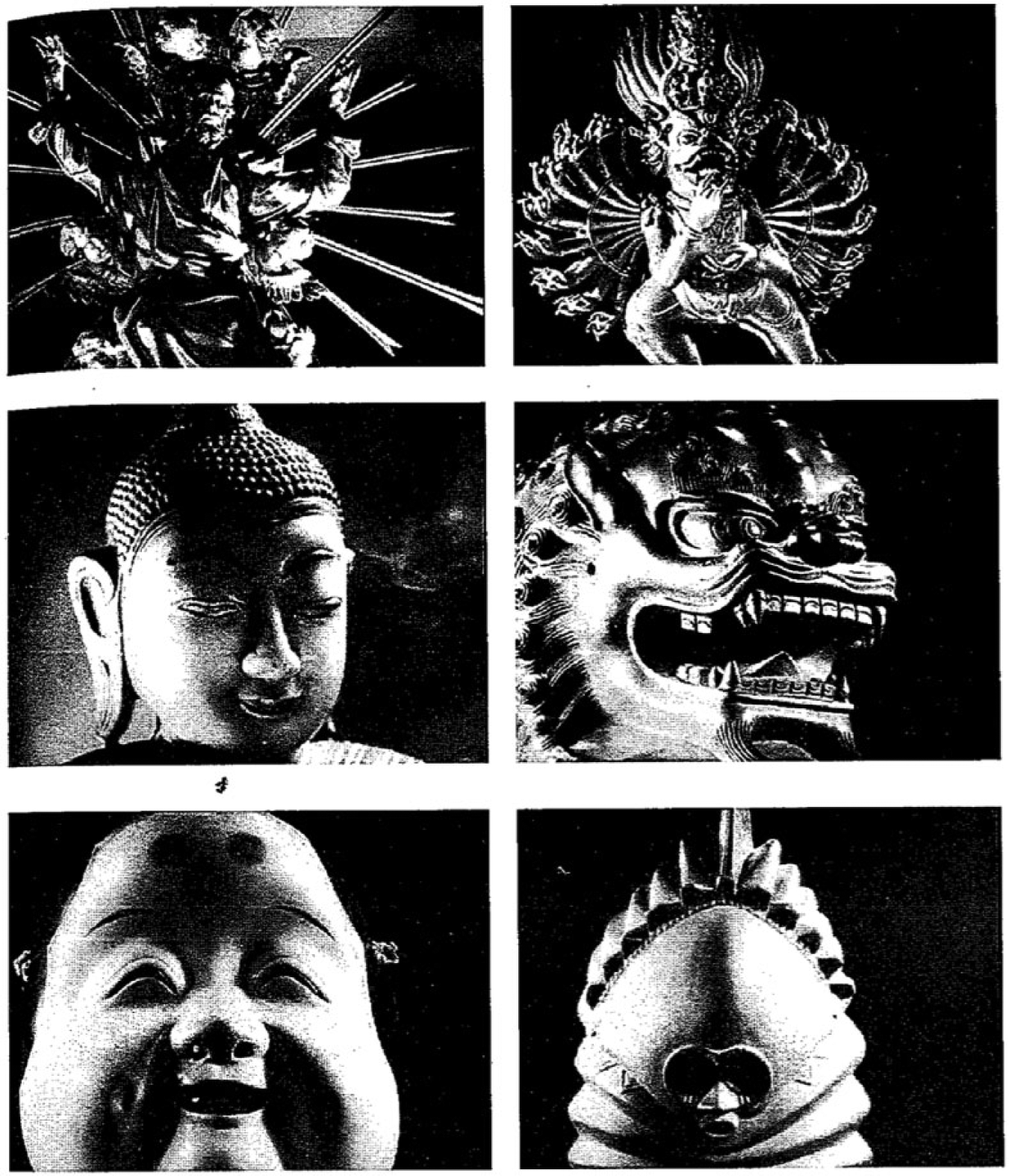
Sergei Eisenstein, October, 1925. Photograms (sequence of statues).

Sergei Eisenstein, October, 1925. Photograms (sequence of statues).
Armed with this principle – again, a cinematographic one — André Malraux will no longer have any hesitation in staging, or placing on the page, the stark contrasts between a Napoleon by Meissonier and an Old King by Rouault, between a horse of the Steppes and a sculpture by Degas, between a comely Roman Apollo and a haunting Christ from Perpignan, between a Renaissance Madonna and a sculpture by Georges Braque (see Figure 13; Malraux, 1951: 251, 328–329, 542–543, 770–771, pp. 60–61 in original). For from now on a museum without walls has been opened to us, and it will carry infinitely farther that limited revelation of the world of art which the real museums offer us within their walls … In substituting the album for the gallery of a museum, it awakens this rather opaque lyricism induced by a meeting between works separated by half the surface of a globe. (Malraux, 1952: 16, 161; Gilbert, 1979: 12 and 48, slightly altered)
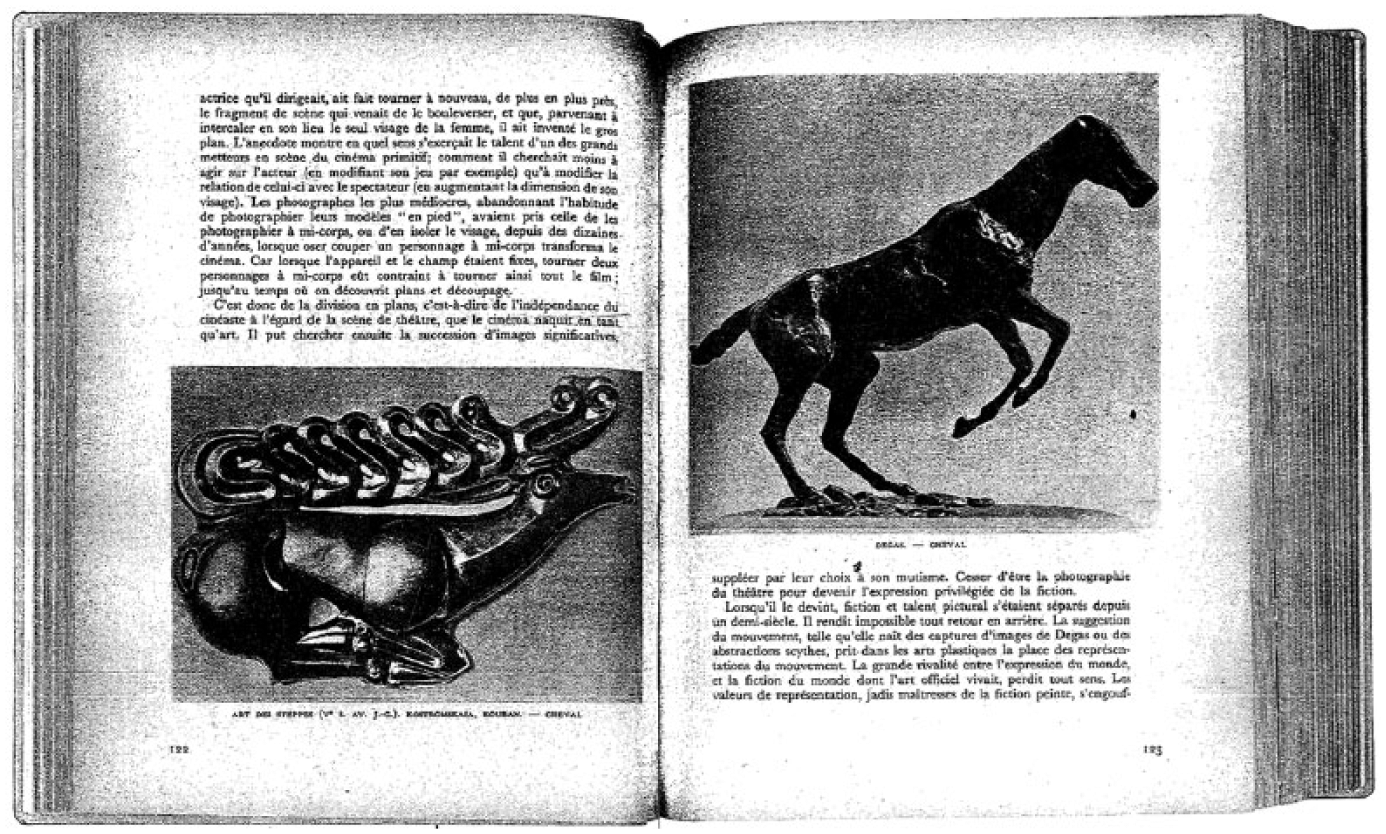
Horse of the Steppes and by Degas (Malraux, 1951: 122-123).
This juxtaposition of images – the montage – is indeed the equal of this ‘rather opaque lyricism’. Malraux even defends montage as the only truly artistic and anti-historical element in the entire production of the Museum Without Walls: The historian (annoyed) cannot entirely neglect systems of forms that are a part of history and occasionally shed light on it; the artist (gratified) is conscious of the dialogue between one or another of the Fertilities and a particular sculpture of Picasso [see Figure 16], between a certain Etruscan stone carving and a particular print of Braque. (p. 98; Gilbert, 1979: 88)
But, in juxtaposing objects far removed in space and time, Malraux will not allow differences to remain inassimilable or disparate. He must always – unlike Georges Bataille, for example – have recourse to a higher unity, a stylistic or spiritual synthesis, which is the foundation for his notion of universal ‘art’ or ‘creation’. The stark contrasts either fade or harmonize in order to reveal a family resemblance, of which the album is the model of presentation.
Of course, Malraux’s albums present to us very disparate works, but these works are brought together in order to converse across boundaries and to help expose us to the unity of human culture across the globe and throughout history. The same formal rigor joins The Lady of Elche with Autun’s Temptation of Eve; the same feminine grace appears on the Indian Apsara and the Greek Aphrodite (Figure 14, pp. 62–63 in original); the same serene smile crosses a Christian head from Reims and a Buddhist head from Gandhara (Figure 15, pp. 64–65 in original); the same seriousness magnifies the face of a Roman emperor and that of a Gothic John the Baptist; the same sense of distance is present in a Chinese landscape of the 18th century and a painting by Claude Monet; the same schematic design is at work in a Swiss butter mold and in Byzantine earthenware; the same sense of mass animates a Sumerian goddess and a Picasso head (Figure 16, pp. 66–67 in original), or even a Native American pipe and a Joan Miró ceramic (Malraux, 1951: 214–215, 278–279, 364–365, 426–427, 552–553, 746–747, 782–783, 858–859). These are examples taken from The Voices of Silence, but they are also found everywhere else as, for example, in the connection Malraux established in Museum Without Walls between a Christ by Donatello and Saint John the Baptist by Auguste Rodin (Malraux, 1951: 36–37).
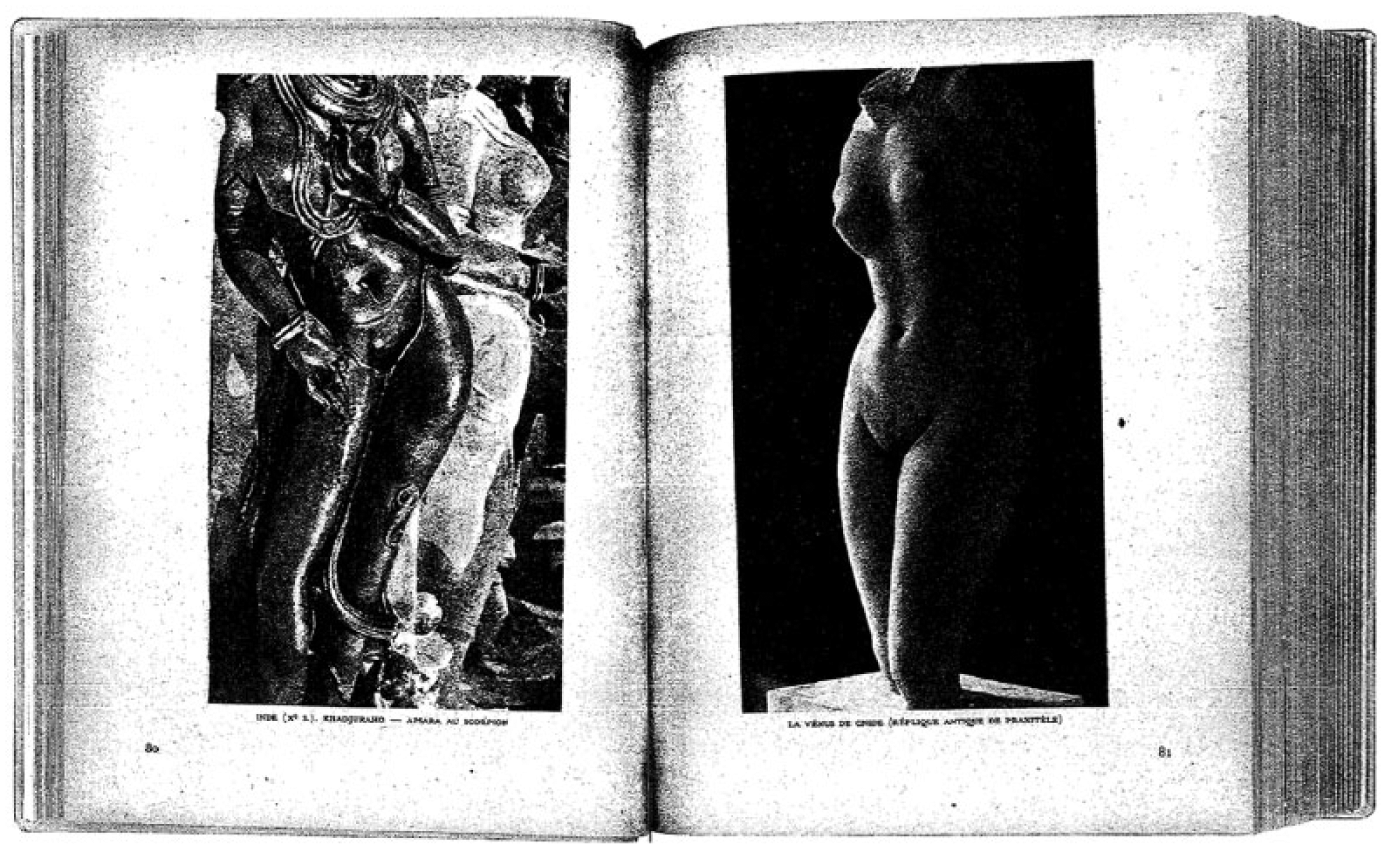
Indian Aspara; Greek Venus of Cnidus (Malraux, 1951: 80–81).

Gothic head of Reims; Buddhist head of Gandhara (Malraux, 1951: 158–159).
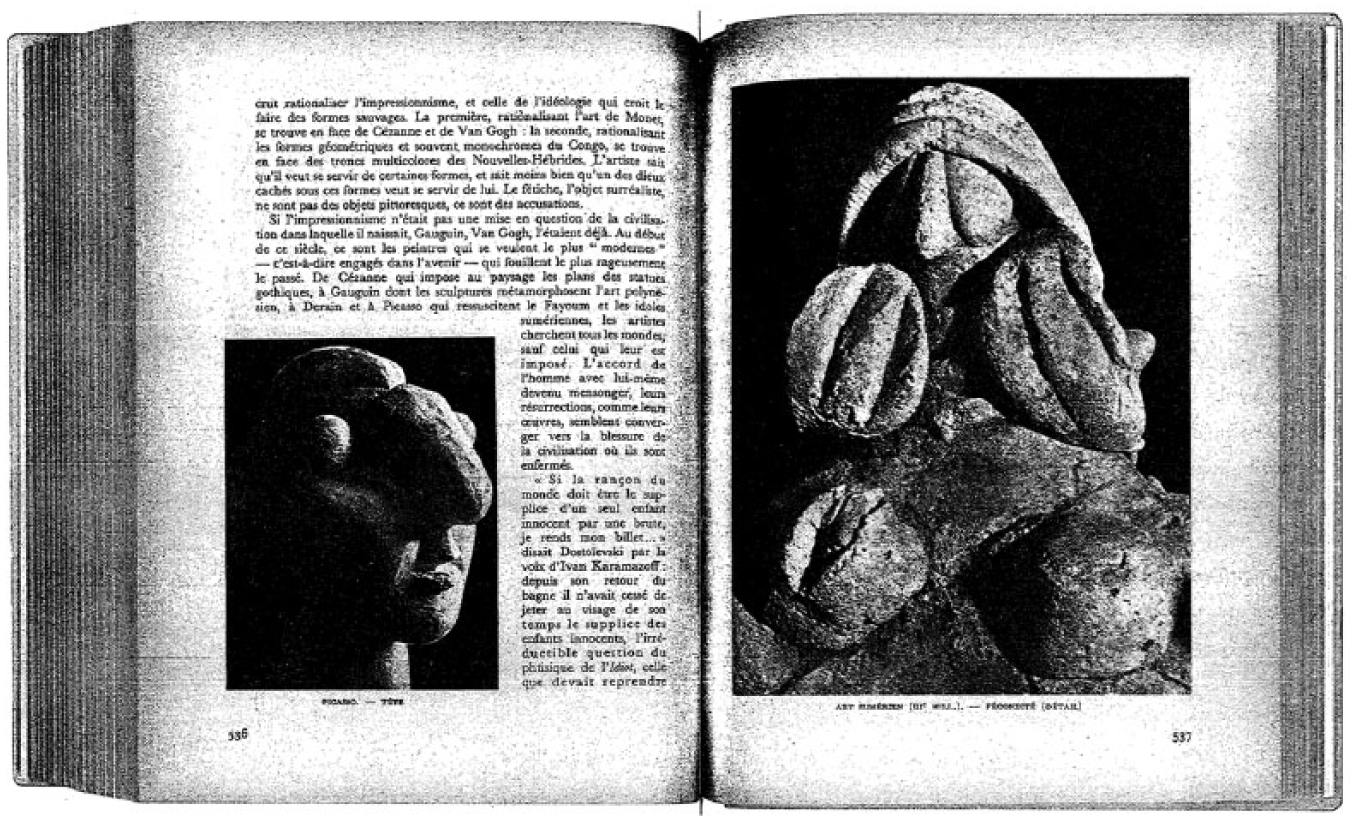
Head by Picasso; Sumerian Fertility (Malraux, 1951: 536–537).
In almost all of the examples, one notices that the ‘dialogue’ established by Malraux between the two images always requires some extremely elaborate work on the expressive qualities of frame and light. Two details by Michelangelo are brought together by similar close framing, similar light contrasts, and similar treatment of the background – deep black with a reserve of light to surround the two faces like aureoles (Figure 1). In the confrontation between two Oceanian heads, Malraux plays with the dramatic inversion of light values, black mass on a light background responding to a white volume standing out against its black background (Figure 7). In the Japanese example, the psychological discord is accentuated by the confrontation of a tranquil face (lit in the formal unity of its surface) and the irate profile (lit in the violent contrast between the shadow and light) (Figure 8). Conversely, the comparison made between the smiling face of Reims and that of Gandhara depends on unity of framing, orientation of faces (which no doubt required modification of the photos), and the same neutral background (Figure 15).
Here Malraux’s honesty consists of openly taking responsibility for all of these operations and in even attempting to lend them theoretical justification: The angle from which a work of sculpture is photographed, the manner in which it is framed and centered, and, above all, a carefully studied lighting – the lighting of some famous works is beginning to share a degree of attention that once was granted only to film stars – may strongly accentuate something that previously had only been suggested. (Malraux, 1952: 94, emphasis in original; Gilbert, 1979: 82)
One is thus meant to understand that, for Malraux, all of the procedures are fundamentally related: writing about art requires a choice of visual presentation, which combines, in a single photographic gesture, the framing, montage and lighting of the art work.
Framing? Most important for Malraux is the close-up, which simultaneously brings us into proximity with an object and brings it into proximity with another. Moreover, the author of the Museum Without Walls deeply understood the link – when the presentation of images is seen as a process of culture – between frame and aura. In his vital strategy of restoring ‘major’ and ‘minor arts’ to the same plane, close-up framing allows for this ‘creation through photography’, where ‘works lose their relative proportions … to the benefit of their common style’ (pp. 96–98; Gilbert, 1979: 84 and 88, slightly edited). Unlike for Walter Benjamin, for André Malraux the issue is not some general ‘decline of the aura’ in art but, rather, a matter of using photography to return the aura to all of men’s other creations, so that Gallic coins might compete with a medieval tympanum and a terra cotta statue with a bronze Colossus.
Enlargement makes some art forms, which for centuries have been studied and considered as minor arts, into rivals of their major arts … The specific life which is given to the work by an enlargement of it attains its greatest strength in the dialogue permitted – indeed, demanded – by a comparison of photographs. The art of the Steppes was a highly specialized form, but if its bronze or gold plaques are shown beside a bas-relief, in the same format, they themselves become bas-reliefs, as do the seals of the ancient Orient, from Crete to the Indus. Thus reproduction frees their style from the limitations that made it seem a minor art. (pp. 106, 115; Gilbert, 1979: 94, 102–103)
This would be the great virtue of the albums making up the Museum Without Walls: The isolation of the album sometimes brings about a metamorphosis resulting from enlargement, sometimes enables us to discover and compare, and sometimes reveals facts we had not previously known. Through his use of the fragment, the photographer instinctively restores to certain works their due place in the company of the elect … Classical aesthetic proceeded from the part to the whole; ours, often proceeding from the whole to the fragment, finds a precious ally in photographic reproductions. (pp. 118–120; Gilbert, 1979: 106, 110)
Note that if, in the spirit of Malraux, the close-up allows us to ‘discover’ and ‘compare’, this is only to the extent that it is used in conjunction with the montage, which allows the close-up to include works in a dynamic point of view, in a visual thought.
Once more, Malraux’s reflections on photography seem to find their source in his passion – as much, lest we forget, as his practice – of cinema. It is significant that in discussing DW Griffith, the author of the Sketch for a Psychology of the Moving Pictures did not separate the invention of the close-up from that of montage – or ‘cutting’, as he then referred to it (Malraux, 1946: 8–9). And we should recall that Eisenstein’s films, which Malraux admired so deeply, powerfully combined the use of close-ups, light contrasts, and ‘dialogues’ comprised of different points of view in the dynamism of his montage. At the same time, Malraux was no doubt well aware of the captivating prose of Jean Epstein who already praised the unparalleled visual powers of the close-up in 1921 (Epstein, 1921: 93–108). Finally, what should be said about the fact that Malraux’s ‘farfelu mock-up’ was first composed from stills – from Man’s Hope, directed by Malraux in 1938–1939, of course, but also, and more surprisingly, from comedies by Georges Méliès – whose images have nothing iconographically to do with the actual content of the work?
Consequently, the ‘museum without walls’ will become, in the eyes of Malraux – specifically through the photographic and textual apparatus under his direction – a work for reshaping or reforming our own understanding of world art. The albums of the ‘museum without walls’ unfold like an immense propaedeutic montage, where the power of words goes hand in hand with the rhetorical and phenomenological power of photography. What could Malraux have had in mind when he imagined that photography would one day manage restoring our luminous experience of stained glass in gothic space (‘Perhaps, with the help of photography, the sun may soon resume its role in the Gothic play of which it was once director-in-chief’: Malraux, 1952: 143; Gilbert, 1979: 132)? Or when he hoped, through his montages of images, ‘to capture the movement’ of mobile bodies in dance (pp. 84–85; Gilbert, 1979: 75)? What, if not a lived experience of visual creation, which, by turns, he also named ‘revelation’, ‘presence’ and even the ‘absolute’? But then how can one found the absolute of this experience on the basis of experimental – thus altogether relative – encounters of images brought together by montage?
Footnotes
Acknowledgements
The author, translators, and the journal would like to express their deepest thanks to Éditions Hazan and Éditions du Musée du Louvre for their kind permission to publish this article.
1.
This text constitutes the second chapter of the book, The Album of Art in the Age of the ‘Museum Without Walls’ (Paris: Éditions Hazan, 2013).
Notes
Address: Reed College, 3203 SE Woodstock Blvd, Portland, OR 97202, USA. [email:
Address: Stony Brook University, 2048 Humanities Building, Stony Brook, NY 11794-5355, USA. [email: