




Abstract
This essay addresses the issue of cuts in the cultural sector in Greece during the last five years and its consequences on the sustainability of artistic production, institutional survival and emerging forms of collaboration, self-management and art in public space. It describes new practices and strategies of cultural institutions and the relationship between the private and public spheres. Long-term artistic projects, such as the Athens and Thessaloniki Biennale, public museums like the State Museum of Contemporary Art, private organizations and artist initiatives are discussed in the context of crisis.
The following essay addresses the issue of cuts in the cultural sector in Greece during the last five years and its consequences on the sustainability of artistic production, institutional survival and emerging forms of self-management. Based mostly on empirical data, since there has been no deep research or documented statistics, I will try to describe the situation as it has developed in recent years, its impact on the practices and strategies of cultural institutions and the overall reformation of cultural life in Greece, including the relationship between the public and private spheres in contemporary art practices. This text serves as a report intended to give a first-hand account of an ongoing process of transformation.
Since the euro crisis erupted in Greece and other southern European countries, funding to the cultural sector has been drastically reduced due to the austerity measures that followed Greece’s submission to the International Monetary Fund’s regulations. The circulation of capital and loans inside the European Union has led to the subversion of labour relations, mass-scale unemployment and the rapid impoverishment of the population, all culminating in the exacerbation of social inequality. One of the worst consequences is the widespread diffusion of racist attitudes and practices, expressed in the form of attacks against migrants and together with homophobic behaviours, feeding into political extremism that opened the door for the Golden Dawn fascist party to win seats in the Greek parliament. This coincided with the beginning of the ‘Grexit’ era, saddling Greece with the perpetual threat of withdrawal from the Euro Zone and the discontinuation of the euro as its national currency – a threat that still looms large today.
In this context, the place of culture in public policies is becoming dangerously weak. Culture, together with public health and education, has been severely suffering due to serious underfunding. The reduced funding for contemporary art has to be considered in relation to the fact that contemporary art in Greece has always attracted less attention from the state compared to the attention paid to the cultural heritage of ancient Greece, archaeological treasures, their conservation and display. The consequences of the crisis are already visible in the cultural sector, as almost every cultural institution’s survival is at risk. The State Museum of Contemporary Art (www.greekstatemuseum.com), one of the two public museums that were established 15 years ago, has undergone a 70 per cent cut in public funding during the last four years, a fact that has affected not only its exhibition, collecting and public program planning, but its very existence, since we are often confronted with the situation of not having enough money to face daily operational issues, such as electricity, art work insurance, wages of the workers, and so on.
Generally speaking, in the sphere of contemporary culture, there has been a ‘back to the basics’ trend: a tendency towards sparing one’s strength, rethinking curatorial practices towards long-term projects, activating already existing communication and cooperation nets as well as expanding the inter-subjectivity of action. These processes are indicative of a broader tendency to re-evaluate active priorities and practices towards the direction of resilience and self-management. In this environment of economic downturn, where the state retreats from its fixed obligations towards public institutions, new artistic collectives appear and strive to realise their social interventions with minimum resources. At the same time, private institutions like NEON (neon.org.gr), the DESTE foundation for contemporary art (deste.gr), the Stavros Niarchos (www.snf.org) and Alexander S Onassis (www.onassis.gr) foundations re-examine their politics towards social responsibility models, or actively organize their own program regarding art in public space, education, collection management, collaboration with existing institutions, support of original artistic production, networks of international partnerships and so on. This is the case with the NEON foundation that has shown important activity in the last two years and – among other initiatives – has been building new strategies concerning the activation of cultural heritage sites and public space through contemporary art.
Changes are happening in the form of artistic expression, too. The boundaries between visual and performing arts (painting, theatre, dance, video, performance, etc.) are no longer visible, while experimentation enhances the exploration of new ways of communicating with audiences beyond the binary dichotomies between public and private space. The urban environment has been ‘attacked’ by groups or individual artists who ‘stage’ theatrical, musical, and other hybrid actions in the streets (www.thessalonikiallios.gr). Community projects that explore cultural history, everyday life and urban and natural environments re-signify archaeological spaces or deserted industrial sites, thus coming to terms with their role as social catalysts. Other groups such as ‘artspirators’ activate sites of historical importance through their artistic interventions that engage local and non-local publics by selecting archives and testimonies (www.artspirators.com). These interventions are focused on everyday culture – an underdeveloped realm compared to the overall developments in the realm of ‘high’, ‘institutional’ or ‘official’ artistic production. Additionally, institutions, big events like the Biennales in Athens (www.athensbiennale.org) and Thessaloniki (www.thessalonikibiennale.gr) and other smaller-scale initiatives bring back to the foreground the forgotten political dimension of art, supporting, or undertaking unconventional actions in public spaces, beyond the safety of museum walls. When I refer to the ‘political dimension of art’, I don’t want necessarily to point out attempts to denounce through cliché the political system and the unreliability of political institutions or to stress efforts to represent realistically the condition of a painful everyday life. On the contrary, I am referring to the critical space created by art that allows an original understanding and interpretation of politics and human relations.
A characteristic paradigm of self-organization and collective undertaking is the 4th Athens Biennale, realized in 2013. Under the title ‘Agora’ which clearly refers to the ancient Greek practice of citizens’ dialogue and common decision making, a collective of more than 40 artists, curators and intellectuals engaged themselves in a long-term experimental project with interesting results declaring that: At a time when the financial crisis in Greece and elsewhere is reaching a highpoint, the 4th Athens Biennale (AB4) cannot but respond to this bleak situation through a pertinent question: Now what? Using the empty building of the former Athens Stock Exchange as its main venue, AB4 proposes AGORA not only as a place of exchange and interaction, but also as an ideal setting for critique. (About Athens Biennale 2013, Agora 2013)
The investigation of the influence of social changes in artistic creation and the detection of the critical research shift towards issues of collective interest highly orienting the choices and directions of the Thessaloniki Biennale. In 2009, the 2nd Thessaloniki Biennale of Contemporary Art, organized by the Greek State Museum of Contemporary Art, attempted to record the state of art in ‘times of uncertainty’ focusing on a dialogue between artists from prominent geopolitical centres and their colleagues from distant and not easily accessible areas foan aim that is well inscribed within the broader agenda of the Thessaloniki Biennale of Contemporary Art. The 2nd Thessaloniki Biennale attempted to bring together in a common exhibition art works from Latin America, Africa, West Europe and the Balkans. Based on the work of the English theorist Terry Eagleton, After Theory, the exhibition ‘Praxis: Art in Times of Uncertainty’ tried to trace the emerging sense of awakening that seems to follow the lethargy of uncritical and total disregard of ideologies and sociopolitical systems. Wondering whether the time for the re-examination of the inherent value of artistic practice has come, whether ‘the moment to explore art as a privileged space for relatively free expression of ideas and for an alternative view of the world’ has arrived, the exhibition presented groups and single artists whose art came back to life, back to Praxis and to collective creation, contributing to the formation of a political view and proposing new ways of co-existing with the ‘Other’ (2nd Thessaloniki Biennale 2009).
This report regarding the critical situation that artists and institutions undergo during the times of crisis in Greece ends with History Zero, the work by Stefanos Tsivopoulos for the Greek pavilion in the 55th Venice Biennale in 2013 (see Figure 1). Tsivopoulos’s work is as an indicative case of creative reaction to harsh reality (www.historyzero.gr). It is a film in three parts accompanied by an archive of texts and images. The film narrates episodes from the lives of three different people exploring how the value of money is transformed in the hands of the three protagonists, seeking to understand how money impacts the formation of human relations in unexpected ways. The interconnectedness of everyone’s choices or how random acts might affect other people’s lives is a salient issue underpinning the political and social dimensions of economic exchange. The Archive of Alternative Currencies accompanying the film contains examples and testimonies of alternative, non-monetary exchange systems. The archive focuses on the ability of such models to erode and throw into question the homogenizing political power of a single currency, pointing to ways in which, in hard times, societies can by-pass a monetary economy altogether and use a system of exchange based on goods and services. History proves that it is precisely during these critical times that new approaches and meanings emerge concerning our relationship to each other and the environment. Broadening the meaning of value means introducing the question of cooperation, solidarity and communal activity. And that, indeed, is exactly what History Zero attempted to do.
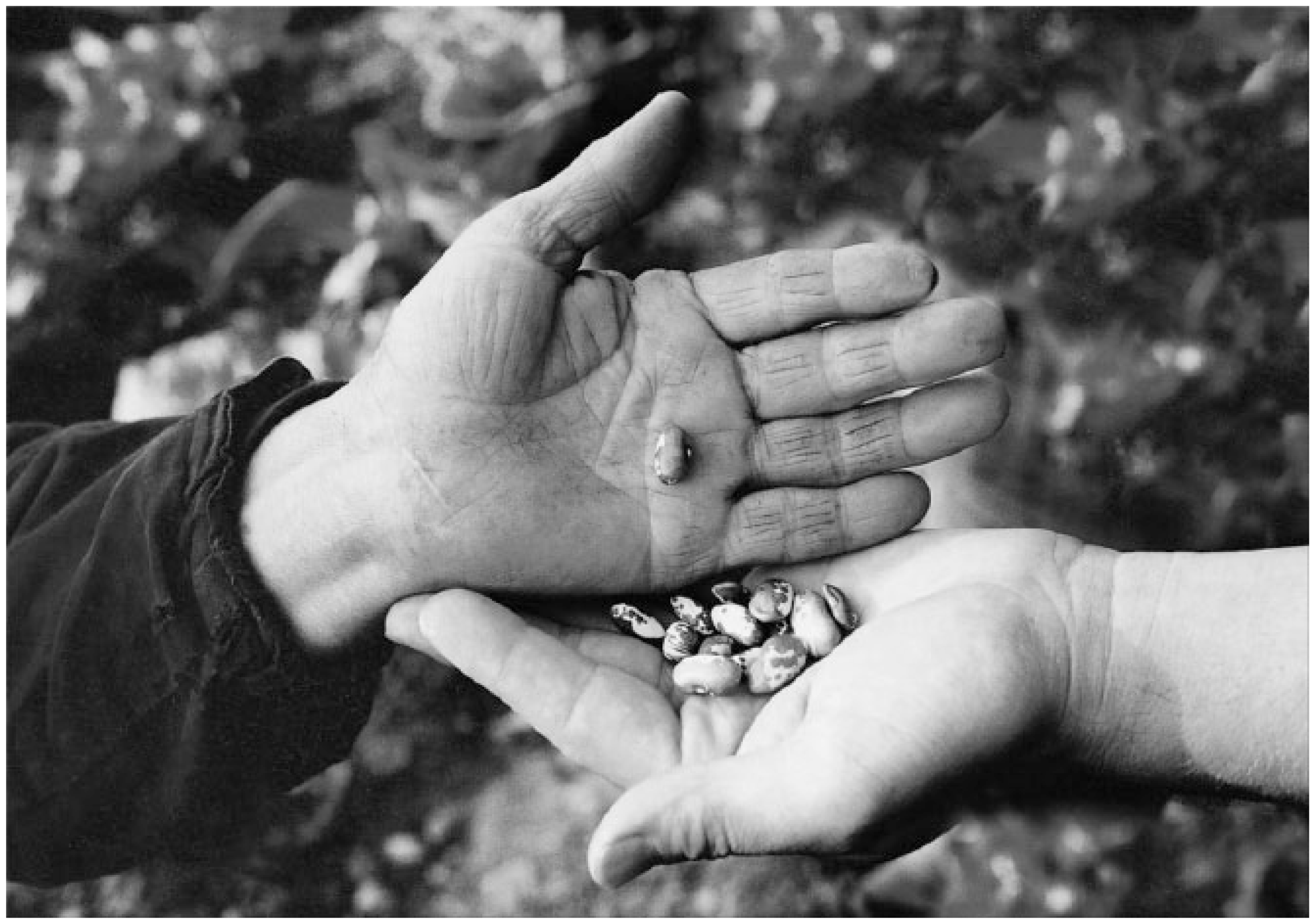
Peliti’s iconic image depicting seed exchange. From the exploratory mission seeking indigenous seed varieties, August 2003, Pomakohoria of Xanthi, Greece. Alternative Currencies: An Archive and a Manifesto, 2013, photograph from History Zero, Stefanos Tsivopoulos, black and white, 2013.
This analysis of contemporary art in Greece in times of crisis concludes with History Zero as a case study for political art focusing on new forms of social relations through the example of alternative currencies. Every certainty in Greece has been severely threatened and disrupted. Public institutions have lost their mission of being catalysts for the production of art and are no longer structures of support for art creators, private organizations transform the cultural environment through their own strategies, while artists struggle to survive through common initiatives and self-organization. These words are written during the final preparations for the 5th Thessaloniki Biennale which will open on the 23 June 2015. Katerina Gregos, the main exhibition curator, has given the title ‘Between the Pessimism of the Intellect and the Optimism of the Will’. These words, derived from Antonio Gramsci’s Prison Notebooks (2011[1929–1935]), describe in the most accurate way the milieu for cultural workers, insisting on producing meaningful art against all odds.
Footnotes
Address: State Museum of Contemporary Art, Kolokotroni 21, 56430 Thessaloniki, Greece. [ email: