




Abstract
This article considers how the museum produces knowledge about the past and present of feminist politics through its framing of marginal, activist artworks that have engaged the sphere of social reproduction or care labour. It is contended that neoliberalism’s assault on social reproduction in our current ‘age of austerity’ – which sees responsibility displaced from the state onto individuals – has sparked a reengagement with earlier socialist–feminist discourse and, as a result, we are perceptibly enmeshed within a new age of social reproduction debates. The Hackney Flashers’ germinal photographic project Who’s Holding the Baby? (1976–1978), acquired by Madrid’s Reina Sofia in 2010, is taken as a case study to explore a range of contextual, temporal and historical contradictions in further detail. Examining the ambiguous relocation of this photographic project provokes vital questions about the contribution of culture to the troubled terrains of art, property and care labour in the 21st century.
Today we are experiencing a crisis in social reproduction. Within Marxist–feminist discourse, social reproduction is understood to encompass those routine processes of care and maintenance that renew the worker (daily or generationally) in his or her capacity to labour productively. Over the past five years especially, the rhetoric and policies of austerity politics have forced the continuous displacement of reproductive responsibilities from the state onto individuals. At the same time, this displacement has been matched by a rise in precarious and under-waged contracts that perilously limit the individual’s ability to reproduce himself or herself successfully. However, carrying out this labour under constrained circumstances remains a necessity; its deferral or refusal is not an option. Silvia Federici has argued (see Vishmidt, 2013) that it is precisely this ‘double character’ of reproductive labour that renders it a promising site for resistance, as ‘it also reproduces our lives and potentially it reproduces our revolt against being reduced to labour power.’ Perhaps then it is with optimism that writers, theorists and artists have reengaged with socialist–feminist debates that were especially prevalent in the 1970s West, as they seek to make sense of, or find a way out of, the current social reproduction crisis.
Contemporary conditions of life and production have forced a reassessment of feminist labour debates, at least in the Western European contexts that form the basis of this article. The collective historical gaze appears particularly focused on Federici and her comrades in the famous Wages for Housework campaign (Federici, 2012; Historical Materialism, 2012; James, 2012; Weeks, 2011). However, while they may not have engaged directly with the contemporaneous struggles of their Italian feminist sisters, artists and art historians in 1970s Britain were covering related theoretical and concrete territories. 1 The legacies of socialist–feminist organising in this period have only begun to receive decisive institutional and art historical attention relatively recently. Particular instances include Mary Kelly’s commemorative art project of 2007, Love Songs (Deutsche, 2006) and Tate Britain’s exhibition of Women and Work: A Document on the Division of Labour in 2013–2014 (Bryan-Wilson, 2014). The pioneering documentary film Nightcleaners (Rowbotham, 2008) has received numerous screenings, including at Tate Modern in 2013 as part of a collaborative project ‘Work Like This’ and at the 2015 Venice Biennale. These activist artworks have received attention in recent studies (Battista, 2013; Dimitrakaki, 2013), while Siona Wilson’s (2015) analysis deserves a special mention as the first book-length study to excavate the vital correspondence between the acknowledged sexual politics of 1970s UK feminist art and labour politics.
It is crucial to note here the diffusing of politics following the social upheaval of 1968, for as Sheila Rowbotham (2008: 3) reminds us: ‘one aspect of this enthusiastic expansion of politics was the interconnecting of life and art.’ Thus, Griselda Pollock (1988[1982]) wrote that feminism was engaged
in a contest for occupation of an ideologically strategic terrain. Feminist art history should see itself as part of the political initiative of the women’s movement, not just as a novel art-historical perspective, aiming to improve existing, but inadequate, art history. (p. 23, emphasis added)
The insistent materialist critique mounted by Pollock and others at this time understood art to be a privileged sphere of production, and art history to be a discursive formation that maintains this privilege by occluding the material and thus mystifying artistic labour as the task of a few gifted individuals. That these individuals were normatively ‘dead white European males’ was a significant contention of feminist criticism. Targeting their aim in this direction, the hyperbolically mundane, domestically oriented artwork of many 1970s feminists was calculated to deflate the profoundly gendered distinction between the rational and material, the transcendental and immanent, challenging the preservation of art as a special sphere, the artist as exceptional worker, and the gendered division of labour more broadly. 2 And yet, given that neoliberal capitalism has survived and thrived in spite of such cultural critique, how can we make sense of a prevalent institutional return to these artworks in the early decades of the 21st century? Acknowledging the transformed global dynamics of care labour (Bose et al., 2006), particularly as it pertains to an expanded sphere of affective work, or to urgent problems of migration and citizenship, how should we approach such an archive while avoiding melancholic or nostalgic political impulses?
This article aims to contextualise and explicate a significant but under-discussed example of 20th-century British documentary photography. A feminist–agitprop project created by The Hackney Flashers will be examined in order to comprehend to what extent political art continues to have political effects beyond its immediate moment of production and context of reception. The discussion initially situates the artwork within interconnected debates about representations of motherhood and the potential of art to transform audience consciousness concerning (gendered) labour conditions. Thereafter the contemporary art museum, and its current market interest in feminist art of the 1960s and ’70s, is shown to have enormous and contradictory significance for how we understand the history of these activities. The article optimistically suggests that the artwork’s power lies in its provocation, in a moment of encounter that carries potential to renew political discourse around class, gender and care relations.
Witches, mothers and The Hackney Flashers
Formed in London in 1974, The Hackney Flashers was a fluctuating agitprop collective comprising nine core members and several collaborators, who worked together until its disbandment in 1980. In recent years, however, renewed interest from a younger generation of feminists (particularly Angela Stapleford who assisted in the creation of their new website) and increased institutional attention have prompted the remaining members of the collective to come together again to oversee their historical legacy. The Hackney Flashers, in its original iteration, seamlessly instantiated the politics of the second-wave feminist movement through both its formal composition and agitprop output, organising collectively to avoid individual attribution and rivalry, whilst strategically intervening in hegemonic representations of women’s work, sexuality and motherhood. Describing their collective cultural labour in 1979, The Hackney Flashers stated that:
All of us work within education or the media and between us share a variety of skills – design, illustration, photography. Our practice is also rooted in the on-going discussion and criticism around feminist issues and the presentation of women. We all define ourselves as socialists and feminists. (The Hackney Flasher’s Collective, 1979: 80, emphasis added)
Fusing their wide-ranging practical skills to a keen political impulse, in 1976 the group commenced an 18-month project entitled Who’s Holding the Baby? (Figure 1). The resulting documentation examined the lack of state-funded childcare, how this deficiency intersected with accompanying issues of low income and poor housing, and the effect that these factors had upon caregivers, the majority of whom were women. Research was carried out at Market Nursery, a community nursery in north-east London that had been established by a couple of friends attempting to provide affordable, neighbourhood childcare. Accumulating documentary photographs and conducting extensive interviews with parents and workers at the nursery enabled the collective to produce a series of 29 informative wall panels. These crudely montaged boards incorporated the photographs alongside advertising imagery, statistical information, illustrations, newspaper articles and personal anecdotes. The lightweight, laminated boards had reinforced holes punched into the corners, which allowed for easy display of the project at feminist conferences, health centres and other extra-institutional art spaces across the UK.
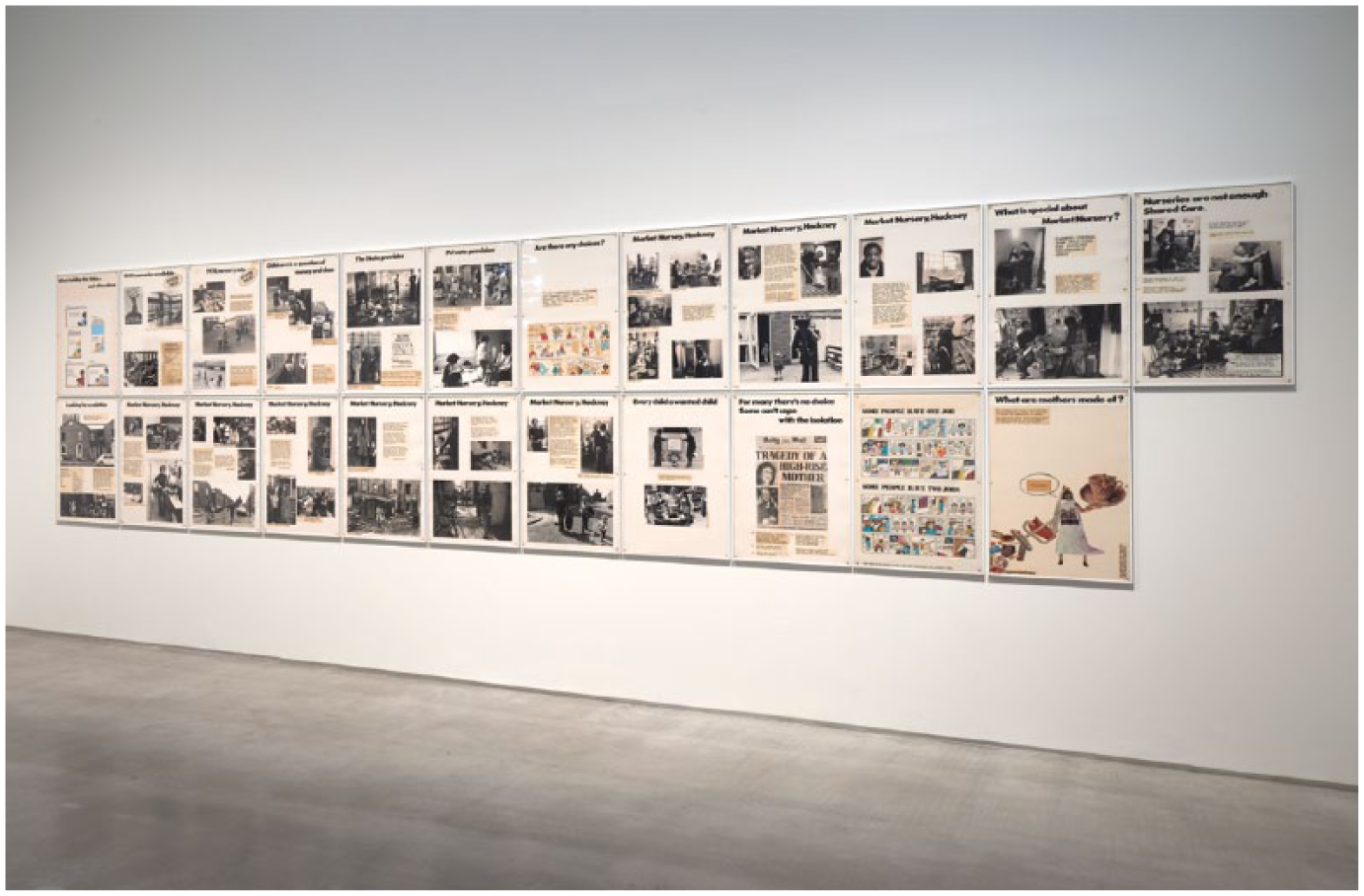
Installation photograph of Who’s Holding the Baby? Courtesy of Museo Nacional Centro de Arte Reina Sofia.
The photomontage style of Who’s Holding the Baby? consciously harked back to 1930s Germany and the pioneering work of John Heartfield (Heron, 2014a), which had been recently shown at London’s ICA in an exhibition of 1969. However, the content of the project is irrepressibly entrenched within the social and political debates of 1970s Britain. Take for instance the four strategic demands articulated on International Women’s Day in March 1971, when the National Women’s Liberation Conference organised mass-marches in Liverpool and London for: (1) equal pay now; (2) equal education and job opportunities; (3) free contraception and abortion on demand; and (4) free 24-hour nurseries. It is, conspicuously, the fourth of these demands that remains the most poorly addressed in the intervening decades. In part, this is due to the escalating privatisation of childcare, in which parents are individually responsible for providing or outsourcing this labour, dependent on social status. The hegemonic position of women in such care relations in turn relies upon the myth of the happy middle-class housewife, the natural ‘angel in the home’, to generate the devaluation of care labour. Structurally, this neglect can also be attributed to the heightened discrepancies between women, what Angela McRobbie (2008: 159) understands as the incorporation and professionalisation of some women, both at the expense of other individual women and of a collective feminist struggle. As McRobbie has demonstrated, transformations in Higher Education and white-collar work during the post-feminist 1990s reshaped (some) young women’s aspirations towards becoming ‘top girls’ in a competitive marketplace, which proved to be an effective campaign of divide and conquer along classed lines.
Already, in 1976, The Hackney Flashers demonstrated keen awareness of the socially uneven burden that childcare presented to mothers and the need for creative ‘solutions’ (Figure 2). In one panel (Figure 3), a neatly staged advertisement for up-market housing in South Kensington is juxtaposed against a photographic scene of a cluttered real-life kitchen, children dining in the centre of a room overwhelmed by drying laundry. Given the 1970s technological context, the move from colour to black-and-white photography reaffirms the obvious division in wealth between the two environments. A neighbouring panel (Figure 4) plainly reports the costs of privatised childcare solutions on an escalating scale, from au pairs and child-minders to nannies, accompanied by photographs displaying the harried faces of such hard-working women. Together, these montages remind viewers that all care is not created equal, or as one heading plainly states: ‘Childcare is a question of money and class’.

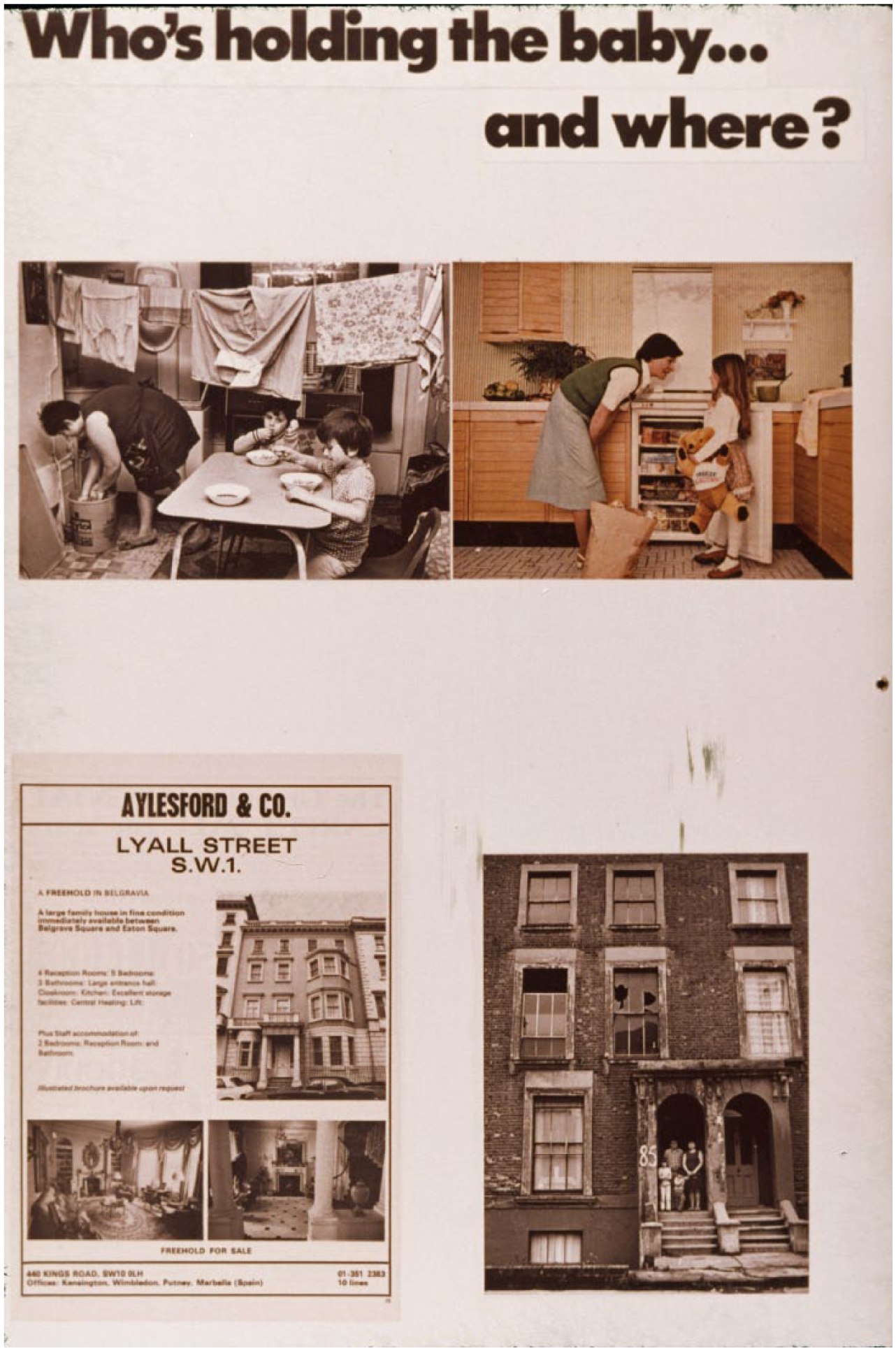
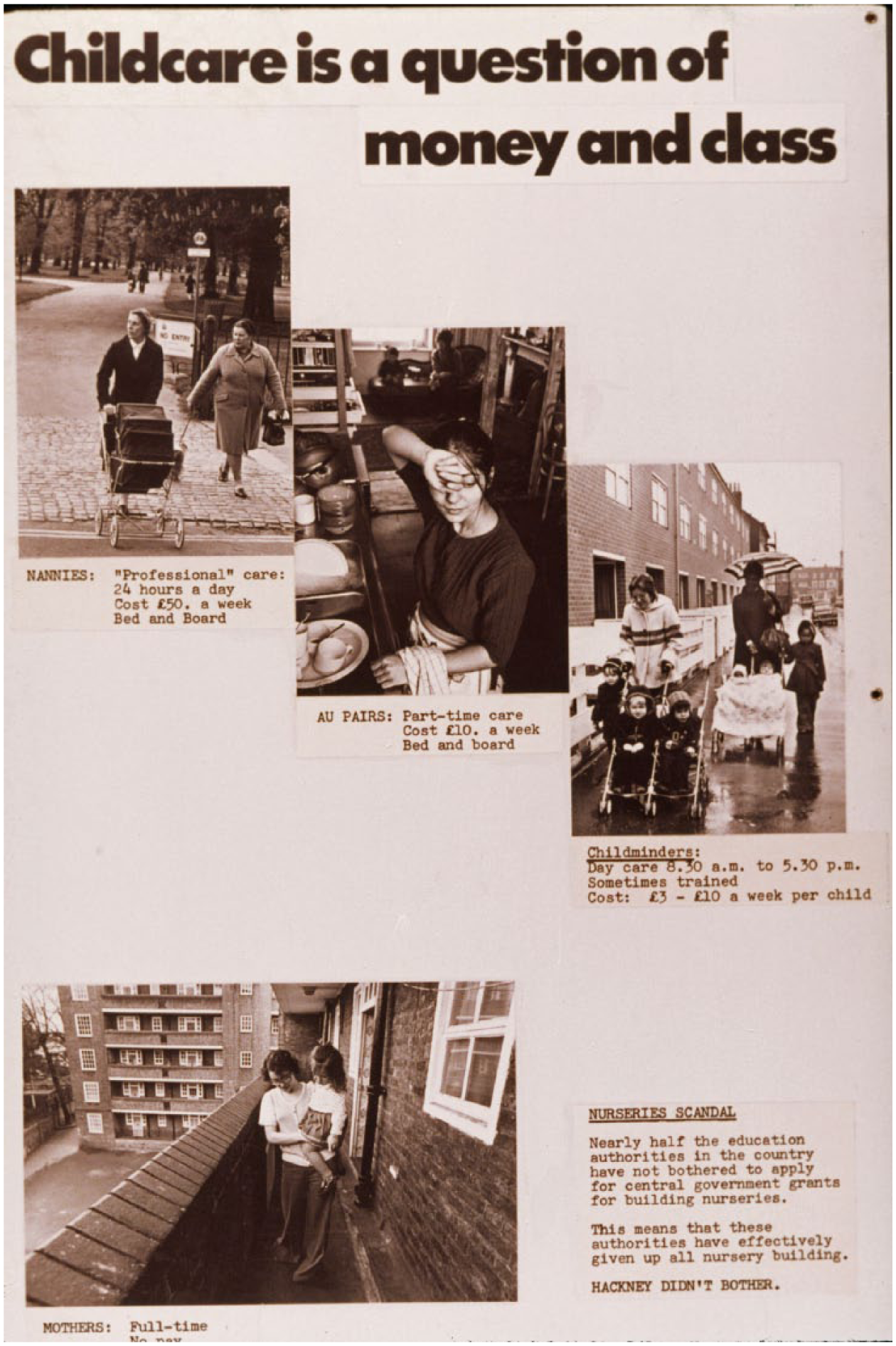
Panel details from Who’s Holding the Baby?, 1976–1978. Courtesy of The Hackney Flashers.
Who’s Holding the Baby was created between 1976 and 1978, a time that has come to be understood paradoxically as both a boom period for feminist organising and also an era in which the dismantling of the unions and welfare state commenced the march towards the current neoliberal hegemony. Peter Osborne (2006: 21) has written that, in the UK:
The Seventies crisis was … primarily a crisis of a particular state form: a crisis of the welfare state. More broadly, it was the crisis of the residual, compromise form of social democracy that was constructed in Western Europe after 1945, for which ‘welfare’ became the privileged signifier. In this context ‘welfare’ was thus at least in significant part a sign of inclusion; rather than, as in the USA (as it is, increasingly, in Britain today), of marginalisation, social exclusion, and a distinct, almost abject economic sub-culture.
The activities at the Market Nursery must be understood against this fundamental reorganisation of the social terrain, as an attempt to arrest the drift towards marginalisation and exclusion by collectivising childcare and thereby undermining the coercive, isolating conditions of bourgeois family structures. In its complexly layered documentation of the nursery, The Hackney Flashers attempted to broadcast such a message, directing particular attention to the function of the popular media in perpetuating harmful welfare myths. Living under the prolonged effects of such transformations upon the welfare state, in today’s conditions of crisis, media-fuelled fictions express and extend the austerity illusion by reinforcing anxieties around class, gender and work. Thus, Osborne’s description corresponds with a more recent article by McRobbie (2013: 126), in which the decline of social democracy over the past 30 or so years is understood to permit the emergence of a ‘new moral landscape of motherhood’. Against this landscape, family-raising and the domestic activities associated with social reproduction, which feminists struggled to ‘make visible’ in the 1960s and ‘70s, are no longer conceivable in terms of politics and value but only as individualised ethics or consumer choices. McRobbie emphasises the ubiquitous media paradigm of professional, maternal citizenship, emblematised by a youthful, slim, active, usually white mother. This profoundly classed model is opposed by
an abject maternal figure, typically a single mother with several children fathered by different men, reliant on benefits, living in a council house, and with an appearance that suggests lack of attention to body image, all of which within today’s moral universe imply fecklessness, promiscuity and inadequate parenting. (pp. 124–125)
It is easy to overlook or even mock the normalising consumer horizons set by mainstream media outlets, and McRobbie paints a faintly ridiculous picture of ‘play dates, coffee shops and jogging buggies’ (p. 136) as a case in point; however, failure to conform to this horizon carries manifest punitive effects. On 29 October 2014, The Guardian published a survey illustrating public misperceptions on the question: ‘What percentage of girls aged between 15 and 19 give birth each year?’ (Nardelli and Arnett, 2014). That all 14 countries considerably overestimated this number (Great Britain guessing 16% to the actual figure of 3%) exposes the unsubstantiated frenzy surrounding teen pregnancy and points towards the effects of a long-term ideological assault. An analysis directed towards comprehending the role of the visual in constituting subjects must conclude that the ambiguous impression of care-less mothers can, to an extent at least, be attributed to popular culture and print media. Pre-dating McRobbie’s observations on the glamorised cult of motherhood by some four decades, The Hackney Flashers keenly recognised emergent models of consumerism and the divisive class effects these luxurious ideals had upon the collective organisation of women. In one montage (Figure 5), a glamorous red-clad model, posed upon a sofa, is sharply contrasted with the bathetic line, ‘mustn’t be late for the evening shift at the bread factory’. The ironic arrangement of photograph and text emphasises the gap between high-end consumerist fantasies and the lived experience of a majority of women, suggesting damaging effects upon an individual and collective psyche.

Panel detail from Who’s Holding the Baby?, 1976–1978. Courtesy of The Hackney Flashers.
As Federici (2004) has noted, the use of printed media to generate suspicion and impose discipline upon the bodies of ‘rebel’ women can be traced back as far as the witch hunts of the 15th century. The instant, Federici contends, that a functioning press was in order, woodcuts were deployed to fuel mass hysteria and compel the persecution of so-called witches, often framed as such, lest we forget, because of their childlessness or knowledge of contraception which permitted women autonomy over their bodies and some control of family management. In her classic study of 1988, Lynda Nead likewise speculated on the significance of narrative painting to the production and maintenance of a moral panic around motherhood and sexuality in 19th-century Britain. Moreover, Nead explicates a shadowy relationship between the bourgeois family unit and the expanding Empire, noting that a ‘connection between imperial decline and moral laxity is critical’ (p. 82). Alexandra Kokoli and Aaron Winter (2015: 162) have more recently exposed the ruthless treatment of young, often socially vulnerable, female celebrities, in an analysis of feminine biopolitical labour and contemporary media narratives. Their article highlights a widespread moral condemnation of seemingly negligent mothers, who are understood to be responsible for ‘poor health and obesity’, the ‘bad educational performance of herself and her children’, and in the case of 2011 London riots even ‘for the state of the nation’.
The connections between Federici’s witches, Nead’s immoral women, McRobbie’s feckless mothers, and Kokoli and Winter’s welfare queens are not difficult to trace. Each instance points towards a profound entwinement of visual culture, news media, and the social disciplining of women who fail to conform to the (ever altering) maternal ideal. The intensely mediated conception of motherhood that emerges from these readings is employed to ideologically reinforce everything from sexual behaviour and childhood education to state security. Moreover, the centrality of these mediated ideals to the reproduction of class distinctions between women is convincingly established. This is the framework in which The Hackney Flashers’ photographic project must be situated: as a social research tool, pragmatic documentation, collective activism and a critical intervention into the codes of representation that repeatedly generate and codify myths which demonise women for failing to be ‘good mothers’. It is little wonder that the art of The Hackney Flashers speaks to current crises in social reproduction and care labour, in which the gains of second-wave feminism appear insecure, women are contending with a renewed cult of domesticity, and debates concerning imagery, sexuality and the logic of consumerism persist without resolution.
The politics of art and work
In 1975, The Hackney Flashers presented 240 images for a project entitled Women and Work, which was organised at the request of the Hackney Trades Council. Collective member Michael Ann Mullen (in Gresty, 2014) has suggested:
After the exhibition closed we realised most of the women we photographed had children. We hadn’t thought to ask who cared for them while they worked … Despite our commitment to equal rights we completely overlooked the need for childcare provision, just as the society in which we lived did. There could not have been a better lesson in how we are shaped by the prevailing male-dominated and capitalist ideology.
At the very least, the political intention of The Hackney Flashers’ project emerges here: to document an overlooked site of feminine labour, the so-called second-job, at a ‘time when work was typically still equated with waged production of material goods’ (Weeks, 2007: 235). The recognition that gendered reproductive labour – including, but not limited to, childcare – is necessary to the maintenance of capitalist relations in that it reproduces labour power was fundamental to the feminist critique of both capitalist and Marxist traditions at this time. In short, according to Kathi Weeks (2007: 235), the 1970s socialist–feminist debate boiled down to whether domestic labour could be considered ‘properly inside or outside capitalist production’. Mullen’s anecdote powerfully articulates The Hackney Flashers’ revelation that unwaged household labour was inextricable from waged factory labour, particularly for the photographed women workers represented by their artistic research. Thus Who’s Holding the Baby? corresponds with the analyses classically articulated by Wages for Housework that argued for an expansion in existing (gendered) conceptions of work, so that care labour be revalued and recognised as a site of exploitation from which organised resistance might emerge. The Hackney Flashers’ artistic campaign must be considered alongside such contemporaneous theoretical discussions; however, its investigations into the double exploitation of working-class women were never merely descriptive of those debates. As Mullen illustrates above, art making was an educational process for the collective and, simultaneously, a realisation of their political philosophies through praxis. Thus, the project was not simply to document the activities at Market Nursery, but to transform the thinking of collective members and of future audiences. Consciousness-raising had its roots in the US Civil Rights Movement, and it had gained extraordinary popularity within the Women’s Liberation Movement of the 1960s and ’70s. Therefore, we can understand The Hackney Flashers’ investigatory project as an opportunity for knowledge production and exchange aimed at providing a basis for future collective action.
In order to extend this analysis, we must consider why the photomontage form was chosen as an exemplary medium for The Hackney Flashers’ critical practice. To start with, it is necessary to note the double entendre implied by the collective’s title: ‘to flash’ referring simultaneously to the mechanics of photography and to unexpected sexual exposure. Here such exposure might refer to the uncovering of social reproduction labour, usually invisible within the circuits of Fordist capitalism, and to the interrogation of photography’s imagined ‘truth-telling’ abilities. Thus the exposing ‘flash’ emerges at the level of both content and form. Moreover, in 1949, André Malraux (in Boherer, 2008[2002]: 249) claimed that ‘for the last hundred years … art history has been the history of that which can be photographed.’ By this reasoning, photography is bound up with the modern establishment of art history, its mechanisation contributing to the discipline’s pseudo-scientific intellectual respectability. In an immediate reading, The Hackney Flashers’ photographic project extends the legitimating function of the medium by conflating artistic production with banal subject matter in order that unobserved reproductive labour might register publicly. However, montage techniques are forcefully deployed in order that this legitimation is never conclusive, meaning never registers as complete and the political narratives that emerge are as discontinuous and fragmented as the lived experiences that generate them.
Who’s Holding the Baby? thus engaged decisively with second-wave feminist discourses around the politics of representation, realism and deconstruction, as well as gesturing towards a longue durée within art production that Carol Duncan (1973) had previously traced. Duncan’s research pointed to the emergence of ‘good and happy’ bourgeois motherhood in revolutionary France, an ideal that was articulated politically, aesthetically and materially as a new family form came into being. According to Duncan, paintings gave ‘expression to a new concept of the family that challenged long-established attitudes and customs’ (p. 572). In the mid-1970s, during a later period of reorganisation in labour practices (the move to post-Fordism), and transformation in the character of middle-class motherhood, art once again assumed a significant function in generating new meanings around this figure. However, like those 18th-century artworks examined by Duncan, Who’s Holding the Baby? embodies certain contradictions. That is to say that, following the 1960s critique of domesticity and the declining cult of motherhood (which Duncan illustrates emerging within modern bourgeois culture of the 18th century), a new model of femininity develops as part of a widespread feminist political movement. This, however, materialises at the same time that the economic terrain undergoes a decisive transformation and, as various scholars have demonstrated (for example, Eisenstein, 2009; Fraser, 2009), was able to recuperate many of these feminist goals to the interests of global capital. While I have argued that the artwork stands as an act of resistance and community building, it could simultaneously stand as a prescient example of the contemporary artist (whom Andrea Phillips [2011: 39] has claimed to be ‘the vanguard of capitalism’) adapting to the ‘socially engaged’, entrepreneur prototype of later decades.
Nevertheless, the transformative ambition of The Hackney Flashers, as articulated through various acts of exposure, remains clear. This ambition ultimately depended upon the artwork’s self-reflexive address to a public. As Wilson (2015: 159) writes, the bulletin board arrangement of Who’s Holding the Baby? ‘comes from the widely used practice of the wall newspaper. Common in factories and other contexts, the wall newspaper was a temporary makeshift collage of information and imagery that served as a leftist alternative to the mainstream press.’ The very form of the project and its mode of address therefore engaged with an activist tradition and reflexively indicated its critical, interventional approach to representation and the right to knowledge. This moment of encounter enables the project to fulfil (potentially) its consciousness-raising impulse. And yet the altered conditions of its encounter today, especially given its clear relevance to current social reproduction debates, compel a deeper consideration of the artwork’s public re-emergence.
Who’s Holding The Baby … and where?
Who’s Holding the Baby? was first exhibited at Centerprise in Hackney, before going on ‘tour to community, political and educational events and venues round the country’ (http://hackneyflashers.com/history/). Centerprise originally offered a politically apt exhibition space, a cooperative cultural hub centred on a bookshop and café, and the provision of education classes. However, after delivering 42 years of cultural support within the Dalston community, in 2012 the centre was forced to close when Hackney Council vastly increased the annual rent on its property. Instead, The Hackney Flashers project returned to a public audience in London via a large-scale exhibition at the Hayward, a gallery well known for staging dazzling spectacles of contemporary art for a high admission price. 3 The work was also, at an earlier date, acquired for the permanent collection of the Museo Nacional Centro de Arte Reina Sofía in Madrid – it is this context that provides the focus of the following analysis. The museum obtained a slightly later print of the project (1980) comprising 23 of the original 29 panels, and it has been put on permanent display within the feminismo multi-room exhibition. An accompanying booklet claims to offer ‘a feminist perspective on the avant-garde’ within late 20th-century art and daily tours were offered (at the time of my visit in January 2013) on the theme of feminism.
The Hackney Flashers collective has written of the project: ‘In 1979 it was included in Three Perspectives on Photography at the Hayward Gallery in London. This attracted controversy and some criticism from the art establishment’ (http://hackneyflashers.com/history/). It is said to have also resulted in heated debates within the collective itself, as members fundamentally disagreed on whether to accept guest curator John Tagg’s invitation to exhibit in a formal, art gallery context. However, at an event on 14 October 2014, a few collective participants recounted that ‘they accepted the exhibition and utilised the public events to stage debates on the problems of women and work’ (Tobin, 2014). Across 40 years, the collective’s actions evince keen attentiveness to institutional context. Clearly, its members do not wholly trust in the immanent power of the artwork over its audience, judging instead that the work is benefited by particular institutional framing (in autonomous, community-led spaces, for example), or that strategic measures are required to reinforce the artwork’s meanings within the mainstream art world. In 1979, for instance, the collective’s ultimate decision to include its work in the Hayward exhibition rested upon certain demands, most notably the provision of a crèche throughout the duration of the show.
Collective member Liz Heron (2014b) has informed viewers that the artwork’s sequence of panels, ‘can be seen on the Reina Sofia website. They are part of its permanent collection and got there unbeknownst to us’ (emphasis added). The historical issue that accordingly emerges is how and why this socialist–feminist photographic project was relocated from a 1970s London nursery, via mostly extra-institutional and community exhibition sites, to Spain’s national museum for modern art – a major institution that reported almost 2.5 million visitors in 2010, the year of the work’s mysterious acquisition (The Art Newspaper, 2010: 24). 4 The tactile material of the artwork’s panels, scraped and marked and hole-punched for hanging, indicates that it was designed for easy transport and display. The construction, circulation and consumption of this visual project were extrinsic to the conventional circuits of fine art. The altered circumstances of its display compel us to ask what purpose the artwork now serves, beyond most obviously an aesthetic function (for it is certainly visually compelling), a narrative function (typifying a moment in the progressive narrative of 20th-century art), or simply as an example of left cultural retromania (Reynolds, 2011). Most vitally, a debate is thus opened up around how political or activist art translates into institutionally validated spaces such as the national museum, if at all.
Exhibition politics
What does it mean to display Who’s Holding the Baby? in the Reina Sofia in the 2010s? As The Hackney Flashers reports on its website, the project attracted criticism from the mainstream art establishment during the 1979 Hayward exhibition, presumably because of its activist content or its illegibility as ‘art’. The project has only had limited discussion in art historical contexts since that time, primarily materialising in relation to the formal framework of photography or in reference to the biography of Jo Spence, the collective’s most prominent member. Explanations for its re-emergence are complex, but I do not think we should ignore the most encouraging: that recent attacks upon welfare states across Europe have prompted a renewed interest in left politics, and audiences may be looking back to engage with and learn from the vibrant political culture of the 1970s. The urgency of this engagement is implied by the collective’s website description, where it is stated:
Over the past ten years members … have been contacted by an increasing number of young women, and some men, researching political and cultural activism in the 1970s … The purpose of this website is to record our work so that it may contribute to the ongoing struggle for adequate childcare and equality for women. (http://hackneyflashers.com/home/)
Extending this logic, we might ask to what extent the museum exhibition contributes to such an ‘ongoing struggle’.
Two conceivable art historical explanations transpire to account for the recent acquisition of The Hackney Flashers’ work by the Reina Sofia. First, it is notable that with the dizzying ascendance of critical discussion around relational (Bourriaud, 2002[1998]) and dialogical (Kester, 2004) aesthetics, socially engaged practices have become remarkably popular within mainstream institutions of contemporary art. Such art tends towards formal collaboration and participation, the gallery space functioning as a laboratory in which human relations play out; alternatively, artists adopt an activist outreach role in engaging ‘disenfranchised’ communities beyond the institutional spaces of art. However, as Helena Reckitt (2013: 151) has significantly demonstrated, such practices and their supporting discourses disavowed the feminist legacy that paved their way: ‘while Bourriaud and the artists he championed popularised feminised forms of art practice, emulated feminised labour traits, and created “relational” art institutions … feminist artists such as Ukeles, Antoni and Fraser mostly remained marginalised “forgotten relations”.’ Extrapolating from Reckitt’s argument, it is quite feasible that the excessively dominant turn to social engagement in art over the past 15 years or so has shaped an institutional terrain upon which earlier forms of feminist art are now legible as such within a particular historical narrative.
Second, as Hilary Robinson (2013: 129) reminds us, in 2005–2011, ‘some twenty or more institutions in different parts of the world put significant time and financial resources into surveys of feminist art and/or art by women.’ These often large-scale or ‘blockbuster’ shows have been criticised for consolidating an unsubtle category of ‘feminist art’ as another ‘-ism’ to add to the canon of reactive, late 20th-century art movements. Such thinking tends to reduce the creative labours associated with feminist political action to formal or thematic concerns, often conforming to progressive temporal and national narratives. Robinson exemplarily critiques one such curator for ‘her interest in feminist art as the product of internal art world events, rather than as a commitment to feminist thought and action as a broader political position’ (p. 135). It has also been argued (Jones, 2008) that the art world’s return to 1970s feminism can be partly attributed to commercial concerns, the comprehensive reframing of these objects as collectible ‘art’ serving to commodify a sizeable archive of accessible and relatively inexpensive materials for the ever-expanding art market. While The Hackney Flashers did not feature in any of the larger-scale survey exhibitions, audiences should not discount the effect that these shows had upon the institutional reception and historicisation of art associated with the feminist movement.
The market recognition of these art historical categories has contributed towards the creation of conditions in which The Hackney Flashers’ activist work can register appropriately as art, worthy of inclusion in the collection of a national museum. This is certainly not a wholly negative effect: the acquisition of this project must be considered against the feminist struggle for historical visibility, as well as in relation to the continued devaluation of women’s art. It is necessary at the same time, however, to question whether political art can retain its political function when displaced from one circuit of display to another – especially when that new space is the under-funded art museum of the 21st century, forced to engage in competitive business operations and corporate branding strategies (Stallabrass, 2014). This is where a tension powerfully emerges, between the numerous provocations of the artwork (some of which I began to clarify above) and the institutional contexts of its display. Although largely ambivalent, Amelia Jones (2008) has optimistically reasoned that ‘the recuperation of feminism in art discourse and institutions is … in part about a desire to return to, and take wisdom from, the most successful political movement within the visual arts in the past 50 years.’ I would agree, and add that the difficulties of igniting such intergenerational motivation are exacerbated within the de-contextualising space of the museum. The museum provides a necessary archival and preservation function for historically neglected feminist art, and yet as I have written elsewhere (Horne, 2014: 67), in resituating the art object, ‘the work’s character changes significantly and the impact of this evolving framework needs to be made visible to audiences, if its historical, political and artistic meanings are to be preserved along with its physical materials.’
The specific framing of Who’s Holding the Baby? within the Reina Sofia therefore requires further attention. As discussed, the artwork was acquired for the collection in 2010 and was exhibited as part of a feminism display within ‘Collection 3: From Revolt to Postmodernity (1962–1982)’. The exhibition does a commendable job of merging Spanish, wider European and American artists’ work, yet certain tensions can be traced here. The emphasis of the display that I saw in 2013 seemed to be on the body, one very significant, but at times overwhelmingly dominant, aspect of feminist art history and theory. Who’s Holding the Baby? was for instance flanked by Àngels Ribé’s beautiful black-and-white photographic series The Unseen, the Unmade, the Unsaid (1977) showing the artist tensely grappling with her own body, pulling her hair, mouth and shielding her eyes. Elsewhere in the room, Esther Ferrer’s photographs (1977) presented a less refined sight; her starkly exposed body, measured and written upon, confronted the viewer in a series of performance shots. The three series are unmistakably linked by the medium of photography, but the located, strategic and political differences between them are greater, and hard to do justice to under the totalising banner of ‘feminism’. In a further twist, at the 1979 Hayward exhibition, The Hackney Flashers’ series was not included in its ‘Feminism and Photography’ section. Although the collective member Jo Spence had her individual work exhibited there, the Flashers were incorporated into ‘A Socialist Perspective on Photographic Practice’. The collective’s self-characterisation as socialists and feminists appears to pose a conundrum for exhibition organisers. In a well-received exhibition at the Reina Sofia in 2015, Jorge Ribalta reversed the Hayward’s decision, claiming Jo Spence for his temporary exhibition of socialist photography and acceding the Hackney Flashers to the permanent collection’s feminist display. 5 This ambiguity of classification illustrates, quite unmistakably, the discipline’s intractable problem of categorisation: both formal (the temporary exhibit against collection) and political (socialism against feminism).
In a public presentation, Ribalta (2015a) explained that he had excluded The Hackney Flashers from the show, preferring to ‘prioritise other work that isn’t shown so much’. His distinction prompts an enquiry into what kinds of attention are drawn by the temporary curated show rather than permanent collection display in the contemporary art museum. While I do not have the space to explore such an enormous issue in detail, it should be noted that the Reina Sofia suffered a 19.2 per cent drop in attendance in 2014, with this figure entirely credited to the anomalous success of a Salvador Dali exhibition in 2013. According to the 2014 Museum Index (Rubin, 2015): ‘These figures demonstrate the massive impact that traveling blockbuster exhibitions can have.’ It also notes that, even more than entry cost, the ‘greater influence on visitor numbers is the number and quality of the temporary exhibitions hosted by the institution’ (emphasis added). This is of relevance here in that it demonstrates distinctions between the audiences attracted to temporary and permanent displays within the museum, presumably accompanied by varying modes of engagement. Neither is fundamentally better or worse, but the scenario certainly requires further feminist analysis.
I would, however, like to suggest a further reading of the distinctions drawn. Asked about the lack of attention given to sexual difference in his photography exhibition, Ribalta (2015a) admitted that it ‘was weak in this respect’. The show was constructed around a dialogue between two moments of economic crisis in capitalism, in 1929 and 1972, ‘years that also mark the invention and reinvention of documentary … Extending the parallel, we can ask whether the crisis that began in 2007 – our own crisis – coincides with the new documentary demands and experiences of our time’ (Ribalta, 2015b: np) This obsessive focus on rupture and renewal seems deeply antithetical to the art of social reproduction, which is necessarily focused on consistency, duration and the ceaselessness of care. This indicates it that was not only structural forces shaping audience or museum classification that directed the exhibition choices, but an acute temporal dislocation between the documentary traces of social reproduction activism and museum art history. While the subject of feminism has certainly not remained the same throughout the past 40 years, it is undeniable that the struggle for access to affordable childcare continues without cessation.
Exhibition publics
In endeavouring to increase awareness of the gendered problems endemic to the social organisation of childcare, Who’s Holding the Baby? self-reflexively addressed itself to a public. Education packs were provided for the audience, attesting to the pedagogic motivation of the project. The final work produced by the group, Domestic Labour and Visual Representation (1980), extended this ambition further. Taking the form of an educational dossier for schools and community centres, it included 24 image slides and an accompanying booklet with reading suggestions and discussion questions. An attention to portability, reproducibility and audience access link the two projects, with a clear pedagogic intention emerging – particularly with relation to non-gallery audiences and thus tying into New Left impulses for generating mass working-class education initiatives. What pedagogic encounter does the contemporary art museum stage, and how does it differ from avowedly grassroots sites, given its contradictory function as also a global site of leisured entertainment? Any discussion of the Reina Sofia as a politicising space must take into consideration its location on Madrid’s impressive ‘Paseo del Arte’. Miguel Zugaza (in King and Hyland, 2006), director of the neighbouring Prado, has remarked that it was a ‘political decision’ to cluster the museums together to deliberately mimic the success of other cultural centres in London, Berlin and Vienna. Moreover, a report by economist Javier de Esteban Curiel (2006: 2) demonstrated the significance of a visitor economy to the growth of Madrid since the early 1990s and characterises this bundling together of resources as a significant action in selling Madrid as a ‘cultural city’. These details are relevant when considering to what audience expectations the artwork is shown.
It has frequently been suggested that the contemporary art museum has its basis in the 18th-century Parisian salon, where it became possible to imagine, according to Thomas Crow (1985: 18), ‘that a public unified in its engagement with art might be the foundation of a new, liberal social order’. Here Crow suggests that a radically new leisure experience (of looking at art) could signal particular, elevated virtues and values that both generated and expressed the principles of a new democratic order. This corresponds with a recent assessment from curator Simon Sheikh (2011([2007]: 54), in which he argues contemporary art exhibitions are compelled to constitute a new public consciousness:
An exhibition must imagine a public in order to produce it, and to produce a world around it – a horizon. So, if we are satisfied with the world we have now, we should continue to make exhibitions as always, and repeat the formats and circulations. If, on the other hand, we are not happy with the world we are in, both in terms of the art world and in a broader geopolitical sense, we will have to produce other subjectivities and other imaginaries.
Ironically, given the initial efforts of The Hackney Flashers to forge alternative formats and circuits of display for their project, one striking conclusion is that the exhibition of art is in many ways dramatically unchanged from its 18th-century roots (Dimitrakaki, 2012). Thus, the display of Who’s Holding the Baby? embodies a central contradiction of the contemporary art museum in the 21st century: whilst we can hope that the power of the artwork compels an altered public consciousness, we must also cynically presume the failure of the audience to become a public, that it will not be moved from an observational to an active role in face of the ethical questions posed by the artwork. Moreover, the optimistic constitution of a gallery-going public expressed by Crow and Sheikh requires a significant consideration of environment, class and access. For, as Pierre Bourdieu (2013[1979]) famously theorised, the museum is a key site for the reproduction of cultural capital and, as a disciplining public space, the rites of the institution reproduce inequality for some at the same time that they perform a pedagogic function for others. The Hackney Flashers attempted to move beyond these circuits and yet, faced with the recuperative power of 21st-century art capital, its photographic project was collected by a museum even ‘unbeknownst’ to the collective itself.
Thus, in considering the new unexpected public to which the artwork is now displayed at the Reina Sofia, the collective has been forced to contend with significant contextual changes. Issues of translation emerge on cultural, temporal and national levels, particularly considering how little supporting information is provided to illuminate the artwork’s messages. It is critical to consider how this depiction of working-class 1970s English culture registers for a contemporary European audience, or how its feminist politics might speak to contemporary concerns. Framed within a generalised leisure experience in a metropolitan tourist city, we might be justified in feeling anxious that the display commodifies poverty for the empathetic pleasure of its audience, or even that its focus on community solutions serves to reinforce the Big Society rhetoric of conservative politics. In relation to feminism, in particular, it is critical to note the temporal incongruities of a movement that has developed unevenly across the globe. For, as the Catalan writer Montserrat Roig (cited in Davis, 2000: 5) noted in 1981, due largely to the fascist regime: ‘Feminism arrived late and badly in Spain.’ Thinking these temporal and national inconsistencies in relation to the modern exhibition form is crucial, given the historical critique of that form’s insistent projection of linear, teleological narratives. One vital line of enquiry in this regard is whether the absorption of The Hackney Flashers into art’s history implies that the social challenges explored are also historical. Theodor Adorno (in Liu, 2005: 218) famously described the word ‘museal’ as containing ‘unpleasant overtones’ because:
It describes objects to which the observer no longer has a vital relationship and which are in the process of dying. They owe their preservation more to historical respect than to the needs of the present. Museum and mausoleum are connected by more than phonetic association. They testify to the neutralization of culture.
As Catherine Liu (2005: 218) elaborates, in Adorno’s theorization, the ‘respect of history institutionalises and places the art object under quarantine, at a safe distance from the tensions of contemporary contradictions.’ This delimitation raises urgent difficulties for the museum display of Who’s Holding the Baby? which, as elaborated through this article, has a continued and expanded relevance to contemporary crises of social reproduction, gentrification and gendered labour within the contexts of global capital. The curator Bettina Steinbrugge (2008) has eloquently diagnosed the problem of ‘cooling out’ in feminist politics, arguing that: ‘The discussions of gender and feminism have been institutionalised as part of what a society teaches, and this is connected to the good feeling that someone somewhere is dealing with the issue’ (p. 10, emphasis added). Connections can therefore be harder to see because the institutional display of socialist–feminist art endorses the belief that its politics are always delimited to elsewhere: either, in Adorno’s terms, temporally, or in Steinbrugge’s, ethically, distanced from the present.
Conclusion
This article has demonstrated that an artwork cannot be assumed to be political, nor can an artwork produced in specific social contexts necessarily retain its political character within altered circumstances of display. These observations are already known. However, for the art associated with 1970s socialist–feminist struggles, which is beginning to be collected at a greater rate and encountered in mainstream institutional spaces, it is a relatively new concern that demands further analysis. This is not a matter of individual artistic or political will, nor a question of institutional complicity as inherited from the oppositional rhetoric of 20th-century avant-gardes. Instead the position of The Hackney Flashers encourages us to consider the role of the museum, and its legitimating discourse on art history, in relation to the histories of feminist art. Can the histories of feminism be told within these spaces, or does the relocation of extra-institutional art practices fundamentally alter the terms in which they produce meaning? Is the exhibition of Who’s Holding the Baby? ultimately successful because it points to continuities between past and present, because it allows its audience to trace and engage with the collective politics represented? Or does the success of this exhibition lie in closing off the past and neutralising its politics as only historical? Although writing to very different ends, Keith Moxey’s (2013: 1) words offer poignant hope for this art of social reproduction. Clarifying the latent possibilities of the encounter, he describes ‘the anachronism involved in the experience of works of art, the awareness that regardless of the moment of their creation they still have the power to affect the present’.
Footnotes
Acknowledgements
Many thanks to the reading group members of Social Reproduction in Art, Life and Struggle in Edinburgh, whose conversations over the past year have immeasurably informed my thinking on this subject. I am grateful in particular to Harry Weeks, who prompted the title for this article. An earlier version of this research was presented at the Historical Materialism conference in 2014.
Notes
Address: University of Edinburgh, Hunter Building, Lauriston Place, Edinburgh EH3 9DF, UK. [email: