




Abstract

It is a truism to suggest we engage constantly with architecture. For many, this extends beyond the immediacy of first-hand experience. We scrutinize plans at exhibitions, wage virtual battles in 140 characters or less, follow Snøhetta on Instagram, or thumb the pages of Domus. We gorge on photographs and renderings of buildings we will never enter – that perhaps will never be built. In other words, we judge buildings (and the architects and firms who design them) by means of irrevocably mediated experiences. As these media diversify, go online, and become more accessible, the size and appetite of the audience grow. If, as in Marshall McLuhan’s (2003 [1964]: 4) conception, we occupy an ‘electrically contracted’ global village, architects are populating that digital village with representations of buildings even as they remake our actual cities in concrete, wood, and steel. Like reproductions of art in John Berger’s Ways of Seeing, these representations ‘have become ephemeral, ubiquitous, insubstantial, available, valueless [and] free’ (Berger, 1972: 32).
Significant energy has been exhausted in recent years debating the merits, or corrupting influence, of so-called ‘starchitecture’. But to speak of this work is to speak, in simplest terms, of offices acting as prestige guns for hire astride a global terrain. For instance, in 2015 OMA was set to complete headline projects in Italy, the Netherlands, China, the United States, and Russia. In 2016, construction continues in Germany, France, Qatar, and Canada. To assess the firm’s output first hand, as a collective body of work, would require a punishing travel schedule (and budget) that few can manage. As a result, these businesses are, to their most loyal and fleeting devotees alike, primarily media producers rather than producers of buildings. The new operating landscape – architecture in the age of digital reproduction, with apologies to Walter Benjamin – is a crucial way in which architects not only fashion their reputations and position themselves at the forefront of design discourse, but also secure new work.
The images flooding digital media networks comprise a coherent system of visual culture that the field of architecture today lives and dies by. Buildings themselves have not lost their aura. Pilgrimages are still undertaken. But architectural photographs often function in the same way that Susan Sontag (1977: 104) described commercial photographs: they aim to ‘embellish and idealize the subject’, the camera is ‘lenient, [even though] it is also expert at being cruel’. Architectural renderings – views of an idealized future replete with outsized crowds and gauzy sunset skies – push this mediation a step further. They encapsulate Jean Baudrillard’s (1983: 2) ‘precession of simulacra’: copies of objects that are yet to exist. If we accept that architecture is consumed and traded by way of this system, then architects with social goals can and must leverage its power. After all, McLuhan’s global village is not just a world made small by media, but ‘a sudden implosion [that] has heightened human awareness of responsibility to an intense degree’ (McLuhan, 2003 [1964]: 104).
Architectural exhibitions are a more traditional, but still prominent, vehicle through which visual material is shared. In these settings, curators ask us to treat architectural simulacra – models, drawings, plans for unrealized buildings – as art objects. That is, to be experienced and disassembled via the myriad aesthetic and interpretative lenses through which art conveys meaning. Yet, when architects exhibit their work, it cries out for public discourse in a way that most art does not. These are representations of projects that may one day demolish treasured heritage, house the homeless, rupture urban space, or fuel gentrification. The cavalier attitude of many architects in encroaching on adjacent creative fields speaks to an egocentricity verging on dilettantism, evident (at least) since the era of high modernism. The same can sometimes be said of exhibiting architecture. Even as digital media have proliferated, architects have simultaneously gravitated to the sanctity of the white cube as a means to both engage in self-aggrandizement and cultivate patronage.
By the same token, however, artists without any training or licensure in architecture, such as Rick Lowe, Tania Bruguera, Theaster Gates, and Thomas Hirschhorn, have ventured beyond the gallery to renovate structures, create community centers, and even develop supportive housing. Their works not only point toward a broader ‘architecture in the expanded field’, pioneered by figures like Gordon Matta-Clark, but also encapsulate an ideal of socially-oriented practice that seeks to divert the resources of the commoditized global art market to more constructive ends (see Atlee, 2007; Krauss, 1979). At Urban-Think Tank, we develop ideas that emerge from self-initiated research identifying a need, and pursue activist tactics to secure the constellations of support required to realize them as concrete projects. Similarly, we use our research and documentation to advocate for broader systemic shifts in the arena of urban development and governance. For us, the same visual culture that transforms architectural images into an aspirational lifestyle currency can be deployed in the service of social change.
One example of this is our work on Torre David (see Brillembourg and Klumpner, 2012), which was originally conceived as a landmark commercial development for downtown Caracas. Construction on the 45-story skyscraper was abandoned in the wake of a national banking crisis in 1994. After lying dormant for over a decade, the tower was transformed into an improvised, occupied home for more than 750 families, living as a self-organized community (Figure 1). Urban-Think Tank spent a year studying the physical and social organization of the tower. The architectural sum of residents’ efforts simultaneously resembled both an incursion of informal barrio survival strategies into the heart of the city, as well as a consummation of John Habraken’s 1960s vision of an open building. Despite an absence of elevators, electrical infrastructure, running water, and windows, shops, services, and sporting facilities sprung up over time, alongside work-in-progress living spaces. Notwithstanding its deficiencies, Torre David emerged as an organic example of adaptive reuse in the face of endemic scarcity and political inertia.

Exterior view of ‘Torre David’, Caracas. © Daniel Schwartz/U-TT.
Fascinated and inspired, we initiated a relationship with community leaders in the tower. We aimed to document and share what residents had accomplished, and to help develop improvements to the building. Our work ultimately produced retrofit designs, a short film, a book, and, perhaps most (in)famously, a Golden Lion-winning installation at the 2012 Venice Biennale, in collaboration with Justin McGuirk and Iwan Baan (Figure 2). By adhering to the system of visual culture that envelops and propels architecture in the 21st century, we shared representations of a project, built without architects, that provided homes and a sense of community to thousands of people in a flexible, affordable way. The crucial difference is that instead of exhibiting photographs of a structure we had built, or drawings of one we hoped to deliver, we demanded that the global architectural elite assembled in Venice confront this reality with the same respect and critical view they would afford any other representation of architectural practice or speculation.
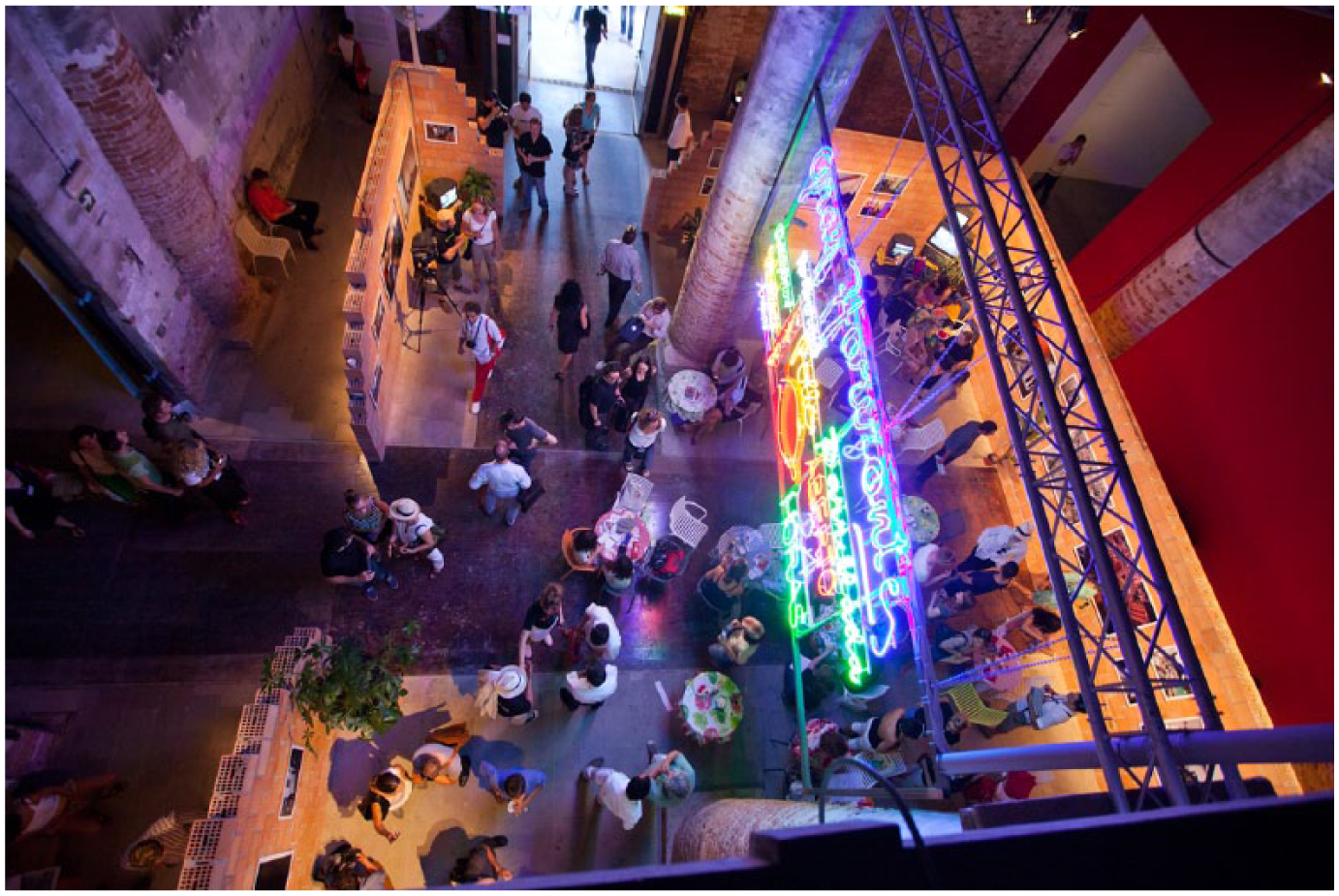
Torre David/Gran Horizonte, Venice Biennale of Architecture, Venice, 2012. © Daniel Schwartz/U-TT.
If architecture is transmitted by and understood through visual media, why not coopt these processes to draw attention to social issues evident in the already-built environment? With our communication around Torre David, and the privileged pulpit we were afforded, we sought to redirect the public gaze toward a global problem that often suffers from invisibility. Urban-Think Tank has since been accused of turning the struggles of residents into art. But ‘art’ that probes beyond a vacuous appropriation of ‘favela chic’ can agitate for and even set in motion genuine progress. Ultimately, we were unable to convince the Venezuelan government to avoid the tired ruts of modernist planning – in 2014, residents were evicted en masse to housing blocks in a nearby satellite city. We remain hopeful, however, that the debate that was ignited, including the notoriety it attracted, will contribute to a more sustained commitment amongst architects internationally to not only address urban inequality, but also use what already exists in creative, unexpected ways.
While the impetus of the Torre David research was to challenge certain core values of the discipline, and suggest alternative possibilities grounded in the complex realities of urbanization, our more recent efforts in Cape Town are focused on carefully conceived strategies to address a worsening housing crisis. For more than 7.5 million people in South Africa, life plays out amidst the precarious conditions of 2,700 informal settlements spread across the country – the legacy of both discriminatory apartheid-era planning practices, and the inadequacies of the post-1994 policy response. In Cape Town, sprawling townships like Khayelitsha, home to our project site BT-Section, are characterized by poorly built shacks, limited access to basic infrastructure, and personal dangers and environmental risks stemming from ad hoc development patterns. Those facing the interminable wait for an identikit subsidized dwelling on a peripheral greenfield site are locked out of the formal property market due to escalating prices, restrictive financing, and inflexible regulations.
Empower Shack aims to develop a comprehensive and sustainable upgrading strategy for these informal settlements. The approach comprises a low-cost housing prototype, participatory spatial planning, and an experimental financing model. Visual communication has been central to securing financial backing and non-monetary ‘buy-in’. In a perhaps unorthodox move, we exhibited the embryonic results of our initial research and design at a leading Zurich commercial gallery in 2014 (see Kalagas, 2014). Through film, photography, drawings, models, and large-scale installations, we sought to contextualize and convey the catalytic potential of the project – all in a rarefied space normally reserved for international art sales (Figure 3). The intention was not to rethink the form of the architecture exhibition, but its curatorial purpose. We did not disguise commerce as artistry, nor unrealized architecture as conceptual art. Instead, we devised an exhibition that could function as a fundraising platform, by suggesting the promise of a process of design thinking, rather than consecrating an end product.
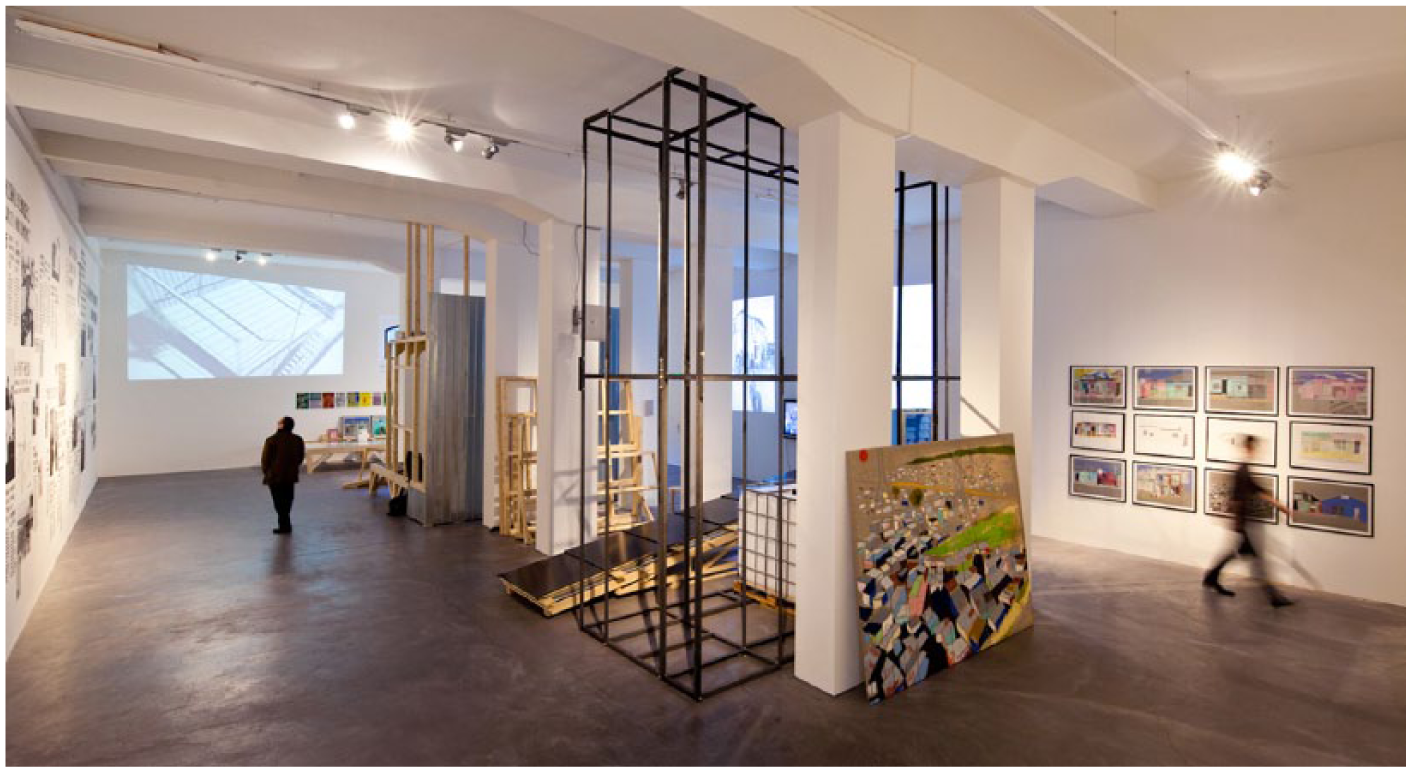
Empower Shack, Galerie Eva Presenhuber, Zurich, 2014. © Daniel Schwartz/U-TT.
Like our participation in Venice, it might be simple to dismiss such efforts as art-world posturing. Yet, presenting the work in the gallery, and accessing the audience this entailed, led a prominent philanthropist to our project. In turn, this was instrumental in the award of a multi-year institutional grant to expand the pilot to encompass an entire community. A crew of residents from BT-Section is now being employed with these funds to construct new homes for themselves and their neighbors based on an improved prototype design developed by a multidisciplinary team (Figure 4). On a broader scale, municipal authorities have joined a supportive constituency interested in the future scaling up of the pilot should it prove successful. Ultimately, just as artists are borrowing from architecture to transform their social practice into impactful physical spaces, so too can a design collective like Urban-Think Tank temporarily inhabit a commercial gallery in Zurich and emerge with the resources to effect real change in Cape Town.
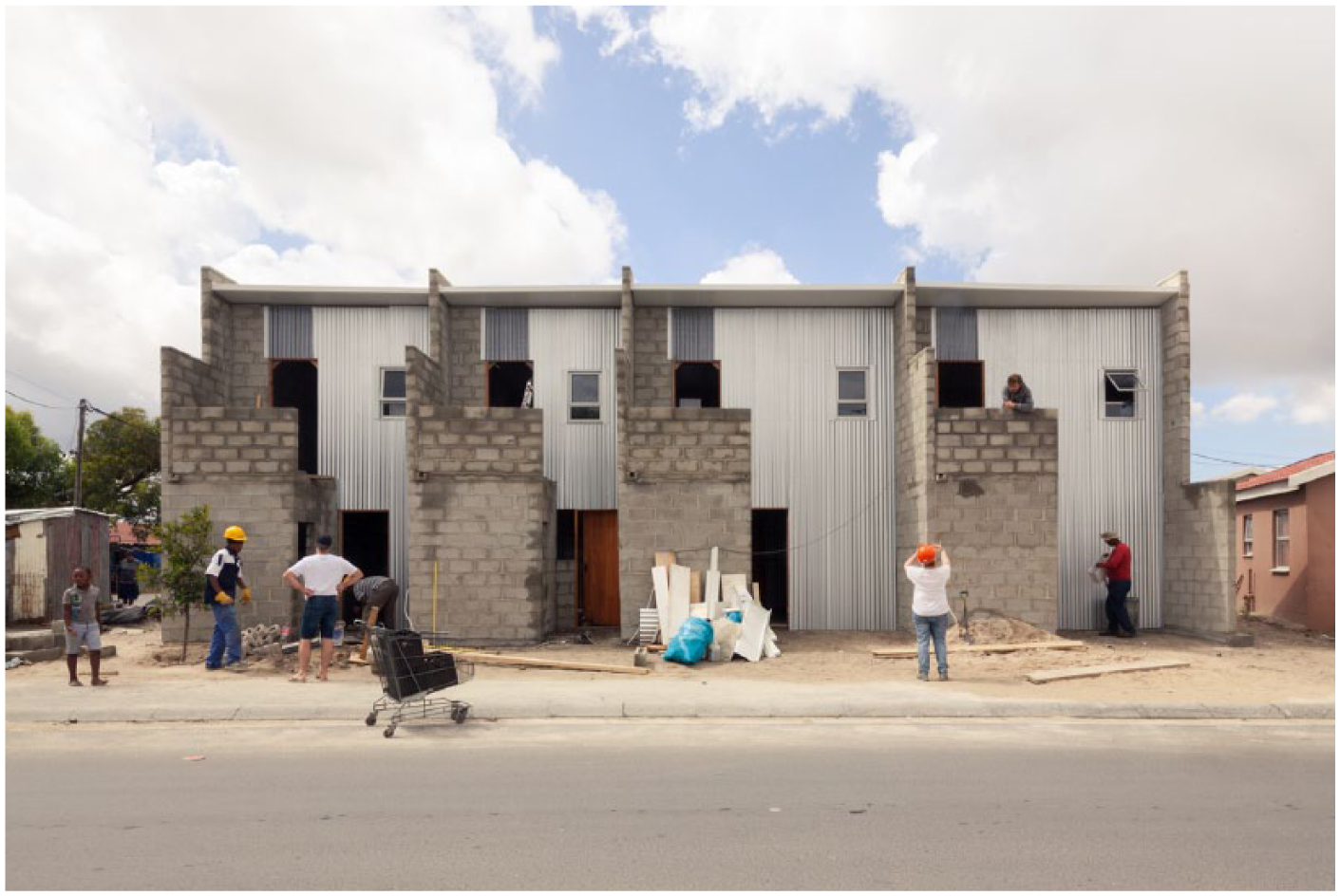
Empower Shack’ housing prototypes in construction, Cape Town. © Daniel Schwartz/U-TT.
Social design has perhaps replaced ‘starchitecture’ as the field’s zeitgeist in an era of widening inequality and austerity. But while its practitioners have lately garnered some of the most prestigious accolades in art and architecture, who pays for these projects remains a thorny question. We have been here before. The opening of MoMA in November 1929 coincided with the onset of the Great Depression. Throughout the 1930s, curators in the nascent architecture department staged a series of exhibitions advocating openly for improved public housing. A global confluence of economic largesse and political change gave rise to the Modern movement, whose key figures found willing partners in governments committed to social progress. Public funding today is more likely to be directed towards ‘iconic’ projects intended to generate tourism revenue, or rebrand cities in the ongoing scramble for foreign capital. As we have found, architects pursuing social goals must get creative in order to conduct the research and experimentation that can seed more traditional investment and, we hope, make a difference outside of the art-world bubble.
Footnotes
Address: Department of Architecture and Urban Design, ETH Zurich, Neunbrunnenstrasse 50, Zurich 8093, Switzerland. [ email: