



Abstract
This article examines the history of the commercial street photographer, or photofilmeur, in France from 1945 to 1955. Although itinerant photographers had long operated, they organized as a new profession after the Second World War in response to hostile reactions from other ‘sedentary’ photographers, conservative officials, lawmakers, and the police. Tracing the fight to regulate and even ban photofilmeurs in state and police archives, courtroom accounts, and union publications, this article reveals a struggle over the who, what, and where of photography: Who has the right to photograph whom? Can you take pictures of people without their consent? What is professional photography? Answers to these questions recast the history of street photography not as an aesthetic category, as most scholarship treats it, but in terms of the medium’s engagement with the law and issues of consent, intent, copyright, privacy, and dissemination that are at the heart of 20th and 21st-century photographic history.
Keywords
‘After the war, the street photographers came back to [Paris]’, recounts author, editor, and avid amateur photographer Roger Grenier (2013). ‘On the boulevard Saint-Michel, like just about everywhere in the world, they took pictures of the passers-by and handed them a ticket. If you wanted to, you could return later, show your ticket, and pick up your portrait on the front of a postcard’ (p. 52). The reappearance of commercial street photographers signaled the capital’s return to normalcy, but, as Grenier noted, they were common the world over. In France alone, they snapped people window-shopping along La Canebière in Marseille, strolling on Nice’s Promenade des Anglais, and winding through medieval streets in towns such as Grasse. The coming years, however, were anything but normal for these operators. As more and more of them aimed cameras at pedestrians enjoying the fruits of economic recovery, they found themselves embroiled in a fierce professional and legal battle for legitimacy. By 1948, studio-based photographers had declared the commercial street photographer a veritable ‘plague’ spreading from city to city (Anon, 1948: 221). 1 The former petitioned governing officials to regulate street photographers and then sued them for violating overly restrictive ordinances. In Paris, the same photographers who signaled a return to everyday life claimed they were under attack, victims of an often-brutal police campaign. Even after the 1951 success of a multi-year, nationwide struggle for legal authorization, Parisian street operators still told of bruises, broken cameras, and un-explained hours spent in police custody. 2 All in a city that has emerged as a key site – a capital – of postwar street photography. This article examines the struggle of French street photographers, also called photofilmeurs, for legitimacy, considering ten years of conflict staged on the streets, in courtrooms, and behind the scenes by studio-based photographers, municipal officials, and lawmakers.
Unearthing this overlooked history of the commercial street photographer sheds new light on larger histories of street photography, vernacular photographic practices and culture, and the medium’s legal regulation. 3 Colin Westerbeck and Joel Meyerowitz’s now-classic Bystander proposed street photography as an aesthetic genre produced by individual, named photographers, rather than the work of commercial vendors (1994: 34). Their street photography was defined by a shared subject matter (the street) and formal concerns (‘instantaneity and multiplicity’) (1994: 34). 4 Their interpretation was possible, however, only because they ignored these other street photographers, the commercial ones who simply didn’t count.
The commercial photos that 20th-century pedestrians purchased for a few pennies are strikingly homogenous, the same from Marseille to Paris, from ‘Czernowitz [Ukraine] to New York to Mexico City to Sydney’ (Batchen, 2009: 30). They fall into two categories. For the first, posed portraits, vendors arranged their subjects in picturesque public parks and squares, asked newlyweds to pose as they left city hall, or lured market- or fairgoers with clever props and backdrops (for the latter see Chéroux, 2005). The second genre, increasingly common over the course of the century, caught people on the move. Photographers framed subjects in head-to-toe shots, often snapped with one leg fully extended forward, much like runway model photos (Figure 1). Many people looked at or even smiled into the lens; others were caught seemingly unawares. These photos offer up a wealth of information about changing fashions, streetscapes, habits, and entertainments. Certain pictures capture an interesting moment – or the type of formal echoings and embodiments of chance that Westerbeck and Meyerowitz identified. 5 But as pictures, they are largely the same, with one operator’s work indistinguishable from another’s. Their very predictability undermines any idea of street photography as an authored, artistic investigation into the ephemeral and unpredictable. 6 One might conclude then that these photos tell simply another banal history of vernacular photography. Echoing Geoffrey Batchen, however, I insist that this homogeneity is part of what makes them so compelling (2009: 30).
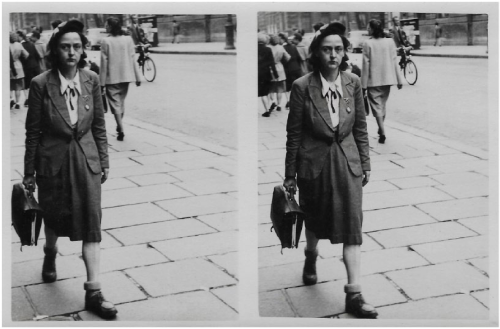
Photofilmeurs often sold two copies of the same image, one to keep, one to give away. Anonymous, dated 17 April 1953. 13.9 by 8.9cm. Image courtesy of Seconde Vague Productions, Marseille.
The commercial street photographer fostered a global culture of frequent, anonymous, public photography. You can’t turn around these days without running into another article about how photography has become integral to our everyday lives, about how we photograph ourselves and others and expect in turn to be photographed regularly. New and cheaper cameras, from the Kodak to the iPhone, are only part of the story of how this came to be. The commercial vendor is the other part. Like the photo booth (see Pellicer and Shugaar, 2010; Chéroux et al., 2012), he offered a form of self-portraiture to even those who could not afford a camera. 7 In Marseille after 1945, a commercial street photo cost anywhere from 25 to 150 francs, at most three times the price of an issue of the illustrated magazine Paris Match.
In order to see this story, we need to put aside the question of street photography as an aesthetic category. We must reframe the street photographer as a participant in – not a bystander to – the social world. My analysis of commercial street photography foregrounds photography as a social act and a legal, even political, question. 8 And I posit that even though commercial vendors existed everywhere, their local histories are more uneven than their photographs would suggest.
In France, street photographers received a new name – the photofilmeur – and came face to face with laws regulating France’s droit à l’image (the subject’s right to his or her own image), notions of competition, and ideas about the street itself. They confronted ‘the issues of privacy and who was allowed to photograph in public spaces, and for what purposes’ that Jennifer Tucker (2012: 14) has argued comprise the medium’s 20th-century urban history. If you utter privacy, photography, and the 1950s in the same sentence, though, the paparazzo, not the commercial street vendor, springs to mind (see Howe, 2005; Schwartz, 2011; Linkof, 2011). But I suggest that adding the commercial street photographer to the history of photography gives us another lens through which to view this discussion, one that reveals that expectations of candid public photography and concerns about privacy were hardly unique to the rarified realm of celebrities. 9 Street vendors, like the paparazzi, embraced spontaneity, ‘taking’ images without prior permission and sometimes against their subjects’ will. Many paparazzi cut their teeth selling portraits to passersby. The original paparazzo, the eponymous character in Federico Fellini’s La Dolce Vita (1960), was modeled on a real photographer, Tazio Secchiaroli, who got his start photographing ‘off-duty GIs in front of the Colosseum’ (Howe, 2005: 56). Their photos are even aesthetically similar. Paparazzi snaps of actors walking their dogs or laden with shopping bags reproduce the commercial vendor’s head-to-toe actions shots. Only their potential clients differ. The street photographer wanted to make photos the subject would buy. The paparazzo realized that someone else might pay more for photos the subject would never want. And yet, the commercial vendor nonetheless provoked heated discussion about the limits of privacy in public space – and the wide-scale legislation of public photographic practices.
Photography doesn’t just happen inside cameras, darkrooms, albums, galleries, or museums. It takes place on the street. If we follow the commercial photographer there, we’ll find a battle over the who, what, and where of photography: Who has the right to photograph whom? Can you take pictures of people without their consent? Can you photograph the police? What is professional photography? Where can it be practiced? Is photographic freedom the freedom to take a picture wherever you want? Or is it the freedom from having one’s picture taken? What we’ll find, in union discussions and courtrooms, is that the commercial vendor is not just an interesting addition to the history of photography at midcentury: his story is the missing linchpin to understanding photography’s social role and photographic practices today.
The Who, or a New Profession
The commercial street photographer burst onto the postwar scene as both a member of a newly distinct profession and a public problem. Photographers had, of course, worked in the streets before 1945. Itinerant photographers had set up tents at small fairs and markets, knocked on doors in working-class neighborhoods, and visited far-flung villages since the mid-19th century (Linkman, 1990; About, 2015). By the 1920s, both itinerant and boutique-owning photographers regularly brought cameras and tripods to parks, the seaside, and other sites of leisure. They printed the resulting portraits on the cheapest available type of paper – the postcard, which their subjects tucked into albums and mailed to friends and family (Chéroux, 2005: 100). Often these photographers used simple box cameras that functioned as a camera and darkroom in one, producing paper negatives that the photographer then rephotographed to make a positive (Figure 2). By the 1920s, vendors had repurposed old hand-cranked film cameras in order to photograph people in motion. Cinematographers continued to crank their machines manually until the wide-scale adoption of sound in the 1930s created the need for standard frame rates. But they also regularly bought newer camera models and sold the old ones on the secondhand market. 10 These machines were a boon for vendors and the companies they worked for. The film camera allowed them to shoot quickly without having to stop to reload the camera after every image. Operators could take several portraits in rapid succession and print them together as a film strip of modern life (Figure 3). Film cameras required tripods though, and as use of the latter was restricted, street photographers increasingly deployed handheld cameras (Figures 4 and 5). All three types of cameras were in use in the period under consideration here, but in general the French term photofilmeur referred to someone using either of the latter two.

This photographer is working with a box camera that he’ll use as a makeshift darkroom. He’ll dry the photos on the line hanging from the tripod. Frères Séeberger, ‘At the Foire du Throne, an itinerant photographer sets up his camera, 1950’. ©Séeberger/BHVP/Roger-Viollet.
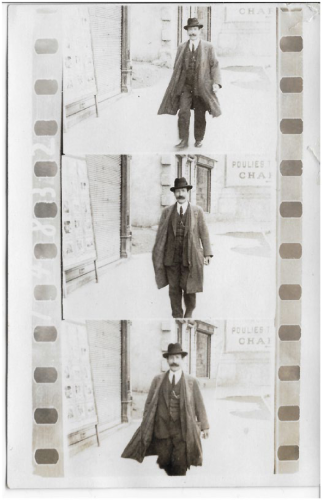
Portraits printed as a film strip – the origin of the ‘photofilmeur’. Anonymous, dated November 1928. 13.8 by 8.9cm. Image courtesy of Seconde Vague Productions, Marseille.
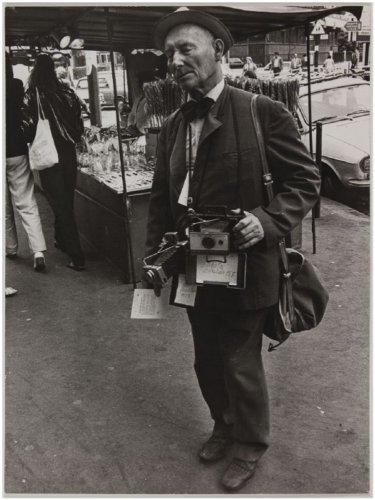
This photographer carries two cameras, one loaded with color Polaroid film (15 francs), the other with black and white (10 francs 2 centimes). The franc was revalued in 1960, but these prices are still cheaper than the 150 francs one could have paid in Marseille in the 1950s. Gilbert Rosati, ‘A professional “photo-souvenir” seller’, Saint-Ouen flea market, Paris, June–July 1979’. ©Rosati/BHVP/Roger-Viollet.
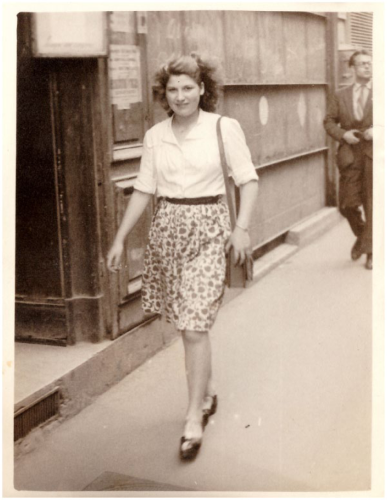
A young woman captured by a street photographer. The size of this image suggests it was taken with a hand-held camera. Anonymous, c.1950s, 8.7cm by 6.9cm. Image courtesy of Seconde Vague Productions, Marseille.
In 1946, a set of new terms for photographers became commonplace. In the past, those who took pictures in the streets were either called ‘street’ or ‘itinerant’ photographers. The latter was the legal and administrative term designating a tradesperson operating outside of the commune in which he resided (Anon, 1951: 591). But by the 1940s, most did not travel from city to city. At that point, they might simply have been absorbed into the ranks of the professional photographers, from the owners of portrait studios and specialists in illustration or industrial photography, to self-styled artists, who all belonged to existing professional associations and unions. But these groups actively resisted this possibility. Their members considered street vendors, who charged lower prices (because they did not shoulder the costs of studios), disloyal competitors. The unions rejected street photographers’ membership applications and lobbied mayors and departmental prefects to regulate them (Anon, 1947b: 164). To better restrict this ‘enemy’, they gave it a name.
Le Photographe, the official publication of French professional photographers, first mentioned the new and troublesome form of competition in November 1946. The article called them ‘filmeurs’, or filmers, a name derived from their cameras (Anon, 1946: 215). Other names, deployed by newspapers, the courts, as well as the street photographers themselves, followed. They became ‘photo-stop filmeurs’, ‘photographes-filmeurs’, ‘photofilmeurs’, ‘photo-stoppeurs’ and even ‘auto-stop filmeurs’. All combined photography with either hitchhiking (autostop) or the act of filming, of capturing moving images. The photographers in question often used ‘photographes-filmeurs’, or by the 1950s the shorter ‘photofilmeurs’. The courts and the national press would favor this version of the new name. They would refer to the photofilmeurs’ competition as ‘sedentary photographers’. This was not a new way of describing non-traveling professional or amateur photographers. It had been used as early as 1911 as a catch-all category for those who saw itinerant photographers as competition (Stebbing, 1911: 4). By the 1940s, not all of these professionals took photos exclusively in studios, but in general they stored materials at fixed addresses and had space in which to receive clients.
The new name, nonetheless, worked in the photofilmeur’s favor by, at least on the surface, ridding him of the itinerant photographer’s unsavory cultural and social associations. These figures had born the double social taint of the photographer and the peddler or hawker (About, 2015). The former was often seen as a ‘con-artist on the periphery of bourgeois society’ (McCauley, 1994: 27), while, since the 18th century, the word for the latter had also meant ‘tramp’ or ‘trickster’ (Fontaine, 1996: 1). Even as the peddler sold needed goods, he ‘remained a disturbing figure […] on the fringes of society’ who often also distributed radical political tracts (Fontaine, 1996: 1). In the late 19th century, the daily press abounded with stories of photographer scammers. Because dissatisfied customers, not to mention the police, never knew where to find them again, itinerant photographers came to seem even less trustworthy than those with fixed addresses. The portmanteau ‘photofilmeur’ replaced old associations of trickery and deceit with a modern and future-looking nod to the cinematographer.
In a brief history of the profession, the Paris-based Syndicat général de photofilmeurs made no mention of itinerant photographers. Rather, the union recast the photofilmeur as the more courteous, discrete, and ultimately ethical version of two established and respected figures: the journalist and the newsreel cinematographer ([Bret], 1952: 3). On the one hand, this reinterpretation seems a transparent attempt to re-associate the photofilmeur with a more prestigious and higher socio-economic class of image-making professionals. After all, a 1965 study of 200 current and aspiring professional photographers revealed that they held photojournalists (and fashion photographers) in highest esteem (Boltanski and Chamboredon, 1990: 169). On the other hand, the photofilmeur, who sought out spontaneous, unposed shots in the street, did share more with the Leica-wielding photojournalist or the cinematographer than the studio portraitist. He was not just a photographer, he was someone who caught the lives of average people on the fly and in the streets. He, if anyone, was witness to his era.
Mayors, departmental prefects, and chiefs of police could hardly agree less. As early as 1946, and at the urging of sedentary photographers, these officials deployed their powers to regulate both street commerce and traffic on public thoroughfares to issue three types of restrictions on photofilmeurs. The first called for them to conform to existing regulations pertaining to street trades. They needed to receive official authorization and could only operate in specific places during restricted hours. On 30 April 1949, for example, the mayor of Grasse, a small town on the French Riviera, restricted photofilmeurs to one square except on public holidays (Anon, 1950b: 712). Starting in 1946, photofilmeurs in Nice could only work along the Promenade des Anglais, the palm-tree-lined boulevard that borders the sea (Anon, 1947a: 58). The second type of restriction was similar but assigned photographers specific locations. This was the case in Marseille starting in March 1946, where the police stationed photofilmeurs every 10 meters along La Canebière (Massenet, 1946; Anon, c.1946). The third type of regulation simply outlawed the practice. In 1948 and 1949, officials in Bordeaux, Villeneuve-sur-Lot, Rodez, and Choisy-le-Roi all banned photofilmeurs (Anon, 1951: 590; Chaban-Delmas, 1948: 371; David, 1950: 139).
Almost immediately, photofilmeurs tested the practical and legal limits of these restrictions. Some accepted the fact of paying the occasional fine. In Paris, sedentary photographers complained that photofilmeurs remained thick on the streets despite an outright ban (Vandamme, 1949: 391). Others challenged the regulations in civil, criminal, and administrative courts. 11 They and their lawyers argued that the restrictions had overstepped the law, that the mayors and prefects had taken their right to regulate street commerce too far. This argument helped a Grasse-based photofilmeur charged with working outside the single approved square win his criminal case (Anon, 1950a: 137). The town’s police commissioner and the local union of photographers and merchants of photographic materials, however, appealed the decision in the civil courts. They won, only to receive a single franc in damages from the photographer (Anon, 1950a: 139). Photofilmeurs charged with violating regulations in Bordeaux, Villeneuve-sur-Lot, Rodez, and Montaubon won a major victory in the administrative courts in June 1951. France’s highest administrative court, the Conseil d’État, ruled the municipal decrees in these cases illegal. It declared that the overly strict regulations and interdictions constituted mayoral excès de pouvoir, or ultra vires (Anon, 1951: 592). The court acknowledged mayors’ rights to regulate street commerce, including photography, but it ruled that they did not have the right to prohibit or otherwise render these professional activities impossible. Doing so infringed on the ‘freedom of commerce and industry’ (Anon, 1951: 592).
The Conseil d’État’s decision produced a jurisprudence that gave the profession of photofilmeur legal recognition. Responding to the court, the cabinets of the Ministry of the Interior and the Ministry of Industry and Commerce issued guidelines for regulating commercial street photography. They affirmed the legal status of the ‘photographers operating in public, called photographes-filmeurs’ (Arrighi de Casanova and Verdier, 1951: 1). Mayors and prefects could, though, restrict the hours and places where photofilmeurs operated. And, in a concession to the competition, the circular declared that such regulations should stipulate that it was illegal for photofilmeurs to work in close proximity to a professional photographer’s establishment. Ironically, the campaign launched by sedentary photographers and their unions to rid the streets of photofilmeurs had ended up ensuring their place there in the coming years.
The Where, or the Battle for Paris and the Idea of the Street
Local officials complied with the instructions put forth in the interministerial directive of July 1951, with one notable exception. Jean Baylot, head of the Paris police, refused. His officers actually ramped up ticketing of photofilmeurs in 1951 and 1952. He would not issue a directive regulating them until 1954. Baylot was able to stall for structural reasons. As Prefect of Police, he enjoyed such independent power that he could more or less, or at least for a while, disregard interministerial instructions if he believed them ill-adapted to the capital. 12 In this case, Baylot followed in the footsteps of right-leaning officials who, as early as 1927, had judged the presence of working-class photographers taking pictures of strangers in public an attack on Paris’s dignity and reputation. The ‘new right-wing approach to the city’ that Brooke Blower (2011) has explained emerged during the interwar period and ‘which entailed bolder claims to the use of state power and expanded associations between traditional political subversion and more diffuse forms of moral subversion’ would continue after the Second World War (p. 156). This conservatism and the accompanying emergence of a nostalgic and reactionary understanding of the Parisian street itself gave shape to the battle between photofilmeurs and the police.
The first effective ban on Parisian photofilmeurs, issued in 1927 by then Prefect of Police Jean Chiappe, formed part of his larger campaign to purge the capital of radical, scandalous, dirty, noisy, and simply annoying activities. During his seven years in office, Chiappe worked to cultivate Paris’s status as a capital of art, the luxury trade, and dignified pleasures at the expense of its reputation as a place of radical politics, wild nightlife, or sexual liberties (Blower, 2011: 131–2). He targeted the pesky and dirty, ordered the preemptive arrests of left-wing protestors and strikers, and waged a particularly intense war on immorality, raiding nightclubs, cafés, bars, bookseller’s stalls and periodical kiosks (Blower, 2011: 158–9, 164–6). Many of Chiappe’s targets – sellers of dirty postcards, smalltime conmen, and guides offering nightlife tours – stalked the squares and boulevards frequented by foreign tourists (Blower, 2011: 145). The photographers operating in the streets likely came onto his radar in this context. They would have fallen somewhere between the purely pesky and the morally suspect ranks of these other street peddlers.
Curbing commercial street photographers seems to have been a top priority for Chiappe; he issued the directive banning them not even a month after taking office. The directive applied an 1862 one regulating street commerce to the itinerant photographer, who, at the time, often worked with a tripod (Anon, 1951: 589). It required street sellers to be truly ambulant, not stopping ‘even for an instant on the street to show wares for sale or do any type of work’ (Le Commissaire de Police, 1952). Only those with police authorization could set up in public. But according to Jean Carbonnier, the lawyer who analyzed the 1951 Conseil d’État decision for the legal journal the Receuil Dalloz, ‘the Prefect of Police [had] decided, once and for all it appears, that no [street photographer] would receive authorization’ (C[arbonnier], 1951: 593). This Catch-22 of a directive appeared to follow the rule of the law but really created an arbitrary ban. Chiappe had begun applying the far-right’s extra-legal tactics to street photography.
Chiappe only cracked down on certain photographers working in the streets. He did not modify the 1896 decree that deregulated public photography. 13 Until then, both amateur and professional photographers needed police authorization to take pictures in the streets (Anon, 1903). And in the 1920s, all photographers sometimes disrupted traffic or snapped passersby without their permission. But Chiappe touched neither amateurs nor photojournalists, targeting only the most working-class photographers, the itinerant operators who still bore all that term’s cultural baggage. That he spared the act of photography in general suggests that Chiappe’s concerns had more to do with observation and control of the city’s population – in particular foreigners, immigrants, communists, and the working classes – than photography per se. His administration recognized the power of random photographic observation and wanted to limit who might be on which end of the camera’s lens in the process.
Jean Chiappe lost his job in 1934 (his dismissal helped spark the bloody 6 February riots), but the idea that the presence of photographers in the street sullied the city’s dignity long outlived his tenure. For nationalist right-wing architect-turned-municipal-councilor Charles Trochu, the problem lay with photojournalists. In 1939, he described how they relentlessly tracked famous visitors (most notably Charles Lindberg and the Duke of Windsor) to the capital (Conseil municipal, 1939: 6). And he suggested a solution: without passing any new laws, the Prefect of Police and the Prefect of the Seine might simply negotiate controlled photo-ops upon the celebrity’s arrival. The police would then be free to fine or arrest any photographer subsequently caught in pursuit. In other words, Trochu proposed another version of the type of extralegal administrative order issued by Chiappe in 1927. He promised this policy would make Paris even more attractive to such figures whose presence served as ‘the greatest form of advertising […] living proof that the sweet life is still sweetest in Paris’ (Conseil municipal, 1939: 6). Trochu explicitly linked the city’s appeal to the freedom from public photography. He wanted to promise celebrity visitors that what happened in Paris would stay in Paris. Later arguments against photofilmeurs in the capital repurposed both this idea of dignity and the anxiety about working-class photographers that it masked.
Such arguments resonated perhaps even more strongly after 1945, when city officials sought to rebuild Paris’s reputation. In 1940, the German army had occupied the capital, turning it into a tourist outpost for soldiers on leave (Gordon, 1998). To many Parisian, the Americans’ 1944 arrival felt like another occupation (Roberts, 2013). In 1951, the Municipal Council and the Chamber of Commerce mobilized Paris’s rich history in order to rebrand it as a capital of art, luxury commerce, and dignified leisure. From late spring well into the fall, Paris fêted the ‘Bimillénaire de Paris’, the city’s 2000th birthday. 14 Hundreds of thousands of tourists – mainly from the United States – flocked to Paris that summer. 15 It is little wonder then that the Prefect of Police would be loath to let a presumably ragtag bunch of photographers loose on the streets, and on these visitors, without a fight.
And a fight they would have. The Paris police reported handing out 1485 citations to photographers operating illegally in the streets between 1 January and 31 August 1950 (Conseil municipal, 1950: 1154). These cases went to the Tribunal de Simple Police, the court responsible for judging the least serious violations of the penal code, where photographers could be sentenced to fines of up to 36,000 francs. 16 These numbers and my own survey of the court’s records at the Archives de Paris suggest that Paris-based photofilmeurs were receiving multiple fines per year – if not per month – in the early 1950s. In response, photofilmeurs organized. They founded the Syndicat général des photofilmeurs (hereafter Syndicat) in December 1951. But even as the Bimillénaire wrapped up, the crackdown on photofilmeurs did not. According to Maurice Bret and Louis Adam of the Syndicat, the Prefect again sent out instructions to target photofilmeurs between January and July 1952. By September, photofilmeurs had been issued 5500 fines (Bret and Adam, 1952a: 1). Fines alone, however, did not do much to keep these photographers off the streets.
The police also tried violence. Baylot combined the right-wing tactics of Chiappe’s era with the skills of personnel trained in brutal policing and repression in the colonies (House and MacMaster, 2002: 270). 17 Baylot had orchestrated a ‘counter-purge’ of the police in 1951 in order to remove Communist Party sympathizers, and he encouraged his forces to mistreat demonstrators and political ‘subversives’ (Ross, 2002: 52). The Syndicat’s administrators believed the photofilmeur figured on this list, claiming the police considered him: ‘a troublemaker, an outlaw, a baldy, a leper, a worthless man to be hunted day and night, all the while demanding from him the same taxes and duties as other photographers!’ ([Bret], 1952: 4). Its members were cited for violating 1912 and 1862 street commerce laws as well as for ‘blatant commercial soliciting’ (if, for example, they insisted that the client take the photo ticket), ‘distributing commercial leaflets’, or even for littering ([Bret and Adam], 1953: 3, 4). This manhunt became physical. The Syndicat complained that its members were regularly subjected to: ‘8 hours of ‘holding’ [in police stations], physical abuse, breaking of cameras, destruction of film, illegal expulsions, and torrents of fines’ ([Bret], 1952: 4). Even photographers whose materials escaped unscathed often had trouble making a living because they were pulled from the streets for hours at a time. In their defense, the Syndicat addressed a flurry of letters, documents, and phone calls to government ministries. At one point, Bret and Adam complained about being sent back and forth between ministries – from Justice to the Interior – like ‘a ping-pong ball’ (Bret and Adam, 1952b). By 1953, the Prefecture de Police promised a directive shortly, and, in the meantime, the Syndicat’s representatives had worked out a modus vivendi.
The truce hinged on the idea that photofilmeurs posed a threat to the capital’s reputation. In their description of the agreement, Bret and Adam reminded members: ‘Paris is the world’s most elegant city […] our profession’s success depends on the favorable atmosphere that tourists know they will find each year during the fair weather’ ([Bret and Adam], 1953: 2). The police would intervene if photofilmeurs did anything to sully this ambiance. They should dress properly, avoiding above all the stereotypical ‘worn-out shoes, unkempt beard, slovenly clothing or loutish appearance’ ([Bret and Adam], 1953: 2). They needed to remain ‘smiling and courteous’ with other commercial operators and refrain from competing for customers ([Bret and Adam], 1953: 3). The police required the same show of respect. Some photofilmeurs, it appeared, liked to photograph on-duty officers or simply fix them with a ‘certain irritating smile’ ([Bret and Adam], 1953: 2). Both actions endangered the fragile peace between the profession and the forces of order. Bret and Adam’s description of the truce underlines the subjectivity of the crackdown on photofilmeurs. An ill-timed or smug smile could provoke an arrest. The state of one’s dress and facial hair, the tone of one’s voice, was likely to determine the legality of one’s profession that day. While they claimed only a handful of photofilmeurs really caused trouble, Bret and Adam nonetheless adopted the discourse of the city’s dignity – and of the importance of suppressing outward markers of class – in order not to endanger it.
At the same time, a group of legislators tried to remove photofilmeurs from the street altogether. In October 1953, eight right-leaning members of the National Assembly, headlined by Parti radical representative Pierre de Léotard, proposed a project for a law to ‘suppress the trades that infringe on citizens’ freedom and tranquility on the public street’ (de Léotard et al., 1953: 1). It stipulated the prohibition of ‘all trades that surprise or intrusively solicit clients’ (de Léotard et al., 1953: 2) but only named photographers and the postcard and engraving sellers who, as Brooke Blower (2011) reminds us, usually sold pornographic images (pp. 147, 164). As a Ministry of Justice staffer noted on the circulated text, the law clearly ‘target[ed] photofilmeurs’ ([Jaillet], 1953). Their punishments would have been severe. Any photographer caught operating without ‘a professional license’ faced proposed fines of 20,000 to 100,000 francs (de Léotard et al., 1953). For repeat offenders, the sum could rise to 1 million francs, compounded by the seizure and confiscation of their equipment. 18 Such penalties could actually have stopped photofilmeurs from working in Paris once and for all. For although it was put forth at the national level, the deputies who proposed the law clearly had the capital in mind. They all represented constituencies in the greater Paris region. Two of them, Jean-Louis Vigier and Paul Coirre, were also both simultaneously members of Paris’s municipal council (Nivet, 1994: 186).
The proposed law sought to make real the reactionary vision of the Parisian street emerging in the 1950s. The ‘Belle-Époque’ was invented in these years, as films, picture books, personal essays, and novels idealized a nostalgic and often right-wing vision of pre-First World War Paris (see Schwartz, 2007: 18–55; Rearick, 2011: 82–118). The short text explaining the proposed law’s rational lamented the existence of ‘trades only distantly related to traditional ones’ (de Léotard et al., 1953: 1). It asks: Will [the pedestrian] no longer know a few minutes of relaxation? Will he no longer be allowed to ‘flâner’ with friends without coming up against the indiscretion of several hawkers? Must he bear the cost of some photographer out for the sensational or even the scandalous? (de Léotard et al., 1953: 1)
But pedestrians had never been able to stroll the streets of Paris in uninterrupted reverie. Prosecutor François Gazier had refuted this myth two years earlier in his arguments to the Conseil d’État. As he put it, ‘the street is not a closed arena reserved for meditation. Unexpected encounters, surprises of all sorts are common there. For some they are even the very charm of a stroll through the streets’ (Anon, 1951: 591). This law nonetheless invoked the same type of reactionary arguments about the peace, cleanliness, safety, and access to the street that would help push large portions of the working classes out of Paris after the Second World War (Wakeman, 2009).
Luckily for the photofilmeurs, the law never made it beyond the proposal stage. Staff at the Ministry of Justice declared it vague, willfully dismissive of the importance of amateur photography, and too harsh in its punishments (Anon, 1954). Such a national interdiction and the fines it imposed would have wrecked the gains the profession had made elsewhere in France and the fragile peace – nay the victory – that the Syndicat général des photofilmeurs repeatedly announced was imminent. But the reactionary ideal of the Paris street would temper triumph when it did finally come. Just a month before he was removed from office, Jean Baylot finally issued a decree regulating commercial street photographers. This document recognized the legality of the profession, set up a process of licensing, and regulated when and where they could work (Baylot, 1954). Its revisions over the decades that followed, however, has slowly removed photofilmeurs from the wealthiest neighborhoods and the most popular tourist destinations. What’s more, the directive would maintain an ‘extra-legal’ stipulation banning photofilmeurs from photographing anyone against their will.
The Whom, or the Right to the Image
In fighting for their profession’s legitimacy in the late 1940s and early 1950s, photofilmeurs had come up against a widely shared concern about the potential negative consequences of being photographed in the streets. Sedentary photographers framed the question in terms of conflicting rights: the photographer’s right to work infringed on the subject’s rights to be left alone and to control his or her image. The Ministry of the Interior and the Ministry of Industry and Commerce had stipulated that local regulations include a clause preventing photofilmeurs from photographing subjects against their will. Impossible to properly police, this stipulation stretched the legal limits of the subject’s ownership of the image in the service of other photographers’ professional interests and right-wing politicians’ fears of photographic surveillance.
Two notions of legal rights governed the dissemination of photographs at mid-century. The first – the droit d’auteur, or the right of the author to his or her work – was relatively weak. French law only extended it to photographs in 1957 and then only for those of an ‘artistic or documentary’ nature (see Gendreau, 1999). Until then, courts did often rule in favor of photographers’ ownership of their images, but only if they could prove that the work was artistic rather than industrial (see McCauley, 2008; Nesbit, 1987). Professional photographers’ battle for the droit d’auteur helps, in part, to explain their virulent reaction to photofilmeurs. The issue came up frequently in Le Photographe in these years. Professional photographers feared that if the latter cheapened photography’s public image, the government would never revise the droit d’auteur laws in their favor. The second legal right – the droit à l’image, or the right to one’s image – was much stronger. An extension of personal property rights, the droit à l’image dated from 1858. It gave a portrait’s subject – or after her death, her heirs – ownership of her likeness. The subject thus needed to authorize the display or reproduction of the portrait (for more see Dupuy-Busson, 2014). In the intervening century, the subject’s control of his or her likeness almost always trumped the author’s ownership of the work. As a near-exact copy of ‘reality’, photography was particularly susceptible to stringent application of the droit à l’image. Photographers who sold work for publication often got around this problem by staging snapshots of paid models (see Vestberg, 2011).
The photofilmeur’s subject thus enjoyed far more ownership over his pictures than the photofilmeur himself. The 1951 interministerial guidelines stipulated that photofilmeurs could neither publicly display their work nor sell photographs to anyone but those in possession of the corresponding tickets (Arrighi de Casanova and Verdier, 1951: 2–3). These photographers could not then seek out secondary markets as photojournalists could when, for example, they repurposed news photographs as book illustrations. This restriction denied the photographer the use of the very reproducibility of the photograph. The photofilmeur might as well have been a rapid sketch artist operating on the streets, producing a singular image. And yet the photofilmeur had fewer rights even than the street sketcher, for he could not even keep a photograph for private use if the subject objected. Each ticketholder had 30 days to request the destruction of the negative and any prints made of it and could do so without even purchasing it (Arrighi de Casanova and Verdier, 1951: 2, 3). Not surprisingly given these regulations, photofilmeurs rarely, if ever, signed their photographs. The backs of their photos simply bear the stamped number of the ticket handed to the subject. No trace of the photographer remained once the photo had entered the subject’s possession. As such, these photos represent the extreme limit of the tug-of-war between the author’s right and the subject’s right to the image: the complete erasure of the photographer and his rights.
In regulating photofilmeurs, government officials and sedentary photographers attempted to invoke the droit à l’image even before the photo’s capture. Under existing French legal interpretation, the droit à l’image did not protect individuals from having their likeness taken. It only applied to its subsequent public display or dissemination. And yet the 1951 interministerial circular required that local regulations prohibit photofilmeurs from ‘taking a picture against the clearly expressed desire of the person in question’ (Arrighi de Casanova and Verdier, 1951: 2). Photofilmeurs countered that they did not waste film on people who were unlikely to buy photos (Anon, 1951: 591). François Gazier argued that the droit à l’image did not guarantee ‘the model’s right to his own features, before any reproduction that he would be able to authorize or prevent’ (Anon, 1951: 591). To be photographed in private would have been a different matter, but these subjects were in public. You could no more ban photofilmeurs from taking people’s pictures without their consent than bus passengers from looking at each other too intently. And indeed, Jean Carbonnier, who had commented on the Grasse case for the Receuil Dalloz, saw no harm done to the subject of the photograph: ‘he is neither jostled, nor pressured, nor even blinded [with a flash]’ (1950: 714). Carbonnier declared the photofilmeur no more dangerous than a passerby with a photographic memory.
No other image-makers were held to the same interpretation of the droit à l’image. Amateurs could take photographs of whatever and whomever they wanted in public provided they remained for private use. Painters set up easels in the street without police permission although they were not allowed to sell their canvases on the street (Le directeur général de la Police municipale, 1954). As Maurice Bret pointed out in his history of commercial street photography, photojournalists and newsreel cinematographers often captured the image of people against their will in the street. While photofilmeurs only sold the subject’s image back to him, the other two professions either ‘published them in thousands of copies’ or trotted them out ‘for the eyes and ears of millions of spectators’ without obtaining their consent ([Bret], 1952: 3).
Indeed, the photofilmeur worked in the streets during the heyday of low-budget street filming in Paris. In the 1950s, Jean d’Arcy, the director of French television and radio, changed the single national channel’s line-up from ‘film re-runs and prerecorded theatrical shows to live programming and on-location transmissions’ (Wakeman, 2009: 219). D’Arcy’s crews overwhelming worked in the capital, where they interviewed passersby for programs including Ce soir à Paris (Tonight in Paris), En direct de … (Live from…), and Une visite à (A Visit to…) (Wakeman, 2009: 219–20). In the early 1960s, this mode moved to the big screen, after Jean-Luc Godard, Jean Rouche, and Chris Marker all shot films in the same streets (À bout de souffle (Breathless), 1960; Chronique d’un été (Chronicle of a Summer), 1961; Le joli mai (The Lovely Month of May), 1963). As much as these Left Bank, New Wave, and Cinéma-Vérité filmmakers revolutionized the French film industry, they were building on a well-established culture of street recording. And while we can hardly say that the photofilmeur gave rise to the French New Wave, we can say that these operators helped foster the post-1945 culture of anonymous public image-making and profited from French people’s desires for pictures of their own lives.
How and why, if there was no legal basis for the ban on photographing people without their consent, and if it did not apply to all these other people making pictures in the streets, did it nonetheless become part of the national guidelines for regulating photofilmeurs? In large part, this interpretation of the subject’s rights emerged thanks to sedentary photographers’ lobbying. In casting about for a defense against the photofilmeur in the late 1940s, professional photographers had found that the language of unfair competition [compétition déloyale] had little legal purchase. A discourse about the rights of the individual, however, did. A lawyer hired to represent professional photographers’ interests explained that the liberty of the individual not to be photographed always trumped that of the photographer to exercise his profession (Anon, 1950c: 156). Union members must have realized, though, that upholding such an absolute right might come back to haunt them. 19 And so, in 1951, Le Photographe published another interpretation by a lawyer (who also happened to be a member of the Clermont-Ferrand Police), who proposed instead that the photographer’s intentions determined the legality of ‘forced’ or ‘‘surprise’ photography’ (Martignat, 1951: 118–19). Photographing someone by accident did not infringe on the individual’s rights. But as soon as the operator meant to take a person’s picture, it did (Martignat, 1951: 119). By introducing the idea of intention into this discussion, members of professional photographic unions sought to spare their own public photographic practices from regulation.
Politicians and municipal officials also invoked the individual’s right not to be photographed. In 1952, the police commissioner assigned to the Tribunal de Simple Police explained to the Ministry of Justice that the court was finding photofilmeurs guilty in such high numbers because: ‘the judges have always shared my opinion that any way you look at it, outside of any legal controversy, the act of photographing people in public, on the street, in Paris, and without their knowledge could have very regrettable consequences’ (Le commissaire de Police, 1952). What might these ‘very regrettable consequences’ be? Just two years earlier, municipal councilor Pierre Benoist had named them: in ‘hostile hands’ such photographs could ‘shatter a life or a career’ (Conseil municipal, 1950: 1154). The adulterer might immediately come to mind, Benoist explained, but the dangers extended far beyond dallying spouses to
thousands of other cases in which, for the most varied reasons – commercial, social [mondaines], diplomatic, political even – it is not convenient for someone to know that on this day, at this time, you were in this place, with these people, and even less so that a tangible document establish irrefutable proof. (Conseil municipal, 1950: 1154)
The cultural, political, and economic elite of France regularly walked Paris’s streets, and photofilmeurs put them in danger. Was Jean Chiappe really concerned about photofilmeurs sullying Paris’s dignity? Or was he worried about the probability that photofilmeurs would capture proof of street violence at the hands of the extreme right? Jean Baylot left office in the wake of the 1954 Affair of the Leaks, a plot designed to discredit and unseat socialist minister François Mitterrand. He too might very well have been worried about what a photographer in the wrong place at the wrong time might capture. And yet, according to François Gazier’s 1951 arguments, no legal case had ever been brought against a photofilmeur for relationship destruction, career ruination, or blackmail (Anon, 1951: 592).
The attempt to extend the droit à l’image to apply even before the image’s capture was motivated thus by other professional photographers’ efforts to remove competition and by officials’ mistrust of the photograph’s potential use. Men in positions of power simply did not believe that street photographers would not seek to profit from a compromising image despite strict laws against it. Worse, photofilmeurs might even be seeking out such photographs, lying in wait in front of hotels or restaurants. Photofilmeurs did photograph the police. Nearly two decades later, they were still snapping the arrests of their colleagues to have evidence of violence and mistreatment (KC, 1970). But it seems on the whole that photofilmeurs did not flout the law quite as easily as the officials who sought to regulate them feared.
***
The profession of the photofilmeur emerged in the late 1940s in France, forged out of the virulent reactions of professional photographers to the presence of commercial operators in the streets. Quickly organized into unions, photofilmeurs fought in the courts and behind the scenes to lift the city- and department-level directives which effectively banned them from working. They came up against a particular challenge in the capital, where a notion of Paris’s dignified reputation to the rest of the world, fears of photographic surveillance in the hands of the working classes, and a reactionary interpretation of what those streets should look like shaped a four-year-long battle. Even once photofilmeurs had seen the implementation of interministerial instructions recognizing the profession’s legitimacy, though, they found themselves banned from photographing people without their consent. This restriction – a twisted application of the droit à l’image – applied to no other image-maker working in public. It serves as further proof of wariness, on the part of those in power, of the consequences of random photographic surveillance. The photofilmeur’s history is thus entangled with that of the itinerant salesperson, the advertiser, the paparazzo, the photojournalist, the television crew, and the documentary film maker in that it combines issues of commerce, privacy in public, professional competition, and class. But his story is all his own.
Commercial street photography nonetheless enjoyed a heyday in the decades following the Second World War. Middle- and working-class French people largely welcomed having their pictures taken in the streets. Some, of course, did not want to be photographed. They threw punches, smashed cameras, and caused public disturbances for which photofilmeurs often took the blame. But most people appreciated their services. According to a report commissioned by the Prefect of the Gironde at the time, older subjects grumbled about how many photofilmeurs they encountered. Members of the younger generation though were ‘unanimously happy to be able to buy a snapshot of their outings for a modest price’. Only a handful of those surveyed even mentioned photography’s danger to ‘citizens’ freedom and tranquility’ (cited in Anon, 1951: 592). The photofilmeur’s image is a staple of French family albums from these years. He crops up too in the memoires of young Americans who came to Paris in the 1950s and 1960s. Nancy Miller (2013) describes several photos purchased from such men (pp. 12, 76, 127). Susan Sontag too bought her image from a photofilmeur when she first arrived in the capital in 1958 (Kaplan, 2012: 94).
But the photofilmeur would not last on most streets. The Polaroid changed the profession by allowing photofilmeurs to sell their images on the spot, which violated laws regulating street commerce. Later archival documents describe roving bands of Polaroid-using photofilmeurs, moving from site to site, uncontrollable and uncontrolled (Anon, c.1964). In Paris in subsequent decades the list of forbidden places only grew longer, eventually almost removing photofilmeurs from the center of the city altogether. Photofilmeurs would continue to complain of excessive violence at the hands of the police. By the 1980s, photofilmeurs were prohibited in many places throughout France. Today, you won’t encounter them working on the Boulevard St Michel anymore, but they haven’t disappeared. One might snap your picture at a ski resort or theme park, in front of the Louvre, on one of the tourist boats that ply the Seine, or along a Mediterranean beach in the summer. During the Cannes film festival, tuxedoed photographers line the red carpet: the paparazzi wear black bowties and the photofilmeurs red ones (Figure 6). Today, these photographers are more likely to offer to fill your flash drive or make a digital print on the spot with a portable printer than sell you a postcard of yourself. Nonetheless, even the advent of the selfie-stick has not put such photographers out of business.
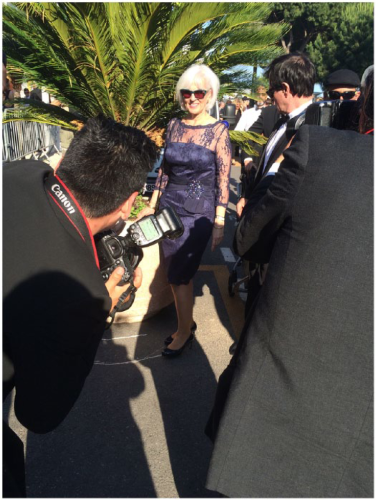
Wilfrid Rouff, A photofilmeur working in Cannes, May 2016. ©Wilfrid Rouff.
The figure of the photofilmeur and the issues he faced in the late 1940s and early 1950s help us to look in new ways both forward to our contemporary moment and back to the history of photography. The police – in France and the United States – continue to block public photography, even as they themselves turn visual surveillance on protestors and the public at large. During Occupy Wall Street protests in 2012, police routinely targeted and arrested people, including members of the press, for taking photographs and video (Gilens, 2012). The American Civil Liberties Union responded with a series of blog posts and even a short animated music video affirming people’s First Amendment Right to take photographs of whatever they want, even without the subjects’ consent, in public (Stanley, 2011; The Gregory Brothers, 2012). The right to photograph and videotape police activities – and police rejection of it – is at the heart of the Black Lives Matter movement (Mirzoeff, 2015). Reports of the Nuit Debout protests against reforms to France’s labor laws attest to similar behavior from French police and riot control forces (Moullot, 2016). The latter even checked and erased images from striking employees’ phones and digital cameras at the Cinémathèque française, the institution dedicated to the preservation of image-culture that played a key role in the development of May ’68 (Deruisseau, 2016).
In August 2016, a photographer on the beach in Nice took a picture of three police officers standing over a woman pulling a blue shirt over her head. The scene occurred just feet below the Promenade des Anglais, where photofilmeurs had snapped strolling vacationers. The woman was removing a tunic; the officers enforcing Nice’s newly instituted mayoral interdiction on the burkini, or burka-style swimsuit. The ban was already controversial when the British Daily Mail first published this photograph. As the photo went viral, the controversy became global. The mayor of Nice only fanned the flames when, in response, he called for a national law that would make sharing photos of the police illegal and those who took them eligible for legal prosecution. The idea was quickly laughed off, but the impulse behind it is simply another instance of a long history of efforts to control photography in public.
The history of the photofilmeur demonstrates that police and government hostility to photography in the hands of the ‘wrong’ public is nothing new. Digital photography and social media have changed the problem’s scale, but this resistance to public photography has roots in the who, when, and where of photography worked out in the mid-20th century. The regulation of photofilmeurs produced a precedent for arguments about photographers’ intent determining the legality of their actions. Only more research into the particular social histories of commercial street vendors will reveal how representative their French story is. The United States, after all, does not have a droit à l’image, but it does have a longstanding culture of public image litigation (see Barbas, 2015). And so perhaps these two histories are not as discrete as they appear.
In looking back at the history of photography, the photofilmeur helps to tell a new story of vernacular photographic practices and to reconsider Paris’s reputation as a capital of street photography. Commercial vendors followed the crowds who flocked to popular boulevards, promenades, and squares. In Marseille, the photofilmeur took pictures along La Canebière where people came to shop, to see a movie, to eat dinner, or to have a drink on a terrace. His outsourced snapshots were simply another part of a culture of seeing and being seen, a culture fostered by increasing household incomes and leisure time in the decades after 1945. Although photofilmeurs worked throughout France, from the Mediterranean promenades to North Sea ports, Alpine villages to the streets of Bordeaux, his presence in Paris matters most for the history of street photography, as Colin Westerbeck and Joel Meyerowitz defined it. While photofilmeurs have disappeared from view, street photography as an aesthetic category has come to occupy an increasingly visible and prestigious role in French cultural politics. The Hôtel de Ville in Paris regularly dedicates its exhibition space to free shows of mid-century street photographs by the likes of Brassaï, Izis, or the photographers of Magnum. These exhibitions link the capital’s importance today to this heritage. They promote an idea of its architecture, people, and its very culture as uniquely suited to this type of artistic documentation and experimentation. Such shows leave no room for the twin story of how commercial operators made public photography part of urban life in the mid-twentieth century and how the city tried to remove these photographers from the streets. Officials have no use for the photofilmeur – nor, thus far, have most scholars – and so the window he provides onto issues of ownership, access, competition, dissemination, technological reproduction, and public perception that are at the heart of the history of 20th- and 21st-century photography has remained shut and shuttered.
Footnotes
Acknowledgements
Thank you to Abigail Lewis for research assistance and Kim Timby, Brian Jacobson, Heather Lee, Steve Ungar, audiences at the 2016 meeting of the Western Society for French History and the 2016 PHRC conference at De Montfort University, as well as the anonymous JVC reviewers for their thoughtful feedback. Elisabeth Hulten at Seconde Vague Productions and Marie Noëlle Perrin at the Archives municipales de Marseille made this research possible. The French Initiatives Endowment Fund and MIT’s Class of 1947 helped with funding. Wilfrid Rouff, Michèle Séeberger, and Gabriel Rosati kindly allowed me to use the photos that appear here.
Notes
Address: Massachusetts Institute of Technology, 77 Massachusetts Ave., 14N-305, Cambridge, MA 02139, USA. [email: