




Abstract
This article utilizes photographs taken in Berlin just after the end of World War II to reconstruct the history of mass rape that took place in the city during this period and to argue for this event as foundational to post-war democratic political regimes that inscribed imperialism’s ruling logic within a ‘new world order’. In arguing this point, the author refuses the positivist and evidentiary frameworks through which scholars typically work with photographic images, abjuring an over-emphasis on what is or is not seen within the photographic image, instead focusing on the photograph’s affective and sonic registers, as well as other types of inscriptions in the body of the camera and emissions that require another modality of re/coding. By rereading images historically interpreted as documenting Berlin’s destruction alongside and through textual evidence of the mass rape, this analysis challenges the imperial scopic regime that has classified these images as not being photographs of rape, and connects this act of photographic erasure to the Allies’ post-war efforts to present themselves as saviors, thus legitimizing their continued imperial dominance over the world’s populations.
German cities were systematically destroyed in 1945. 1 Those who survived the aerial bombing, mostly the women among them, went through another type of violence, from the land this time. A popular axiom held that Germans had to pay for Nazis’ crimes, and women, for their part in the new world order, had to relearn the lesson of rule by men, regardless of the regime to which these men belonged. The possibility that, in the political vacuum created by destruction, women suspected the same old order hid beneath the guise of the new order, and would establish another polity amid the ruins, had to be eradicated.
Over the course of several weeks, anywhere between a few hundred thousand and two million German women were raped, including in urban spaces from which cameras were not absent, to say the least, as the destruction of buildings was carefully recorded in numerous trophy photographs. Destroyed cities were quickly crowded with photographers, some of whom acted as if nothing could stop them as they journeyed through the destruction, seeking out sights that constituted prime objects for the photographic gaze. The presence of rape, including both what preceded and followed the physical violence, did not require any special haste to detect. It was ubiquitous, but still, it did not appear as a prime object for the gaze of these photographers, in the way the large-scale destruction of cities did. In the center of this photograph (Figure 1), we can see a photographer holding his camera ready in his left hand; but in a broader sense, we also discern an interest in the photographer as a figure who is always already ready, as this same photographer becomes the subject of another photograph being taken by the photographer featured to the right. This attention to the presence of photographers in zones of war and violence is of course reinforced by still another photographer, the one who took the photograph that pictures these two photographers in front of a tank and the destroyed Brandenburg gate. But in the context of the alleged absence of photographs of rape, we can look at this photograph slightly differently, and ask, where are the photographs of rape that these photographers could have been taking in a city plagued with rape? Did they not witness these rapes first-hand, or did they choose not to use their cameras when women were raped in front of their eyes? Until the moment we encounter a ‘photograph of rape’ in post-WWII Berlin, we can use this photograph as a placeholder in a photographic archive in formation, and relate to it as a particular species: the untaken photograph of rape, the inaccessible photograph of rape or the as yet unacknowledged photograph of rape, depending on the circumstances under which the photographs were – or were not – taken, given, or disseminated, and on the position of spectator that we negotiate. For now, this placeholder can be named an untaken photograph of rape.
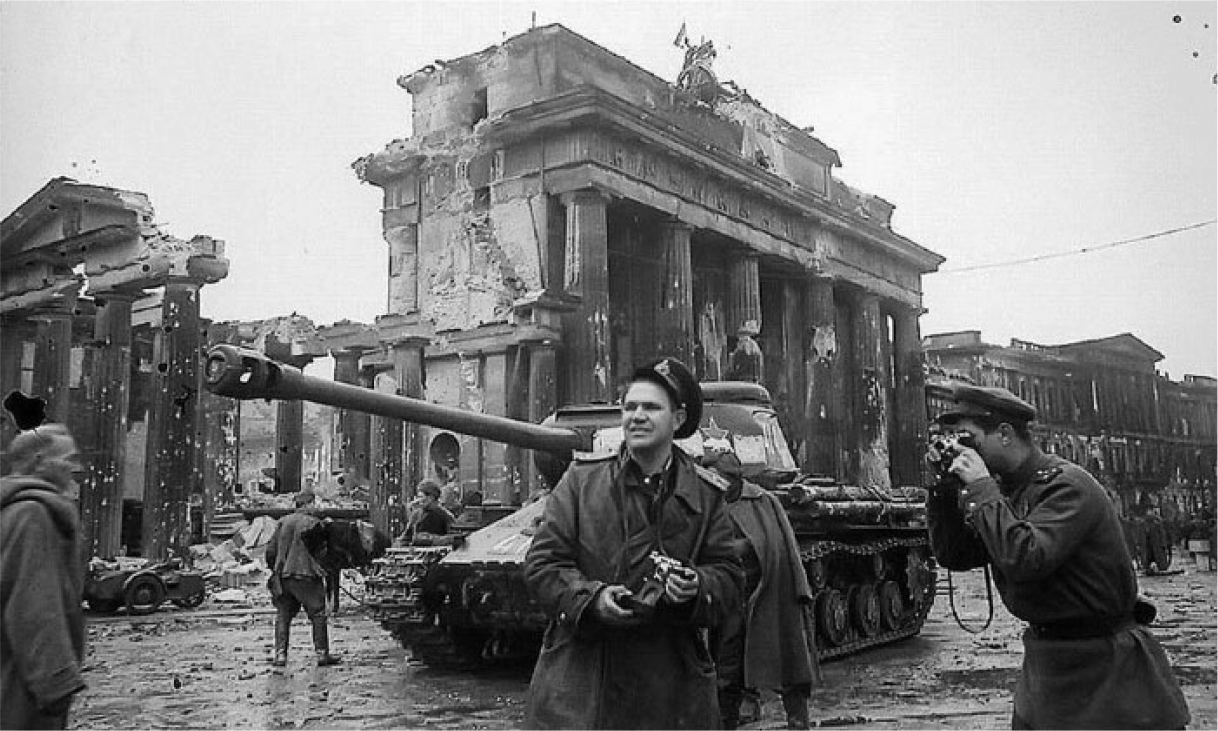
Untaken photographs of rape, three cameras, three photographers at the Brandenburg Gate, Berlin, May, 1945.
The rapes in 1945 Berlin are discussed, though not in depth or at length, in quite a few historical accounts. There is no disagreement among researchers about the widespread occurrence of rape – only about the precise number of women who were violated. To ask where the photos of these rapes are, then, is not to search for evidence that women were systematically raped. Such evidence abounds. Instead, this is an onto-political question forced upon the photographic archive, defying the priority given to photographs as the primary outcome of the event of photography, and the sanctity accorded to the frame as the boundary that determines which photographic narratives can be written. These priorities and presumptions limit what can be learned from photographs to facts, those discrete units of information which, stripped bare, are sometimes used for summary accounts – as if the most important issues were whether ‘only’ 700,000 or 800,000 women were raped in Berlin – or, more often, are dismissed as having anything to do with rape. When so many oral accounts from victims of rape describe the destroyed urban fabric and the presence of armed soldiers in the streets as the arena of their rape, we cannot refrain from asking, how come none of these photos of destruction became associated with rape? What are the expectations implied by the dismissal of these photos – that only a photograph in which a rapist or a group of rapists are captured in the same frame with an attacked woman could the photograph be recognized as a ‘photograph of rape’?
Rather than endorsing the scarcity paradigm common to archival searches and expecting that, after 70 years, during which photos from this systemic violence of rape did not circulate, all of a sudden the archive will provide us with some rare, unseen images of torn bodies, and instead of inhabiting the imperial role of a discoverer of a large-scale and known catastrophe, I limit my study to available images. After all, the aim is not to endorse the known number of raped women with photos of their wounded bodies. When we speak about conditions of systemic violence, we should not look for photographs
As with the rabbit–duck test, I propose to ask in which kinds of images this systemic rape is located, even if it remains somewhat elusive, and to attempt to bring rape to the surface of the photograph, side by side with other, more visible phenomena. Photos showing the massive destruction of built environments are my first sources in this effort. I started to read these perforated houses, heaps of torn walls, empty frames, uprooted doors, piles of rubble – all those elements that used to be pieces of homes – as the necessary spatial conditions under which a huge number of women could be transformed into an unprotected population prone to violation.
No Marks Left on the Historical Timeline
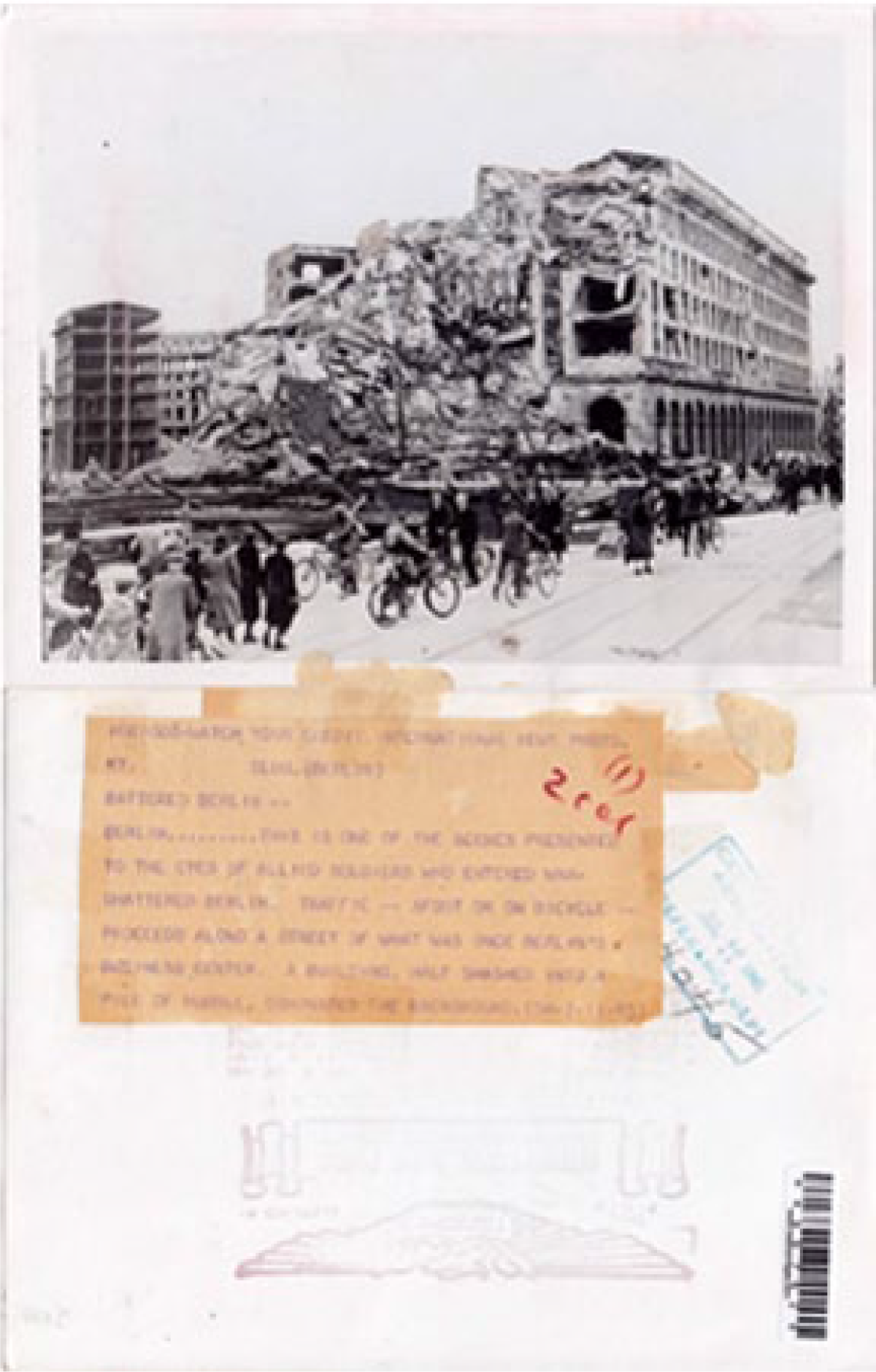
Already in July 1945, the absence of rape was constructed carefully through tropes of substitution and displacement. Here is an urban trope of displacement. The chaotic, dilapidated environment that formed the arena of systemic rape had been already remodeled and replaced by discrete destroyed objects on relatively cleansed sidewalks like the building in the photograph (Figure 2). On the back of the photo, which is titled ‘Battered Berlin’, one can read the way it was described by the agency that distributed it: ‘this is one of the scenes presented to the eyes of the allied soldiers who entered war-shattered Berlin’. This sentence deserves attention. Rather than commenting on the city that is ‘battered’, the description focuses on the way it was given to the eyes of Allied soldiers. Rather than displaying interest in the way people experienced life in their battered city, the photo caption assumes the manifest permission of those who destroyed the city to continue to seize it, administer it, and view it, and to act as if they are not the destroyers but those who come to explore, assist, and restore order. It is the use of violence that grants authority to take up certain positions, like that of the spectator, inhabited by the Allies without remorse, even though they are not just spectators but those who occupy and dominate the city, and bear responsibility for the spectacle the city was forced to perform. In accordance with the familiar imperial protocol, the plight one perpetrates becomes one’s trophy, an object of one’s gaze. The plight of certain segments of body politics or entire populations doesn’t etch historical time. Thus, a photograph taken three months after the Allies entered the city, in which women are seen walking casually in the street (see Figure 2), and not as if they had just seen their first daylight after being forced to live for weeks as ‘cave dwellers’, can be distributed as a representation of the scene the Allies first saw when they stopped bombing the city from above and entered it by foot. Weeks of terror simply do not exist in the timeline of imperial powers’ news desks. Only in a few weeks, not earlier, when women will be back on the streets, ‘hustling and bustling about’, an anonymous spectator will write in her diary: ‘I even spotted one woman wearing a hat, the first I think I’ve seen in a long time’ (Anonymous, 2000: 194). To one another, these women still seemed ‘unbelievably different’, ‘unfamiliar, older, distraught’ (p. 84), even at the time when some of the main arteries of the city were cleared from rubble, and differentiations between roads and sidewalks, private space and commons, locked indoors and open outdoors, made the street safe again for them.
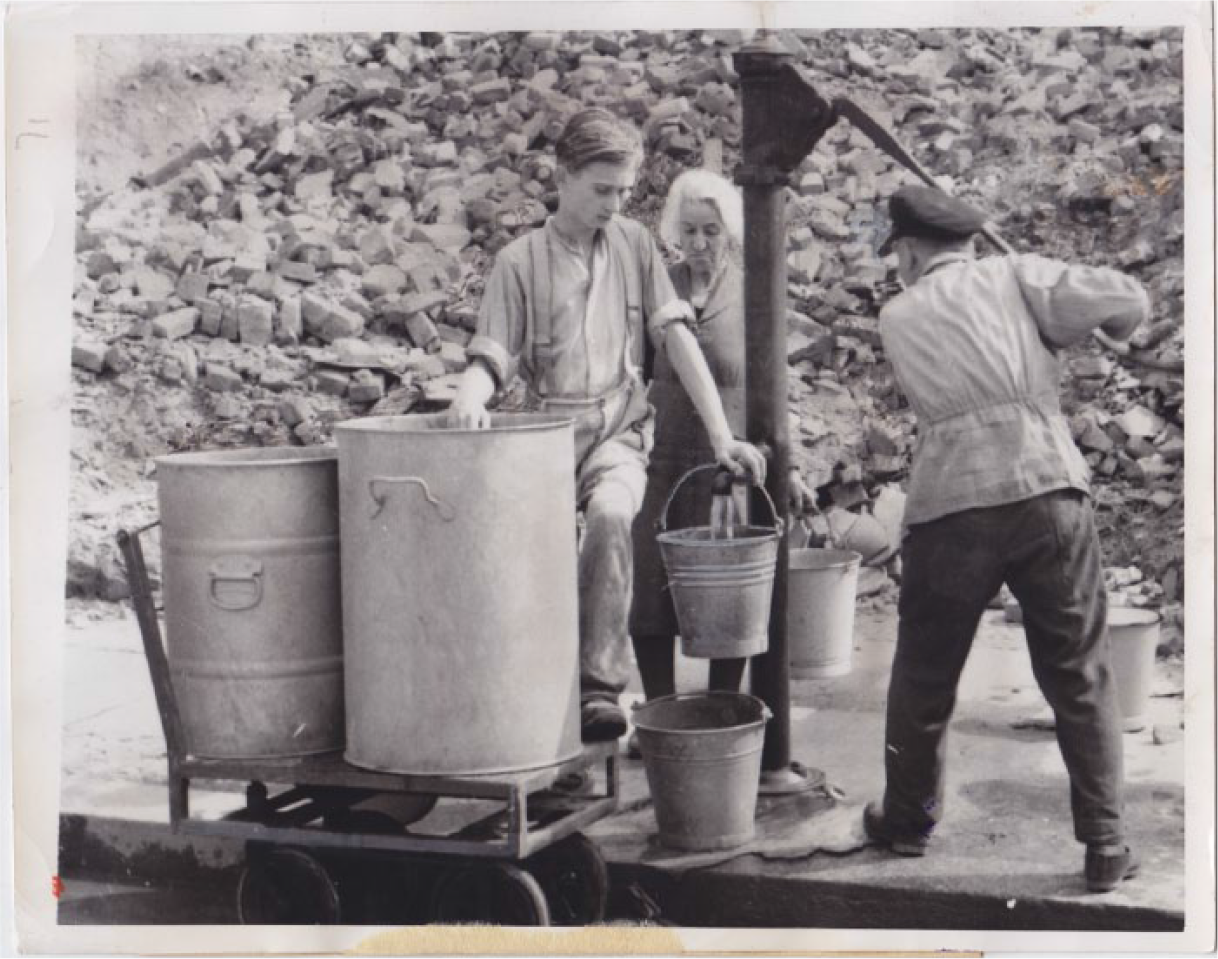
Photograph by Charles Haacker/ACME Photo, 20 July, 1945. From the news agency caption typed and pasted on photo back: ‘Pumping for water in Berlin, Germany’.
My working assumption is that when photos record the presence of well-dressed girls and women in open spaces, like in this ‘battered Berlin’ photo, we should not forget to restore their temporality and to remind ourselves that these women are in a very early moment of experiencing anew the meaning of walking in their city without the threat of being violently captured and raped, or forced to choose a cruel deal of being provided with enough food to survive in exchange for their body and work. This is a photo of a city from which the omnipresent rape was wiped out in order to clear the way for its survivors to be shaped as consumers by the Marshall plan devised for them (see Figure 2).
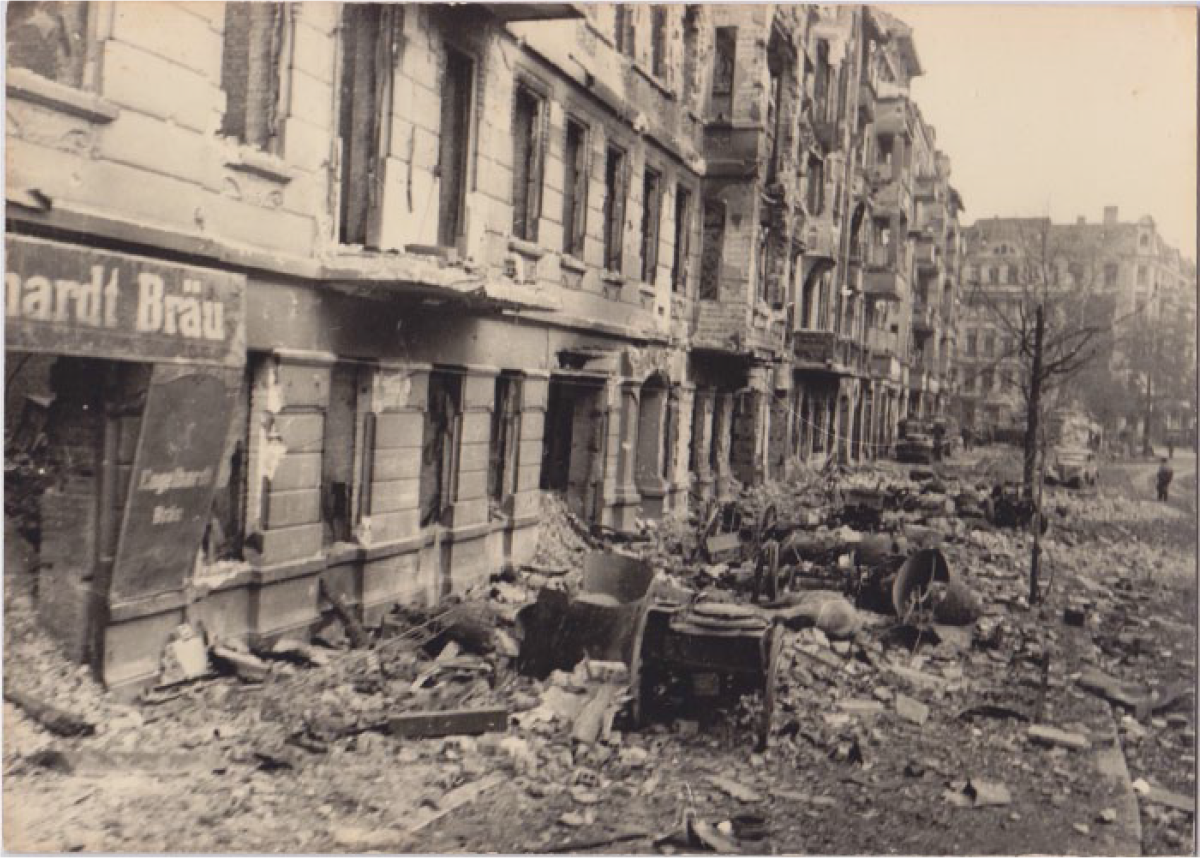
When the Allies walked into Berlin after heavily bombing it, smoke was often still hanging in the air, while the streets were carpeted with rubble, dead bodies of people and animals, and a few refugees on the run, carrying small bundles. Though these elements gradually disappeared from the city, the degree of their presence in photographs can be used as a timeline of the rape that took place in this décor. Shortly after Allied troops entered the city, the screams of women being raped or resisting rape could be heard. This sound should be associated with images where the level of rubble and density of smoke are still high. When this photo (see Figure 4) by an anonymous Russian infantry soldier was taken, women’s screams were likely still audible.
This is not a photo of a bombed city seen from above. Indeed, this article refutes merely factual descriptions like ‘bombed city’, and attempts to make such classifications unavailable for simple reiteration without criminalizing the prevalent speaking position of those who had the power to both destroy a fabric of life and promote the discursive matrix in which such violence could be justified and made into fungible patterns removed from the historical timeline. In his book On the Natural History of Destruction (2004), WG Sebald is guilty of such reiteration when he writes about the Allies’ campaign of destruction, even as he laments the scarcity of accounts on this subject:
Even in later years, when local and amateur war historians began documenting the fall of German cities, their studies did not alter the fact that the images of this horrifying chapter of our history have never really crossed the threshold of the national consciousness. (p. 11)
This ‘national consciousness’, no less a rhetorical product of imperialism than those ‘battered cities’, is comprised precisely of such images, and of their acceptability; hence it cannot be transgressed or altered by what is recorded in these images. A threshold can be crossed only when the violence documented in such photographs is reconstructed as universally unacceptable, no matter who the victims and who the perpetrators are, and no matter what the different justifications for this violence were. It is unlikely that Sebald didn’t know about the mass rape of German women in this mesmerizing décor of destruction, or about the controversy in Germany every time women sought to publicly raise the issue of those rapes and how they were silenced, as if the numerous children to whom they gave birth after these events living in Germany simply did not exist.
The photos included in Sebald’s book were never banned from circulation, nor were they unknown to Germans who collected and exchanged them in the form of postcards. The absence described by Sebald was always accompanied by an excess that renders Sebald’s gesture of (re)printing these photos a reiteration and not a first exposure. Sebald elides the meaning of such a gesture, and negligently inhabits it by not letting these reprinted images be informed by the experiences of those for whom the destroyed cities were never separated from other aspects of the catastrophe they experienced and struggled to preserve. These reprinted images were never what the Allies wanted people to see in them: ‘battered cities’ or ‘destroyed cities’. Sebald is attentive to the movement of refugees, ‘numbering one and a quarter million, dispersed all over the Reich, as far as its outer borders’ (p. 29), but oblivious to what happened to them on the roads, in the woods, in the refuges they found in their homes or along the way in tattered buildings. When photos of catastrophe are not studied, but merely made into tokens of destruction, details like the density of smoke, the height of rubble, the latter’s position in the entrance to a building, women’s grimaces, features, and clothes are neglected, and appear as more of the same. When imperial violence is made into ether, these details can be helpful in making it palpable again. After all, there are innumerable photographic records taken in imperial arenas of violence. Careful attention to smell, color, sound, and other tactile aspects is necessary to endow this etheric violence with material presence in photographic archives.
Visual documents of rape are not missing; this is just another cliché rooted in the imperial fusion of perpetrators’ points of view with neutral facts. Visual documents of violence perpetrated in the open are not missing; they should be located within available images, falsely declared not to be images of rape, even though they were taken in the same place, and at the same time, as the rapes.
Inserted in such a reconstructed timeline, Figure 4 can no longer be read as another photo of destruction, but rather as The apartment is open to a few friends of the house, if that’s what they can be called, as well as to the men Anatol brings from his platoon, and no one else. It seems that I really am taboo, at least for today. (p. 82)
The rubble that blocked buildings’ entrances didn’t stand in the way of those who came to rape women. On the contrary, the chase after women was part of the adventure:
Just when I think I’ve shaken him he’s standing next to me, and slips into the basement along with me. He shines his flashlight on the faces, some forty people altogether, pausing each time he comes to a woman, letting the pool of light flicker for several seconds on her face. (pp. 48–49)
Even though the buildings were not secure, women still preferred to stay in them rather than going outside and walking to their predators. The deserted street in this photo (Figure 4) clearly indicates this. The road is already relatively cleansed from rubble, and only one or two soldiers are seen on it.
On 9 May, Anonymous (2000: 155) wrote in her diary that she was ‘alone between her sheets for the first time since April 27’. The day before, with the help of some of their ‘protectors,’ the women were able to block the entrance of the building with a kind of door. The door restored, even if in a very vulnerable way, some semblance of privacy, threshold, choice, and order. Rapes didn’t cease at this point in time, but with some signs of order and organization, their number and frequency diminished. After some of the apartments’ doors were restored, it came time to clear buildings’ street entrances. Writing on the same morning, Anonymous continues, ‘some people equipped with heavy scoops called us down to the street, where we shoveled the pile of refuse on the corner’ (p. 155). When this photo by the Russian soldier was taken (Figure 4), some time after April 20 and not much earlier than the first week of May, rapes were still numerous.
What exactly is this photo (Figure 4)? Who took it, and why? It doesn’t seem like the dead corpse of the horse, still attached to the damaged carriage, attracted the photographer; nor did the scale of the destruction, as is clearly the case in the photo whose focus is a collapsed building. In this image, the photographer’s gaze is closer and more intimate. The photo was not taken in order to show the house or the street. It seems more like an idiosyncratic souvenir the photographer wanted to carry with him. He would have been familiar with this particular building: he probably knew how to get in and out of each of its holes, and wanted to keep some memories of the many evenings and nights he spent there with one woman or maybe many, first having to ‘grab her wrists’, ‘jerk her around the corridor’, and ‘pull her, hand on her throat, so she can no longer scream’, and later providing some vodka, herring, candles, and cigarettes after he raped her. 2 At this point, food rations were either inexistent or minimal enough to push women to choose a sort of rape-under-control in the form of a food-for-sex exchange, in the place of other forms of rape. As Anonymous (2000: 64) writes, ‘Physically I feel a little better, though, now that I am doing something, planning something, determined to be more than mere mute booty, a spoil of war.’ The photographer might be this guy, described by anonymous: ‘for out of all the male beasts I’ve seen these past few days he’s the most bearable, the best of the lot’ (p. 116). Those who succeeded to avoid rape, or its recurrence, found themselves outside of any of these providential economies. City dumping lots were rare places where they could find food (see Figure 5). The black market economy was manipulated to authorize certain people to provide women with food, and to ensure that women were not creating their own markets with their own rules. When Anonymous met with her friend, this was their exchange: ‘How many times were you raped, Ilse?’ ‘Four, and you?’ ‘No idea, I had to work up the ranks from supply train to major’ (p. 204). Under these conditions, four times could not have been enough for surviving. Not much could be found in a nearby dumping lot either. Anonymous noted ‘the people going hungry’ in mid-May, after another friend of hers biked a two-hour distance to ask for some food. ‘She herself looks pitiful; a piece of bacon. Her legs are sticks and her knees jut out like gnarled bumps’ (p. 140).
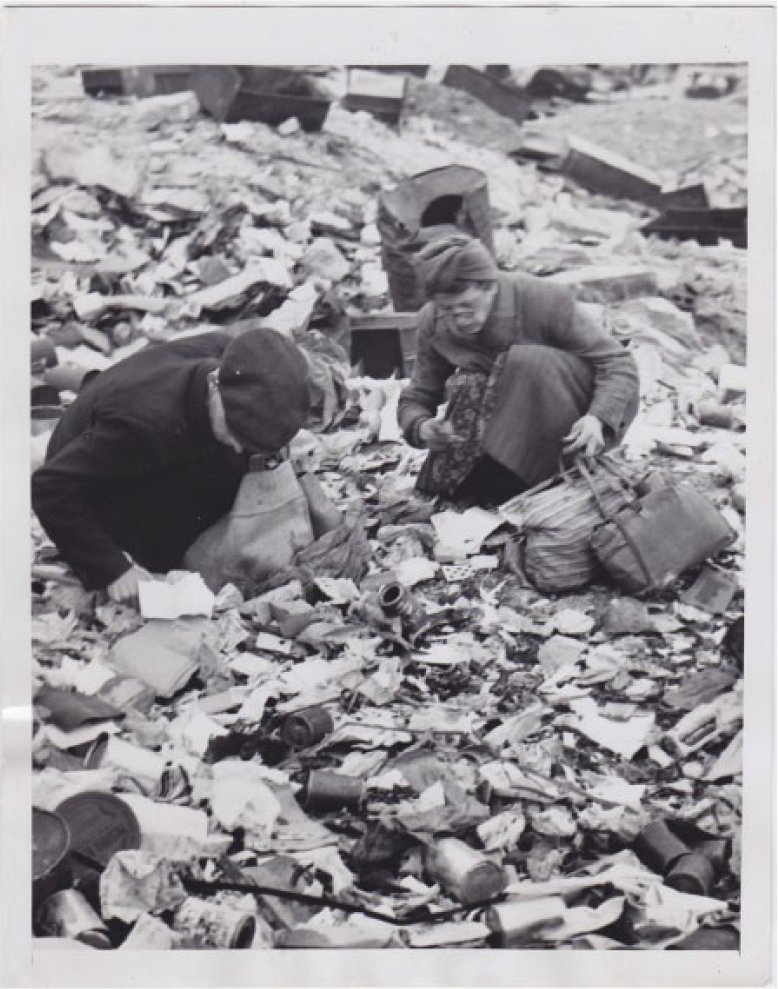
Photograph by Emil Reynolds/ACME Photo for The World Telegraph and Sun, 23 October, 1945. From the news agency caption typed and pasted on photo back: ‘Hunger - the price of defeat, Berlin…. Here two Berliners pick through the refuse in a garbage dump for scraps of food.’
There are no existing statistics, but many women preferred to shelter themselves from multiple gang rapes in these types of relationships. These men became friends, of sorts, welcomed insofar as they could prevent foreigners from intruding and raping the women more brutally. Even if this particular photo was not taken by Petka, Antol, the Major, Vanya, it was taken by another soldier from a threatening proximity for women who at that very moment when the photo was taken hide in houses that were violated.
Footnotes
Notes
Address: MCM Department, Brown University, 155 George St Providence RI 02912, USA. [email: