




Abstract
This article considers snapshot photography and affect through a reading of artist Jason Lazarus’s Too Hard to Keep. Lazarus’s project is an archive and shifting installation of anonymous photographs that donors can no longer bear to keep. It highlights the dual nature of the photographic snapshot – simultaneously banal and emotionally charged, tedious and intensely affecting, private and public, a site of cultural normativity as well as resistance. The article proposes that because viewers of Lazarus’s installations cannot know what specific feelings any of the images previously evoked, they are encouraged to contemplate shared practices of photography and the diffuse affective charge of ordinary photographs.
Keywords
A balding white man stands in a gallery (Figure 1). He tilts his head back to consider small images placed high on the wall in front of him. From the vantage one is given, behind the man, it appears that he has wrapped his arms across his chest in a kind of self embrace. As viewer, one is situated too far away to see clearly any of the images on the wall, but even at a distance one recognizes the analogue forms of photographic snapshots.
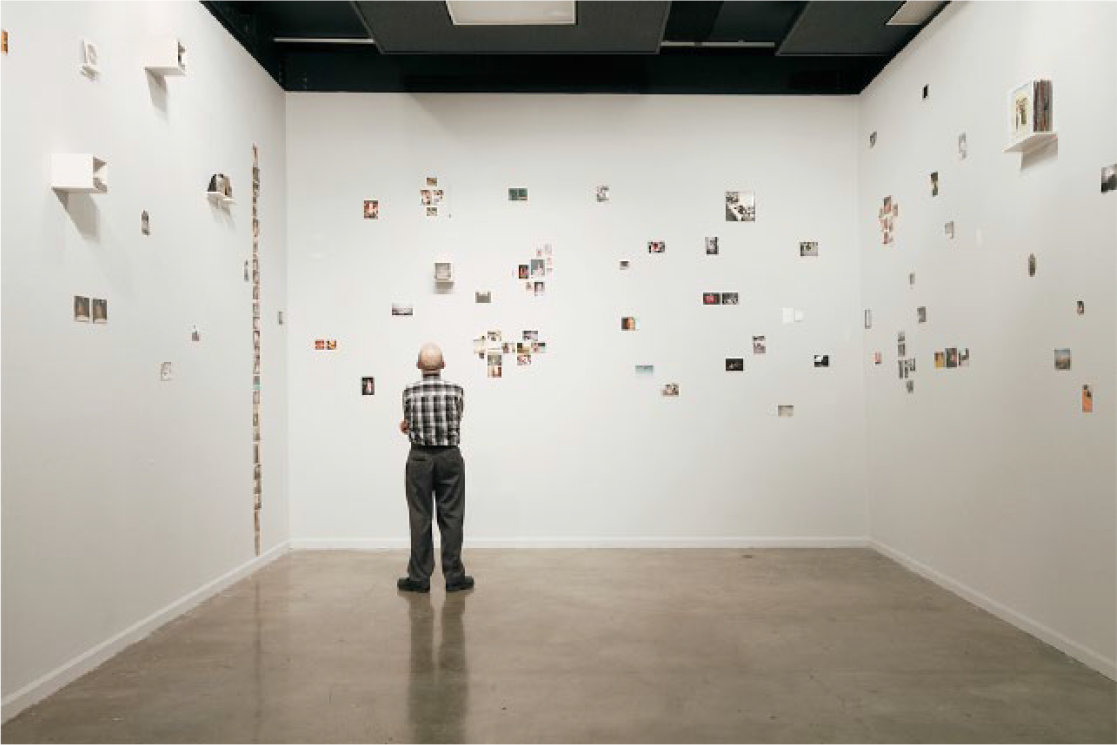
Jason Lazarus, Too Hard to Keep, Illinois State University, Bloomington–Normal, 2011.
This is an installation view of Jason Lazarus’s multi-tiered project Too Hard to Keep. In 2010, Lazarus began collecting photographs that cause people distress. He solicits submissions of images that are too hard for people to keep but too painful to destroy. Specifically, these are images ‘that are too difficult for their original owners to continue to live with because of a painful memory associated with them’ (Lazarus, 2011). Too Hard to Keep is a repository of snapshots sent to Lazarus to be stored and displayed among other affectively charged images. It is an unusual archive – ‘an archive of feelings’, to describe it in Ann Cvetkovich’s (2003) words. The project is a novel engagement with the promises and limitations of photography, the varied and shifting nature of photographic meaning, the mediation of private and public relationships, and the affective import of ordinary images.
In Lazarus’s archive and installations of donated photographs, images are no longer linked to the specific feelings of the individuals who made them, but released into the diffuse, inchoate, and shared registers of affect. 1 Because so much is unknown about the images, the installations allow viewers to think beyond their visible referents. As the particularities of signification fade, recognizable genres, as well as historical prints and technologies, come into view as shared social forms. The anonymity of the images invites viewers to consider what is unconsciously known and experienced through rituals of photographic practice. As specific feelings fade, viewers begin to sense collective affect.
To date, Lazarus has collected 5,000 images. They are mostly vernacular photographs – snapshots printed on paper – the remains of a dying form. Storing them in boxes and drawers in his home, Lazarus marks his own space with the traces of other people’s lives. The project is a generous endeavor, and the artist has said that there is ‘a lot of empathy in the work’. When asked how he came to the idea, he said, ‘I would use the archive if it wasn’t mine’, and he has, in fact, included one of his own images in the collection (2013, 2016, personal communications).
One of the most notable aspects of the photographs that comprise Too Hard to Keep is their utter banality. In general the images appear entirely ordinary, even though one knows they have become extraordinary for their donors. The project highlights the dual nature of the photographic snapshot – simultaneously banal and emotionally charged, tedious and intensely affecting, private and public, a site of cultural normativity as well as resistance. The archive underscores how the specific meanings of individual snapshots might be known only to a small circle of viewers, and perhaps even to an audience of one. But the repetition of snapshot forms, including the material formats of images and the performative registers of poses, links a vast, anonymous group of viewers in an affective community of familiar photographic practice.
*****
The Too Hard to Keep archive contains square Polaroids with bright white frames and washed out highlights, color photographs starting to turn orange, black and white pictures cut roughly with scissors, half an image torn in two. One finds young women caught in flashes smoking and drinking, sunsets snapped out of car windows, couples mugging for the camera. Among the most curious images are empty landscapes – a photograph of the sea with a tilted horizon.
A couple of the images point directly to violence – a blackened eye, a bloody nose. A few overtly suggest loss: a corpse laid out in a coffin, an elderly woman in a hospital bed. Some ask viewers to guess at horrors, and the photographs of children in this context are especially disturbing. But most tell one next to nothing about the narratives they mark for the people who once owned them.
How did these images become ‘too hard to keep’? It is impossible to say. As Lazarus has argued, ‘the darkest part of something is not in the photograph.’ Further, few of the photographs in the collection were made to record a disturbing event; most, as Lazarus notes, were ‘taken with enthusiasm, love, abandon’ (2013, personal communication). The meaning of the images has shifted over the course of their existence. They have had a before and after life. Despite the fixed appearance of the images, they have, perhaps, called forth radically different feelings for their original viewers.
Too Hard to Keep is about such shifts in photographic meaning, about the malleability of the photographic message. The import and function of the images change again as they enter Lazarus’s archive, as they join and mix with other ambiguous records, becoming markers of anonymous memories among others. This diffusion and dilution of their specific emotional triggers is part of the pleasure and relief of sending the images to Lazarus, part of the process whereby the original owner can begin to detach himself or herself from a moment of distress, from the painful redirection of a once happy story.
The project is called Too Hard to Keep, but it is also about images that are too hard not to keep, that are too hard to destroy (see also Mobley, 2013: 3). If an image is disturbing, why not shred it, or simply throw it away? Why send it to Lazarus to preserve? His archive is a strange kind of in-between place, where one can relocate something without having to ruin it, a repository that will shelter one’s melancholia even as one tries to move beyond it. In Freud’s (1957[1917]) description of mourning and melancholia, mourning is a process in which the bereaved gradually relinquishes a lost object, and is ‘healed’ by learning to live without it. Melancholia, on the other hand, is a state in which the bereaved refuses to let go, holding onto the lost object, identifying with it. Melancholia is mourning gone awry, grief that refuses to release what has been lost. In this way, as Sharon Sliwinski (2009: 210) has argued, melancholia resembles photography itself: ‘The melancholic turns away from the reality of the loss and holds onto the beloved in a hallucinatory manner – in effigy, in the truest sense of the word.’ And, as she notes, this is precisely how Roland Barthes describes the photograph in the final pages of Camera Lucida (1981[1980]). The photograph, like the melancholic, will not release its object.
By sending an image to the Too Hard to Keep archive, the mourner can loosen his or her grip on the photograph, and thereby relax the hold of melancholia, without fully letting go. The archive offers donors a way to mourn but to maintain a bit of melancholy too. What one has given away is not lost, just kept by someone else, preserved in a drawer along with other fragments that are too hard to keep, and too hard not to.
The meaning of the images shifts yet again as they are displayed for anonymous viewers in Lazarus’s installations in galleries and museums. To produce the installations, the artist inhabits a given place for two or three days, creating site-specific works that respond to the proportions, flow, and feel of a space. The exhibitions are generally sparse, small constellations of images gathered against blank walls. In Liège, Belgium, the installation occupied a shallow alcove divided by long glass windows (Figure 2). Lazarus scattered snapshots across the light gray walls, arranging images almost down to the floor and up to the edge of the recessed ceiling. Many are placed too high or too low to be seen comfortably by viewers standing in the gallery. In the exhibition, tiny shelves support framed images and albums. Small white boxes hold neat stacks of prints. A few of the images are mounted face to the wall. Eleven images are clustered together, suggesting a connection between them. Others float alone on the wall, or in pairs, or in looser associations, as if a kind of gravitational force is beginning to pull them together.
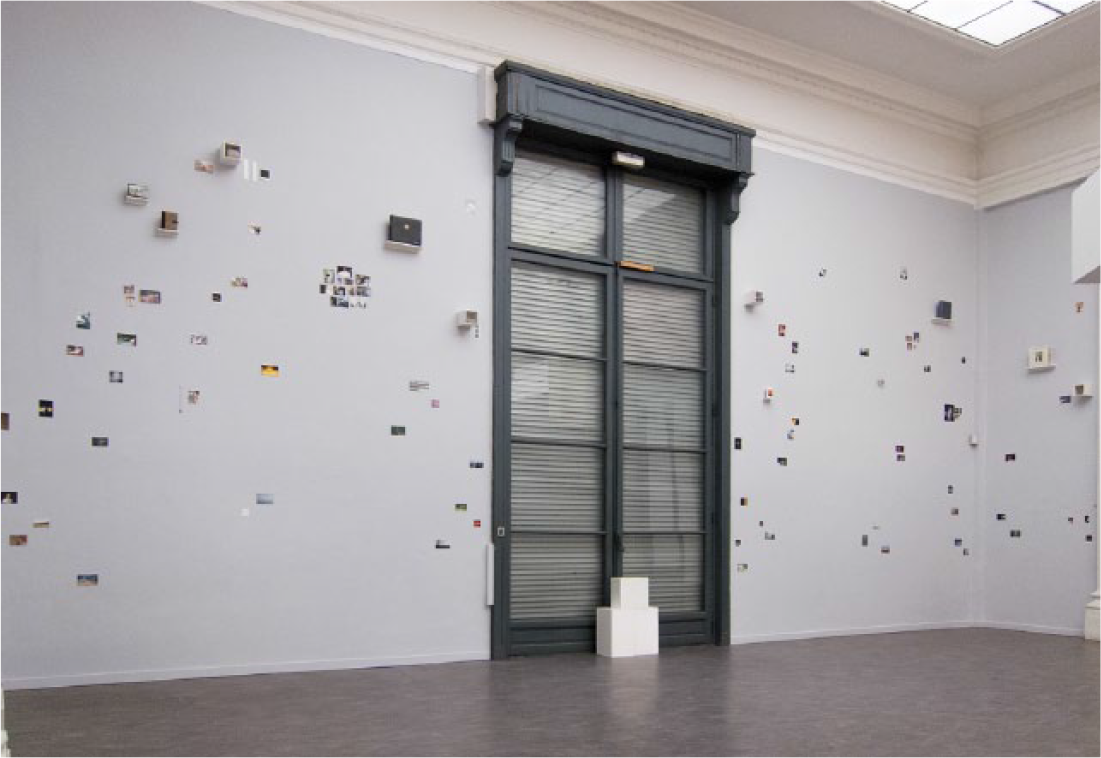
Jason Lazarus, Too Hard to Keep, Liège, Belgium, 2012.
A poetic sensibility guides the arrangement of the images. Although Lazarus calls the collection an ‘archive’, he does not gesture toward institutional forms in his displays. The organizing principle of this collection is a felt one. The photographs are presented just as they are, usually small, sometimes worn, adhered to the wall without borders or frames or labels. This presentation highlights both their material and ephemeral qualities. Historians of photography, as well as most Americans over the age of 40, will recognize shifting photographic technologies and forms in the installations: the black and white snapshot, the 4 x 6-inch glossy color print, the square Polaroid, the long narrow photobooth strip, the Sears portrait, the school picture, the canister of undeveloped film.
In the installations, the negative spaces, the wide expanses left around the images, underscore how much one does not know about the photographs, how much they refuse to tell, how inadequate and partial they are as traces (see also Solomon-Godeau, 2013: 57). The sparseness also highlights how much one asks of photographs, regardless of how misguided one’s faith in them might be. People depend on these tiny fragments to hold import they cannot contain. And yet, Lazarus’s display also has a light touch. The installations do not overwhelm. One senses a generosity in the anonymous sharing of images, and in the artist’s willingness to preserve these delicate traces for others.
Not knowing is also underscored by the images facing the wall (Figure 3). These photographs demonstrate how little the visual content of the images actually matters. They are not invisible exactly, but opaque. They are rectangular scraps of paper that signal photographs but do not serve their purpose, photographs that no longer function as images. As blank ciphers, the photographs facing the wall invite viewers to project their own images onto them. They function as mysteries or as screens, asking viewers to provide them with narratives and meaning. But actually, these off-white squares and rectangles are not quite blank. As Kendra Paitz (2013: 74) has argued, ‘Though emptied of a photographic visuality, the private submissions are replete with the visuality of the photographic process.’ They are mechanically printed with dates and the company names of photographic papers, and some have handmade marks on the back – dates, places, and other notations. In many ways, the photographs that turn their backs to viewers emblematize all of the images in the collection – they are signs that remain largely indecipherable in their specificity, but call attention to the mechanical and material history of snapshot photography and its circulation and exchange.
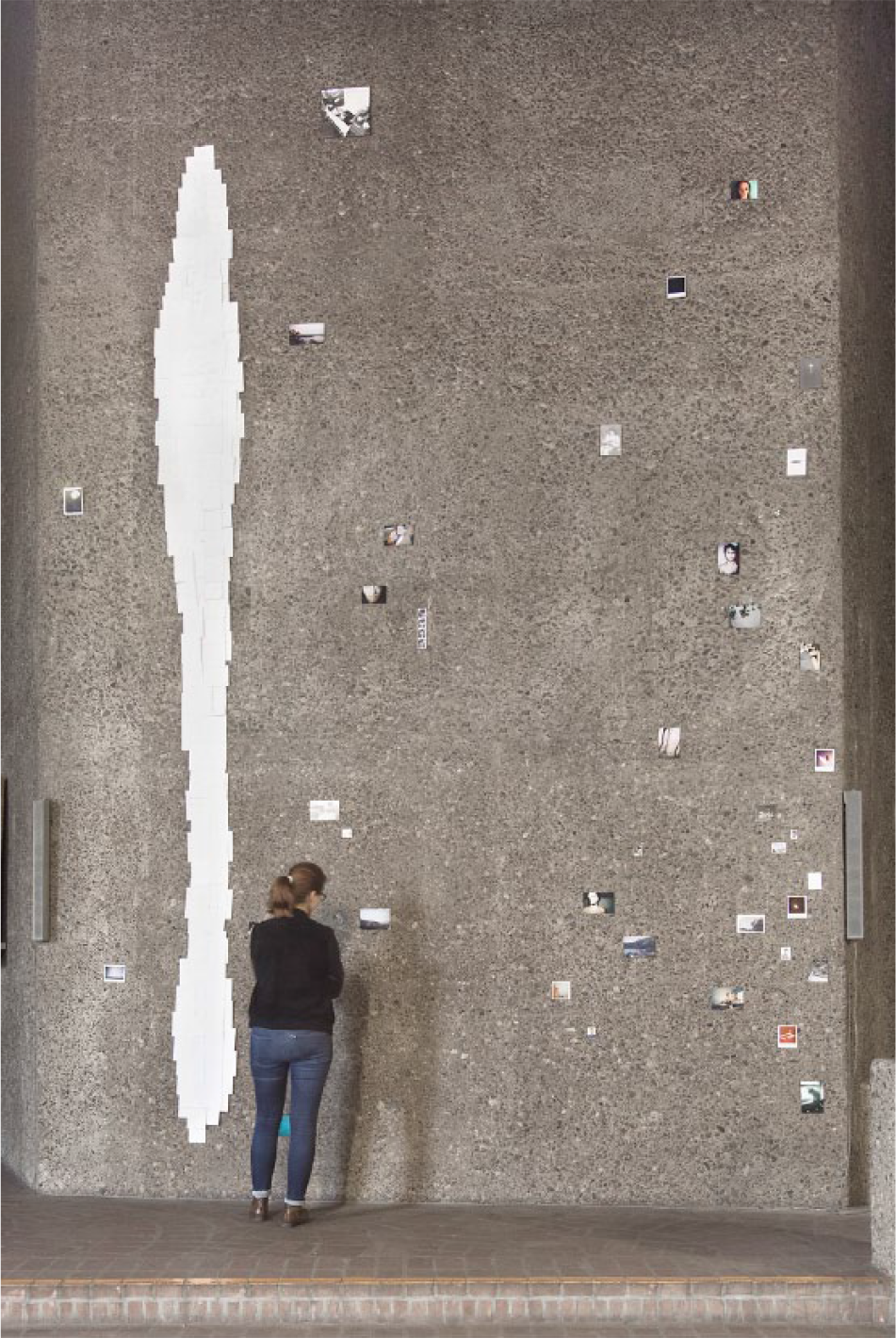
Jason Lazarus, Too Hard to Keep, Cologne, Germany, 2016, showing a large group of images facing the wall.
Too Hard To Keep makes apparent how much of photographic meaning is located not in images but in viewers. An image that seems utterly boring to one person might signal joy or anguish for another, because, as Catherine Zuromskis (2013: 8) has argued, ‘The amateur snapshot photograph is the site of both banal conformity and deep affective response.’ Lazarus’s installations illuminate Margaret Olin’s (2012: 17) claim that how photographs look may be less central to their meaning than how people look at them. The photograph is a prompt that solicits an unspecified response. What Cvetkovich (2003, 2014, 2016) has said of objects in general pertains to photographs as well, ‘value resides in our attachments to things, not in the things themselves’ (2016). Affect activates photographs, readying them to focus the disparate feelings of viewers.
For Lazarus the project is not about loss, but about collectivity. He has said he would like it to have ‘lots of sentiment, without being sentimental’ (2013, personal communication). In part, the very banality of the photographs helps to build a sense of imagined community because one understands these vernacular images as shared cultural forms. There is a sense of play in recognizing genres and artifacts one has seen, experienced, or made. In this way the installations demonstrate how groups of photographs can ‘create a community or the illusion of one’ (Olin, 2012: 129). The images do not ask viewers to ‘feel someone else’s pain’, indeed they obscure the stories they mark. Instead, the installations ask viewers to acknowledge unknown but perhaps familiar struggles through the recognizable and shared cultural forms of snapshot photographs.
As the photographs enter the archive and then are displayed in installations for anonymous viewers, the particularity of the feelings they evoke fades. Indeed, the very lack of specificity, its diffusion, helps to inspire a collective impulse in viewers. Individual events are not legible in their distinctiveness. The photographs are both specific and general, inaccessible to anonymous viewers in their precise forms, but recognizable as common cultural objects. Not knowing what any specific image signifies in a narrow sense allows viewers to acknowledge and project shared experiences of loss, disappointment, happiness, elation, embarrassment, anger, and transformation. The recognition of shared practice taps into the affective potential of photographs that may or may not trigger specific feelings in viewers.
The legibility of images that remain indecipherable in specific terms is the effect of a collective repetition that informs the practice of snapshot photography. Many people compulsively repeat the gesture of photographing at socially scripted moments, at holidays, birthdays, weddings and graduations. These are symbolic cultural moments in which the specific event is subsumed by the more important cultural repetition, and snapshots made at such celebrations work in the same way to make the personal conform to social practice. Just as one repeats these rituals, one repeats their photographic documentation; indeed, as a number of scholars (Bourdieu, 1990[1965]; Zuromskis, 2013) have noted, the act of photographing becomes an essential part of the ritual itself. As Pierre Bourdieu (1990[1965]: 19) proposed, popular photography serves community, and especially family, cohesion, making the group visible to itself as a group. In many ways, photography defines the group, making it legible according to broader social codes. One photographs moments of transition to mark the group and also to reassert its coherence in the midst of change.
The repetition of ritualized acts of photography also marks the photograph’s inadequacy. One’s photographing is never complete, never enough. One repeats these performances to stave off future loss. It is a repetition compulsion that precedes an anticipated trauma.
Photographs also exceed the grasp of their subjects and makers in the extended reaches of what Ariella Azoulay (2011: 75) has called ‘the event of photography’. Although Azoulay considers images made (or not made) under radically different political circumstances, her insight that the event of photography supersedes the photograph itself might also be brought to an understanding of ordinary snapshot photography. Lazarus’s installations call attention to the endless character of ‘the snapshot event’, to the ways in which the meaning of an image changes over time and under different conditions, and always depends on who is looking. Further, his work extends an understanding of the meaning and effects of images beyond the shifting registers of circulation to include the inchoate and unconscious registers of affect. Lazarus’s work brings the snapshot event into view as collective photographic practice animated by ordinary affects. 2
The images collected in Too Hard to Keep are the residues of altered narratives and feelings. If the one who knows the transformation a snapshot measures can no longer bear it, he or she can send it to Lazarus. In doing so, the image is detached from personal feelings and can take on a new life and new resonance, brushing up against the fragments of other people’s stories and calling upon a new audience of unknown viewers who may recognize the image in different ways. If the snapshot is about inscribing one’s particular experience into larger cultural narratives, Lazarus’s installations allow viewers to understand themselves as part of a larger, anonymous community founded in the practice of photography, its shared material forms and affective potentialities.
Footnotes
Notes
Address: School of the Art Institute of Chicago, 112 S Michigan Avenue, Chicago, IL 60603, USA. [email: