



Abstract
In the post-Civil Rights late 1960s, the Black Panther Party (BPP) artist Emory Douglas created visual messages mirroring the US Western genre and gun culture of the time. For black people still struggling against severe oppression, Douglas’s work metaphorically armed them to defend against daily injustices. The BPP’s intrepid and carefully constructed images were compelling, but conversely, they motivated lawmakers and law enforcement officers to disrupt the organization aggressively. Decades after mainstream media vilified Douglas’s work, new generations celebrate its prescient activism and bold aesthetics. Using empathetic strategies of reflecting black communities back to themselves, Douglas visualized everyday superheroes. The gun-carrying avenger/cowboy hero archetype prevalent in Westerns did not transcend deeply embedded US racial stereotypes branding black people as inherently dangerous. Douglas helped the Panthers create visual mythology that merged fluidly with the ideas of Afrofuturism, which would develop years later as an expression of imagined liberated black futures.
Keywords
In 1966, Huey Newton, Bobby Seale and other young people in Oakland, California, organized around the police killing of a black teenager named Denzil Howell. The group named themselves the Black Panther Party for Self-Defense and challenged police brutality directly, in their communities, creating a new iteration of the American Western avenger. The Panthers’ visual presentation referenced deeply embedded cultural myths and subverted them to appear familiar and astonishing at the same time. Their followers and detractors alike recognized these young people’s charismatic appeal and were either intrigued or threatened by it – sometimes both. As G Louis Heath wrote in 1976, the Panthers were ‘blessed with a theatrical sixth sense that enabled them to gain an audience and project an image [that] frightened America’ (p. 214). The leaders of the Black Panther Party (BPP) had almost everything required of mainstream American heroes in the late 1960s. They were intelligent, handsome, strong, coolly irreverent, well-read and well-dressed men with guns, but they were black. 1 Emory Douglas, as the BPP’s Minister of Culture, art director, artist and illustrator, specifically helped the Panthers to create new visual mythology mirroring the pervasive televised and cinematic avengers of the Western, superhero, and sci-fi genres as an expression of imagined liberated black futures.
Douglas’s creative direction and individual artwork in The Black Panther newspaper visualized black people using guns as protection against police brutality and other vulnerabilities. Response from the mainstream majority-white US society ranged from alarm to terror. Even though the US was founded by revolution and expanded by violence, 2 after creating a methodology for achieving international liberation featuring trained gunmen and women, members of the BPP were perceived as an imminent threat. Douglas continually incorporated provocative or frightening (depending on the point of view) images of guns and their mythological associations into the party’s visual communications. As he said in a 2004 interview, ‘There were all kinds of guns out there during that period’, referring to the late 1960s when the Western genre and cowboy ethos occupied the public imagination and popular media (Douglas, 2004). The Western cowboy myth evolved into science fiction and space exploration in tandem with the US space program, swapping the fabled Wild West for potentially more democratic fantasies involving unknown planets and beings.
Through the party’s newspaper, BPP leaders visualized imagined agency that would eventually create conditions for sustainable, even thriving black life in the US. In the background of all BPP initiatives was their idea of utopia. Various manifestos and their Ten-Point Program and Platform outlined a clear and specific vision for justice. For example, the 1972 version of the Ten Points included basic human needs and desires such as ‘1. We want freedom. 2. We want full employment for our people.’ Point number 10 demanded, ‘We want land, bread, housing, education, clothing, justice, peace and people’s community control of modern technology’ (Newton, 1999). In recognizing technology’s eventual omnipresence, Douglas and other BPP artists anticipated Afrofuturism, which would not be named until decades later. Alondra Nelson, author of Body and Soul, which examined the BPP’s health initiatives, and edited a 2002 volume on Afrofuturism, described its ideas as, ‘[looking] across popular culture … to find models of expression that transform spaces of alienation into novel forms of creative potential. In the process, it reclaims theorizing about the future’ (Nelson, 2000: 34). Although Black Panther newspaper images were arguably transgressive in their portrayals of armed conflict, the BPP’s simultaneous optimistic imaginings of a just future made them progressive at the same time.
The Panthers were part of a broader militant Black Power movement, inspired by Stokely Carmichael of the Student Nonviolent Coordinating Committee (SNCC), Malcolm X, Franz Fanon, and other international black thought leaders. The Civil Rights Act, guaranteeing fundamental rights to African Americans, was just two years old in 1966 when the Black Panthers formed. Until then, non-violence and passive resistance were the most effective tactics against racist police brutality that was explicitly or tacitly condoned by politicians and elected officials. Black Power leaders in the US broke with this tradition by aligning with international freedom fighters in a transformative worldwide liberation movement. The Black Panthers eventually diverted from a black nationalist ideology that drove most of the Black Power movement. They allied themselves with the goal of global liberation for all people, eventually calling their liberation theory ‘revolutionary intercommunalism’ (Bloom and Martin, 2013: 312).
Douglas’s images of black people confidently wielding guns visualized a shift from the Civil Rights movement’s restraint to the empowerment of threatened armed resistance. As Carmichael expressed in a 1966 speech: The only time I hear people talk about nonviolence is when black people move to defend themselves against white people. Black people cut themselves every night in the ghetto – don’t anybody talk about nonviolence. Lyndon Baines Johnson is busy bombing the hell out of Vietnam – don’t nobody talk about nonviolence. White people beat up black people every day – don’t nobody talk about nonviolence. But as soon as black people start to move, the double standard comes into being. (Carmichael, 2003[1966])
Leigh Raiford, who traced the role of photography in the black freedom struggle, points out that ‘The Panthers did not set out to be a ghetto police force. Rather, they set out to show people what a ghetto force might look like’ (Raiford, 2011: 172). Likewise, in ‘The Correct Handling of the Revolution’, BPP Minister of Defense Huey Newton summarized the strategy behind arming the community: The main function of the party is to awaken the people and teach them the strategic method of resisting a power structure which is prepared not only to combat with massive brutality the people’s resistance but to annihilate totally the Black population. The end result of this revolutionary education will be positive for Black people in their resistance, and negative for the power structure in its oppression because the party always exemplifies revolutionary defiance. If the party does not make the people aware of the tools and methods of liberation, there will be no means by which the people can mobilize. (Foner, 1995: 42)
Serving as material manifestations of Newton’s prophecy, Douglas’s visualizations in The Black Panther of armed black people defending themselves were aspirational rather than documentary. However, in their time, these images and rhetoric were perceived by politicians and law enforcement organizations as literal threats and instructional orders inciting people to actually kill police and politicians. Late 1960s mainstream media presented the Black Panthers as the Al Qaeda, ISIS, and MS-13 gang of their time. They were branded thugs and instigators of violence – armed and dangerous. The US House of Representatives even published a staff study on Internal Security on 6 October 1970 devoted entirely to the BPP’s newspaper, complete with an index containing 26 pages of drawings and 3 pages of photographs, all created or supervised by Douglas (United States Congress, House Committee on Internal Security, 1970).
Despite their criminal characterization, the Panthers were entirely within their legal rights when they showed up at the California State Capitol in Sacramento to protest the impending 1967 Mulford Act, designed to enact strict gun control laws. The state’s governor – Ronald Reagan – was on the grounds of the Capitol at the time, greeting a school group. When word got out that Black Panthers with guns were present, the students were hustled off and Reagan ‘hastily deserted the youngsters … and hightailed it to the security of his offices’ (Bloom and Martin, 2013: 60). The NRA (National Rifle Association) supported the Mulford Act, which contradicted its subsequent positions on gun control (Sullum, 2014). However, in fact, the NRA’s mission statement dovetails with the Black Panthers’ intentions: To protect and defend the Constitution of the United States, especially with reference to the inalienable right of the individual American citizen guaranteed by such Constitution to acquire, possess, collect, exhibit, transport, carry, transfer ownership of, and enjoy the right to use arms, in order that the people may always be in a position to exercise their legitimate individual rights of self-preservation and defense of family, person, and property, as well as to serve effectively in the appropriate militia for the common defense of the Republic and the individual liberty of its citizens. (National Rifle Association, Guidestar)
Similarly, the Black Panther Party’s 7th Point in their 1966 Ten-Point Program stated that: We believe we can end police brutality in our Black community by organizing Black self-defense groups that are dedicated to defending our Black community from racist police oppression and brutality. The Second Amendment to the Constitution of the United States gives a right to bear arms. We therefore believe that all Black people should arm themselves for self-defense. (Foner, 1995: 3)
Other parallels between the organizations included an emphasis on public safety and training in the handling of arms. 3 The Black Panther newspaper regularly featured articles with instructions about gun safety and proper use (for example, 13 May 1971: 13).
Preparing a concerted message of real-life actions, writing, and images in the BPP newspaper, the party formulated the second phase of their agenda – providing services for people in poor and underserved communities. The Panthers created schools, clinics, food banks, and famously started the now institutionalized school breakfast programs. According to some FBI insiders, J Edgar Hoover, then director of the FBI, was more threatened by the idea of the Panthers gaining trust in their communities and organizing with other groups to broaden their message’s reach than he was about a massive armed uprising (Rhodes, 2007: 184). The real danger would be that black people and other marginalized groups would lose faith in government and police systems, and create their own, insulating them from control by hegemonic institutions (Bloom and Martin, 2013: 241).
Two cartoons from the BPP newspaper (Figure 1) reproduced in the 1970 Congressional document show policemen as anthropomorphized pigs who have been shot by armed revolutionaries, presumably Black Panthers. Distraught police-as-pigs are projectile crying: huge tears fall copiously from their closed eyes. Douglas portrayed them as contemptible non-human beings, with flies hovering around them as an index for the dirt and smell of their bodies, thereby reversing the racist trope of animalizing black people as monkeys and stereotyping them as unsanitary. Over years of drawing pig cartoons, the word ‘oink’ was often repeated in the background as if permeating the air with staccato noise for receivers of a visual image, reminding them that the police were pigs, according to the Panthers and other leftists at the time. The US government failed to see any humor in the cartoons and regarded the images as direct threats to law enforcement. Hoover designated the Panthers ‘the greatest threat to internal security of the country’ (Rhodes, 2007: 184). The Congressional report quoted Douglas from The Black Panther, ‘… our pictures must show fascist judges, lawyers, generals, pig policemen, firemen, senators, congressmen, governors, presidents, etc., being punished for their criminal act against the American people and the struggling people of the world’ (US House Committee on Internal Security, 1970: 19).
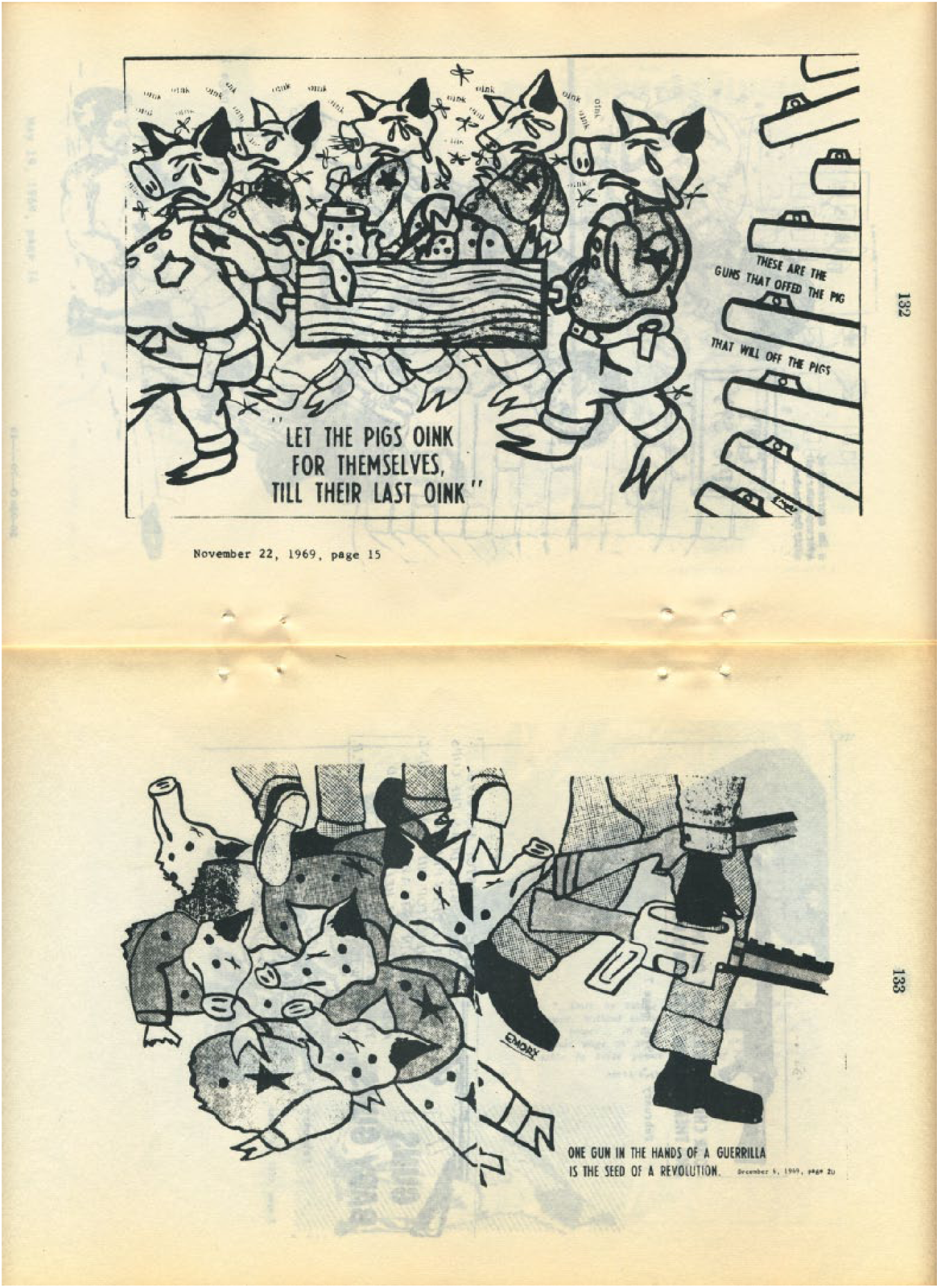
Spread from Staff Study by the Committee on Internal Security, House of Representatives, 6 October 1970: 132–133. Images © 2018 Emory Douglas/Artists Rights Society (ARS), New York.
Another critical intervention culminates in the high visibility of armed women in the pages of the BPP newspaper, despite women being somewhat absent from the pervasive mental image of party members. Normalizing the idea of armed women, one of Douglas’s most famous and reproduced images is a BPP newspaper back-page poster showing a determined armed black woman wearing a bright yellow button that reads ‘self-defense’ and wielding a bright yellow, deliberately oversized gun (Figure 2). Her finger rests on the trigger, ready to shoot. Here Douglas’s signature heavy dark lines and use of rub-down background patterns reference the Pop style of 1960s artists like Roy Lichtenstein. It is an irony that traditional artists appropriated the tools of commercial art and Douglas brought the style full circle back to the inexpensive production methods of black and white art on newsprint with spot color. Douglas used his commercial art skills to interpret party principles and ideology ‘in the most simple and obvious form’ (Douglas, 1968: 5). His images served two purposes: ‘to illustrate conditions that made revolution a reasonable response and to construct visual mythology of power for people who felt powerless and victimized’ (Gaiter, 2014: 96). The drawings and much of the writing in The Black Panther newspaper were intended as motivational propaganda anticipating an imagined future, but the guns were available and real. The Black Arts movement poet, playwright, activist and friend of Douglas, Amiri Baraka, accurately described the paradox of Douglas’s images by writing: Emory’s art was a combination of expressionist agitprop and homeboy familiarity. I always felt that Emory’s work functioned as if you were in the middle of a rumble and somebody tossed you a machine pistol. It armed your mind and demeanor. Ruthlessly funny, but at the same time functional as the .45 slugs pouring out of that weapon. (Baraka, 2007: 180)
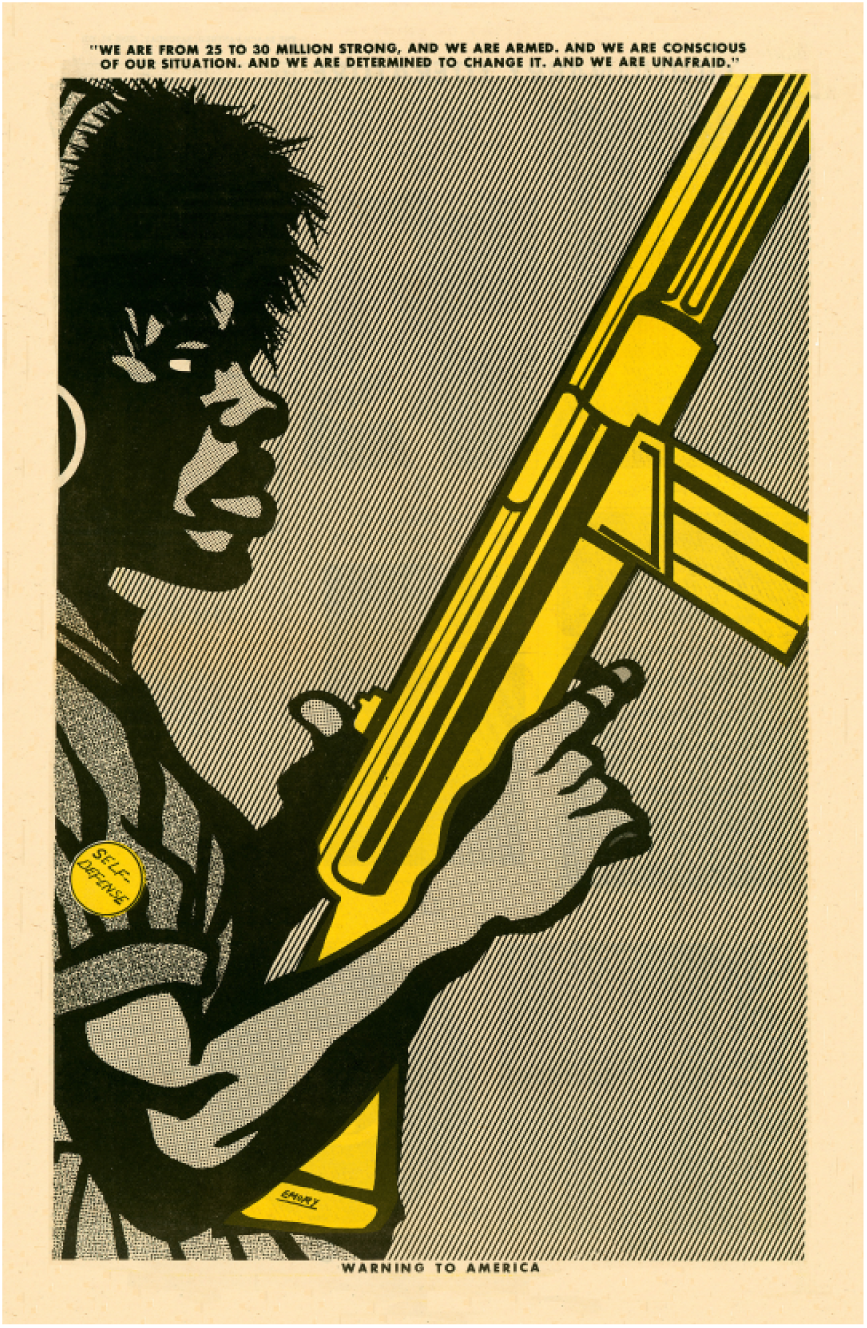
Emory Douglas, Warning to America. Back page poster. The Black Panther newspaper, 27 June 1970. Images courtesy of Emory Douglas. © 2018 Emory Douglas/Artists Rights Society (ARS), New York. Photo credit: Photo courtesy of Emory Douglas/Art Resources, NY.
Most of the guns wielded in the pages of The Black Panther newspaper were ‘long guns’ – rifles, shotguns, machine guns – more intimidating and lethal than handguns. The infamous AK47 or Kalashnikov rifle is a perennial and iconic signifier of ideological armed resistance. The Kalashnikov, writes CJ Chivers (2010: 9), ‘marks the guerrilla, the terrorist, the child soldier, the dictator, and the thug – all of whom have found it to be a ready equalizer against morally or materially superior foes’. In formal visual terms, its distinctive trigger design and geometric shapes make it an attractive and easily identifiable object. Douglas also used these guns to signify international solidarity, as AK47s were the preferred weapon for global freedom fighters against colonialism, militarized dictatorships, and soft occupations. 4
In addition to visually referencing Kalashnikov rifles to align the Panthers with international revolutionaries like armed Maoists portrayed in Chinese propaganda posters, Douglas’s armed everyman/everywoman alluded to the distinctly American cowboy archetype. Ideologically, the Black Panthers did not share the politically conservative values of Westerns – especially the rationalized genocide of Native Americans. However, the idea of cowboys as heroes was embedded in the American collective unconscious because of the Western’s popularity (Cantor, 2012). Have Gun – Will Travel, the popular American TV show which ran from 1957–1963, featured a private detective/bounty hunter for hire named Paladin. The character challenged traditional cowboy tropes by wearing all black clothing and a black hat, mixing the two Jungian archetypes of outlaw and hero. Paladin stepped in as a hired gun when the law failed, and aggrieved parties had the resources to circumvent the legal establishment. His character’s behavior aligned with the idealized rugged individualism required of a hero in a Western but circumvented the law when the sheriffs and courts did not bring justice (p. 90). In those situations, Paladin was required to use his gunman’s skills to be the true champion of the weak when the authorities failed (p. 60).
The show’s premise and popular following attest to tacit American approval of vigilante tactics, but only under certain circumstances. Protecting people and avenging injustice was only for those perceived as deserving of a detour around the law and potential risks. This American West myth also depended on gun power: ‘By the 1700s guns had replaced swords as the main weapon favoring European invaders over Native Americans and other native people’ (Diamond, 1997: 73). Fascination with guns references collective mediated memories of a Wild West that had to be ‘tamed’ – a euphemism for containing or eliminating Native people. To be seen as heroes in the American mid-century popular imagination, protagonists in Western stories had to be smart, facile with their guns, and white.
Mass-mediated representations of black men and journalistic coverage of the Black Panthers showed that the American Western ‘righteous avenger’ myth did not transfer to black people fighting centuries of oppression resulting from slavery in the US. One example is how conservative pundit William F Buckley challenged the BPP and their methods in a 1971 New Yorker essay. Buckley criticized black comedian and activist Dick Gregory’s defense of the BPP (as providing a sense of safety and security for black people who felt under siege) by accusing the party of spreading ‘poisonous rhetoric with which they seek to infect the interracial dialogue [with] racism’ (Buckley, 1971: 38). Naming calls for black power and self-defense ‘racism’ was a rhetorical tactic used to undermine the Panthers and other Black Power advocates, especially those who did not rule out violence in pursuit of equality. Images of black people pointing guns at colorless (presumed white) pig policemen produced a visceral reading of ‘racism’, even though it was the police who regularly implemented racist practices with relative impunity.
Douglas’s images and Have Gun – Will Travel expanded entrenched cultural ideas about villains and heroes while looking to the future, along with two other cultural products released in 1966: Star Trek, and Marvel’s latest comic, Black Panther. Gene Roddenberry worked on both television shows, writing 24 episodes of the Western and working in other areas of production. Well known as the creator of Star Trek, Roddenberry’s work moved frontiers – from the US West to space – ‘the final frontier’. In his essay titled ‘The Original Frontier’, Paul Cantor (2012: 62) points out that: Star Trek offered a vision of the future in which an intellectual and specifically a scientific, elite will heroically bring the benefits of technology and the liberal idea of freedom and democracy to backward peoples all around the galaxy – whether they happen to want these benefits or not.
Additionally, Stan Lee and Jack Kirby of Marvel Comics created the Black Panther comic book character to correct the lack of [non-white] superhero representation – just months before the founding of the BPP. The name of the character was completely coincidental and ‘to avoid controversy, Marvel briefly changed the name to Black Leopard but later realized that just didn’t have the same oomph’ (Betancourt, 2018). The pair of comic creators – both white and Jewish – had brought awareness of civil rights to their work before. In 1963, they created X-Men, who, while drawn as white, faced discrimination for being mutants. ‘Professor Xavier was seen as a Martin Luther King figure, while his friend-turned-enemy Magneto took a by-any-means-necessary, Malcolm X-like approach to prejudice.’ Like Douglas and Roddenberry, Lee and Kirby used visual vernacular and popular culture to introduce somewhat radical to revolutionary political ideas in familiar media forms.
The motion picture and television genre of the Western (Kuhn and Westwell, 2013) is a uniquely American idea tied to the country’s particular geography and history of invasion. TV Western dramas declined at about the same time as the US Civil Rights and later Black Power movements gained momentum. Perhaps the cowboy ethos could not persist in an environment of increasing liberalism, awareness of inequality and the reality of how classic Westerns portrayed Native people. 5 Popular culture stories reflected prejudices and racist ideas of ‘others’ who were branded as dangerous and predatory. Using force seemed necessary to keep black people enslaved and to protect slaveholders from the possibility of that force being reversed, which occurred in slave rebellions in Haiti and the Virgin Islands (Lundy, 2004). As evidence of this imaginary’s persistence, a 2017 article in the Journal of Personality and Social Psychology posited that ‘black men tend to be stereotyped as threatening and, as a result, may be disproportionately targeted by police even when unarmed’ (Wilson et al., 2017: 59). This same perceptual misreading by law enforcement and the general public motivated the Black Panther Party for Self Defense, and the Black Lives Matter movement, which started almost a half century later in 2013.
Douglas’s work on The Black Panther newspaper may have been performing a ‘chronopolitical act’ – visualizing situations that did not exist to encourage their eventual realization, which is an essential element of science fiction and Afrofuturism (Bennett, 2016). All cultures and societies need myths to explain the unexplainable and to maintain the story of their values and beliefs. The Black Panthers did not see the American Dream as a relevant myth for black people, so they created their own heavily illustrated mythology. Fifty years later, Emory Douglas is still a visual activist, traveling around the world to assist in securing rights for people in places like Australia, New Zealand, Chiapas, Mexico, and Palestine. He is also a celebrated artist, recognized by the establishment art world that would have labeled his work too volatile to show until almost 40 years after its creation. The Panthers’ ultimate public demise in the early 1980s - after being strategically targeted by the FBI and local police while struggling with internal conflicts – changed their images’ perception to historical artifacts that are no longer current threats. Tempering effects of time and change allow room for more unbiased appreciation of this body of visual work, notable for both its content and aesthetics.
Juxtaposing Douglas’s work against the genre Western Have Gun – Will Travel and Star Trek charts an evolution in black social thought that parallels changes in US mainstream popular culture. A theoretical line connects Roddenberry’s Western Have Gun – Will Travel to the science fiction/humanistic drama of Star Trek, to Marvel Comics’ Black Panther superhero, to The Black Panther newspaper’s version of everyday black life, to the 2018 Black Panther film. All of these texts deviate from standard US hero narratives and hegemonic cultural mythology to challenge embedded ideas about race, justice, heroism, and morality. Through their images, Emory Douglas and the other BPP artists visually armed a conceptual revolution, creating more space for African Americans in the 1960s and 70s to imagine a global liberated future.
Footnotes
Notes

Address: University of Delaware, 104 Recitation Hall, 22 E Main St, Newark, Delaware 19716, USA. [ email: