




Abstract
This article focuses on the vertical visioning of the bridge as a visual icon of the global city in urban planning, specifically the Bandra-Worli sea link in Mumbai. The author contends that the sea link, launched in 2019 as a way to connect the southern part of the city with its western suburbs, participates in aerial visual significations in which views from above partake in framing of the urban metropolis as an essential aspect of the nation-state’s global modernity aspirations. By analyzing the recurrence of the sea link through a variety of visual illustrations, he suggests that views of the sea link through omniscient perspectives tether urban experiments of modernity to forms of aspirational city planning that are deemed both axiomatic and necessary for urban dreams of development. He contends that ‘reparative’ work in visual culture assumes a task beyond the exposure of ‘unequal scenes’ if it is to grapple with the material contexts of urban repair and redistribution of resources. Rather than views from above or looking from below, the article theorizes a notion of reparation through the ontology of the edge – one that offers speculations of hope beyond the neoliberal logics of infrastructural futurity.
In the ongoing visual project Unequal Scenes, South African photographer Johnny Miller uses drone technology to capture urban landscapes from aerial perspectives in various cities across the globe – Mumbai, Mexico City, Nairobi, San Francisco, and Detroit, just to name a few. Miller’s purpose in photographing these views from above is to expose, in his terms, the ‘scars within our urban fabric’ (Miller, 2018) that get naturalized as already existing geography – an inevitability that erases unequal histories or the calcified arrangements of urban planning. From the all-seeing awareness of vertical perspectives, Miller’s photographs appear to reveal what cannot be purportedly gleaned from the views at ground level. Even while the images are shot in different cities, they all share repeated formal patterns that recur through the photographic series: neglected and makeshift slums line the outskirts of sleekly chiseled condos; haphazard barren dots of undeveloped spaces are juxtaposed against the unvarying geometries of skyscrapers; pristine and verdant golf courses sit adjacent to the sprawl of informal settlements; homeless encampments and tents line the architectural borders of majestic bridges. Aerial logics function as the visual mechanisms through which these glaring disparities get magnified. If Unequal Scenes functions as a kind of self-described ‘multimedia storytelling’, then the task of the vertical visual perspective is that of an omniscient narrator who exposes hidden truths or ‘scars’ to its audience/readers. Aerial photography is thus a visual agent of defamiliarization – a social barometer that more glaringly points to scales of difference in its views from above. In Miller’s own words: ‘By placing a non-human photographic actor – in this case, a remote-controlled drone – above these liminal spaces, a new vantage point is reached, previously reserved for the government and the very rich.’ Miller concludes the description of Unequal Scenes by suggesting that the series constitutes ‘an act of defiance’ against spatial divides and urban inequalities, rendered so stark by aerial perspectives. For Miller, the views from above contravene those power structures ‘that keep these inequalities hidden so well’. From the vantage point of aerial distance, the seemingly covert inequalities are thus exposed and unveiled.
I begin with Miller’s project as an entry point into this article since one of the series of photographs in Unequal Scenes focuses on contemporary Mumbai, India (see Figures 1 and 2) – the geographic and geopolitical site of my inquiry into the relation between visual culture and reparative practice. In Miller’s panoramic tableaus of class conflict and income inequality, it is not surprising that Mumbai occupies a prominent focus, given the glaringly obvious class divides that inform the city’s urban landscape (exemplified most obviously in the stark differences between slums and skyscrapers). In the images of Mumbai, the jigsaw-shaped haphazard slums of Dharavi sit adjacent to the manicured frames of Bandra-Kurla complex’s verdant squares. The visual representations are described by Miller as a ‘strange’ assemblage of ‘industry and grinding inequality’. Through their high-angle visual perspectives, Miller suggests that these images ‘make inequality relevant’, i.e. ‘people can see themselves reflected in the images, and it’s deeply unsettling.’ The view from above confers what Rey Chow (1998: 23) calls a kind of ‘projectional idealism’ in its professed ability to expose hierarchies of difference in urban landscapes, specifically in the Global South context of Mumbai, India.
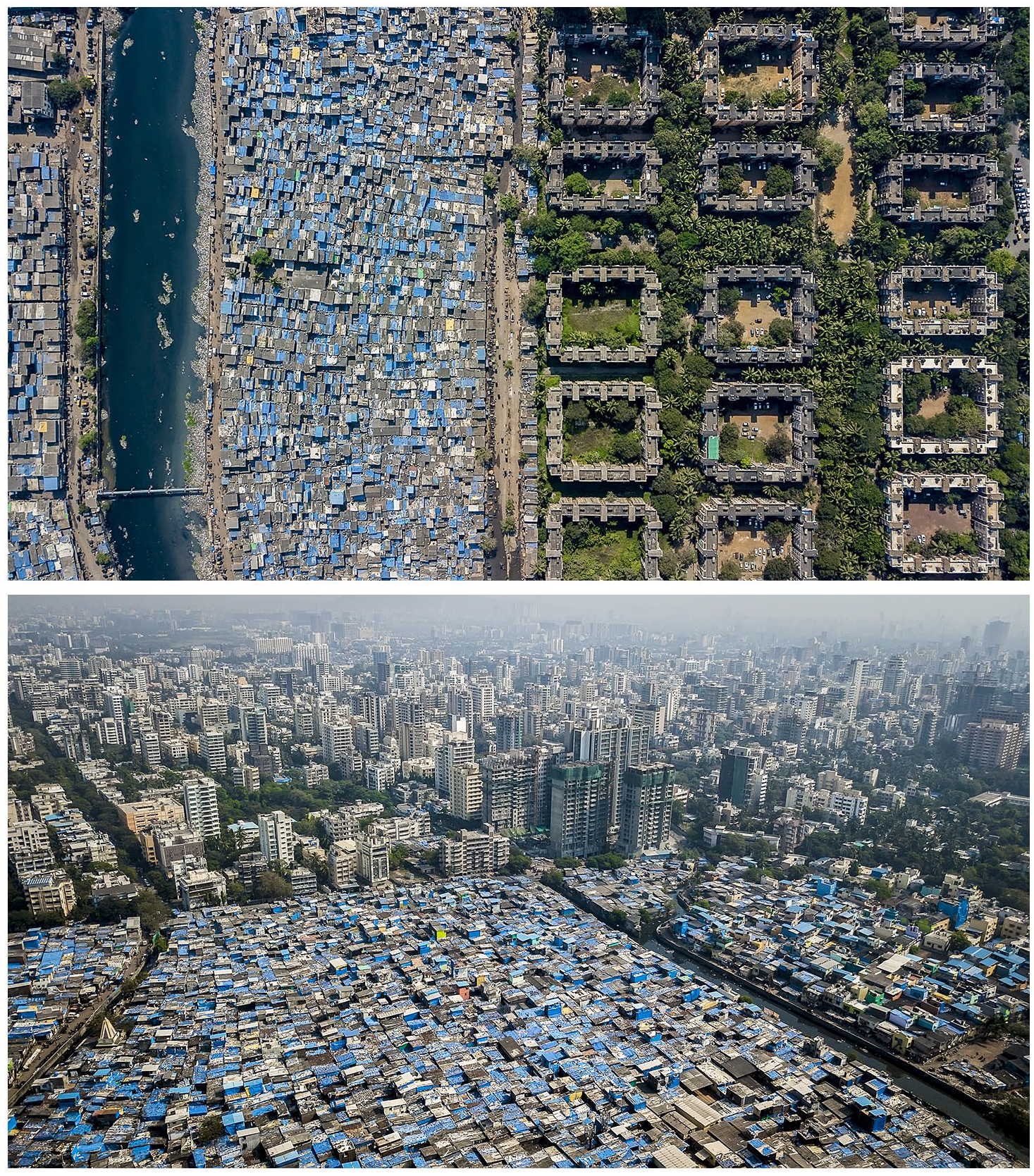
Unequal Scenes Project. Johnny Miller/Unequal Scenes. Reproduced with permission.
This article offers a counternarrative to Miller’s suggestion that the logics of aerial omniscience offer a more proximate relation to ‘defiant’ modes of knowledge production. Adjacent to Miller’s privileging of aerial logics, I focus on the vertical visioning of the bridge as a visual icon of the ‘global city’ in urban planning, specifically the Bandra-Worli sea link in Mumbai. I contend that the sea link, launched in 2019 as a way to connect the Southern part of the city with its Western suburbs, participates in aerial visual significations that do not contravene ‘unequal scenes’ – in fact, aerial views of bridges from above partake in framing of the urban metropolis as an essential aspect of the nation-state’s global modernity aspirations. By analyzing the recurrence of the sea link through a variety of visual illustrations, I track aerial visions from above in multiple senses of the term. Panoramic perspectives capture the grandeur of the sea link in all its majestic glory, literally visioning the city from above. But these are also ‘visions’ in another sense of the term in that they index particular kinds of aspirational desires and neoliberal experiments for the city and, by implication, for the nation-state as well. The urban city is thus the site of local/national revivalism that paradoxically is implicated in the flaunting of global credentials. These seemingly contradictory visions for the city are marked by what Ananya Roy (2011: 259) has called ‘a violent expansion of the urban frontier’ that is justified by the mandates of modernity and logics of development framed as an inevitable necessity.
Aerial views of bridges from above function as crucial visual signifiers of these justifications. To visually frame the city from above the aerial expanse of bridges becomes a way to aesthetically naturalize urban initiatives as essential tasks for the future of a developing nation and its aspirational ‘worlding’ practices. In their theorization of urban experiments that mark metropolitan Asian cities in the 21st century, Ananya Roy and Aihwa Ong (2011: 12) refer to the notion ‘worlding’ as a set of ideological practices that are particularly germane to urban centers in the Global South. Ong describes worlding practices of cities as a set of relations ‘that creatively imagine and shape alternative social visions and configurations’. In Ong’s definition, she emphasizes the role of aesthetics in these visionary projects of remapping the city. She thus writes: There is a mix of speculative fiction and speculative fact in worlding exercises as practitioners aim to build something they believe is for the better. It seems important to register that such creative and contingent activities are at the core of urban innovation and that tinkering with a spectrum of urban ideas and forms is an art of being global. (p. 12)
The art of being and becoming global is thus tethered to image-making and the visual form: to look at the cityscape from above; to take in the expanse and scale of bridges across urban space and time; and to apprehend the connection of discrete geographies from aerial views. These forms of seeing and looking become crucial visual technologies for the worlding of the city.
In their theorization of worlding, Ong and Roy are careful to foreground how this art of globalism is paradoxically strongly tethered to and shaped by the local. In theorizing global aspirations, they are thus also careful not to frame globalization through the lens of ‘planetary capitalism’ (p. 6), i.e. a hierarchical system of global capitalism that produces universalizing effects on a docile local. Rather than analyzing the worlding practices of Asian cities as ‘weak products of Western urbanism’ (p. 310), they propose a framework that recognizes, in Roy’s words, modes of ‘fractal geography’ attending to ‘private jurisdictions and territorial interests’ (p. 326) that do not simply emerge from top-down circuits of power. The worlding of cities is inevitably shaped by ‘world-class’ global aspirations, but their material forms have as much to do with the domestic parochialisms of the local and the negotiations of their governing practices with economic policies, legal systems, and religious practices. In thinking about the worlding practices of a metropolis like Delhi, Roy thus calls for the ‘provincialization of urban theory’ (p. 310), i.e. an attention to the ‘homegrown’ configurations that track the contradictory and fractal logics of the city’s spatial geographies and aesthetic appearance through practices such as slum clearance, suburbanization, visual beautification, zoning laws, and the privatization of public land.
Reparation and repair
For the purposes of this article, I am interested in thinking about how ‘worlding’ of the urban centers through aerial visual logics serves as a replacement system for reparative practices during neoliberal times of the Indian nation-state. Before understanding the specific material context of this ideological substitution, it might be useful to unpack what ‘reparative’ means for my theoretical purposes. First, the idea of ‘reparative practice’ signals a critical hermeneutic or a practice of reading, in Eve Sedgwick’s (2003) theorization of the term. Eschewing faith in projects of hermeneutic exposure, reparative readings move beyond paranoid reading’s investments in the exposure of bad news of oppressive power structures. Paranoid readings are those that ultimately only confirm what is already known or anticipated; they foreclose any consideration of those reparative critical practices that consider more hopeful engagements with alternative possibilities of thinking and organizing. Paranoid readings obscure questions around the performativity of knowledge production – ‘what does knowledge do’ and for whom (p. 124). The act of exposure becomes a theoretical end in itself. As a result, paranoid readings, writes Sedgwick, ‘may have made it less rather than more possible to unpack the local contingent relations between any given piece of knowledge and its narrative/epistemological entailments for the seeker, knower, or teller’. For example, Miller’s exposure of radical class disparity fails to move beyond the confirmation of what is already visible. The co-existence of extreme wealth with abject poverty in Mumbai is not exactly hidden or insidiously obscured. The exposure of disparity through drone footage, while rendered spectacular in its aerial vantage point, purports to demystify that which is already known.
Sedgwick’s formulations on reparative frameworks, while conventionally theorized in relation to reading practices, aesthetics, and hermeneutics, has important material implications in thinking about how theories of the visual subtend an understanding of power differentials and the uneven distribution of life chances. Take, for example, this often-overlooked passage in Sedgwick’s analysis of reparative reading practices and its racialized implications on theorizations of state-sanctioned violence: . . . the force of any interpretive project of unveiling hidden violence would seem to depend on a cultural content . . . in which violence would be deprecated and hence hidden in the first place. Why bother exposing the ruses of power in a country where, at any given moment, 40 percent of young black men are enmeshed in the penal system? In the United States and internationally, while there is plenty of hidden violence that requires exposure there is also, and increasingly, an ethos where forms of violence that are hypervisible from the start may be offered as an exemplary spectacle rather than remain to be unveiled as a scandalous secret . . . What does a hermeneutics of suspicion and exposure have to say to social formations in which visibility itself constitutes much of the violence? (p. 140).
The above passage offers useful ways to think about the relevance of critical reparative hermeneutics to actual material practice, i.e. the rearrangement and redistribution of resources as a way to not simply ‘expose’, but to actually repair racist logics of dispossession. Sedgwick’s critique of a hermeneutics of exposure acquires new resonances in the contexts of the state-sanctioned police killings of George Floyd and Brianna Taylor (among various others) in which the visual documentation and veracity of police violence on film does not axiomatically translate into reparative justice. For example, the call for more police reform via body camera video footage as a way to expose the already known facts of anti-Black racism functions like a convenient smokescreen for the more radical and reparative projects of abolition – an end to policing and prisons that would also involve the radical redistribution of resources away from what Eric Stanley et al. (2012: 116) call ‘law and order fantasies’ and into universal healthcare, housing, and education. The challenge to paranoid reading practices that fixate on projects of unveiling open up more hopeful and politically imperative reparative logics, i.e. deeper considerations on how to repair and divest from carceral logics of policing and punishment. As Saidiya Hartman (Artforum, 2020) reminds us: ‘The possessive investment in whiteness . . . requires a radical divestment in the project of whiteness and a redistribution of wealth and resources. It requires abolition, the abolition of the carceral world, the abolition of capitalism.’
While the links between prison abolition and reparative hermeneutics remain beyond the scope of my purposes, I emphasize this relation via Sedgwick’s essay to refuse any simple distinctions between epistemological, aesthetic, and political considerations subtending theories of reparation. To mobilize Sedgwick’s critique of paranoid readings more explicitly for my purposes, I want to thus ask: To what extent does the ‘exposure’ of unequal scenes from aerial drone imaging unveil the violence of inequality? Instead of building bridges, what might it mean to abolish them (to invoke Hartman’s polemic), if ‘building’ always already serves the interest of bourgeois aspiration? How could this act of ‘abolishing’ bridges be construed of as a reparative practice? What might a more reparative visual practice allow beyond the exposure of urban ‘scars’? How does the nation-state mobilize and co-opt such exposures in the service of ‘worlding’? The idea of Mumbai as an urban space of radical contrast is not a hidden secret that awaits critical exposure. Instead, it is a technology of the state in which violent class hierarchies and parochial forms of nativism are reduced to benign bromides around the city’s contradictory idiosyncrasy and capacious character, i.e. the ‘multitudes’ that Mumbai contains that allows slums and skyscrapers or sea links to co-exist in proximity and ‘seamless’ harmony with one another. The visual aesthetics of radical difference, exposed as ‘scandalous secret’ through aerial footage thus performs the ‘art’ of being global for the ‘world-class’ city.
The phrase ‘art of being global’ offers a useful conduit through which reparation as critical hermeneutic (in Sedgwick’s sense of the term) indexes a more explicitly material practice. The visual aesthetics of globalism tether urban experiments of modernity to forms of aspirational city planning that are deemed both axiomatic and necessary for worlding dreams of development. The building of bridges like the sea link are thus infrastructural projects that facilitate mobility, but they also constitute idealized visual icons of globalization. The sea link in Mumbai was designed by an international consulting company Dar Al-Handasah and sponsored by Maharashtra State Development (See Figure 3). Justified as a way to alleviate the bottleneck of congestion and overcrowding that is typical of Mumbai, the building of the sea link was part of several infrastructural transport initiatives undertaken by the state government to modernize the city in a post-liberalization milieu. In thinking about the art of globalism as a worlding premise, I want to suggest then that ‘reparation’ in the context of the sea link assumes quite literal connotations of infrastructural repair. In The Promise of Infrastructure, Nikhil Anand, Akhil Gupta, and Hannah Appel (2018: 2) suggest that ‘infrastructure is a terrain of power and contestation: To whom will resources be distributed and from whom will they be withdrawn?’ When infrastructure is a placeholder for understanding the distribution of reparative practices, structural abandonment can be understood as a requirement of the city’s modernity aspirations instead of simply an unintended consequence. The sea link is thus an important visual icon for Mumbai and its worlding aspirations precisely because it can function as repair under the guise of development and infrastructural investment. But this putative investment in infrastructure functions to replace actual reparative practice in the form of, for example, attending to uneven electricity and water supply in slums, fixing broken sewage systems in areas where toilets and clean water seem perpetually out of reach, or reducing income gaps to pre-empt homelessness and informal settlements in the first place. In Sedgwick’s theorization of reparation, she suggests that ‘hope’ is one of the organizing features through which the reparative reader organizes fragments into ‘something like a whole’. In replacing the reparative practice of re-assembling or redistributing of resources with the worlding practices of infrastructural development, the reparative promise of ‘hope’ gets transformed and co-opted into a mode of what Appel (2018: 45) calls ‘infrastructural time’ that is structured by delay and temporal lags – ‘a kind of infrastructural futurity that is more akin to deferral’. Drawing on Ann Stoler’s analysis of imperial logics, Appel suggests that these forms of urban delay ‘mete out promisory notes’ that appear to offer hope for cleaner and shinier futures. But these forms of pseudo-reparative hope are simultaneously ‘haunted by abandonment’ (p. 45). Reparative logics that are invested in repair or economic redistribution get absorbed into speculative visions of the world-class city. Aesthetic considerations subtending these visions are intimately braided with the economic. Architectural speculations such as the sea link thus also index a form of speculative capital that is central to a post-liberalized Indian economy. In ‘Concrete Geographies’, Andrew Harris (2013: 357) contends that ‘Mumbai’s success as a world-class city relies on a new physical terrain being created that eases and quickens the travel of foreign investors through the city and accordingly facilitates an accompanying influx of capital.’
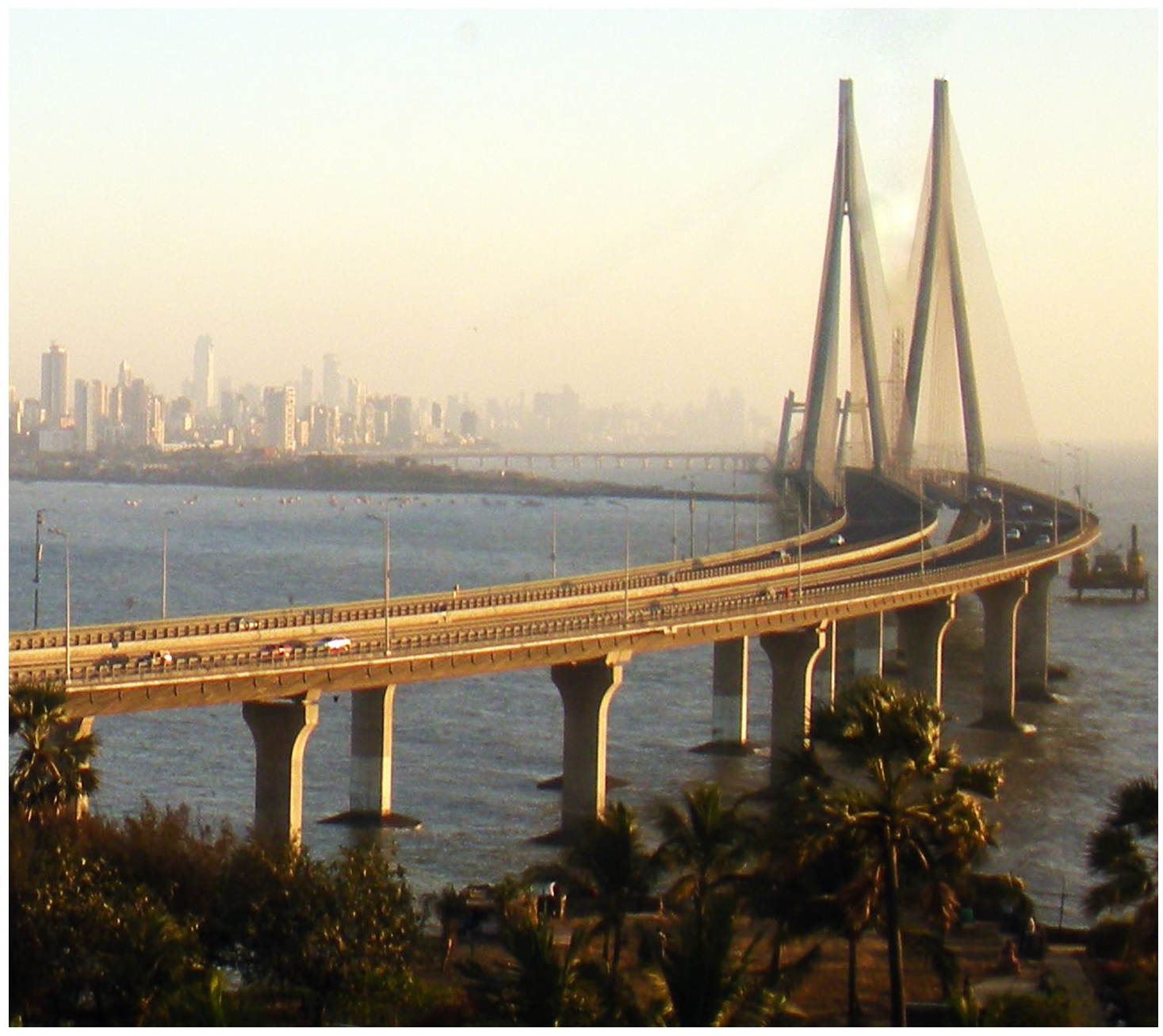
Worli Skyline (Mumbai) with Bandra Worli Sea Link View, 9 March 2011. Available at: https://www.flickr.com/photos/woodysworldtv/5530750545/sizes/o/
The sea link, quite literally facilitates and accelerates the pace of speculative capital in how it connects Mumbai’s international airport with the rest of the city – a crucial conduit for business travelers and foreign investors to seamlessly make their way from the international airport to the heart of the city. Once again, aesthetic considerations become inseparable from economic ones. Prior to its launch in 2009, the journey from the airport into the city was one that was marked with congestion, traffic jams, and labyrinth-like detours through the city’s crowded suburbs. In contrast, the sea link transforms the first impression of the city: from the congestion of a ‘maximum city’ to neoliberal signifiers of flexibility, mobility, and easy movement. The sea link is not simply an emblem of global capital – it also indexes global capital both in its very emergence as well as in its accelerated facilitations of foreign investments.
Iconic aesthetics
In offering a variety of visual representations of the Bandra-Worli sea link, I am not simply mobilizing the realm of aesthetics as case studies or visual illustrations of ‘worlding’. Instead, aesthetics constitutes a crucial technology in how urban planning legitimizes certain infrastructural initiatives as vital and essential for development of the global city. The focus on the aesthetics of space is not simply a superficial investment in surface appearance. Instead, it interpellates the middle-class citizen to participate in the worlding of the city in which the demand for easy (privatized) mobility and world-class aesthetics are neutralized as apolitical investments in progress that can then be simply cut off from resettlement of slums or the displacement of the poor from the city. The blurring of state and non-state actors in the creation of the world-class city in the Global South as a modern and sophisticated metropolis is facilitated by the dissolution of boundaries between legal discourse and what Ghertner has called ‘rule by aesthetics’, i.e. an emphasis on visual geography and aesthetic appearance that functions in tandem with the putatively objective category of jurisprudence. Ghertner (2011: 288) remarks: In this new, more aesthetic framework, the law crafts fields of intelligibility by disseminating standardized aesthetic norms. Spaces are known to be illegal or legal, deficient or normal, based on their outer characteristics. A shopping mall, even if in violation of planning law, is legal because it looks legal. A slum, even if its residents have been formalized at their current location, is illegal because it looks like a nuisance.
The mall thus acquires, what Ghertner calls ‘cartographic legibility’ (p. 289) in which appearance becomes the ultimate evaluative category that gets conflated with knowledge of its use value. According to Ghertner, the privileging of aesthetics as a form of governance releases the state from considering more complex criterion such as ‘population densities, land-use designations, territorial area, settlement history’ in the process of urban planning. The recourse to aesthetics thus does not simply undermine these evaluative criterion – it actually replaces them.
The wide-angled or aerial views of the sea link bridge in Mumbai function as a kind of cartographic legibility in which panoramic aesthetics confers an aura of ‘world class’ iconicity on to the city. The iconicity plays a crucial role in legally and ideologically justifying the destruction of ecosystems on which Koli people (indigenous fishing communities of Mumbai), have depended for their livelihood. The city’s central Worli ‘koliwada’, i.e. a home that opens up to the sea, faces the sea link, dwarfed by its vast expanse. As Shriti Tyagi (2020) points out, ‘Though the Bandra Worli Sea Link has become a lifeline for commuters in Mumbai, it acts as a visual boundary for the Kolis of Worli Koliwada. It has reduced catch, changed fish patterns and broken sea currents.’ If ideological narratives of ‘health’ and ‘quality of life’ have justified the removal of slums and informal settlements in Mumbai in post-liberalization decades, the city’s worlding investments in development and global modernity have become the rhetorical and ideological frames through which urban initiatives such as the sea link are justified at the expense of its indigenous populations.
In a reversal of Nicholas Mirzoeff’s (2011) argument about the desire to see from above as an exercise of power, the aerial views of the sea link invest in the desire to be seen. In Mirzoeff’s theorizations, panoptic visuality is one modality of imperial or hegemonic logic. But the circulation of sea link images also performs its worlding visual logics through invitations to be looked at. Take, for example, Manjunath Shenoy’s (2014) photo op-ed on the sea link in which the photographer reiterates the need for a visual emblem as a signifier of the city’s relationality with other major global cities and their iconic visual symbols: Every mega city needs that one icon, a sharply defining symbol. Think Sydney, New York or London and we think of the Opera House, the Statue of Liberty or the London Eye. Dubai has the Burj Khalifa and San Francisco its Golden Gate.
The sea link thus functions as a signifier of worlding, instantaneously recognizable as Mumbai’s visual brand for global modernity. In Miller’s Unequal Scenes, the elevated drone perspectives expose a ‘truth’ about class difference and segregated space, drawing on what Caren Kaplan (2014: 14) calls the putatively ‘more objective and impartial view of the ground based on the distance between subject and object, and the wider scope of inclusion of objects of vision’. For Miller, aerial logics yield ‘defiant’ perspectives of class difference that are otherwise obscured without the omniscient vantage point of drones. But in Shenoy’s photo spread of the sea link, observations from a distance and height mobilize the seemingly neutral logics of elevated vision for a very different purpose. In this instance, the objectivity that is ostensibly engendered by visual depth and height function to create visual distinction – the ‘sharply defined symbol’ that is both exceptional to the city and relational to its global counterparts at the same time.
While depth of scale recurs in all the photographs of the sea link in Shenoy’s photospread, its iconic status is captured from various different locations in the city: the view from Bandra fort reveals its conical peaks surrounded in foggy mist; the distant panorama of the bridge from Mahim Bridge captures a sunset while the sea link appears in bright pink, lit up to mark Breast Cancer Awareness week; and the view from Worli fort also reveals a hazy skyline where the photographer stumbles onto a brass band rehearsing the Indian national anthem, further consolidating the link between the bridge and an investment in nationalist iconography. In these instances, the expanse of the bridge is spliced into fragmentary parts in which panoramic views are conjured not through the monolith of aerial omniscience, but by combining a montage of various segments. It is worth recalling that in Eve Sedgwick’s (2003) critique of paranoid reading practices, reparative framings are marked precisely by the re-assembling of fragments into more global visions of totality, that is, the attempt to ‘repair the murderous part-objects into something like a whole’ (p. 128). In Shenoy’s (2014) photospread, the sea link’s ‘part-objects’ function as a technology of geographic and affective connection. He thus writes: ‘The Sea Link not only connects physical locations, it also connects moments in the city’s history.’ Building new infrastrucuture for flexible Indian citizenship in these worlding visions of the sea link facilitates a mobility that connects old with new. These are literal connections through the compression of time and space facilitated by the sea link; but the connections are also ideological in which the ‘old’ is made over in the service of the ‘new’ global city, its futurity re-imagined through iconic signifiers. Practices of worlding, according to Ananya Roy (2011: 312), are invested in exacerbating their ‘circulatory capacity’. To this end, the sea link must both be exceptional and unique to Mumbai as a kind of urban emblem of modernity, but it must also function through relational and comparative registers (its likeness to the Opera House in Sydney or the Golden Gate Bridge in San Francisco, for example) to consolidate global circuits of modernity and world-class aesthetics.
Even while spliced into part-objects, Shenoy captures different fragments of the sea link that visually perform a panoramic whole of the city. In doing so, the sea link literally connects the city, but also functions as a symbol for the cultural logics of globalization, and its demands for hyper-connectivity. Crisis intrusions in global capitalism, after all, are pronounced at the very moments of disconnection – when links fail and ‘bridges’ collapse. As Eric Cazdyn (2007: 647) points out in his analysis of disaster, crisis, and revolution, the apparent seamlessness of globalization is threatened ‘when the relation between one thing and another breaks down’. In the context of financial disaster, this collapse in connection happens ‘when goods cannot be related to markets, when idle capital and idle labor cannot be related’ (p. 647). It is no wonder then, that one of the most frequently repeated qualifying phrases that characterizes globalization is the seemingly innocuous bromide ‘in our increasingly connected globe . . .’ that prefaces almost any ‘global’ initiative from the marketing of international financial investments to online educational endeavors at universities. Through this language of connectivity, globalization functions as a panacea that purports to guarantee speed, mobility, and flexibility (the time–space compression of the sea link, for example), obscuring its debilitating, disconnecting, and displacing effects. If globalization requires linkages between capital and labor, or between local and global, then the sea link functions as the aesthetic, spatial, and economic conduit that secures these modes of compulsory relationality. Its visual iconicity papers over what Anand et al. (2018) call the city’s failed ‘promise of infrastructure’ that is justified under the guise of innovation and modernity but leaves public infrastructure in a state of deferred precarity.
From an aerial distance, these ‘corroded pipes and broken concrete’ (Anand et al., 2018: 6) of promised but threadbare infrastructure remain obscured from view in Shenoy’s montage. In his historical analysis of how understandings of globalization are informed by visual perceptions of the earth as a spherical globe, geographer Denis Cosgrove (2003: ix) uses the term ‘Apollo’s Eye’ to describe modes of seeing and looking that suture ‘elements of a historically deep geographical imagination to practices of globalization that have helped define the West through continuous reworkings of an expanding archive of global images, narratives and myths’. In Cosgrove’s analysis, ‘Apollo’s eye’ with its synoptic omniscience is a hallmark of contemporary globalization that has its historical origins in the West where ‘meanings of the photographed earth were anticipated long before the photographs themselves were taken’ (p. ix). Cosgrove’s genealogy of visual history establishes a conceptual proximity between the capacious character of ‘Apollo’s eye’ and the logics of globalization as one that is germane to the hegemonic West. But while Cosgrove theorizes globalization as interchangeable with Western global capitalism, contemporary theorists of globalization have complicated such unilateral understandings of multinational capital as having monolithic origins in the West. The challenge to these conventional understandings of globalization thus articulate visual geometries that contravene top-down optics of power.
In her anthropological account of transnationality, for example, Aihwa Ong (1999: 241) warns against what she calls the ‘unidirectional’ and ‘totalizing discourses of globalization’ that ‘paper over the actual uneven spread of capitalism, the intertwining of capitalism and state power, the cultural forms of ruling, and the dynamism of cultural struggles in different parts of the world that do not fit their logical schemes’. Against those theorizations of globalization invested in the logics of ‘planetary capitalism’, she calls for transnational analysis that refuses center-periphery formulations that posit singular modernities that become primal scenes for the rest of the globe. She thus contends: ‘we need to attend to how places in the non-West differently plan and envision the particular combinations of culture, capital, and the nation-state, rather than assume that they are immature versions of some master Western prototype’ (p. 31). Relatedly, the critique of singular modernity defined in purely Anglo/Euro-centric categories also requires a challenge to the positing of postcolonial formations either as sites of opposition, or conversely, as always already brutalized by the inequities of global capital. Such dichotomous formulations erase the operations of what Ong calls the ‘emergent capitalist powerhouses that are “colonizing” territories and peoples in their own backyards’ (p. 35). Similarly, drawing on Achille Mbembe, Ananya Roy (2011: 330) argues for understandings of postcoloniality as a site that contains multiple temporalities, ‘one that cannot be reduced to a “before” and an “after” of colonization, one that is instead constituted of an “interlocking of presents, pasts, and futures,” one where “time is made up of disturbances”.’
Ong and Roy’s critiques demand an attention to how the directions of globalization do not simply flow from global North to South. The re-arranged relations of power that inform post-liberalization India’s modernity aspirations combine systems of domination and subordination, making it impossible to retain oppositional or dialectical categories that are formed around clashes between global North and South. In keeping with Ong’s insistence on the impossibility of theorizing a unitary notion of modernity that is always located in the West, it might be useful to think of infrastructure initiatives like the sea link as the concatenation of ‘culture, capital, and nation-state’ that Ong references in critiquing planetary capitalism. Reparative ‘alternatives’ to aerial logics of ‘Apollo’s eye’ cannot therefore simply participate in reverse discourses, i.e. views from ‘below’ do not necessary confer any privileged vantage point from which to contravene the aerial logics of globalization and its worlding imperatives. Perspectival framings that are on the ground and ‘looking up’ still maintain the structural logics of aerial looking in reverse – what Roy (2011: 316) calls ‘the verticality of power’ – even if optics shift from up in the air to down below.
The genre of the slums on screen, for example, appears to offer the granular authenticity of material lived experience ‘on the ground’ that is denied by the abstractions of aerial distance subtending Miller’s photographs or even Shenoy’s panoramic framings. Much has been written (and debated) about award-winning Slumdog Millionaire’s (2008) representations of contemporary settlements in Mumbai or the more recent Gully Boy (2019) that recreated set designs capturing ‘realistic’ details of Dharavi slums. For example, in Ranjani Mazumdar’s ‘The Mumbai slum: Aerial views and embodied memories’ (2019), she references Miller’s Unequal Scenes as participating in a ‘planetary view’ in which aerial distance ‘does not engage with the delicate and turbulent world that exists inside the squatter settlements’. Against the ‘planetary consciousness’ of aerial footage, Mazumdar contrasts the ‘sensory knowledge’ of views from below: ‘If the high angle drone imagery used in Miller’s photographs generate abstract spectacles of shock, in Slumdog Millionaire, Gully Boy and Kaala our senses are assaulted with a form of embodied cartography.’
Views from below
Yeh Ballet (2020, dir. Sooni Taraporevala) is yet another cinematic instantiation of such an ‘embodied cartography’ in which the sea link functions both as a backdrop and framing device. In the very opening credits, the camera gradually pans over the cityscape from an aerial planetary perspective of Mumbai – immediately recognizable from the cable-stayed triangular peaks of the sea link – and then gradually descends on to the ‘delicate and turbulent world’ of Worli Koliwada, the fisher community that borders the southwest side of the sea link. From a distance, the initial wide-angled panoramic view offers an expansive vista of the bridge in the midst of the Arabian Sea, its majestic views scored by the soothing cadence of Western classical music. The harmonious notes accompanying these introductory moments, however, eventually give way to discordant sounds of horns, traffic, and the bustling clatter of hectic city life. The classical music transitions into a contemporary and Indianized hip-hop with the repeated lyric ‘Mumbai ka king kaun’ (who is the king of Mumbai?). At this moment of transition, the horizontal panning of the camera that hovers over the sea link and the city through the omniscience of the camera’s Apollo-eye momentarily halts and begins a more vertical movement downwards. Right from the outset then, Yeh Ballet signals its intent to shift from up above to down below, inserting the viewer in the humdrum of a ‘maximum city’. As the camera vertically descends into the neighborhood scenes, the viewer is introduced to Asif, one of the film’s protagonists, who is in the midst of B-Boying style street dance in Worli Koliwada against the backdrop of the sea link. The chaos and hectic pace of the scene culminates with the young boys being chased away by Koliwada’s fisherwomen who require the space occupied by the street dancers to dry the day’s catch.
Within just a few seconds, Yeh Ballet establishes the logic of dialectical contrasts in both form and content: classical music versus hip hop, abstract aerial vistas versus material realities on the ground, wide and airy expanse versus granular and gritty density. These juxtapositions lie at the very heart of the film which tracks the story of Asif and Nishu, two teenage boys (loosely based on the real-life story of Manish Chauhan and Amiruddin Shah) residing in Mumbai’s slums, attempting to succeed in the elitist exclusive world of ballet. The framing of the film against the backdrop of the bridge makes the sea link a horizon, both literally and figuratively. The juxtaposition of Koliwada against the visually blurred but always discernable presence of the sea link frames Mumbai as an archetypal city of radical contrast in which the bridge epitomizes both an emblem of possibility but also the barrier that defers dreams of upward mobility.
While the backdrop of the sea link in Yeh Ballet is a relatively novel visual signifier for ‘new’ India that has emerged in the last decade, the framing of the city as one that is predicated on extreme polarities has a longer history that has been repeatedly performed across various cultural and rhetorical registers. The ‘Indian at Heart, Global in Spirit’ promotional campaigns for the International airport in Mumbai is the most obvious illustration that mobilizes the logics of idiosyncratic paradox as constituting the essential character of the city – its capacious nature allowing for the reconciliation of apparent contradictions. Returning to Miller’s Unequal Scenes (2018), it is worth quoting the passage on Mumbai at length to see how the city is described through this language of stark contrast: It contains the heart of India’s most powerful industries, and some of its poorest slums . . . Billion-dollar houses in the form of skyscrapers exist next to vast slums covered in blue tarps against the monsoon rains. Informal recyclers in Dharavi exist within sight of the National Stock Exchange, traditional fishermen moor their boats in the shadows of skyscrapers in Worli . . . In short, it’s a city of contradictions. Even the new airport is stunted, India’s second busiest, with the east section unfinished and a second runway impossible to build because of the slums which encircle the airport from all sides. A modern subway system is being dug below ground, while above the streets heave with every form of conveyance in a vast cacophony of horns blaring.
Miller’s above description of Mumbai as a city of radical extremes is framed by a brief and straightforward observation: ‘Simply put, Mumbai is . . . fascinating.’ The understanding of radical class inequalities as ‘fascinating’ is not innocuous in this context. It functions as an important rhetorical means through which the hierarchies between ‘slums’ and ‘skyscrapers’ get transformed into worlding devices to frame the city as a quaint assemblage of difference. Rather than visualizing unequal scenes (or imagining reparative alternatives), the proximity of slums with skyscrapers and sea links only serve to highlight the city’s benign contradictions – its capacity to contain multitudes and scenes of difference. The juxtaposition of slums against skyscrapers – of views from above against those from down below – are contained through the language of proximity and co-existence. The violence of class inequality and wealth accumulation is reduced to aesthetic amazement or the shock of difference in scale; ultimately the exposure of unequal scenes can only be ‘fascinating’, erasing the mutual dependence of the existence of sea links on slums, not just in terms of uneven distribution of wealth and priorities in urban planning, but also in how the promise of infrastructure depends on pools of cheap labor and migrant workers residing in slums and informal settlements.
Like Miller’s project, Yeh Ballet invests in exposing unequal scenes, what Ranjani Mazumdar (2019) calls ‘the cheek-by-jowl coexistence of skyscrapers and slums’ that is the default trope of the ‘new’ global city on screen. If Miller’s views of the sky bridge make aerial omniscience and planetary perspectives the medium of exposure, the film eschews abstractions from above in favor of granular detail on the ground: the camera re-creates compressed space, urban sprawl, serpentine alleys, and spatial density, often literally and figuratively pushing its characters toward the edges of the city. But while seemingly antithetical in form, both Unequal Scenes and Yeh Ballet participate in projects of exposure through scenes of difference that preserve visual dyads of verticality, the former from above, the latter from below. Interspersed throughout the film are visual tableaus of contrast, not that different from Miller’s representation of inequalities: the towering skyscrapers against informal and makeshift settlements on the ground; the expanse of the modern engineered and architecturally-sound bridge against the traditional fisher folk of Koliwada amidst shantytowns and crudely improvised boats that line the coast of the city. In one scene the camera’s focus alternatively blurs and accentuates a line of fish drying in the foreground with the sea link in the background – the difference in emphasis accentuating how urban ‘innovation’ threatens to encroach on traditional livelihoods.
But even while the film visually and thematically documents unequal scenes, its representation of class difference is absorbed through exceptionalist narratives of mobility and global modernity. This mobility is achieved quite literally in the final scene of the film when Nishu and Asif make their way to Mumbai’s international airport (via the sea link) to embark on their journey to the US to train as professional ballet dancers. The final scene of the film circles back to its opening: the camera’s eye ascends upwards and once again returns to its aerial perspective. The vertical shift from slums to the sky is achieved through a final omniscient gaze over the sea link amidst the city’s shimmering lights and skyscrapers. The passage away from India for Nishu and Asif comes to embody the city’s worlding promise. The film’s investments in ‘down below’ and its proximity to the material ground of Koliwada function in the service of flexible citizenship that fetishizes and even mandates mobility. In Yeh Ballet, views from the ground cannot ultimately foreground the need to reparatively redistribute the city’s resources to the inhabitants of slums or the inhabitants of Koliwada. Instead, the success of Nishu and Asif signals the thrill of individual class transgression through exceptionalist narratives of mobility that are rewarded with greener (and foreign) pastures. Their mobility is emblematic of flexible citizenship that allows the seamless flow of capital and requires transnational linkages for a ‘new’ and ‘shining’ India. It is apposite then that the sea link that always appears through the film at a distance now becomes the horizon of possibility away from the claustrophobia and constraints of urban squalor. The promise of mobility in the concluding scene poses as a kind of pseudo-reparative response to the violence of class hierarchies in a ‘new’ India, just as the sea link proffers infrastructural promise in place of repair or affordable urban housing.
‘Maloom Hai’ (‘I know’): Speculating at reparative edges
Hope, often a fracturing, even a traumatic thing to experience, is among the energies by which the reparatively positioned reader tries to organize the fragments and part-objects she encounters or creates. Because the reader has room to realize that the future may be different from the present, it is also possible for her to entertain such profoundly painful, profoundly relieving, ethically crucial possibilities that the past, in turn, could have happened differently from the way it actually did. (Sedgwick, 2003: 128).
I re-quote Sedgwick’s theorization of paranoid and reparative readings in this final section to consider how the visual could become a placeholder for reparative possibilities beyond the dyads of verticality. Infrastructural promise that is mobilized to naturalize the seamless continuity of worlding logics must foreclose its fracturing and traumatic effects – sea links and skyscrapers must ‘naturally’ co-exist with slums as if they are simply inevitable and essential features of the unequal city. Reparative impulses, in contrast, attempt to map ‘fragments and part-objects’ through the fracturing traumas of ‘depressive positions’ in order to arrive at more ethical, hopeful, and pleasurable possibilities. If the sea link is predicated, as I have suggested throughout this article, on the speculative promise of India’s participation in global modernity, perhaps visual fictions – speculations of another kind – might chart alternative reparative possibilities to imagine urban experiments that are not rooted in displacement, gentrification, and uneven distribution of life chances.
I want to mine these speculations in reparative edges – in both the exegetic and diegetic borders of visual culture and form. While Yeh Ballet focuses on the unlikely success story of Asif and Nishu, it might be useful to bring into focus a character from its narrative edges: a young woman B-Boy dancer who Asif befriends and seems attracted to precisely because she out-dances him in many of their spontaneous sessions by the edges of the sea. In Asif’s casual flirtations in attempting to discover more about his talented competitor, he repeatedly asks her name – a request that is rebuffed till the very last moments of the film when Asif is at the precipice of making his passage away from India. At this moment we learn that her name is ‘Asha’ (hope, when the Hindi word is translated into English). What might it mean to brush ‘hope’ as Asha in a more Sedgwickian reparative sense of the word against the neoliberal aspiration of sea links and their promised projects of infrastructural development? In the film, the invocation of hope tracks the achievement of mobility and the entry into global modernity as signified by the passage away from India. In this moment of gendered and narrative appropriation, ‘hope’ gets diverted and then sutured to Asif’s rags to (potential) riches story of flexible citizenship. To re-imagine hope through Asha, however, would require a narrative that does not culminate in passages away from India, which is precisely why she must remain at the edges of the film’s narrative.
While narrative edges offer speculative re-thinking of what could be, more diegetically the film does capture edges of another kind: the coastal borders of Koliwada slums that assume the camera’s focus against the backdrop of the sea link. What if, rather than culminating in the inevitability of upward mobility highlighted by the film’s formal return to aerial perspectives, we might linger in these coastal edges? Such a lingering cannot take place in the service of putative transparency or claims to veracity of slum life from ‘down below’. In these narrative and geographic edges, Asif and Asha walk toward Koliwada’s coastline with the sea link appearing only as a faint blur in the soft-focus distance. Since this meandering to the coast follows one of their dance-offs, Asif marvels at his competitor’s skills, and then tries to impress on her his knowledge of the geography that surrounds them. His compliments on her dancing prowess are met with a cool ‘Maloom hai’ (I know) accompanied by a casual shrug of the shoulders. He then proceeds to offer some urban historical detail around the emergence of the sea link and its encroachment on traditional labor practices that are threatened by rapid urban development. He explains that the coast was once full of fish. But with the emergence of the sea link, the fish have fled to Dubai. He then proceeds to offer information about the building of the new coastal road that further threatens the livelihood of Koliwada fisher folk. He tells Asha that the poor fisher folks would be hung out to dry like their fish.
Asha’s response yet again is the casual shrug with the familiar ‘Maloom Hai’, to which he incredulously asks if there is anything she does not already know. Asha’s cavalier shrug in response to Asif’s pedagogical offerings differentiates her knowledge from that of disdainful omniscience. To put it differently, the utterance of ‘Maloom hai’ is not the paranoid faith in a hermeneutics of suspicion that marks the paranoid reader’s vigilance ‘that bad news be always already known’ (Sedgwick, 2003: 130). Rather than the ‘already-known’ anticipation of paranoid thinking, we can read Asha’s response as a shrug to the shock of difference between unequal scenes that do not simply require exposure if they are so clearly already visible (indeed she is surrounded by the reality of difference in this very moment). This ‘already knowing’ is not the paranoid anticipation of bad news as much as it is an indifference to the ‘surprise’ knowledge of Mumbai’s extremes. She is not therefore interested in unveiling the already hypervisible violence of slums that lie adjacent to sea links and skyscrapers. In insisting that she already knows, Asha instinctively realizes Sedgwick’s question regarding the performativity of knowledge production, i.e. ‘what does knowledge do – the pursuit of it, the having and exposing of it, the receiving again of knowledge of what one already knows? How, in short, is knowledge performative, and how best does one move among its causes and effects?’ (p. 124). ‘Maloom hai’ as a speech-act performs reparative hopefulness – a fracturing and traumatic thing to experience precisely because Asha understands that the pseudo-reparative promise of infrastructure is always mediated by structural abandonment. Such an understanding is not an end point, but hypothetically (since it is never witnessed within the film’s diegesis) a way of assembling or repairing ‘murderous part-objects’ (p. 128). That the false promise of modernity is built on the deferred premise of infrastructure in Koliwada does not come as a surprise to Asha (unlike the ‘hidden truths’ and ‘scars’ of Unequal Scenes that await exposure through Miller’s aerial perspectives). Asha can literally see the sea link in the distance from the edges of the city. Visually, these edges contravene logics of verticality, existing outside the binaries of Apollo-eyed omniscience and the anti-planetary proximity of down below. It is from these reparative edges that she not so much rejects Asif’s attempts to ‘unveil hidden violence’ as meets it with casual nonchalance. Asha’s response is not a refutation of Asif’s exposures – his observations are not completely inaccurate. Thus while ‘Maloom hai’ signals acknowledgement, its lack of surprise at unequal scenes simultaneously indicates the need to move beyond Asif’s faith in the hermeneutics of exposure. Asha’s non-response in this non-space at the edges of the city is a kind of reparative hope: an understanding that the apparent seamlessness of urban ‘development’ might not be as inexorable and inevitable as infrastructural promise makes it out to seem. Maloom hai is a refusal to let paranoid and planetary visions dominate by ‘blotting out any sense of the possibility of alternative ways of understanding’ (p. 131). What if, rather than ending at the exposure of unequal scenes from up above, or mining for authentic visual veracity from down below, we might instead begin from these edges of hope? How might asha or hope for reparative futures beyond worlding aspirations of the city reveal infrastructural edges in need of repair beyond the neoliberal promise of sea links?
Footnotes

Address: Washington State University, 305 SW State Street, Pullman, WA 99164-1009, USA. [ email: