



Abstract
I distinguish four different interpretations of ‘equality of opportunity.’ We get four interpretations because a neglected ambiguity in ‘opportunity’ intersects a well-known ambiguity in ‘equality.’ The neglected ambiguity holds between substantive and non-substantive conceptions of ‘opportunity’ and the well-known ambiguity holds between comparative and non-comparative conceptions of ‘equality.’ Among other things, distinguishing these four interpretations reveals how misleading ‘equal opportunity for advantage’ formulations of luck egalitarianism can be. These formulations are misleading in so far as they obscure the difference between two separate claims about which inequalities are consistent with true equality. Luck egalitarianism claims that inequalities that have been chosen in some suitable sense are consistent with true equality, while the traditional ideal of equality of opportunity only claims that inevitable inequalities that have been determined through fair competitions are consistent with true equality. Obscuring the difference between these two claims therefore serves both to arrogate the rhetorical advantages of the traditional ideal to luck egalitarianism and to cover over a limitation to luck egalitarianism’s ambition to provide a comprehensive principle of distributive justice.
Keywords
Equality of opportunity is a venerable ideal. 1 In both political philosophy and ordinary politics, its appeal is powerful and enduring. I shall argue that the ideal contains two ambiguities, one well known (by now) and the other scarcely noticed. The well-known ambiguity concerns the concept of ‘equality’ (Parfit, 1997), while the neglected ambiguity concerns the concept of ‘opportunity.’ My central aims here are to distinguish ‘substantive’ conceptions of opportunity from ‘non-substantive’ conceptions and to trace some implications of the ambiguity thereby exposed for how we understand ‘equality of opportunity.’
Substantive versus non-substantive opportunities
One might begin with the perfectly general question, what is an ‘opportunity?’ 2 However, it is more profitable to jump ahead and consider how ‘having an opportunity for some good’ contrasts with simply ‘having the good’ itself. Indeed, we can be more efficient still by speaking in terms of ‘advantage’ rather than ‘good,’ as this will align our analysis with some relevant background debates about distributive justice. Contemporary discussions of distributive justice often distinguish the question ‘what to distribute?’ from the question ‘how to distribute?’ 3 Following Cohen (1989), we can call the ‘what?’ question the currency question. Cohen himself uses ‘advantage’ to name his own preferred answer to the currency question (strictly, his preferred first approximation to the answer)—one he prefers, e.g., to either ‘resources’ or ‘welfare.’ But I shall let advantage function instead as a generic place-holder for the true (first approximation to the) currency of distributive justice, whatever that might be. 4
So, to rephrase, how does having an opportunity for some advantage contrast with simply having the advantage itself? More specifically, is it possible for someone to have the ‘opportunity for advantage α’ independently of having ‘advantage α’ itself? According to non-substantive conceptions of opportunity, the answer depends on whether the person has ‘refused’ advantage α, i.e. chosen in some sense not to have it. For anyone who has not refused advantage α, there is no difference between ‘having α’ and having ‘an opportunity for α.’ That is because, on the simplest non-substantive conception, ‘opportunity’ merely functions in ‘opportunity for some advantage’ as a device for expressing acceptance of the following thought: when someone has refused an advantage, not having the advantage does not count against the justice of its distribution. There is nothing else to it. Hence, for anyone who has not refused advantage α, the truth condition for ‘has the opportunity for α’ just is ‘has α.’ On this conception, in other words, it is impossible for anyone who has not refused α to have the opportunity for α independently of having α itself. That is why I call this conception ‘non-substantive.’
Of course, one can always mean more by ‘opportunity’ than this. Later we shall see that one can even mean more by it without abandoning a non-substantive conception of ‘opportunity.’ But it is useful to begin with the simplest non-substantive conception, which certainly corresponds to a well-established usage of ‘opportunity.’ To illustrate it, recall one of Sen’s favorite examples (Sen, 1985: 200–202): A fasting monk lacks the advantage of ‘being nourished.’ Yet this does not impugn the justice of any distribution of nourishment, since the monk has freely chosen not to eat. To pre-empt the need for this maneuver, we can refine our specification of the relevant advantage. Notably, we can explicitly specify the object of distribution as ‘opportunity for nourishment’ rather than ‘nourishment,’ thereby making it clear from the outset that the monk’s lack of nourishment grounds no complaint of distributive injustice. For the same reason, Sen prefers the language of ‘capability’ to that of ‘functioning,’ where capabilities are defined as ‘opportunities to function.’ Capabilities, that is, are defined in terms of non-substantive opportunities.
By contrast, on substantive conceptions of opportunity, an ‘opportunity for some advantage’ is something anyone can have independently of having ‘the advantage’ itself. In particular, someone who lacks advantage α and has not refused α can still have an ‘opportunity’ for α. For there is something to the opportunity which stands free from the associated advantage. It falls to advocates of substantive conceptions to spell out what this something is.
To confirm that at least one substantive conception of opportunity is coherent, let us turn to the traditional understanding of equality of opportunity as a political ideal. I shall take Williams’ (1962) classic analysis as representative. For present purposes, two features of the traditional ideal are of particular importance. To begin with, equality of opportunity is characteristically invoked in the context of distributing advantages ‘which not all the people who desire them can have them’ (Williams, 1962: 243). In other words, it is invoked in the context of distributing some advantage that cannot itself be distributed equally, since inevitably some who desire the advantage will not get it. Williams’ example is a grammar school education. 5 On his analysis, the point of appealing to ‘opportunity’ in such contexts is precisely to substitute an alternative distribuendum that can be distributed equally. Thus, even if the distribution of grammar school education is perforce unequal, equality can still be served by equalizing the ‘opportunity for a grammar school education’ instead. Notice, however, that an ‘opportunity for a grammar school education’ can only be substituted for a grammar school education to this effect if it can be enjoyed by those who lack a grammar school education and have not refused one. It follows that the ‘opportunity’ being appealed to here must be substantive.
The second feature of the traditional ideal is a corollary of the first. It is that the distributions governed by equality of opportunity so conceived are competitive. Hence, the traditional metaphor of the ‘[level] playing field.’ This feature allows us to identify the substance of the relevant opportunities with the terms on which the competition is conducted. The opportunities are ‘equal’ just in case the competitive terms are ‘fair.’ According to Williams, the terms of the competition are fair when the grounds on which the advantage is awarded are ‘such that people from all sections of society have an equal chance of satisfying them’ (Williams, 1962: 244). For example, opportunities for a grammar school education would be equal if the results of the 11+ entrance examination did not vary substantially by social class. But my formulation leaves open what is required to make the competitive terms fair, i.e. to level the playing field.
To distinguish substantive from non-substantive conceptions of ‘opportunity for advantage α,’ then, we should focus on the case of someone who lacks but has not refused α. This person necessarily lacks a non-substantive opportunity for α (just because she lacks, but has not refused α). However, if she lacks α because she lost out in a fair competition for α, then she once had a substantive opportunity for α (and an equal one at that), despite never having either had or refused α.
Luck egalitarianism
Although I did not introduce non-substantive conceptions of ‘opportunity’ by means of an ‘equality of opportunity’ construction, they are certainly apt to be embedded within one. This development is transparent within various versions of luck egalitarianism. Most straightforwardly, Arneson (1989) defends ‘equality of opportunity for welfare’ in preference to ‘equality of welfare,’ where welfare is his preferred specification of our ‘advantage.’ Arneson’s reason for preferring ‘opportunity for welfare’ to ‘welfare’ as the currency of distributive justice is explicitly parallel to Sen’s reason for preferring ‘capability’ to ‘functioning,’ namely, to clarify from the outset that when lack of advantage has been chosen in some suitable sense, it grounds no complaint of distributive injustice (Arneson, 1989: 83–84, 90–91). That is to say, ‘equality of opportunity for welfare’ is also defined in terms of non-substantive opportunities.
Arneson’s motivating examples differ from Sen’s, however, in ways that suggest how the simplest non-substantive conception of ‘opportunity’ stands to be complicated. Arneson denies, for instance, that someone whose lack of welfare is due to having lost out in voluntary high stakes gambling has any complaint of distributive injustice. This (and other) examples indicate a wide latitude in the sense of ‘choice’ one might employ to void complaints of distributive injustice when individuals have ‘chosen’ their lack of advantage. Compared to Arneson’s gambler case, the choice in Sen’s monk case was rather narrowly construed: it directly concerned the advantage in question (nourishment), it was reversible (so that the advantage remained under his control), and no interesting uncertainty intervened between the choice (fast or not) and the outcome (nourished or not). None of these limitations apply in Arneson’s gambler case.
Let me set aside the important question of what sense of choice it is exactly in which complaints of distributive injustice are correctly voided whenever someone has ‘chosen’ her lack of advantage. While central to the evaluation of luck egalitarianism (see, e.g., Anderson, 1999), it is not our present concern. An alternative way to articulate the general idea behind non-substantive conceptions of ‘opportunity’ is that they use ‘opportunity’ to name some discount or corrective function on ‘advantage’: specifically, a function that aims to remedy the residual deficiencies of ‘advantage’ as the currency of distributive justice. 6 Whatever the precise content of such a discount function, it remains the case that only someone who satisfies its conditions can possibly have an ‘opportunity’ (in the sense thereby defined) for advantage α without also having α. That is still what makes the relevant opportunities non-substantive, whether or not those same conditions are truly sufficient to void complaints of distributive injustice.
Cohen (1989) also prefers ‘equal opportunity for advantage’ to ‘equal advantage,’ again on grounds explicitly parallel to Sen and Arneson. But he actually prefers ‘equal access to advantage’ as his final account of the currency of distributive justice (Cohen, 1989: 916–917). In Cohen’s view, not all of the conditions required to discount fully for the residual deficiencies of ‘advantage’ are well described as matters of ‘opportunity.’ (Roughly, some concern luck rather than choice.) It may help, then, to observe explicitly that not every discount function on ‘advantage’ gives rise to a conception of ‘opportunity for advantage,’ though every conception of ‘opportunity for advantage’ that names some such function represents a non-substantive conception of ‘opportunity.’
The first ambiguity
The first ambiguity in ‘equality of opportunity’ is therefore inherited directly from the ambiguity in ‘opportunity.’ Traditional equality of opportunity involves substantive opportunities, whereas the equality of opportunity formulations that articulate variants of luck egalitarianism involve non-substantive opportunities.
This difference in the kind of opportunity being equalized corresponds to a significant difference in normative content between the traditional and the luck egalitarian ideals of equality of opportunity. Since the basic point of appealing to equality specifically of opportunity is to reconcile certain inequalities of advantage with the (defensible) claims of equality, we can identify the relevant difference in content in terms of the different inequalities the respective ideals hold to be consistent with true equality. As we have already seen, the inequalities of advantage sanctioned by luck egalitarian equality of opportunity are inequalities that have been ‘chosen’ in some suitable sense. By contrast, the inequalities sanctioned by traditional equality of opportunity are (inevitable) inequalities that have been determined through a fair competition. These are simply different ideas. Among other things, the former inequalities need not have resulted from any competition (let alone a fair one); and the fairness of the latter inequalities does not follow merely from the fact that the competitors chose to compete. However, this fundamental difference in normative content is obscured by the ambiguity in ‘equality of opportunity.’
Of course, the claims made by traditional and by luck egalitarian equality of opportunity are fully consistent with each other. It is possible, that is, that both ‘chosen’ inequalities and (inevitable) inequalities determined through fair competitions are consistent with true equality. Moreover, this may be just as well for luck egalitarianism: On the assumption that even willing competitors do not choose to lose in any suitable sense, it is not clear how luck egalitarian equality of opportunity on its own can accommodate the fact that inequalities of advantage suffered by losers in a fair competition do not give rise to valid complaints of distributive justice.
A second ambiguity
Parfit (1997) famously distinguishes two different conceptions of ‘benefit’: absolute benefit and relative benefit. His structural distinction also applies to our notion of ‘advantage.’ Relative advantage is defined in comparative terms: someone’s advantages so defined partly depend on the advantages enjoyed by other people (e.g. her relative education may be defined as a comparison of her years of schooling to the national average). Absolute advantage is defined in non-comparative terms: someone’s advantages so defined are independent of anyone else’s advantages (e.g. her absolute education may be simply defined as her years of schooling).
Parfit’s distinction reveals an ambiguity in the concept of ‘equality.’ Egalitarians strictly so called (comparative egalitarians) are concerned with the distribution of relative advantage, whereas prioritarians (non-comparative ‘egalitarians’) are concerned with the distribution of absolute advantage. Now both traditional equality of opportunity and Arneson’s ‘equality of opportunity for welfare’ are egalitarian in the comparative sense. However, ‘equality of opportunity’ might also be understood in the non-comparative sense of ‘equality.’ So the ideal contains a second ambiguity.
Moreover, its two ambiguities are independent. We therefore have to distinguish four different interpretations of ‘equality of opportunity.’
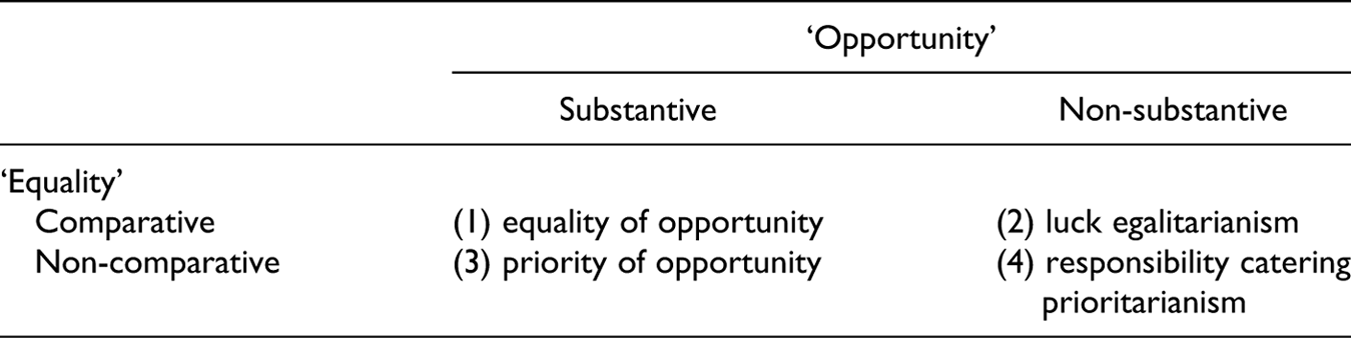
Arneson (2000) now defends ‘responsibility catering prioritarianism,’ amending his earlier position to clarify that his concern lies exclusively with absolute levels of advantage. Schematically, he has moved from (2) to (4). Notice that the difference between Arneson’s two positions explicitly concerns the structural definition of the advantage being distributed (specifically, welfare), rather than the structural definition of the ‘opportunity’ for the relevant advantage. Earlier he was concerned with the distribution of [opportunities for] relative welfare; and now with the distribution of [opportunities for] absolute welfare. Given a non-substantive conception of ‘opportunity,’ this makes perfect sense, notwithstanding the syntax of ‘equality of opportunity for welfare.’ If ‘opportunity’ is only a name for a discount function on advantage, then it is the object of the discount function (i.e. advantage) to which questions of structural definition (relative or absolute?) sensibly apply, rather than the function itself.
This observation can also be made in a logically weaker fashion: The foregoing interpretation of ‘equality of opportunity for welfare,’ on which it employs the non-substantive conception of ‘opportunity’ described, is fully adequate to making Arneson’s main point about which complaints of distributive injustice are valid and it frees him from further explanation of what an ‘opportunity’ is. It now turns out to have the additional merit of plausibly accommodating the distinction between ‘equality’ and ‘priority’ within his position in a clear and simple manner.
Is `priority of opportunity' coherent?
On a substantive conception of ‘opportunity,’ however, Parfit’s question about structural definition seems to apply squarely to the relevant opportunities themselves. (This is not to deny that it can also be raised separately about the associated advantages.) In the case of the traditional ideal of equality of opportunity, i.e. (1) in our matrix, I said that the substance of the relevant opportunities could be identified with the terms of a competition for the advantage in question and that the demand to equalize these opportunities should be understood as the demand to make the terms of the competition fair. On this interpretation, it is compulsory to regard the ‘opportunities’ being distributed as defined in relative or comparative terms, since competitions (and hence, their terms or rules) are necessarily so defined.
This brings us to the question of whether an ideal of ‘priority of opportunity,’ i.e. (3) in our matrix, makes any sense. Up to a point, this is a matter of whether a substantive conception of ‘opportunity’ can be made out according to which it is coherent to speak about absolute or non-comparative levels of opportunity. Past a certain point, it becomes a matter of whether the construction on offer is an appropriate object for demands of ‘priority.’ Each of these issues presents a hurdle for the coherence of (3). Let me illustrate them both with respect to a simple-minded proposal.
Suppose a person’s ‘opportunity for advantage α’ is simply identified with the probability of attaining α. This is over-simple in various respects (cf. Hansson, 2004), but let us never mind about that here. Since the probability of someone’s attaining α holds whether a person actually attains α or not, including the case where that person has failed but not refused to attain α, this conception of ‘opportunity’ counts as substantive. Furthermore, it is hardly compulsory to treat the probability of a person’s attaining α in comparative terms. A comparative treatment is obviously possible and, in practice, will often be convenient. Recall that, on Williams’ analysis, equality of opportunity for α in effect required that the probability of attaining α be the same across different sections of society. But it is also possible, at least in principle, to consider in isolation the event of a person’s attaining α, without regard to anyone else’s attaining α, and to assign that event a probability. This yields a substantive opportunity with a non-comparative magnitude and thereby gets us over the first hurdle.
Prioritarians hold that ‘benefiting people matters more the worse off these people are’ (Parfit, 1997: 213). The most obvious way to bring ‘the probability of a person’s attaining advantage α’ within the scope of this claim is to redefine ‘benefit’ as the product of the value of advantage α and the probability of a person’s attaining α, i.e. as a person’s expected value of α. In that case, ‘priority of opportunity’ would claim that a person’s expected value of α matters more the worse off that person is. Indeed, this might be fairly taken as the ex ante formulation of prioritarianism itself. Now, in itself, ex ante prioritarianism is perfectly coherent. But it still fails to get us over the second hurdle, since whatever else one might say about it ex ante prioritarianism does not qualify as a plausible interpretation of an ideal of ‘equality of opportunity.’
A minimum constraint on such interpretations is that they preserve some distinction between equality of opportunity and equality of outcome. 7 Since references to ‘equality’ in this context may be tendentious, let me reformulate the requirement at hand. What must be preserved is some distinction between an outcome standard and an opportunity standard, with the result that the opportunity standard sanctions certain violations of the outcome standard. All that ex ante prioritarianism accomplishes, however, is to refine prioritarianism’s outcome standard (in ex ante terms). Rather than making ex post violations of prioritarianism permissible, this simply makes them irrelevant.
Nor does it help to count the probability of a person’s attaining α as a ‘benefit’ independently of the value of α. For what results is the claim that, holding the value of α constant, a person’s having a given probability of attaining α matters more, the worse off that person is; and this is simply equivalent to ex ante prioritarianism. So an interpretatively objectionable collapse into ‘equality’ of outcome has not been avoided.
I propose to leave the coherence of a substantive and non-comparative interpretation of ‘equality of opportunity’ as an open question. I myself do not see how to make suitable sense of it. But others may be able to do better.
An illustration
In some contexts, this question may appear to be no more than a taxonomic brain-teaser. However, in other contexts, it will be a matter of consequence if a substantive and non-comparative interpretation of equality of opportunity (i.e. (3)) proves to be incoherent. To illustrate this point, let me briefly discuss Daniels’ seminal rationale for universal access to health care (Daniel, 1985, 2008).
Daniels anchors his argument in a principle of equality of opportunity. For the most part, Daniels’ original discussion focuses specifically on Rawls' (1971) principle of fair equality of opportunity, yet his argument explicitly aims to function with any principle of equality of opportunity (Daniels, 1985: 41–42). At bottom, the resultant rationale for universal access to health care employs an instrumental logic—or, rather, a doubly instrumental logic. Daniels claims that good health is instrumentally necessary to preserve an individual’s opportunities and that (access to) health care is, in turn, instrumentally necessary to preserve an individual’s health. By this reasoning, everyone is entitled to access to health care just because everyone is entitled, so we are meant to assume, to equality of opportunity.
In his later, comprehensive revision of the argument, Daniels (2008: 64–72) specifically claims that it could also function on the basis of the opportunity principles variously affirmed by Sen, Cohen, early Arneson, or late Arneson—in addition to Rawls’ fair equality of opportunity principle. That is to say, in terms of the four positions in our matrix, Daniels now claims that his argument could be founded on (2) or (4), in addition to (1). But this is a mistake. For in thereby overlooking the difference between substantive and non-substantive conceptions of opportunity, Daniels overlooks something that is actually crucial to his argument, given its instrumental logic. A non-substantive opportunity has no instrumental pre-conditions, since there is literally nothing to the ‘opportunity’: it is merely a name for a discount function on advantage. 8 Hence it is false, in particular, that good health is instrumentally necessary to preserve an individual’s non-substantive opportunities. Accordingly, neither (2) nor (4) can serve as a basis for Daniels’ argument. While he is right that it does not necessarily require Rawls’ principle, his argument does require an equality of opportunity principle that involves substantive opportunities. As far as the logic of Daniels’ rationale goes, then, only (1) or (3) will do.
The availability of (3) acquires a special salience for Daniels in the context of an empirical critique of his equal opportunity rationale for universal access. Somewhat surprisingly, this critique challenges the second link in Daniels’ instrumental chain, denying that health care is instrumentally necessary to preserve an individual’s health. 9 While counter-intuitive, the critique’s fundamental claim is supported by solid data suggesting, for example, that the introduction of universal access to health care in Britain did nothing to reduce inequalities in life expectancy there among the different social classes. For present purposes, however, the more significant point is that this critique of Daniels wholly depends on defining an individual’s ‘health’ in comparative terms (e.g. as a comparison of that individual’s life expectancy to the average in other social classes). If health is defined in non-comparative terms (e.g. simply as the number of years an individual is expected to live), the critique fails.
Daniels can therefore evade the empirical critique entirely provided that his argument can license a non-comparative definition of individual health. To do so, his argument has to be anchored in an equality of opportunity principle that is itself interpreted non-comparatively (and substantively). 10 In other words, it has to be anchored in (3). But, evidently, that is only possible if (3) is coherent. If (3) is incoherent, Daniels’ rationale cannot avoid facing the empirical music.
I have already expressed my doubts about the coherence of (3). So let me close by pre-empting a final respect in which one might be misled by failing to distinguish substantive from non-substantive opportunities. As we have seen, Arneson shifted his position in our matrix from (2) to (4). Moreover, it would be advantageous for Daniels to make an ‘analogous’ shift: that is, to shift the anchor for his rationale from (1) to (3). However, the ease of Arneson’s transition says nothing about the prospects for Daniels’ transition. For in Arneson’s case, as we have also seen, the question of structural definition (comparative or non-comparative?) applies directly to the advantage being distributed (welfare), rather than to the associated opportunities (for welfare). In Daniels’ case, by contrast, the question of structural definition applies to the opportunities themselves. The two structural transitions therefore take place at quite different points in the construction ‘equality of opportunity for α,’ leaving no real analogy between them.
Conclusion
I have distinguished four different interpretations of ‘equality of opportunity.’ We get four interpretations because a neglected ambiguity in ‘opportunity’ (between substantive and non-substantive conceptions) intersects a well-known ambiguity in ‘equality’ (between comparative and non-comparative conceptions). Among other things, distinguishing these interpretations reveals how misleading ‘equal opportunity for advantage’ formulations of luck egalitarianism can be. These formulations are misleading in so far as they obscure the difference between two separate claims about which inequalities are consistent with true equality. Luck egalitarianism claims that inequalities that have been chosen in some suitable sense are consistent with true equality, while the traditional ideal of equality of opportunity only claims that inevitable inequalities that have been determined through fair competitions are consistent with true equality. Obscuring the difference between these two claims therefore serves both to arrogate the rhetorical advantages of the traditional ideal to luck egalitarianism and to cover over a limitation to luck egalitarianism’s ambition to provide a comprehensive principle of distributive justice.