



Abstract
Rawls’ The Law of Peoples does not offer a clear principled account of the way in which liberal and decent peoples should deal with benevolent absolutisms. Within the Rawlsian framework, benevolent absolutisms are a type of society that respects basic human rights and is not externally aggressive. Rawls rules out the use of coercion to engage with benevolent absolutisms but does not provide an alternative strategy. The article develops one, namely, it argues that liberal and decent peoples should use positive incentives to induce benevolent absolutisms to make their transition to the status of well-ordered peoples. In so doing, it offers a principled way to expand Rawls’ international nonideal theory and, in the process, provides a more nuanced approach to the promotion of political participation in international society. The article draws on the literature on economic statecraft and political theory and constructs an incentive model with seven distinct parameters attached to its definition of incentives. Finally, the article provides a real-world example, of how to concretely implement the incentive mechanism.
A specter is haunting Rawls’ The Law of Peoples (1999; henceforth LP) 1 − the specter of benevolent absolutisms. 2 Benevolent absolutisms are one of the five types of political society that populate Rawls’ theory of international justice (p. 4). They respect the basic human rights of their members but do not allow for political participation of their citizens. Rawls tells us that they are not well-ordered, and thus cannot be members in good standing of what he calls the Society of Peoples (p. 63). Yet, Rawls’ statements concerning benevolent absolutisms are sparse, the rationale for their exclusion from the Society of Peoples is underdeveloped, and the way in which well-ordered peoples are to deal with benevolent absolutisms is almost completely overlooked. 3 In fact, the very structure of Rawls’ international theory seems, conceptually, to obliterate them.
Rawls’ theory is structured around his account of different types of peoples and societies. Liberal peoples are at the heart of the ideal theory of LP, as the latter is initially conceived as the foreign policy of a just liberal democratic polity (p. 10). Decent but nonliberal peoples are central to understanding the second part of ideal theory by exploring the rationale for toleration in international society (p. 59). In nonideal theory, outlaw states are the paradigmatic case of noncompliance with a just law of peoples (p. 90), while burdened societies represent cases in which compliance is made impossible by unfavorable conditions (p. 105). Within this four-pronged architecture, in which different polities stand for different aspects of the law of peoples, benevolent absolutisms float in the background without a clear place in a Rawlsian normative account of international politics.
The article’s main aim is to develop a principled nonideal theory to engage with benevolent absolutisms. Stated differently, the article aims to provide a principled guide for the foreign policy of liberal and decent peoples with regard to benevolent absolutisms and to do so within the framework of a Rawlsian (normative) account of international relations.
The main challenge that the article addresses is, succinctly: How is a just Society of Peoples (or its members, when they abide by its prescriptions) to engage with benevolent absolutisms? In order to answer this question, I develop a system of positive incentives for benevolent absolutisms to become well-ordered. According to Rawls, benevolent absolutisms cannot be the object of sanctions: They respect human rights and are not externally aggressive, so they cannot be treated as outlaw states (p. 92). At the same time, they are not burdened societies, and so straightforward aid would be inappropriate. Positive incentives are thus developed as a conceptual middle ground between the different types of prescriptions of LP’s nonideal theory.
The article proceeds as follows. First, I provide a summary of LP’s ideal theory and explain the practical puzzle posed by benevolent absolutisms within LP’s nonideal theory. I conclude the first part of the article with the initial statement and justification of the proposed solution to this puzzle, namely, the articulation of an incentive-based strategy. The second part then goes on to develop the incentive-based strategy by defining the meaning of incentives and by discussing several potential objections. Finally, in the third part, the article illustrates the incentive strategy with a real-world example, Brunei Darussalam.
Allow me two observations before embarking on the main discussion. The first is that the article assumes, at least to some extent, the soundness of Rawls’ LP which is, of course, controversial (see especially Beitz, 2000; Buchanan, 2000; Caney, 2002; Pogge, 1994). Nonetheless, there are good reasons to do so. First, and most evidently, there are reasons of focus and space. The article tries to illuminate one specific and underdeveloped aspect of LP, namely, the treatment of benevolent absolutisms within its nonideal theory. To defend the framework itself is thus beyond its stated purposes and would require much more space than is available here. Yet, there is one sense in which the framework itself is made more plausible by the article’s argument: Working out the implications of a set of general principles for an important case and appreciating its plausibility helps us, in the Rawlsian spirit of reflective equilibrium, to have more confidence in the principles themselves.
Of course, the latter point is sound only if we find the article’s argument as having plausible implications for how we deal with benevolent absolutisms. This brings us to the second observation. How we should relate to regimes that are not democratic or decent but respect human rights is a genuinely difficult task. The incentive answer provided in the article puts forward, in my view, a more nuanced approach than the indifference of those who see international relations as a realm of power, and the intolerance of those who wish to export democracy through war, come what may. 4 It recognizes the importance of political participation for membership in a just Society of Peoples and provides recommendations that do not presuppose a black-and-white picture of the world. There is a great deal of moral and conceptual space between a perfectly just liberal democracy and a (internally) murderous and (externally) aggressive outlaw state. Benevolent absolutisms are situated somewhere in the continuum between these extremes. The way we treat them should, at least intuitively, reflect this. I believe the incentive-based strategy provided by the article achieves the latter goal.
The practical puzzle posed by benevolent absolutisms
The ideal theory of LP
Rawls’ theory of international justice is addressed to peoples, not states. Rawls sees states as merely rational actors predominantly concerned with their relative power and economic standing (pp. 27–28). Instead, peoples have a moral nature and are capable to constrain the pursuit of their rational interests by what they see as reasonable (p. 25). A people is prepared to offer fair terms of cooperation to other peoples and to honor such terms provided that other peoples are willing to do the same (p. 25). Furthermore, peoples lack the traditional powers of sovereignty (p. 25). Peoples do not have traditional rights to war nor do they enjoy rights to unrestricted internal autonomy (pp. 26–27). Peoples are also different from the other types of political society that populate Rawls’ international theory. Peoples are well-ordered, while outlaw states, burdened societies, and benevolent absolutisms are not. 5 Well-orderedness is a central feature of Rawls’ definition of a people (pp. 41–44). A well-ordered political society’s system of law and institutions is organized according to a public conception of justice. Furthermore, a well-ordered political society allows its citizens to have a significant role in the process of political decision-making (Pettit, 2006: 43; LP: 4, 63).
According to Rawls, well-ordered liberal peoples are characterized by three main features: (a) they have a political organization consistent with the model of a constitutional democracy, (b) they are united by “common sympathies,” and (c) they endorse a moral/political liberal conception of right and justice (p. 23). In LP, Rawls reframes his domestic account of the original position (p. 32) in order to “extend a liberal conception to the Law of Peoples” (ibid). Representatives of liberal peoples are placed behind an appropriately framed “veil of ignorance” (Rawls, 1971: 118–23). The veil of ignorance prevents them from knowing the size of their territory or population, the relative strength of the peoples they represent, their level of economic development, or the amount of natural resources available to each people.
6
Representatives of liberal peoples would, behind the veil of ignorance, adopt eight principles to govern their mutual undertakings: Peoples are free and independent, and their freedom and independence are to be respected by other peoples. Peoples are to observe treaties and undertakings. Peoples are equals and are parties to the agreements that bind them. Peoples are to observe a duty of nonintervention. Peoples have a right of self-defense but no right to instigate war for reasons other than self-defense. Peoples are to honor human rights. Peoples are to observe certain specified restrictions in the conduct of war. Peoples have a duty to assist other peoples living under unfavorable conditions that prevent their having a just or decent political and social regime.
This concludes the first part of LP’s ideal theory. The second part of ideal theory “extends the Law of Peoples to nonliberal peoples” in order to “specify how far liberal peoples are to tolerate nonliberal” ones (p. 59). For Rawls, toleration does not simply entail to refrain from coercing or imposing sanctions on those who are to be tolerated – it means to respect them as “equal participating members in good standing of the Society of Peoples” (p. 59, emphasis added). The second part of ideal theory is thus, according to Rawls himself, more complex, as it requires the specification of a nonliberal way of organizing political society worthy of toleration. Rawls claims that decent peoples are such kind of political society. Decent peoples are not liberal. However, they too are well-ordered. Rawls only provides us with one possible way of organizing decent political institutions, what he calls a decent hierarchical society. A decent hierarchical society does not have aggressive foreign policy aims (p. 64); its system of law, developed in accordance with a common good conception of justice, secures the basic human rights of all citizens (p. 65) and imposes bona fide moral duties and obligations on its members (pp. 65–66); and its public officials have a sincere and not unreasonable belief that a decent hierarchical people’s system of law is effectively guided by a common good conception of justice (pp. 66–67). A common good conception of justice is not a liberal conception of justice and the citizens of a decent hierarchical people are not seen as free and equal and entitled to equal representation. However, in a decent hierarchical people, persons are seen as decent and rational and the common good conception of justice contains what Rawls calls a decent consultation hierarchy that allows “different voices to be heard” and for dissent to be voiced (pp. 71–72). Not only are decent hierarchical peoples well-ordered, they too are able to endorse the same principles of international justice adopted by liberal peoples. According to Rawls, representatives of decent hierarchical peoples would “in an appropriate original position … adopt the same eight principles as those … [that] would be adopted by the representatives of liberal peoples” (p. 69). They are thus to be tolerated as equal members in good standing of the Society of Peoples.
The nonideal theory of LP and benevolent absolutisms
For Rawls, ideal theory assumes that (a) there is full compliance with the normative principles that regulate the domain under consideration and (b) there are favorable conditions for the fulfillment of the obligations that are given by the relevant normative principles. The breakdown of these assumptions corresponds to the two parts of nonideal theory in LP. The first part deals with cases of “noncompliance,” and concerns outlaw states (p. 90). Outlaw states display externally aggressive behavior and actively refuse to abide by the prescriptions of LP that pertain to the use of force (the right to wage war, but also the projection of influence through power) in international relations (p. 90). Well-ordered peoples should not tolerate the externally aggressive conduct of outlaw states (p. 92). Severe violations of human rights (internal repression) might also be cause enough for legitimate interference or intervention (p. 90 n1; pp. 93–94 n6). The second part of the nonideal theory deals with burdened societies or with what Rawls calls “unfavorable conditions” (p. 4). Burdened societies are societies lacking the main tools (resources, human capital, and/or political culture) to become well-ordered; Rawls states that well-ordered peoples have a “duty of assistance” toward these burdened societies (p. 90).
In this neat classification of cases of nonideal theory, it is striking that there is no clear place for benevolent absolutisms. As we have seen, because benevolent absolutisms “deny their members a meaningful role in making political decisions they are not well-ordered” (p. 63) and thus cannot be members of the Society of Peoples, yet Rawls does not tell us whether they are cases of noncompliance, or of unfavorable conditions, or both. Nor does Rawls tell us clearly how decent and liberal peoples should conduct their foreign policies in relation to them. For example, does it follow from the fact that benevolent absolutisms are not well-ordered that members of the Society of Peoples should have no form of interaction with them? Or are benevolent absolutisms merely denied full membership in the Society of Peoples? Rawls’ text simply provides no guidance here. However, guidance is clearly needed. Not being member of the Society of Peoples provides, per se, insufficient information when it comes to what the relationship between members and non-members should be. This is shown by the fact that LP’s nonideal theory prescribes radically different types of engagement with outlaw states and burdened societies. Put differently, accepting the fact that benevolent absolutisms are not within the scope of international toleration is not enough to understand how well-ordered peoples are to relate to them. Rawls’ conception of toleration is based on the idea that liberal and decent well-ordered peoples who endorse the eight principles of LP for the right reasons are to respect each other as equals as they are all members in good standing of the Society of Peoples. However, to deny membership in the Society of Peoples is to deny a measure of respect. It does not provide clear guidance on how we are to engage with those who are not to be respected as equals.
One might be initially tempted to treat benevolent absolutisms just as outlaw states. Yet, the only instance in which LP allows (explicitly) for outside intervention is when a collective violates human rights and/or is externally aggressive (p. 90). Rawls’ discussion of sovereignty (pp. 25–27) and the limited nature of “the freedom and independence” enjoyed by liberal peoples (p. 38) never mention the lack of internal political participation (displayed by benevolent absolutisms) as a genuine reason for outside interference. Benevolent absolutisms are not externally aggressive and, by definition, they respect human rights. In fact, Rawls goes as far as telling us that they too are entitled to wage war in self-defense, since any “society that is nonaggressive and that honors human rights has the right of self-defense” (p. 92). Can benevolent absolutisms be the object of weaker (compared to the use of force) forms of outside political pressures such as economic and diplomatic sanctions? The answer is, at least according to LP’s text, clearly no. When Rawls discusses the role of human rights in LP, he states that “their fulfillment is sufficient to exclude justified and forceful intervention by other peoples, for example, by diplomatic and economic sanctions …” (p. 80). Thus, no form of coercive political pressure seems to be justified toward benevolent absolutisms. 7
Finally, it must be noted that benevolent absolutisms and outlaw states have a structurally different type of normative relationship with the eight principles of LP. A political society’s normative relationship such principles is essentially constituted by two main elements: (1) whether the political society respects (for the right reasons) the principles themselves and (2) whether it meets what we can call the membership criteria implicitly stated by the principles. The second element refers to the idea that the eight principles of LP are addressed to peoples rather than to political societies generally (that is, only addressed to well-ordered political societies). While outlaw states clearly fail to have an appropriate normative relationship with LP both because they violate its principles and because they do not meet its membership criteria, the situation of benevolent absolutisms is potentially more complex. On the one hand, we have no principled reason to believe that they cannot respect the eight principles of LP. 8 On the other hand, they do fail to meet the membership criteria implicitly stated by such principles (by definition, benevolent absolutisms are not peoples). It is thus plausible to conclude that, at least prima facie, the way in which members of the Society of Peoples engage with benevolent absolutisms and outlaw states should differ as well.
The basic elements of the incentive-based strategy
How are we to engage with benevolent absolutisms within the framework of LP? For guidance on how to proceed it is important to note that the long-term objective of the Rawlsian framework is for all peoples to become well-ordered and equal members in good standing of the Society of Peoples. For Rawls, the great evils of human history are political in nature. Allegiance to the eight principles of LP is the best we can hope for to banish those evils and make the world a just and peaceful place (p. 5). Rawls’ discussion of nonideal theory is also premised on the idea of progressively enlarging the constituency of the Society of Peoples (p. 89). In engaging with benevolent absolutisms, therefore, the long-term objective of LP would seem to be that they too become well-ordered peoples.
Once we have clarified the nonideal theory goal of LP with respect to benevolent absolutisms, we still need to devise a strategy for how the Society of Peoples is to engage with them. In what follows, I want to argue that a fruitful way of constructing this underdeveloped aspect of the nonideal theory of LP is to imagine the relationship between benevolent absolutisms and the Society of Peoples as one based on positive incentives for benevolent absolutisms to become well-ordered. The plausibility of this strategy requires some explaining. The nonideal theory of LP assumes two basic problems and two basic remedies to such problems. The two basic problems, as outlined above, are the unwillingness of some (outlaw states) and the inability of others (burdened societies) to comply with the eight principles of LP. The two basic remedies are, crudely put, sanctions (economic and/or military and/or diplomatic) for those who are unwilling to comply and aid for those who are unable to do so. To use positive incentives in order to encourage benevolent absolutisms to become well-ordered is, essentially, to accept that the latter present LP with a middle ground between the case of outlaw states and that of burdened societies, and thus that the strategy used to deal with this aspect of the nonideal theory of LP needs to reflect this middle ground. 9 But first let me define what I mean by “incentives.” Once such definition is in place it will be clearer why incentives represent this middle ground effectively.
Developing the incentive-based strategy
Defining incentives
Incentives can be defined as inducements (that is, a transfer of benefits) from one actor, the sender, to another, the target or receiver, with the expectation of a concession on the part of the target or receiver (see Baldwin, 1985; Crumm, 1995; Drezner, 1999a). While no definition of incentives can be fully exhaustive, I propose to further specify the structure of an incentive mechanism by taking into consideration the following seven parameters: Their source or origin: who is the sender? Their content: what is the inducement used? Their target: who is the receiver? The government, or different elements of the civil society of the target? Their goal: what is the hoped-for concession of the incentive mechanism? The timescale adopted
10
: are the inducements a request for short-term or long-term concession? The welfare and distributional effects
11
of the inducement on the sender: are they negative or positive for the sender as a whole? How does the sender stand to gain or lose? The welfare and distributional effects of the inducement on the target: are they negative or positive for the receiver as a whole? How does the target stand to gain or lose?
Two comments concerning this definition are in order. First, the definition I adopt refers to “positive” incentives. It can be broadened by including negative incentives, or sanctions. This can be achieved simply by conceiving of the “inducement” mentioned in the definition as causing loss of welfare to the target or receiver. 12 Second, note also that the idea of a transfer of benefits requires a baseline to be meaningful. In the economic statecraft literature, some refer to the status quo as the relevant baseline (see especially Drezner, 1999b). However, using the status quo baseline, the lifting of an existing sanction would count as an incentive. This clearly would not fit with the normative situation of benevolent absolutisms in LP, as the latter cannot be the object of sanctions. I thus proceed under the assumption that we can imagine a counterfactual baseline defined as the lack of interaction between members of the Society of Peoples and benevolent absolutisms. Given that part of the task of the article is to establish what the relationship between the Society of Peoples and benevolent absolutisms should be, the choice of a “no cooperation baseline” seems intuitively appropriate.
With this definition in hand we can, I believe, better understand why incentives are a middle ground between cases of noncompliance and unfavorable conditions and the remedies imagined by LP to address them. Incentives share one feature with both remedies that LP indicates for engaging with cases of noncompliance and unfavorable conditions. That is, incentives share the element of conditionality with regard to sanctions or the threat of force that is plausibly attached to the Society of Peoples’ relationship with outlaw states, while, at the same time, they share the positive (to the receiver) welfare effects with regard to aid 13 as imagined by Rawls for burdened societies (see Table 1). Incentives, as defined above, assume that the target is at least capable of complying with the request for concession attached to the inducement mechanism – otherwise the entire “inducement-based” strategy would seem rather pointless. Incentive provision thus excludes the idea that benevolent absolutisms are simply a case of unfavorable conditions as is the case for burdened societies. Furthermore, the idea of providing incentives incorporates some aspect of unwillingness. If benevolent absolutisms were willing to become well-ordered, inducements would be superfluous. In this respect, then, incentive provision assumes some form of commonality between benevolent absolutism and outlaw states when it comes to their attitude toward LP: Both are plausibly depicted as unwilling to ameliorate their normative relationship to the latter. However, positive incentives, unlike sanctions and coercion more broadly, seem to afford greater space for voluntary responses (more on this below).
Characteristics of different foreign policy instruments.

Note: The italicized words show the fact that incentives share certain features with aid (positive welfare effect on receiver, and open welfare effect on sender) and with sanctions (element of conditionality).
aSee endnote 13 for further discussion of aid conditionality.
bThe possibility that incentives have positive welfare effects on the sender is discussed below.
What justifies incentive provision to benevolent absolutisms?
One might be tempted to believe that positive incentives are not really worrisome from a moral point of view, as they simply involve the offer of a benefit. This would be the natural conclusion if we looked at incentives purely from an economics perspective. In economics incentives are “an offer of something of value (…) meant to influence the payoff structure of a utility calculation so as to alter a person’s course of action.” (Grant, 2006: 29). Understood in this way, incentives are but one further form of trade and thus are prima facie ethically unproblematic. However, matters are not so simple. Incentive provision is always marked by the desire to influence the target’s autonomous choices (see Grant, 2011). One needs to ask whether, all things considered, this type of influence attempt can be justified. What is the normative justification to believe that members of the Society of Peoples are entitled to influence the internal makeup of benevolent absolutisms? In other words, what justifies the influence attempt on the part of the Society of Peoples (or any of its constituent societies) toward benevolent absolutisms?
According to Ruth Grant (2006: 32), two of the main criteria to assess the justifiability of incentives provision are: (a) the legitimacy of their purpose and (b) whether they allow for a voluntary response. 14 In what follows, I will largely assume that Grant is right and that “voluntariness of response” and “legitimacy of purpose” affect the normative landscape of incentive provision. While involuntariness does not necessarily remove an agent’s liability for a choice, it does seem to affect the way in which we normatively characterize an incentive mechanism – there seems to be a presumption against the justifiability of an incentive mechanism that does not allow for voluntary responses. In the same way, providing an incentive for purposes that we find morally repugnant or simply unjust provides strong initial reasons for considering the incentive in question unjustifiable.
Let’s consider the two aforementioned criteria in order. Is the purpose of incentives to benevolent absolutisms legitimate? The purpose of the incentive mechanism is for benevolent absolutisms to become well-ordered and thus compliant with the membership criteria of the Society of Peoples. As we have seen, according to Rawls, expanding the constituency of the Society of Peoples is the best way to banish the great evils of human history. Do positive incentives to benevolent absolutisms allow for a voluntary response? The answer to the latter question may seem obvious at first glance: Any agent is free to refuse the offer of a benefit. However, once again, things are not so simple. The idea of “offering a benefit,” per se, is insufficient to appraise the voluntariness of the target’s response in the absence of some knowledge concerning the alternative courses of action available to the target. For example, a father (sender) may offer his child (target) the following incentive: “If you study more diligently (request for concession), I will stop beating you every morning (inducement).” While this clearly fits the description of a positive incentive, it would be a stretch to argue that this implies that the incentive mechanism allows for a voluntary response. 15 It makes a significant difference to whether the child is responding voluntarily that the only available alternative option (to be beaten every morning) implies accepting the daily violation of her/his basic rights. This simply reflects something that is intuitively clear, namely, that the nature of the options one faces affect the voluntariness of a choice (Olsaretti, 2007).
What are the options faced by benevolent absolutisms if they refuse to accept the inducements offered by well-ordered peoples? Given that well-ordered peoples are not authorized to use explicitly coercive measures such as military and economic sanctions, the carrot of incentive provision toward benevolent absolutisms cannot be coupled, as it often is in the real world (see Cotright, 1997), with the stick of punishment if the incentives are refused. What if a benevolent absolutism faces a scenario where the refusal to accept the incentive mechanism would make it impossible for it to secure the basic rights of its members? Given Rawls’ emphasis on basic human rights, the ability to secure such rights should clearly count as a constraint on the acceptability of alternative courses of action. However, benevolent absolutisms are unlikely to face this hypothetical scenario. Benevolent absolutisms, by definition, are not burdened societies and respect the basic human rights of their members. We can thus presume that they have (prior to any interactions with well-ordered peoples) the relevant social, economic, and political capital required to secure the basic rights of their citizens. While the former two scenarios are not necessarily exhaustive, they seem to address what we often see as problematic about “offers to help” in international society: that the help cannot be refused because there is a more coercive alternative ready to be deployed and/or because the condition in which members of a political community find themselves is such that refusal would imply the acceptance of a great deal of human suffering.
Further problems: Appeasement, crowding out, and paternalism
Even accepting that incentives to benevolent absolutisms have a legitimate purpose and allow for a voluntary response, one may still argue that they pose further problems. Here I briefly consider whether the incentive strategy developed by the article is (a) a form of appeasement, (b) counterproductive, or (c) paternalistic. I believe that all three objections fail to apply to the case of benevolent absolutisms.
Appeasement is a familiar problem in the economic statecraft literature. For example, Cotright (1997: 277–279) explicitly addresses the worry that incentives imply the risk of appeasement with otherwise oppressive regimes. However, it should be noted that the concerns with appeasement expressed in the economic statecraft literature mainly pertain to regimes that participate in large-scale human rights violations (the historical examples used by Cotright are North Korea and South Africa). The fact that we address benevolent absolutisms (and that the latter respect basic human rights) should defuse the worry. Furthermore, the incentive mechanism described in the article is precisely geared to address the very source of the “appeasement worry.” In other words, if the appeasement worry is based on the idea that we should not offer benefits to a political society that, for example, does not protect basic rights to political participation, it must be recognized that the very purpose of the incentive mechanism is to alter this condition and that the delivery of the benefits that are part of the incentive mechanism is made conditional precisely on the gradual development of well-ordered institutions that would allow the citizens of a benevolent absolutism to have a greater say in the process of political decision-making.
A further possibility is that incentives may actually be counterproductive, as a result of the so-called “crowding out effect” investigated by behavioral economists (see Titmuss, 1970). The basic idea is that providing monetary incentives for a given socially desirable action may crowd out non-self-interested motives for the performance of the action and eventually reduce the extent to which the action is performed compared to the pre-incentive benchmark. Blood donations are the original illustration of this effect: Paying people for donating blood may actually end up reducing the supply of blood donors rather than increasing it (see Bénabou and Tirole, 2005; Bowles, 2008). One reason why this problem does not apply to benevolent absolutisms is because the crowding out of intrinsic motivation presupposes the presence of intrinsic motivation, something that cannot be assumed by the current framework concerning benevolent absolutisms. A second reason why the crowding out effect does not apply in the case of benevolent absolutisms is that the effect is generally connected to instances of direct financial transfers, yet for benevolent absolutisms (and the example of Brunei provided below is but one possible illustration), the incentive mechanism does not necessarily refer to monetary compensation (see Lacetera and Macis, 2010). 16
A different way of voicing the concern that incentives may prove to be self-defeating is to consider the possibility that, to paraphrase Rawls, incentive provision may lead to “bitterness and resentment” (p. 62). The latter idea seems to be reinforced by Rawls’ explicit remarks about incentive provision (Section 11.3, pp. 84–85). However, first, note that, in the passage on pages 84 and 85, Rawls discusses the idea of offering incentives to decent peoples. The latter are seen by Rawls as equal members in good standing of the Society of Peoples, while benevolent absolutisms are not. We can thus conjecture that Rawls’ reticence to consider incentives as a useful policy tool (for liberal peoples) is mostly explained by the kind of target that he considers in his discussion rather than by the inappropriateness of the tool per se.
Second, consider what might explain the idea that incentives may lead to “bitterness and resentment.” When incentives are provided to decent nonliberal peoples, they are, presumably, aimed at changing the structure of an existing system of collective self-rule (that is, providing incentives to decent peoples to become liberal). Yet the situation of benevolent absolutisms is markedly different, as their governments do not really represent their citizens. True, members of a benevolent absolutism’s government might feel some resentment and bitterness, but such feelings, and the potential for “bitterness and resentment” that may ensue as a result of such feelings, are unlikely to be as deep or widely diffused as would be the case if incentives were offered to a well-ordered people – incentives to benevolent absolutisms are not incentives to alter a system of collective self-rule but rather to create one in the first place. 17
Finally, one could argue that the attempt to influence benevolent absolutisms through incentives is paternalistic. I will not provide an exhaustive definition of paternalism. I will instead limit myself to the observation that most accounts of paternalism rely on the idea that the attempt (whether coercive or not) to influence the target is performed with a view to the welfare, good, or happiness of the target itself (see Arneson, 1980; De Marneffe, 2006; Quong, 2011; Sunstein and Thaler, 2003). If we were to acknowledge this common aspect of most accounts of paternalism, then incentives to become well-ordered would not be paternalistic. While there might be a sense in which liberal and decent peoples think it would be good for benevolent absolutisms to become well-ordered (and, given the structure of a specific incentive mechanism, positive welfare effects for the target or parts of its population), this is not the primary goal of their incentive provision. The latter is rather geared to reflect the fact that compliance with the eight principles of LP is a matter of right and that the goal of LP, when used as a guide for developing the foreign policy of well-ordered peoples, is for all societies to become well-ordered.
The seven parameters in context
Going back to the parameters stated above, the sender (parameter 1) of the inducements can be (a) members of the Society of Peoples individually, (b) groups of decent or liberal peoples, or (c) the Society of Peoples as a whole (for instance, by way of one of its cooperative institutions). The first case (a) is one of bilateral incentive provision, while both (b) and (c) can be defined as cases of multilateral incentive provision. The distinction between multilateral and bilateral incentives is also relevant in order to further specify the goal (parameter 4) of the incentive scheme. As I mentioned above, the long-term goal of LP is for all peoples to become well-ordered. This goal is symmetrically shifted to become the inherent goal of the incentive mechanism. Nonetheless, as the structure of LP makes clear, there is more than one way in which a people can develop well-ordered institutions. Although this number is potentially infinite given that Rawls only specifies one example of a decent people, and that there is bound to be great variance even between different types of liberal models of governance, we can at least distinguish three different ways of specifying the content (parameter 2) of the goal of the incentive mechanism: to develop liberal institutions, to develop decent institutions, and to develop a system of institutions which is neutral with respect to liberal or decent forms of institutional makeup (call this an open system) (Table 2).
Goal specification and sender types.
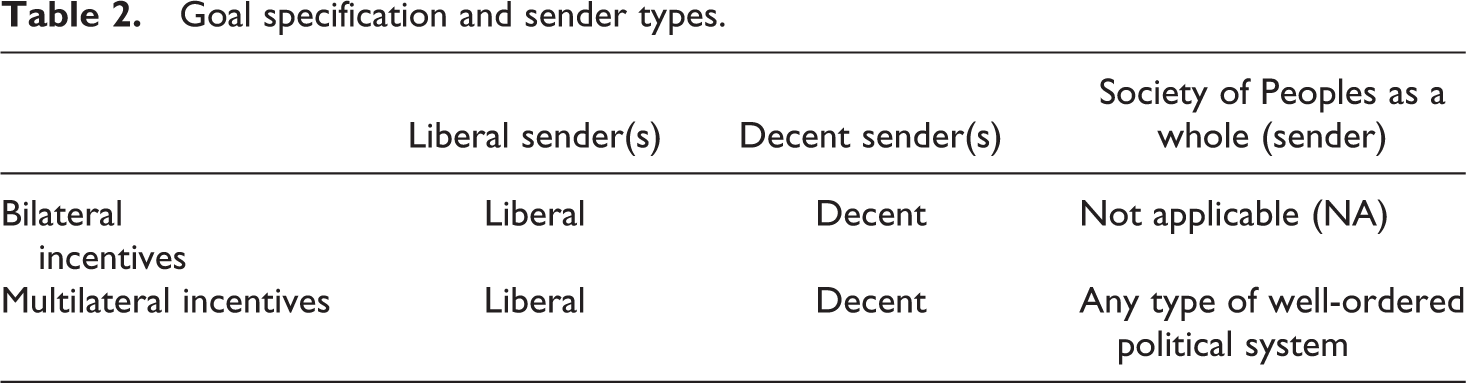
In the case of bilateral incentives, or of multilateral incentives from a group of either liberal or decent peoples, I believe it should be allowed that the incentives be targeted to develop the types of institutions that the sender(s) most prefer(s). For example, it would seem permissible that bilateral help from a liberal people could come on condition of the development of liberal democratic procedures. While the goal is always to transform benevolent absolutisms into well-ordered peoples, there are many types of institutional framework that satisfy that condition, and becoming liberal and democratic certainly represents one. Of course, the same would hold if decent peoples provided incentives to a benevolent absolutism to develop a consultation procedure modeled on the one available within their common good conception of justice. In the case of multilateral incentives from the Society of Peoples as a whole, on the other hand – that is, if the incentives are the result of collective agreement on the part of the entire Society of well-ordered Peoples (or of one of its cooperative institutions) – then the incentive model should remain open to the types of institutions that can be developed by the benevolent absolutism. In other words, when the Society of Peoples acts as the sender, what should drive the choice of the goal should be less dependent on what members of the Society of Peoples believe to be the best way of organizing a political society (there would be no agreement on that score) but instead focused on what all liberal and decent peoples’ foreign policies have in common: their wish that all political communities become well-ordered. Proceeding this way would also allow the Society of Peoples not to provide an implicit statement as to its preferred way of organizing the internal political life of its members and thus avoid offending the self-respect of some of them. For example, if the Society of Peoples, acting as the sender, assumed that the default goal of the incentive mechanism should be to develop liberal well-ordered institutions, this would imply that the Society of Peoples considers nonliberal decent institutions as inferior compared to liberal ones, and that would clearly display lack of respect toward nonliberal decent peoples.
The content (parameter 2) and target (parameter 3) of the incentive mechanism are closely connected. Recall that our assumed target has been thus far the category of benevolent absolutisms. Yet as the literature on economic statecraft amply demonstrates, the effectiveness of incentive provision crucially depends not only on regime type but also on the internal political structure of the receiver or target (see Blanchard and Ripsman, 2013; Brooks, 2002; Escribà-Folch and Wright, 2010). 18 This line of argument will be pursued no further here than to note that the content of the incentive provision is potentially vast (see Table 3), and that the best way to ensure that incentives are of the right kind is to pay attention to the type of internal political structure of the target (see Table 4) and to the welfare and distributional effects (parameter 7) that the inducements have within the target. 19
Examples of inducements classified by issue area.a

a Source: Baldwin, 1985; Brooks, 2002; Crumm, 1995; Long, 1996.
bThe idea that military cooperation of any kind might be an acceptable instrument seems to run contrary to the intuition that nondemocratic regimes should not be given tools to repress internal dissent. However, any economic benefit or inducement can be used to purchase or develop military capacity (see Baldwin, 1985).
cFor example, see Ethier (2003) and Fakhro (2009).
Examples of factors potentially affecting target’s response.a
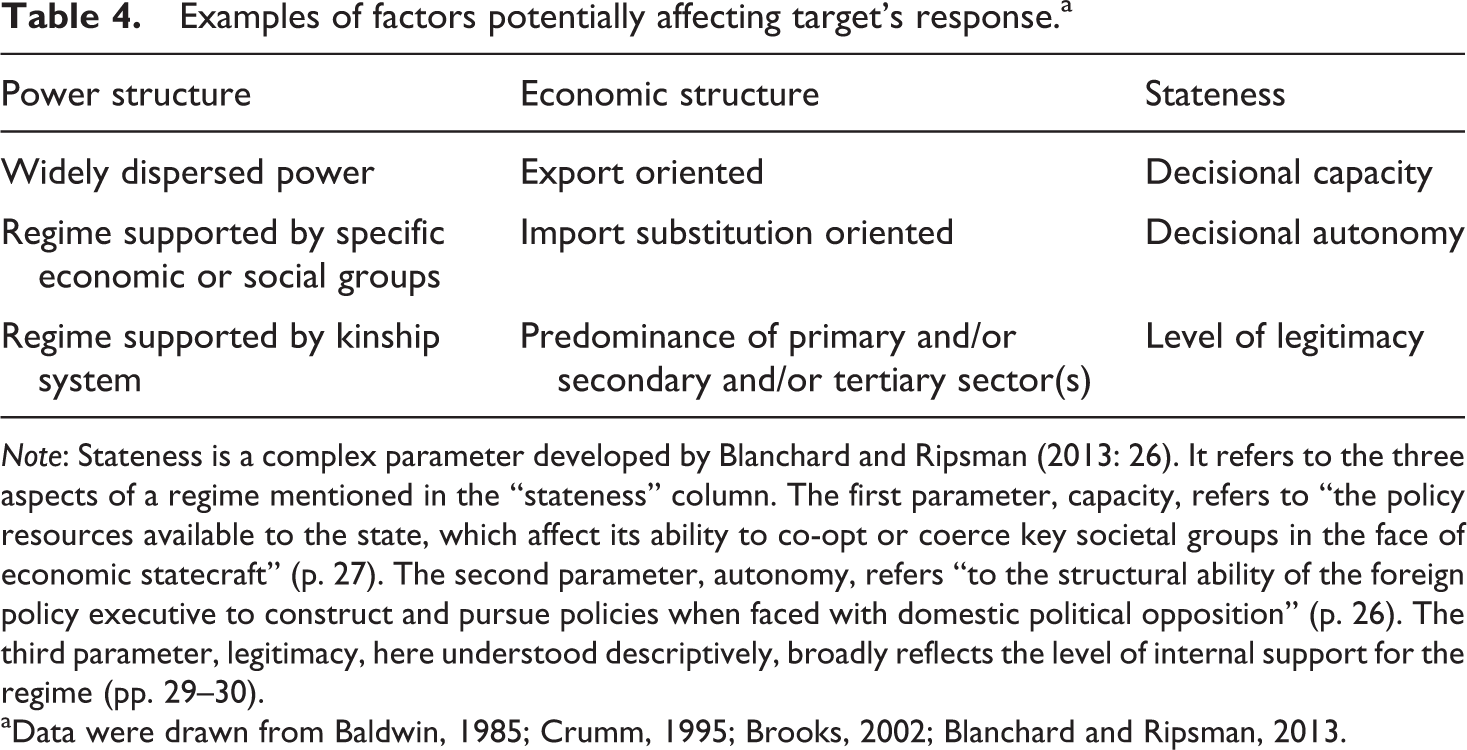
Note: Stateness is a complex parameter developed by Blanchard and Ripsman (2013: 26). It refers to the three aspects of a regime mentioned in the “stateness” column. The first parameter, capacity, refers to “the policy resources available to the state, which affect its ability to co-opt or coerce key societal groups in the face of economic statecraft” (p. 27). The second parameter, autonomy, refers “to the structural ability of the foreign policy executive to construct and pursue policies when faced with domestic political opposition” (p. 26). The third parameter, legitimacy, here understood descriptively, broadly reflects the level of internal support for the regime (pp. 29–30).
aData were drawn from Baldwin, 1985; Crumm, 1995; Brooks, 2002; Blanchard and Ripsman, 2013.
The welfare and distributional effects on the sender (parameter 6) for the incentive provision allows us to pay attention to those who provide the incentives and to what they can reasonably expect from the target. One of the most pressing issues in the literature on international economic incentives concerns the motivational aspects of incentive provision for the sender (see Dorussen, 2011). Of course, the basic rationale for the sender is connected to the political concessions it wants to extract from the receiver or target. But it is often thought that incentives might have a negative impact on the sender’s welfare and that such negative impact might threaten the motivational basis or even the entire commitment of the sender to the incentive provision mechanism (Dorussen, 2011).
While this point is not without merit, I want to suggest that it fails to consider two aspects of the incentive mechanism proposed here. First, it relies on a picture of incentives in which the latter are a cost to the sender; and, while intuitively plausible, this assumption is not necessarily sound (see Long, 1996: 22). 20 Second, the commitment of the sender (in the specific case under consideration here) is not likely to be fully determined by looking at the welfare effects (on the sender) of the incentive mechanism. Given that Rawls sees well-ordered peoples as moral agents as opposed to simply rational ones (pp. 23–30) and that the goal of the incentive mechanism is part of the (moral) aims I have ascribed to them, we can conjecture that the senders would be willing to accept at least some welfare losses as a price for the success of the incentive mechanism.
An example: Brunei Darrussalam
Preliminary remarks
In the previous two parts of the article, I have justified and developed an incentive-based strategy for members of the Society of Peoples to deal with benevolent absolutisms. In what follows, I provide a real-world example of the strategy described, focusing on the case of Brunei Darrussalam. I wish to make a few caveats at the outset about the choice of this case and the role the example is meant to play.
The first point to note is that the Rawlsian categorization of peoples cannot be applied too rigidly to the real world. If it were, there would be few liberal democracies, few decent peoples, few (if any) benevolent absolutisms, and very possibly many outlaw states and burdened societies. This is not to say that the categorization of existing political communities along Rawlsian lines is arbitrary but only to signal that how we categorize different (existing) political communities within the Rawlsian framework depends on judgment and on the extent to which we believe that the parameters of their ideal type are met to a sufficient degree.
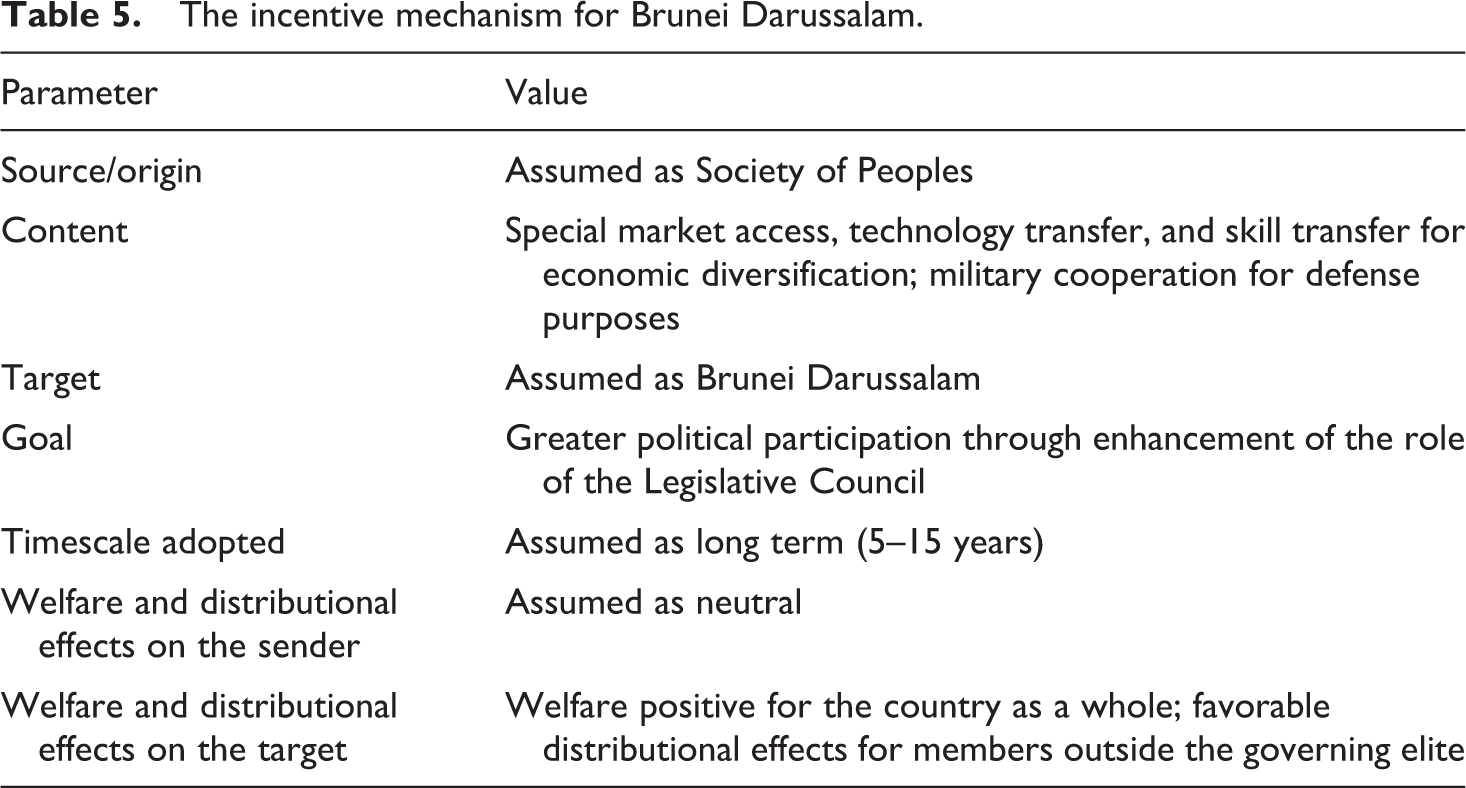
Second, benevolent absolutisms are defined, in part, as political societies that respect human rights. A crucial aspect of how we choose to define a given political community as a benevolent absolutism thus depends on what we consider to be respect for human rights. To give just a single example, if human rights are meant to incorporate political rights, then the very idea of a “human rights-respecting benevolent absolutism” would be self-contradictory and essentially conceptually incoherent. In what follows, I adopt the Rawlsian framework to define what basic human rights are, and thus, I take for granted that the presence of political rights can be treated as a separate issue (indeed, as the motivating factor behind the incentive mechanism) but not as an aspect of basic human rights themselves (see Table 5).
The incentive mechanism for Brunei Darussalam.
Third, the example is not meant to signal that the incentive-based strategy would necessarily succeed for the case in hand (or at least not in the short term and under actual existing political conditions). 21 The incentive-based strategy developed in the article takes for granted that those providing the incentives are correctly motivated. 22 In other words, it assumes that decent and liberal peoples’ foreign policies are based on the moral character that Rawls assigns to them and that their goal is for all peoples to become well-ordered. In the real world, we know that this is not the case. Yet, the success of the incentive mechanism I am suggesting would necessarily be affected by the distance that exists between the foreign policies of liberal and decent peoples as they should be and as they are.
Brunei Darussalam: Basic data and human rights record
Brunei Darussalam is a small kingdom in South East Asia with a population of 412,000. 23 Its government is highly autocratic, and all the executive and legislative power is formally or informally exercised by the royal family headed by Sultan Haji Hassanal Bolkiah. The small state’s economic life is dominated by natural gas and oil exports which constitute the main source of economic revenue for the sultanate. As a result of its large oil and gas reserves and its ability to export efficiently in global markets and increasingly to neighboring countries, Brunei’s GDP 24 stands at close to US$17 billion and its GNI 25 is US$31,590 per capita. (The figure is even higher, US$45,690, if considered in PPP 26 terms.) 27 This makes Brunei one of the richest countries in the world (on a per capita basis). But while aggregate data all too often mask a picture of unbearable inequality and deprivation, most indicators concerning human development and human rights in fact paint a much more nuanced picture of the country. Its primary school enrolment rate is virtually 100 percent, with no significant differences between boys and girls. Its life expectancy at birth is 78, and the state spends significant amounts of money to provide social security to its citizens. The Human Development Index, itself an aggregate measure of different aspects of population welfare in a country, ranks Brunei as 30th in the world with an Human Development Index (HDI) of 0.8555, steadily rising from 0.830 in 2000, and compared to a world average of 0.694. 28
Of course, this is not to suggest that “all is well in Brunei.” The idea of an idyllic place is far from reality. The country is, after all, an absolute monarchy and the idea of pluralism in political life is, to put it mildly, unwelcomed. Furthermore, religious pluralism is curtailed by the prohibition on all non-Muslims to proselytize and practice their religion in public. Nonetheless, Brunei’s human rights record is, according to several international sources, substantially good. Most of the human rights limitations reported by the US State Department in its 2012 report are connected to freedom of expression and the lack of political rights. These are compounded by some religiously motivated gender discrimination. But it is noteworthy that no case of political violence or repression is reported, that women are actively part of public life and of the workforce, and that religious diversity, if not encouraged or welcomed, is not persecuted; all forms of religious practice are legal if privately held. As the US Department of State makes clear, “there were no known reports of human rights abuses by government officials during the year [2012] and impunity was not a problem.” 29
Lest one suspect that the judgment provided by the US Department of State is politically motivated by the commercial relationships between the United States and Brunei, the 2012 Amnesty International Country Report for Brunei, paints a (largely) similar picture. Once again, while the record is not immune from criticism, it is one in which government officials seem to respect the basic rights of citizens and institutional corruption and abuses of power are limited. Brunei has also displayed a similar attitude when it comes to international procedures connected to human rights regimes. The country participated in the sixth Universal Periodic Review conducted by the UN Human Rights Council and maintained a constructive attitude toward the proceedings. 30
In short, Brunei is a good example of a Rawlsian benevolent absolutism. The country is nonaggressive in its foreign policy, and it respects, albeit imperfectly, the basic human rights of the population. The judgment that Brunei is a good example of a benevolent absolutism is also reinforced by the fact that, as mentioned above, we can allow for real-world examples to diverge in some measure from the ideal types provided by LP. In addition, the extent of the reported human rights violations is further reduced if we adopt, as the article’s framework does, the Rawlsian definition of basic rights, thus excluding complete freedom of conscience and political rights as part of the definition of human rights (pp. 78–81).
Brunei falls short of the standards required to be considered a well-ordered people, and thus cannot be an equal member in good standing of the Society of Peoples. However, its respect for basic human rights and its peaceful foreign policy make it sovereign over its people and territory. The incentive mechanism devised in the article allows members of the Society of Peoples to engage with a benevolent absolutism such as Brunei, and to do so without relinquishing their goal of a world exclusively populated by well-ordered peoples. In the previous part of the article, I developed the general framework for this mechanism, and in the following section, I will apply the framework to the particular case of Brunei.
Brunei Darussalam: The incentive mechanism
In what follows, I briefly discuss the application of the incentive mechanism to Brunei Darussalam, by way of assigning a specific “value” to the aforementioned seven parameters. Before doing so I wish to note that, as the discussion following the general explanation of the parameters above makes clear, there are a vast number of factors potentially affecting the choice of instrument for the incentive mechanism. To provide a full discussion of even a single case would require more space than is available here.
Thus, in order to restrict the scope of the parameters, I will fix four of them and partly determine a fifth. I will assume that the incentive mechanism is put in place by the Society of Peoples (parameter 1) and that it does not require transition to full liberal democratic status (parameter 4). Instead, I will suggest that the best way forward is to concentrate on the enhancement of the representativeness and powers of Brunei’s Legislative Council (more on this below).
The latter point immediately raises the following issue: What justifies the exclusive focus on political participation? The goal of the incentive-based strategy is for benevolent absolutisms to become well-ordered; however, being well-ordered is a much more extensive and nuanced criterion compared to political participation taken in isolation. My choice is motivated by two main reasons. Firstly, Rawls explicitly states that benevolent absolutisms are not well-ordered because they do not allow their members to have a meaningful role in the political process (Rawls, 1999: 4, 63). It thus seems safe to assume that the greatest obstacle for a benevolent absolutism when it comes to the transition toward well-ordered political institutions is represented by the lack of representative political institutions. Secondly, the choice, as I will explain below, is also motivated by recent political developments inside the specific target under consideration (Brunei). The introduction of more genuinely representative institutions has been already internally considered and this seems to allow the incentive mechanism to intervene in an already ongoing political debate. Doing so gives the incentive mechanism higher likelihood of success (since there should be at least some form of internal constituency ready to support the changes suggested via the incentive mechanism).
I will also assume that, given the size of Brunei, the incentive mechanism is welfare neutral with respect to the sender and does not have distributional effects internal to the sender (parameter 6). Furthermore, I will assume that the timescale necessary for the incentive mechanism to succeed is medium to long term. The sought-after concessions pertain to the way in which the country is governed. Longer timescales are to be expected in order to allow for adjustment (parameter 5). Finally, given that we are considering how to develop the incentive mechanism for a specific example, Brunei Darussalam, the target of the incentive mechanism is automatically fixed (parameter 3). I will thus concentrate on the two remaining parameters: the content of the incentive mechanism (parameter 2) and the welfare and distributional effects of the incentive mechanism on the target (parameter 7). However, I will also have something to say about how to improve the representativeness of political institutions in Brunei (parameter 4).
Given Brunei’s very high per capita income (see above), direct monetary inducements are unlikely to work effectively. Yet, as we have seen, the content or inducement of the incentive mechanism can vary widely. Exclusive reliance on monetary transfers is unnecessary. The superfluity of monetary transfers is reinforced by that fact that Brunei’s government spends substantial parts of its budget on social services; the (aggregate) GNI figure is also, to some extent, translated into some genuine benefits for the general population. On the other hand, the main challenges that Brunei faces are its dependence on foreign partners for its security and defense vis-à-vis its neighbors and its economy’s excessive reliance on natural resources exports (see Roberts, 2012). 31 It thus seems appropriate to think that the content of the inducement mechanism should be the aim to moderate the dependence on oil resources of Brunei’s economy by encouraging diversification and by assuaging its external security threats. I do not have sufficient space to detail the specific choice of instruments, but it is worth mentioning that technology and skill transfers linked to the development of the non-resources-based sector, coupled with preferential access for exports, are usually considered the standard tools to achieve that goal. In the same way, constructing a realistic incentive mechanism concerning the provision of security against external threats would require a much more detailed analysis of regional security in South East Asia. Nonetheless, it seems safe to assume that Brunei’s small population, coupled with its considerable natural resources and territorial disputes with much larger neighbors (chiefly Malaysia, but also China, see Roberts, 2012), would make it susceptible to an instrument that promised a guarantee of its territorial and economic sovereignty through joint defense agreements. 32
Once the instruments of the incentive mechanism are defined, it remains to be seen how to further specify the goal of the mechanism and how such specification would interact with the likely distributional effects (within the target) of the instruments selected. Once again, the discussion can only be cursory. That said, greater representativeness for Brunei’s citizens could be achieved by encouraging, or more accurately reviving and augmenting, the role of the Legislative Council within the system of governance. The Legislative Council was convened in 2005 after 20 years of inactivity (see Talib, 2013). The Council is mostly appointed by the Sultan, and its role is largely symbolic. Plans to make the Council at least partly elected have been the object of ongoing political deliberations. But, they recently seemed to have stalled (see Roberts, 2012). Yet given that the institution is part of Brunei’s traditional system of governance, and that its representativeness has already been discussed, suggesting changes to its composition and powers would constitute a precise and politically realistic way of specifying the goal of the incentive mechanism. For example, the Legislative Council’s composition could cease to be controlled by the Sultan and gradually become more representative of the citizenry. While a Legislative Council elected through universal suffrage is not a requirement, one can conjecture that, following the model of Kazanistan, the different social groups constitutive of Brunei’s society may eventually gain some form of representation. In the same way, one could also conjecture a gradual evolution of the Legislative Council’s role, not simply its composition. The merely advisory role it currently has could be changed into a more substantively consultative one where the Council’s opinions are taken into account and affect legislative outcomes. 33
The distributional effects of the inducement coupled with the greater role of the Council in the internal politics of Brunei are likely to have positive welfare effects (not to mention symbolically and politically relevant ones) on Brunei’s middle class. 34 Although they would diminish the royal family’s control over internal politics, they would not necessarily worsen their economic prospects nor would they require the total eclipse of their role within governing institutions. Whether these combined effects would be enough to trigger political pressure to accept the inducement is difficult to say. But the incentive mechanism seems to positively affect the position of the emerging middle classes and does not impose prohibitive losses on the actual governing elite. It thus offers a plausible framework to work with.
Conclusion
In this article, I have extended the nonideal theory of Rawls’ The Law of Peoples to benevolent absolutisms. I have claimed that the most effective way of extending the nonideal theory of LP is to provide benevolent absolutisms with positive incentives to become well-ordered. I have also provided a concrete example of how to use the incentive mechanism.
Footnotes
Acknowledgements
I would like to thank two anonymous referees for their extremely detailed and constructive reviews, and Mat Coakley, Laura Valentini, Leif Wenar, and John Williams for written comments at various stages of the writing process. Last but not least, I would like to thank the editors of the journal for their support during the revision process.
Declaration of Conflicting Interests
The author(s) declared no potential conflicts of interest with respect to the research, authorship, and/or publication of this article.
Funding
The author(s) received no financial support for the research, authorship, and/or publication of this article.