




Abstract
We discuss the impact of unmet role expectations of expatriates as one of the situations where support from host country nationals (HCNs) might be more useful for expatriates. Using job demand-resources (JD-R) theory, we argue that HCN support is an important job resource that can reduce the negative influence of unmet role expectations on expatriate adjustment. Because HCNs are distant others within the social network of expatriates, we also suggest that expatriates will be more accepting of HCN support if they believe that such support is coming from credible sources.
Keywords
Although cross-cultural management research has provided theoretical justifications for considering HCNs as important factors in expatriate adjustment (Olsen and Martins, 2009; Toh and DeNisi, 2003, 2005, 2007), scant research discusses specific circumstances where help from HCNs might be more useful for expatriates. This is a significant omission as contact with HCNs can provide expatriates with useful first-hand information about the host country and facilitate their acculturation to the host norms.
HCNs can also be an important source of support for expatriates. Lack of support from HCNs can increase the risk of premature return of expatriates (i.e. expatriates’ desire to return to the home country without finishing the foreign assignment: Florkowski and Fogel, 1999). Each premature return or a failed expatriate assignment costs companies an average of US$198,000 (Tungli and Peiperl, 2009). Further, this estimate does not include social costs such as disruption of projects, bruised relations with the host country, and tarnished image of the company.
Given the high costs associated with expatriate failure, it may be important for companies to look at support from HCNs as a significant resource that facilitates expatriate adjustment. Further, support from HCNs not only facilitates expatriate adjustment but also reduces the impact of negative factors on expatriate adjustment. For example, role conflict has been found to be negatively related to expatriate work adjustment (Aryee and Stone, 1996). In such situations, information support (a type of help; Caliguiri and Lazarova, 2002) from HCN co-workers can significantly attenuate the negative impact of role conflict on expatriate adjustment. In addition, it is likely that factors such as credibility of HCNs interact with HCN support to influence expatriate adjustment. However, previous research has not discussed the importance of such factors in expatriate adjustment. Therefore, the purpose of this paper is to present a theoretical framework that (1) highlights the importance of HCN support in attenuating the impact of negative factors on expatriate adjustment and (2) studies the interactive influence of HCN support and HCN credibility on expatriate adjustment.
Although, there are several factors that can negatively influence expatriate adjustment such as role conflict, role novelty (Aryee and Stone, 1996; Black et al., 1991), we discuss the influence of expatriates’ unmet role expectations on expatriate adjustment for two reasons. First, there exists a large body of domestic research that suggests unmet expectations negatively impact various employee outcomes such as newcomer’s job satisfaction and organizational commitment (e.g. Wanous et al., 1992). However, few researchers have explored this phenomenon within the context of expatriate adjustment (e.g. Caligiuri et al., 2001). Second, year after year, global relocation surveys suggest that job not meeting expectations has been cited by expatriates as one of the important reasons for assignment failure (Brookfield, 2009, 2010; GMAC, 2008). Hence, we chose to investigate the role of HCN support in reducing the negative impact of unmet role expectations of expatriates on expatriate adjustment.
HCN support and expatriate adjustment: a brief review
Among the early researchers exploring the role of HCNs in expatriate adjustment were Zeira and Banai (1985). These researchers argued that a high rate of expatriate failure was due to large variability on the criteria for selecting expatriates between parent-country and host-country managers. Put differently, parent-country managers were selecting expatriates based on a set of criteria that did not align with the expectations of the host-country managers. In similar research, Pazy and Zeira (1985) argued that cross-cultural training that was not aligned with the expectation of expatriates, parent-country managers, and host-country managers had a significant negative impact on expatriate effectiveness.
More recently, reviews done by Black and his colleagues provide convincing theoretical support for considering HCN support as an important resource to facilitate expatriate adjustment (Black, 1988; Black and Mendenhall, 1990; Black et al., 1991; Gregersen and Black, 1992). Research also suggests that HCN support influences expatriate job performance, overcomes initial stress relating to foreign assignment and facilitates general adjustment of expatriates in the host environment (Aycan, 1997; Black, 1990; Black and Gregersen, 1991; Gregersen and Black, 1992). Further, as HCNs possess crucial local knowledge, contact with HCNs is likely to help expatriates in making sense of the local–parent differences, thereby facilitating their adjustment in the host nation (Shaffer et al., 1999).
Some research also suggests that the attitude of HCNs towards their expatriate colleagues impacts expatriate adjustment. For example, Sinangil and Ones (1997) found that those expatriates who were perceived by their HCN co-workers as ethnocentric were less likely to adjust to the host environment. In a similar study, Florkowski and Fogel (1999) found that expatriates’ perceptions of host ethnocentrism were negatively related to expatriate adjustment. Some research also suggests that HCN’s perceived quality of relationship with expatriates influences their willingness to show supportive behaviors towards expatriates (Varma et al., 2009).
Further, Toh and DeNisi (2003, 2005) argued that, in response to the ethnocentric policies favoring expatriates, HCNs might withdraw social support to expatriates, which in turn negatively influenced expatriate adjustment. They developed a conceptual framework and theorized that several factors influence HCNs’ desire to demonstrate helping behaviors towards expatriates (Toh, 2003; Toh and DeNisi, 2007). Using self-categorization theory (Turner, 1987), they argued that demographic differences such as physical appearance and language, ethnocentric attitudes, values dissimilarity, and perceived pay discrepancy between expatriates and HCNs increases the salience of nationality, and lead to outgroup categorization (Expatriates vs HCNs). This in turn inhibits HCNs from showing helping behaviors towards expatriates. In such situations, expatriates were less likely to adjust to the host environment and more likely to show poor job performance.
However, results obtained from an empirical study provide mixed evidence for the relationship between HCNs’ helping behaviors and expatriate adjustment (Toh, 2003). For example, in the sample consisting of HCNs, HCNs’ helping behaviors were found to be positively related to HCNs’ perceptions of expatriate adjustment, but for the sample consisting of expatriates no significant association between HCNs’ helping behaviors and expatriate adjustment was found. Thus, although HCNs perceived that their helping behaviors towards expatriates facilitated expatriate adjustment, expatriates did not perceive help from HCNs to be useful for their adjustment.
Clearly Toh’s work is preliminary and there is more to be done in this area. The cognitive processes through which HCNs make sense of their relationship with expatriates are far more complex than has been uncovered by previous researchers. More effort needs to be undertaken in developing comprehensive theoretical frameworks explaining such phenomena. Further, there is a need to resolve the inconsistency in the results obtained by recent empirical evidence (e.g. Toh, 2003) and previous research (Black et al., 1991; Caligiuri, 2000) regarding the importance expatriates attach to the helping behaviors of their HCN colleagues. We surmise that one of the aspects overlooked in the previous research is the importance of HCN support in situations that negatively impact expatriate adjustment. Therefore, we discuss one of the negative situations, unmet role expectations of expatriates, and advance arguments to suggest ways through which HCN support can mitigate the negative influence of unmet role expectations on expatriate adjustment.
Theoretical framework
We use the job demand-resources (JD-R) theory (Demerouti et al., 2001) to advance our arguments as it presents a parsimonious framework to integrate the two constructs in our theoretical model: unmet role expectations and HCN support. According to the JD-R theory, job demands are those aspects of a job that require sustained physical or mental effort, which in turn increase job strain. These can be quantitative job demands such as the extent to which a job requires employees to work fast, as well as qualitative job demands such as the extent to which a job is not clearly defined (Janssen, 2001). On the other hand, job resources refer to those aspects of a job that help in achieving work goals as well as reduce the negative impact of job demands (Baker et al., 2005; Demerouti et al., 2001). Research on JD-R suggests that job resources buffer the impact of job demands on job burnout (Baker et al., 2005). In another study, Van Yperen and Hagedoorn (2003) found that, as job demands increased, support from co-workers and supervisors helped in maintaining intrinsic motivation at a higher level. Therefore, in line with the JD-R theory we argue that HCN support is a job resource that can mitigate the negative impact of unmet role expectations on expatriate adjustment. In addition, we also argue that the relationship between HCN support and expatriate adjustment will be stronger if expatriates perceive their HCN colleagues to be credible. Figure 1 depicts the proposed relationships.
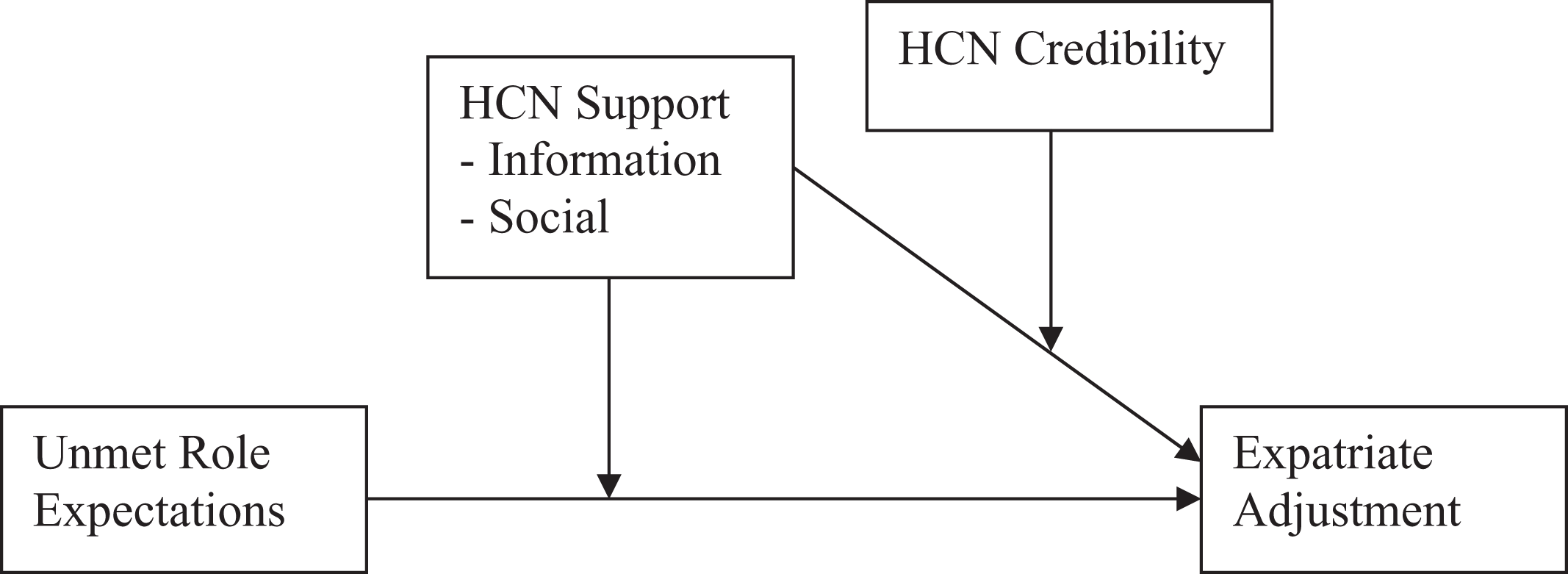
Direct and Indirect Influence of HCN Support on Expatriate Adjustment
Unmet role expectations of expatriates, HCN support, and expatriate adjustment
Porter and Steers (1973) define (un)met expectations of newcomers as the difference between a newcomer employee’s expected experiences and actual experiences which they encounter as they begin their job assignment. Expectations that are met are likely to yield positive outcomes and unmet expectations are likely to yield negative outcomes. For example, met expectations have been found to be positively related to organizational commitment, job satisfaction, and job performance (Greenhaus et al., 1983; Tannenbaum et al., 1991; Wanous et al., 1992). Unmet expectations, on the other hand, negatively impact newcomers’ adjustment, and increase newcomer absenteeism and turnover (Lee and Mowday, 1987; Porter and Steers, 1973; Van Maanen, 1975; Wanous et al., 1992).
Similar to a newcomer’s entry into an organizational setting, expatriates also enter a new host country and a different work environment. They carry with them anticipatory expectations regarding their role within that environment (Black et al., 1991). It is likely that when anticipatory expectations of expatriates regarding their role do not match the reality of their work life, it might have a dysfunctional impact on their adjustment. In worst cases, they might experience culture shock and may end their assignment prematurely (Bhaskar-Shrinivas et al., 2005; Black and Mendenhall, 1991).
Although not much empirical evidence exists that directly applies the concept of unmet role expectations in a cross-cultural context, findings from a few empirical studies are consistent with that of the domestic researchers. For example in a study on repatriation, Black and colleagues found that unmet expectations of expatriates both at work and non-work were negatively related to their adjustment in the home country, and increased the likelihood of quitting their organizations (Black, 1992; Stroh et al., 1998). In another study, Caligiuri et al. (2001) found that met expectations of expatriates positively affected their overall adjustment in the host nation. From this evidence it is clear that expatriates’ unmet role expectations negatively influence their adjustment and are likely to increase their withdrawal cognitions.
Some domestic research also suggests that a newcomer’s relations with their supervisor as well as with their co-workers mitigate the negative impact of unmet role expectations on several employee outcomes such as organizational commitment and job satisfaction (e.g. Major et al., 1995). Extending these findings to cross-cultural management, we argue that HCN support acts as a job resource for expatriates and helps in mitigating the negative influence of unmet role expectations on expatriate adjustment. We advance three reasons for considering HCN support as a job resource for expatriates. First, expatriates lack an elaborate network of extended family and friends in the host environment and therefore may feel isolated and lonely. In such situations HCN co-workers can fill that void by actively socializing with expatriates and their families. Second, unmet role expectations signal a breach of psychological contract for expatriates (Stroh et al., 1998). Lacking support from their parent organization, expatriates may want to vent their frustration and share their work- and non-work-related problems. HCN colleagues can serve such a purpose and provide psychological comfort to expatriates. Finally, even if expatriates show reluctance in seeking support from their HCN colleagues due to language problems, cultural differences or expatriates’ personality traits such as introversion, still the intent of HCN colleagues to provide support itself may be sufficient for expatriates to adjust in the host nation. Because intentions are good predictors of behaviors (Ajzen and Fishbein, 1974), HCNs’ intentions of helping expatriates (e.g. by indicating to expatriates that they can help) can provide an additional resource to expatriates for seeking help should expatriates need their help in order to adjust in the host country. Therefore we propose the following:
Proposition 1: Unmet role expectations of expatriates will be negatively related to expatriate adjustment.
Proposition 2: HCN support will moderate the relationship between unmet role expectations of expatriates and expatriate adjustment such that at high levels of HCN support, the negative influence of unmet role expectations on expatriate adjustment will be significantly less than at low levels of HCN support.
Types of HCN support and expatriate adjustment
Researchers have discussed three types of support – informational, emotional, and instrumental – that expatriates can get from their organization, family and friends, and co-workers in order to adjust in a new environment (Caligiuri and Lazarova, 2002; Caligiuri et al., 1998; Kraimer et al., 2001). Informational support can range from routine issues such as providing role information to expatriates to strategic issues such as providing advice on cultural differences in negotiating a business contract with another local company. Such support can be vital for reducing work stress of expatriates as well as facilitating their understanding of the acceptable behaviors and norms of working in the host country (Adelman, 1988). Emotional support can range from passive listening to expatriates’ frustration of living in a new environment to actively engaging in socializing with expatriates and their families outside work (Caligiuri and Lazarova, 2002). Finally, instrumental support such as helping expatriates find good schools for their children and housing in a good community may help them connect with HCNs at a deeper level. Whereas informational support can fulfil the informational needs of expatriates, emotional and instrumental support can be critical for fulfilling higher order needs such as belonging and feeling acceptable in the host nation (Caligiuri and Lazarova, 2002). Further, it may be difficult to differentiate between emotional and instrumental support as both extend beyond work domains and help expatriates form connections with HCNs at a deeper level. Therefore, in the present research we use only two types of HCN support: social support that includes both emotional and instrumental forms of support, and informational support from HCN co-workers. This is consistent with the previous research that categorized HCN support into informational and social support in order to predict its relationship with expatriate adjustment (Toh, 2003; Toh and DeNisi, 2007).
Informational support
Although expatriates may receive informational support from various sources, the role of HCN co-workers may be especially important in providing such type of support for variety of reasons. First, expatriates face lots of challenges such as the time involved to adjust in the new environment. As HCNs are native to the host culture, they can help expatriates make sense of the new environment. Second, on the job, expatriates may not know the process of finding required information – who to contact, lead time to get such information – and any other better ways to perform a given task. Further, pressures to obtain role information increase if information has to be obtained from a source outside the organization. HCNs as information providers can ease such pressures. Therefore, proactive help from HCNs in serving role needs of expatriates can go a long way in facilitating expatriate adjustment.
Proposition 3: Informational support from HCN coworkers will be positively related to expatriate adjustment.
Social support
At another level, social support from HCN co-workers can create a feeling of acceptance among expatriates, and increase expatriates’ affiliation with the host country. Initially, expatriates may not know many people in the host country and thus may feel reluctant to talk to other host nationals out of their work area. They may also be oblivious to things such as proper attire for a given occasion, acceptable greetings and courtesy, transportation, housing, schools for children, and such other activities. Although these activities may seem insignificant, they are an important part of an expatriate’s daily life and can be anxiety-provoking and stressful. If not addressed, uncertainty arising from these activities may lead expatriates to adopt dysfunctional coping strategies such as avoiding contact with HCNs. This may eventually trigger expatriates’ intentions to withdraw from the host nation. However, HCN co-workers can socialize with expatriates outside work and invite them to be part of their social network. Being part of a larger social group, expatriates and their families will feel psychologically secure and part of a local society (Caligiuri and Lazarova, 2002). Therefore, social support from HCN co-workers that helps them in performing their routine activities as well as helps them in connecting with the host nation can facilitate expatriate adjustment.
Proposition 4: Social support from HCN coworkers will be positively related to expatriate adjustment.
HCN credibility, HCN support, and expatriate adjustment
Credibility can be defined as the extent of appropriateness of an individual’s actions, which are determined with reference to a socially accepted system of values and norms (Suchman, 1995). Although there are several ways through which individuals acquire credibility, it always confers on them a notion of trustworthiness (Elsbach and Sutton, 1992; Suchman, 1995). Therefore, individuals are more likely to accept those decisions that are made by credible decision-makers because credibility signals decision-makers’ competence and ability (Elsbach and Elofson, 2000; Fisher et al., 1979).
Some research also suggests that credibility of a manager positively influences their peers’ ability to trust them (e.g. McAllister, 1995). On a similar note, credibility of HCN co-workers is likely to have a favorable impact on expatriates. For example, expatriates are likely to feel more comfortable if they receive support from HCNs who are also credible.
Further, as expatriates are primarily selected because of their technical superiority over HCNs (Toh and DeNisi, 2005), they may be skeptical of any information received from their HCN colleagues. However, presence of legitimating labels such as HCNs’ professional credentials, information on HCNs’ competence provided to expatriates by their organization, may help expatriates affirm faith in the competence of their HCN colleagues. Therefore, we argue that expatriates are more likely to adjust well not only when they receive HCN support but also and more importantly when such support comes from credible sources. Therefore we propose the following:
Proposition 5: HCN credibility will moderate the relationship between HCN support and expatriate adjustment such that when HCN credibility is high, the relationship between HCN support and expatriate adjustment will be stronger than when HCN credibility is low.
Although HCN credibility can add legitimacy to the informational and social support offered by HCNs, its importance will be more for informational than social support. Because informational support from HCNs will be directly relevant for solving work-related problems, expatriates will be more willing to accept such support if they perceive HCNs to be credible sources of providing such information. Thus, HCN credibility cues expatriates about the competence of HCNs to solve their work-related problems and helps expatriates in establishing cognitive-based trust (McAllister, 1995) in HCNs. However, expatriates will be less keen on validating the credentials of HCNs while receiving social support from them. Being native to the host country may itself serve as a legitimating label for HCNs to offer any advice pertaining to the host country. Moreover, by offering social support HCNs indicate their genuine care and concern for expatriates, which in turn facilitates expatriate adjustment. Thus HCN credibility may be less important for receiving social support as compared to informational support.
Proposition 6: HCN credibility will be a stronger moderator for the relationship between informational support and expatriate adjustment than the relationship between social support and expatriate adjustment.
Discussion
Theoretical contributions
This paper makes several contributions to the existing body of literature in cross-cultural management. First, it takes the HCNs’ perspective into consideration which has not received adequate attention from previous researchers. Although some research in cross-cultural management has discussed the importance of HCNs, more emphasis has been given to desirable traits (e.g. HCN interpersonal skills, Liu and Shaffer, 2005) or cultural orientation of HCNs (e.g. collectivism, Varma et al., 2009) and less on what types of HCN support facilitate expatriate adjustment, when does HCN support become more salient for expatriates, and how do expatriates’ perceptions about HCNs impact the meaning expatriates attach to receiving HCN support. The theoretical framework discussed in this paper addresses some of these limitations and underscores the importance of HCNs as socializing agents who can help expatriates adjust in the new environment. Two types of helping behaviors from HCN co-workers – information support and social support – are proposed to facilitate expatriate adjustment. We have argued that expatriates who receive help from HCNs will be better adjusted than those who do not receive any help from HCNs. Furthermore, this paper discusses when receiving help from HCNs will be more useful for expatriates. Specifically, one of the situations – unmet role expectations of expatriates – is considered. It is argued that receiving help from HCNs will mitigate the negative impact of unmet role expectations on expatriate adjustment. Unmet role expectations are indicative of a breach of the psychological contract (Coyle-Shapiro and Conway, 2005) between expatriates and the organization. In such situations, support from HCN co-workers is likely to be more meaningful for expatriates. Thus, although HCN support facilitates expatriate adjustment, it will be more salient in situations where expatriates perceive their role expectations have not been met. With regard to how expatriate perceptions about HCNs interact with HCN support, we have argued that, because HCNs are relatively distant members (compared to other members such as other expatriates, and family and friends) in expatriates’ social network, expatriates will be less willing to accept HCN support without any information on whether HCNs are credible sources to offer support. This will be more true for receiving information support from HCNs as HCN credibility will cue expatriates regarding the competence and ability of HCNs to provide such support. However, for receiving social support, expatriates are less likely to question the credibility of HCNs because by being in the host country longer than expatriates HCNs are more accustomed to the host-country cultural norms, which itself lends credibility to HCNs to offer social support to expatriates.
Thus, by focusing on the types of HCN support, the situations when such support is more useful and how expatriates’ perceptions about HCNs interact with HCN support, we have delineated a theoretical framework that provides a broader understanding of the HCN–expatriate relationship in cross-cultural management.
Second, cross-cultural management researchers have used social identity theory (SIT; Tajfel and Turner, 1979, 1986) or its subsequent variant, self-categorization theory (SCT; Turner, 1987) to discuss the factors that can create a wedge between HCNs and expatriates (Olsen and Martins, 2009; Toh and DeNisi 2003, 2005), thereby reducing the possibility that expatriates receive any help from HCNs (Toh, 2003; Toh and DeNisi, 2007). However, to date, not much empirical work has tested these propositions. Furthermore, some evidence even suggests that HCN support does not have a direct positive effect on expatriate adjustment (e.g. Toh, 2003). Therefore, there is a need to discuss alternative theories in order to study the relationship between HCN support and expatriate adjustment. In this paper we have used one of the alternative theories (JD-R) in order to suggest an indirect relationship between HCN support and expatriate adjustment. Except for recent work by Lazarova et al. (2010), JD-R theory has not been applied to expatriate adjustment. However, based on existing domestic research (e.g. Major et al., 1995), JD-R is a useful theory to study the relationship between HCN support and expatriate adjustment. Thus, the theoretical framework presented in this paper extends the JD-R theory to cross-cultural management.
Finally, the theoretical framework presented in this paper has implications for the coping mechanism expatriates use in order to deal with cultural differences in the host country. Getting support from HCNs not only can help expatriates socialize with HCNs but also can help expatriates in better understanding the host culture and dispel any negative feelings towards the host country. This in turn can help expatriates identify the nature of their problems (e.g. cultural differences), and adopt appropriate coping strategies (e.g. problem-focused coping strategies that are directed toward managing person–environment relationship such as showing tolerance and patience in a new cultural environment; Selmer, 1999; Stahl and Caligiuri, 2005) in order to solve those problems and better adjust in the host environment.
Managerial implications
Companies spend much effort in providing cross-cultural training to expatriates in order to facilitate their adjustment in the host location (Caligiuri et al., 2001). A recent survey suggests 80 percent of companies provide some form of cross-cultural training to expatriates (Brookfield, 2010). Despite increasing emphasis on cross-cultural training, failure rates among US expatriates are still on the high side1 (Black and Mendenhall, 1990). Therefore, emphasis on cross-cultural training may only provide partial answers to the inability of expatriates to adjust in the host location.
Based on survey findings (Brookfield, 2009, 2010; GMAC, 2008), we suggest that one of the factors leading to expatriate failure, and which has been overlooked, is the unmet role expectations of expatriates. Because various aspects of foreign assignment cannot be predicted, there is a greater likelihood that role expectations of expatriates may not be met. Therefore, there is a greater need for companies to effectively manage such negative experiences. We have suggested that companies should look for resources within the host unit such as HCN support in order to help expatriates buffer the impact of unmet role expectations.
HCN co-workers can be an excellent source of support should expatriates need them. Being native to the host country, HCNs can take the role of mentors. As mentors they can advise expatriates on appropriate work behaviors and acceptable norms of doing business in the host country. Outside work, HCN co-workers can invite expatriates and their families to be part of their social network. This can ease the adjustment process of expatriates and their families. Such support is indicative of genuine care and concern and can help build trust between expatriates and HCNs. To utilize the full potential of HCN support as a resource, we suggest that companies extend their cross-cultural training to include HCNs as well. Providing cross-cultural training to HCNs can increase their cross-cultural knowledge, which can be useful during interactions with expatriates and their families.
Future research
There are several directions for future research. First, the theoretical propositions should be empirically tested. One of the ways to measure unmet role expectations of expatriates is through longitudinal research. Role expectations of expatriates can be measured before expatriates enter the host country and again after the start of expatriate assignment. Discrepancy scores between the actual and expected role experiences can be calculated and entered into the regression equation. Other alternatives to using discrepancy scores such as polynomial regression can also be used (see Edwards, 2001; Edwards and Parry, 1993).
Second, data should be collected from different sources (i.e. HCNs, expatriates, expatriate supervisors) in order to increase the validity of the findings. In addition, other sources of support such as the spouse and the organization can also be included in the model. It might be interesting to investigate if, by introducing other sources of support, the effect of HCN support on expatriate adjustment is reduced.
Another possible avenue for future research is to include different categories of HCNs in addition to HCN co-workers (e.g. HCN friends, HCN supervisors) and study the impact of support received from them on expatriate adjustment. Future research can also study if male and female expatriates respond differently to HCN support.
Conclusion
The present research underscores the importance of HCNs in cross-cultural management. We argue that HCN co-workers can be useful sources of support for expatriates in order to adjust in the host nation and effectively do their job. Using JD-R theory, we also argue that HCN support acts as a buffer and reduces the negative impact of unmet role expectations on expatriate adjustment. Because HCNs are distant others in the social network of expatriates, we highlight the importance of HCN credibility. We have argued that expatriates will feel more comfortable if they receive support from HCN co-workers who are also credible.
Footnotes
Funding
This research was supported by a Humanities and Social Sciences Research Grant, University of Windsor, awarded to Ashish Mahajan.