



Abstract
Employing an experimental design, we investigated how Norwegian managers’ (N = 78) evaluations and intended hiring decisions varied with job applicants’ ethnic background (immigrant vs. native Norwegian mainstreamer) and the degree to which the candidates’ self-presentation fitted Norwegian cultural norms (level of cultural fit). The participants viewed video clips of applicants whose ethnicity and self-presentation was manipulated. Irrespective of ethnic background, low cultural fit candidates were evaluated as less similar, less likable, less likely to perform well, and as more poorly fitting the managers’ organization. However, low and high cultural fit candidates were evaluated as exhibiting similar levels of person–job fit. Logistic regression analyses showed that low cultural fit candidates were about six times less likely to be hired than high cultural fit candidates. In practice, immigrant applicants are more likely to exhibit low cultural fit. It is concluded that emphasis on cultural fit could easily have a disproportionate effect on immigrants’ chances of being hired, notably if fit is not predictive of job performance.
Immigrants to Western Europe run a higher risk of unemployment than the native populations (van Tubergen, 2006). This holds true also for highly educated immigrants with qualifications obtained in the host country (e.g. Brekke and Mastekaasa, 2008; Duvander, 2001). Among the reasons for this inequality is unfair discrimination, which has been demonstrated in a number of Western countries (Riach and Rich, 2002). Another source may be the widespread use of job interviews as the primary tool in selection, as interviews are more susceptible to various sources of bias than more structured types of assessment. Securing a job depends in part on one’s self-presentation, the way one markets skills and personal qualities in the interview. By managing the impression projected to the interviewer, applicants influence the interviewer’s evaluations of their fit with the job and the organization (Chen et al, 2008; Higgins and Judge, 2004; Kristof-Brown et al., 2002), which subsequently impact strongly on interviewers’ hiring recommendations (Chen et al., 2008; Higgins and Judge, 2004). Presenting the “right” image, however, requires a specific set of discursive skills and intimate familiarity with the unwritten rules of the interview game, a familiarity that immigrant applicants may lack (Campbell and Roberts, 2007). As a consequence, immigrant applicants are more likely to show a lack of cultural fit in the job interview; that is, they are likely to present themselves in ways that diverge from national cultural norms in the host society. Because unfavorable information tends to outweigh favorable information in selection decisions (Rowe, 1984), otherwise qualified immigrant candidates may be rejected if their self-presentation does not fit with mainstream (i.e.native) interviewers’ expectations.
In this study, we employed an experimental design to investigate the effect of degree of cultural fit in candidates’ self-presentation on Norwegian managers’ evaluations and intended hiring decisions. Previous interview research has focused on unfair discrimination of applicants with minority backgrounds (e.g. Huffcutt and Roth, 1998), on how applicants’ self-presentation tactics influence interviewers’ evaluations (e.g. Barrick et al., 2009), and on how applicants’ self-presentation tactics vary across cultures (e.g. Bye et al., 2011). We integrate these three perspectives in our study. We also discuss how our results have practical implications for hiring managers operating in multicultural settings and for counselors who prepare immigrants for the job search process.
Ethnic background and cultural fit
Immigrants and ethnic minorities are often subject to unfair treatment in hiring (Riach and Rich, 2002). Applicants with names indicating an immigrant background are less often invited to interviews (Carlsson and Rooth, 2007). Similarly, other studies have shown biased evaluations based on foreign accents (Hosoda and Stone-Romero, 2010) and skin complexion (Harrison and Thomas, 2009). This type of discrimination, however, is not the only obstacle immigrant applicants may face in selection. A different line of research has focused on how job applicants increase their chances of being hired by managing impressions during the job interview (see Barrick et al., 2009, for a review and meta-analysis). Notably, foreign-born candidates were less successful in impression management (Campbell and Roberts, 2007; Roberts and Campbell, 2006).
Kacmar et al. (1992) argued that implicit expectations regarding appropriate, acceptable, and expected applicant behavior are embedded in the interview context. Immigrants who pass the first hurdle of being invited to an interview may be at a disadvantage because such implicit expectations vary across cultures. A cross-cultural study among students from 10 countries examined how applicants intended to present themselves when interviewed for a desired job, and the results showed that intended self-presentation varied with cultural value emphases (Sandal et al., submitted for publication). Similar results have been found in cross-cultural research on employees’ upward impression management in the work place (Xin, 2004; Zaidman and Drory, 2001). One implication of this is that interviewers and applicants from different cultural backgrounds may have more dissimilar expectations regarding desirable applicant self-presentation than applicants and interviewers with a shared cultural background. The extent to which an applicant’s self-presentation conforms to the interviewer’s culturally bound normative expectations can be conceptualized as the degree of cultural fit.
When being interviewed for a job, immigrants may have poorer chances of being hired both due to unfair discrimination and because they are more likely to exhibit poorer cultural fit in their self-presentation. Prior experimental studies of differential treatment have focused on the effects of ethnicity, whereas the influence of applicant’s self-presentation has been addressed by relying on stimulus materials such as résumés with names or pictures, or by training interviewees to exhibit a specific self-presentation style (Carlsson and Rooth, 2007; Harrison and Thomas, 2009; Riach and Rich, 2002). By manipulating both applicant ethnic background and cultural fit in self-presentation, we aim to disentangle the effects of these constructs on managers’ evaluations of the candidates. This study thus contributes to the literature on minorities and interview assessments by addressing the issue of the cultural appropriateness of applicants’ behavior as well as examining the issue of whether the interpretation of applicants’ behavior is moderated by their ethnic background. As the study took place in Norway, we outline applicants’ self-presentation tactics that we consider to be indicative of high and low cultural fit in a Norwegian context.
Cultural fit in the Norwegian context
Norway is a country of approximately 5 million inhabitants, of which 13.1 percent are immigrants or Norwegian-born to immigrant parents. Similar to the other Scandinavian countries, Norway is a modern welfare state. It has one of the highest per capita income levels in the world and is characterized by low levels of income inequality. Labor unions are strong and according to the Norwegian Confederation of Enterprise (2013), “there is a deeply rooted tradition for employee involvement and information/consultation of workers” in Norwegian enterprises. Espedal (2008) and Espedal et al. (2009) describe leadership in the Norwegian context as characterized by cooperation and trust among leaders and subordinates, and subordinates are given quite a lot of responsibility and freedom. Self-enhancing factors, such as competition, individual incentives, and self-interest, are not valued.
In the psychological literature, Norwegian culture is characterized by a strong emphasis on the cultural values of egalitarianism and harmony and a low emphasis on values of hierarchy and mastery (Schwartz, 2006). In egalitarian and harmony-oriented cultures, there is an emphasis on seeing people as equals and on fitting into the world as it is and a de-emphasis on ascribed roles with unequal status and active self-assertion (Schwartz, 2006). Norway is also characterized by a strong emphasis on the cultural value of femininity (Hofstede, 2001). This means that feminine values like equality, solidarity, and quality of work life are important. According to Hofstede (2001), job applicants in feminine countries tend to “undersell themselves”. Moreover, Scandinavians highly value and practice equality of outcome in social relationships (Thomsen , Sidanius & Fiske, 2007). This is achieved through interpersonal leveling: “don’t think you are better than anybody or everybody else! …. In Scandinavia, you must not see yourself as outstanding: an outstanding person stands out above others, and such stand-outs may be outcasts” (Thomsen et al., 2007: 450). Taken together, this constellation of cultural values and norms paints a picture of a society in which the cultural ideal is fitting in and being equal to others.
We suggest that interviewers’ norms about how applicants should present themselves are shaped by dominant cultural norms and values. Applicants can thus show a low cultural fit by employing a tactic that violates a cultural ideal. To define levels of cultural fit, we focused on whether different self-presentation tactics are congruent with Norwegian cultural values and the extent to which they are endorsed by native Norwegian mainstreamers. Based on previous research (Bye et al., 2009, 2011; Sandal et al., 2009, submitted for publication), we focused on two self-presentation tactics showing cultural variability: emphasizing organizational competencies and presenting an idealized image. While the first tactic was identified in both student and adult samples from different cultural backgrounds (Bye et al., 2009, 2011; Sandal et al., 2009, submitted for publication), the second tactic was identified in a study among Norwegian mainstreamers and immigrants to Norway from four ethnographic regions (Horn of Africa, South East Asia, the Middle-East, and the Sub-Indian continent; Bye et al., 2009; Sandal et al., 2009).
Emphasizing organizational competencies during the interview is characterized by showing enthusiasm and desire to learn as well as emphasizing that one is disciplined, proactive, and a good colleague. This tactic is desirable in a Norwegian context. First of all, it is not in conflict with Norwegian cultural values. Second, both Norwegian students and adults have rated emphasizing organizational competencies as important for making a good impression (Bye et al., 2009, 2011; Sandal et al., 2009). Applicants employing this tactic exhibit high cultural fit and are likely to receive positive evaluations by Norwegian hiring managers.
Presenting an idealized image in the interview entails emphasizing willingness to work long hours and take on tasks despite lack of training or interest. It also includes emphasizing being the best at everything and exclusively focusing on positive personal qualities (Bye et al., 2009; Sandal et al., 2009). A similar tactic is described by Roberts and Campbell (2006: 137) in their discourse analytic study of job interviews in Britain: For those who have experienced being an immigrant to Britain, anxieties about possible discrimination and failure … contribute to a form of self-presentation that may damage their chances. Born abroad candidates … seek to present themselves as always working hard, willing to do anything, and denying anything negative about past work experiences.
Presenting an idealized image, especially the element of making claims of being the best at anything one does, is not desirable in a Norwegian context. Employing this tactic was considered less central to making a good impression by mainstream Norwegians than by immigrants from the Horn of Africa, South East Asia, the Middle-East, and the Sub-Indian continent (Bye et al., 2009; Sandal et al., 2009). It is incongruent with the values of egalitarianism, harmony, and femininity. Moreover, giving a perfectionistic description of oneself is a clear violation of the Scandinavian norm of leveling in social relationships (Thomsen et al., 2007). Even in a job interview setting, making statements about one’s superiority is likely to be perceived as being overconfident and not humble enough by a mainstream Norwegian interviewer. Because presenting an idealized self is incongruent with Norwegian cultural values as well as the norm of interpersonal leveling, we believe that applicants who employ this tactic exhibit low cultural fit.
Impact of cultural fit on interviewers’ evaluations
Following social rules is important for how candidates are evaluated (Ramsay et al., 1997), notably if candidates do not follow these rules. Our main argument is therefore that a lower cultural fit in applicants’ self-presentation is associated with poorer interview evaluations by hiring managers. Previous interview research has focused on interviewers’ evaluations of perceived similarity, likability, performance expectations, person–organization (P-O) fit, person–job (P-J) fit, and hiring outcomes (Cable and Judge, 1997; Chen et al., 2008; García et al., 2008; Higgins and Judge, 2004; Kristof-Brown et al., 2002). We believe that a low level of cultural fit as expressed through an idealized self-presentation will have a negative impact on all these evaluations.
First, when Norwegian hiring managers are faced with a candidate whose self-presentation conflicts with what is considered appropriate in Norwegian culture, they are likely to perceive the candidate as being less similar to themselves. Second, low cultural fit candidates are rated as less likable. This can be inferred from the close link between similarity and liking (similarity–attraction paradigm, Byrne, 1971) but is also likely because persons who violate the leveling norm are disliked by Scandinavians (Thomsen et al., 2007). Performance expectations refer to the interviewers’ expectations to the candidate’s future job performance, organizational citizenship behaviors, and functioning as a team member (García et al., 2008). We suggest that interviewers should hold lower performance expectations about a low cultural fit candidate; performance expectations include how the candidate relates to others, and a low level of cultural fit may be perceived as an indication of poor interaction skills.
The degree of cultural fit in applicants’ self-presentation should also impact on interviewers’ perceptions of P-J fit and P-O fit. P-J fit is defined as the degree to which a candidate’s knowledge, skills, and abilities match the requirements of the job. P-O fit concerns the match between the candidate and the organization or its employees in terms of broader characteristics such as values (Kristof-Brown, 2000). We focus on supplementary P-O fit, which involves a match in terms of being similar to the employees already in the organization and as sharing the organization’s values. Both P-J and P-O fit are often viewed as the characteristics that are specific to a job or organization. However, when dealing with a multicultural applicant pool, both types of fit can be viewed as having important cultural elements. A low level of cultural fit could lower ratings of P-J fit if candidates whose self-presentation violates cultural ideals are perceived as lacking the interaction skills necessary to perform the job effectively. A similar reasoning holds for P-O fit. Organizational cultures are embedded in national cultures (Erez and Gati, 2004). Thus, despite the fact that organizational cultures differ, they share common features based on dominant values at the national level (Brodbeck et al., 2004). A candidate whose self-presentation conflicts with national cultural norms is therefore likely to be seen as a poor fit with many organizations within a national culture.
To summarize, we expect that a candidate whose self-presentation expresses a low cultural fit will be rated as less similar, less likable, less likely to perform well, and as exhibiting lower P-J and P-O fit than an identically qualified candidate whose self-presentation indicates high cultural fit. As a consequence, we also expect that a low cultural fit candidate has a lower likelihood of being hired than a high cultural fit candidate.
Interaction between ethnic background and cultural fit
A person’s individual values and norms may be more or less congruent with values and norms espoused in the broader societal culture (Lu, 2006). Therefore, variations in cultural fit can be expected also among members of the ethnic majority, in our case mainstream Norwegian applicants. However, cultural fit may interact with the candidates’ background; lower levels of cultural fit may impact more strongly on immigrant applicants’ likelihood of being hired.
According to the theory of aversive racism (Dovidio and Gaertner, 1998), modern forms of discrimination are subtle and expressed in indirect ways. Discrimination is more likely to occur in ambiguous situations in which a negative response (e.g. choosing not to hire) can be rationalized on the basis of factors other than ethnicity (Dovidio and Gaertner, 1998). For example, Dovidio and Gaertner (2000) found that discrimination against a Black, relative to a White, applicant was only observed when the candidate was moderately qualified, not when the candidate was clearly qualified or unqualified. Similarly, a recent study by Park et al. (2009) showed that managers assigned a lower salary to a Muslim applicant and gave her lower ratings of future career progression relative to a European American applicant when some slightly negative information about the applicant was included. When no negative information was included, the applicants received equal evaluations.
Consequently, we expect that when hiring managers are faced with the task of choosing among a group of job applicants in which an immigrant applicant is best qualified, they will choose the immigrant applicant unless the choice of a mainstream candidate can be defended on the basis of negative information about the immigrant applicant. We suggest that a low cultural fit in applicants’ self-presentation constitutes such negative information and has a disproportionately large negative effect on evaluations of the suitability of immigrant applicants. In other words, we expect that there is an interaction between background and cultural fit.
Hypotheses
In our study, we asked hiring managers to view videos of male job applicants who were interviewed for a position as a Human Resource (HR) advisor in their company. Each participant saw video clips of three applicants, one of which was the target candidate. The description of the target candidate was such that he was the best formally qualified for the position; yet, there was no clear statement in the text to this effect so that ambiguity was created that could trigger discrimination. We manipulated the degree of cultural fit in the self-presentation of the target candidates; a high cultural fit was portrayed by the candidate emphasizing his organizational competencies and a low cultural fit by the candidate presenting an idealized image. To assess the interaction effect of background with cultural fit, we manipulated the target’s ethnicity; he had either a Turkish background (immigrant target) or a Norwegian background (mainstream target). We chose to include a Turkish immigrant applicant because Turks are one of the largest immigrant groups in Norway and the largest group of nonnationals (i.e. non-European Union citizens) living in the European Union (Statistics Norway, 2010; Vasileva, 2009). The hiring managers were asked to rate each applicant on measures of perceived similarity, likability, performance expectations, P-J fit, and P-O fit. We refer to these ratings as the managers’ evaluations. They also made a forced choice ranking of the applicants (i.e. they indicated the candidate they would prefer to hire). We refer to this forced choice as the hiring outcome.
Method
Data for the present study were collected together with the data presented in Horverak et al. (2013), a study focusing on how applicants’ acculturation styles influence managers’ evaluations. The procedure and participant instructions were the same in the two studies, as was the instruments used to measure some of the evaluations of the candidates. For completeness, the procedure and instruments are also described in full here.
Participants
To get a diverse sample of managers from a variety of industries and sectors, we employed several strategies to recruit participants. Managers from 10 companies received an invitation and a link to the experiment via e-mail from a contact person in their organization (typically the head of the HR Department). In addition, two organizations that run leader networks distributed the invitation and link to the study through their electronic mailing lists. We also extended invitations to participate to managers attending leadership training and lectures for managers. Finally, we placed an ad in an online magazine for managers. When the ad was clicked on, the webpage of the experiment opened in a new window. Managers who were invited via e-mail received reminders 1–2 weeks after the initial invitation. The response rate from the participating organizations ranged from 13.6 to 60.0 percent, with an overall response rate of 21.0 percent. The response rate for those invited via the electronic mailing lists of the leader networks and courses for leaders was 10 percent.
The sample (N = 78) consisted of 53 men and 24 women. One respondent did not report information on sex. Participants’ age ranged from 26 to 71 years (M = 45.08, SD = 10.35). All except one of the respondents were Norwegian by nationality. The non-Norwegian national had a Western background and had lived in Norway for a long period of time and was therefore retained in the sample. Generally, the respondents were well educated. The highest level of education completed by the respondents was high school (12.8 percent), university or college degree (1–4 years; 34.6 percent), university or college degree (5–6 years; 50.0 percent), and PhD (1.3 percent). Area of education was assessed by the Norwegian standard classification of education (Statistics Norway, 2003: 8). The three most common areas of education were natural sciences, vocational, and technical subjects (38.5 percent), business and administration (32.1 percent), and social sciences and law (14.1 percent).
Most participants held a leadership position in their organization (89.7 percent). Among these respondents (n = 70), the average number of years in a leadership position was 12.63 (SD = 8.55). In terms of leadership level, 17.1 percent were chief executive officers/senior executives, 10.0 percent were the head of a division, 54.3 percent were leaders at the department/unit level, and 18.5 percent held other types of leadership positions. In the complete sample, 76.9 and 23.1 percent of the respondents worked in the private and public sectors, respectively. On average, the respondents had interviewed 43.51 applicants (SD = 36.17).
Experimental design
The study design was a 2 (background: immigrant vs. mainstream) × 2 (cultural fit: high vs. low) between-groups factorial design.
Procedure
The experiment was set up online. First, the respondents were introduced to the aim of the study that was described as learning about how hiring managers evaluate job applicants. They were also ensured that their responses would remain anonymous. Second, the respondents were asked to imagine that the HR department in their organization was hiring a new HR advisor, who would be working closely with them and their subordinates. Because of the future working relationship, respondents were asked to take part in the hiring decision. A job description for the position, stating key tasks and formal requirements, was then presented. Finally, the respondents were asked to view video clips of structured interviews with three male applicants (actors). Each applicant was evaluated on the outcome measures before the participants viewed the next candidate. The target candidate was presented second. Respondents indicated which of the applicants they would prefer to hire after they had evaluated all three applicants.
Before viewing the videos, the respondents answered background questions and were randomized into four experimental groups. Each group saw different target candidates: an immigrant high cultural fit candidate (n = 15), a mainstream high cultural fit candidate (n = 22), an immigrant low cultural fit candidate (n = 23), and a mainstream low cultural fit candidate (n = 18). The two nontargets were both mainstream Norwegian and were held constant across all conditions. After they had ranked the applicants, the respondents were asked to indicate the degree to which the films were experienced as realistic. The final page of the survey consisted of a debrief and gave the researchers’ contact information.
The job description
Key work tasks were stated as personnel and organizational development, recruitment, and providing guidance in difficult personnel cases and issues related to labor legislation. The formal requirements for the position were: college or university education (preferably with a specialization in HR), previous experience within the field, knowledge of labor legislation, good communication and cooperation skills, and ability to work in an independent and structured manner.
The applicants’ formal competence
We varied formal competence across the target and the two nontarget applicants (see Appendix 1). The target candidates were the most qualified for the position. They had a higher level of education than the nontargets as well as the most relevant educational background. The target candidates were also more experienced. As unqualified candidates would normally not be invited for interviews, both nontarget applicants met some of the requirements for the position.
The interview videos
In the interview clips, the candidates answered four questions or prompts from the interviewer: “Tell me about yourself,” “What have you worked with previously?,” “Tell me about a work performance you were happy with?,” and “Is there something else we should know or that you would like to inform us about?” Answers to the questions about previous work experience and an example of a work situation were based on informal interviews with informants who were or had been employed in the position the candidates were speaking of. Scripts for work tasks, situations, and experiences described by the actors were thus based on real people’s experiences at work. All scripts were of equal length, and on average, the videos lasted 3 min and 53s. The first author acted as the interviewer by asking the questions, but was not visible in the videos.
Manipulations
Ethnic background was manipulated by having a mainstream Norwegian and a foreign-born Turkish actor play the target candidates. In the video clips, the candidates indicated being born in either a Norwegian or Turkish city. The immigrant candidate also added that he came to Norway when he was 20 years old (i.e. he had lived in Norway for 23 years). He spoke Norwegian fluently, but with an accent. Degree of cultural fit in the candidates’ self-presentation was manipulated in their descriptions of a work performance that they were happy with and in their final comments to the interviewer (see Appendix 2).
Measures
Perceived similarity
Two items were adopted from Kristof-Brown et al. (2002) to create a measure of perceived similarity: “This applicant and I have many of the same beliefs and values” and “This applicant reminds me of myself.” Respondents answered on a five-point scale from 1 (strongly disagree) to 5 (strongly agree).
Liking
Respondents’ liking of the applicants was assessed by two items: “This applicant is a likable person” and “This applicant and I could have a good relationship.” Again, respondents answered on a five-point scale from 1 (strongly disagree) to 5 (strongly agree).
Performance expectations
Managers’ expectations of the candidates’ performance was measured by six items adopted from García (2004) 1 . Respondents were asked to rate how likely it was that the candidate would be creative, perform well in the job, and be a good team and organizational member. An example item is “How likely is it that this applicant will work well as part of a team or work group?” Answers were given on a scale from 1 (not at all likely) to 5 (extremely likely).
P-J fit
Two items were used to measure P-J fit: “To what extent does this applicant fit the demands of the job?” and “To what extent does this applicant possess the KSAs [Knowledge, skills, and abilities] necessary to perform the duties of this specific job?” These items were adapted from Kristof-Brown (2000) and Higgins and Judge (2004). Responses were given on a scale from 1 (not at all) to 5 (to a very large extent).
P-O fit
Three items were adapted from Kristof-Brown (2000) 2 and Higgins and Judge (2004) 3 and combined into a measure of supplementary P-O fit: “To what degree does this applicant fit with your organization?,” “To what extent is this applicant similar to other employees?,” and “To what extent do this applicant’s values reflect the values of your organization?” Responses were given on the same five-point scale as for the P-J fit items.
Hiring outcome
A ranking measure was employed to assess which candidates were hired. 4 We presented pictures of the candidates and asked the respondents to indicate which candidate they preferred to hire.
Translation and reliabilities
Items in English were translated into Norwegian by three persons independently. Then, the translations were discussed and revised until consensus was achieved on the final Norwegian items. Cronbach’s αs for the continuous outcome measures (perceived similarity, liking, performance expectations, P-J fit, and P-O fit) ranged from 0.81 to 0.85 indicating acceptable internal consistency reliabilities.
Control measures
In addition to our main outcome variables, we included two control measures. Because the target applicants were played by two different actors, we tested whether they were perceived as differing in attractiveness. We also assessed the perceived realism of the video clips. First, however, we assessed whether the randomization process had created similar groups across the experimental conditions.
Randomization check
The four experimental groups did not differ significantly in terms of the proportions of men and women χ
2(3, N = 77) = 1.00, p = 0.80. The groups were also similar in age (F(3,74) = .65, p = 0.66,
Attractiveness
Applicant attractiveness was measured by a single item: “This applicant has an attractive appearance.” Responses were given on a scale from 1 (strongly disagree) to 5 (strongly agree). There was not a significant difference between how attractive the two actors playing the mainstream and immigrant target candidates were considered to be, F(1,76) = 1.83, p = 0.18,
Realism of the videos
To assess the realism of the videos, we employed the same procedure as followed by Lievens and Peeters (2008). The respondents rated the realism of the films on a scale from 1 (very unrealistic) to 7 (very realistic). On average, the interview videos were perceived as fairly realistic (M = 4.91, SD = 1.28) and evaluations of realism did not differ significantly across experimental conditions, F(3,74) = 1.34, p = 0.27,
Results
Hypotheses 1(a) and 2(a) were tested in a two-way multivariate analysis of variance (MANOVA) with target background and level of cultural fit as independent factors and perceived similarity, likability, performance expectations, P-J fit, and P-O fit as the dependent variables. To test hypotheses 1(b) and 2(b) regarding hiring outcomes, we performed a logistic regression analysis, with target background, target level of cultural fit, and the interaction between background and cultural fit as predictors and hiring outcome (not hired vs. hired) as the dependent variable. Prior to the MANOVA, the data were screened for univariate and multivariate outliers, normality, linearity, and homogeneity of variance–covariance matrices. No violations of underlying assumptions were noted. Frequencies, means, and standard deviations are presented in Table 1. Correlations between all outcome variables across experimental conditions are presented in Table 2.
Frequencies, means, and standard deviations of evaluations of target candidates across experimental conditions.
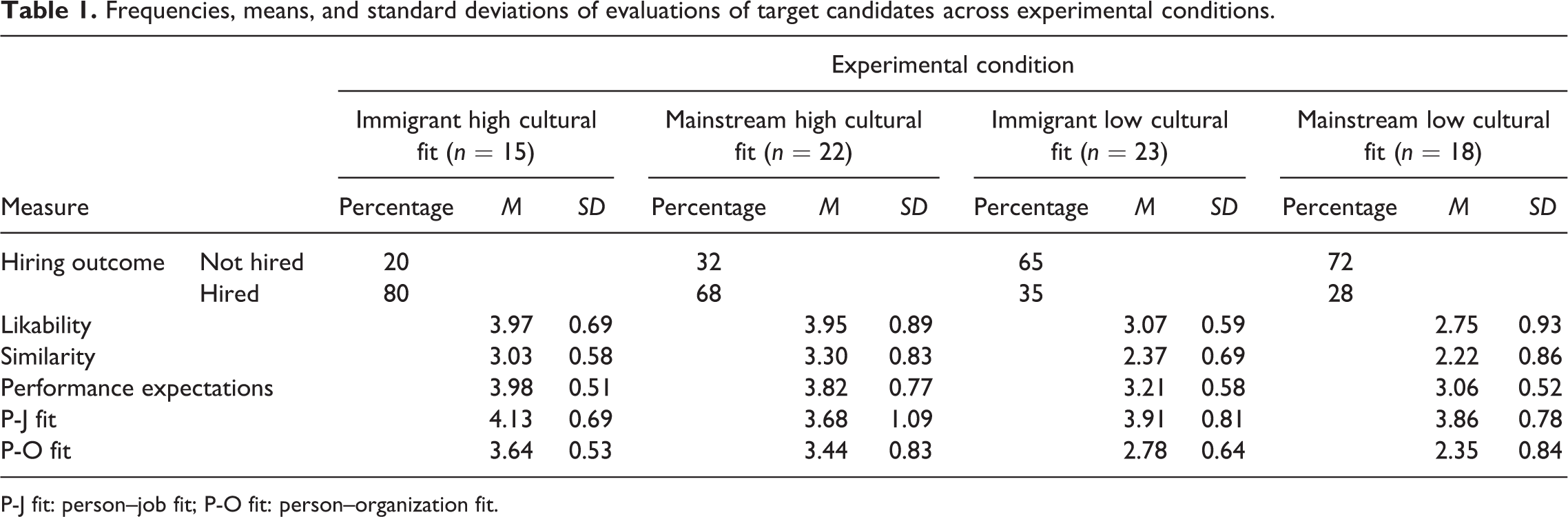
P-J fit: person–job fit; P-O fit: person–organization fit.
Correlations between outcome variables across experimental conditions.

aHiring outcome coded 0 = not hired, 1 = hired.
*p < 0.05; **p < 0.01; ***p < 0.001.
Evaluations
In the two-way MANOVA, assessing the impact of background and cultural fit on evaluations, the interaction between background and cultural fit was not significant, contrary to hypothesis 1(a); Wilks’ λ = 0.95, F(5,70) = 0.77, p = 0.57,
Hiring outcomes
The results from the logistic regression analyses are presented in Table 3. A test of the full model with all three predictors (i.e. background, cultural fit and their interaction) against a constant-only model was significant, χ 2(3, N = 78) = 14.56, p < 0.01. This indicated that the predicators as a set could reliably distinguish between hired and nonhired candidates. The percentages of correctly predicted cases were 73.7 and 67.5 for nonhired and hired candidates, respectively. According to the Wald criterion, only cultural fit reliably predicted hiring outcome. Comparisons of log likelihood ratios indicated that a model with cultural fit as the only predictor was not significantly different from the full model, χ 2(2, N = 78) = 0.88, ns. Percentages of correctly predicted cases remained the same. The odds ratio for cultural fit (coded 0 = high fit, 1 = low fit) was 0.17, 95 percent confidence interval (0.065, 0.458), which indicates that the low cultural fit candidates were about six times less likely to be hired than the high cultural fit candidates. These findings strongly support hypothesis 2(b).
Logistic regression analyses predicting hiring outcome from candidate background and level of cultural fit.
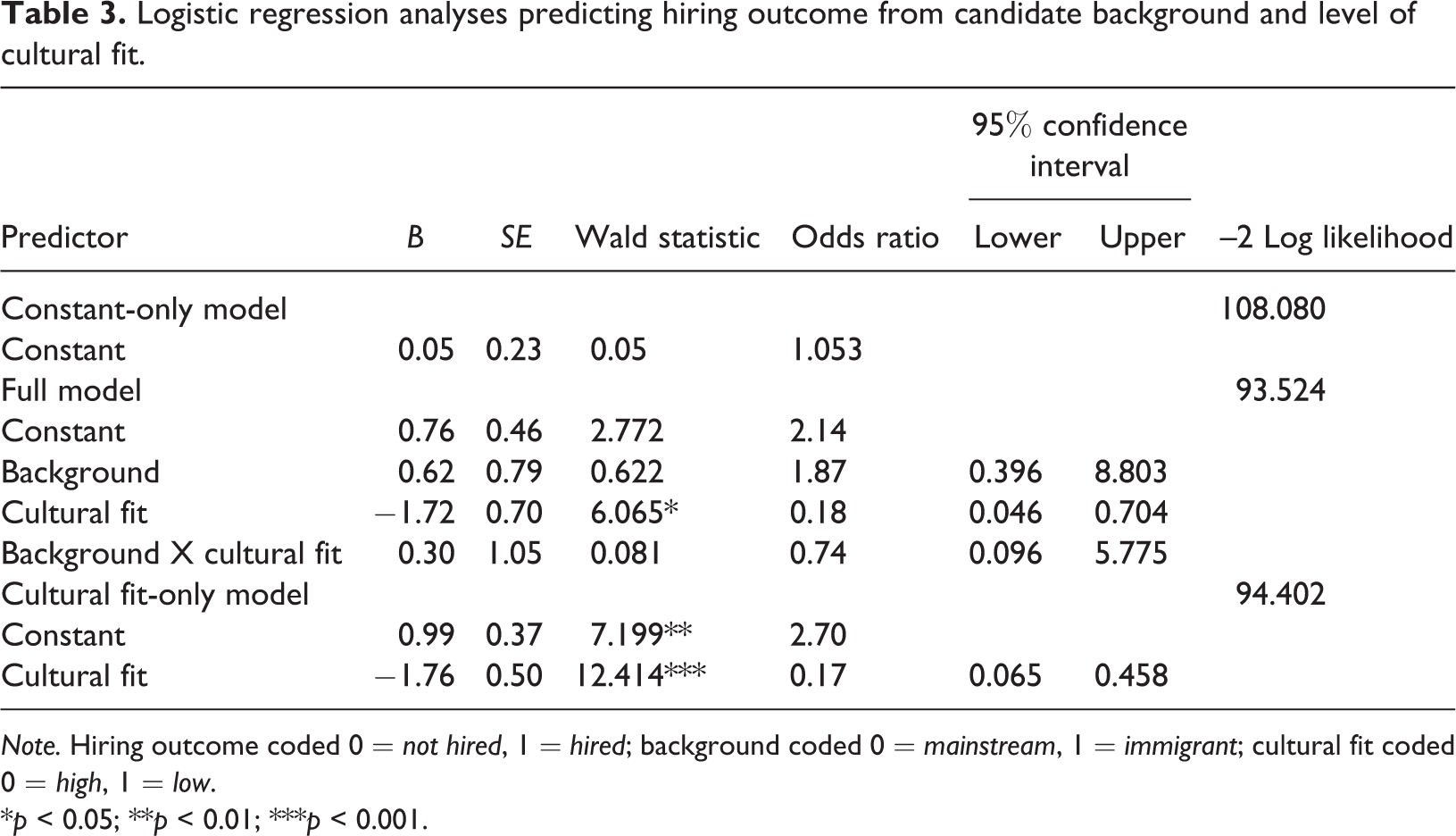
Note. Hiring outcome coded 0 = not hired, 1 = hired; background coded 0 = mainstream, 1 = immigrant; cultural fit coded 0 = high, 1 = low.
*p < 0.05; **p < 0.01; ***p < 0.001.
As the interaction between background and cultural fit was not a significant predictor of hiring outcome, we did not find support for hypothesis 1(b) stating that exhibiting a low level of cultural fit would impact more strongly on the immigrant candidate’s chances of being hired. Background was not a significant predictor of hiring outcome, indicating that mainstream and immigrant applicants had similar probabilities of being offered the job (controlling for the background by cultural fit interaction).
Discussion
We employed an experimental design to assess the impact of ethnic background and cultural fit in candidates’ self-presentation on hiring managers’ evaluations and intended decisions among 78 Norwegian managers; they read job descriptions and watched videotaped interviews with candidates. Our results showed that the immigrant and mainstream candidates were evaluated similarly and had similar chances of being hired. Contrary to our expectations, exhibiting a low level of cultural fit did not affect the evaluations or hiring outcome of the immigrant candidate more negatively than those of the mainstream candidate. Independent of target background, level of cultural fit strongly affected both evaluations and hiring outcomes. Targets with a low level of cultural fit in their self-presentation were evaluated as less similar, less likable, less likely to perform well, and as exhibiting lower levels of P-O fit than targets exhibiting high cultural fit. However, targets exhibiting low cultural fit were not rated lower for P-J fit than targets exhibiting high cultural fit. With respect to hiring outcomes, a low level of cultural fit in the candidates’ self-presentation significantly reduced their chance of being hired.
Based on the theory of aversive racism (Dovidio and Gaertner, 1998), we predicted that lower cultural fit in self-presentation (i.e. including negative information) would impact more strongly on the hiring outcome and the evaluations of the immigrant candidate. Our results, however, did not indicate such an interaction. The study by Park et al. (2009) is relevant for interpreting our findings. Consistent with the aversive racism perspective, their study showed that managers assigned a lower salary to a Muslim applicant and gave her lower ratings of future career progression relative to a European American applicant when some slightly negative information was included. Park et al. (2009) suggested that these discriminatory judgments were observed because the negative information presented was minimal, and that more obvious negative information would possibly eliminate differential treatment of the applicants. In our study, low cultural fit in the candidates’ self-presentation can be conceptualized as strong negative information. As the target candidates were very well qualified for the position, we expected this information to create ambiguity and allow for discriminatory judgments (e.g. “This candidate has excellent credentials, but I really did not care for the way he described his own performance. What should I do?.”) However, our results support Park et al.’s (2009) idea that differential treatment will not be observed when strong negative information is present. In fact, the effect of high and low cultural fit parallels that of strong and weak qualifications observed by Dovidio and Gaertner (2000). Similar to our experiment, the job description in Dovidio and Gaertner’s (2000) study (i.e. peer counselor) had clear interpersonal demands. At this point, we can only conclude that our results do not indicate unfair discrimination in the evaluation of immigrant applicants in the presence of strong negative information.
Regardless of the candidates’ ethnic background, exhibiting a low level of cultural fit had a quite dramatic effect on their probability of being hired. The target applicants were the most qualified and experienced; however, low cultural fit targets were often discarded for a less qualified candidate. A core question is whether or not the effect of cultural fit should be considered as biasing hiring managers’ decisions. The answer depends on whether or not cultural fit as exhibited in the interview is predictive of job performance. On the one hand, job descriptions commonly include criteria such as ability to work well in a team and good cooperation skills. These criteria may be especially common for jobs that are characterized by extensive interpersonal contact, such as the HR advisor position in the present study. Consequently, sensitivity to aspects in candidates’ self-presentation that may indicate potential cooperation problems is rational, and in practice, low cultural fit may reflect limited mastery of local interaction codes. One can then argue that lower performance expectations (which included expectations of cooperation and team work ability) to low cultural fit candidates are valid inferences to some extent.
On the other hand, level of cultural fit in the candidates’ self-presentation may be given a disproportionate weight in the hiring decision. First of all, even though self-presentation tactics predict interviewers’ evaluations, they have a modest relationship with job performance (Barrick et al., 2009). If presenting oneself in the “right way” is weakly related to performance, then it is possible that presenting oneself in the “wrong way” is not a strong predictor of performance either. Second, we observed that low cultural fit had a negative impact on perceived similarity and liking of the candidates. Both factors have been shown to be related to interview outcomes (Cable and Judge, 1997; Chen et al., 2008), although arguably, they are unrelated to the candidate’s subsequent job performance (García et al., 2008). Third, and perhaps most importantly, low and high cultural fit candidates were rated similarly on degree of P-J fit. Despite their very different hiring outcomes, formal competence and ability to do the job were perceived as similar for the low and high cultural fit targets. This may indicate a bias in the hiring managers’ decision making; low cultural fit targets’ formal competence and ability to do the job may carry too little weight in their hiring outcome.
We also observed that low cultural fit candidates were rated lower on P-O fit; they were not seen as similar to other employees or as sharing the values of the hiring managers’ organizations. This indicates that violating national cultural norms for self-presentation in the interview affects the perceptions of fit with organizational cultures within that nation. In samples of job incumbents, P-O fit is associated with stronger organizational commitment and job satisfaction, and it is modestly associated with performance and turnover (Arthur et al., 2006; Kristof-Brown et al., 2005). It is rational for managers to place emphasis on P-O fit in hiring decisions, because they may have experienced that employees that do not fit are less committed and more likely to leave the organization. However, the predictive value of P-O fit as assessed in the interview may be different for immigrant and mainstream applicants. We may speculate that immigrants can be more flexible when adapting to a new organizational culture as part of a general acculturation process, and that initial P-O fit in the interview may be less predictive of subsequent P-O fit and job performance in immigrant samples.
Strengths and limitations
Response rates tend to be lower in managerial samples than other types of samples in organizational research. Although it is lower than desired, the 21 percent that was obtained in this study is not atypical for surveys of organizational representatives such as managers (Baruch and Holtom, 2008). Leaders prioritize their time strictly and one reason for the low response rate may be the amount of time required to complete the experiment (20–25 min).The 10 percent response rate obtained from the leadership courses and the leadership network mailing lists is probably an underestimate of the true response rate. All automatically generated “delivery failure” messages were taken into consideration, still it is likely that several e-mails were delivered but not read by the intended respondent for various reasons (leave of absence, obsolete address, etc.).We could not obtain demographic information about those who did not respond. However, we can compare our data to national statistics (Statistics Norway, 2009). Females make up 31.3 percent and males 68.7 percent of those in leadership positions in Norway. Our sample consisted of 30.7 percent females and 67.9 percent males. Private sector leaders make up 73.3 percent and public sector leaders 26.7 percent of the population; our sample consisted of 76.9 percent and 23.1 percent private and public sector leaders, respectively. This suggests that our sample is fairly representative of Norwegian leaders with respect to sex and sector.
Different clusters of immigrant groups are associated with different stereotypes (Lee and Fiske, 2006) and figures from Statistics Norway (2008) showed that immigrants to Norway from Iran, Iraq, and Somalia subjectively experience more discrimination in hiring than immigrants from Turkey. It is possible that comparing the mainstream target with an applicant of another ethic background than Turkish would have yielded different results, particularly with respect to the background by cultural fit interaction. Replicating the study with applicants of different backgrounds is an interesting task for future research.
A related issue is whether the observed effect of cultural fit generalizes across different types of jobs. In the present study, the respondents evaluated potential HR advisors. Interpersonal and communication skills are inherent to this job. This may have contributed to the strong effect of cultural fit. However, social skills have been shown to be important selection criteria for employers across a wide range of occupations (Jackson, 2001), and there is evidence to suggest that communication skills have become increasingly important for employers across occupational groups (Dörfler and Van de Werfhorst, 2009). We therefore believe that candidates exhibiting low cultural fit would receive lower evaluations and be hired less often also when the job in question involves less social interaction. The question can be raised whether immigrants and Norwegians are equally likely to be seen as showing a poor fit. Our study does not provide data to address this question. Still, it can be reasonably assumed that immigrants are much more likely to be viewed as showing a poor cultural fit, because they tend to be less aware of the culture-specific implicit norms of job interviews. If this is the case, differential hiring decisions are likely even if, as we found in the present study, hiring managers do not differentially react to poor cultural fit in immigrant and mainstream applicants.
Experimental research on selection decisions has been criticized for lacking mundane realism (Stone et al., 2008). The strength of this study is that we used naturalistic sources when making the experimental materials (e.g. work tasks, responsibilities, and situations described were based on real people’s experiences at work). In addition, the experimental task of evaluating and ranking three applicants is similar to actual selection settings, in which managers typically choose between several applicants with relevant qualifications. The interview video clips were rated as fairly realistic by the participating leaders. In sum, we believe that our experimental setup strengthens the generalizability of our results to actual selection decisions.
Implications
Barrick et al. (2009) suggested that employing self-presentation tactics successfully can be learned through training. One implication of the present study is that training programs designed to prepare immigrants for the domestic labor marked should include modules on cultural norms and expectations about how skills and personal qualities should be portrayed. A focus on what not to do would be an important part of this. An interesting way to assess whether such training has an effect would be to compare the labor market outcomes of immigrant applicants going through a culture-specific interview training program with the outcomes of mainstream applicants and immigrant applicants not included in the program.
Even though both immigrant and mainstream applicants can exhibit lower levels of cultural fit, the frequency is likely to be higher among immigrant applicants (Campbell and Roberts, 2007). Although some of the managers’ reservations against hiring a low cultural fit candidate may be valid in the sense that lower cultural fit may be indicative of lower performance on the job, we believe that the relevance of cultural fit could easily be overrated; cultural fit is a malleable person characteristic that can be changed by training. HR personnel and hiring managers working in multicultural societies need to be aware of the effect that cultural fit may have on their hiring recommendations and decisions. Instead of immediately rejecting candidates whose way of presenting themselves is at odds with expectations, decision makers may be advised to make an extra effort to achieve an accurate evaluation, for example, in the form of additional reference checks and a very careful weighting of formal qualifications against perceptions from the interview.
Footnotes
Appendix 1
Appendix 2
Acknowledgment
We would like to thank the following people for their help with developing the experimental materials, data collection, and technical assistance: Marianne Bille, Geir Scott Brunborg, Murcit Cetin, Gunnar Ellingsen, Murat Gencher, Kurt George Gjerde, Dag Hammerborg, Sigurd William Hystad, Hilde Høivik, Ole Rogstad Melkevik, Arne Magnus Morken, and Trude Remme. We would also like to thank our contact persons and the leaders in the participating organizations.
Funding
This study was funded by the Norwegian Research Council (Working Life Research), the Norwegian Labour and Welfare Administration (NAV FARVE—forsøksmidler arbeid og velferd), and a grant from the Meltzer Foundation.