




Abstract
Workplace bullying has increasingly become of interest to scholars and practicing managers due to its creation of dysfunctional intraorganizational conflict and its negative effects on employees and the workplace. Although studies have explored bullying in different cultural contexts, little research exists that provides a comparison of bullying behaviors across cultural dimensions. This article describes a new research agenda that analyzes the impact of specific cultural dimensions—assertiveness, in-group collectivism, and power distance—on organizational bullying. An expanded categorization of bullying prevalence and form is also proposed, with implications for both future research and organizational practice provided.
Frameworks for conceptualizing bullying typically include theory and empirical studies that outline traits (of both bullies and their targets) and situations (such as leadership style and organizational factors) that influence the prevalence of organizational bullying. For example, Einarsen et al. (2003: 21) designate a bullying process model that identifies multiple levels of explanatory factors of and reactions/responses to bullying. In fact, they describe bullying as a “multicausal social phenomenon” that includes “cultural and socioeconomical factors.” Unfortunately, while many bullying frameworks identify both micro- and macro-level antecedents of bullying (e.g. Einarsen et al., 2003; Harvey et al., 2009; Moayed et al., 2006), few have attempted to describe, in detail, the vast influence that national culture may have on organizational bullying behaviors.
Whether bullying is a function of the individual or the situation has not been fully determined. Personality variables may play an important role in the prediction of bullying (e.g. the “highly aggressive” bully: Matthiesen and Einarsen, 2007; the “authoritarian” personality: Adorno et al., 1950; and the “petty tyrant”: Ashforth, 1994). In addition, the organizational culture may influence bullying behavior (Lewis, 2006; Logsdon et al., 2007; Peyton, 2003). However, in this article, we focus our attention specifically on the under-researched construct of national culture.
We note that some previous work on organizational bullying has explored cross-level effects. Studies of particular note have shown that industry-level effects can predict variations in the prevalence of workplace bullying (Einarsen et al., 1994; Mikkelsen and Einarsen, 2001). There are also conflicting results regarding the role of public versus private ownership in bullying (compare Einarsen and Skogstad, 1996; Salin, 2001). A recent article by Harvey et al. (2009) provides a description of bullying within a global framework in an attempt to piece together the ethical nature (and subsequent components) of bullying. However, most bullying research follows a culturally insular trend that is far from global in scope. Moayed et al. (2006: 312) perhaps said it best: “It can be assumed that bullies can also be affected by the society and environment as well, and react to these organizational problems and conflict accordingly [but] the authors did not find any article examining this issue.” Although there is a paucity of existing research regarding society and bullying, some posit that certain dimensions of Hofstede’s (1980) cultural framework (e.g. power distance and individualism, among other dimensions) may play a role in the increased prevalence of bullying when comparing the United States and the Scandinavian countries in general (Lutgen-Sandvik et al., 2007). Harvey et al. (2006b) also suggest that national/cultural mores lead societies to emulate, and subsequently tolerate, organizational bullying activities. We draw from bullying research across the globe in an attempt to discern important components of culture that are then linked to organizational bullying behaviors.
Cross-cultural researchers often utilize cultural data from the Global Leadership and Organizational Behavior Effectiveness Research Program (GLOBE: House et al., 2004)—a cross-cultural study of 62 societies across the world focused on organizations and their managers that seeks to understand how cultures differ in ways that have implications for organizations. Studies utilizing data from GLOBE have been instrumental in assessing societal influences on myriad organizational behaviors, such as flexible work and turnover (e.g. Stavrov and Kilaniotis, 2010), organizational citizenship behaviors (Euwema et al., 2007), human resource management practices (Alas et al., 2008), and leadership behaviors (e.g. House et al., 2004; Raskovic and Krzisnik, 2010), to name but a few. Importantly, researchers utilizing GLOBE research have utilized two different approaches, either studying clusters of countries (see Gupta et al., 2002 for a rationale) or studying specific nations. The current article attempts to extend the work of GLOBE research across cultures by identifying specific dimensions of national culture (namely, assertiveness, power distance, and in-group collectivism) that might affect different forms and types of workplace bullying behaviors across national cultures and then predict differences in the prevalence of organizational bullying.
In order to explore the dynamic relationship between national culture and organizational bullying, the current article is organized as follows. First, we review recent attempts to define bullying and its subsequent costs for employees and organizations. We then review the history of bullying research, including research on school bullying, and then move toward our main interest area, workplace bullying. Next, we provide a brief discussion of cross-national studies to date on bullying and explore the potential relationship of certain dimensions of the GLOBE research program (House et al., 2004) to the study of bullying. In particular, the article develops propositions on how cultural dimensions might influence the relationship of assertiveness (the degree to which individuals in organizations or societies are assertive, confrontational, and aggressive in social relationships), in-group collectivism (the degree to which individuals express pride, loyalty, and cohesiveness in their organizations, families, circles of close friends, or other such small groups), and power distance (the degree to which members of an organization and a society encourage and reward unequal distribution of power with greater power at higher levels) with differing forms of workplace bullying.
In addition, the prevalence and form of bullying are distinct concepts that are often lumped together in bullying research. We suggest that more meaningful interpretations of various manifestations of bullying can be discerned by highlighting differences; thus, we have established distinct categorizations of bullying behaviors in order to explicate and differentiate among bullying relationships. Specifically, the prevalence of bullying refers to whether bullying is more or less prevalent within the wider culture—and by extension, within organizations located in that culture. Form of bullying refers to the manifestation of bullying and has two subdimensions: visibility and clustering. The first subdimension, visibility, is whether the bullying is overt or covert. Bullying can, at times, be overt, out in the open, and observable by others. Alternatively, sometimes bullying is hidden from public view because if it was observable, it would be negatively sanctioned (Hood et al., 2011). The second subdimension of the form of bullying, clustering, takes into account whether it is dyadic-based or group-based. Sometimes bullying is done by one individual and directed at another individual; in other cases, it is a group-based behavior that is directed at an individual or another group in the organization (compare Heinemann, 1972; Leymann, 1990; Roscigno et al., 2009). We propose that cultural attributes such as those described in the GLOBE study thus affect the prevalence and form of bullying within organizations embedded in those cultures. Finally, we provide a research agenda for the future and discuss implications for managers, focusing on assessing and remedying bullying behavior in differing cultural contexts.
Definition and outcomes of bullying
Research surrounding any construct typically requires a brief description of the phenomenon. However, as Smith et al. (2002) suggest, a significant difficulty in cross-national comparisons of bullying surrounds the comparability of terminology. They also suggest differentiations in both perceptions of bullying, as well as situational meanings/interpretations of aggression based upon social and historical contexts. In most studies, for example, the perceptions of the victim being bullied are more important than any objective assessment of the behavior (Giorgi, 2010). It is prudent, therefore, first to define bullying as generally as possible for the current research agenda.
Workplace bullying is the exhibition of repeated, hostile behaviors toward one or more individuals that are unwanted by the target(s) and cause humiliation, distress, or harm to that individual or group (Einarsen, 1999; Jennifer et al., 2003). Bullying behavior can take many forms, including emotional and physical abuse that harms an individual or group (Brodsky, 1976; Einarsen, 1999). Types of bullying (Rayner and Hoel, 1997) can include threat to professional status (e.g. public humiliation), threat to personal standing (e.g. name calling), isolation (e.g. withholding of needed information), overwork (e.g. impossible deadlines), and destabilization (e.g. being given meaningless tasks). Researchers across the globe typically take Olweus’ (1993) lead when defining bullying. Specifically, bullying encapsulates three components: (1) unwanted aggression, (2) a pattern of repeated behavior over time, and (3) an imbalance of power or strength.
The current research proposal takes these three major facets of bullying into account when reviewing bullying research from across the globe and also when discerning attributes of national cultures in relation to subsequent “bullying” behaviors. Thus, we suggest that the terminology used to describe bullying may also be culturally dependent. We therefore discuss bullying as types of behaviors that typically fall within at least one of the three components of Olweus’ definition and that result in “bullying-related” adverse consequences for the bullying target(s).
Bullying has been found to be related to heightened levels of anxiety, depression, burnout, frustration, and helplessness and to negative emotions such as anger, resentment, and fear (Keashly and Jagatic, 2003). Individuals subject to workplace bullying have difficulty concentrating at work, with lowered self-esteem and self-efficacy as a result (Keashly and Jagatic, 2003). Bullying has been associated with a number of negative outcomes, including psychosomatic illness (Djurkovic et al., 2004), reduced productivity (Hoel et al., 2003), alcohol abuse (Richman et al., 1996), posttraumatic stress disorder (Jennifer et al., 2003; Vartia, 2001, 2003), decreased job satisfaction, reduced organizational commitment, and greater intention to leave the organization (Tepper, 2000). From a cross-cultural perspective, Nansel et al. (2004) found an association between bullying and poorer psychosocial adjustment in a student sample that encompassed 25 countries. Moreover, Moayed et al. (2006) suggest that the most common and most costly outcome of workplace bullying is absenteeism, and Harbison (2004) notes that even a one percent increase in absenteeism can cost an organization US$720,000 (for a staff of 1000). It is, additionally, estimated that the exit cost of those who witness bullying alone is conservatively at $1.2 million (for the same company of 1000 employees; Rayner and Keashly, 2005). Thus, organizational bullying is an important area of study with significant implications for cross-cultural management. As researchers note, even though the definitions and conceptualizations of bullying may differ across countries, the psychological and organizational consequences seem to be remarkably similar.
The etiology of bullying research
Interest in bullying behavior began in Sweden in the 1960s when Heinemann (1972) described the phenomena as mobbning or, in English, mobbing. This research was followed by Olweus’ (1978, 1999) work involving aggression in school children. Research was subsequently carried out in Scandinavia and spread to Western European countries, such as England, Wales, and Scotland. Starting in the 1980s, scholars in Japan also began to study the concept from a slightly different perspective, that of ijime (Morita, 1985; Morita et al., 1999), bullying that emphasizes the group and the solidarity thereof. More recently, scholars in the United States, Australia, and New Zealand have started research programs on bullying (Smith et al., 2002).
Importantly, and in conjunction with the current examination, exhibitions of bullying behavior or aggressive acts may be understood differently in differing cultural contexts. Bond (2004), for example, attempted to study the linkages between culture and aggression by describing culture as a set of norms that both afford and constrain the expression of aggressive behavior. Thus, the prevalence of bullying or amount of aggression necessary for the behavior to be perceived as bullying, along with the manifestation of these behaviors, may vary by national culture. The origin of bullying research began with analyzing bullies in school. The current article first reviews this important literature due to the fact that “workplace bullying is a relatively new subject” (Moayed et al., 2006: 311) and recent researchers, such as Harvey et al. (2006a), suggest a significant interrelationship between past playground bullying and subsequent “boardroom” bullying behavior in organizations. Thus, in order to understand the cross-national manifestation of bullying in the workplace, the initial research on school bullying provides some insight and most of the current context of previous attempts to empirically examine bullying across cultures.
School bullying
Social Learning Theory suggests that individuals learn and emulate subsequent adult behaviors based upon their surroundings (Bandura, 1973, 1986). For example, research shows that child bullies and those bullied as children are more likely to become bullies in their adult lives (Harvey et al., 2006a). Therefore, before we describe bullying in relation to organizations, we must first describe bullying as it manifests within the school setting in different cultures.
There are few studies that examine school bullying from a cross-cultural perspective. One major contribution on school bullying is an edited volume by Smith et al. (1999). The book describes 21 different cultures, the manifestation of bullying in each of the cultures, and the research on school bullying in the various cultures. In an investigation of the terms used to describe bullying, Smith et al. (2002) gathered data from 14 different countries. This study asked school children to look at 25 different stick figure cartoons illustrating situations that might be considered bullying (Smith, 1999). Findings indicated that younger children had a less differentiated understanding of the terms used to describe the behaviors depicted than did older children. Thus, younger children could contrast aggressive and nonaggressive scenarios, but could not clearly distinguish among different forms of aggression (e.g. physical aggression, ostracism, and verbal aggression). Cultural differences were found in the terms utilized to describe bullying, with some cultures including behaviors such as ostracism or, on the more overtly aggressive end, fighting. Thus, the terms various cultures used to describe bullying-type behaviors in school actually described both similar behaviors, but in some cases, dramatically different behaviors.
The Health Behaviour in School-aged Children study (Currie et al., 2000) is an international collaborative study to analyze various aspects of health including bullying for children at average ages of 11.5, 13.5, and 15.5 years. The original school-based anonymous surveys were conducted in 25 countries and included 113,200 participants (Nansel et al., 2004). This study found that the percentage of children who were victims of bullying ranged in various cultures from 9 percent (Sweden) to 54 percent (Lithuania). The study also looked at involvement in bullying, which includes the bully, victim, or bully/victim. Findings indicated that there were significant effects on psychosocial adjustment for those involved in bullying, with the most severe effects on individuals who were simultaneously a bully and a victim. The effects included emotional adjustment, relationships with classmates, health problems, school adjustment, and alcohol problems.
Other studies of import that show cross-national differences in school-based bullying include the work of Eslea et al. (2003) in their study of seven countries. The authors determined that schoolyard bullying is a universal phenomenon, and its subsequent effects are universally negative, but with important cultural variations—specifically in relation to social support for victims. Moreover, Nesdale and Naito (2005) compared Japanese and Australian students on the cultural dimension of individualism–collectivism, wherein Japanese students had more positive attitudes toward bullies than their Australian counterparts. Taken together all the aforementioned studies in the current section suggest that cross-cultural research in bullying is both worthwhile and an important avenue for future inquiry, particularly with regard to understanding the extent and form of bullying across cultures.
Workplace bullying
Research on bullying in the workplace began in Sweden soon after Olweus’ (1978) groundbreaking aggression and school bullying study. In the later years of the 20th century, Leymann’s (1990) concept of mobbing was expanded to the workplace arena and researchers in Norway and Finland began to study this phenomenon (e.g., Bjorkqvist et al., 1994; Einarsen et al., 1994). A series of British Broadcasting Corporation (BBC) broadcasts in England brought the attention of the public to the issue of what was now called “bullying” (Adams and Crawford, 1992; Lutgen-Sandvik et al., 2007). The investigation of workplace bullying began to spread to other countries within Europe as well as to Australia, South Africa, and the United States. Workplace bullying is now seen as one aspect of a broader framework of counterproductive work behavior (Pearson et al., 2005). In this framework, bullying falls within the broader category of aggressive behavior, which also includes violence, mobbing, and incivility. All four of these constructs have overlapping elements.
The extent of workplace bullying varies according to the measurement and location of the study. For example, studies in the United States indicate that workplace bullying affects 10 percent of the workplace population at any one time, with 25–30 percent of workers being subject to bullying at some time in their careers (Keashly and Jagatic, 2003; Lutgen-Sandvik et al., 2007). Studies of bullying among Australian nurses indicate that lateral bullying by nurses at the same level of their organizations is endemic (Paliadelis et al., 2007). Rayner et al. (2002) reported that over 15 percent of British employees in their studies label themselves as bullied. Analyzing 14 different “working life” surveys in Norway, Einarsen and Skogstad (1996) found that 8.6 percent of the respondents experienced ongoing bullying. Leymann (1996) found that 3.5 percent of the Swedish working population classified themselves as bullied at work. Thus, just as the definition of bullying varies among cultures, so too does prevalence (or “level”) of bullying behaviors, both in terms of what is recognized by “targets” as bullying and on the actual incidence of bullying. Therefore, we have found it necessary to provide a clearer description of bullying manifestations in order to appropriately designate the culture–bullying relationship.
The displays of bullying behaviors vary by both prevalence and form. The prevalence of bullying identifies the amount, or level, of bullying behaviors and is labeled as either high or low in nature. Additionally, the form of bullying is typified by two important representations of bullying behaviors—visibility and clustering characteristics. Visibility is labeled as either overt or covert expressions of bullying (Hood et al., 2011). Clustering designates the number of perpetrators involved in the bullying behaviors; thus, it is demonstrated by either dyadic- or group-based behaviors. Our designations of the multifaceted nature of bullying manifestations are necessary in order to appropriately designate the relationships between culture and bullying.
We now turn our attention to cultural dimensions that we believe will enhance our understanding of the types and forms of organizational bullying across the globe. We do so with the help of previous bullying research collected by multiple scholars across various cultures including (although not an exhaustive list): Australia, Denmark, Japan, Norway, Sweden, the United Kingdom, and the United States. These examples, from different national cultures, are meant only to provide illustrative patterns of interactions between national culture and the various manifestations of bullying in order to build a theoretical framework.
National culture dimensions: an important influence
Distinctions among and definitions of culture have been the subject of considerable scholarly research (Hofstede, 1980, 1984, 2001; House et al., 2004). Culture—whether defined at the local, regional, national, or organizational level of analysis—of course affects myriad social phenomena. This is not to say, however, that national cultural dimensions are completely determinative. Organizations within the same national culture can—and do—often differ with regard to how much bullying is observed. For example, Hofstede et al. (1990) studied multiple organizations in the same country and found significant variation in organizational culture. However, the authors also noted that organizational cultures reflect nationality. In the following section, we draw on the work done within the GLOBE studies (House et al., 2004) to theorize about cultural dimensions at the national level that might affect specific organizational-level bullying.
We have chosen the GLOBE framework (House et al., 2004) because of its provenance as a cross-cultural study of organizations. We developed propositions based on the three GLOBE cultural dimensions that are most salient to an understanding of organizational bullying: assertiveness, power distance, and in-group collectivism. These three dimensions, we propose, have predictive utility with regard to understanding of two important dimensions of organizational bullying that we believe better illustrate the complexity of organizational bullying manifestations: the prevalence of bullying and the form of bullying.
The GLOBE study of 62 societies draws on Hofstede’s (1980, 1984, 2001) and others’ (e.g. Kluckhohn and Strodtbeck, 1961) prior work with regard to culture. Questionnaire responses were obtained from approximately 17,000 managers from 951 organizations. In addition, the researchers carried out interviews, focus groups, and formal content analysis of printed materials. The study developed and reported on nine core dimensions of culture, six of which were based upon Hofstede’s (1980, 1984) framework of cultural dimensions. The nine dimensions of the GLOBE study are: assertiveness, future orientation, gender egalitarianism, humane orientation, institutional collectivism, in-group collectivism, performance orientation, power distance, and uncertainty avoidance (please see Chhokar et al., 2008: 3–4, for full definitions).
Each of these dimensions might have some effect on the prevalence and form of bullying in organizations across different cultures. However, we focus our attention on assertiveness, power distance, and in-group collectivism for two reasons. First, we believe that these three dimensions capture much of the variance in how cultural differences at the national level affect bullying at the organizational level. This is not to say that the other six dimensions do not contribute something to an analysis of cultural influences on organizational bullying, but rather that a parsimonious explanation of differences across countries includes these three dimensions and the interactions among them.
Second, these three dimensions map onto three distinct levels of analysis. Assertiveness maps onto the individual level of analysis and primarily takes in how one person relates to others. In-group collectivism, by its very definition, is a group-level construct. In-group collectivism is more concerned with the group’s interests than self-interest. Power distance is best understood in this context as an organizational-level construct, although we do concede that it has dyadic effects as well. However, the current examination highlights the organizational effects with regard to whether power distance is high or low. Thus, assertiveness, in-group collectivism, and power distance are most directly related to workplace bullying, while also mapping onto distinct levels of analysis.
Levels of analysis when studying national culture and workplace bullying
While not a new concept in business research, level of analysis is an important notion to address when studying macro- to micro-level relationships in organizations (e.g. Avolio and Bass, 1995; Klein et al., 1994; Rousseau, 1985). Heames and Harvey (2006) note that workplace bullying is a cross-level phenomenon encompassing three fields. Importantly, by presenting their cross-level perspective of bullying, they highlight the fluid movement and interactions of bullying behavior across an organization. Our current article takes this premise and adds an additional layer (the national environment) to this dynamic system of bullying. Specifically, national cultures affect organizational activities from all three bullying echelons proposed by Heames and Harvey. In other words, bullying activities are shaped and affected by the specific national cultures where the organization resides.
Much like other phenomena such as organizational corruption (Ashforth et al., 2008; Scholtens and Dam, 2007), we propose that bullying in organizations is affected by national- and regional-level cultural factors that are outside the control of any one organization. We would expect that downward effects (from the culture to the organization) would be stronger than the reverse. This is not to say that upward effects might not be meaningful in some contexts; however, for the purpose of this article, we focus on the likely stronger “downward effect” of national culture affecting organizational bullying.
Similar to the discussion by Avolio and Bass (1995) concerning transformational leadership, bullying most commonly represents a behavior of individuals. Some studies have examined bullying as being influenced by the organizational culture (e.g. Hood and Logsdon, 2008; Lewis, 2006; Logsdon et al., 2007; O’Moore, 2000; Salin, 2003), but in order to fully understand bullying behavior, it is necessary to analyze the influences of the wider cultural context on the individual’s behavior. Scholars have theorized the effect of national culture—specifically in relation to organizational culture and its place within the prediction of organizational behaviors. Hofstede et al. (1990), for example, hypothesized that organizational cultures are partly predetermined by nationality. Dickson et al. note that “national culture and industry are integral parts of the environment in which organizations function” (2004: 74). Finally, Hanges and Dickson (2004) found in their development and validation of the GLOBE culture and leadership questionnaire that national and organizational cultures interact, but that each has unique variance, and that both can be meaningfully applied to organizational behaviors. The interpretation of bullying behavior by targets or observers of the behavior may be dependent on what is considered normal behavior in the bully’s country of origin. For example, in a highly assertive culture, the threshold of behavior that would be labeled “bullying” might be higher than in a culture that does not exhibit high aggressiveness. In the same way that national culture has an effect on managerial ideology (Ralston et al., 2008), we propose that national culture has an effect on bullying behaviors observed within organizations and enacted by individuals.
Because each interacting individual in a context brings his or her own cultural background to the situation, interpersonal interactions are never context free. Thus, each individual invokes his or her own experiences and cultural background, which will then impact the resulting interpretation of the behavior as bullying or not. The organization is also embedded in a cultural milieu in which bullying is exhibited and interpreted. The national culture influences the organizational culture, which diffuses downward in terms of expectations of behavior, rewards, and guidelines for interactions. Similarly, we propose that dimensions of national culture derived within the GLOBE studies have utility for the study of bullying across cultures.
Thus far, we have focused on the culture-to-organization link across levels of analysis. Of course, embedded in the study of bullying are other cross-level effects. Bullying may also be characteristic of the culture of an organization (e.g. Enron’s cutthroat and unethical cultural practices) and it can be analyzed at the group level (e.g. a clique gossiping about one individual in the organization). We would observe that downward effects from higher to lower levels of analysis would be observed, say from the organization to the group level and the group to the individual level. Thus, bullying is a multi-level construct with each level influencing the next higher level, but with each level also worthy of study as a separate manifestation of the construct. Linkages across all of these levels of analysis with regard to bullying likely exist and merit further theory and empirical study. We seek to apply cultural dimensions—exogenous to any one organization—that would affect the extent, content, and form of bullying within organizations embedded within particular cultures.
Relationships between cultural dimensions and bullying prevalence and form
The three cultural dimensions of interest (assertiveness, power distance, and in-group collectivism) will first be described and will subsequently be discussed in terms of their relationship to bullying prevalence and form. Propositions are summarized in Table 1.
Review of propositions.
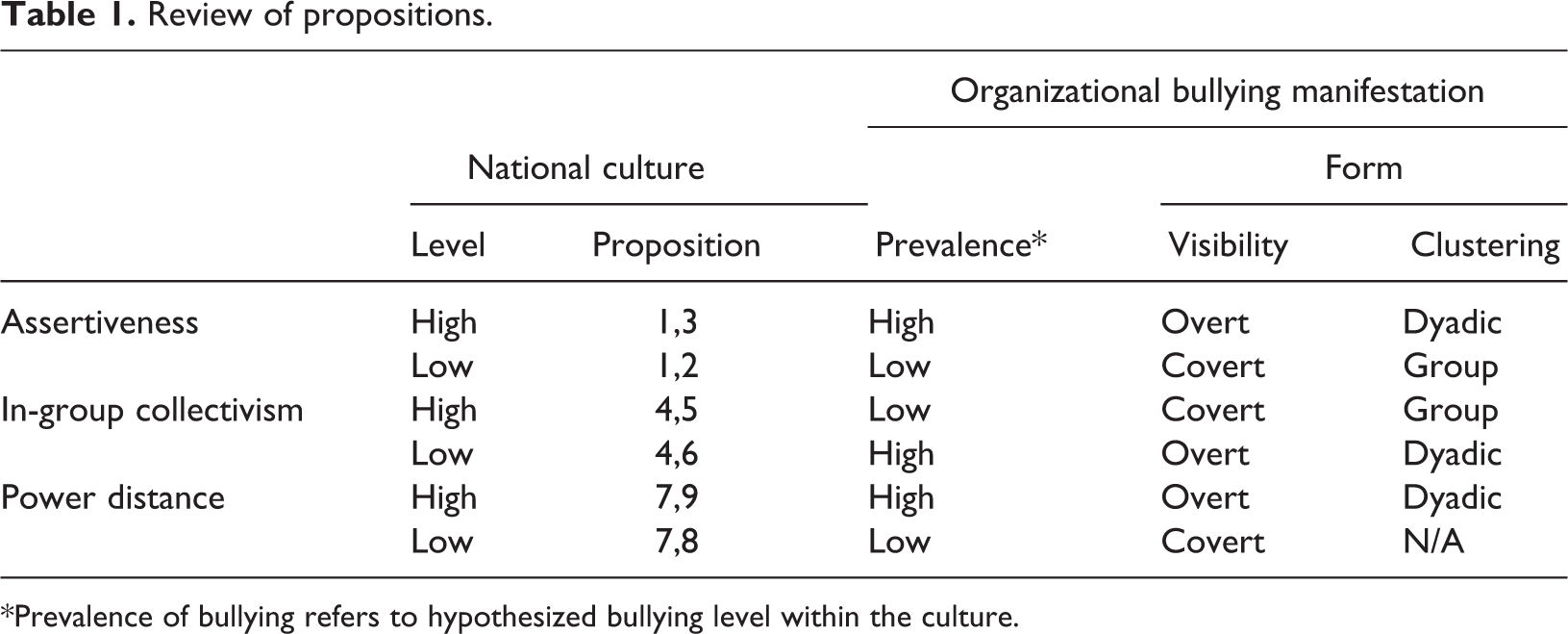
*Prevalence of bullying refers to hypothesized bullying level within the culture.
Main effects of assertiveness
The GLOBE framework specifies assertiveness as one of its cultural dimensions. The definition of assertiveness it uses—the degree to which individuals in organizations or societies are assertive, confrontational, and aggressive in social relationships—at first glance may seem imprecise. For example, it includes the notion of aggression directly in the definition of the construct, although assertiveness and aggression are not necessarily the same thing (Ames, 2009). It is possible, for example, for one person to be assertive with another person but to do so in a respectful way. However, it is also clear that aggression is a kind of extreme assertiveness, albeit one that is unhealthy for the recipient of the aggression and often the organization as well (Kalliotis, 2000). In the GLOBE study, assertiveness is defined such that individuals within organizations would be seen as tough, dominant, and aggressive in social relationships (House et al., 1999). Highly assertive cultures would have an orientation toward “doing” or taking control of the environment (Kluckhohn and Strodtbeck, 1961); value competition and competitiveness believing that the individual should “eat or be eaten,” “control your destiny,” and “try to be a winner”; value success and progress; value expressiveness and revealing thoughts and feelings; and emphasize results over relationships (Den Hartog, 2004). Low assertiveness cultures value cooperation, people, and warm relationships, harmony; emphasize tradition, seniority, and experience; and value detached and self-possessed conduct (Den Hartog, 2004).
Assertiveness can be categorized and measured in various ways (Rathus, 1973; Wolpe and Lazarus, 1966). Studies of bullying that have sought to understand the relationship between assertiveness and bullying tend to focus on aggression, which we have noted is an extreme form of assertiveness. While assertiveness and bullying are not precisely the same, it does follow that more assertive cultures will have more aggression and therefore more bullying—as will organizations located within those cultures.
Put a different way, Sweden received the lowest score on the practice of assertiveness of all 62 societies measured in the GLOBE study and workplace bullying has been reported to be only 3.5 percent of the entire Swedish workforce, with researchers often concluding that there is low prevalence of bullying in Sweden (Leymann, 1996; Nansel et al., 2004; Nordhagen et al., 2005). This may be because “Swedes are typically nonassertive, that is, timid, nondominant, and nonaggressive in social relationships” (Holmberg and Akerblom, 2008: 47). Thus, we start with a general proposition about assertiveness, proposing that higher cultural assertiveness predicts higher prevalence of organizational bullying and vice versa:
However, it is not necessarily the case that lower levels of cultural assertiveness lead to a complete absence of bullying. For example, the Japanese culture discourages the expression of emotion and is considered a rational culture (Bhagat and Steers, 2009). Thus, anger, frustration, and other aggressive emotions will not be expressed freely (Bhagat et al., 2007; Gudykunst and Ting-Toomey, 1988). However, although the typical Japanese worker may avoid conflict and try to make things work for the good of the organization (Giorgi, 2010), bullying in Japanese workplaces is prevalent to the extent that the special term “ijime” has been coined to describe the phenomenon (Giorgi et al., 2008). Such cultures may be more likely to exhibit different forms of bullying (e.g. visibility and clustering).
There is evidence that low-assertiveness cultures can manifest bullying that takes a less visible form and is covert rather than overt (e.g. Morita et al., 1999). For instance, bullies will sometimes engage in forms of aggressive behavior that allow them to conceal any hostile intentions (Einarsen et al., 1998). Research on bullying in Japan provides support for this view. Bullying in Japan is often composed of mainly indirect types of bullying (e.g. teasing, verbal threats, exclusion from social groups, ignoring, and ostracism; Morita et al., 1999). Bullying is believed to function as a form of social control within Japanese organizations (Akiba, 2004) and ijime is objectively more effective if the victim and the aggressors belong to the same group, thus making the occurrence of ijime more covert than overt (Morita et al., 1999) and group clustered versus dyadic. In other words, less assertive cultures may foster more clustering bullying behavior, essentially drawing power from the masses. We believe that Japan is likely typical of how organizational bullying can unfold in low-assertiveness countries. Thus,
Main effects of in-group collectivism
House et al. (2004) proposes two facets of collectivism, institutional collectivism, and in-group collectivism, whereby the former represents macro-level laws, societal programs, and rewards of a collective economic system, while the latter reflects the degree to which individuals express pride, loyalty, and cohesiveness in their organizations, families, circle of close friends, or other such small groups. Although both types of collectivism may influence bullying behaviors in the workplace, we assert that bullying behaviors may be more heavily influenced by in-group collectivism because it focuses on employee feelings (such as pride and loyalty) and a desire for familial and organizational cohesiveness regardless of the group rewards structure, vis-à-vis institutional collectivism. Societies high in in-group collectivism, for example, are ones in which individuals are integrated into strongly cohesive groups, group goals take precedence over individual goals, extended family structures are prevalent, communication is indirect, and individuals make greater distinctions between in-groups and out-groups (Gelfand et al., 2004). Societies scoring high in individualism would be those in which individuals look after themselves and their immediate families, individual goals take precedence over group goals, nuclear families are the norm, communication is direct, and there are fewer distinctions between in-groups and out-groups (Gelfand et al., 2004). With regard to in-group collectivism, we therefore predict that in societies where in-group collectivism is high, organizational bullying will be low. This is because collectivistic cultures tend to have a higher level of care and concern for others; organizations embedded in such societies will perceive bullying of their members to be inconsistent with the cohesiveness prized in such cultures.
Societies with low levels of in-group collectivism will thus have more bullying in comparison with societies with high levels of in-group collectivism. Additionally, the form of bullying in societies with low in-group collectivism is likely to be overt rather than covert, as there are no negative sanctions associated with bullying. Previous research has indicated that individualistic cultures are related to the use of more dominating conflict strategies and fewer avoidance strategies (Oetzel and Ting-Toomey, 2003; Ohbuchi et al., 1999; Ting-Toomey and Kurogi, 1998). Furthermore, in the United States, a society rated low on in-group collectivism, there are no laws to contain bullying and few organizational policies to curb bullying in organizations (Namie and Namie, 2009). Low levels of collectivism denote that there is less likely to be a discernible and cohesive group to bully collectively or to be bullied, in contrast to cultures with high collectivism in which people belong to in-groups or collectivities that look after each other (Hofstede and Bond, 1984) and value cooperation with in-group members. Thus, bullying in low collectivism cultures would also be dyadic rather than group based.
Conversely, cultures with a high level of in-group collectivism might also find that low visibility bullying that is covert, a result of indirect aggression, and that involves exclusion from a group of perpetrators is a powerful bullying approach in the workplace. Meek, for example, suggests that management and coworkers began bullying in Japan, a high in-group collectivism culture, as “an unofficial means to drive out employees without technically violating the lifetime employment principle” (2004: 313). Research on bullying in Japan often involves one against the many (Munakata et al., 1998). Thus, it is important to take both prevalence and form of bullying into account when assessing in-group collectivism influences on bullying behaviors. Therefore, we propose the following:
Main effects of power distance
One of the three major facets of bullying requires the existence of a power imbalance between the perpetrator and the target, and it is likely the case that high levels of power distance (i.e. the degree to which members of an organization and society encourage and reward unequal distribution of power with greater power at higher levels) increase such imbalances and ultimately predicts a higher prevalence of bullying. Power distance in societies is normally related to social inequality, with individuals in high power distance cultures having limited social mobility, weak civil liberties, and localized information (Carl et al., 2004). The high power distance culture is one in which power bases are stable; power is seen as providing social order and is relational, with certain groups having differential involvement in governance (e.g. women). Low power distance cultures tend to have a large middle class, with power seen as a source of corruption and dominance, all groups are involved fairly equally in governance, information is shared, and civil liberties for individuals are strong (Carl et al., 2004). Einarsen (2003) asserts that there is some indication that the prevalence of bullying or the frequency of bullying is lower in low power distance countries, such as Norway, Sweden, and Finland, than it is in high power distance countries such as France, Spain, or the United States. Lutgen-Sandvik et al. (2007) suggest that this particular cultural dimension explains current bullying differentials between Scandinavian countries and the United States. The reasoning for this is fairly simple: people are more likely to bully a person with less power because the target of the bullying is less able to fight back and resist the bullying. In fact, several studies have indicated that supervisors are often found to be the most likely source of workplace bullying (Hoel and Cooper, 2000; Hoel et al., 1999; Zapf et al., 1996). We therefore propose that,
With regard to the form of bullying, the same basic reasoning used for in-group collectivism holds. Cultures in which there is low power distance would sanction behaviors such as bullying, which effectively increases the power distance between perpetrator and target. Thus, organizational bullying in low power distance countries is likely to be covert as the bullying behavior is much more outside the norm than for high power distance countries. As noted by Mikkelsen and Einarsen (2001), aggressive behavior and other forms of power abuse will be less accepted in Scandinavian culture than in the United States. We do not take a position on whether bullying in low power distance cultures is more likely to be dyadic or group based, as it is equally likely to be negatively sanctioned by others observing the bullying in either case.
For high power distance countries, bullying would more likely be overt than in low power distance countries. Hofstede’s (1993) study found that managers in the United States tended to stress market processes, competition, and the importance of managers over workers. Bullying here could be understood as a strategy to communicate and reinforce power differentials within an organization, thus seeking to keep lower power individuals “in their place.” Furthermore, if most bullying occurs between supervisor and subordinate, then there would be more individual bullying as opposed to mobbing. Thus, in high power distance cultures, everything else held equal, bullying would be more dyadic than group based.
A research agenda
We have discussed three dimensions of national culture—assertiveness, in-group collectivism, and power distance—that we propose have effects on the prevalence and form of bullying in different cultures. Bullying is receiving increasing attention from management researchers. We propose that attention to cultural dynamics is an important addition to current work on bullying. There are several elements of a future research agenda based on the present article.
Empirical research on cultural dimensions
We have offered a set of propositions based on the three GLOBE cultural dimensions that we believe make the greatest contribution to explanations of variance in manifestations of bullying across cultures. Future research might test these propositions empirically. In addition, other cultural dimensions of national culture (including those from the GLOBE studies that we have not examined in this article) may provide insight on workplace bullying. Furthermore, interactions among different cultural characteristics might be a fruitful area of research (Ralston et al., 2008). For example, in-group collectivism might interact with power distance in an interesting way: collectivistic cultures that have low power distance (e.g. Japan) might utilize group-type bullying behaviors that include exclusionary tactics, since the power of group membership supersedes an employee’s individualistic goals. Exploring this cultural dimension interaction, among others, might lead to more complete explanations of differences and similarities in how bullying is manifested in different cultures. Furthermore, other definitions related to culture might be brought to bear on the study of bullying.
Definitions and manifestations of bullying
There are myriad definitions of bullying (Agervold, 2007). We suggest that bullying is an aggressive behavior, no matter the context. Beyond that baseline, however, bullying may be defined by the people who live within one country quite differently than by people who live in another country (Smorti et al., 2003). Additionally, our article suggests that meaningful dissection of bullying behaviors in relation to national culture should also take into account not only the prevalence but also the form of bullying (i.e. visibility and clustering). Overt versus covert bullying behaviors, for example, may align with the cultural dimension of assertiveness. In other words, higher amounts of assertiveness practices within a culture suggest a positive correlation with overt bullying tendencies. Understanding how cultures differ with regard to how bullying is defined, as well as varying types of bullying manifestations, would be a useful area for future cross-cultural research.
Cross-national relationships within the same organization
Business is becoming increasingly globalized. Managers who grew up in one country may live and work in another. When people who work together bring different expectations of interpersonal behavior and perceptions of what is and is not bullying, there is the possibility of conflict and discord (Harvey et al., 2006a). Research here might focus on how expatriate managers relate to host-country nationals with regard to bullying behaviors and policies.
Policies to remedy bullying
Finally, if bullying is to be reduced and remedied, it is necessary to account for differences in national cultures. Organizational policies in this regard will be more or less effective based on their congruence with cultural characteristics that are salient to the local context. Understanding how culture affects the kinds of policies that are most effective with regard to organizational bullying would be another fruitful area of research, since recent research regarding bullying litigation found that over 73 percent of cases sided with employers without any current workplace bullying laws in the United States (Martin and LaVan, 2010). Cross-national differences between countries with laws addressing bullying and other types of harassment may provide insight into this issue. In France, for example, general harassment is a civil offense for which an employer is liable. However, in the United States bullying is not an offense, but sexual harassment is illegal. Workers seeking damages are most likely to pursue a sexual harassment claim in the United States and a bullying claim in France (Roscigno et al., 2009). Thus, a serious treatment of the problem of bullying may be said to occur in countries with legislation that outlaws the behavior.
Implications for managers and organizations
The present article has significant implications for managers as well as researchers interested in bullying. Organizations are increasingly developing policies related to the quality of interpersonal relationships, a trend that is likely to continue as organizational managers respond to stakeholder concerns about bullying (Fox and Stallworth, 2009; Salin, 2003). To this end, it is important for managers to understand what forms bullying can take in their organizations so that the deleterious effects of bullying can be counteracted.
However, it is not the case that bullying in one national context is the same as in another. Some countries have lower prevalence of bullying and others higher. Some countries have bullying that is largely covert, which is of course harder to detect and thus regulate within organizations. There are some countries that exhibit dyadic bullying and other countries exhibit group-based bullying. From the standpoint of preventing bullying, managers need to understand how national-level differences affect the extent and range of bullying within different countries in which they might be operating. Understanding the cultural context in which a manager and an organization is embedded is essential for that manager to act effectively to prevent and remedy bullying within his or her organization.
For organizations operating in multiple countries, the responsibilities of managers who are overseeing diverse operations are more complex. There is an increasing expectation among stakeholders that organizations will seek to prevent bullying. However, what effectively prevents bullying in one society may be quite different than in another. In societies where bullying is largely covert, even defining bullying in organizational policies is difficult—much less detecting and remedying it. Thus managers with responsibilities that are multi-national in scope will need to develop and administer policies that are simultaneously consistent with regard to the generalized expectation that organizational members will not be bullied, no matter which country they are working in, while also flexible in their implementation dependent on the national culture that a particular operation is embedded in.
Conclusion
Organizational bullying is becoming an important topic for management research. In part, this is because of increasing interest among individuals and within organizations about the quality of interpersonal relationships as well as the monetary costs associated with bullying. Such research would be enhanced by attention to cultural dynamics as they affect behaviors in organizations. We have thus drawn on research from the GLOBE studies of cultures to describe how the prevalence and form of organizational bullying differs based on cultural differences.
The area of bullying research will continue to be a robust area within management studies. Bullying is a complex phenomenon, with myriad causes and manifestations. National-level culture is one of the many possible variables that can help explain the prevalence and form of bullying within organizations. Further research can and should seek to understand the phenomenon of bullying, the differing manifestations of which have implications for individuals and organizations.
Footnotes
Funding
This research received no specific grant from any funding agency in the public, commercial, or not-for-profit sectors.