




Abstract
Empirical evidence supports the notion that communication behaviors in intercultural encounters are effectively extensions of cultural values as well as epistemologies. Study 1 established communication behaviors of Asians and New Zealanders (NZs) as consistent with vertical collectivism and horizontal individualism, respectively. In particular, argumentativeness is positively related to independent self-construal (SC) and negatively related to interdependent SC. This supports Markus and Kitayama’s SC theory. Study 2 showed that NZs exhibited more idiocentric and argumentative behavior, while Asians displayed more sociocentric and less argumentative behavior during two actual interactions; specifically, participants diverged in their communication styles to be more consistent with their cultural values during intercultural interactions. Analyses of decision outcomes provide support that culture moderates cognitive consistency behaviors such that NZs exhibited more inconsistency-reduction behaviors, which is rooted in adherence to noncontradiction. In contrast, Asians exhibited more inconsistency-support behaviors, suggesting that naive dialecticism rooted in acceptance of contradiction is customary in Asian social interaction.
Keywords
Communication style as extensions of internalized cultural values and epistemology
The topic of cross-cultural communication has received some well-deserved attention in the literature in the past (Adair et al., 2001; Limaye and Victor, 1991; Lindsley, 1999) and recently due to the changes in the world’s workforce; now large percentages of a nation’s workforce come from a variety of cultural backgrounds (Okoro and Washington, 2012; MacKenzie and Forde, 2009). Prescriptions for effective communication in intercultural encounters often suggest adapting one’s behavior to that of the other culture; however, empirical evidence for actual behaviors and effectiveness of adaptive strategies is still equivocal (Gallois et al., 2004; Francis, 1991; Thomas and Ravlin, 1995; Tse et al., 1994). In fact, Adair et al.’s (2001) work suggests that adaptation by negotiating parties does not necessarily ensure the most effective outcomes.
This study aims to investigate communication tendencies of people from different cultures and the extent these styles are shown during initial intercultural interactions. To this end, two studies were conducted. Study 1 examined the relationship between individuals’ cultural values, self-concept, and argumentative behavior. Study 2 tested actual communication behaviors in intracultural and intercultural situations. As such, it extends previous works by examining the role of self-concept and communication behaviors during intercultural encounters that illustrate internalized cultural values as well as inconsistency-reduction and inconsistency-support behaviors (Kim et al., 2001; Pekerti and Thomas, 2003). The study also contributes to extant debate concerning Markus and Kitayama’s (1991) notion of self-concept and how it influences behaviors, showing that communication behaviors are extensions of independent self-construal (independent-SC) or interdependent self-construal (interdependent-SC).
Cultural values of individualism and collectivism
Consistent with previous research (Gudykunst et al., 1996; Kim et al., 2001; Pekerti and Thomas, 2003; Sanchez-Burks et al., 2003; Singelis and Brown, 1995; Suzuki and Rancer, 1994), we predict that culture influences communication behaviors in different situations. We adopted the vertical and horizontal dimensions of individualism and collectivism to differentiate our cross-cultural sample and base our predictions due to the broader variation of possible cultural profiles, that is, vertical collectivism (V-C) and horizontal collectivism (H-C) and vertical individualism (V-I) and horizontal individualism (H-I). In addition, research indicates that the polarity that emerges from the most sophisticated mapping of cultures to date (Schwartz, 1994) falls quite neatly along the broad cultural profiles of V-C and H-I (Smith and Bond, 1999). In short, verticality is conceptually equivalent to the power distance dimension, whereby the positive correlation between power distance and collectivism (r = 0.67, Hofstede, 1980) suggests that V-C and H-I may be the dominant cultural profiles around the world (Triandis, 1995).
The attributes of the V-C and H-I cultural profiles suggest the extent to which situational factors will influence behavior. For example, vertical collectivists see themselves as members of in-groups, acknowledging that members are different in terms of status. V-C cultures typically have social systems that do not reflect values of individual freedom and/or equity (Rokeach, 1973). In essence, verticalness causes one to be sensitive to cues coming from authorities, while collectivism predisposes them to be willing to sacrifice their individual goals (Triandis, 1995). In contrast, horizontal individualists are susceptible to self-referent factors in their exchange relationship because of their independent nature and high freedom of choice. H-I cultures are characterized by social systems that emphasize both the values of equality and individual freedom (Rokeach, 1973).
Communication style and internalized cultural values
A number of theoretical perspectives suggest communication styles also vary across cultures since they are logical extensions of internalized cultural values, which strongly influences style, conventions, and practices of communication (Gudykunst et al., 1996). One way in which communication varies as a function of culture is the extent to which messages are varied to communicate according to the culture’s norms and social beliefs (axioms) (Bond et al, 2004). The low-context (LC) and high-context (HC) communication typologies are one that posit communication is culturally driven (Hall, 1976). In LC cultures, messages are conveyed largely by verbalization, thus the use of both written and spoken modes, whereby meaning is contained in the verbalized message. However, in HC cultures, a good deal of the meaning is implicit, thus the verbal mode convey only a small part of the message. The rest of the message and meaning must be derived based on past knowledge of the speaker, setting, or other contextual cues.
Scholars of culture and communication have documented a link between communication style and cultural values, where LC and HC communications are linked to individualism and collectivism, respectively (Gudykunst et al., 1988; Hofstede, 1980). The logic of this relationship is based on the two primary functions of communication, affiliation (relational) and reducing uncertainty (functional) (Honeycutt, 1993). Hall (1976) argued that people in all cultures use both LC and HC communication just as individualism and collectivism exist in all cultures, but a culture will have predominate mode depending on that culture’s norms and social beliefs. Although the emphasis of communication on affiliation or reducing uncertainty varies according to situations, they also tend to vary according to culturally based motives for communication (Thomas et al., 2008).
Influence of interdependent-SC and independent-SC on communication
Literature suggests that socialization is the mechanism responsible for differing patterns of SCs, communication, and how people interpret information in individualistic and collectivistic cultures (Hofstede, 1980; Markus and Kitayama, 1991; Pekerti and Kwantes, 2011).
Markus and Kitayama (1991) posited that everyone in every culture has both independent-SC and interdependent-SC; however, similar to Hall’s (1976) view of communication modes one typology tends to predominate depending on the cultural milieu. They described people socialized in collectivistic societies as placing more value on social order and harmony (Markus and Kitayama, 1991; Oishi et al., 2004; Singelis, 1994; Singelis and Brown, 1995; Triandis et al., 1993). Actions stemming from a relational motive are labeled sociocentric, indicated by behaviors such as affiliative, flexible, avoiding arguments, fitting in with the environment and relevant others, and emphasizing group identity (Park and Levine, 1999), thus akin to HC communication (Gudykunst et al., 1996; Pekerti and Thomas, 2003).
In contrast, a functional approach to communication associated with the motive of achieving (Burgoon and Hale, 1987) is often associated with members of individualistic cultures (Kluckhohn and Strodbeck, 1961; Sanchez-Burks et al., 2003; Triandis et al., 1984). While most communication has both relational and functional purposes, when one is emphasized over the other, such as uncertainty reduction, it relegates the affiliative function to a secondary role. This, in turn, emphasizes personal identity and task orientation (Burgoon and Hale, 1987; Gallois et al., 2004; Park and Levine 1999). Behaviors associated with this task accomplishment motive are labeled idiocentric, indicated by direct communication and other actions such as propensity to argue (Gudykunst et al., 1996; Infante and Rancer, 1996; Pekerti and Thomas, 2003; Suzuki and Rancer 1994). We contend that these behaviors are akin to LC communication modes; please see Figure 1.
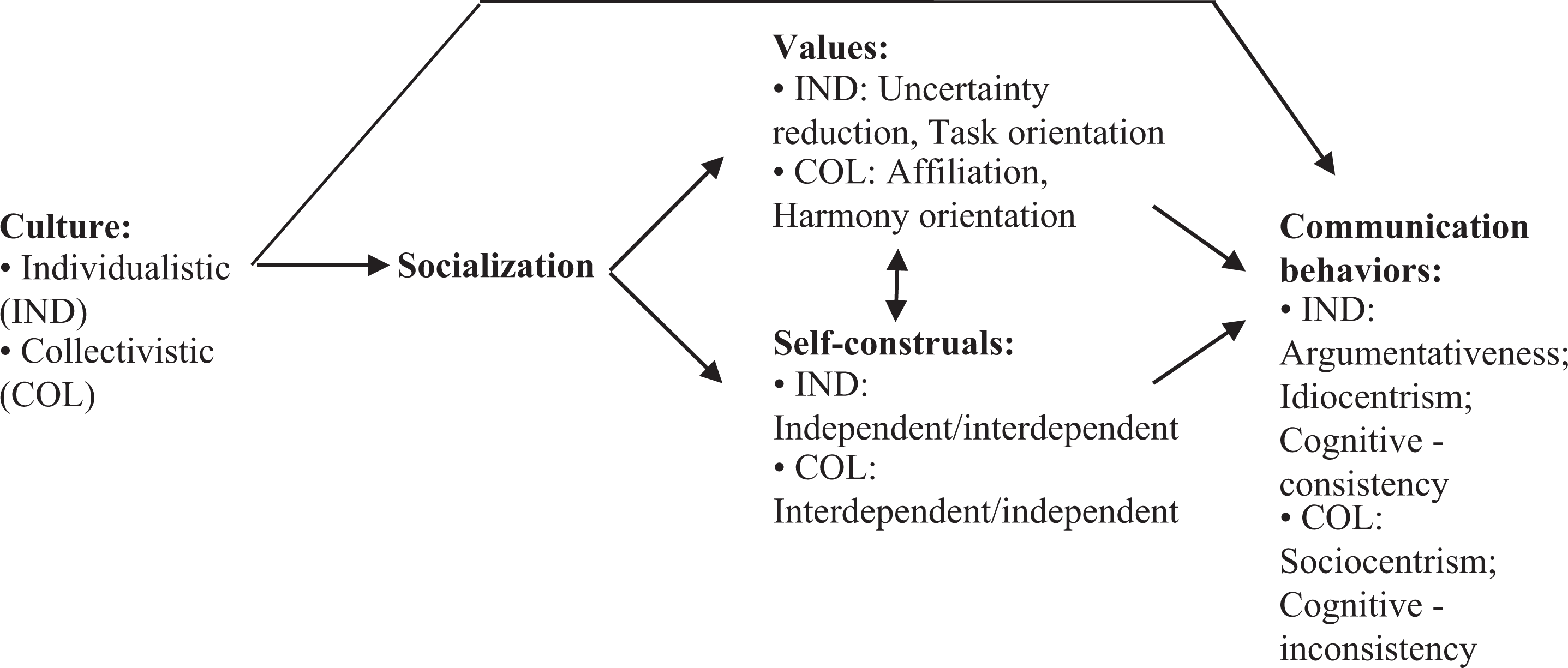
Influence of culture on communication behavior (Source: Adapted from Gudykunst et al., 1996).
Extant literature suggests that individuals socialized in individualistic or collectivistic cultures are more likely to have an independent-SC and idiocentric behavior or interdependent-SC and sociocentric behavior, respectively (Markus and Kitayama, 1991; Triandis, 1989). Further, other scholars have documented that individualism and collectivism are associated with LC and HC communication (Gudykunst et al., 1996; Pekerti and Thomas, 2003). Based on the above discussions, we present the first of four hypotheses.
Culture, self-concept, and argumentativeness
One communication construct that appears to support Hall’s (1976) and Markus and Kitayama’s (1991) theories is argumentativeness. Argumentativeness refers to a disposition that leads to the propensity to argue (Infante and Rancer, 1996). It is considered constructive since it “involves attacking the positions that others take on given issues as opposed to the negative disposition of verbal aggressiveness which involves attacking the self-concept(s) of others, rather than their positions” (Infante and Rancer, 1996: 320). Argumentativeness is related to workplace success, especially when used with an affirming communication style (Infante and Rancer, 1996). Argumentativeness has been validated cross-culturally, for example, Infante and Rancer (1996) as well as Suzuki and Rancer (1994) found members of collectivistic Japanese and Korean cultures less argumentative than members of individualistic North American culture. Kim et al.’s (2001) work indicate that individualism is positively linked to independent-SC and argumentativeness, including the idea that as one’s level of individualism decreases so does one’s argumentativeness.
We contend that argumentativeness is an extension of one’s cultural values and self-concept. Logically, collectivists with an interdependent-SC have lower tendencies to attack another’s position concerning a given issue or ideas because they do not make distinctions between ideas and the person who expresses them (Cross et al., 2002; Cross et al., 2000; Kim et al., 2001; Singelis and Brown, 1995). Since attacks on ideas would be perceived as an attack on the person, collectivists are less likely to be argumentative in communication interactions to ensure harmony with relevant others, especially if the other participants are of higher status. In contrast, individualists with an independent-SC do distinguish between ideas, and the person who expresses them thus do not mind attacking an idea and opposing it compared to collectivist, that is, being argumentative. Therefore, we present the following hypothesis regarding argumentativeness.
Communication in intercultural interactions
Understanding dominant communication styles used in different cultures is an important step in understanding behaviors of individuals from different cultures. However, this understanding is insufficient in intercultural interactions since it fails to address the extent to which individuals might alter their preferred behavior in these situations. Although there are sound theories that predict probable strategies people may adopt during intercultural encounters (Gallois et al., 2004), to date, we know only few studies that document actual communication behaviors during intercultural interactions (e.g.Adair et al, 2001; Pekerti and Thomas, 2003). As such, extant empirical evidence is still equivocal regarding accommodation strategy in intercultural interactions. Accommodating one’s communication style so that it converges with another person’s style to bridge cultural distance is largely based on the similarity attraction paradigm (Byrne, 1971; Giles and Noels, 1997). Logically, convergence leads to perceptions of similarity, which leads to positive attitudes toward members of the other culture (Gallois et al., 2004). However, the extent to which stylistic accommodation is viewed positively seems to depend on the motive to which it is attributed (Thomas and Ravlin, 1995). Research indicates that there might be an optimal level of adaptation concerning another culture’s pattern of behaviors, whereby the effects are less positive if a person goes beyond this threshold (Gallois et al., 2004; Francis, 1991). In short, when people interact with different cultures, they have a choice of using either an adaptive strategy or not (Rao and Hashimoto, 1996; Tse et al., 1994).
Other research suggests that when situations fail to yield enough contextual clues to provide participants with cues to behave in a particular manner, people tend to rely on internal cues for guidance (Catrambone and Markus, 1987;Fiske and Taylor, 1991). For example, Laurent (1983) found individuals in multicultural environments exhibiting behaviors that were more characteristic of their own culture (i.e. divergence behavior) than in monocultural situations.
In sum, extant research suggests that people may alter their communication style during intercultural interactions; however, it is still unclear which strategy will bring about a more productive outcome (Adair et al., 2001). We suggest that in situations where cues for behavior are ambiguous, such as in initial encounters or novel situations, a strong case can be made for individuals to revert to preferred communication behaviors that are consistent with their cultural norms. To explore whether people diverged in their communication behavior in ambiguous situation, such as initial encounters or novel situations, we propose the following regarding communication behaviors in initial intercultural encounters.
Cross-cultural comparison of cognitive consistency behaviors
An alternative concept that further explains and predicts differences in intercultural encounters is cognitive consistency theory. Cognitive consistency theory posits that all things being equal, individuals will change their attitudes and/or behaviors when there is discrepancy between their views and behavior to maintain consistency (Heider, 1946), especially, when the consequences are of functional importance to them. The theory posits that one might also attempt to influence others to change their attitudes, standards, or behaviors to maintain consistency, thus called inconsistency-reduction behavior (Iwao, 1997; Kelman and Baron, 1968a,1968b). In contrast, there are people who are comfortable with differences between their views, behaviors, and not attempt to change their own views and/or behavior or in others; these behaviors are called inconsistency-support behaviors.
Studies have shown cultural effects in cognitive consistency behaviors. Iwao (1997) and Iwao and Triandis (1993) found Japanese participants exhibited inconsistency-support behaviors by not expressing discrepancy between one’s private and publically expressed views regarding an issue. In contrast, Iwao and Triandis (1993) found Americans attempted to reduce their cognitive inconsistency by attempting to change another person’s opinion to maintain consistency between their privately held and their publically expressed views. Similarly, Khokhlov and Gonzalez (1973) found Americans changed their views to maintain consistency with a significant other (friend, father, or country), whereas Greeks were comfortable with perceived cognitive inconsistencies and did not change their views.
The importance of individuals’ SCs lies in the notion that it is the framework that activates the processing of information from the environment (Triandis, 1989). Therefore, we argue that SC is linked to cognitive consistency orientation and communication behavior. For example, collectivists with interdependent-SC place primary importance on maintaining relationships thus will behave in ways that avoid conflict, loss of face, and protect relationships (Cross et al., 2002; e.g. amae in Japan—Doi, 1974). We argue that Japanese and Greek participants in the previous experiments (Iwao, 1997; Iwao and Triandis, 1993; Khokhlov and Gonzalez, 1973) exhibited inconsistency-support behaviors because their sociocentric communication norms had relegated expressing an opinion that one believes as true secondary to maintaining harmony. Therefore, Greek and Japanese participants did not attempt to maintain consistency between their private and expressed opinions by attempting to change others’ opinions.
In short, people who have an interdependent-SC and values harmony are more likely to exhibit inconsistency-support behaviors, such as being less argumentative compared to people who have an independent-SC who are more likely to be more argumentative to maintain consistency; please see Figure 1. In addition, due to the orthogonality of SCs (Cross et al., 2000; Pekerti and Kwantes, 2011), one’s self-concept is more likely to be a better predictor of cognitive consistency behaviors than one’s cultural background.
Dialecticism as cultural foundations of cognitive consistency
A metaphysical and epistemological view, which explains cognitive consistency and inconsistency in Asians versus Westerners in the workplace, is how people deal with paradoxes and/or contradictions (Cameron, 1986; Chen, 2002; Lewis, 2000; Nisbett et al., 2001; Paletz and Peng, 2009; Peng and Nisbett, 1999; Peng et al., 2006). In her exposition, Lewis (2000: 760) claimed that paradoxes are socially constructed concepts that incorporate contradictory yet interrelated elements. These works suggest that Westerners approach paradoxes via dialectical thinking that is rooted in the concept of noncontradiction. Westerners recognize contradiction then move on toward resolving it via verbal debate and argumentation, which fits in with Western preference for consistency (Boucher et al., 2009; Nisbett et al., 2001; Peng et al., 2006; Peng and Nisbett, 1999; Spencer-Rodgers et al., 2010).
In contrast, East and South East Asian societies (Chinese, Korean, Japanese, Singaporean, and Thailand) approach life and paradoxes via the middle way that prescribes a holistic approach (Chen, 2002; Peng and Nisbett, 1999; Spencer-Rodgers et al., 2010). The middle way has been attributed to the teachings of Lao Tzu and Tao philosophy (Chen, 2001, 2002), including Confucian teachings (Chen, 2002; Fletcher and Fang, 2006). Symbolized by the yin–yang, and coined naive dialecticism, this approach accepts contradictions in life, since life involves as a constant state of flux (Peng and Nisbett, 1999; Nisbett et al., 2001; Spencer-Rodgers et al., 2010), to the extent that individuals can change depending on the context (Boucher et al., 2009; Peng et al., 2006).
A naive dialectism approaches apparent paradox by believing that both views of a contradiction might be right, thus truth lies between the two perspectives (Peng and Nisbett, 1999). Since both views can be correct, people can have differing views without having to persuade another to take another perspective. For example, Peng and Nisbett (1999) found Chinese participants more likely to accept two contradictory propositions compared to American participants, suggesting a holistic approach by the Chinese as opposed to a polarizing approach in dealing with contradictions.
Recent works suggest that tolerance for contradiction has been documented in India and in cultural milieus that accept multitheism (Spencer-Rodgers et al., 2010). Although cognitive consistency theory posits that the motives for maintaining consistency are universal, studies indicate that occurrence of inconsistency-reduction behaviors may be lower in some cultures (Boucher et al., 2009; Peng and Nisbett, 1999; Spencer-Rodgers et al., 2010). Thus, the need to reconcile the inner-self with external behaviors may be lower for collectivists with an interdependent-SC than for individualists with and independent-SC (Gudykunst et al., 1996; Kashima et al., 1992); that is, collectivists accept contradictions as part of life (Boucher et al., 2009; Peng and Nisbett, 1999; Spencer-Rodgers et al., 2010). Based on these findings and previous discussions, we propose the following hypothesis:
The present research
Two studies were designed to examine the relationship between cultural value orientations and communication style. Study 1 examines the relationship between cultural values, SCs, and the propensity to argue. Study 2 investigated actual communication behaviors in intracultural versus intercultural interactions with the aim of explaining behavioral adjustment strategies in intercultural interactions.
Study 1
Study 1 tested predictions regarding individuals’ cultural orientation, self-concept, and propensity to argue.
Method
Participants
Participants were undergraduate students from a large university in New Zealand (NZ). Surveys were administered in English, which was the language of instruction at the university. A total of 193 participants took part in the study, consisting of 96 Asian international students from East and South East Asia, 97 NZ Caucasian participants with NZ, English, European and North American descent. The average age for NZ participants was 21.1 years and that for Asians was 22.2 years. Of the 97 New Zealanders (NZs), 61percent were women, while 70 percent of the 96 Asian participants were women.
To account for acculturation effects, Asian participants were required to meet two criteria to control for possible acculturation effects. First, they had to be either first-generation Asian in NZ or international students.
Measures
Argumentativeness
We measured argumentativeness using Infante and Rancer’s (1982) 20-item scale, measuring the tendency to argue (ARGap) and avoid arguments (ARGav). The scale had been validated in individualist and collectivist cultures (Kim et al., 2001; Infante and Rancer, 1996; Suzuki and Rancer, 1994). To establish construct equivalence for this study, the scale was subjected to a confirmatory factor analysis (CFA) using structural equation modeling in each culture simultaneously (Bollen, 1989; van de Vijver and Leung, 1997). The model fit for factors ARGav and ARGap had goodness of fit indexes of 0.97, indicating equivalence of the measure across cultures. The reliabilities of the resulting factors were α = 70 for ARGap and α = 0.63 for ARGav.
Horizontal-, vertical-, individualism and collectivism
Horizontal-, vertical-, individualism and collectivism scales were measured with Triandis and Gelfand’s (1998) scale. Construct equivalence was established using structural equation modeling. The resulting four scales had goodness of fit indexes ranging from 0.98 to 0.99. The internal reliabilities of the resulting scales were α = 0.70 for H-I, α = 0.70 for V-I, α = 0.70 for H-C, and α = 0.70 for V-C.
Self-construal
Independent-SC and interdependent-SC were measured with Singelis’ scale (Singelis, 1994; Yamada and Singelis, 1999). Construct equivalence was established using structural equation modeling. The independent and interdependence scales had goodness of fit indexes of 0.97. The internal reliability coefficients were α = 0.60 for independence and α = 0.72 for interdependence, which are similar to other works (Green et al., 2005).
Results
A multivariate analysis of variance (MANOVA) was performed to test
MANOVA, culture and gender on argumentativeness, horizontal–vertical individualism–collectivism, self-concept.
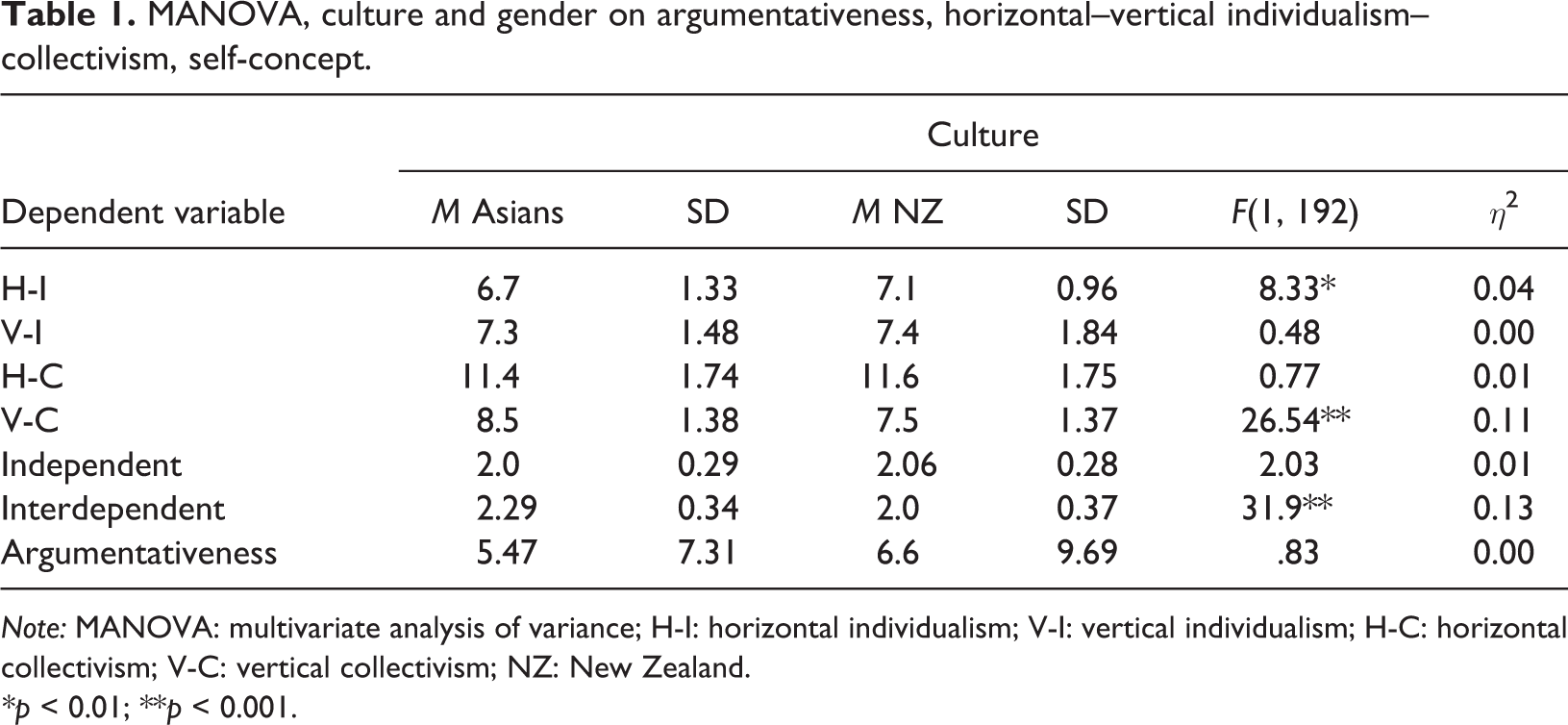
Note: MANOVA: multivariate analysis of variance; H-I: horizontal individualism; V-I: vertical individualism; H-C: horizontal collectivism; V-C: vertical collectivism; NZ: New Zealand.
*p < 0.01; **p < 0.001.
Within-group correlations in Table 2 confirmed our predictions. Within NZs, argumentativeness was positively related to independence and V-I, while argumentativeness is negatively related to H-C. Interdependence was positively related to H-C and V-C, while independence is positively related to H-I and V-I. The Asian sample showed some interesting correlations, for example, argumentativeness is negatively correlated to interdependence but positively linked to independence, interdependence and independence are positively correlated, argumentativeness is positively related to H-I and V-I, interdependence is positively related to H-C and V-C, and independence is positively related to H-I and V-I as well as H-C and V-C. These findings indicate that individuals can be both independent-SC and interdependent-SC (Cross et al., 2000; Markus and Kitayama, 1991; Pekerti and Kwantes, 2011; Singelis, 1994).
Means, standard deviations, and intercorrelations of variables in study 1 for Asian and New Zealand data.

Note: H-I: horizontal individualism; V-I: vertical individualism; H-C: horizontal collectivism; V-C: vertical collectivism.
*p < 0.05; **p < 0.01; ***p < 0.001.
Further analyses confirm that for Asians the concept of independence is driven by both H-I and V-C, but H-I is the predominant source of independent-SC, while V-C solely drives the concept of interdependence, as presented in Table 3. In contrast, argumentativeness is positively linked to the NZs' independent-SC and negatively linked to interdependence, thus supporting the argument that argumentativeness is effectively driven by one’s independent-SC (Kim et al., 2001; Infante and Rancer 1996; Suzuki and Rancer, 1994), as given in Table 4. Taken together, these findings partially support
Backward regression analyses testing link between independence and individualism–collectivism variables in Asian sample.

Note: H-I: horizontal individualism; V-I: vertical individualism; H-C: horizontal collectivism; V-C: vertical collectivism.
*p < 0.05; **p < 0.01; ***p < 0.001.
Backward regression analyses testing link between interdependence and individualism–collectivism in Asian sample.
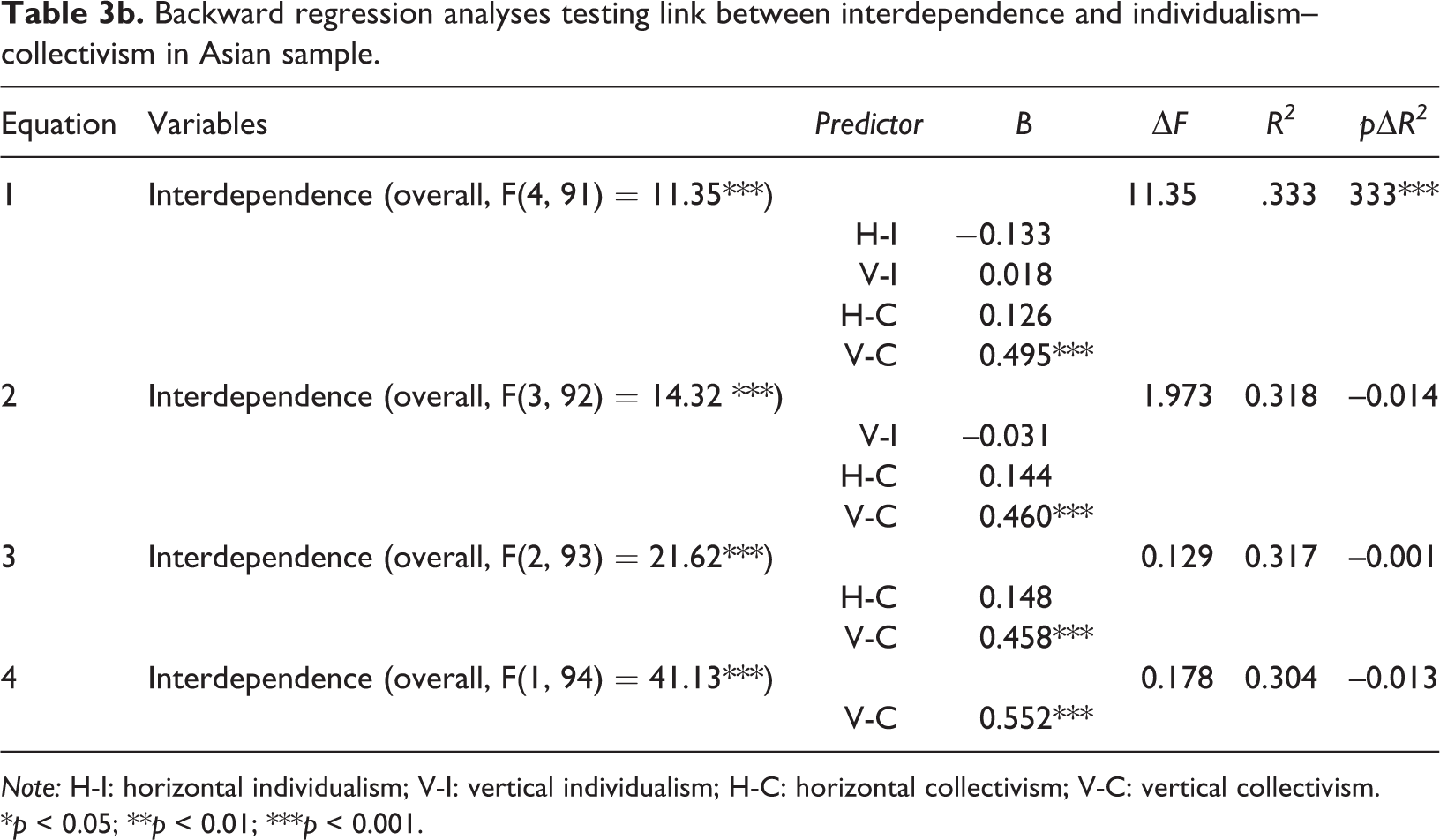
Note: H-I: horizontal individualism; V-I: vertical individualism; H-C: horizontal collectivism; V-C: vertical collectivism.
*p < 0.05; **p < 0.01; ***p < 0.001.
Backward regression analyses testing link between argumentativeness and independence-interdependence in Asian sample.
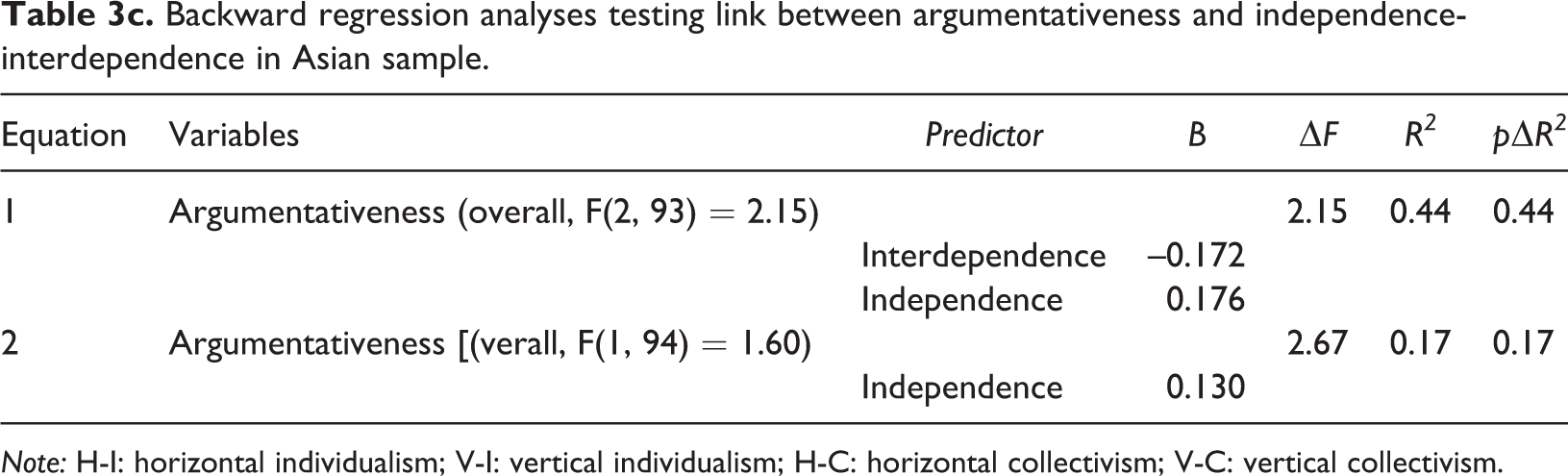
Note: H-I: horizontal individualism; V-I: vertical individualism; H-C: horizontal collectivism; V-C: vertical collectivism.
Backward regression analyses testing link between independence and individualism–collectivism variables in NZ sample.

Note: H-I: horizontal individualism; V-I: vertical individualism; H-C: horizontal collectivism; V-C: vertical collectivism; NZ: New Zealand.
*p < 0.05; **p < 0.01; ***p < 0.001.
Backward regression analyses testing link between interdependence and individualism–collectivism variables in NZ sample.
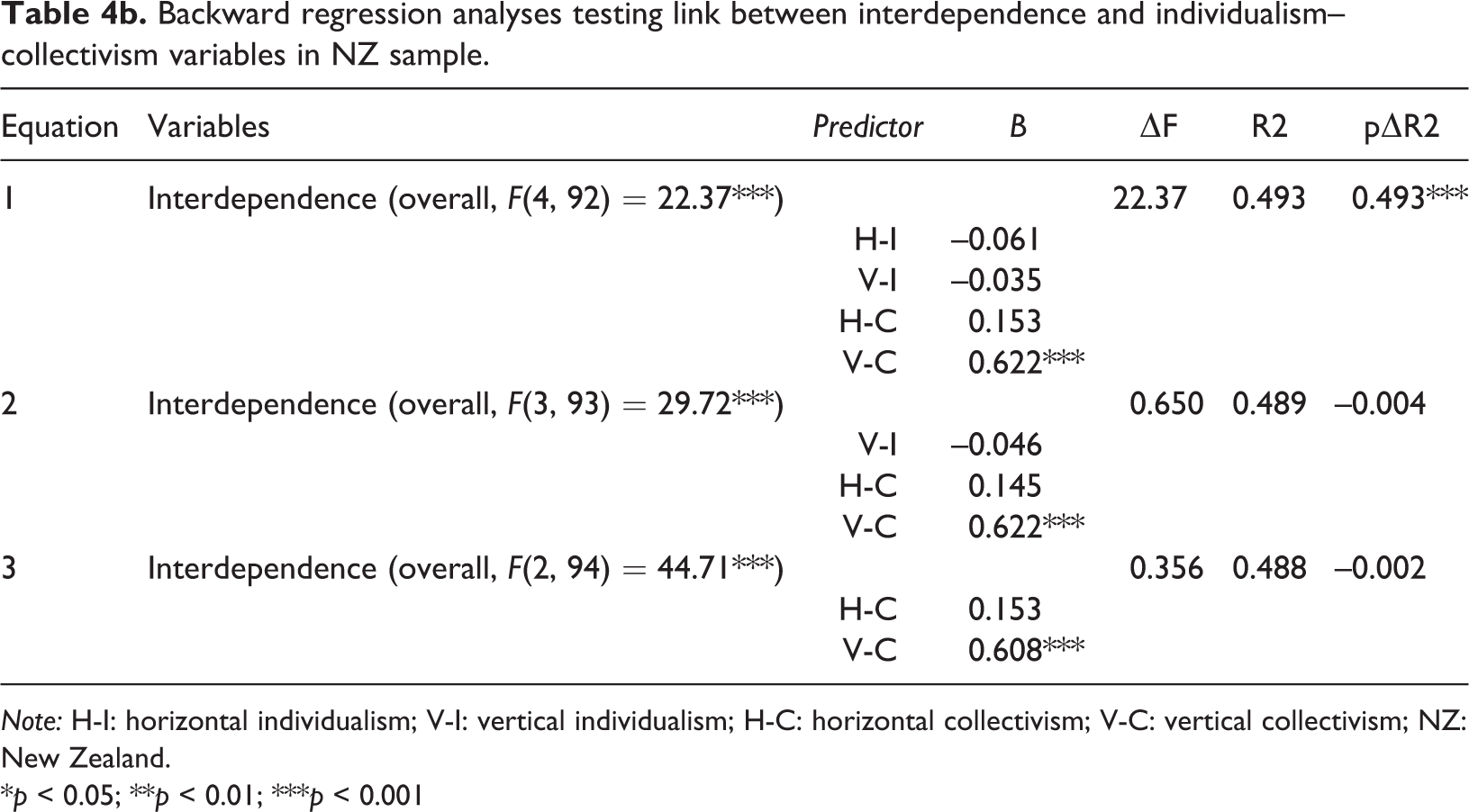
Note: H-I: horizontal individualism; V-I: vertical individualism; H-C: horizontal collectivism; V-C: vertical collectivism; NZ: New Zealand.
*p < 0.05; **p < 0.01; ***p < 0.001
Backward regression analyses testing link between argumentativeness and independent-interdependent in NZ sample.

*p < 0.05; **p < 0.01; ***p < 0.001.
Mediating effect of self-concept
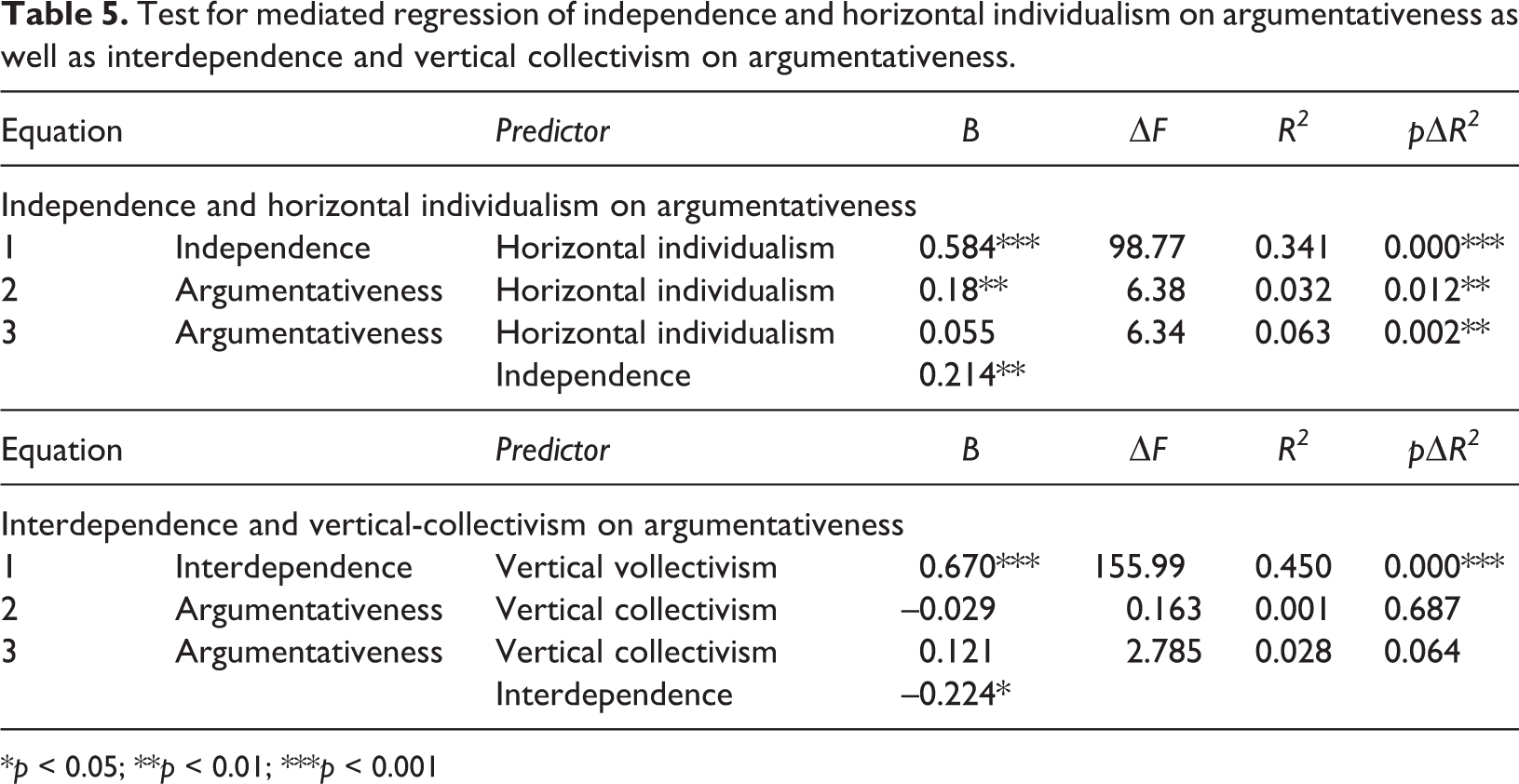
To examine the possible mediating effect of self-construal as depicted in Figure 1, we used the three-equation approach recommended by Baron and Kenny (1986) as well as Preacher and Hayes (2004). Since H-I and V-C were found to be the factors driving independent-SC and interdependent-SC, respectively, we limited the mediation analyses to these particular relationships. Mediated regression results for interdependence and V-C on argumentativeness as well as independence and H-I on argumentativeness are presented in Table 5. As shown, the pattern of results supports a mediated relationship between H-I, independence, and argumentativeness (Preacher and Hayes, 2004; Preacher et al., 2007). That is, the relationship between H-I on independence and propensity to argue is as predicted, then H-I on argumentativeness becomes nonsignificant when independence is in the equation, the Sobel test supports this conclusion (Z = 2.47, p < 0.01). However, this effect was not found for V-C, interdependence, and argumentativeness; the Sobel test concurs (Z = 0.43, p < 0.068). As such, it confirms that an individual’s independent-SC will mediate one’s propensity to argue to the extent the more independent one is the more likely he/she is to be argumentative.
Test for mediated regression of independence and horizontal individualism on argumentativeness as well as interdependence and vertical collectivism on argumentativeness.
*p < 0.05; **p < 0.01; ***p < 0.001
For the most part, results of study 1 are consistent with our predictions; however, a few unexpected findings were observed. Positive relationships between collectivism and independence in the Asian data are examples of such findings. These findings, however, are not surprising since the sample were students. In general, university students are trained to think independently, thus Asian students living and studying in individualistic nations may be more independent compared to Asian students living in their home nations. This also explains why Asians were not significantly different in independence compared to NZs. These results illustrate the advantages and disadvantages of obtaining data from a student sample. Heine et al. (2001) suggest that gathering data from people of similar background in different countries such as university students can validate cultural differences when they exist, which we did discover. However, at the same time, the similarities in experiences and opportunities that students have may also minimize potential cultural differences that may otherwise exist. Therefore, Heine et al.’s (2001) work suggests that if we were to interview Asians and asked to compare themselves with NZs, it is likely that Asians may view themselves as significantly less argumentative than NZs.
Summary and discussion
Study 1 provides empirical evidence of the relationship between people’s cultural value orientation, SC, and propensity to argue. Individuals from traditionally collectivistic culture were found to be more interdependent than those from traditionally individualistic culture. Results lend support to Markus and Kitayama’s (1991) theory in that H-I was the predominant factor driving independent-SC, while V-C was the predominant factor driving interdependent-SC.
The result also meets the seven criteria set by Matsumoto (1999) for validating the influence of culture on SC and behaviors. In short, using samples from two cultural backgrounds, study 1 showed that there was an effect for H-I and V-C and for SC with both effects and correlations in the predicted direction as described by Markus and Kitayama’s (1991) theory. Culture influenced the propensity to argue through the intermediate variable of SC. In particular, independent-SC was positively linked to argumentativeness, and the mean scores for argumentativeness were in the predicted direction with NZs more argumentative compared to Asians.
The nominal effect of argumentativeness and significant relationship between independence and argumentativeness found in this study are consistent with Kim et al.’s (2001) work. They found Koreans less argumentative compared to US participants from the mainland and from Hawaii but did not find a significant main effect for argumentativeness (Kim et al., 2001). The results suggest that when used with a student sample, the argumentativeness scale may suffer the lack of reference effect, which serves to minimize cultural effect (Heine et al., 2001). As such, future studies using the argumentativeness measure may need to specify a reference group to compare with to test predictions.
In study 2, we extend our findings by testing the link between culture and communication and adjustment behavior in intercultural interactions.
Study 2
Study 2 tested predictions that collectivists and individualists will exhibit sociocentric and idiocentric communication behavior, respectively, whereby in initial intercultural interactions, the two groups will exhibit communication styles that are representative of their own cultural norms. Finally, we tested the prediction that individualist are more likely to exhibit inconsistency-reduction behavior than collectivist who are more likely to exhibit inconsistency-support behavior.
Method
Participants
Participants were Caucasian NZs as well as East and South East Asian students at a large NZ university. Asian participants met two criteria to control for possible acculturation effects. First, they had to be a first-generation Asian or international student.The sample consisted of 96 volunteer participants with an average age of 23 years; however, each participant was paid NZ$10.00. The NZ Caucasian sample consisted of 24 men and 24 women who were from NZ of NZ, European, and North American descent; one participant was born in NZ with parents from South Africa. The Asian sample consisted of 24 men and 24 women from East and South East Asia. They were predominantly of Chinese ancestry with the exception of two participants who were indigenous Indonesians.
Procedures and experimental design
Participants interacted in a dyadic consensus communication task performed at two different times. This design was included to test whether subsequent interactions might affect behavior patterns since familiarity can change behaviors between dyads (Honeycutt, 1993; Neff and Karney, 2005). The interactions were videotaped and the setting standardized. The study used a 2 × 2 (Culture × Condition) design, with participants in each cultural groups interacting in either intercultural or intracultural condition. Because communication research has indicated that social roles and gender can affect communication behaviors (Fletcher et al., 1986), participants were uniformly blocked for gender and age, as well as culture, before being randomly assigned to each condition (Cook and Campbell, 1979). This blocking controlled for possible effects of gender and/or status caused by age.
Consensus task
The experimental task was to rank the severity of 15 crimes (Taylor, 1987/88). Each participant was asked to rank the crimes as quickly and as accurately as possible, individually (individual ranking). Participants were informed that there was a model answer derived from expert opinions consisting of lawyers and judges. After participants completed the task individually, they were asked to interact and complete a new set of rankings via consensus (consensus ranks); a maximum of 15 min was given to complete the consensus ranks. The consensus ranks were then compared against the model answers and dyads were given the feedback, “you did not do so well compared to the expert rankings”. They were then asked to improve their consensus ranks in a second attempt. This particular consensus task was chosen because it allowed participants to form individual opinions and to think about the rationales of why one maintains those opinions and/or change them during the task at two different points in time. The task fits the study well since we test whether participants’ communication styles and opinions differ at two different points in time. The interactions were conducted in English, which was the language of instruction at the university.
Scoring of crime-ranking task
The scoring of the crime-ranking task was as follows: Individual scores (I) were the sum of absolute value of the differences between their individual ranking and the expert ranking. Difference scores between individuals (DI) were the sum of absolute value of differences between individual’s ranks on each crime. Difference scores between individual’s ranks and consensus ranks (DIC) tell us how much an individual had changed his/her rankings during the consensus task, this was the sum of the absolute value difference between the individual’s ranks and consensus ranks.
Because of the within-person design, we were able to record scores from Consensus Task at time 1 (CT1) and consensus task at time 2 (CT2).
Coding procedure of communication task
The experiment resulted in 96 videotaped communication interactions. Three coders unfamiliar with the study’s hypotheses coded the interactions. The coders represented both the Anglo NZ and Asian cultures and both genders. All coders were trained using videotaped interactions that were not part of the data. All coders completed six practice rounds before they coded the actual interactions. Based on observations, pilot study, and interviews, including previous research of what constitutes as dyadic and business communication behaviors (Burgoon and Hale, 1987; Gudykunst et al., 1988; Hall, 1976; Hinkle et al., 1988), 12 behavior categories were used to code the participants communication patterns. Interactions were coded according to the occurrence and intensity of behaviors consistent with dyad communication interactions. Each dyad were labeled A or B on the screen and coders rated who displayed more behaviors than the other participant did, then rated the intensities of these observed behaviors on a 7-point rating scale. For example, all participants displayed expressions; however, one participant might have been more emotive and colorful in his/her expressions; this difference in degree of expressiveness was the basis for the intensity rating. Cognitive consistency behaviors were determined by the degree of change between one’s individual crime–rank scores at CT1 and CT2 compared to the consensus scores at CT1 and CT2, respectively.
The interrater criterion was established at two of the three coders concurring on a coded behavior for it to be considered valid for analysis; thus, all data put forward for analysis had at least 0.67 interrater agreement. The study’s interrater agreement for the data was 0.88, which is above the acceptable recommended value of 0.61 to 0.80 for interrater reliability (Landis and Koch, 1977).
Results
Communication style
Testing our predictions involved examinations of participants’ behaviors intraculturally and interculturally; results are presented in Table 6a and 6b. Since each behavior occurred with reference to the other participant, the cell counts in Table 6a and 6b depict judgments identifying the participants that exhibited the most of each behavior in the three interaction conditions during CT1 and CT2, respectively.
Comparative judgments of observed behaviors in intercultural and intracultural interactions during the consensus task at time 1.
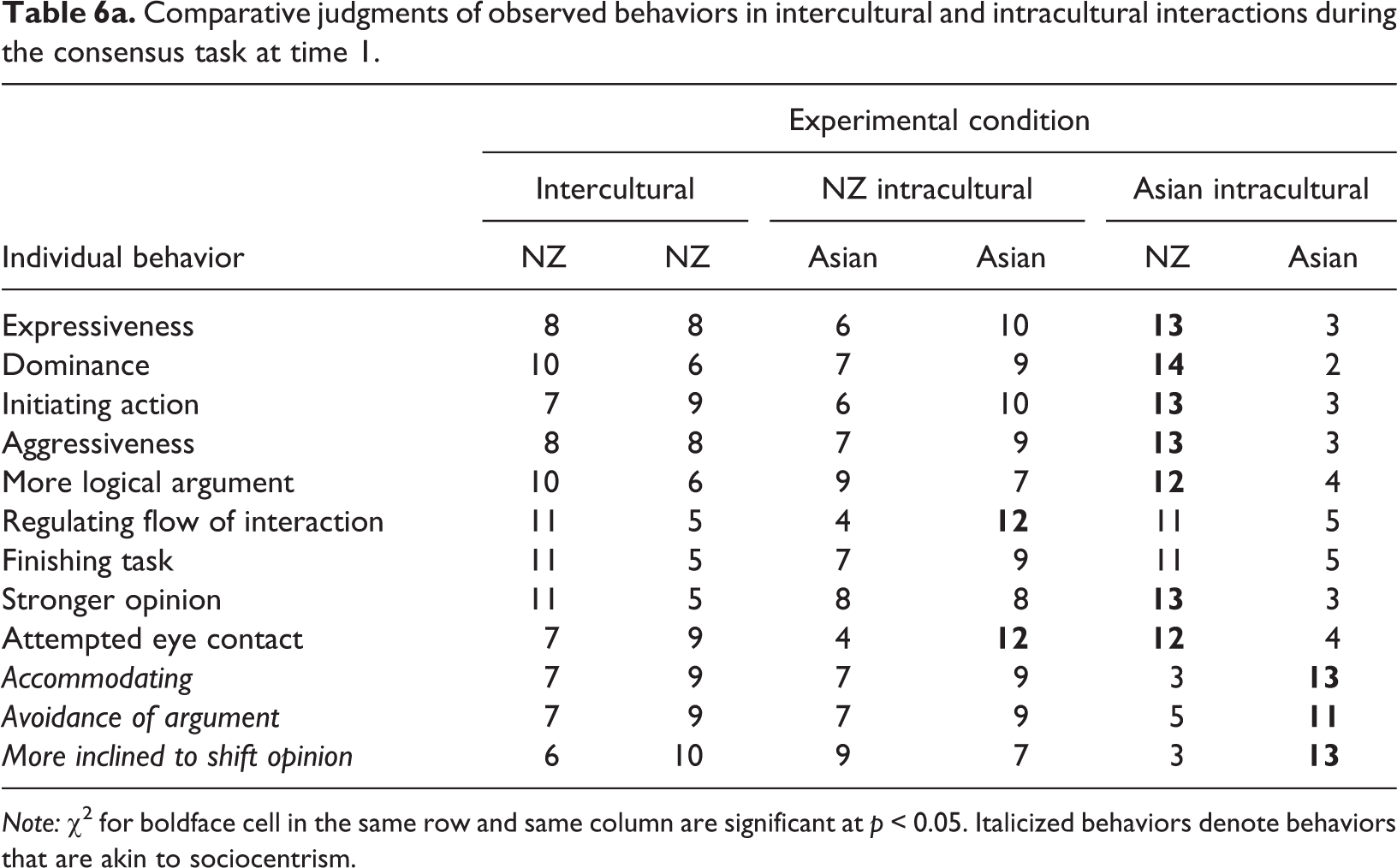
Note: χ2 for boldface cell in the same row and same column are significant at p < 0.05. Italicized behaviors denote behaviors that are akin to sociocentrism.
Comparative judgments of observed behaviors in intercultural and intracultural interactions during the consensus task at time 2.
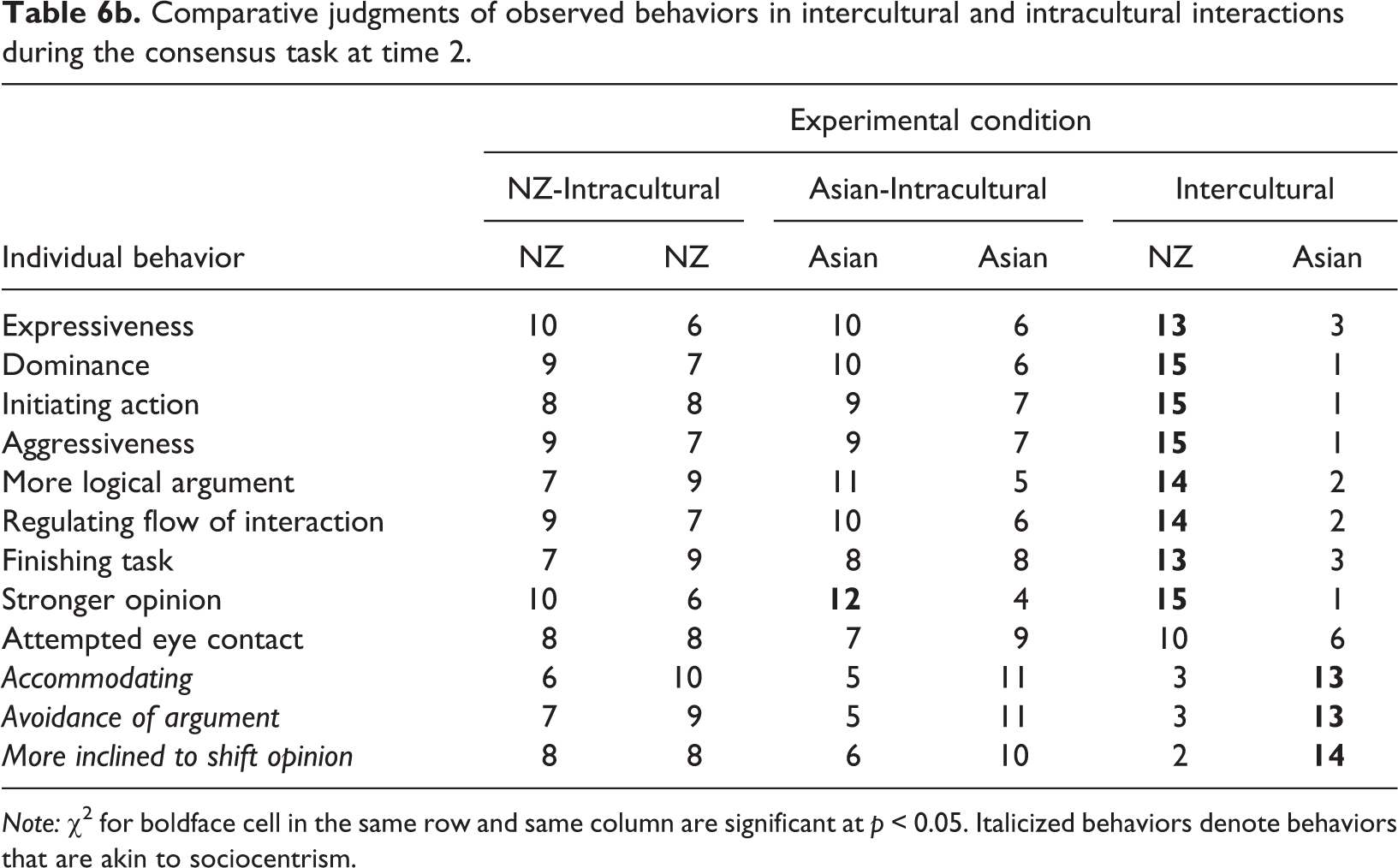
Note: χ2 for boldface cell in the same row and same column are significant at p < 0.05. Italicized behaviors denote behaviors that are akin to sociocentrism.
As shown in Table 6a and 6b, individuals in the intracultural interactions were equally likely to exhibit each behavior during the interactions; the exception was in the Asian intracultural condition where one of the dyad members had regulated the flow interaction and attempted eye contact in CT1 and stronger opinions in CT2. In the intercultural condition, NZs and Asians demonstrated contrasting behaviors. NZs exhibited expressiveness, dominance, initiating action, aggressiveness, logical argument, stronger opinion and attempted eye contact in CT1; the same pattern was found for NZs in CT2 with additional behaviors regulating flow, finishing task being significantly different. Taken together, these behaviors are akin to idiocentric behaviors. In contrast, Asians exhibited behaviors that can be considered sociocentric behaviors, namely, accommodating, avoidance of arguments, and shifting opinion in both CT1 and CT2. The results suggest that in intercultural situations, both groups exhibited communication behavior consistent with their cultural norms; NZs were observed to be task oriented and opinionated (idiocentric), while Asians were flexible and accommodating (sociocentric).
Further analysis focused on the intensity of behaviors exhibited by participants, which was analyzed by conducting a 2 × 2 MANOVA controlling for gender. In CT1, a significant effect was found for culture F (Wilks criterion; 12, 95) = 2.16, p < 0.02; p η2 = 0.25, but not for condition. The effect for gender was also not significant. However, there was a significant interaction effect for Culture × Condition, F (12, 95) = 1.92, p < 0.04; p η2 = 0.22. These multivariate results were replicated in CT2.
Univariate analysis indicated that participants’ culture had a significant effect on 11 of 12 behaviors in CT1 (finishing task was not significant) and 10 of 12 behaviors in CT2 (finishing task and attempted eye contact were not significant). Taken together, NZs exhibited more intensity for idiocentric behaviors while Asians for sociocentric behaviors. The impact of culture and situation was reflected by significant Culture × Condition interactions on 10 of 12 behaviors in CT1 (finishing task and avoidance of argument were not significant) and 11 of 12 behaviors in CT2 (finishing task was not significant).
Examination of the interaction effects indicated that communicating with a member of another culture enhanced the intensity of idiocentric behaviors for NZs and of sociocentric behaviors for Asians on both occasions. Table 7a and 7b depicts the intensity of observed behaviors in the three interaction conditions in CT1 and CT2, respectively. As depicted in Table 7a, individuals in the two intracultural interactions were equally likely to exhibit similar intensity of behaviors during their interactions; the exceptions were for regulating flow of interactions and attempted eye contact in the Asian intracultural condition. However, in the intercultural condition, all behavior categories were significant, NZs exhibited higher intensities expressiveness, dominance, initiating action, aggressiveness, logical argument, regulating flow, stronger opinion, attempted eye contact, while Asians exhibited higher intensities of behaviors accommodating, avoidance of arguments, and shifting opinion in CT1.
Summary of intensity in communication behaviors in intercultural and intracultural interactions for consensus task at time 1.

Note: NZ = New Zealand. Bold means denote higher scores within the columns significant at: *p < 0.05; **p < 0.01; ***p < 0.001. Italicized behaviors denote behaviors that are akin to sociocentrism.
Summary of intensity in communication behaviors in intercultural and intracultural interactions for Consensus Task at Time-2.
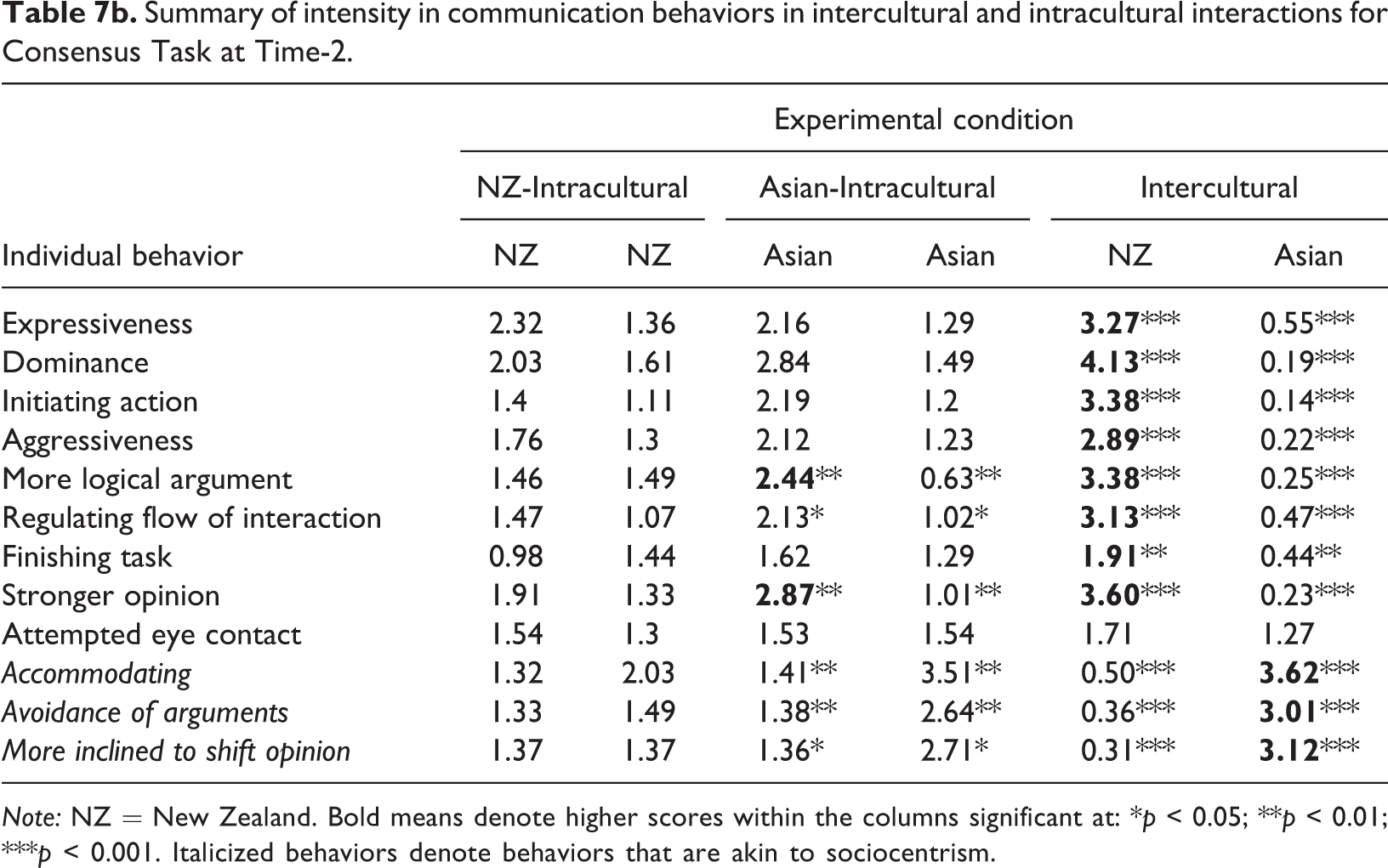
Note: NZ = New Zealand. Bold means denote higher scores within the columns significant at: *p < 0.05; **p < 0.01; ***p < 0.001. Italicized behaviors denote behaviors that are akin to sociocentrism.
In CT2, the results were replicated for the NZ intracultural condition and intercultural condition; however, there were slight variations in the Asian intercultural condition. As shown in Table 7b, Asians in the intracultural condition exhibited normative dyad behavior, where one person exhibited higher intensities of regulating behavior and presenting logical arguments and a stronger opinion, while his/her counterpart exhibited higher intensities of accommodating behavior and avoiding arguments and shifting his/her opinions.
Cognitive consistency
Examining our predictions with regard to inconsistency reduction or inconsistency support involved an examination of the crime-ranking scores from CT1 and CT2. First, ANOVA was conducted on the difference scores between individuals’ rankings (DI) across the three interaction conditions. The ANOVA showed a main effect, F (Wilks criterion; 2, 47) = 8.27, p < 0.001, p η2 = 0.27, the largest difference was found in the intercultural condition (M = 52.06), then Asian intracultural condition (M = 49.88) and smallest in the NZ intracultural condition (M = 34.94). Because the consensus ranks were derived during dyad interactions, we also examined the difference scores between individual and consensus ranks for both participants A and B (DIC A and DIC B, respectively) in each interaction condition in CT1 and CT2.
Table 8 presents the mean difference scores between individual versus consensus ranks at CT1 and CT2. At CT1, the difference scores between participants in the NZ intracultural condition was the highest and close to significant F(1, 31) = 3.93, p < 0.057. The mean of difference scores between individual versus consensus ranks in CT2 were not significant in all three conditions. Despite NZs in the intracultural interactions having the least difference (M = 34.94) in their rankings, the actual difference between their individual and their consensus ranks indicate that one person in the dyad made larger changes compared to the other person in the interaction. Therefore, it is possible that the more dominant person persuaded the other to a greater degree in an attempt to maintain consistency between his/her individual ranks by changing the other person’s view.
Within condition ANOVA for difference between individual ranks versus consensus ranks (DIC) at CT1 and CT2.
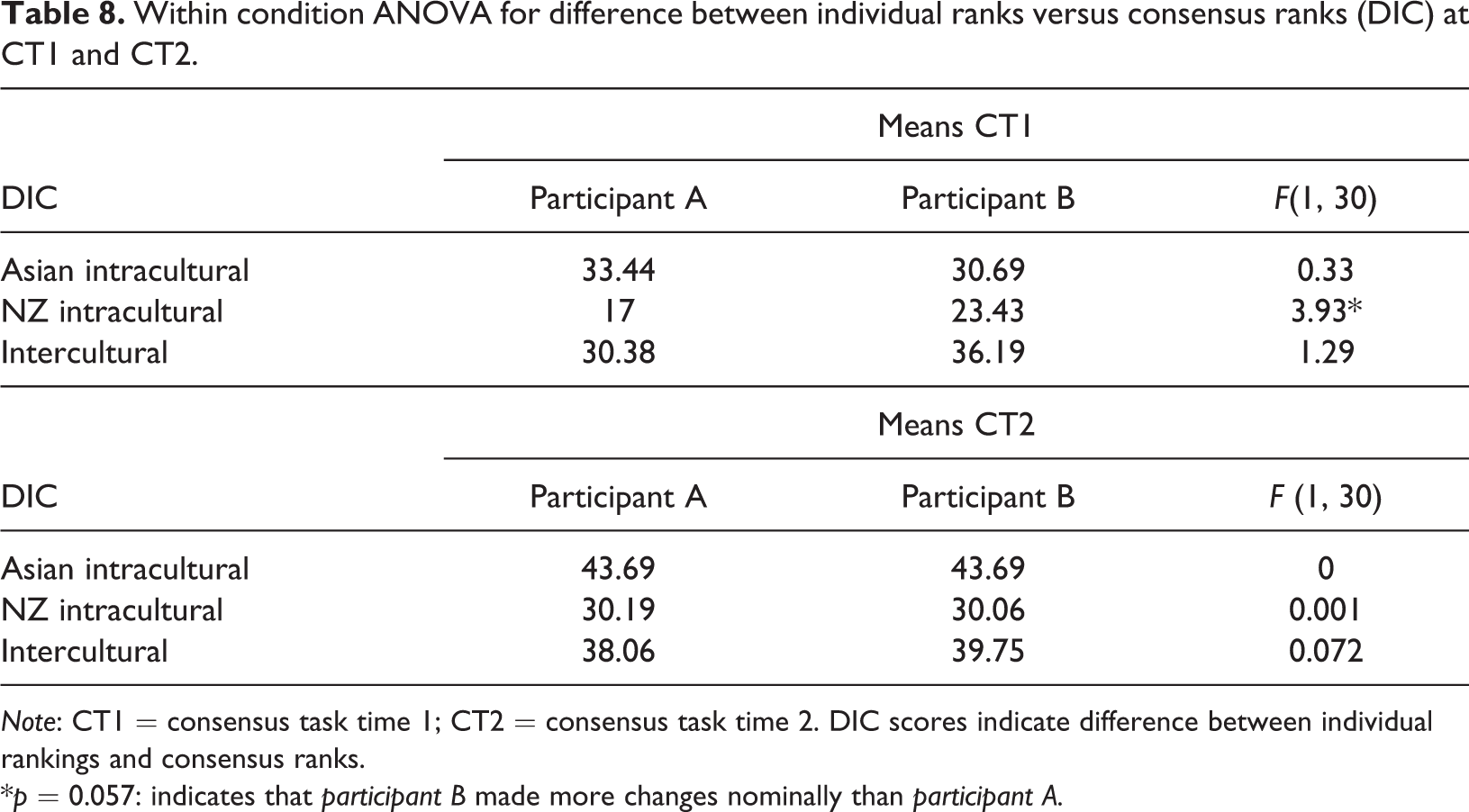
Note: CT1 = consensus task time 1; CT2 = consensus task time 2. DIC scores indicate difference between individual rankings and consensus ranks.
*p = 0.057: indicates that participant B made more changes nominally than participant A.
To explore which of the two participants in the dyad made the largest change between their individual ranks during the consensus task, we regressed the difference between individuals’ ranks (DI) versus the consensus ranks (DIC A and DIC B). As shown in Table 9, in CT1, in the NZ intracultural interactions, participant B made significant changes toward the consensus rankings, β = 0.82, p < 0.01, while participant A made relatively smaller changes. In the Asian intracultural condition, both participants made significant changes toward the consensus rankings, β = 0.72, p < 0.05; and β = 0.60, p < 0.05. In the intercultural condition, both participants made significant changes toward the consensus rankings, β = 0.42, p < 0.05 and β = 0.43, p < 0.05.
Regression analysis: difference scores between individual rankings and consensus ranks for CT1 and CT2.

Note: CT1 = consensus task time 1; CT2 = consensus task time 2. Scores indicate the degree of change each participant (A and B) made during the consensus task; a higher score indicate larger changes made. DIC A and DIC B are the difference scores between participant A and participant B’s ranks and consensus ranks, respectively.
*p < 0.05; **p < 0.01.
In CT2, the pattern within the Asian intracultural condition was replicated; both participants made significant changes toward the consensus rankings, β = 0.54, p < 0.05 and β = 0.64, p < 0.05. However, the pattern in the NZ intracultural and intercultural condition changed. In CT2 of the NZ intracultural condition, participant A made significant changes toward the consensus rankings, β = 0.62, p < 0.05, whereas participant B made relatively smaller changes. This is different to the pattern found in CT1 since it was participant B who made the significant changes in CT1. In CT2 of the intercultural condition, it was only the Asian participants who made significant changes toward the consensus, β = 0.39, p < 0.05. Again this is different to the pattern found in CT1 since it was both participants who made significant changes to their rankings in CT1.
Taken together, it suggests that Asians are open to shift their opinions in intracultural andintercultural interactions, as opposed to their NZ counterparts; this effect was especially evident in CT2. This evidence suggests Asians were exhibiting inconsistency-support behavior, that is, they did not mind contradicting their initial position. In contrast, while some of NZs did not mind changing their minds, the results suggest that one was consistently persuading the other half of the dyad to change their minds. This finding corroborates our findings regarding communication styles in intercultural interactions, namely, that culturally based communication style became more pronounced during the intercultural interactions.
Summary and discussion
Study 2 contributes to our understanding of cross-cultural interactions in several ways. First, it provides actual empirical behaviors as opposed to recalled or intended strategies, documenting distinctive communication styles exhibited by collectivists and individualists during intercultural interactions. Second, it showed that idiocentric style was dominant for NZs and sociocentric style dominant for Asians as well as evidence for cognitive inconsistency-reduction versus cognitive inconsistency-support behaviors, respectively. Third, we documented that communication styles were different in intercultural compared to intracultural interactions, with patterns suggesting that in intercultural interactions participants were more likely to diverge and rely on their culturally dominant communication style as rather than converging to the style of their counterpart.
Fourth, notwithstanding the Asian intracultural condition showing variations in intensities of communication behavior in CT2 compared with CT1, it still points to the fact that Asians were the group exhibiting inconsistency-support behaviors. Analyses on the crime-ranking scores indicate that all Asian participants in the intracultural and intercultural conditions made significant changes in ranking the crimes toward the consensus in both CT1 and CT2. In the Asian intracultural condition, both participants made changes equally in both CT1 and CT2, while in the intercultural condition CT2, it was only the Asian participants who made significant changes. This provides some evidence that collectivists have a propensity to be flexible during communication interactions. This pattern is different to NZs. For the most part, it was only one participant or the other who significantly changed their rankings in the NZ intracultural condition. It suggests that one-half of the dyad consistently exhibited inconsistency-reduction behaviors, possibly to reduce cognitive dissonance (Peng and Nisbett, 1999). This corroborates that Westerners have a propensity to take a strong view of initial preference or positions compared to Asians (Nisbett et al., 2001; Peng and Nisbett, 1999; Spencer-Rodgers et al., 2010) and will argue to maintain this position.
General discussion
The generalizability of this research has some limitations associated with survey research and student samples. However, we contend that appropriate use of a student sample can properly reflect a fundamental process such as communication, especially for cross-cultural communication (Basil, 1996; Locke, 1986). A number of factors point to the appropriateness of our sample and suggest that our findings are generalizable to cross-cultural interactions. First, we used a sample from cultures that were different to NZ who can speak English fluently. Second, since we are investigating cultural patterns, our sample with mean age of 21.5 years has internalized their respective cultural values. Third, the task performed required argumentation, a skill that university students have been trained to do. This leads to our final point in that cross-cultural studies with samples that have similar experiences and opportunities across cultures, such as a student population may actually have higher validity than if we are less certain about the sample’s conditions (Heine et al., 2001). With that in mind, the sample was appropriate to address Matsumoto’s (1999) concerns regarding empirically demonstrating the validity of core beliefs underlying our theories and research. In particular, it showed that the theoretical predictions posed by Markus and Kitayama’s (1991) independent and interdependent construal theory were valid, despite the fact that the sample had cross-cultural experiences, which might have minimized the effect.
Underlying any intercultural interaction is communication behaviors and the processes involved in the interactions. Results of this research provide evidence that culturally based rules govern the style, conventions, and practices of language usage. Additionally, it validates communication styles that have not been empirically well documented in previous research (e.g. Glenn 1981; Hall, 1976; Servaes, 1989). Overall, findings indicate that Asians who are collectivists interdependents are less argumentative. These findings suggest that collectivists might ascribe a higher priority to the affiliative function of communication, which are prescribed by harmony-maintenance scripts found in collective cultures. In contrast, NZs who are more individualists are predisposed to be argumentative. It suggests that individualists may ascribe a higher priority to the functional facet of communication, which are associated with a direct and task-oriented style during communication (Gudykunst et al., 1996; Pekerti and Thomas, 2003).
A key issue in understanding intercultural interactions is the extent to which the act of interacting with a member of another culture influences behavior. Results showed that interacting with a member of a different culture enhanced individuals’ culturally dominant communication style. Therefore, participants diverged by exhibiting more and higher intensities of their culturally dominant behavior. We offer several possible reasons for this divergent behavior. First, interacting with a member of a different culture may have created uncertainty concerning the appropriate behavioral norms. Therefore, in the absence of explicit situational cues, individuals may have relied on their culturally based norms for guidance. In addition, the presence of a culturally different other may have caused individuals to represent their culture and motivated them to display culturally consistent behavior (Laurent, 1983). In either case, results suggest that the dominant tendency in initial intercultural interaction is not adaptation toward the style of the counterpart but enhancement of their culturally dominant behavior. These findings are consistent with other previous research on intercultural and intergroup interactions (e.g. Aberson et al., 2002; Laurent, 1983; Pekerti and Thomas, 2003).
Our present study partially corroborates Adair et al.’s (2001) and Sanchez-Burks et al.’s (2003) findings, which suggest that communication behaviors across context may be consistent for members of different cultures; however, the behaviors within each context are different when cross-cultural comparisons are made. The implication is that when cross-cultural encounters do occur, members of these different cultures are likely to communicate using different styles and behaviors thus may lead to misunderstandings if people are not prepared.
This study underscores that it is the interdependent person socialized in a collective society and not the independent person socialized in an individualistic society that has changed his/her behavior more during a consensus task; that is, collectivists/interdependents exhibit inconsistency-support behaviors (Iwao, 1997; Khokhlov and Gonzalez, 1973; Suh, 2002). It supports cognitive consistency theory’s premise that consistency behaviors are determined by individuals’ perception of value concerning a particular issue (Kelman and Baron, 1968b). This was evident in our study since NZs in the intercultural condition exhibited higher intensities of finishing the task and more occurrences (in CT2), suggesting that completing the task was prioritized, which facilitated idiocentric behaviors compared to Asian participants who may have prioritized other things, such as harmony.
Results also implied that inconsistency support could also be viewed as behavior that is consistent with the valued norm of harmony in collective cultures (Oishi et al., 2004; Suh, 2002). For example, in Japan, the ability to behave in a face-saving manner (tatemae) as opposed to expressing brutal truths (honne) verbally or nonverbally is valued. “In Japan inconsistency-support is at least on certain occasion valued more than inconsistency-reducing behavior” (Iwao, 1997: 324). The fact that both Asians and NZs in the intercultural condition made significant changes toward a consensus during the first interaction clearly indicated that both participants were active. However, it was only Asians who made the significant changes toward a consensus during the second interaction; taken together, this point to Asians in the intercultural condition not simply acquiescing during the second interaction but consciously invoking g sociocentric communication behaviors. This finding corroborates Cross et al.’s (2002) and Doi’s (1974) views that exhibiting sociocentrism such as avoiding conflict is in part face-maintenance behaviors that is paramount in collective and interdependent societies thus serving to avoid loss of face and protect relationships.
These findings also lend support to theories that posit naive dialecticism is prevalent a social processing norm in Asian societies (Peng and Nisbett, 1999); in practice, Asians are sensitive to change and do not mind changing their own views to maintain harmony (Nisbett et al., 2001; Paletz and Peng, 2009; Spencer-Rodgers et al., 2010). Along the same theoretical vein, the fact that NZ participants took turns persuading each other in the intracultural situation provide evidence for cognitive consistency or the need to reduce dissonance (Peng and Nisbett, 1999). In short, Western dialectical approach of noncontradiction and preference for consistency can manifest as a propensity to take a strong view of initial preference or position, which in turn may require arguing and persuading others to change their positions (Nisbett et al., 2001; Peng and Nisbett, 1999; Spencer-Rodgers et al., 2010).
Conclusions and implications
In summary, our study showed that communication styles are extensions of one’s cultural values, metaphysics, and epistemology. There are several practical implications for cross-cultural management from these findings.
First, where people were socialized is consistent with their cultural value orientations including their SC. H-I was found as a significant contributor to one’s independent-SC and, in turn, one’s propensity to argue. The implication for individuals and managers in intercultural settings is that they have a basis for systematically predicting probable communication behaviors of their counterparts or colleagues in initial interactions. At the same time, our results serve as a caveat that we must not interpret these findings as a form of stereotypes but rather to go beyond it. In particular, we found that Asians in our sample may have salience of both independent-SC and interdependent-SC. It points to the importance of knowing people’s background and experiences beyond where they come from as well as their chosen self-identity. In other words, an Asian with a more salient independent-SC can be argumentative. An awareness of this possibility can help managers not to interpret argumentativeness (an unexpected and non-stereotypical behavior) from members of collective societies as undesirable behaviors (Burgoon and Hale, 1988; Rosenthal, 2002) but rather a positive individual idiosyncrasy.
Second, individualists and collectivists, respectively, use idiocentric and sociocentric communication styles, and these behaviors are more likely to be enacted and exaggerated during intercultural interactions. Further, given the opportunity to adjust, participants from two different cultures still communicated with styles that were representative of their own cultures. The implication for individuals and managers in intercultural settings is that despite calls for communication accommodation and convergence strategies, in practice, people tend to behave and communicate in ways that reflect their cultural background. In sum, one cannot assume that members of different cultures will accommodate to communication and behavior patterns of host cultures, especially, in initial interactions. In fact, our findings suggest that the behavior that one encounters in initial intercultural interactions may be more culturally stereotypical than an individual’s style once he/she is familiar with the counterpart. In addition, it may take more time than two encounters for hosts and members of different cultures to accommodate their behaviors and communication styles.
Third, culturally dominant communication styles may be compounded by the fact that the need to reconcile the inner-self with external behaviors may be lower for collectivists than for individualists. The inconsistency-support behaviors exhibited by Asians in our sample suggest that outcomes of initial negotiation and business discussions may not reflect the true views of collectivist participants. The implication for individuals and managers in intercultural settings is that views expressed in public meetings or initial encounters may not be consistent subsequent views or views expressed privately in an attempt to maintain harmony.
Finally, managers should acknowledge that adaptation of behaviors to or in response to another culture is not a normal reaction. Adapting one’s behavior may not seem natural and might be attributed to insincere motives (Thomas and Ravlin, 1995), which in turn may negate any potential positive effects from the adaptation. It is crucial for managers to implement training to overcome workers’ normal tendencies to behave in their culturally dominant styles in different settings. Further, training and/or mentoring where there are opportunities for feedback is important to ensure that adaptive behaviors are effectively appropriate and not interpreted as patronizing and/or offensive in different multicultural settings.
Footnotes
Acknowledgment
The authors are grateful to Dharm Bhawuk, Cindy Gallois, Gary Oddou, and Colleen Ward for comments on a previous version of this manuscript.
Funding
This research received no specific grant from any funding agency in the public, commercial, or not-for-profit sectors.