



Abstract
Although language is gaining increasing attention in the international management literature, much of the existing empirical work takes a mechanistic approach and as such fails to give sufficient attention to the relationship between language policies and power. By synthesizing the language-sensitive literature in international management with that of organization studies, I demonstrate how the choice of language policy can be viewed as a particular application of power and how employees may seek to resist such choices. This is an important contribution to the cross-cultural management literature, as it extends the understanding of the link between language policies and power by moving away from neutral, pragmatic understandings of language use which have dominated previous research. In doing so, it provides future directions for empirical research in order to enable a deeper understanding of the microprocesses by which employees subjectively experience and resist the imposition of such policies.
Introduction
Having been ‘the forgotten factor’ in international business (Marschan-Piekkari et al., 1997), language is now firmly on the research agenda for international management scholars and has demonstrated that it is a distinct field of investigation within its own right (Brannen et al., 2014) and is not merely a subset of culture.
While empirical work in the field has covered a range of themes, considering knowledge transfer in organizations, headquarter subsidiary relationships, the impact of language on global teams and, more recently, the impact of language competencies for individual career progression (Itani et al., 2015; Yamao and Sekiguchi, 2015), I argue that an area which has yet to be sufficiently theorized is the relationship between language management policies – defined as ‘the rules and regulations that govern language use’ (Peltokorpi and Vaara, 2012: 809) – and power. This is a significant lacuna in the literature as there is increasing evidence that such policies are not experienced neutrally by the employees to which that they apply, but rather, form part of the power struggles and interpersonal contests that occur in the organizational arena (e.g. Hinds et al., 2014; Tenzer and Pudelko, 2017). Therefore, I use Fleming and Spicer’s (2007) conceptualizations of power and resistance to demonstrate how language policies could map on to their framework of ‘struggle’, thus synthesizing the nascent literature on language management with that of organization studies, a field which to date has made few contributions to language-sensitive research (Piekkari et al., 2014). In doing so, I provide future directions for research for cross-cultural management scholars exploring the linkage between language, power and resistance and consider the methodologies that could be used in order to systematically investigate these phenomena.
Perspectives on language in international business
When considering language use in international business, scholars can draw on translation studies to provide perspectives that enable the categorization of different ontological positions on language (Janssens et al., 2004). The mechanistic approach to language assumes that equivalence between different natural languages is achievable and that translation is therefore a routine, quasi-administrative task of selecting the correct, equivalent options when moving between languages. Under such an approach, language and meaning systems are therefore not culturally bound but discrete entities that exist independently of the culture in which they operate. While this approach has frequently been challenged within the area of translation studies (Venuti, 1993; Vermeer, 2012), within international business, the idea that translation equivalence exists has not yet been sufficiently challenged (Chidlow et al., 2014; Piekkari et al., 2014), and thus to date, the majority of language-sensitive research in the field has been conducted under this assumption (Peltokorpi and Vaara, 2014).
The cultural approach rejects this perspective as being somewhat simplistic and suggests that language and meaning are culturally bound, and thus, translation should not necessarily be a search for equivalence but an endeavour to try and contextualize meaning across different languages. Here, we may find work dealing with culturally salient and untranslatable words (e.g. Blenkinsopp and Shademan Pajouh, 2010; Wierzbicka, 2001), and a consideration of the role that translators can play in spanning not just linguistic boundaries, but cultural ones as well (Ribeiro, 2007).
The third approach is a political approach, which can be considered as an extension of the cultural approach, as it accepts that language and meaning are culturally bound but, in addition, considers the power differentials between languages and cultural systems and seeks to explore ‘the weight of voices involved in the translation activities’ (Janssens et al., 2004: 423). Under this approach, language cannot be considered as a neutral vehicle for communication, but instead a medium in which existing power relations, such as colonial relationships, can be perpetuated and reified (Boussebaa et al., 2014). Alternatively, it is a medium through which oppressed voices can resist such expressions of power and thus enable themselves to be heard and invited to join the conversation and can therefore also act as an emancipatory agent.
It is this final approach that has received the least attention in the international management literature (Peltokorpi and Vaara, 2014), despite the proliferation in the number of studies exploring languages and power (e.g. Hinds et al., 2014; Tenzer and Pudelko, 2017; Vaara et al., 2005). While studies exploring language management strategies in multinational corporations – and the use of common corporate languages in particular – have pointed out the potential negative effects of these strategies, with a few notable exceptions (e.g. Vaara et al., 2005), the treatment of the potential power implications of such decisions has been treated in a relatively cursory way, and an exploration of expressions of resistance at the micro level, by employees who are expected to comply with such language strategies, is almost entirely absent from the international management literature. Therefore, there is potential for the framework of Fleming and Spicer (2007) which is mapped on to potential language management policies in this article, to act as a catalyst in order to stimulate further empirical research from a political perspective.
A further point to note is that language use in intra-firm relationships, primarily within multinational corporation (MNCs), has dominated the research literature to date (Cuypers et al., 2015) and yet language diversity also exists in inter-firm relationships, although this has received relatively little attention in comparison. The framework I present can be used to consider these inter-firm relationships as well, and therefore as the field of language management reaches a degree of maturity (Barner-Rasmussen and Aarnio, 2011; Harzing and Pudelko, 2014), it seeks to expand the boundaries of the debate in order to encompass different types of inter-organizational relationships. Furthermore, it is inclusive of small and medium enterprise (SMEs), who face linguistic diversity in international relationships, but have received less attention in the literature than their much larger counterparts, and therefore represent a fruitful avenue of research for cross-cultural management scholars.
Power and resistance
While many competing conceptualizations of power exist, here a relational view of power is taken, understanding that power is not something that resides within individuals but instead is constructed and performed during social interactions (Clegg, 2014; Geppert and Dörrenbächer, 2011). I therefore use the definition of Fleming and Spicer (2014: 239) who suggest that power is ‘a resource to get things done through other people, to achieve certain goals that may be shared or contested’. This enables a neutral conceptualization of power, in contrast to the traditional depiction in the literature of power as a purely negative force (Hardy, 1996). Furthermore, I follow Ezzamel et al. (2001) in arguing that power relations are subjectively experienced, and thus, the microprocesses through which power is enacted and resisted are of great importance, and therefore call for an in-depth, qualitative research approach, which will be further detailed later in this article.
While such an approach rejects the view of power as something which is solely negative, given that it is a social phenomenon, the fact that it is used in order to oblige individuals to do something which they may not otherwise have done means that it does not exist in isolation, as individuals involved in the power relationships may seek to resist the enactment of power in a variety of ways and for a multitude of different reasons (Sharpe and Mir, 2009) ranging from a knee-jerk response to change (Thomas et al., 2011) to feelings of identity threat (Bordia and Bordia, 2015; Ezzamel et al., 2001). As a result, it is therefore inappropriate to study power without considering corresponding acts of resistance which may occur and which form part of the relationship dynamic in a process that Fleming and Spicer (2007) term struggle. Rather than framing power and resistance as a dichotomy, Fleming and Spicer suggest that the two are instead locked in a codependent relationship, as those who may be romanticized as being an oppressed group may exercise their own forms of power and those who are traditionally regarded as having formal power within organizations may in fact resist some of the initiatives which they are obliged to enact by others in the hierarchy. Thus, the concept of struggle enables us to consider ‘the multidimensional dynamic that animates the interface between power and resistance’ (p. 58).
As with power, equally resistance is not solely negative, although it is frequently portrayed in literature as an attempt by employees to thwart managerial intent (Thomas et al., 2011). By adopting the perspective of organizational becoming (Tsoukas and Chia, 2002) which views organizations not as fixed entities but as sites of continuous change, which are constituted of ongoing linguistic performances, we are able to view organizational struggle as a necessary, creative force which is a legitimate part of organizational life, rather than deviant activity that must be controlled through the application of appropriate control mechanisms.
Therefore, it is particularly important to consider how power and resistance can be performed through language and speech acts, as ‘communication is the mechanism by which power is exerted’ (Schacter, 1951: 191), and thus ‘power is always present when we communicate with each other although it is not always evident or obvious’ (Martin and Nakayama, 2008: 48). From an organizational perspective, it is relevant to consider how strategies that organizations use in order to manage linguistic diversity in their relationships can be viewed as an exertion of power and, in turn, how employees may experience and potentially resist this power.
Fleming and Spicer (2007) identify four faces of power and corresponding acts of resistance which may be found in organizations, which are coercion/refusal, manipulation/voice, domination/escape and subjectification/creation. These acts can be further subdivided into episodic acts of power and resistance, which consist of individual acts, which occur in specific circumstances, and systemic acts, which are embedded into macro-level organizational or societal structures. These two levels of power are linked, as systemic acts can be viewed as individual acts of power which have been routinized, and legitimized, and therefore have become the ‘rules of the game’ (Clegg, 2014: 383). With this in mind, I discuss these faces of power and resistance in order to demonstrate how language policies governing communication both within and between organizations can fit in to each of these four categories and thus provide a framework for future empirical work which explores the processes by which individual actors in organizations use and resist particular strategies in order to overcome linguistic diversity, as visually represented in Figure 1.
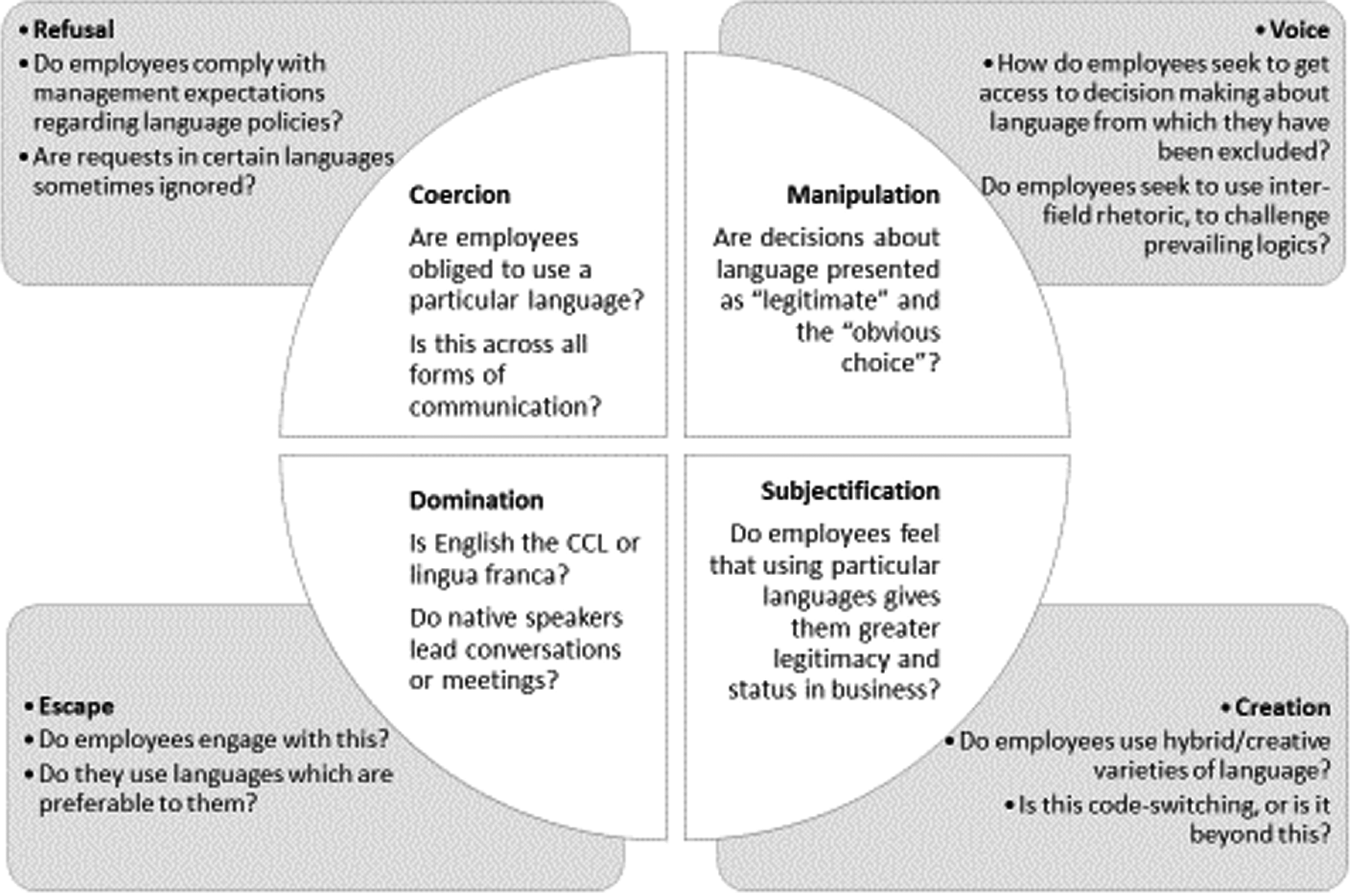
Manifestations of power and resistance in language management practices. Adapted from Fleming and Spicer (2007).
Coercion/refusal
The first face of power which Fleming and Spicer identify is that of coercion. This is an episodic, direction application of power which involves ‘getting another person to do something that he or she would have not otherwise done’ (Fleming and Spicer, 2007: 14). While in a monolingual situation, this may frequently be achieved through linguistic means, for example, Thomas et al. (2011) describe a situation in which senior management verbally dismisses suggestions from lower status employees and insists they follow the plan formulated by management. In multilingual situations, this is sometimes achieved in terms of obliging employees to speak in a language that they otherwise would not have used. In many organizations, this is done through the means of a common corporate language, which is a language that has official status at an organization and is used by both native speakers and non-native speakers alike. Thus, it should be regarded as conceptually distinct from a lingua franca, which is a means of communication between non-native speakers (Fredriksson et al., 2006; Poncini, 2003). The common corporate language is an aspect of language policy that has received a significant amount of attention in the international business literature (Janssens and Steyaert, 2014) and is frequently presented as a solution to managing linguistic diversity within an organization, on the basis that it increases efficiencies through a reduced need for translation and creates a sense of shared identity (Marschan-Piekkari et al., 1999). However, the literature suggests that coercing employees to use a certain language through the mechanism of a common corporate language is not unproblematic and such a use obscures the multilingual reality of many organizations (Fredriksson et al., 2006).
Furthermore, Méndez García and Pérez Cañado (2005) suggest that where common corporate languages are used, native speakers enjoy a privileged position when engaged in communicative acts, as they have higher competence in the language being used, which can lead them being viewed as more trustworthy and competent in other aspects of their role (Tenzer et al., 2014). In such a situation, resistance may occur through refusal, where employees choose not to participate in what is expected of them (Fleming and Spicer, 2007) and such acts of resistance are frequently documented in the international management literature. Marschan-Piekkari et al. (1997) suggest that where requests are made and employees do not have sufficient language skills to cope then they may simply do nothing and ignore the request – thus refusing to participate in the communicative act. However, as Piekkari et al. (2013) note, this is easier to do when you are not physically present in the same space as the person who is attempting to coerce you to use a particular language as it is much easier to ignore an email rather than someone who is in a meeting with you.
Fredriksson et al. (2006) thus note that the fact that senior management may designate a language as a common corporate language does not necessarily mean that it will be used in this way throughout the organization, as employees may resist and use a language of their own choice. While this act of refusal may be linked to a lack of competence in the language, it may also be as a result of an identity threat, where an individual’s linguistic identity feels threatened due to the imposition of a competing language (Bordia and Bordia, 2015).
Therefore, it can be seen that the unreflexive use of a common corporate language can be seen as an act of coercion. While it may be accepted by many employees (e.g. Swift and Wallace, 2011) to ignore how employees may react and resist such an act is to deny them agency, and thus, the idea of a common corporate language cannot be regarded as a panacea to the management of multilingual realities in international business, and therefore, other practices that organizations may use would benefit from increased empirical attention.
Manipulation/voice
The second type of episodic power identified by Fleming and Spicer (2007) is that of manipulation, where the powerful seek to limit which issues are available for discussion and those which are not, thus ensuring that those which are supportive to their world view are perpetuated. Thus through manipulation, power is not only exercised through action but through non-action, in order to perpetuate the status quo or ‘the way we do things around here’ (Deal and Kennedy, 1982: 4). Thus through individual acts (or none acts), manipulation can provide the current way of doing things with legitimacy which is ‘a generalized assumption that the actions of an entity are desirable, proper or appropriate, within some socially constructed system of norms, values, beliefs and definitions’ (Suchman, 1995: 574).
In terms of language policies in management, one way in which power is exerted through manipulation is demonstrated in the work of Vaara et al. (2005). Here, we see that management seeks to control the language that is used within the newly formed company following the merger of Swedish and Finnish banks, but rather than using an act of coercion, and dictating the choice of language, an appeal to logic and pragmatics was used and Swedish was presented as the natural choice, that happened ‘almost by accident’ (p. 607) as it is also an official language of Finland and taught in Finnish schools. Using this, discussion regarding the choice of language was effectively limited, as Swedish had already claimed legitimacy, and thus, the agenda had been manipulated, closing off other options that prevented Finnish managers from working effectively within the organization. This corresponds with Wodak’s (2012) concept of ‘power in discourse’, whereby struggle can occur over the choice of particular linguistic codes and the rules of interaction in specific settings, such as within an organization.
Fleming and Spicer (2007) suggest that manipulation is most frequently resisted through ‘voice’, whereby actors seek to gain access to the decision-making processes from which they have been excluded, and thus attempt to make their own views heard. In this way, the Finnish managers exerted their voice through the use of English, in which they were on equal footing with the Swedish managers (Vaara et al., 2005). While the concept of English being a politically neutral language (e.g. Louhiala-Salminen and Kankaanranta, 2012) is not unproblematic (Pennycook, 1994; Tietze, 2004) as will be discussed in the following sections, here we can see that the decisions that were made by individual Finnish managers regarding their choice of language were done in order to gain access to the ‘circuits of power’ from which they were excluded due to the presentation of Swedish as the most appropriate language of communication.
What is interesting regarding manipulation as an example of an episodic application of power is that it is very much linked with macro-level structures that have already gained legitimacy, as per Suchman (1995), and thus while in individual circumstances, the reification of these power structures can be achieved through acts of manipulation or coercion, their very existence points to the fact that power also exists at a systemic level, operating in a much wider arena than in struggles over language in specific organizations. It is to these systemic faces of power to which we now turn.
Domination/escape
Domination is where systems of power are made to appear both legitimate and inevitable, and therefore become hegemonic (Gramsci, 1971) and have the ability to shape our value systems and beliefs and as a result may cause individuals to act in a way that goes against their best interests (Fleming and Spicer, 2007).
Many scholars have pointed to the hegemonic position that English enjoys within the field of international business, among other domains (e.g. Crystal, 2003; Phillipson, 2009; Tietze and Dick, 2013; Venuti, 1993; Yamao and Sekiguchi, 2015), and thus, it has been awarded a privileged position in international business communications in both inter- and intra-firm relationships. Such a position has frequently led to the portrayal of English as a neutral solution for overcoming linguistic diversity in these relationships, as exemplified by the concept of Business English as a lingua franca (BELF). Under this approach (e.g. Louhiala-Salminen et al., 2004), English is not owned by native speakers but instead by the international business community who use it in order to communicate, and thus, it is unconcerned with ‘correct’ usages of grammar and spelling but instead is judged by the success of the communicative event in which it is employed. Thus, if two interlocutors are able to successfully communicate their message using BELF, then it is judged to have been correct. Such an approach is appealingly democratic, however its inclusive nature can be criticized for naivety, and the assumption that in such scenarios, native speakers do not still enjoy a privileged position due to their linguistic competence.
Furthermore, and more troublingly from a critical perspective, such an approach does not consider the relationship between the English language and capitalist, techno-rational assumptions about the nature of organizations and business.
As Tietze (2004) identifies, the English language is bound up with the production and dissemination of management knowledge, and thus as capitalist expansion is made possible through the medium of English, linguistic competence has become a commodity for managers to use in order to facilitate this process (Jack, 2004). Therefore, as per Holland (2002), in this article, I take a ‘phobe’ approach to the idea of English as a global lingua franca, as I consider it impossible to separate the language and its use from the colonial origins of the spread of the language, and the capitalist process through which this spread has continued to the dominance of the language that we see today.
Instances of English language use being dominant in international business abound. From its adoption as the corporate language of Rakuten – which is unusual for a Japanese organization as Japanese executives frequently have low levels of English competence (Peltokorpi, 2007) – where the adoption of English acts as a signifier of the organization’s global ambitions (Mikitani, 2013), to the use of English alongside German at Siemens (Fredriksson et al., 2006) to the obligatory use of English in Indian call centres (Boussebaa et al., 2014), English does indeed to be all conquering in the arena of common corporate languages and lingua francas.
In inter-organizational relationships, there is evidence to suggest that anglophone organizations rely on the dominance of the language in order to avoid acquiring any other form of linguistic competence in order to communicate internationally. Scholars and business lobby groups alike have long lamented the poor foreign language skills to be found in organizations across the anglophone world, particularly SMEs (e.g. CILT, 2005; Clarke, 2000; Crick, 1999; Economist, 2015; Enderwick and Akoorie, 1994; Rees and Rees, 1996).
Fleming and Spicer (2007) suggest that where domination is present in macro-level structures, as is the case with the status of the English language in international business, it is most frequently resisted through escape, where employees may attempt to disengage mentally from work (Cohen and Taylor, 1992). This may take the form of active disengagement where workers de-identify with the organization and its goals or may be evidenced by a form of weary cynicism and scepticism (Ezzamel et al., 2001).
Tietze and Dick (2013) demonstrate how management academics who are non-native speakers of English may disengage from the obligation to publish in English which is imposed on them by their business schools. However, they note the challenges which academics generally would face in doing so and note that the one who seems to disengage and escape from publication requirements is already established in their field and furthermore is close to retirement, and thus no longer feels it necessary to publish in order to advance their career prospects. However, as both these authors and Fleming and Spicer (2007) note, such cynical disengagement remains an individual act of resistance, as by disengaging, these individuals do not attempt to challenge or destabilize the norms of the systems that they operate. Tietze and Dick (2013) demonstrate that in the management academy, the domination of English is so strong, that for academics who wish to develop and progress in their career, it is almost impossible to resist through disengagement, and thus, a reluctant compliance frequently occurs – although it could be argued that by drawing attention to such an issue, resistance through voice is occurring, as ‘“talking about it” disrupts its influence by making it subject to debate’ (Tietze and Dick, 2013: 130), and thus, such interfield rhetoric (Harmon et al., 2015) can be used to challenge the dominant institutional view.
For employees in the anglophone world, escape from the domination of English may take a different form. While these employees are able to participate in the dominant discourse, and thus frequently do not perceive language barriers to be a particularly important factor in international communication (Harzing and Pudelko, 2014), this can lead to escape through disengagement if anything appears to challenge this status quo. Thus, in a notable case (DTI, 1996), when business premises were cleared after an organization in the United Kingdom had gone bankrupt, a fax was found in German which had been put in a drawer without having been actioned. Faced with this unfamiliar communication, the employees who had received it had clearly disengaged to the extent that they did not attempt to understand it; however, it was subsequently found that the order contained in the fax was large enough to have saved the company from bankruptcy. Thus, we can see that domination can have harmful effects even for those which it may initially appear to privilege.
Subjectification/creation
Subjectification is the final face of power identified by Fleming and Spicer (2007), and it can be defined as power producing ‘the kind of people that we feel we naturally are’ (p. 23). Thus, subjectification should be regarded as a step further than domination, a more insidious use of power, as what it does is not only create hegemony based on particular ideologies but instead considers how these ideologies are subjectively experienced, and thus individuals internalize particular belief systems to the extent that they shape and affect how we see ourselves as individuals. In other words, ‘domination may “naturalize” an extant social order, whereas subjectification normalizes a particular way of being in that social order’ (Fleming and Spicer, 2014: 245).
In terms of how policies regarding language use can lead to subjectification, we can turn once again to the privileged status of English in international business. While we have seen in the previous section that the English language can be considered hegemonic, this section explores how this can be internalized and subjectively experienced by both employees and managers who use English as a frequent part of their working life.
Boussebaa et al. (2014) explore the use of English in offshore call centres in India in order to communicate with Western, anglophone customers. In this pioneering work, they consider how the use of English reproduces and reifies colonial power relations between organizations located in the core, for example, English organizations, and periphery, in this case, those located in India. Thus, not only do they demonstrate the hegemonic position of English but they show how a certain variety of English was considered to be ‘pure’, which had greater legitimacy than local Indian varieties of English, and how employees in managerial positions policed language use, rejecting workers with a strong local accent during the recruitment process and forcing workers to undergo training in order to ‘neutralize’ their regional accents. Thus, these Indian managers could be seen to have ‘internalized the ideal of “pure” English as appropriate and legitimate’ (Boussebaa et al., 2014: 1160), despite the fact that linguists, for example Kachru (1992), have long argued that English is not a monolithic entity consisting of a single idealized form but instead exists as a constellation of many different world Englishes.
While such an act by managers could be seen as linked to the face that English is the dominant language of management education (Tietze, 2004), and thus Indian managers perceive that by speaking in what they consider to be correct forms of English, they are demonstrating themselves to be highly competent and part of a global managerial cadre. This is a view that has also been expressed in studies that look at the use of English as a common corporate language. Ehrenreich (2010) reports employees who felt that using English on a frequent basis at work made them feel more international and a part of the global business community, in a way that using other languages didn’t.
However, Boussebaa et al. (2014) also demonstrate how customers of the call centres, native English speakers located in the United Kingdom and the United States, considered their regional accents to be linguistically superior to the accents found in the call centre workers. They note that the most frequent complaint from customers was regarding the level of English of the call centre workers, often demanding to speak to an operator who was able to communicate in ‘proper’ English and therefore had greater ‘knowledge’ about the job. Thus, not only can be it seen that the anglophone customers had internalized values regarding the superiority of their accents but that in line with Tenzer et al. (2014), they then used their opinion of the operators’ linguistic competence in order to make judgements regarding their wider professional competence, even where this was unrelated to linguistic matters.
Fleming and Spicer (2007) suggest that one of the most frequent forms of resistance to subjectification is creation, where micro-level acts use ‘power to create something that was not intended by those in authority’ (p. 43). With regard to language, employees can engage in ‘translanguaging’ (Janssens and Steyaert, 2014) in which new language varieties are created and emerge as linguistic features from different languages are merged together in order to reflect the individual identities of the speakers. This goes beyond simply code-switching, but instead results in an act of creation where ‘languages are so deeply intertwined and fused into each other that the level of fluidity renders it difficult to determine any boundaries that may indicate that there are different languages involved’ (Makoni and Pennycook, 2012: 447).
Boussebaa et al. (2014) observed how operatives frequently resisted English by using Hindi and ‘producing hybrid linguistic forms’ (p. 1162), and even though by doing so, employees realized that they were putting their careers in jeopardy. In this way, employees engaged in individual acts of subversion, and thus sought to reassert their identities. Given the impact of language on identity construction (Clarke et al., 2009; Joseph, 2010), resistance in this way could be a powerful tool for employees to reject the constraints that organizations attempt to place on them through the language policies that were in place.
In the management literature, the notion of creation through hybridity or translanguaging is a relatively recent concept (Janssens and Steyaert, 2014) and so empirical examples are rare, thus necessitating further study. In addition to the work of Boussebaa et al. (2014), Logemann and Piekkari (2015) observe how subsidiary managers may exercise agency in translating headquarter texts for local dissemination and in doing so create hybrid texts. However, such practices have frequently been observed in the field of sociolinguistics, for example, Billings (2014), who observed how Tanzanian beauty queens use hybrid varieties of English and Swahili in order to construct their identities of modern, urban Tanzanian women, and Blommaert (2013), who observed how different ethnic communities in Antwerp use available linguistic resources in creative ways in order to establish and cement their presence within a neighbourhood.
Future directions for research on language and power
Having presented a theoretical framework drawing on language-sensitive management research and the field of organization studies, consideration is now given to potential future directions for research in this area using this framework, given the lack of explicitly power-sensitive research on language use (Logemann and Piekkari, 2015).
While the neutral conceptualization of power taken in this discussion means that not all expressions of power may be experienced negatively by employees, instead it is suggested that researchers should consider that there is potential for resistance when power is exerted and that this should be regarded as a legitimate expression of agency by employees. With this in mind, possible future avenues for empirical research in this area and questions that may be of interest to researchers can be found in Figure 1.
Given the lack of empirical work on subjectification and creation in an organizational context, this may be a particularly fruitful area for researchers, and thus, studies sensitized to the possibility of hybridity, rather than merely code-switching, would be a welcome addition to the field, as detailed in Figure 1. Given that translanguaging generally occurs where there is prolonged contact between individuals with different linguistic identities (Bordia and Bordia, 2015), it may be more prevalent in intra-organizational relationships, as observed by Boussebaa et al. (2014), rather than in inter-organizational relationships. In addition to this, given the close association of English with management knowledge (Tietze, 2004), in situations where English is one of the languages involved, there may be less opportunity for the playfulness in creative acts suggested by Janssens and Steyaert (2014) given that English words can be used to represent management practices in languages other than English where equivalent concepts do not exist (e.g. Holden and Michailova, 2014; Kuznetsov and Kuznetsova, 2014).
Furthermore, although Fleming and Spicer (2007) do not suggest that the four faces of power are always resisted through the same methods, it is suggested that the forms of resistance detailed are most frequently found with the corresponding face of power, as shown in Figure 1. It would be of interest for language-sensitive researchers to investigate whether this is the case when it comes to language policies or whether different forms of resistance are used against particular faces of power, for example, whether employees may seek to resist subjectification with refusal or coercion with escape.
Thus, having outlined how the framework of power and resistance suggested by Fleming and Spicer (2007) can be related to the use of language policies to manage linguistic diversity in inter- and intra-organizational relationships, consideration will now be given to how this complex area may be empirically examined.
Empirically researching language and power
As the relationship between language and power is one which has to date received comparatively little attention in the extant literature (Peltokorpi and Vaara, 2014), investigations of this topic would be best served by an inductive, qualitative study as this is an emergent area within the field of language-sensitive management research, which has itself now reached a certain level of maturity (Harzing and Pudelko, 2014). Although the field of international business has traditionally been dominated by quantitative work (Marschan-Piekkari and Welch, 2004), there is an increasing acceptance within the field that quantitative methods alone are unable to answer the questions that should be considered of legitimate interest (Buckley and Lessard, 2005), and therefore, qualitative methods can enable us to ‘open the black box’ of organizational processes (Doz, 2011). All of the questions raised in Figure 1 could be addressed using an emic approach in order to investigate how individual actors subjectively experience power, and the microprocesses of resistance which they use when engaging in struggle, and with a few exceptions (e.g. Cuypers et al., 2015; Reiche et al., 2015), qualitative approaches have been most frequently used in language-sensitive research in the international management literature, particularly when investigating emerging areas such as power.
One of the most frequently used research designs using qualitative methods within international business is that of the case study (Piekkari et al., 2009), which is particularly advantageous when building up a ‘thick description’ (Geertz, 1973) of a particular context, as it enables the research to incorporate multiple methods of data collection, such as interviews, observations and document analysis. Currently, many case studies do not engage in multiple methods of data collection, instead preferring to rely on one, such as interviews, which has led to Piekkari et al. (2009) to call for greater plurality in case study research, and when investigating the interplay between language and power, it would be helpful to use the multiple methods afforded by this approach in order to build up a detailed picture of lived experience, which is vital in understanding how power and resistance are subjectively experienced.
For example, semi-structured interviews are frequently used in inductive research (Cooper and Schindler, 2008), as they enable the exploration of themes which may not have been identified from the literature, as demonstrated by Neeley et al. (2012) who found that emotions related to language use were an emergent theme when conducting interviews. While this is therefore likely to be a useful method for understanding employee perceptions around which languages dominate in the organization, and the role that native speakers may play within this, semi-structured interviews do rest on espoused values, and when research is done in the critical tradition (Alvesson and Deetz, 2000), which research investigating this topic may well be, questioning interviewees about acts of resistance (particularly through refusal) could potentially expose employees as not participating fully in the requirements of their role, and they may thus be reluctant to disclose such information for fear of reprisal. Here, participant observation and documentary analysis may be useful for the critical researcher, as they facilitate a proximity to microprocesses which employees may not explicitly identify in interviews.
While participant observation in the form of ethnography is an established tradition in the management literature (Van Maanen, 2011), document analysis is rather less used (Mills and Helms Mills, 2011) despite the fact that written artefacts of language use can be a rich source of information when exploring how language is used in practice in organizations (e.g. Kankaanranta, 2006). Given the dearth of empirical evidence regarding linguistic creativity as a form of resistance within the domain of management, it would be interesting to explore whether workers engage in this using both oral and written forms, as written communication tends to be associated with a greater degree of formality (Crystal, 2010).
Conclusion
In this article, I have synthesized the nascent literature on language management within organizations with conceptualizations of power and resistance drawn from the organization studies literature, which to date has had little impact on language-sensitive research (Piekkari et al., 2014).
While interest in language-sensitive research within international management has grown significantly over the past 15 years, much of the empirical work in this area has taken a mechanistic approach to language (Janssens et al., 2004), and thus, the linkage between language and power dynamics in organizational relationships is yet to be sufficiently studied.
By demonstrating how a framework of power and resistance (Fleming and Spicer, 2007) can be linked to language usage within and between organizations, I suggest new directions for research within this area and discuss how this theme may be empirically investigated in order to better theorize the interplay between language and power.
The contribution of this article for cross-cultural management scholars is therefore to add to the growing body of literature which positions language as a subfield of cross-cultural management in its own right (Brannen et al., 2014) rather than viewing it as a subdivision of culture.
By drawing on organization studies in order to provide a more nuanced understanding of language management policies as manifestations of power, rather than mere functional mechanisms for managing linguistic diversity, I hope to stimulate future research in this area that can contribute to a critically interrogative space which examines the impact of such policies on employees as individual actors with their own agency and subjectivities, rather than on the organization as a whole.
Footnotes
Declaration of Conflicting Interests
The author(s) declared no potential conflicts of interest with respect to the research, authorship, and/or publication of this article.
Funding
The author(s) received no financial support for the research, authorship, and/or publication of this article.