



Abstract
This research is a multinational study of the effect of religiosity on salespeople’s attitudes about their jobs, even after controlling for cross-cultural differences and the particular management practices in their sales organizations. We theorize moderator effects between religiosity and the salespeople’s traits and attitudes, as well as interactive effects between organizational factors and the cultures in which the firms are embedded. We test the effects of these joint culture and religiosity influences on multiple facets of job satisfaction and find support for our hypotheses. We also demonstrate financial consequences for both individual salespeople and their sales organizations. We test these effects in a survey of salespeople working in 38 countries operating in diverse industries.
Many aspects of religion matter in people’s lives, sometimes as a desired part of how they go about living their lives, sometimes as a part of the milieu, and news and media that comprise contemporary life. Yet religion remains a somewhat understudied topic in business research. Academics and practitioners know that cross-cultural differences matter. This research will build on that and demonstrate that religiosity matters also. In particular, in this research, both culture and religion will be shown to affect different facets of job satisfaction, which in turn affect individual performance and firm profitability.
Our focus is on salespeople who serve as boundary spanners between the firms they represent and their customers. Selling products or services is the primary revenue-generating function of businesses; thus, the importance of salespeople cannot be overemphasized. In the US and European countries, salespeople represent about 10 percent of the countries’ workforce (Eurostat, 2010; U.S. Bureau of Labor Statistics, 2016). Consequently, the investment in building and maintaining sales forces is massive. For example, US organizations invest over US$800 billion annually in maintaining their sales forces (Chung and Narayandas, 2014; a figure that exceeds all but 15 countries’ gross domestic products). In addition, scholars have recently highlighted the ever-increasing complexity of selling and its embeddedness in the larger marketplace ecosystem (Hartmann et al., 2018). With so much at stake, processes of supervising, motivating, and compensating salespeople are of critical importance to organizations as well as to national economies.
The existence of multinational corporations and the wave of globalization have added extra layers of consideration in the design and implementation of sales force management strategies. The top 500 companies in North America employ almost 24 million salespeople across the globe (Chung and Narayandas, 2014). A natural question arises as to how to manage these international and cross-cultural complexities. Given the differences in cultural norms and in social and work-related expectations across countries, decisions about adapting sales force management practices to ensure satisfied and motivated salespeople, regardless of their locations, need to be well founded.
In addition, it is well known that high turnover is typical of the salesperson occupational group, being as high as 50 percent in many sectors (Landau and Werbel, 1995). The cost of losing a salesperson is not just the attendant loss of investment but also the opportunity cost of having an unstaffed territory especially when competition is fierce. As a result, employee job satisfaction, an issue at the nexus of sales force management and human resources, is of critical importance.
In this article, we will elaborate upon these arguments and observations: that religion matters even beyond culture, that sales forces are important to businesses and economies, that culture and religion matter particularly as companies oversee diversities inherent to global offices and management, and that turnover must be studied to further enhance profitability. To do so, we first conceptualize job satisfaction as multidimensional (a standard assumption, e.g. Taber and Alliger, 1995), with a particular focus on employees’ satisfaction with their coworkers, their direct-report supervisors, their customers and the accounts to which they have been assigned and for which they are responsible, and their perceptions of their promotion possibilities within the firm.
Second, given the global reach of many large sales organizations, we will be testing our model on a large data set of salespeople from 38 countries. The inherent cross-cultural context in which these salespeople work will be incorporated into the model. We do so by focusing on several important cultural dimensions, including individualism and collectivism, masculinity and femininity, uncertainty avoidance, and power distance.
Third, we also include the religiosity of the country within which the salespeople work to formulate another set of antecedents to job satisfaction. Religiosity is increasingly considered to be an important management contextual construct (Chan-Serafin, 2013; Hilary and Hui, 2009), with direct and indirect implications for attitudes and behaviors of citizens and employees. While religiosity has not yet achieved the widespread presence in business studies as the recognition of cross-cultural factors, religiosity is increasingly being incorporated into business models (Gundolf and Filser, 2013). We wish to understand whether its inclusion provides insights above and beyond those of multidimensional job satisfaction and the many elements of international and cross-cultural contextual dimensions.
Fourth, we will tie the sales functions to corporate valuation, as a means to begin to understand marketing’s return on investment and accountability (e.g. Ahearne et al., 2012; Rouzies and Hulland, 2014). Thus, while the emphasis of our model is on the numerous antecedents to the multiple facets of job satisfaction, we will also examine consequences for the firm. We will test whether job satisfaction impacts profitability, both at the individual salesperson performance level and at the aggregate level of the firms’ profitability.
We will test our model using a large-scale, international sample of salespeople and organizations. Our data represent salespeople from 38 countries, spread across Africa, Asia, Australia, Europe, the Middle East, and North America. For the very reasons that multinational research can be challenging, we believe our broad coverage of countries and cultures to be another strength of this research.
The remainder of this article is organized as follows: We begin by briefly justifying the importance of both culture and religion in the behaviors exhibited by salespeople and their organizations. We then develop and test the model. Given the model’s complexity, being inclusive of many constructs, we begin with the facets of job satisfaction, then we bring in the culture and religion variables, and we close with testing effects of individual and firm performance. The article concludes with a discussion of the results, limitations, and suggestions for future research.
The importance of culture
The link between job satisfaction and performance has attracted researchers’ attention in cross-cultural contexts (e.g. Chakrabarti et al., 2009; Ng et al., 2009). Several scholars have attributed satisfaction differences to culture; for example, positive relationships between collectivism and job satisfaction have been reported (e.g. Hui, 1996; Hui et al., 1995; Kirkman and Shapiro, 2001). Not only has culture been shown to be directly related to job satisfaction, but it has also been found to have a moderating effect on behavioral responses to job satisfaction; for example, cultural groups responded differently to low job satisfaction with exit, voice, loyalty, or neglect (Thomas and Au, 2002).
Indeed, Kirkman and Shapiro (2001) reported that, all other things being equal, satisfaction levels differ across borders, and drivers of satisfaction differ from country to country. Accordingly, such findings (e.g. Hui, 1996) have ushered in context-driven contingency frameworks in the study of employee satisfaction. Beyond satisfaction, recent cross-cultural selling research has shown the importance of aligning incentive systems to the salespersons’ cultural context (Hohenberg and Homburg, 2016) and suggests possible interventions to moderate those contexts, such as encouraging sales managers to have closer interactions with their salespeople in high power distance cultures to help overcome the natural perceive distance.
The importance of religion
In this article, we propose and test hypotheses that show that salespeople who work in more religious cultures behave differently from those who work in less religious cultures. Religion encompasses attitudes and behaviors by individuals with respect to what, in their opinion, transcends reality (Saroglou and Cohen, 2011). These attitudes and behaviors inform the individuals’ philosophy of life and hence the manner in which they interpret phenomena and engage with others. Ronen and Shenkar (2013: 871) argued that “religion may be part of culture, constitute culture, include and transcend culture, be influenced by culture, shape culture, or interact with culture in influencing cognitions and emotions; however, religion does not equal culture, and culture does not necessarily include religion.” The foregoing suggests that religion and culture are distinct, but related constructs (Ronen and Shenkar, 2013; Saroglou and Cohen, 2011). In this article, we investigate religion and culture as complementary drivers of various aspects of job satisfaction and related outcome measures. We define our measures in detail shortly, but for the moment, take religiosity to be an index per country reflecting the proportion of the country’s inhabitants who report their beliefs in religious constructs such as God, heaven, hell, and sin (Jacob and Osang, 2010, from the World Value Survey).
Religion has long been part of the economic discourse. For example, Weber (1905) suggested that the Protestant ethic was one of the major drivers of capitalism-based economic development. More recently, religion has been associated with social decisions at a microeconomic level (Iannaccone, 1998) and economic growth at a macroeconomic level. For example, Barro and McCleary (2003) found a negative correlation between macroeconomic development and church attendance across countries but a positive relationship with beliefs in heaven and hell. Countries with moderate religious values and behavior were also found to exhibit higher income levels than countries on either end of the religious spectrum (Jacob and Osang, 2010), suggesting a relationship between religion and income level, a proxy often used for economic development. Although the link between religion and economic development is generally acknowledged, there is paucity of empirical research on this predicted relationship (Jacob and Osang, 2010).
Some previous research has examined the relationship between religiosity and various managers’ characteristics, for example, suggesting a positive relationship between individual religiosity and risk aversion (Hilary and Hui, 2009; Miller and Hoffmann, 1995). At an aggregate level, this link has been found to impact organizational behavior; in particular, Hilary and Hui (2009) found that firms located in counties (in the United States) with higher levels of religiosity exhibited lesser risk exposure, growth, and investment rate but commanded more positive market reaction when they announced new investments. As Hilary and Hui (2009: 455) state, “firms do not make decisions, people do and what they do outside work is likely to affect the ways they make these decisions inside work.”
In this article, we examine how culture and religion interact with organizational and salesperson variables to shape different aspects of job satisfaction and hence individual and firm performance. Our model permits us to (1) gain insights about a relatively neglected area of behavior, to help address questions about beliefs, norms, and values; (2) investigate how religion influences economic attitudes and behaviors of an important group of employees, namely salespeople; and (3) show the effects of religiosity even after controlling for the importance of cross-cultural contexts.
The cross-cultural and religiosity model
Job satisfaction has long attracted the attention of management scholars largely because of the role it plays in shaping several personal–organizational outcomes such as absenteeism (e.g. Hackett and Guion, 1985), staff turnover (e.g. Carsten and Spector, 1987), and organizational citizenship behavior (e.g. Organ and Konovsky, 1989), all of which have direct consequences on employees’ productivity (Miller and Monge, 1986) and, ultimately, firm profitability. To enhance an understanding of overall job satisfaction, scholars have explored its various facets, including internally and externally focused job satisfaction. In particular, research on job satisfaction components has addressed facets related to salespeople’s internal stakeholders such as supervisors and colleagues and those associated with external parties such as joint venture partners or customers with whom salespeople must interact on a regular basis and on whose actions their own commissions depend (e.g. Diestel et al., 2014). Yet despite valuable insights generated by this approach, the internal and external foci of job satisfaction are rarely modeled in the same framework; thus, we aim to do so in our model.
Figure 1 represents the base of our model, in which each of four facets of job satisfaction is predicted to contribute to a salesperson’s overall job satisfaction. These facets include satisfaction with one’s colleagues, satisfaction with one’s customers, satisfaction with one’s direct supervisor, and satisfaction with the potential for promotion. We will explain the precursors to those facets next.

Cross-cultural and organizational moderators and salesperson trait and religiosity moderators of multiple aspects of overall job satisfaction.
The first hypothesis (rightmost in the figure) is an empirical benchmark, the relationships already having been established in the literature (e.g. Churchill et al., 1974), and we do not make claims that this is our main research contribution. Specifically, each of the facets should contribute to an overall assessment of job satisfaction.
Coworkers will be positively related to their overall job satisfaction. Their customers will be positively related to their overall job satisfaction. Their direct-report supervisor will be positively related to their overall job satisfaction. Their potential to be promoted will be positively related to their overall job satisfaction.
In turn, each contributing facet of job satisfaction is proposed to be a function of religiosity antecedents in conjunction with salespeople’s traits and attitudes, as well as the cross-cultural dimensions of individuality, masculinity, power distance, and uncertainty avoidance working jointly with organizational structural properties. The hypotheses follow.
Salesperson satisfaction with coworkers
Monitoring is an organizational function used to ensure that employees’ behaviors and choices conform to organizational values, as well as to obtain information that could inform appraisal, coaching, and intervention needed for employee development, such as to decrease workers’ shirking (Jones, 1984), and it has been shown to influence employee job satisfaction and turnover (Chalykoff and Kochan, 1989). Cooperation with coworkers is considered a prosocial corporate behavior, it is enhanced, as is job satisfaction, by the clear administration of rules in monitoring employees’ behaviors (Bettencourt and Brown, 1997), and it can be particularly important when working in teams (Chen and Lim, 2017). We hypothesize that the acceptance of monitoring varies across countries, specifically in that employees in individualistic cultures are more likely to resent the presence of monitoring, instead of wishing to achieve their sales goals without the continual observation and questioning embodied in a monitoring system, perhaps even bending slightly or working around rules that are thought to be arbitrary and blocking their own individual achievement (Marx and Sherizen, 1987). By comparison, employees who work in more collectivistic cultures are more used to explicit and implicit monitoring and comparisons with others. Salespeople working in individualistic countries with highly salient monitoring may well attribute the need for monitoring to their coworkers (one is unlikely to attribute the need for monitoring to one’s own behaviors), whereas employees working in collectivistic countries will be happier with their coworkers, being assured that they must all abide by the same rules. Thus,
Coworkers can be the source of frustrations and obstacles, and different employees respond differently to such challenges. Some employees have a stronger tendency to confront situations, for example, to find solutions or “clear the air” rather than remain passive (Spilka et al., 1985). They seek to initiate change and proactively influence their environment (Sun and van Emmerik, 2015), and this self-assertion often results in downstream effects of stress reduction (Alsomali et al., 2016) as well as enhanced productivity (Hung et al., 2015) and constructive feedback and promotion (Dimotakis et al., 2017). Religious tenets often encourage consideration and love for one’s fellow men and women (Lim and MacGregor, 2012), including presumably coworkers. Religion can encourage people to take action to try to correct problems in their lives (Holland, 1976; Pargament, 1997; Pargament et al., 1988; Tom, 1971). Thus, together, employees inclined to confront others may do so in a kinder, gentler manner, engaging with others in attempts to find solutions and navigate challenging situations. Those communications may help resolve issues and reduce the likelihood of escalating conflictual feelings. Religious beliefs have been shown to provide the courage to confront situations and cope with stressors (McIntosh, 1995; Park, 2005; Reutter and Bigatti, 2014). A religious or spiritual orientation creates a motivation for kindness in confronting fears and challenges for oneself (Barrett, 2003) or when confronting others, such as coworkers (Kurth, 2003). Hence, a religious disposition coupled with a personal propensity to confront challenges should engender greater satisfaction with one’s coworkers, with a positive orientation and a goal to communicate and work through any interpersonal challenges. Thus,
Satisfaction with customers
For many sales jobs, a salesperson actually spends more time with, and more time trying to please, his or her customers, relatively to other kinds of jobs in which satisfaction with one’s boss or coworkers might loom larger. With respect to addressing the needs of external stakeholders like customers, salespeople in masculine cultures value the empowerment to target specific stakeholders and craft suitable solutions while simultaneously engendering perceptions of independence. Countries with higher masculinity profiles have a greater achievement orientation (Laitinen and Suvas, 2016); thus, the notion of taking advantage of opportunities and being creative in problem-solving and taking the initiative to please customers are welcomed in masculine cultures (Jeanine et al., 2014). Accordingly, salespeople in more masculine cultures who work in organizations with centralized decision-making will find it more difficult and frustrating to operate in an independent manner they would prefer in trying to serve and satisfy external stakeholders’ needs (Magnusson et al., 2014). Coupling masculine cultures with centralized organizations would simply increase the level of conflict and dissatisfaction, for the salespeople as well as for levels of their customers’ complaints. By comparison, decentralized organizational structures are established precisely to empower locally optimal behavior and service to customers, which would be appreciated particularly in masculine cultures. Thus,
Religiosity should also affect a salesperson’s satisfaction with customers, particularly those salespersons with a “transformer” personality (cf. Herrmann and Felfe, 2014). Specifically religiosity itself is centrally about profound transformation, changes in people’s attitudes and behaviors (Paloutzian et al., 1999), and it can foster a sense of responsibility to transform oneself as well as the world around (Hill et al., 2000; Weber, 1905). This orientation seems consistent for transformer people, who are naturally prone to see the silver lining in a situation and seek ways of converting problems into opportunities, such as a service recovery scenario or situation that requires going the extra mile to enhance customer value and appreciation. Transformational relationships can help employees find meaning in their work (Frieder et al., 2018) and manifesting these feelings into bringing about prosocial change to benefit others (Lebel and Patil, 2018). Transformative actions help enhance salespeople’s job satisfaction (Aydogmus et al., 2018), and such positive actions toward enhancing customer satisfaction have also been repeatedly shown to reduce turnover (e.g. Sunder et al., 2017), in a somewhat self-reinforcing cycle. A spiritual personal orientation also helps an employee finding meaning at work (Karakas, 2010), and an ability to engage in helping to institute change and contributing to a learning environment to help others makes changes as well (Howard, 2002). These tendencies and orientation would be enhanced in more religious cultures, given that the goals are consistent with religiosity predisposing people to proactively seek solutions when facing challenges. Thus, it is expected that salespeople with greater transforming tendencies in environments with high levels of religiosity will express greater satisfaction with their customers.
Satisfaction with supervisors
A Gallup poll of more than a million US-based employees showed that the number one reason people quit their jobs is a bad boss or immediate supervisor, suggesting therefore that “people leave managers, not companies” (Lipman, 2015). Satisfaction with one’s supervisor is therefore a critical factor in employee retention. The relationship between a supervisor and a subordinate is sensitive to the relative emphasis placed on hierarchy in the organization (Kulkarni and Ramamoorthy, 2011). It is thus expected that power distance will shape the outcome of leader–member exchange. In a recent Harvard Business Review article, Meyer (2017) classified countries using two cultural dimensions, one of which was power distance, being the extent to which attitudes toward authority were hierarchical (high power distance) or more egalitarian (low power distance). For example, subordinates in high power distance countries generally show deference to constituted authority. Compared with their counterparts in low power distance nations, employees will take less initiative and expect regular guidance and instruction. Research consistently shows the impact of autonomy on job satisfaction and performance as well as reducing stress and absenteeism (Spector, 1986; Thompson and Prottas, 2006). Employees who work in low power distance cultures already behave as if they operate with some workplace autonomy, whereas employees who work in high power distance, hierarchical settings, are likely to appreciate the autonomy all the more. At first, they may be surprised when accorded autonomy, and indeed, it might take time to adjust to working under such freer conditions, but initial fears should eventually subside, giving way to self-discovery and mastery through the repeated exercise of responsibility and learning. The knowledge and abilities gained increase their self-confidence and readiness to take on bigger roles. Thus, over time, granting autonomy to subordinates in high power distance countries will lead to more satisfaction with their supervisors. Thus, we predict:
Employees who are sufficiently satisfied with their jobs and companies, such that they feel loyalty, attachment, and general affective commitment, are also more likely to be satisfied with their supervisors (Schmitz et al., 2014), and this sense of loyalty and commitment is encouraged by many religions. In general, religious adherents, owing to the importance of fidelity to tenets contained in their religion, tend to reflect strong loyalty in secular relationships (Ali et al., 2005; Swimberghe et al., 2011). This commitment is consistent with studies that show that the principles imbibed by religious followers influence their behaviors and attitudes in the workplace (e.g. Ali et al., 2005; Hungerman, 2014). The organization in which a person works is one of many platforms to practice teachings received from one’s religious leaders. Therefore, it is expected that organizational commitment will be bolstered by increasing levels of religiosity (Neubert and Halbesleben, 2015). Accordingly, coupled with the premise that organizational commitment is a reflection of commitment to supervisors (Miao et al., 2013), we hypothesize as follows:
Satisfaction with promotion possibilities
The environment in which companies operate is fraught with uncertainties. For example, salespeople on commission compared with those on fixed salary face more uncertainties and bear more risk. The very heterogeneity in salespeople’s pay leads to perceptions of greater uncertainty (Daljord et al., 2016). These uncertainties are particularly distressing for people who live in cultures with high uncertainty avoidance. Either on their own or assisted by their employers, employees devise various coping strategies in their quest to achieve individual goals or quota. One of the ways by which firms assist their employees is coaching and mentorship (Kim et al., 2013). Coaching helps employees by encouraging and modeling likely successful work behaviors that will help them get ahead (Theeboom et al., 2014). Through coaching, organizations alert staff on the nature of uncertainties expected on the job, knowledge about alternative antidotes, available resources, and how to access same. All other things being equal, the amount of coaching and training provided to employees should improve their success rate in spite of the challenges posed by environmental uncertainties and their perceptions of their likely potential for promotion within the organization (Kim et al., 2013). The greater the context of uncertainty avoidance, the more positive should be the effect of coaching or other organizational activities that help support the employee and counteract and reduce the uncertainties. Given that opportunities for promotion or career advancement are often conditioned on success in delivering expected performance goals, there will likely be less satisfaction with promotion possibilities reported by employees in high uncertainty avoidance culture, unless they are supported by compensatory coaching resources. Thus,
In addition to countries and cultures differing in their desires to avoid uncertainty, individuals also vary in their tolerance of the unknown, and inferences about possible inequity can be interpreted as unfair (Guo, 2015). At this trait level, we theorize that religiosity might help. Faith and hope, together with charity, are fundamental to the world’s largest religions. While some people might naturally have a low tolerance for ambiguity, this disposition should be mitigated or obliterated as they become more fervent in their religious beliefs (Lechner et al., 2015). Looking toward one’s future, such as one’s anticipated position and role in the organization may inherently be uncertain, but given a belief system that encourages faith and hope, then ambiguity should become less of an issue (Deaton and Stone, 2013; Lim and Putnam, 2010; Reutter and Bigatti, 2014). Salespeople are likely to be most positive about their future prospects in the organization when they operate with some trait level of tolerance for ambiguity in a society with higher levels of religiosity. Thus, we hypothesize:
Next, we describe the variables measured, and we test the hypotheses in the context of the sales departments of large, multinational organizations.
Samples
We test our model on an international and multiindustry sample of salespeople. We collected the data via a survey of salespeople working in 51 companies based in 38 countries spread across Africa, Asia, Europe, the Middle East, and North America. The 51 large companies operate in various industries (such as chemicals, food, health care, information systems and technology, light and heavy engineering, pharmaceuticals, plastics, and services), and our models will include these industry covariates. High-level sales executives who attended seminars on sales force management at two international business schools provided access to their organizations and employees.
We presented the purpose of the study to senior management of each company and offered a postsurvey summary report as an incentive for their participation. Each organization provided contact details for all its salespeople. Before we mailed the questionnaire, a senior member of management informed all salespeople of the forthcoming survey via an internal memo. The original questionnaire was developed in English. Via two-way back translations, we obtained six alternative versions of the questionnaire (in French, German, Hungarian, Italian, Spanish, and Turkish) to cater to those respondents who preferred not to respond (or were unable to respond) in English. Every communication, including the in-company memo, was carried out in respondents’ native languages as much as possible.
First- and second-wave mailings yielded 2,742 completed and usable questionnaires (33 percent female, 67 percent male) in seven languages (English: 68 percent, French: 5 percent, German: 1 percent, Hungarian: 4 percent, Italian: 5 percent, Spanish: 15 percent, and Turkish: 2 percent). The overall response rate was strong, 75 percent. Analysis of nonresponse bias by means of an extrapolation approach (Armstrong and Overton, 1977) revealed no significant differences between early and late respondents. On average, respondents were 35 years old, had 12 years of schooling after the age of 10, and had an average work experience in sales of 9 years.
Measures
All scale items and reliability coefficients are included in the Appendix 1. Job satisfaction and its facets, namely satisfaction with coworkers, customers, supervisor, and promotion possibilities, were measured with seven-point Likert-type scale items borrowed from Churchill et al. (1974). The scales developed by Churchill et al. (1974) were originally applied in a sales force setting and have been widely used in the study of salespeople. (The scale originally had seven facets, of which we use four; researchers have frequently selected from the facets that best fit their particular research context, e.g. Kerber and Campbell, 1987; Ruekert and Churchill, 1984; Smith, 1982.)
The cross-cultural profiles on dimensions of individualism, masculinity, power distance, and uncertainty avoidance were obtained for all countries represented in our data from the Hofstede Insights (2018). We certainly acknowledge and respect the existence of strong alternative frameworks, such as GLOBE (House et al., 2001; Javidan et al., 2006), but we chose to work with Hofstede’s country scores (1980, 1991), given that they are the most widely used in empirical research, which facilitates theoretical comparisons across the literature (Jeanine et al., 2014; Kirkman et al., 2006; Tang and Koveos, 2008; van der Lans et al., 2016).
There are several options from which to obtain an index of country religiosity. For example, the Central Intelligence Agency World Factbook (CIA World Factbook, 2018) offers a fairly comprehensive listing of numerous countries, and they provide percentages of the countries’ adherents to several mainstream religions. However, we sought to obtain data that reflected a more personal experience of religion, rather than an index of categorical membership or a country’s pluralism, for example. Thus, we drew from Jacob and Osang (2010: 7), who in turn drew from the World Values Survey (Center for Political Studies, University of Michigan’s Institute for Social Research), from which we used their belief measures in “people’s faith in core religious concepts, such as God, Heaven, Hell, and Sin.” In these data, the beliefs were aggregated across the concepts to obtain an overall percentage as an index for each country reflecting the proportion of the country’s inhabitants who report their belief in the religious constructs. This belief index is our operationalization of the religiosity construct.
The secondary data on cultural and religiosity indices per country were merged with the original survey data, through which we had measured the facets of overall job satisfaction and other constructs we describe shortly. We believe that this combination of primary and secondary data helps to minimize any potential common method bias in our research. To that same end, we will further supplement the data set with the salespeople’s compensation, information obtained directly from their companies, and firm profitability from public reports.
The survey also measured several other constructs that we theorize to be important in understanding a salesperson’s attitudes and motivations in the workplace. These new measures include characterizations of the salesperson’s organization that we will use in interaction terms with culture, as well as salesperson traits and attitudes that we will use in interaction terms with religiosity beliefs. We describe those additional measures next.
Survey questions reflecting salespersons’ perceptions of their organizations (which will interact with culture dimensions) included monitoring (involved in hypothesis 2), centralization (hypothesis 4), autonomy (hypothesis 6), and coaching (hypothesis 8). Monitoring is simply the extent to which management stays informed of and exercise control over salespeople’s activities. We measured the salespersons’ perceptions of their organization’s level of monitoring using a seven-point Likert-type scale of Oliver and Anderson (1994) and Evans et al. (2007). Centralization of decision-making was operationalized as the degree to which salespeople participate in decisions that define their work goals and processes. It was measured with a seven-point Likert-type scale using items from Hage and Aiken (1967). Autonomy and coaching were measured with scales from Oliver and Anderson (1994).
Survey questions reflecting salespersons’ attitudes, motivations, traits, and behaviors (which will interact with religiosity) included the extent to which the salesperson tends to confront situations (involved in hypothesis 3), seek transformations of situations (hypothesis 5), feel contentment and positive affect and commitment to their jobs (hypothesis 7), and is tolerant to ambiguity (hypothesis 9). Specifically, the tendency to confront situations head-on (confronter) and the tendency to transform situations into opportunities (transformer) are facets of proactive dispositions (Bateman and Crant, 1993; Crant, 1995). These dispositions inspire a determination to influence the environment rather than be influenced by it (Bateman and Crant, 1993; Crant, 1995). These constructs were measured with items borrowed from Bateman and Crant (1993), which have been validated in use on salespeople, in the context of real estate agents Crant (1995). Affective commitment to the organization was measured with seven items from Porter et al. (1974) and Tsui et al. (1997). These measures of organizational commitment have been shown to generalize to non-American as well as non-Western cultures (Ko et al., 1997; Lee et al., 2001; Meyer et al., 2002). Tolerance for ambiguity, or a need for clarity, was measured with a seven-point Likert-type scale from Lyons (1971).
Finally, we also included a number of covariates in the analyses: salesperson professional maturity, a combined index of age, selling experience, and organizational tenure (Onyemah and Anderson, 2009), gender, the size of the organization’s sales force, the geographic scope of the company’s activities (local vs. international), and the economic sector. All of these served as statistical controls. The definitions and data sources of our key constructs are provided in Table 1. Descriptive statistics are presented in Table 2.
Key construct definitions and operationalizations.

Descriptive statistics.

Results
Table 3 contains the results of a regression analysis for overall job satisfaction. The results clearly indicate that each facet helps explain the overall construct. As predicted, the dimensions of job satisfaction—satisfaction with coworkers, customers, supervisors, and promotion possibilities—were significant in contributing to perceptions of overall satisfaction.
Facets of overall salesperson job satisfaction.

Note: **p < 0.01; ***p < 0.001.
It is perhaps sensible that the effect of satisfaction with one’s supervisor is the strongest, given the immediacy and proximal interactions between employees and their direct-report supervisors. It is also perhaps sensible that the effect of satisfaction with one’s coworkers is relatively weaker, at least for these employees in a sales role, given the relative autonomy with which they work, and for whom interactions with customers are more frequent.
Given that each dimension of job satisfaction is important, the next step in our analyses is to understand the drivers of each facet. If job satisfaction is important in affecting salesperson and firm performance (as we shall show), then it is important to understand how each facet may be enhanced. Thus, in Table 4, we bring in cross-cultural predictors and religiosity, to verify the effect of the former and to test whether religiosity has an effect even after including cross-cultural factors. Furthermore, we bring in each class of predictor—culture and religion—through moderated relationships. We recognize that our culture and religious data are measured at the country level, but we wanted those effects to be able to yield some variations within country. Accordingly, we created two interaction terms—one interaction involves a cultural dimension moderated by an organizational characteristic so the effect could reflect better a salesperson’s work environment and the other interaction involves religiosity moderated by a specific salesperson trait to reflect better a salesperson’s orientation to his or her work environment. Organization structural elements and salesperson traits are both known to affect salespeople’s attitudes and performance (Miao and Evans, 2012). The main effects of culture and religion will naturally also be included in the model, but the focus will be on whether a cultural dimension moderated by an organizational climate factor impacts an element of a salesperson’s job satisfaction and whether religiosity moderated by a salesperson trait impacts an element of the salesperson’s job satisfaction.
Salesperson trait and religiosity antecedents and cross-cultural and organizational antecedents on facets of job satisfaction.

Note: †p < 0.10; *p < 0.05; **p < 0.01; ***p < 0.001.
Table 4 shows the effects of culture and religion on the facets of job satisfaction. The main effect of the terms tested in the interactions is also included as statistical controls, but our theorizing and predictions focus on the interaction terms. (Variables were mean-centered before product terms were calculated to serve as interactions.) Given that the cultural variables and religiosity were measured at the country level, we also tested our hypotheses using hierarchical linear models (HLMs). Results were consistent across the models, in positive or negative signs, in the significance levels of the effects, and nearly in magnitude. For example, for the religiosity interaction in hypothesis 3, the regression coefficient in Table 4 is 0.316 (p < 0.05), and in HLM, it was 0.301 (p < 0.05). Similarly, for religiosity in hypothesis 7, Table 4 shows 0.370 (p < 0.01) and the HLM estimate was 0.409 (p < .01), and for religiosity in hypothesis 9, Table 4 shows 0.233 (p < 0.1) and the HLM estimate was 0.317 (p < 0.1). Generally speaking, sometimes, an HLM model can clarify a set of results; here the HLM model merely replicated the regression results. We suspect an HLM approach was less necessary or helpful because we had strived to create interactions between country profiles and variables of organizational characteristics, the latter of which are no longer at the country level, or religiosity with employee traits, again, the latter of which are not at the macro level. Hence, the HLMs were not as essential so we display ordinary least squares results in Table 4.
The results for satisfaction with one’s coworkers indicate that the interaction between individualism and monitoring was negative and significant, as predicted in hypothesis 2. Specifically, for more individualistic cultures, monitoring led to a decrease in salespeople’s satisfaction with coworkers. The interaction between religiosity and an individual’s predilection for confronting situations to improve them was positive and significant, as per hypothesis 3.
Satisfaction with one’s customers decreased significantly when masculine cultures were coupled with organizations with centralized decision-making, supporting hypothesis 4. The interaction between religiosity and having a transformative orientation to problems and solutions was also significant, supporting hypothesis 5. Specifically, in more religious cultures, a philosophy toward transforming situations enhances satisfaction with customers.
The interaction between power distance and autonomy had a significant and positive effect on salespeople’s satisfaction with their supervisors, as predicted in hypothesis 6. The interaction between religiosity and the salespersons’ affective commitment to their jobs and organization was also significant, supporting hypothesis 7. Specifically, for cultures with greater religiosity, employees’ affective commitment to their jobs and organizations further enhances their satisfaction with their supervisors.
Finally in Table 4, satisfaction with one’s potential for promotion was predicted by the significant interaction between the cultural orientations to avoid uncertainty in conjunction with coaching, supporting hypothesis 8. The interaction between religiosity and an individual’s ability to tolerate ambiguity was significant, supporting hypothesis 9. Greater religiosity, coupled with an ability to tolerate ambiguity, contributes to more satisfaction with one’s prospects for promotion.
We believe these results are useful and timely contributions to the literature. The cultural differences are substantiated and obviously important, yet above and beyond their effects, religiosity matters in a salesperson’s social construction of his or her workplace. Furthermore, our model tested interactive effects so that variance was analyzed even with companies sharing a common country and therefore a common cultural profile. Having established a strong array of antecedents, in the next and final model, we examine consequences of salesperson satisfaction, namely financial performance of both the salespeople and their companies.
Modeling salesperson and corporate performance
Thus far, the results have established that a salesperson’s job satisfaction is multifaceted, and those elements of job satisfaction have cultural and organizational antecedents as well as religious and trait antecedents. In this final analysis, we consider several consequences of salespeople’s job satisfaction, both for the salespeople themselves and for their firms.
Salesperson job satisfaction, incentive compensation, and company profits
The extant literature would suggest a positive relationship between job satisfaction and employee performance (Petty et al., 1984), so we would expect a relationship between a salesperson’s job satisfaction and take-home pay, which of course reflects commissions and bonuses in addition to base salaries (cf. Segalla et al., 2006; Viswanathan et al., 2018). We acknowledge the debate as to the direction of causality involving these two variables, even affecting the association between recent performance achievements and subsequent goals and performance (Patil and Syam, 2018), so while we will model job satisfaction impacting compensation, we recognize the likely feedback dynamics and we will also consider and fit alternative models.
In addition to the effect at the salesperson level that satisfaction enhances salespeople’s compensation, we hypothesize that this effect will hold also at organizational level. If it is the case that salespeople who are more satisfied are more likely to work harder and earn higher compensation, then the relationship should hold at the firm level as well. That is, if individual salespeople are earning more, the firm should be experiencing revenue growth. Firms continually struggle with designing motivating compensation plans to effectively reflect these relationships (Steenburgh and Ahearne, 2012). Thus, given that the ability of firms to achieve their performance goals is influenced by individual salespeople meeting or surpassing their targets, we posit that a positive relationship also exists between salespeople’s performance and firm performance:
New measures
To fit this model, we combined the previous data with two additional sources (and once again, we note that the combination of primary and secondary data helps minimize concerns about common method bias). First, we obtained actual pay data from the participating firms’ archives reflecting salesperson’s performance-based incentive compensation (i.e. the proportion of total compensation represented by variable pay for each salesperson). In addition, we obtained performance evaluations of the salespeople as judged and documented by their direct-report supervisors. With respect to these pay and performance data, to ensure an accurate matching of the companies’ pay data with our survey data, each questionnaire was unobtrusively coded. The codes were subsequently destroyed to protect the privacy of respondents. While job satisfaction surveys are not uncommon, actual performance-based pay values are less frequently represented in the literature.
Even more infrequent is an attempt to tie these measures to company-level financials. We sought to model company financial performance, so we derived from publicly available information (specifically, from Yahoo Finance company reports) financial information for each of the companies in our sample. These financial parameters included gross profit, earnings before interest and tax, and net profits. (These financial figures focus on gross profits because we had no objective means of controlling for varying costs.) We also obtained earlier gross profit data as statistical controls and to see whether there were immediate and longer term effects of the salesperson satisfaction factors on these financial performance indicators.
Results
Table 5 shows that the salespersons’ job satisfaction helps predict their ratio of variable to total compensation. For this model, employee satisfaction was operationalized as the average of the job satisfaction facets, and the salesperson’s performance-based incentive compensation model also included several covariates: number of active accounts, relative weight of inputs and outputs during evaluations, job experience and tenure, gender, size of company, and international and industry dummy variables. The result is positive and at least borderline significant, tentatively supporting hypothesis 10. Salespersons’ job satisfaction contributes significantly to compensation, even when controlling for their supervisors’ assessments of the salespeople’s performance.
Financial consequences of salesperson satisfaction.

Note: *p < 0.10; ***p < 0.001.
The results also indicate that companies enjoy greater profitability when their salespeople are more successful. Individuals’ take-home pays contributed significantly to the companies’ bottom lines, not surprisingly, given that greater sales drive both profitability measures. These results support hypothesis 11, and the results are significant even when controlling for the companies’ previous profitability.
We modeled the financial data in several ways: Let us call the year of the salesperson survey year t, we took gross profit of the firm at year t − 5 as a control for modeling gross profit at year t as a look backward, and we took gross profit of the firm at year t to predict gross profits of the firm at years t + 5 and t + 10 as forward forecasts. We report on the t + 5 findings, wanting to have more of forward view (will salespersons’ behavior affect future firm performance) and the 5-year window figuring that a 10-year window simply allows more extraneous variables’ disruptive entry. Even so, the t − 5 and t + 10 models appear very much like the t + 5 results reported in Table 5 (both effects being significant, with the hypothesis 10 effect being smaller than the hypothesis 11 effect).
While our model fit salesperson satisfaction and performance evaluations as predictors of salesperson performance-based incentive compensation, we acknowledge that other researchers may wish to conceptualize the causal direction differently. Our model resulted in a stronger fit than the alternatives we considered, R 2 = 0.341. We fit two competing models in which the directionality is changed, and each resulted in less optimal fits: (i) when using compensation and performance evaluations to predict job satisfaction, R 2 = 0.257, and (ii) when using compensation and job satisfaction to predict performance evaluations, R 2 = 0.110.
We also tested a model combining the effects in Table 5. Specifically, Figure 2 resembles a mediated model, with direct effects of salespeople’s satisfaction on compensation and compensation on company profitability. Testing those paths, and a potential direct link from job satisfaction to company profitability, all while factoring out the remaining variables as covariates, yielded a z-test for the estimate of the indirect path from job satisfaction → salesperson compensation → company profitability that was significant, z = 51.42, p < 0.0001 (Baron and Kenny, 1986; Iacobucci, 2008). A summary of the model results is provided in Table 6.
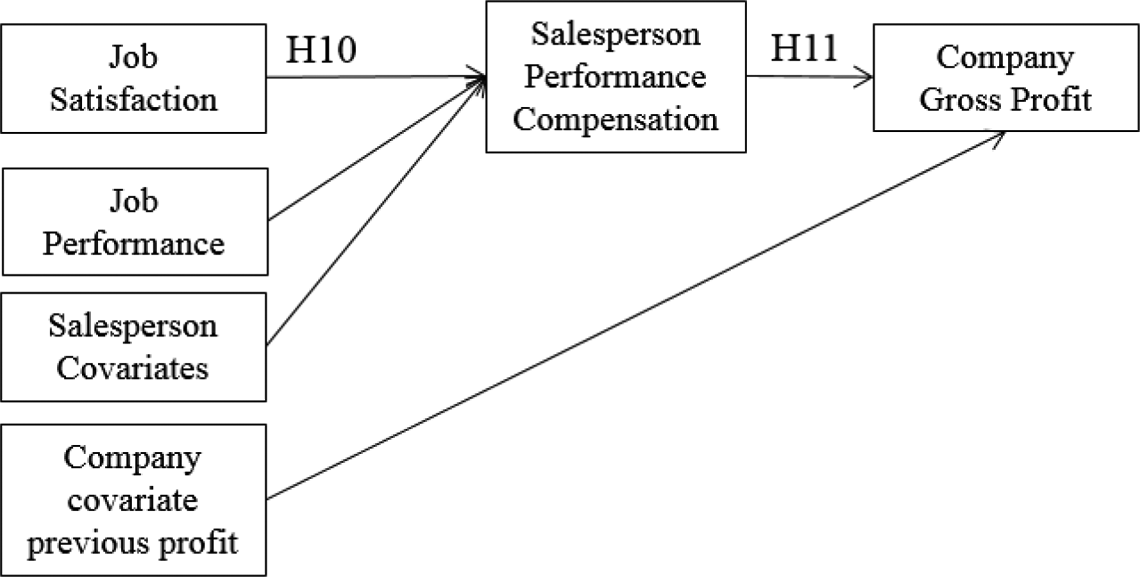
Job satisfaction impacting salesperson and firm performance corporate valuation.
Test of hypotheses: summary of results.

Discussion
This research demonstrated the important effects of religiosity as an antecedent to salesperson job satisfaction, even after accounting for effects of cultural and organizational antecedents. These assessments in turn affected performance, both at the level of the individual salespeople and for the organization.
This research was based on a large-scale sample of multiple companies operating in numerous countries and industries, among the more wide-reaching of such studies in the literature. With multiple sources of data, our hope is that the results are not prone to methods biases.
It was not surprising to replicate the well-known finding that overall job satisfaction has many contributing factors, and our research focused on four such facets. For salespeople, the aspects of their roles that impact their job satisfaction come from all directions—wanting to please one’s supervisor, one’s customers, hoping to be promoted and get ahead, and interactions with coworkers, and indeed, each of these facets contributed positively and significantly to the salespersons’ overall job satisfaction, which in turn helped their performance-based compensation (and further downstream the corporate valuation).
It is also unlikely to surprise any reader that cross-cultural dimensions mattered in this large, multinational sample. Yet we aimed for and achieved moderator hypotheses so as to investigate effects that would be somewhat more sophisticated than, and less likely intuitively anticipated than, cultural main effects. Thus, for example, we posited and found that monitoring, or verifying that everybody played by the same rules, was more appreciated among salespeople in collectivistic than in individualistic cultures when assessing satisfaction with one’s coworkers. Similarly, salespeople like most employees want to understand what it takes to get ahead, and their satisfaction with their promotion avenues was significantly enhanced by coaching, particularly in cultures with high uncertainty avoidance. The path forward is uncertain enough; when it is exacerbated in cultures wherein ambiguity causes greater discomfort, coaching provides a greater clarity in maneuvering through the corporate rules and is all the more appreciated.
Just as our model included moderated effects whereby cultural variables were considered in conjunction with organizational structural variables, effects of religiosity were considered in conjunction with attitudes, traits, and other indicators of the individual salespersons’ world view. For example, salespeople working in countries with greater religiosity were more appreciative of being able to confront a coworker about problems or opportunities and be able to clear the air, presumably in a somewhat kindred spirit sense, which significantly enhanced satisfaction with those coworkers. As another example, contexts with greater religiosity also contributed to enhancing the salesperson’s commitment to the job and company and that mindset contributed to satisfaction with the direct supervisor.
Thus, we believe that, theoretically, our research builds on the well-known and accepted understanding of the effects of culture, in that it also brings separable effects for religiosity. Academics and practitioners know that culture matters; this research shows that religiosity matters also. Furthermore, religiosity contributed to each facet of job satisfaction. Specifically, religiosity strengthens the positive relationship between salespersons’ tendency to confront situations and their satisfaction with coworkers. Religiosity also reinforces the positive relationship between salespersons’ tendency to transform situations into opportunities and their satisfaction with customers. In countries with higher levels of religiosity, salespersons’ tolerance for ambiguity will heighten satisfaction with promotion potential. Finally, religiosity strengthens the positive relationship between salespersons’ organizational commitment and their satisfaction with their supervisor.
Going forward, research on religiosity can be extended in several directions. We focused on an index created with belief statements (e.g. belief in God, heaven, hell, etc.). We did not distinguish among these particular beliefs because they were highly correlated in our data, but in other researchers’ samples, these might be further delineated. In addition, we would have liked to have religious beliefs measured at the individual level, that is, included as items on the primary data survey; however, they had not been, but the survey and its breadth of sampling coverage across countries and industries were too strong to cast aside; thus, we supplemented the survey data with the publicly available religiosity information. An interesting direction for future research might then tie such individual-level religiosity measures to other characteristics of salespeople; for example, are the effects we have identified stronger or weaker for younger or older salespeople? In addition, sales organizations vary in the extent to which they build relationships with customers; it would be interesting to test and compare these findings in sales settings for which there is a great deal of face-to-face interactions over an extended period of time, such as is typical in consultative and long-term relationship–based selling, compared with sales settings with more transactional, shorter term orientations. Further studies might also consider employees who are not salespeople; salespeople are an interesting sample for this content, being both often extraverted (i.e. having a positive orientation toward others) and yet working rather autonomously (and faith can also certainly be a private affair as well).
Managerial implications
Our results have numerous managerial implications, particularly given that they showed effects on salespeople’s performance and even the financial impact on the organizations for which they worked. Presumably these are both ideal outcomes, so managerial implications might well center around their drivers. Figure 1 and Table 4 showed numerous precursors to four different facets of job satisfaction. Enhancing any of the facets in an organization will heighten the overall levels of satisfaction, and of course if possible, enhancing multiple facets will further heighten the overall results.
The antecedents of the four facets of job satisfaction included cultural and religiosity moderating functions. The cultural and religious contexts are fairly stable and so, in and of themselves, would not likely be foci for enhancements or changes so as to effect greater satisfaction. Cultural and religious indicators could however point to which new countries to enter into markets that may be most amenable, yet we recognize that these decisions are usually driven by other factors. Thus, while accounting for the cultural and religious factors, it is the set of predictors with which they worked in conjunction in the model that may be affected. For example, to enhance collegiality, or at least the satisfaction with one’s coworkers, companies can increase their monitoring in collectivistic cultures wherein it would likely be appreciated and decrease their monitoring in individualistic cultures wherein it would not. Similarly, to enhance satisfaction with customers and presumably therefore serve them better, companies functioning in masculine countries might structure their decision-making to be more decentralized than those companies (or the satellite offices of companies) that operate in relatively less masculine cultures, wherein centralized decision-making may offer the perception of better organization and rule-following. In this same regard, we are not suggesting that religiosity is very malleable or that choice of market entrance or hiring be made on its basis. Rather, companies operating in countries in which it is likely that their workforce is more religious can be better aware that greater satisfaction with customers, say, would be strengthened for salespeople who see themselves as transformative “go-getters,” and that greater satisfaction for hopes for promotion is enhanced by a trait that may well serve as a useful screener, that of the ability to tolerate some ambiguity in one’s environment and in specified employment parameters.
Conclusion
Companies all over the world know that cross-cultural differences matter. This research shows how the religiosity levels of countries matter in the business setting as well. Salespersons’ job satisfaction can be measured along several dimensions, and each can be enhanced by some local—organizational-level or salesperson-level—variables in the context of the cultural and religious environments.
Footnotes
Acknowledgments
Support by INSEAD and a public grant overseen by the Environmental Defense Fund Chair and the French National Research Agency (ANR) as part of the Investissements d’Avenir program (ANR-11-IDEX-0003/Labex Ecodec/ANR-11-LABX-0047) is acknowledged and greatly appreciated by the authors. The second author warmly acknowledges the Desautels Faculty of Management at McGill University (Canada) for the support and hospitality extended to her during her sabbatical.
Declaration of Conflicting Interests
The author(s) declared no potential conflicts of interest with respect to the research, authorship, and/or publication of this article.
Funding
The author(s) received no financial support for the research, authorship, and/or publication of this article.
Appendix 1: Scale items and coefficient α s
Unless otherwise specified, all scales measured (1–7, 7 = Completely agree).
Satisfaction with job (Churchill et al., 1974), α = 0.812 My work gives me a sense of accomplishment. My job is exciting. My work is satisfying.
Satisfaction with coworkers (Churchill et al., 1974), α = 0.662 My fellow workers are selfish. My fellow workers are pleasant. The people I work with are very friendly.
Satisfaction with customers (Churchill et al., 1974), α = 0.741 My customers are understanding. My customers live up to their promises. My customers are trustworthy.
Satisfaction with supervisor (Churchill et al., 1974), α = 0.771 Management has always been fair in dealings with me. Management gives me credit and praise for work well done. Management lives up to its promises to me.
Prospects for advancement (Churchill et al., 1974), α = 0.674 My opportunities for advancement are limited (reverse-coded). I have a good chance for promotion.
Degree of management monitoring (Evans et al., 2007; Oliver and Anderson, 1994), α = 0.802 Management tracks my activities. Management keeps a close watch on how I spend my time. Management takes my call and activity reports seriously. Management carries out a detailed examination of my call and activity reports. Management here stays informed of my activities. Management checks to see if I’m following its instructions.
Tendency to confront situations head-on (Bateman and Crant, 1993; Crant, 1995), α = 0.615 I enjoy facing and overcoming obstacles to my ideas. If I see something I do not like, I fix it. I love being a champion for my ideas, even against others’ opposition. When I have a problem, I tackle it head-on.
Centralization of decision-making (Hage and Aiken, 1967), α = 0.708 Decision-making authority is highly centralized in our organization. In almost every case, I have to obtain management’s approval before taking action. Even small matters related to my job have to be referred to someone else above me. I am discouraged from making my own decisions. Management always tells me what I should do in my sales territory. It is difficult for me to make a move without getting my management’s permission.
Tendency to transform situations into opportunities (Bateman and Crant, 1993), α = 0.610 I am great at turning problems into opportunities. If I believe in an idea, no obstacle will prevent me from making it happen. No matter what the odds, if I believe in something, I will make it happen. I excel at identifying opportunities. I can spot a good opportunity long before others can. Wherever I was, I have been a powerful source for constructive change. I feel driven to make a difference in my community and maybe the world.
Degree of autonomy (Oliver and Anderson, 1994), α = 0.764 Management grants me a great deal of autonomy. Management allows me to do almost as I please. I make the final decision on practically everything that has to do with my selling assignment. Management allows me freedom to organize my work.
Affective commitment to the organizational (Tsui et al., 1997), α = 0.865 I am willing to put in effort beyond the norm for the success of the organization. I talk up this organization to my friends as a great place to work for. I am proud to tell others that I am part of this organization. This organization inspires the very best (in me) in the way of job performance. I am extremely glad to have chosen this organization to work for over other organizations. I really care about the fate of this organization. For me, this is the best of all possible organizations for which to work.
Amount of coaching offered (Oliver and Anderson, 1994), α = 0.813 I receive a lot of coaching from my boss or those I report to. Management provides a lot of on-the-job suggestions and tips on ways they think I can improve my selling skills and abilities. There are senior salespeople designated by management who offer me a lot of coaching. Management makes sure I know how to carry out my assigned tasks. Management gives me training intended to improve my productivity.
Tolerance for ambiguity (Lyons, 1971), α = 0.521 Nothing gets accomplished in this world unless you stick to some basic rules. Usually, the more clearly defined rules a society has, the better off it is. Personally, I tend to think that there is a right way and a wrong way to do almost everything.
Professional maturity (Onyemah and Anderson, 2009), α = 0.833 Organizational tenure: number of years in the company. Selling experience: number of years of general selling experience. Age: in years.
Ratio of variable to total compensation
Proportion of total compensation represented by variable pay for each salesperson.