




Abstract
This article examines the relationship between structural empowerment and interpersonal conflict. We examine whether this relationship is moderated by cultural diversity. Although there is some understanding of conflicts in an organization, there is little understanding concerning how conflicts may arise because of structural empowerment. We propose that structural empowerment is positively associated with interpersonal conflict and that this relationship is contingent upon cultural diversity. We draw on survey evidence from 351 employees of international nongovernmental organizations in Pakistan. Our results reveal significant positive relationships among cultural diversity, structural empowerment, and interpersonal conflict and show that where the organization is characterized by a high cultural diversity, the relationship between structural empowerment and interpersonal conflict is stronger, and vice versa. We contribute by offering the first of empirical evidence on the issue using the collectivist context of Pakistan and further extending the research scholarship by offering a contingency of cultural diversity to the structural empowerment and interpersonal conflict relationship. Our study suggests for the managers, a clearer understanding of the roles and responsibilities of the workforce as well as developing a proper socialization process through which a conducive environment for the culturally diverse workforce can be developed.
Keywords
Introduction
Modern organizations are becoming more and more culturally diverse. This is partly because of globalization, disruptive innovations, information and communications technology (ICT), and the Internet, as well as social mobility, which are leading companies toward employing a global workforce (Chen, 2005). A universally competent workforce and global labor market are issues of significant interest for today’s organizations (Parker and Clegg, 2006). Existing research looks at differentiating factors, such as social qualities, state of mind, and work styles (which lead to conflicts among individuals), and suggests that diversity can have both positive and negative impacts on the business performance (Kochan et al., 2003). However, the management of culturally diverse workforce poses significant challenges for organizations, as cultural diversity can lead to interpersonal conflicts (Chen and Starosta, 1997; Triandis, 2006). Adaptation to a multicultural environment is, hence, critical for employees working in multicultural organizations.
Research in this domain mostly centers on comparative studies involving individuals from various ethnicities and focuses on the (interpersonal conflict) management aspect (Wang, 2015). However, how cultural diversity interacts with factors that lead to interpersonal conflicts is less clear. For example, while research suggests that structural empowerment in an organization leads to higher organizational performance and knowledge sharing (Kirkman and Rosen, 1999; Srivastava et al., 2006), it also leads to interpersonal conflicts (Jiang et al., 2016). Whether such conflicts are more likely or less likely to occur in a culturally diverse environment is less clear. Furthermore, empowerment in an organization may have different implications for individualistic versus collectivistic or high-power distance versus low-power distance societies (Jiang et al., 2016). This is important as research on empowerment in organization mainly draws on evidence from individualistic western settings and less on the collectivistic contexts.
In this article, we argue that there are certain contingencies in the relationship between structural empowerment and interpersonal conflict. We examine whether structural empowerment relates to interpersonal conflicts in a collectivist and high-power distance society such as Pakistan and whether the possible relationship between structural empowerment and interpersonal conflict is moderated by cultural diversity. To this end, we draw on survey data from 351 employees working in international nongovernmental organizations (INGOs) in Pakistan. Our results show support for our hypotheses. While existing studies have either mainly examined the relationship between cultural diversity and conflicts or only proposed that team empowerment may lead to intragroup conflicts, we contribute by (a) offering the first of empirical evidence on the issue using the under-researched context of Pakistan, and discuss how structural empowerment and interpersonal conflict are positively associated in the high-power distance collectivist context; and (b) extending the existing empowerment and intragroup conflict debate by offering a contingency of cultural diversity, showing that the positive relationship between structural empowerment and interpersonal conflict is more likely to be stronger where the organization is culturally diverse in terms of the workforce.
Theory and conceptual development
Interpersonal conflict
Conflict is defined as a contradiction in opinion between two or more parties (Huho, 2012). In an organizational context, conflict with supervisors or colleagues is referred to as an interpersonal conflict (Bruk-Lee and Spector, 2006). Person-to-person differences in personality, culture, behaviors, attitudes, values, and perceptions result in interpersonal conflicts (Riaz and Junaid, 2012). Interpersonal conflict involves task and relationship conflicts. Task conflict involves disagreement about the content of the work, and relationship conflict involves the perceived incompatibility among individuals and groups. 1 Relationship conflict occurs when there are differences in identities or feelings among people. Task conflict relates to issues about objectives, key choices, and distribution of assets or facts (Tootoonchy, 2012). Task conflict often transforms into relationship conflict if there is a personal disagreement (Prause and Mujtaba, 2015).
Conflicts cost to organizations in terms of time and resources (Cingöz-Ulu and Lalonde, 2007). Interpersonal conflict has a major downside in that it results in low performance, low organizational commitment, low job satisfaction, and higher turnover intentions among employees (Ollapally and Bhatnagar, 2009). Tran and Tian (2013) show that employees take interpersonal conflict as stressful and troubling events at work. However, conflicts may not necessarily have a negative outcome. For example, task conflict may as well lead to creativity, better decision-making, and organizational performance if managed properly (Girardi et al., 2011). Conflict, therefore, is arguably a double-edged sword, and the value from it depends much on how it is managed (Güçlü, 2014).
Conflicts are inevitable in organizations. When interpersonal conflict arises with supervisors it may lead to employee job dissatisfaction, decreased organizational commitment, and increased turnover intentions. Whereas an interpersonal conflict with peers and coworkers results in personal outcomes like employee sensitivity, employee well-being, and self-esteem (Eunice et al., 2015). Conflict can be reduced but not eradicated as it is an element of human nature. If an organization manages conflicts among employees properly, it can result in a win-win situation for the employees and the organization.
Structural empowerment
Empowerment is a popular idea in the workplace (Marseille, 2004). The idea of empowerment is firmly lined up with this thrust to increase organizational effectiveness through the sensible use of a human resource (Siegall and Gardner, 2000). Empowerment is divided into two categories; one is psychological empowerment and the other is structural empowerment (Mills and Ungson, 2003; Psoinos and Smithson, 2002; Seibert et al., 2004). Psychological empowerment is identified with a psychological state accomplished where people see that they are empowered at work (Mills and Ungson, 2003). Structural empowerment is related to the organizational policies, practices, and structure to decentralize authority and encourage employees’ participation at all levels of the organization (Spreitzer, 2008).
Kanter (1993) defines structural empowerment as the employee’s access to resources, opportunities, information, and support. As noted above, structural empowerment is more about the hierarchical structure of the organization concerning empowering employees. It is more concerned with power-sharing or power decentralization (Kanter, 1993). The idea of power-sharing among managers and their subordinates lies at the core of the structural empowerment. The purpose behind this is to delegate responsibility to the lower levels of the hierarchy. Structural empowerment reflects the formal authority over the resources and the ability to resolve the issues pertinent to an individual’s job or role. Therefore, structural empowerment influences decisions at the workplace (Laschinger et al., 2002, 2004).
Employees feel empowered in an environment characterized by equal opportunities, organizational support, and access to information and resources (Spreitzer, 2008). Pitts (2005) suggests that employee involvement and empowerment are important for managing diversity. Employee empowerment is positively related to employee performance (Srivastava et al., 2006). Empowerment arises from the formal and informal structure of the organization. Formal power emanates from specific jobs related to characteristics such as flexibility, autonomy, and discretion in decision-making, while informal power comes from social, communication, and information channels (Kanter, 1993; Laschinger et al., 2001, 2004). The success of an organization vis-à-vis empowerment depends on the extent to which power is shared efficiently and equally in the organization (Kirkman and Shapiro, 1997; Langfred, 2007; Stewart et al., 2011).
Structural empowerment and interpersonal conflict
Jiang et al. (2016) suggest that empowerment in an organization leads to increased knowledge sharing, but at the same time higher levels of interpersonal conflicts. Khan and Rasli (2015) show a positive link of empowerment with conflicts and a negative link of conflicts with employee performance. It is argued that structural empowerment generates conflicts in an organization for competition for supremacy and leadership (Omisore and Abiodun, 2014) and harms relationship among employees (Saremi, 2015). In a lateral structure, control of decision-making and resource allocation are at times not properly transferred, and roles and responsibilities are not clearly defined (as opposed to what can be more possible in a more hierarchical setting) leading to conflicts (Wolf and Egelhoff, 2010, 2012). Empowerment leads to conflicts in projects and their management (Oberst, 1986).
Structural empowerment in the absence of clear guidance from the organization leads to confusion about authority and procedures in the organization, which then leads to conflicts among employees (Kotlyar and Karakowsky, 2006). In an organization, employees have various levels of authority and discretion, and a clash may occur when employees with varying levels of autonomy work in a group—the conflicts further damage the working environment as empowered individuals in terms of their work and interactions with each other greatly rely on relationships of trust (Langfred, 2000, 2007). Based on the above, it is logical to assume that structural empowerment would positively influence interpersonal conflicts. We, therefore, hypothesize that:
Cultural diversity
Culture is a shared encoding of the mind, which differentiates participants of one group (or category of people) with the other group (Hofstede, 1994). Values, attitudes, beliefs, and behaviors are shared by a group of individuals but are different for each individual, transferred from generation to generation (Matsumoto et al., 1996). Culture is an uncertain set of rudimentary assumptions and values, directions to life, beliefs, plans, procedures, and behavioral resolutions that are shared by a group of individuals, and which effects each member’s behavior and his/her understandings of the other people’ behaviors (Spencer-Oatey, 2008). Desmet et al. (2017) suggest culture as an interaction of a group of individuals. It comprises of the products of knowledge of individuals containing those metaphors and explanations, passed on from previous generations to contemporaries (Sivasubramaniam and Goodman-Delahunty, 2014). Culture enables groups to function smoothly (Hofstede, 2002).
Cultures differ across regions and countries (Hofstede, 1984), and depending on the background of the individuals, cultures can have varying levels of diversity within them. Diversity is the presence of people differing in race, gender, or culture (White, 1999). DeLancey (2013) discusses multiculturalism and diversity and argues that multiculturalism is about people from different backgrounds in one context, and diversity involves race, age, disability, and several related factors. It is, however, important to note that factors such as age, gender, and disability are rather indicators of diversity within a culture, than elements of a culture per se. It may rather be a case of some specific subcultures, for example, transgender people, where gender may be a significant element of the subculture or disabled people where disability could be seen as a key element of the disabled people culture.
Individuals from diverse backgrounds have diverse life experiences, and when they share their knowledge and experiences with others, the overall understanding of the issues at an individual level as well as the organizational level enhances (Singh, 2012). More importantly, creativity flourishes with diversity and so innovation rate is high in multicultural organizations (Beebe and Mottet, 2012). Successful organizations learn to manage diversity (Din et al., 2014). Organizations preferring diversity should be open in terms of linguistics, values, and informational dissimilarity (Fougère and Moulettes, 2007). According to Rahim (2002), openness to diversity reduces the occurrence of interpersonal conflicts among individuals coming from different cultures. In contrast, however, some studies suggest the opposite (see, e.g. Van Knippenberg and Schippers, 2007). There is little understanding as to the situations under which cultural diversity has positive outcomes and situations under which cultural diversity has negative outcomes (King et al., 2009). At an organizational level, managing diversity requires careful development and execution of appropriate strategies to improve the overall performance of the organization in the current competitive business environment (Bueno et al., 2013).
Cultural diversity, structural empowerment, and interpersonal conflicts
In various national cultures, the dispersion of power within an organization can vary from generally equivalent (i.e. in a low-power distance culture) to a great degree of inequality (i.e. high-power distance culture) (Hofstede and Hofstede, 2001). Power distance is the degree to which members of an organization allow and expect inequality of power distribution (Hofstede, 1984). In high-power distance cultures, a general level of disparity is supported by the leader and the followers, and an individual’s social status influences the group decision-making process. Ideas and directions of a high-status individual are openly embraced, despite the possibility of a contradiction with the individual, group, or the organizational interests (Hofstede and Hofstede, 2001). Whereas, individuals from low-power distance cultures are less influenced by high social status vis-à-vis ideas and opinions (Earley, 1999; Schaubroeck et al., 2007). As noted earlier, structural empowerment is fundamentally defined as power delegation (Kanter, 1979). There is a role of power in all sorts of social connections and collaborations in an organization (Greer and van Kleef, 2010; Handgraaf et al., 2008; Kipnis, 2006; Turner, 2005).
The positive link between interpersonal conflict and cultural diversity is well established (Hofstede and Hofstede, 2001; Tung and Quaddus, 2002). An organization with a culturally diverse workforce will likely have conflicts as some individuals will be coming from a collectivistic society, while others from an individualistic society (Brew and Cairns, 2004). Conflicts would arise, as diversity would raise expectations with regard to justice, equality, and recognition (Thomas, 1992; Wang, 2015) as well as certain norms and values. The fundamental issue involved in power distance is the level of human inequality that underlies the working of a specific society and culture that leads toward the conflicts (Hofstede, 1984; Talha, 2012). Individuals working in multicultural workplaces are likely to experience a greater level/frequency of conflict as compared to working in a homogenous culture (Hanif et al., 2016; Paletz et al., 2014). It is not unusual for individuals coming from diverse cultural backgrounds to indulge in conflicts (Podsiadlowski et al., 2013; Ramirez, 2010).
As noted above, research shows a direct link of interpersonal conflicts with cultural diversity. Earlier we argued that structural empowerment per se leads to interpersonal conflicts as some actors in the organization may not readily accept the legitimacy of the peers or actors that are assigned or have assumed authority. Similarly, where everyone has power in an organization, the roles and responsibilities will get blurred, leading to conflicts and a poor understanding of lines of authority. A multicultural environment, characterized by structural empowerment, would further increase conflicts, as there would arise aspects of foreignness, which the locals would not readily welcome. Also, for an organization in a high-power distance culture, a lateral structure will be a misfit, and the expectations of individuals coming from low-power distance cultures would remain unmet. It is, therefore, appropriate to assume that structural empowerment would lead to high interpersonal conflicts, where there is high cultural diversity, and vice versa. We, therefore, hypothesize that:
Figure 1 presents the testable model for this study. Structural empowerment is the independent variable, interpersonal conflict is the dependent variable, cultural diversity is the moderating variable, and ethnicity is the control variable added as a dummy (ethnicity: Pakistani = 0, Other = 1) in the model to control our results with the respondents’ ethnicity.
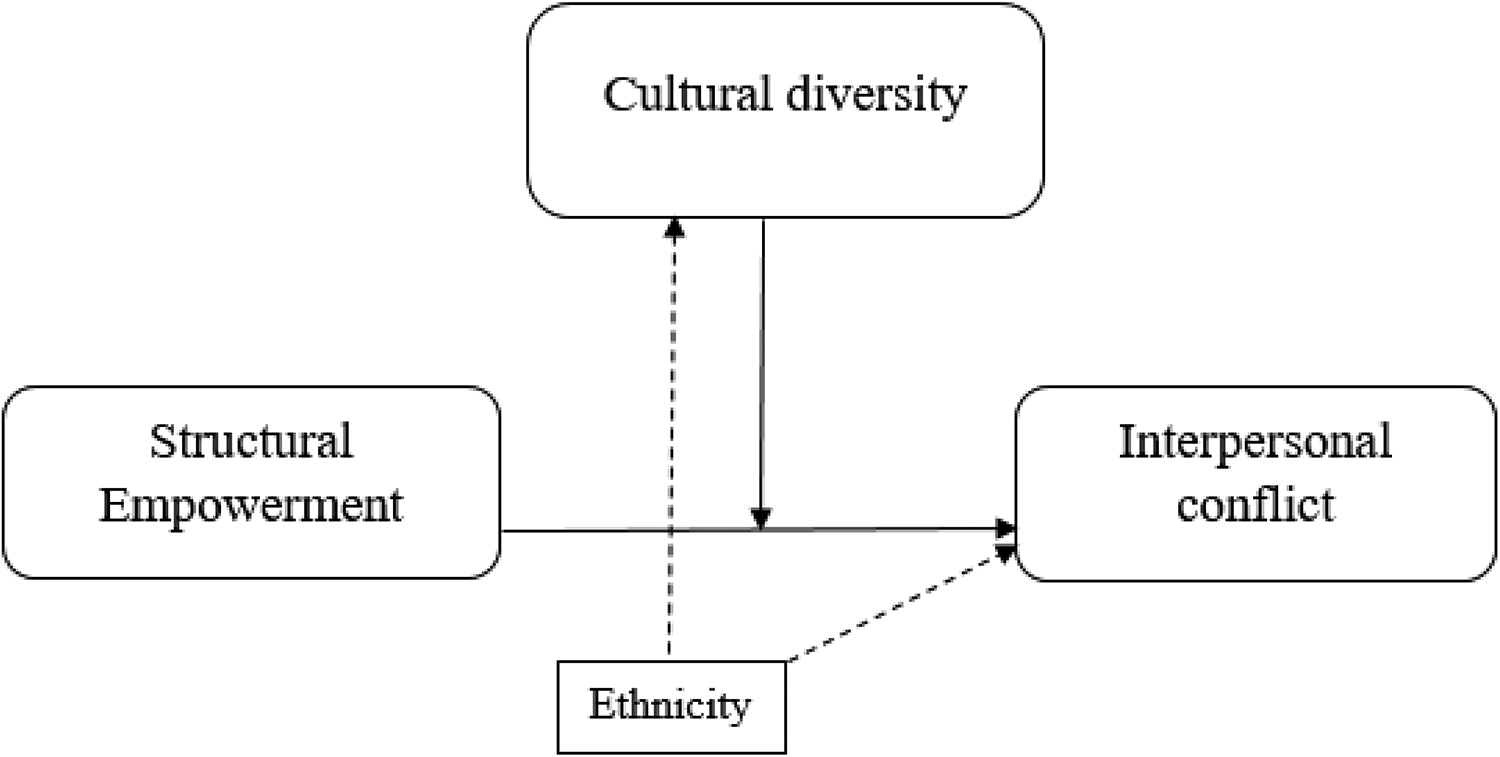
Structural empowerment, cultural diversity, and interpersonal conflict.
Data and methods
Data were collected from INGOs operating in Pakistan. In Pakistan, the NGOs predominantly have foreign donors, and due to the NGO’s international outlook, the NGOs have usually a diverse workforce coming from various cultures and ethnicities. Therefore, INGOs are deemed an appropriate context for this study.
For this study, we selected 12 INGOs. Self-administered surveys were sent to the NGOs, and data from 351 respondents were received. The survey questionnaires were composed of two parts. The first part collected data on demographics. The second part collected data on the organization’s level of cultural diversity, structural empowerment, and interpersonal conflicts. The study adopted measures from existing studies and collected data on a five-point Likert-type scale with options ranging from 1 = strongly disagree to 5 = strongly agree.
Cultural diversity was measured using the scale (Diversity Perspective Questionnaire) developed by Podsiadlowski et al. (2013). The construct measures the extent to which the organization is culturally diverse, welcoming and understands the value and the requirements of cultural diversity for an organization. Interpersonal conflict was measured by the scale developed by Jehn (1995). This construct mainly measures the extent of the conflicts among individuals within the organization. Structural empowerment was measured by the scale (Conditions of Work Effectiveness (CWEQ-II)) developed by Laschinger et al. (2004). This construct looks at the structural aspects of empowerment in the organization, in terms of opportunity, access to information, top management support, and autonomy for the individuals.
We have followed steps to reduce the chances of a common method bias using the guidelines of Podsakoff et al. (2003). First, we applied discriminant and convergent validity tests, and the results show good validity within and across constructs. To test the reliability of constructs, we have also applied Cronbach’s α test. All the constructs show good reliability of above 0.6, with cultural diversity showing a score of 0.777, interpersonal conflict 0.861, and structural empowerment 0.881. To check the associations among the variables, correlations analysis was employed first. This was followed by linear regression. We checked for multicollinearity, the R 2, and the model fit. Following that, moderation analysis was used (in SPSS) using the process macro by Preacher and Hayes (2008). To test for moderation, the bootstrapping method was adopted, which is the contemporary method adopted by studies interested in models involving mediations and moderations, and is considered superior to the conventional Baron and Kenny (1986) method (MacKinnon et al., 2004; Preacher et al., 2007; Shrout and Bolger, 2002). We have used 5000 (bias-corrected) bootstrap samples at a 95 percent confidence interval.
Results
Demographic results show that of 351 respondents, around 70 percent were Pakistani nationals, while the rest were respondents of other nationalities. With such distribution, we achieved adequate representation of both the locals and the foreigners in our data set. Variance inflation factor results show the scores around 1, and so well below the threshold of 10 (see Kutner et al., 2004), indicating little or no multicollinearity among the variables. Mean results (see Table 1) on our scale of 5 show that organizations are predominantly culturally diverse, and their structure allows employee empowerment. However, the results also indicate a fair amount of interpersonal conflict in organizations with a mean score of 3.62.
Demographic and correlation statistics.
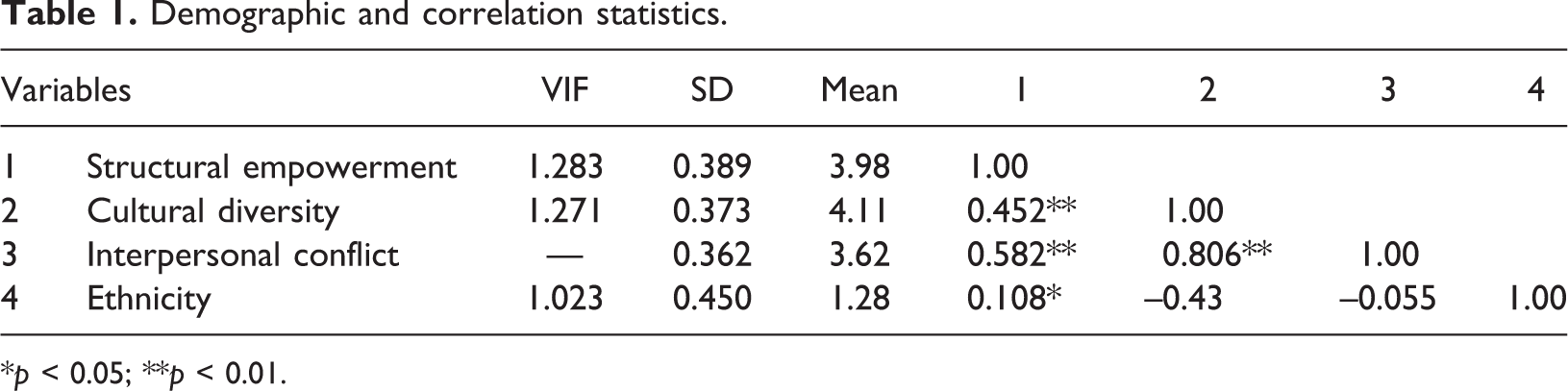
*p < 0.05; **p < 0.01.
Correlations results show a strong positive association among the three variables. The results show a positive relationship between structural empowerment and ethnicity, indicating that a culturally diverse workforce positively influences structural empowerment in the organization. Most importantly, we have found a statistically significant relationship between structural empowerment and interpersonal conflict. With that, our hypothesis 1 that structural empowerment is positively related to interpersonal conflict is confirmed. Now we move on toward the moderation analysis and test for our hypothesis 2.
Applying the process model for the moderation analysis, the results (see Table 2) show an R 2 of 0.71, explaining 71 percent of the variance in the interpersonal conflict caused due to the combination of interpersonal conflict and cultural diversity. Results show a positive significant relationship between structural empowerment and interpersonal conflict, confirming our results from the correlation analysis. Results also indicate that controlled by ethnicity, cultural diversity moderates the relationship between structural empowerment and interpersonal conflicts. This indicates that wherein an organization, cultural diversity is high, the positive relationship between structural empowerment and interpersonal conflict is strong, and where it is low, the relationship between structural empowerment and interpersonal conflict is weak. The R 2 value increases as a result of cultural diversity interaction. With that, our hypothesis 2 that cultural diversity moderates the relationship between structural empowerment and interpersonal conflict is also confirmed.
Moderation analysis.

Note: IV: independent variable; DV: dependent variable.
a R 2 increases due to interaction.
Discussion and implications
In the today’s globalized world, organizations are increasingly employing a diverse workforce, and this is significantly influencing their working environment. This study examined the relationship between structural empowerment and interpersonal conflict and the interacting effect of cultural diversity for this relationship. We drew on INGOs operating in the high-power distance and collectivist society of Pakistan, where the predominant structure adopted by organizations is bureaucratic, and hierarchical, with decision-making rather more centralized (Raziq et al., 2018, 2019) as opposed to organizations in low-power distance countries (such as Western European) where organizational structures are comparatively less bureaucratic and less centralized. Hence, our findings come with a caveat that they may not be easily generalizable across individualistic settings, as they may be to other collectivists and high-power distance contexts.
We find that structural empowerment is positively associated with interpersonal conflicts. Previous research indicates that interpersonal conflict increases for a culturally diverse workforce because of the workers’ differences in their cultural values, belief, attitudes, and working styles (Chan and Goto, 2003; Leung and Chan, 1999; Sauceda, 2003). Structural empowerment also plays a key role in social interactions as well as contention in the organization (Handgraaf et al., 2008; Kipnis, 2006). In line with that and in the context of collectivist societies, Jiang et al. (2016) proposes that team empowerment leads to knowledge sharing as well as intragroup conflict. We offer empirical support to the latter claim. While empowerment encourages knowledge sharing (Jiang et al., 2016), new knowledge creation as well as freedom to take alternate perspectives, which are critical in new knowledge creation; it also leads to interpersonal conflict. Our main contribution here is that we show that the positive relationship between structural empowerment and interpersonal conflict becomes stronger where the organization is more culturally diverse in terms of workforce. In this way, we extend the proposition of Jiang et al. (2016), which conceptualizes the relationship in a more generic way. Using a multicultural context, we offer a contingency to the structural empowerment and interpersonal conflict positive relationship, and hence, further extend the debate.
Concerning the above, where in an organization, individuals and functions have authority, an unnecessary display of independence of authority by both the individuals and the departments may be witnessed. Also, some actors in the organization may not readily accept the legitimacy of others or perceive the assigned or assumed authority of others as legitimate or appropriate. Where everyone has power in an organization, the roles and responsibilities will get blurred, leading to conflicts (Langfred, 2000, 2007) and a poor understanding of lines of authority. A multicultural environment, characterized by structural empowerment, would further increase conflicts, as there will arise aspects of foreignness, which the locals would not readily welcome. Also, for an organization, in a high-power distance culture, a lateral structure will be a misfit as the procedures and policies there demand a rather more hierarchical reporting channel—so, the expectations of individuals coming from low-power distance cultures would remain unmet. Here, in the context of Pakistan, we do not suggest that hierarchical structure is better but rather suggest a fit of structural empowerment and cultural diversity with the broader organizational context. Although, where organizations have a balanced and dynamic power structure, there can be seen a decreased level of interpersonal conflicts, and vice versa (Ospina, 2001). The power structure is critical to all organizations, as it explains the lines of responsibility, authority, and the overall control structure of an organization. An organizational structure should be designed such that the possibilities of conflict between the individuals who get authority and benefit versus those who do not get such privileges are reduced (Oberst, 1986).
Our results have some theoretical, practical, and managerial implications. An important contribution of this study to the empowerment and conflict literature is how cultural diversity interacts with structural empowerment and interpersonal conflict. We argue that empowerment equips employees with individual authority, which may conflict with group-level authority (Langfred, 2000). This as well may lead to a battle for gaining more power (e.g. authority, a span of control or access to resources) among employees, all resulting in conflicts (Jiang et al., 2016). In such a situation, the performance of the entire organization suffers. However, what may exacerbate such situations is the collectivistic cultural context. Research suggests that behaviors of individuals are rooted in their particular cultural contexts, which might differ across nations (Bochner and Hesketh, 1994; Hofstede, 1993). In collectivist cultures, for example, such as Pakistan, when an individual or group of individuals is provided with authority, there is a greater chance of exploitation of subordinates by empowered group or the individual. The reason of this is twofold: (a) individuals with lesser power or the subordinate status in the high-power distance countries easily accept autocratic and paternalistic relationships—or in other words are easily submissive, accepting that acquired power based on status and position in the organization is legitimate (Jiang et al., 2016); and (b) when such submissive individuals are provided with power or authority, they expect allegiance or submission from their colleagues, and while the colleagues (now less powerful individuals) may accept the legitimacy of the authority, this may not always come smoothly and may eventually result in an interpersonal conflict. Furthermore, in such situations, individuals in the high-power distance cultures may have more frequent and severe interpersonal conflict than individuals in low-power distance cultures.
Concerning cultural diversity, empowerment is more likely to cause interpersonal conflict. High-power distance contexts discourage socialization and so the norms and expectations of the locals and the foreigners may not be easily understood by each other, leading to a higher chance of conflict, in the presence of the power element. While cultural diversity can be good, an implication for managers is to develop proper socialization process so that the locals understand the norms and expectations of foreigners and the foreigners understand that for the locals. To enhance harmony and corporation among individuals from various backgrounds, the top management may engage enthusiastically in identifying diversity management approaches to get more efficiency and competitive advantage. Because valuing and managing diversity is a key part of successful people management, which can improve work environment profitability, and without which there could be hindrances in accomplishing organizational objectives.
Furthermore, organizations in Pakistan may adopt mechanisms to create a balance in their structures in terms of empowering individuals and functions. To avoid conflicts, a mix of a structure with elements of both hierarchy and heterarchy is critical. That is, while empowerment can be good, a clear understanding of roles and responsibilities is critical. Furthermore, the scope of power and authority must be clearly defined, and power should mainly be taken as an authority to delegate tasks and responsibilities rather than something which can be exploited. Drawing on the institutional theory, institutional powers (rules, regulation, social norms, and behaviors) may be directed more toward the management of diverse workforce in an organization, taking power into organizational actions to avoid interpersonal conflict among individuals from diverse backgrounds. By adopting a structure that fits in with institutional prerequisites, organizations could show their adjustment to social standards and, consequently, accumulate authenticity for their activities and at the same time minimize the chances of conflicts among individuals.
Like any other study, this study comes with some limitations. Constraints of the study give chances to future research. The research is limited to INGOs operating in Pakistan. This might influence the generalizability of the study. The generalizability of the proposed study can be accessed by exploring this theoretical framework in multinational companies other than INGOs. It also used context from a high-power collectivist society, while future research can add value by replicating this study in an individualist country (such as the United States) to see whether replicating the study would produce the same results. Future research may look at other interactions and interventions such as procedural justice, corrupt practices and examine ways in which a balance between hierarchy and heterarchy can be achieved and how organizations adopt an effective socialization process to mitigate conflicts.
Conclusion
This study looked at the underlying mechanisms in the relationship between structural empowerment and interpersonal conflict. We showed that structural empowerment leads to interpersonal conflict and proposed a contingency to the structural empowerment and interpersonal conflict relationship. Existing studies have either mainly examined the relationship between cultural diversity and conflicts or only proposed that team empowerment may lead to intragroup conflicts. We advance the scholarship of cross-cultural management with our contributions being twofold: (a) we offer the first of empirical evidence on the issue using the under-researched context of Pakistan and discuss how structural empowerment and interpersonal conflict are positively associated in the high-power distance collectivist context; and (b) we extend the existing empowerment and intragroup conflict debate by offering a contingency of cultural diversity, showing that the positive relationship between structural empowerment and interpersonal conflict is more likely to be stronger where the organization is culturally diverse in terms of the workforce. Based on our results, we offer some implications for the multinational organizations or other organizations recruiting a culturally diverse workforce. We suggest that managers of such organizations may aim at delivering a better and clearer understanding of the roles and responsibilities of the workforce and developing a proper socialization process, so that the locals in the workforce understand the norms and expectations of the foreigners and the foreigners understand that of the locals. This may help develop an overall conducive environment for both the locals and the individuals coming from different cultures.
Footnotes
Author’s Note
Muhammad Laeeq Khan is also affiliated with Scripps College of Communication, Ohio University, Ohio, USA.
Declaration of Conflicting Interests
The author(s) declared no potential conflicts of interest with respect to the research, authorship, and/or publication of this article.
Funding
The author(s) received no financial support for the research, authorship, and/or publication of this article.
