



Abstract
Drawing on Conservation of Resources theory and the socially embedded model of thriving, we examine the resource antecedents and retention outcome of expatriate thriving. Using two-wave panel data from 103 international teachers in the United States, we found that the personal resource of cultural intelligence directly influenced thriving, and thriving led to expatriate actual retention. In addition, the contextual resource of organizational embeddedness served as a boundary condition that augmented cultural intelligence’s positive effect on thriving. Applying the concept of thriving to explicate expatriate experiences, we go beyond the dominant emphasis in the expatriate literature on expatriate adjustment. In doing so, we highlight the joint contribution of both personal and contextual resources associated with global work experiences and pinpoint potential boundary conditions that enable thriving.
Introduction
As the economy becomes increasingly global and national boundaries become progressively permeable, both individuals and organizations recognize the value of global work experiences (Shaffer et al., 2012). For example, a growing number of organizations require high-potential individuals to have at least one international assignment in their careers (Yan and Hall, 2002). More and more individuals are also initiating their own expatriation to pursue cultural, personal and career development experiences (Napier and Taylor, 2002). Global work experiences, whether self-initiated or organizationally supported, have become critically important for building employees’ global skills (Takeuchi, 2010) and for carrying out successful business activities (Mendenhall, 2001). Therefore, in line with the concept of “boundaryless career,” which encompasses both physical and psychological mobility of individuals across organizations and countries (Sullivan and Arthur, 2006), it is not surprising that employees are willing to invest time in international assignments that generate valuable cross-cultural knowledge and global experiences (Stahl et al., 2002).
A great deal of research has examined the key factors associated with successful expatriation (Kraimer et al., 2016). Much of this research has followed a stressor-stress-strain paradigm (Black et al., 1991) that asks why expatriates fail to adjust and eventually leave their international assignments. In contrast, we focus our investigation on understanding why expatriates develop and stay on their assignments. In doing so, we integrate Conservation of Resources (COR) theory (Hobfoll, 1998) with the socially embedded model of thriving (Spreitzer et al., 2005).
According to Spreitzer and colleagues (2005: 537), thriving “serves an adaptive function that helps individuals navigate and change their work contexts to promote their own development.” These researchers conceptualize thriving as a joint experience of vitality and learning; vitality denotes feelings of energy and aliveness, while learning refers to the acquisition and application of knowledge and skills. The experience of learning and vitality on the assignment can be particularly important for expatriates, who sacrifice so much by leaving their home country and relocating; this experience may eventually influence their decisions to continue their adventure (Ren et al., 2015). Thus, we bring the concept of thriving to the expatriate literature and examine it as a motivational force that drives expatriate retention.
A basic premise of the socially embedded model of thriving (Spreitzer et al., 2005) is that thriving is a function of an individual’s agentic work behaviors, such as developing and maintaining quality relationships at work, exploring novel ways of working and becoming more focused at work. Different types of resources will promote agentic work behaviors that contribute to thriving (Spreitzer et al., 2005). Therefore, integrating COR theory with the socially embedded model of thriving, we examine the resource antecedents of expatriate thriving. Although COR theory argues that resource losses have a stronger influence on employee outcomes than resource gains, it still recognizes the value of resource gains as a motivational process (see Halbeslaben et al., 2014, for a review of COR theory). Drawing on COR theory’s major tenets that address resource gain, we consider the influence of two resources, cultural intelligence and organizational embeddedness, on thriving. Cultural intelligence (CQ) is defined as the ability to effectively traverse diverse environments (Earley and Ang, 2003). We chose CQ as a personal resource that drives expatriate thriving because of the important role of culture in an expatriate’s transition to a foreign environment. We argue that CQ will help expatriates better deal with cultural uncertainty and free up important cognitive resources for expatriates to engage in task focused and relationship building agentic behaviors that foster thriving.
Organizational embeddedness refers to how integrated and connected a person is in the organization in which he or she works (Crossley et al., 2007). We chose organizational embeddedness as a contextual resource because it recognizes the important role of relational connections for thriving (Spreitzer et al., 2005). Building on the socially embedded model of thriving (Spreitzer et al., 2005), we argue that organizational embeddedness is a contextual resource that brings the benefits of connections and networks, and represents an enabling social context or work environment (Carmeli and Russo, 2016) that provides the opportunity for culturally intelligent expatriates to undertake agentic behaviors and engage in activities that foster their learning and vitality.
Based on our research, we offer several contributions to the cross-cultural management, thriving, and global employment literatures. First, integrating COR theory (Hobfoll, 1998) with the socially embedded model of thriving, we identify CQ as a personal resource and organizational embeddedness as a contextual resource that influence expatriate thriving. For expatriates who are entering a new cultural context as well as a new work environment, economic, social, political, cultural and religious aspects of the external environment differ between the expatriate’s home country and the foreign culture. When such differences are large, expatriates are less certain about their compatibility with the foreign culture (Black and Gregersen, 1991). As native culture influences how individuals perceive, interpret and react to environmental and social situations (Torbiorn, 1982), expatriates may be unsure about the norms and behaviors required in the host country. However, culturally intelligent expatriates who possess the personal resources to adapt effectively to new cultural contexts (Earley and Ang, 2003) are less influenced by the cultural uncertainty inherent in the expatriate assignment and more likely to undertake agentic behaviors and invest in activities that foster their learning and vitality in their global work experiences. By focusing on the critical role of cultural intelligence in the thriving and retention of expatriates, we contribute to the cross-cultural management literature.
Second, although relational resources and contextual features are considered as direct inputs to thriving in Spreitzer and colleagues’ (2005) thriving model, we conceptualize organizational embeddedness as a contextual resource that provides an enabling environment for expatriates to capitalize on their CQ and thrive in the foreign culture. In doing so, we recognize that the value of resources is dependent on the context in which they occur (Hobfoll, 1989) and that resources may serve as boundary conditions that influence other resources’ effects (Ten Brummelhuis and Bakker, 2012). Defined in terms of connections and compatibility with work groups, organizations and communities, embeddedness results in stronger professional and personal ties, and stronger ties have been associated with reduced intentions to leave an organization (Mitchell et al., 2001). Although initially proposed as the main driving force behind retention, organizational embeddedness may play a more conditional role in the experience of expatriates because of the restricted temporal commitment associated with an expatriate assignment. By pinpointing CQ and organizational embeddedness as positive inputs to expatriate thriving, we highlight the joint contribution of both personal and contextual resources associated with global work experiences. Thus, we also contribute to the thriving literature by identifying potential boundary conditions for thriving enablers.
Third, we examine thriving as a motivational force that drives expatriates to stay in their international work role. In this study, we contend that thriving rather than embeddedness will contribute to expatriate retention. From a COR perspective, thriving represents a gain spiral that serves as a motivational force for staying on the assignment. By applying the concept of thriving to explain expatriate retention, we go beyond the dominant emphasis in the expatriate literature on expatriate adjustment. We also demonstrate the usefulness of COR theory as a lens for understanding expatriate retention. Methodologically, we collect data at two points in time and measure expatriate actual retention 5 years after our initial survey. Because temporal precedence is a building block of causal inference, our two-wave data collection design allows for thriving and its antecedents to have the time needed to contribute to expatriate retention (Selig et al., 2013). Therefore, we respond to the call for more time-lagged studies in expatriate research that include actual turnover/retention of expatriates (e.g., Harrison et al., 2004).
Theoretical framework and hypotheses
Expatriate thriving
Thriving is defined as a motivational state that is comprised of a joint experience of vitality and learning (Spreitzer et al, 2005), and it reflects the affective and cognitive foundations of personal development (Carmeli and Spreitzer, 2009). When people experience thriving, they experience a sense of energy and a sense that they are continually improving and getting better at what they do (Porath et al., 2012). According to Spreitzer and colleagues’ (2005) socially embedded model of thriving, thriving is shaped by the context in which individuals are embedded. In particular, the social context in which people are embedded and their resources are important enablers of thriving (Spreitzer et al., 2005). Both drive individuals’ agentic work behaviors that directly contribute to thriving (Spreitzer et al., 2005).
Recently, management scholars have begun to clarify the antecedents and outcomes of thriving based on Spreitzer and colleagues’ (2005) model (e.g., Niessen et al., 2012; Paterson et al., 2014; Wallace et al., 2016). For example, Russo et al. (2018) tested a serially mediated model and found that family supportive supervisor behaviors led to individual’s thriving and this relationship was serially mediated by both psychological availability and work family enrichment. Porath et al. (2008) found that thriving was related to higher individual task performance and more organizational citizenship behavior. As Mendenhall et al. (2008) called for more research to investigate the drivers to thriving in a global context, we believe thriving is particularly relevant for expatriate experience.
Expatriate experience can be perceived as a career enhancer through acquisition of knowledge, especially when career is recognized as a depository of knowledge (De Cieri et al., 2009; Pittinsky and Shih, 2004). According to Porath and colleagues (2012), thriving and career development initiatives are positively related. As individuals experience thriving at work, they are more likely to continue to take the initiative to seek out more opportunities to learn the knowledge, skills, and abilities (KSAs) to develop their career (Porath et al., 2012). Expatriates derive their own learning and knowledge from their international experience. Thus, those who lack a sense of learning tend to find their international experience less valuable (Inkson et al., 1997). Such feelings could increase expatriates’ chances of quitting. In addition, vitality is an important factor in expatriates’ mental well-being (Grant-Vallone and Ensher, 2001). Positive states like vitality cue individuals to continuously seek the reinforcing stimulus that causes the positive experience (Fredrickson, 2001). Therefore, the experience of learning and vitality on the assignment can be particularly important for expatriates and may eventually drive their decisions to continue their adventure.
In the following sections, we examine the antecedents and retention outcome of expatriate thriving. As resources promote thriving by enabling agentic work behaviors (Spreitzer et al., 2005), we draw on Conservation of Resources theory (COR: Hobfoll, 1998) to identify critical resources that can influence expatriate thriving and, ultimately, retention.
Conservation of resources model
According to COR theory, people are motivated to gain resources. Resources are “those objects, personal characteristics, conditions, or energies that are valued by the individual or that serve as a means for attainment of these objects” (Hobfoll, 1989: 516). Resources may be physical, psychological, social, or situational conditions that assist individuals in the achievement of their goals, minimize the impact of work-related stressors, and/or stimulate personal growth and development (Bakker and Demerouti, 2007). Researchers have identified different categories of resources (Halbesleben et al., 2014). For example, according to Ten Brummelhuis and Bakker (2012), based on the source or origin of the resource, we can distinguish between personal and contextual resources. Personal resources are proximate to the self while contextual resources can be found in the social contexts of the individual (Ten Brummelhuis and Bakker, 2012).
COR theory provides valuable insights for the study of expatriate thriving and retention. According to this framework, people with a greater pool of resources are more capable of resource gain (Hobfoll and Shirom, 2000). Therefore, expatriates who possess more resources are more likely to thrive on their assignment. COR theory also states that as resources are acquired, they are re-invested to obtain additional resources, creating a gain spiral (Hobfoll, 2001). Therefore, thriving expatriates are more likely to continue on their assignment to seek out more opportunities to thrive. Resources play a central role in COR theory. They are also important drivers to thriving. Integrating COR theory with the socially embedded model of thriving, we identify CQ as a personal resource and organizational embeddedness as a contextual resource for expatriates. On the one hand, as expatriate assignments involve dealing with cultural uncertainty, cross-cultural competency (i.e., metacognitive, cognitive and behavioral CQ) and cross-cultural motivation (i.e., motivational CQ) may determine whether expatriates have positive experiences on their assignments. On the other hand, as international relocation involves a process of achieving congruence with both work and cultural environments (Aycan and Berry, 1996), and as thriving is shaped by social contexts and relational connections (Spreitzer et al., 2005), we propose that embeddedness will be a powerful contextual resource that influences expatriate retention decisions. In the following sections, we develop our hypotheses, which are depicted in Figure 1.
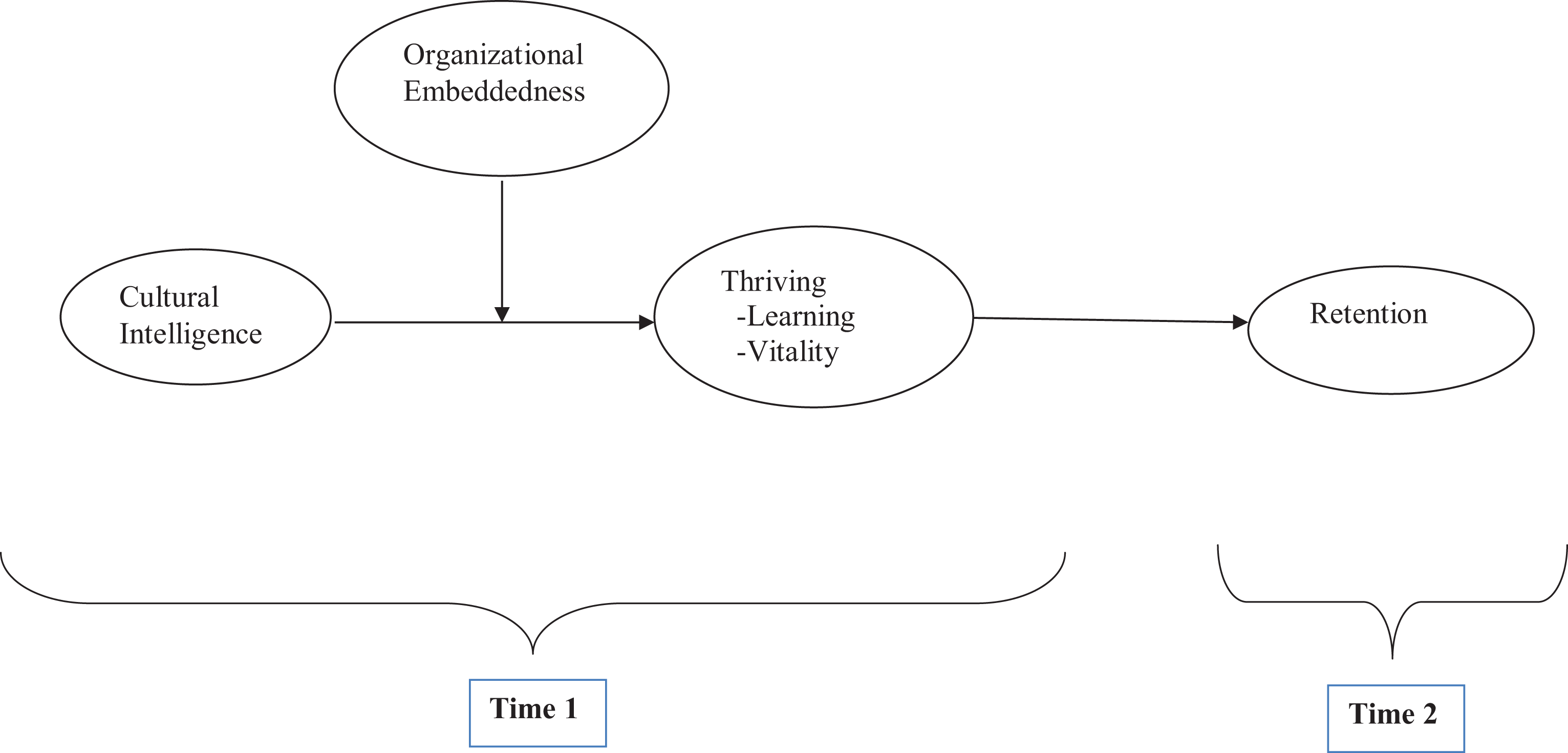
Proposed model for expatriate retention.
Cultural intelligence and thriving
Cultural intelligence is defined as “a person’s capability to adapt effectively to new cultural contexts” and is “a form of situated intelligence where intelligently adaptive behaviors are culturally bound to the values and beliefs of a given society or culture” (Earley and Ang, 2003: 26). CQ represents an important cross-cultural competence (Johnson et al., 2006), and it comprises four dimensions: (1) metacognitive CQ refers to an individual’s ability to recognize and understand new cultural information and integrate that information as working knowledge; (2) cognitive CQ refers to an individual’s cultural knowledge about different cultures; (3) motivational CQ refers to a person’s intrinsic interest and self-efficacy in adapting to different cultures; and (4) behavioral CQ refers to an individual’s ability to utilize culturally sensitive behavior when interacting with people from a different culture (Ang et al., 2007). Overall, people who are high in CQ can more easily navigate and understand different cultures, and therefore are more likely to be successful when working in a different culture (Kim et al., 2006).
In this study, we focus on CQ as a personal resource that facilitates expatriate thriving. According to COR theory, individual differences can be treated as important resources that enable people to gain work-related resources more effectively (Hobfoll, 1989). Similar to domestic relocations, international relocations entail changes in job requirements, social networks and organizational culture. For expatriates, these changes are especially challenging because of the uncertainties associated with entering a new cultural context as well as a new work environment (Black et al., 1991). During the international relocation, expatriates may be unsure about the norms and behaviors required in the host country. Uncertainty about what behaviors are appropriate in work and nonwork settings creates stress or maladjustment (Black et al., 1991). Therefore, whether expatriates themselves possess some personal resources, and in particular, cross-cultural competency (i.e., metacognitive, cognitive and behavioral CQ) and cross-cultural motivation (i.e., motivational CQ), may determine whether expatriates will thrive in their international adventure. Expatriates with elevated levels of CQ are better equipped to conform to necessary cultural differences in their assignments, possess lower stress levels, and find more enjoyment with the international experience (Shaffer and Miller, 2008). In particular, we argue that as a personal resource, CQ will enable expatriates to behave in agentic ways that culminate in thriving.
According to COR theory (Halbesleben et al., 2014), resources can produce more resources. Expatriates with greater metacognitive, cognitive and behavioral CQ are more knowledgeable about the host country’s culture, norms and behaviors, which helps expatriates to predict and find meaning in the international environment and better cope with cross-cultural uncertainties. This will help free up more cognitive resources for expatriates to engage in more task focused and relationship building behaviors that can enhance their learning capacities and boost their energy (i.e., thriving). Greater cross-cultural knowledge and competence also enable expatriates to be more confident in their interactions with host country nationals (HCNs) (Farh et al., 2010), so they can develop heedful relationships (Spreitzer et al., 2005) with HCNs, which help generate vitality and provide more opportunities for learning (Spreitzer et al., 2005). Expatriates with greater motivational CQ are more motivated to learn about the host culture, interact with host country colleagues and engage actively in their cross-cultural work role. Such motivation will result in mindful relating behaviors and task engagement which are key to vitality and learning (Spreitzer et al., 2008). Thus, expatriates who have high levels of CQ have the cognitive, metacognitive, motivational, and behavioral abilities and skills to actively engage in their work, focus on the tasks at hand, and build meaningful relationships on the assignment. That is, culturally-intelligent expatriates will have a greater capacity to engage in agentic work behaviors and invest in activities that foster thriving. CQ and its dimensions have been positively associated with expatriate adjustment and performance (Chen et al., 2011; Kim et al., 2006). Thus, we hypothesize,
The moderating role of organizational embeddedness
In line with the notion that the value of resources is dependent on the context in which they occur (Hobfoll, 1989) and resources may serve as boundary conditions that influence other resources’ effects (Ten Brummelhuis and Bakker, 2012), we conceptualize organizational embeddedness (Lee et al., 2004) as a contextual resource that provides an enabling environment for expatriates to capitalize on their CQ and thrive in the foreign culture.
Organizational embeddedness reflects the idea of being “situated or connected in a social web” (Lee et al., 2004: 712). Previous studies have examined the direct effects of embeddedness on turnover based on the notion that embeddedness absorbs shocks, thus inhibiting employee turnover (Mitchell and Lee, 2001). This notion of a shock or jarring event is defined as perceiving an unanticipated job offer, being overlooked for a promotion, or experiencing family issues (Holtom et al., 2005). Low embeddedness may make people more susceptible to shocks and cause turnover while high embeddedness reflects strong networks/relationships within the organization and serves as a strong force to make people stay (Mitchell et al., 2001). Given the central role of relational connections in the socially embedded model of thriving (Spreitzer et al., 2005), we consider organizational embeddedness as a contextual resource in our model. In particular, we expand the theoretical boundary of organizational embeddedness by suggesting that embeddedness may not only act as a shock absorber, but it may also act as a catalyst for experiencing thriving.
We argue that organizational embeddedness serves as a contextual resource that enables expatriates to efficiently deploy their personal resources toward agentic work behaviors that foster thriving. The positive effect of CQ on thriving will be amplified because expatriates will experience optimal contextual conditions to successfully utilize their CQ and ultimately thrive. In a socially embedded work environment, expatriates are well connected with host country colleagues, who can provide the instrumental, informational and emotional support to them. The connections and networks represent a variety of different resources that culturally intelligent expatriates can utilize. Without such resources, even for culturally intelligent expatriates, achieving thriving will be difficult. It also represents an enabling social context or work environment (Carmeli and Russo, 2016) that provides the opportunity for culturally intelligent expatriates to undertake agentic behaviors and engage in activities that foster their learning and vitality. That is, in a socially embedded environment, culturally intelligent expatriates are more likely to feel the sense of energy when interacting with well-connected colleagues, and will also be able to achieve greater learning capacities through their interaction within the network. Therefore, being socially embedded on the assignment will enhance the chance of culturally intelligent expatriates to thrive.
Thriving and retention
According to COR theory (Hobfoll, 1989), as resources are acquired, they are reinvested to obtain additional resources, creating a resource gain spiral. Therefore, expatriates with excess work resources (e.g., those experiencing high levels of learning and vitality) are likely to reinvest those resources back into work by remaining in their international position, where they seek more opportunities to learn the knowledge, skills, and abilities (KSAs) needed for professional growth and learning (Porath et al., 2012). This is also in line with Spreitzer and colleagues’ (2005) thriving model that describes thriving as operating through a continuous feedback loop to resources and agentic work behaviors that enable future thriving. That is, because the assignment energizes expatriates and provides opportunities for expatriates to learn, thriving expatriates will become more engaged with their work assignment when they can reinforce the stimulus that causes the positive experience.
With a boundaryless career, continuous learning can be a key driver for why expatriates continue to stay in their host organization (De Cieri et al., 2009). Also, when expatriates experience vitality in their work, they are more likely to have the energy and motivation to continue engaging in work. Moreover, given that expatriates undertake international assignments because of the personal benefits such as career development and knowledge accumulation, they should be more inclined to leave if they do not experience the perception of deep work-related learning and growth inherent in thriving. As Spreitzer and colleagues (2005) suggest, thriving serves an adaptive function that helps employees cope with their work context, and also provides internal cues that help employees to assess their own development and progress. Thriving has been found to be an important predictor of career development, employees’ general health (Spreitzer et al., 2008), performance (Paterson et al., 2014) and employee innovation (Wallace et al., 2016). Consistent with these positive outcomes of thriving, we contend that because an expatriate assignment provides the experience of learning and vitality, thriving expatriates are more likely to stay on the assignment. Thus, we hypothesize,
Methods
Data collection and sample
To test our hypotheses, we collected web survey data from expatriate teachers working in the United States (U.S.). The international teachers in our sample were all participants in a teaching abroad placement and tenure program that is facilitated by a private U.S.-based international education organization. The teachers initiated their move abroad by seeking out and applying through the international education organization that selected them into the program through a multi-step selection process. The organization verified the ability to certify them as instructors in the state where they were placed, facilitated their placement by working with various school districts, provided assistance in obtaining a J1 cultural exchange visa, and provided orientation, training, and workshops to help with adjustment to life and work in the U.S. All teachers were placed in U.S. K-12 (kindergarten to 12th grade) public schools (in 7 states). They were paid a salary by their U.S. school district and received performance reviews/evaluations through their schools. U.S. school districts paid the international education organization a placement fee.
Teachers and schools (principals) “renewed” their contract agreements at the end of every year. Teachers might be terminated and/or leave voluntarily at any time. That is, there were teachers who would leave halfway through their first year, after their second year, etc. They did not face any legal ramifications for leaving early. Similarly, the school could terminate employment at any time. The international education organization recommended a minimum of 3-year stays (as this is the estimated break-even point) with the opportunity to renew up to 5 years. After 5 years, teachers needed to return to their home country for 2 years prior to returning to the US per J1 Visa requirements (J1 visa is a non-immigrant visa issued to teachers, research scholars, professors and visitors participating in programs that promote cultural exchange).
As a U.S.-based international education organization that places expatriate teachers in local U.S. primary and secondary schools, the firm invests substantially in teacher recruitment, selection, placement, professional development and training, ongoing teacher support, and curricular resources, as well as relocation and logistical costs to facilitate successful transitions to life as a U.S. teacher. As with most organizations, the calculation of an actual return on investment (ROI: see McNulty et al., 2009, for an overview of expatriate ROI) is challenging. However, this firm estimated that, even though contracts were reviewed and renewed on an annual basis, the firm lost money, on average, on its investment if teachers terminated (voluntarily or involuntarily) their assignment before the third year. The indirect costs associated with premature terminations were also problematic in that they adversely affected the organization’s reputation and relationships with its district and school partners. Thus, this research was critical to help the organization determine, from both a selection and support perspective, expatriate educators that had the competencies and mindset to succeed and to stay for the duration of their contractual obligation.
The data was collected at two different times; expatriate teachers completed the survey at Time 1 in 2009 and the retention information was obtained from the international organization’s database at Time 2 in 2014 (i.e., 5 years later). Of the 450 surveys distributed to teachers, we received 120, giving us a 26.67% response rate.
Survey respondents hailed from 23 different countries representing the following regions of the world: Latin America including Central and South America (49.17%), Europe (15.83%), Asia (8.33%), Caribbean (6.67%), North America (3.33%), Oceania (3.33%), and Africa (2.5%). In the sample, 64.16% of the respondents were female, 25% were male, and 10.83% did not indicate their gender. The average respondent’s age was 36.57 and 53.33% were married. The respondents were highly educated, with 50.83% having a bachelor’s degree, 35% a master’s degree, and 3.33% a doctorate degree (10.83% didn’t specify). A majority of those surveyed were elementary school teachers (40.83%), with the remaining teaching middle school (22.50%) and high school (25.83%). Due to missing data on major variables, 17 respondents were removed, which resulted in a final sample of 103, providing a response rate of 23.78% (Baruch and Holtom, 2008). At time 2, we contacted the international organization that facilitated the teaching abroad program for respondents’ retention information and obtained data for 102 out of the 103 respondents (a response rate of 99%).
Measures
Cultural intelligence, organizational embeddedness, thriving and all control variables were measured at Time 1 and retention information was obtained from the international organization’s database at Time 2 (i.e., 5 years later). All measures were assessed with validated scales, and psychometric properties were good, with Cronbach alpha coefficients ranging from .79 to .94.
Cultural intelligence
Ang et al.’s (2006) instrument was used to measure CQ, which is composed of 4 sub-scales: metacognitive (4 items), cognitive (6 items), motivational (5 items) and behavioral (5 items). Response options ranged from 1 (strongly disagree) to 7 (strongly agree). Sample items for each sub-scale included: “I am conscious of the cultural knowledge I apply to cross-cultural interactions” (metacognitive), “I know the legal and economic systems of other cultures” (cognitive), “I enjoy living in cultures that are unfamiliar to me” (motivational) and “I alter my facial expressions when a cross cultural interaction requires it” (behavioral). Confirmatory factor analysis (CFA) indicated that one metacognitive item (i.e., I check the accuracy of my cultural knowledge as I interact with people from different cultures) had a cross-loading on the behavioral factor, so we deleted that item. Ang and Van Dyne (2015) indicate that the CQ construct may be best conceptualized as an aggregate multidimensional construct. Therefore, following existing studies (Elenkov and Manev, 2009; Imai and Gelfand, 2010; Koo Moon et al., 2012; Lee and Sukoco, 2010; Ramsey et al., 2011), we consolidated the four CQ dimensions to form an overall measure of CQ, with a resulting coefficient alpha of .88.
Organizational embeddedness
We used Crossley and colleagues’ (2007) seven-item scale to measure organizational embeddedness. On a 5-point Likert scale, the response options ranged from 1 (strongly disagree) to 5 (strongly agree). A sample item is “I feel attached to this school.” Coefficient alpha for this measure was .90.
Thriving
Porath and colleagues’ (2012) construct of thriving was used to measure expatriate thriving at work. On a 5-point Likert scale, the response options ranged from 1 (strongly disagree) to 5 (strongly agree). The 10-item measure is composed of two sub-scales: learning and vitality. Sample items included, “I find myself learning often” and “I am looking forward to each new day,” respectively. Consistent with Porath and colleagues (2012), our CFA showed good support for the two-dimensional factor structure of thriving (NNFI = 0.96; CFI = 0.97; IFI = 0.97; SRMR = 0.04). Coefficient alphas were .94 and .92 for learning and vitality, respectively.
Retention
Retention was measured at time 2 based on the international education organization’s database. As noted earlier, although the organization encouraged the teachers to stay at least 3 years, teachers’ contracts were reviewed and renewed annually with a maximum of 5 years due to visa constraints. Therefore, we measured retention as a continuous variable (1 through 5 years). Due to costs incurred with recruiting, training and placement, longer retention represented a superior return on investment.
Control variables
We had four demographic controls: the teacher’s age (measured in years), gender (coded 0 = male, 1 = female), marital status (coded 1 = married and 2 = not married), and time on the assignment (measured in years). Cultural novelty (Black and Stephens, 1989) was also used as a control variable because of its strong relationship with expatriate adjustment and performance (Froese and Peltokorpi, 2011; Hemmasi and Downes, 2013; Zhang, 2013). The scale for cultural novelty consisted of 7 items and was adapted from Torbiorn (1982) by Black and Stephens (1989). The respondents answered a 5-point Likert-type scale 1 (very similar) to 5 (very different) to compare their country to the U.S. Sample items included, “Everyday customs that must be followed” and “Available quality and types of food.” Coefficient alpha was 0.72. We also controlled for adjustment, which has been extensively studied and established as an important input for expatriate success and retention (Bhaskar-Shrinivas et al., 2005; Takeuchi, 2010). We used Black and Stephen’s (1989) 14-item adjustment construct, which is composed of 3 sub-scales: general, work, and interaction. Using a 5-point Likert scale, the response options ranged from 1 (very unadjusted) to 5 (very adjusted). Sample items included, “Living conditions in general,” “Specific job responsibilities” and “Socializing with host nationals,” respectively. The coefficient alphas were 0.80, 0.87, and 0.99 for general, work, and interaction adjustment, respectively.
Data analysis and results
Confirmatory factor analyses
We conducted a CFA to demonstrate discriminant validity among our theoretical variables measured with multiple scale items: CQ, organizational embeddedness, and two dimensions of thriving. To improve our parameter estimates to sample size ratio, we created item parcels for the CQ measure so that there were only 4 indicators for CQ with each dimension as one indicator (e.g., Bagozzi and Edwards, 1998). The results suggested that our hypothesized model with four correlated latent factors has a good fit (CFI = .96; IFI = .96; NNFI = .96; SRMR = .06; RMSEA = 0.07), and fit the data better than the alternative nested models (see Table 1 for the alternative models). Therefore, the CFA results provide evidence that our theoretical measures are empirically distinct.
Confirmatory factor analysis results of measurement and alternative models.

Common method variance
To assess whether common method variance was a concern for the variables collected at the same time (i.e., time 1), we used Harman’s single factor approach (Harman, 1967). For the variables collected at time 1 (CQ, organizational embeddedness and thriving), no single factor emerged and the first factor only accounted for 22% of the variance, which is significantly less than the commonly accepted threshold of 50%. In addition, we followed Lindell and Whitney’s (2001) suggestions and introduced a marker variable: role clarity. This variable was chosen as it was theoretically unrelated to the variables in the model and it was measured on the same survey. Because the marker is not theoretically related to the variables in the model, a relationship between the marker and the variables in the study was not expected. An inspection of the partial correlations among the variables, controlling for the marker, indicated that all significant correlations remained significant. This provides additional evidence that common method bias is not a concern in this study. These remedies, combined, should lessen the concerns for common method bias. Therefore, we argue that common method variance is not likely to be a serious problem in the data.
Hypotheses testing
Descriptive statistics, reliability estimates, and correlations are presented in Table 2. We used hierarchical multiple regression to test all hypotheses. In order to lessen the concerns for multicollineairy, all variables were mean-centered (Aiken and West, 1991). In addition, we checked the variance inflation factors (VIFs) and the highest value was 2.20, which was significantly less than the cutoff value of 10 (Dielman, 1991).
Descriptive statistics and correlations.

Notes: Reliabilities (Cronbach’s alpha) are in the parentheses along the diagonal.
†p < .10, *p < .05, **p < .01, ***p < .001
N = 102
Hypothesis 1 posited that cultural intelligence is positively related to expatriate thriving. To test this hypothesis, we first regressed the thriving learning and thriving vitality dimensions, respectively, on the eight control variables (Step 1a and 1b of Table 3). Then we added cultural intelligence in the two regression equations (Step 2a and 2b of Table 3). As shown in Table 3, cultural intelligence was a positive predictor of thriving learning (β = .33, p < 0.01) and thriving vitality (β = .34, p < 0.01). Therefore, Hypothesis 1 was supported. In addition, for control variables, cultural novelty was positively related to thriving learning (β = .23, p < 0.05), and gender was negatively related to thriving vitality (β = −.24, p < 0.01).
Regression results on expatriate thriving.

Notes: †p < .10, *p < .05, **p < .01, *** p < .001
Standardized coefficients are reported;
N = 102.
Hypothesis 2 proposed that organizational embeddedness enhances cultural intelligence’s positive effect on expatriate thriving. To test this hypothesis, we entered the organizational embeddedness and the interaction term, formed by multiplying cultural intelligence by organizational embeddedness, in the regression equation above (see Step 3a and 3b of Table 3). As depicted in Table 3, for thriving learning, the interaction between cultural intelligence and organizational embeddedness (step 3a: β = 0.27, p < 0.01) was positive and significant, and explained 5% of the variance in thriving learning (ΔF = 6.83, p < 0.05). We plotted the interaction at two levels of organizational embeddedness (i.e., one standard deviation above and below the mean of organizational embeddedness; Cohen et al., 2003). As shown in Figure 2, the positive relationship between cultural intelligence and thriving learning was more pronounced when organizational embeddedness was high. We further conducted a simple slopes test (Aiken and West, 1991). Our results confirmed that the relationship between cultural intelligence and thriving learning was positive and significant when organizational embeddedness was high (β = 0.76, p < .01), but not significant when organizational embeddedness was low (β = −0.10, p > .05). For thriving vitality, the interaction between cultural intelligence and organizational embeddedness (step 3b: β = 0.27, p < 0.01) was positive and significant, and explained 6% of the variance in thriving vitality (ΔF = 8.31, p < 0.01). We plotted the interaction at two levels of organizational embeddedness. As shown in Figure 3, the positive relationship between cultural intelligence and thriving vitality was more pronounced when organizational embeddedness was high. We further conducted a simple slopes test (Aiken and West, 1991). Our results confirmed that the relationship between cultural intelligence and thriving vitality was positive and significant when organizational embeddedness was high (β = 0.81, p < .01), but not significant when organizational embeddedness was low (β = −0.09, p > .05).

Interaction between cultural intelligence and organizational embeddedness on expatriate thriving learning.
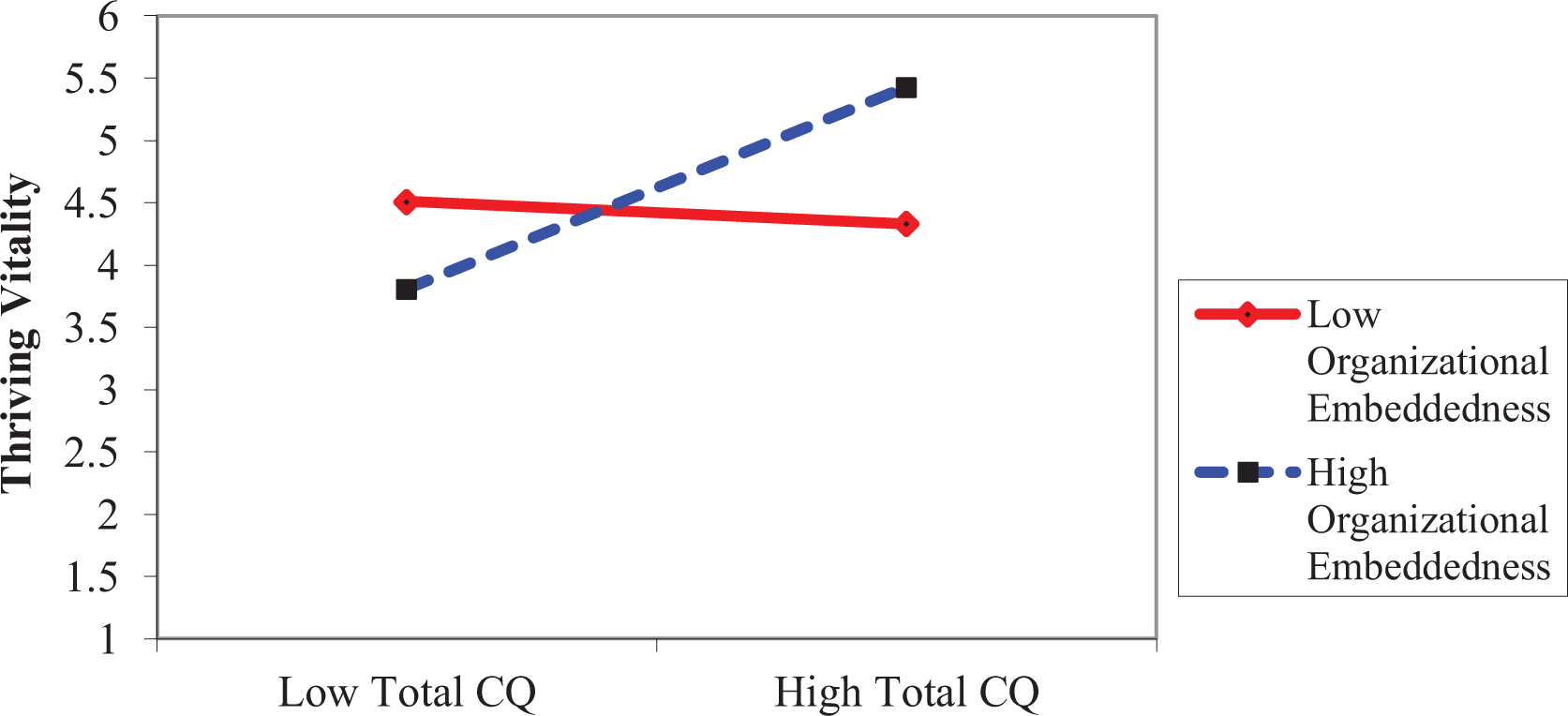
Interaction between cultural intelligence and organizational embeddedness on expatriate thriving vitality.
Hypothesis 3 stated that expatriate thriving would be positively related to expatriate retention. To test this hypothesis, we included the eight control variables and the two dimensions of thriving in the regression analysis. As shown in Table 4, thriving learning was a positive predictor of expatriate retention (β = .30, p < 0.01). However, thriving vitality was not a predictor of retention. Therefore, Hypothesis 3 was partially supported.
Regression results on expatriate retention.

Notes: †p < .10, *p < .05, **p < .01, *** p < .001
Standardized coefficients are reported;
N = 102.
Discussion
Integrating COR theory (Hobfoll, 1998) with the socially embedded model of thriving (Spreitzer et al., 2005), we examine the resource antecedents and retention outcome of expatriate thriving. Based on a sample of 102 expatriate teachers in the U.S., we found that the personal resource of cultural intelligence directly influenced thriving, and thriving led to expatriate actual retention. In addition, the contextual resource of organizational embeddedness served as a boundary condition that augmented cultural intelligence’s positive effect on thriving.
By bringing the concept of thriving to explicate expatriate experiences, we make several contributions to both global employment and thriving scholarship and international human resource management practices.
Theoretical implications
First, integrating COR theory (Hobfoll, 1998) with the socially embedded model of thriving (Spreitzer et al., 2005), we investigate personal and contextual resources that contribute to expatriate thriving. In particular, our results demonstrated the usefulness of CQ as a personal resource in influencing expatriate thriving. Recognizing the importance of CQ to expatriates, previous research has showed that CQ and its dimensions are positively associated with expatriate adjustment and performance (e.g., Chen et al., 2011). In this study, instead of focusing on cultural and job demands and maladjustment, we identify CQ as an important personal resource that can contribute to expatriate positive work experience. To thrive in global work, it is important for expatriates to possess personal resources that can help them adapt effectively to new cultural contexts and enable them to behave in agentic ways that culminate in thriving. In particular, we found that cultural intelligence was related to both dimensions of thriving: learning and vitality. Culturally intelligent expatriates are more knowledgeable about the foreign environments and less influenced by the cultural uncertainty inherent in the expatriate assignment, which will enable them to undertake more agentic work behaviors and invest in activities that foster their learning and vitality in their global work experiences.
Besides cultural intelligence as a personal resource, we also emphasized organizational embeddedness as a contextual resource in enhancing CQ’s positive effect on thriving. The concept of organizational embeddedness is from the domestic turnover literature that emphasizes a relational perspective on organizational retention (e.g., Mossholder et al., 2005). In recent expatriate literature, scholars have also begun to emphasize the importance of embeddedness in expatriate and repatriate experiences (Kraimer et al., 2012; Ren et al., 2014). For our expatriate teachers, although the international organization encouraged them to stay longer due to the large investment in the staffing process, their contracts were reviewed and renewed annually. Teachers might be terminated and/or leave at any time. Considering the restricted temporal commitment associated with an expatriate assignment, we argue that the direct value of embeddedness in expatriate retention may be reduced. However, we believe that it still plays an auxiliary role by enhancing the influence of CQ on thriving.
Organizational embeddedness denotes social connections and relationship networks that are crucial to thriving (Spreitzer et al., 2005). Extending the socially embedded thriving model that considers relational resources and contextual features as direct inputs to thriving (Spreitzer et al., 2005), we conceptualize organizational embeddedness as a contextual resource that serves as a boundary condition that influences personal resource’s (CQ’s) effect on thriving. As Ten Brummelhuis and Bakker (2012) suggest, resources may serve as boundary conditions that influence other resources’ effects. Organizational embeddedness may represent an enabling work environment (Carmeli and Russo, 2016) that provides the opportunity for culturally intelligent expatriates to undertake agentic behaviors and invest in activities that lead to learning and vitality. In particular, our data support the idea that with high organizational embeddedness, culturally intelligent expatriates are able to utilize their personal resources more efficiently to thrive on the assignment.
Although recent domestic research has begun to empirically identify potential resources and agentic behaviors as contributors to thriving (Niessen et al., 2012; Paterson et al., 2014), few studies have explored the resource antecedents to thriving in the expatriate context. By identifying CQ and organizational embeddedness as important resources that facilitate expatriate thriving, we highlight the joint contribution of both personal and contextual resources associated with global work experiences. In doing so, we also pinpoint potential boundary conditions that enable thriving. In addition, among our control variables, cultural novelty was found to be positively related to thriving learning. Previous expatriate research has demonstrated that cultural novelty was a negative predictor of expatriate adjustment (Bhaskar-Shrinivas et al., 2005). Our results here suggest that going to a totally different culture can be very challenging, however, it also creates more opportunities for expatriates to learn. From a challenge and hindrance stressor perspective (e.g., LePine et al., 2005; Podsakoff et al., 2007), cultural novelty could be considered a challenge stressor that has motivational rather than debilitating properties. While our explication of the relationship between CQ and thriving contributes directly to the cross-cultural management literature, the suggestion that cultural novelty is a motivational force in the development of expatriates opens new avenues for better understanding the role of cultural variables in cross-cultural management research.
Second, by integrating COR theory and the socially embedded model of thriving, we introduce a novel lens for examining one indicator of expatriate success—retention. In particular, we go beyond the dominant emphasis in the expatriate literature on expatriate adjustment problems (Bhaskar-Srinivas et al., 2005) to highlight the thriving experience of expatriates. Current views of international assignments cast expatriates as having to respond to uncertainty stressors, and emphasize the adjustment problems faced by expatriates (cf. Ren et al., 2014). This stream of research has advanced our knowledge on expatriation, in particular with respect to why expatriates terminate their assignments (e.g., Shaffer and Harrison, 1998), but few studies have explored the positive experiences of expatriates and the reasons why expatriates stay on the assignment (cf. Ren et al., 2015). We contend that the experience of learning and vitality on the assignment can be particularly important for expatriates and may eventually drive expatriates’ decisions to continue their stay. Our analyses demonstrated that the learning dimension of thriving directly contributed to expatriate retention. From a boundaryless career perspective, increased competence and access to new learning are the driving forces for considering alternative work (Arthur et al., 2005). Thus, for expatriates, learning may be a more essential dimension in their career success than the feelings of vitality alone. Overall, we contribute to the global management literature by identifying thriving as an essential factor in expatriates’ decisions to stay.
Finally, it is also worth noting that we based our study on a sample of expatriate teachers in the U.S. and this sample represented some qualities of both corporate assigned expatriates (AEs) and self-initiated expatriates (SIEs) (Cerdin and Le Pargneux, 2010). AEs are employees who are sent by their home organizations to international posts in order to fulfill a specific role, with the intention to repatriate back to the home country once the assignment is completed (Guzzo, 1997). The expatriate teachers in our sample are similar to AEs because they had support from a sponsoring organization and they were assigned to different schools by the sponsoring organization. However, this sponsoring organization was not their actual employer—but they did recruit and provide some training for the international teachers, and place them into different schools. Because of their large investment in this process, they were interested in improving the retention of teachers—and thereby improving their return on investment. The international organization also sponsored international teachers’ J1 visa, which restricts employment in the U.S. to 5 years. That is, all teachers must leave at the end of their 5th year.
The expatriate teachers in our sample are also similar to SIEs. SIEs are individuals who look for a global employment opportunity and make their own arrangements to relocate to a foreign country (Cerdin and Selmer, 2014; Doherty, 2013). The teachers in our study actively sought an international assignment—and, in fact, they had to quit their job in the home country in order to accept the “assignment” in the host country. Therefore, our sample is somewhat unique in that it does not fall into one camp (i.e., assigned expatriate) or the other (i.e., self-initiated expatriate). Although our sample is a hybrid of assigned and self-initiated expatriates, as noted in the introduction, they do meet the four conditions specified by McNulty and Brewster (2017) for business expatriates. As McNulty and Brewster (2017) note, researchers have for too long used the term “expatriate” loosely and without clear definitions. We agree with their arguments, and while we also concur with the boundary conditions specified, we note that there is still considerable variation within the “business expatriate” population. Rather than being a cause for concern, however, we see this as a basis for generating future research questions. In our case, we recognize some of the unique features of our sample and encourage researchers to examine our model with other types of business expatriates (Baruch et al., 2013). In doing so, we make a contribution by adding to the conversation about what is an expatriate.
Practical implications
Our study has important practical implications for organizations. First, in terms of practical outcomes for organizations, it should be noted that the international education organization that facilitated placement and visas for the teachers prioritized this research given its implications for return on its investment. This organization facilitated the teacher recruitment, selection, placement, orientation, professional development and training, ongoing teacher support staff, and provided curricular resources, by investing significant money in each teacher and relied on their successful retention for a return on investment. Thus, the stability and longevity of expatriate teachers’ tenure were valued by the international organization because longer tenure indicated more profitability in terms of their return on investment.
On the other hand, when teachers either resigned or were terminated by the school district in the early stage of the assignment, the organization lost money on its investment. Early resignation/termination was also a detriment to the organization’s reputation and relationships with its district and school partners. Expatriates who resigned or were terminated mid-year were especially problematic as the organization had to immediately replace them from the recruitment pool so not to disrupt the school year for students and the school community. Given return on investment is an important consideration for organizations employing expatriates, this study helped identify factors from a selection and in-country support perspective that organizations can focus on in improving expatriate retention.
In particular, our study suggested that CQ is an important personal resource that promotes expatriate thriving. Therefore, in addition to selection criteria based on expatriates’ specialized KSAs, organizations should also consider the CQ level of expatriates. Host organizations with larger expatriate populations are also advised to offer cross-cultural training to enhance expatriates’ CQ. If expatriates are able to grasp new culture information and integrate the information into their daily interaction with host country colleagues, they will be more likely to thrive at work and stay in the host organization. Based on our findings, organizations should help expatriates become embedded by creating avenues for developing strong relationships and social networks in the workplace. This could take the form of social activities that allow expatriates to informally interact with coworkers and develop interpersonal relationships with them. Cultivating expatriates’ cultural intelligence while fostering expatriate embeddedness in the workforce will enhance thriving.
Limitations and suggestions for future research
Our findings should be interpreted in light of several limitations. One limitation is that we did not have data on those international teachers who did not respond to our first survey. In this case, we were not able to assess non-response bias. Also, we used cross-sectional data to examine the antecedents of expatriate thriving. The potential common method variance may have inhibited our ability to assess CQ’s ability to predict thriving. However, we did employ a two-wave data collection and measured expatriate actual retention with a 5-year time lag. We also proposed and found evidence for moderated relationships between CQ and expatriate thriving, which should be less influenced by common method variance (Evans, 1985). In addition, Harman’s single factor approach and the test of a marker variable suggested that common method variance was not a serious concern in our data. Nevertheless, a more rigorous test of our model would be to collect data at three different times with repeated measures from multiple sources. Thus, we continue the call for more multi-source data and longitudinal designs in expatriate research.
In addition, based on COR theory, we emphasized CQ and organizational embeddedness as important resources that contribute to expatriate thriving. Future research is needed to investigate other personal/contextual resources or agentic work behaviors, such as proactive socialization tactics (Ashford and Black, 1996), and their effects on expatriate thriving. We call for more research to test serial multiple mediation models on the relationship among resources, agentic work behaviors, adjustment, thriving and expatriate performance using longitudinal designs.
With regard to the unique features of our sample, as noted earlier, we define our sample as business expatriates based on the four boundary conditions proposed by McNulty and Brewster (2017). However, our sample spans both AE and SIE categories. Although we have no reason to suspect that our findings will not generalize to other samples, it is only by testing our ideas across multiple samples that we will be able to establish external validity. We believe that our model should apply to both AEs and SIEs, who relocate to a foreign culture for global work experiences. During this process, both groups face the uncertainties of a new cultural and organizational context, and the challenge of achieving congruence with both work and cultural environments. Thus, personal resources such as CQ and contextual resources like organizational embeddedness should be instrumental for both groups to thrive on their assignments.
The world of expatriate workers has grown more complex and diverse since the labels of SIE and AE were first developed, and the distinction between AEs and SIEs is not always clear-cut. Therefore, we as researchers need to focus more on the context of the “assignment.” In this study, participants initiate their own international experience, but they also receive support from a home country organization (i.e., the sponsoring organization). Consequently, they span both AE and SIE categories. Based on the definition, the major differences between AEs and SIEs seem to be that AEs are “assigned” by their employer and consequently they receive relocation support from that employer. In contrast, SIEs pursue their own foreign experience and may or may not receive support from their employer (which may be an MNE or a local firm). Given our model does not include any of the distinguishing criteria (i.e., organizational support or proactive-seeking behavior) that differentiates AEs and SIEs, we believe that it applies to both types of expatriates. Still we acknowledge that our sample may differ from other forms of business expatriates (McNulty and Brewster, 2017) or other international professionals (Suutari and Brewster, 2000). Therefore, we encourage researchers to test our model using more traditional corporate managers as well as self-initiated expatriates—and those on different types of work visas and in different professional industries.
Conclusion
We have extended theory in the expatriate literature by drawing particular attention to the importance of thriving in expatriate experiences. Using two-wave panel data from international teachers in the U.S., we not only demonstrated the usefulness of CQ and organizational embeddedness as two important resources in explaining expatriate thriving, but we also illuminated the influence of thriving on expatriate retention. Future research is encouraged to further explore the thriving experiences of expatriates.
Footnotes
Declaration of conflicting interests
The author(s) declared no potential conflicts of interest with respect to the research, authorship, and/or publication of this article.
Funding
The author(s) received no financial support for the research, authorship, and/or publication of this article.
