



Abstract
Research on discrimination and inequality has seen a significant increase in workplace religious discrimination toward Muslims. However, it is not well understood how macro-societal, meso-organizational and micro-individual factors contribute to workplace discrimination toward Muslims. Using a systematic literature review (SLR), this study analyses 134 articles to frame a comparative lens of discrimination toward Muslims in Muslim-minority and Muslim-majority countries. This study reveals different discrimination patterns in both country types. In Muslim-minority countries, only the macro-societal level factors are consistently linked to blatant discrimination form while the other two levels (meso-organizational and micro-individual) contribute towards a mixture of blatant and subtle discrimination incidents. Meanwhile, Muslim-majority countries' discrimination cases specifically occur towards women in subtle manners at each level. The different discrimination patterns in the two country types also leads to other notions such as the logic of in-group discrimination toward Muslim women in Muslim-majority countries and the repositioning of gender and religious identities.
Introduction
Following the proliferation of workplace diversity issues, the workplace discrimination topic has caught many management scholars' attention (Deitch et al., 2003). This paper focuses on religious discrimination discourse, particularly toward Muslims or people with Islamic beliefs. This topic is stimulating due to several reasons. First, concurrently, Islam is the world’s fastest-growing (Lipka and Hackett, 2017) and one of the most marginalized religions (Pemberton and Takhar, 2021). Second, many studies (e.g. Masci, 2019; Scheitle and Ecklund, 2020) report discrimination cases against Muslims. Third, the discrimination against Muslims in the extant literature covers the complete type of discrimination varieties: formal and interpersonal (Ghumman and Ryan, 2013; King and Ahmad, 2010); subtle and blatant (Hendriks and Van Ewijk, 2017; Pasha-Zaidi, 2015); direct and indirect (Baldi, 2018; Golesorkhi, 2017).
This paper mainly compares discrimination toward Muslims in Muslim-majority and Muslim-minority countries. Past discrimination literature has put equal focus on discrimination cases toward numerically smaller (minority) groups (e.g. Karlsen and Nazroo, 2002; Nora and Cabrera, 1996) and numerically larger (majority) groups (e.g. Gaertner and Insko, 2000; Mummendey et al., 1992). However, particularly for religious discrimination, most studies concerning discrimination toward Muslims only focus on discrimination cases in which Muslims are the minority (e.g. Ghumman and Ryan, 2013; King and Ahmad, 2010). This disproportion creates a gap of knowledge surrounding the differences in discrimination cases toward Muslims while they bear the minority and majority statuses.
Triggering the choice of this particular comparative frame was the author’s initial observation after reading several papers on discrimination toward Muslims. The authors noticed that a few papers (e.g. Afiouni, 2014; Vidyasagar and Rea, 2004) discuss discrimination toward Muslims in Muslim-majority countries. This initial observation revived the notion of ‘intergroup discrimination’ (initially coined by Tajfel in 1970 and further popularized by other researchers, such as Leonardelli and Brewer, 2001) as an arguably more complex discrimination phenomenon than discrimination cases against minorities (Brewer and Kramer, 1985).
Discrimination exists everywhere regardless of whether a country is Muslim-minority or Muslim-majority. Nevertheless, according to Social Identity Theory (SIT), discrimination will likely happen toward out-group rather than toward in-group (Tajfel, 1970). That postulation makes the author’s initial discovery somewhat unique as it seemingly portrays the inconsistency of SIT, where discrimination toward Muslims also happened in Muslim-majority countries, toward those supposedly perceived as an in-group. Considering that the discrimination toward Muslims in Muslim-majority countries restrictedly applies to particular identity (sub) groups, this paper also potentially rejuvenates further the understanding of identity that commonly lies as the basis of discrimination.
Consequently, the author applies a multilevel analysis approach to better depict the factors contributing to workplace discrimination toward Muslims in Muslim-minority and Muslim-majority countries. Scholars (e.g. Hannah and Lester, 2009; Héliot et al., 2020) increasingly encourage the use of multilevel analysis to better understand the contexts that influence the dynamic within the workplace. Through a multilevel perspective, a paper might probe into a holistic understanding of the relationships among factors within various levels (macro-societal, meso-organizational, and micro-individual) that create discrimination toward Muslims (Al Ariss and Syed, 2011; Ali et al., 2017). A multilevel perspective will also be helpful to generate similarities and differences in the comparison of discrimination toward Muslims in Muslim-minority and Muslim-majority countries.
Additionally, such a unique comparative framing also echoes previous studies’ approaches to contrasting Muslim-majority and Muslim-minority countries on workplace discrimination issues (e.g. Al Ariss and Sidani, 2016; Spierings, 2014a). While scholars (e.g. Gebert et al., 2014; Richardson, 2014) argue that creating universal diversity management guidelines is nearly impossible, a review involving many published articles might convey some hints of how religious employees (particularly Muslims) should be managed in different contexts. These hints are arguably important for being the basis of future religious diversity management discourses. This spirit aligns with the growing scholarly attention (e.g. Cohen and Barbour, 2017; Dolansky and Alon, 2008) to put more effort into examining the way religious diversity in the workplace should be managed, while still taking cultural and demographic factors into account (Gelb and Longacre, 2012; Syed et al., 2017).
In so doing, this paper will also provide argumentations about making sense of discrimination cases toward Muslims in Muslim-majority countries. Furthermore, the paper will present an overview of ‘identity’ term comprehension, following the confusion upon irregular in-group discrimination cases. This identity discourse is relevant with many studies' (e.g. Eckes et al., 2005; Latif et al., 2018) recommendation that a simple categorization of ‘Muslim’ as an identity is excessively stereotypical, simplifies reality, is precarious to articulate particular subgroups' characteristics and is inadequate to depict the existent religious discrimination toward Muslims. From a broader perspective, this paper contributes to cross-cultural management discourse by analyzing the multifaceted religion-based discrimination cases in different cultural contexts.
Finally, this paper addresses two main questions: 1) What factors at various levels constitute workplace discrimination toward Muslims in Muslim-minority and Muslim-majority countries? and 2) How do these factors at various levels interrelate to one another to shape workplace discrimination toward Muslims?
Literature review
Workplace Discrimination
The United Nations (Principle 6 UN Global Compact, n.d.) defined discrimination in the workplace as “treating people differently or less favorably because of characteristics that are not related to their merit or the inherent requirements of the job.” The characteristics commonly act as the basis of discrimination include race, color, religion, sex, and migration status. The use of the ‘discrimination’ term continuously goes hand in hand with ‘stereotype’ and ‘prejudice’ terms. Cheung et al. (2016) clarify the use of these intertwined terms, explaining that discrimination is a behavioral display resulted from biased perceptions (stereotypes) and attitudes (prejudice). From the author’s reading on the collected and filtered articles, the author notices several pairs of religion-based discrimination forms, which are subtle-blatant (Van Laer and Janssens, 2011), formal-interpersonal (Ghumman and Ryan, 2013), and direct-indirect (Ball and Haque, 2003).
The aforementioned discrimination form pairs are fundamentally connected one to another. Subtle form connects to interpersonal and indirect forms of discrimination as these three share common features like being unconsciously exercised, vague, and taking place in day-to-day encounters (Park et al., 2009). On the other hand, blatant, formal, and direct discrimination forms share similar attributes such as being visibly and straightforwardly exercised (Van Laer and Janssens, 2011). Nevertheless, on further investigations, each discrimination form within similar discrimination groups also has distinct characteristics. Hence, the mixture of two seemingly contrasting forms of discrimination might happen in the same cases, like subtle yet formal or blatant but indirect discrimination (Lindsey et al., 2015). For the sake of simplification, in the following sections, the author will only use ‘subtle’ and ‘blatant’ terms to describe incidences belonging to each particular discrimination grouping, as mentioned earlier.
The extant discrimination literature has seen a growing focus towards subtle discrimination rather than blatant discrimination (for an overview, see, for example, Deitch et al., 2003; Van Laer and Janssens, 2011). Scholars (e.g. Brief et al., 2000; Cortina, 2008) capture this growing trend and promote the use of ‘modern discrimination’ to further denote the subtle, vague, and unconscious behaviors that discriminate particular individuals. Although subtle discrimination seems trivial, scholars (e.g. Deitch et al., 2003; Jones et al., 2016) suggest that the consequences of subtle discrimination are at least as significant, if not more significant than overt discrimination.
Discrimination toward Muslims in the workplace
Religion is among the protected classes, or the identities frequently contribute to workplace discrimination (Cheung et al., 2016). Religion as an identity has several distinctive natures compared to other identities that potentially trigger workplace discrimination. Among the uniqueness of religion as an identity highlighted by Ghumman et al. (2013) are that religion is concealable and based on belief values. While it is true that religion is concealable in general, such a feature does not apply to those who have to show their religion in public. Despite several views of hijab as an obligation, the foremost argumentation is that Muslim women have to wear a hijab in front of non-mahram (a person with whom marriage is generally permissible), hence makes them among those who are required to show their religion publicly. Furthermore, Muslim as a belief system is oftentimes perceived wrongly which subsequently provokes discrimination toward them. Based on the depictions of hostility, violence and untrustworthy prejudice of events conducted by particular Muslim groups, there will be a negative evaluation toward Muslims in general (Sides and Gross, 2013).
As briefly mentioned in the introduction, religious discrimination can happen everywhere toward members of all other religious, not restricted to Muslims. Social identity theory suggests that discrimination typically occurs toward those who belong to other group identification (out-group) rather than toward those who belong to the same group (in-group) (Tajfel, 1970, 1974). That explains religious discrimination that commonly targets religious minorities (Akbaba, 2009; Fox, 2000). Following SIT’s logic, discrimination starts with the classification and categorization of surrounding individuals, then the in-group and out-group categories appear (Tajfel and Turner, 1986). Ashforth and Mael (1989) argue that social classification sets out two functions, first to cognitively segment and order the surrounding environment and second to enable individuals to locate themselves in the social setting. Such classification will augment individual differences, which in turn demystify the line between minority and majority. Hence, seeing the reports of discrimination toward religious minorities like non-Muslim in Muslim-majority countries (Akbaba, 2009; Fox, 2013) or toward Muslims in Muslim-minority countries (Ali et al., 2015; Salahshour and Boamah, 2020) are rather unsurprising.
Discrimination toward Muslims in Muslim-majority countries
While the discrimination case toward Muslims in Muslim-minority countries can be easily understood, the claim that Muslims' discrimination also exists in Muslim-majority countries requires a deeper analysis. The discrimination toward Muslims in Muslim-majority countries mainly happens against particular sub-identities, such as workplace discrimination toward Muslim women (e.g. Afiouni, 2014). The problem is deeply rooted in the conception of modesty as being taught by Islamic teachings, which has been multifariously translated and transformed in practices (Syed, 2010). Originally designated as the protective establishment for Muslim women, Muslim women’s modesty grows as a dogma that negatively stigmatizes working Muslim women. The logic behind this stigmatization is similar to what Saguy (2013) describes in the growing negative stigma for obese individuals. The negative stigma was started with the campaign that fat is a threat to an individual’s health; hence, the government declares its commitment to reduce obesity. The continuous campaign against obesity elicits a negative accusation that an obese person is irresponsible and weak, and this eventually results in weight-based discrimination (Lamont et al., 2014).
The same is true for working Muslim women. Where the instilled ideal image of Muslim women is represented by those staying at home, those working potentially incur negative stigmatization. Nevertheless, such stigma is not entirely justifiable as in general, Islam does not prohibit women from working (Predelli, 2004; Syed, 2008a). In addition, there are several cases where women ‘must’ work, like the case where they are a single parent or where particular occupations such as midwifery will deem more suitable to be filled by women rather than men. Working Muslim women are also expected to obey various religious tenets at work, like regulated interaction with male co-workers and to cover all of their body parts except for the hands and face (Bouma et al., 2003).
While the common assumption tends to fault Islamic teachings as the source of systemic inequities toward women (Masood, 2019), the literature arduously proves that Islam acts as the sole factor contributing to workplace gender inequality. Mostafa (2003) found no significant differences between Egyptian Muslims and non-Muslims regarding the views of women who work. The finding provides an assumption that local cultures rather than religion are the more substantial factor generating workplace inequality for women. Elamin and Omair’s (2010) study in Saudi Arabia, where Islam originated, also found that other factors besides religion like age, education level, marital and employment status influence the views of working women. Furthermore, other scholars (e.g. Hendriks and Van Ewijk, 2017; Korotayev et al., 2015) argue that culture instead of religion primarily drives the patriarchal value. Nevertheless, the data shows that Muslim-majority countries' gender labor participation gap is generally higher than those unaffected by Islamic values (World Economic Forum, 2021).
The author suggests that workplace discrimination toward Muslim women can still be categorized as religion-based discrimination cases. Islam perceives male and female gender as ‘equal but different’ where each gender has different economic and societal tasks (Metcalfe, 2006). Consequently, societies that adhere to Islamic principles likely cultivate gendered cultures and practices in daily and organizational lives (Arifeen and Gatrell, 2020; Hutchings et al., 2012). In conclusion, what is seen as ‘gender discrimination' 1 toward Muslim women in Muslim society today is inseparable from the religious tenets. Hence, to label it religion-based discrimination is supposedly justifiable.
Beyond discrimination toward Muslim women, similar argumentations also apply to other discrimination cases targeting Muslims in Muslim-majority countries. If the bias manifests due to religious reasons, the author argues that it is a part of religion-based discrimination.
Method
This paper employs a literature review method to see the field from a comprehensive outlook. Snyder (2019) suggests that literature review methodology enables researchers to fuse evidence from many interdisciplinary studies, potentially developing theoretical and practical understanding of the topic. A literature review will also answer the calls from researchers in this field (e.g. Masood, 2019; Naseem and Adnan, 2019; Sav, 2019) to consider various factors contributing to workplace discrimination toward Muslims. The author searched for the literature until the end of October 2020, hence relevant articles published after that period are not included in this study.
This study collected initial 1055 articles from the combination of keywords and title searches in the Scopus database through ‘Publish or Perish 7′ software. The chosen keywords for the searches represent three areas comprise the research’s topic, which is ‘the main object’ (keywords: Islam; Muslim), ‘the context’ (keywords: work; workplace; employment; career; job), and ‘the main issue’ (keywords: struggle; challenge; problem; discrimination). Through the first screening, the number of papers decreased to 472. Over the final screening stage, 134 papers were sorted and deemed relevant to the research topic. This number is close to the mean number of article size (139) in typical systematic literature review studies in the management field (Hiebl, 2021).
Inclusion-exclusion criteria
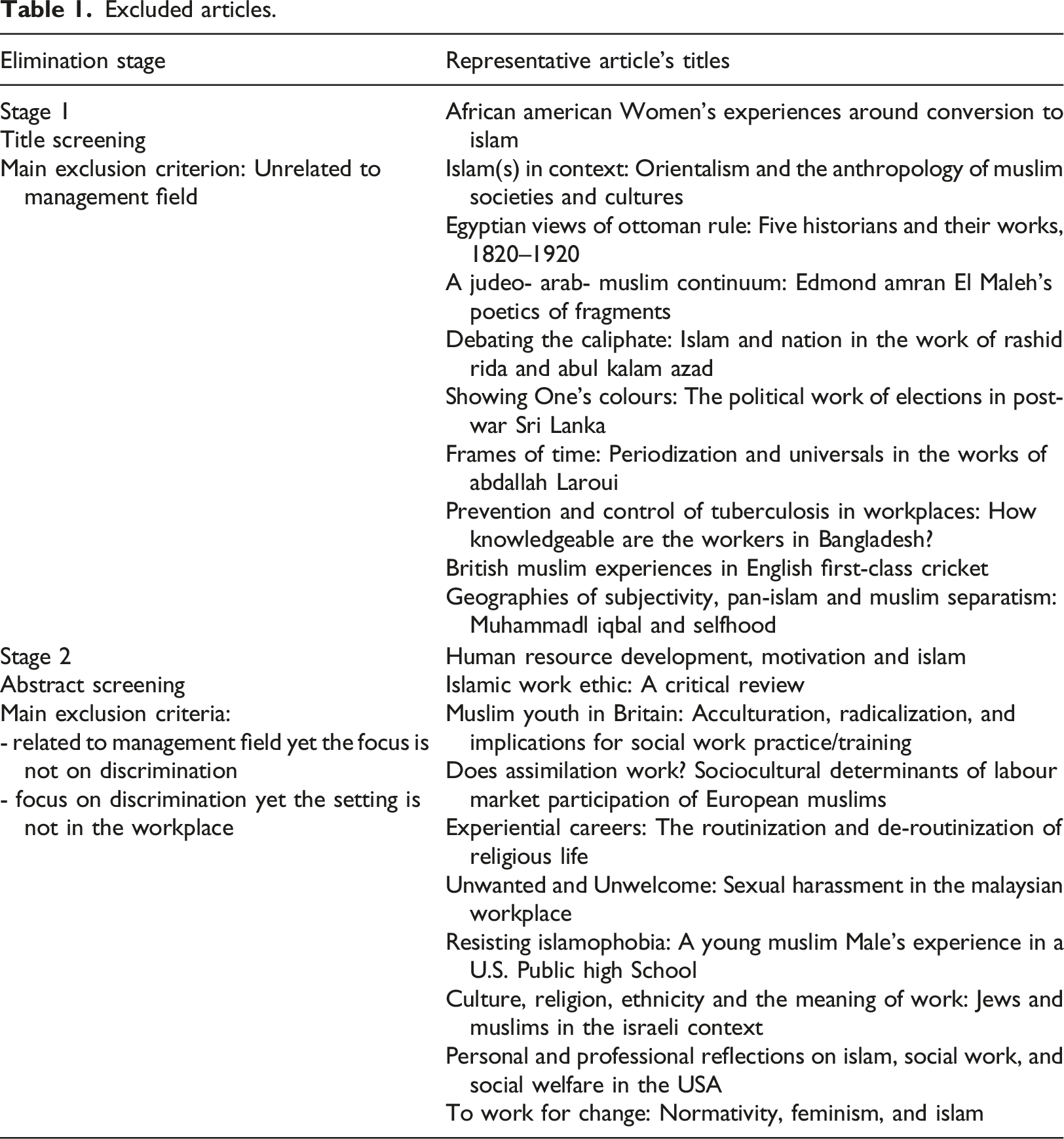
This study’s inclusion and exclusion procedures started early from the use of Scopus' journal database as the pool of potential articles. By only selecting the articles published in a Scopus-indexed journal, the pieces of literature fulfill several criteria such as being written in English and peer-reviewed. During the literature gathering processes, the author encountered articles from various fields such as organizational behavior, political science, medicine, and education. The author conducted two screening stages which are title screening and abstract screening. Title screening was used to filter the articles based on the title; an article whose title is not related to the management field was excluded. Among the excluded articles focus on the thought or work of Muslim figures, history, geopolitics in the Middle East, Africa and other Muslim-majority countries or regions, to mention a few.
Excluded articles.
The reviewed articles with Muslim-minority countries setting.

The reviewed articles with Muslim-majority and mix countries setting.

Findings
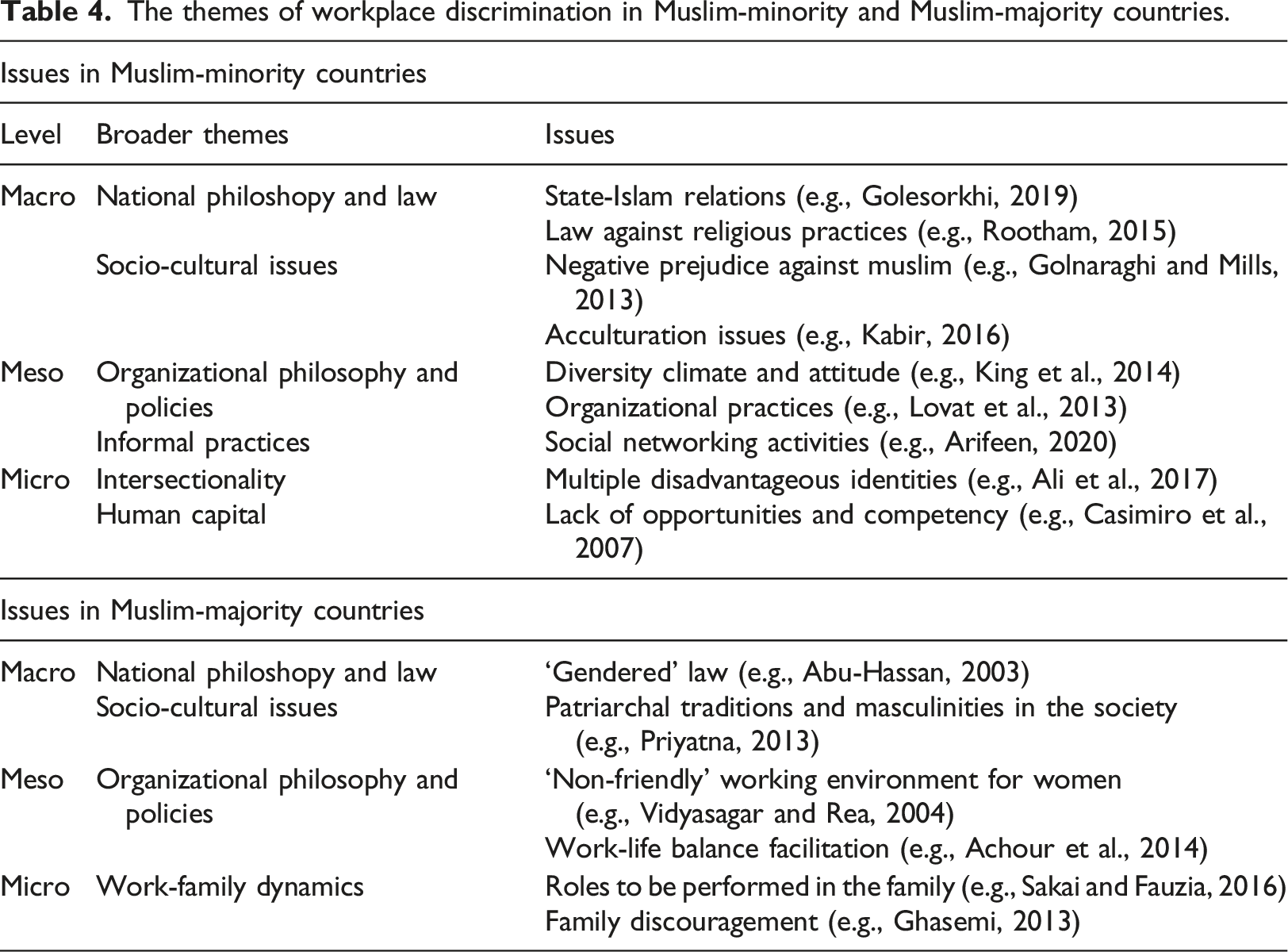
The themes of workplace discrimination in Muslim-minority and Muslim-majority countries.
Muslim-minority countries
Macro-level issues in Muslim-minority countries revolve around conditions that do not accommodate Muslim practices and the negative sentiment toward Muslims. National philosophy and law in several Muslim-minority countries bluntly limit career opportunities for Muslims. Among the most notable examples for this is France with its Laïcité (secularity) principle that stimulates the laws to put aside religions from the workplace, which generates difficulty at work for Muslims (Rootham, 2015). Secular national philosophy affects the laws enacted in the country and influences the socio-cultural issues within the country. It makes the dominant group in France express prejudice and hostility toward the group perceived as distant from the values embraced by the nation, including Muslims (Croucher, 2013). Such a case is not restrictedly an issue in France but also in Western societies like the USA and most European countries (Golesorkhi, 2019). On the societal level, Muslims also bear negative associations linked to terrorism for men (Dwyer et al., 2008) and the oppressed and backwardness for women (Golnaraghi and Mills, 2013).
Most meso-level discriminatory problems in Muslim-minority countries come from the incongruity between organizational and Islamic practices. Studies reported that Muslims face troubles at work because of social networking activities that involve alcohol consumption (Arifeen, 2020; Scott and Franzmann, 2007; Shah and Shaikh, 2010) and difficulty to perform prayers as formally regulated by the organizations (Liao et al., 2017; Lovat et al., 2013; Sekerka and Yacobian, 2018). In addition to the challenges resulted from organizational policy and custom, Muslims in Muslim-minority countries also face discrimination from work-related stakeholders like customers, managers and co-workers. The discriminatory practices from the customers are in the form of rejection to be served by Muslim employees or negative responses to Muslim employees (Reeves et al., 2012; Robinson, 2016). Discriminatory practices from co-workers ranges from undesirability to have Muslims as work colleagues (King et al., 2014) to intimidation, harassment and biased comments and jokes (Ball and Haque, 2003; Malos, 2010). Meanwhile the issues with managers typically revolves around discriminatory hiring and HRM practices (Casimiro et al., 2007; Forstenlechner and Al-Waqfi, 2010; Ghumman and Ryan, 2013).
From a micro-individual perspective, the multiple identities deemed distant from society’s standard create a problem directly related to discrimination, identified as intersectionality (Crenshaw, 1989; Khattab et al., 2018; Tariq and Syed, 2017). Among the identities that commonly accumulate discrimination toward Muslims are migrant status, race and gender (Ali et al., 2017; Murray and Ali, 2017; Tariq and Syed, 2018). Human capital also frequently becomes an issue that triggers workplace discrimination toward Muslims in Muslim-minority countries. Muslims, especially those bearing immigrant backgrounds, tend to have insufficient skills to secure employment and to advance their career progression at work (Casimiro et al., 2007). Furthermore, Muslim immigrants come from distant races compared to the locals, where these Muslims are working. James (2000) found that race moderates the relationship between human capital and career progression, indicating discrimination against a particular race.
Muslim-majority countries
In Muslim-majority countries, the discriminatory factors are somewhat biased toward male superiority, which challenges women. Researchers (e.g. Abu-Hassan, 2003; Koburtay et al., 2020; Özbilgin et al., 2012) note, even though in general most Muslim-majority countries have long promoted gender equality at work, in some parts the laws are ‘gendered’ and implicitly discriminatory for women. Nevertheless, the more significant concern lies in the socio-cultural issues such as patriarchal values and gender roles that believe Muslim women are mainly responsible for household matters (Afiouni, 2014; Lunn, 2006; Priyatna, 2013). The aforementioned socio-cultural factors influence the way Muslim women choose and advance their careers.
In Muslim-majority countries, the glass ceiling acts as the primary meso-level discrimination toward women (Ghasemi, 2013; Vidyasagar and Rea, 2004). The glass ceiling implies an invisible barrier that inhibits a particular group (typically gender group, i.e. women) from advancing to the top of the hierarchy (Cotter et al., 2001). Such a barrier is problematic as working Muslim women do not have equal chances to progress in their careers as Muslim men do. On the other hand, working Muslim women also face challenges indirectly related to discrimination. For example, Muslim women are expected to balance work and family as inspired by societal norms that assume Muslim women are mainly responsible for domestic matters. This specific condition applies for all women and it may impact their career progression (Achour et al., 2015; Özbilgin et al., 2012).
Meanwhile, at the micro-individual level, the issues are encircled in work-family dynamics. As there is a relatively clear division between the tasks performed by males and females (where females will mainly be responsible for household matters), female career or work-related matters tend to be adjusted accordingly (Achour et al., 2014; Sakai and Fauzia, 2016). Acker (2006, p. 445–446) suggests that the condition where women ‘must make adaptations to the expectation that interfere with family responsibilities and with which they are uncomfortable’ belongs to the masculine-stereotyped job behavior pattern. Such practices will create inequality regimes which are closely related to discrimination practices.
Discussions
Driven by the two main questions mentioned in the introduction, the discussion section will focus on comparing each level of discrimination pattern in Muslim-minority and Muslim-majority countries and will review the cases of workplace inequality in Muslim-majority countries against Muslim women.
Pattern comparisons
The probe on each level shows that all factors in Muslim-majority countries led to a subtle form of discrimination. Starting from the ambiguous interpretation of the law, solid male domination within societal norms, non-friendly working environment for Muslim women, lack of work-life balance facilitation to the enhancement of women’s role indirectly pushed Muslim women aside from equal workplace competition. The cases are somewhat different in Muslim-minority countries where a mixture of both subtle and blatant discrimination was exercised toward Muslims. There is a particular exception for the macro-societal level, which strongly associated with the blatant form of discrimination. To understand these different patterns, one has to look more closely at each country’s general characteristics.
Almost all of the Muslim-minority countries being evaluated in this study belong to the Western category. Henrich et al. (2010) popularized the WEIRD term, which stands for Western, Educated, Industrialized, Rich and Democratic, to characterize western societies. The democratic value highly endorsed in the WEIRD countries, mixed with the secular value embraced by the Western society, lead to the vigorous enforcement of freedom of speech which frequently disregards the sacred value of religion. Henceforth, the exchange between freedom of speech and blasphemy arises as a heated public debate, contrasting WEIRD and non-WEIRD (commonly Muslim society’s, if the case is related to Islam) perspectives (Green, 2014; Peterson, 2007). This principle also might explain the forthright manner of hatred toward Muslims shown by right-wing politicians in Western society.
In contrast to the values embedded in Western society, Muslim-majority countries are often reckoned as uneasy with democratic values (Karatnycky, 2002). The Islamic tenets were often not deliberately practiced within Muslim-majority countries, hence creating paradoxes and gaps between the teaching and the actuality, such as the actualization of gender equality and freedom principles in Islamic countries (Rowley and Smith, 2009; Syed et al., 2009). The relatively minimum democracy value leaves the pre-established practices largely uncontested. Such a condition is relevant to the modern form of discrimination argued by Deitch et al. (2003). The discrimination perpetrators commonly buttress their prejudiced view on non-racially based argumentations, which in this case lean on religious pretext or societal customs. The same is true for meso-level variables in Muslim-majority countries, where workplace facilities and the environment are not set to accommodate the specific needs of women employees. Probably such inconsideration is not due to an ill-intentioned mindset, but more on account of a taken-for-granted belief that the workplace is an arena for men.
Similar logic partly applies to Muslim-minority countries' meso-level factors. The taken-for-granted rationale says the workplace should be a secular sphere, which means that Muslim’s concerns at work (e.g. to conduct prayer, avoid alcohol, eat halal) will likely be overlooked. In addition to that, there are also few meso-level cases in Muslim-minority countries that apply blatant discrimination toward Muslims. Van Laer and Janssens (2011) conceptualize blatant discrimination as overt, deliberate, identifiable and commonly can be confronted on legal grounds. Several researchers (e.g. Cavico and Mujtaba, 2011; Malos, 2010) remark that some discrimination cases toward Muslims in Muslim-minority countries ended in court, indicating its blatant form. This applies to both meso and micro discrimination in Muslim-minority countries. Blatant forms of discrimination are typically settled under legal jurisdiction.
The last pattern discourse concerns the subtle discrimination as triggered by micro-individual factors. Though the discriminations in both country types are categorized under the same subtle term, on further elaboration the cases between the two country types are fundamentally different. Bobbitt-Zeher (2011) differentiates stereotyping cases (that eventually transformed into discrimination) into two categories which are descriptive and prescriptive stereotypes. Descriptive stereotypes relate to the belief that the stereotyped party does not have the necessary characteristics, traits, and skills to perform well at work. Meanwhile, the prescriptive stereotype, particularly in cases involving women, believes that a woman is supposed to be a wife and a mother before a worker, making her less invested in work. In Muslim-majority countries, the cases tend to be prescriptive rather than descriptive, backed by religious tenets that justify the claim. In Muslim-minority countries, the cases are more varied. Generally, Muslims bear descriptive stereotyping as potentially bad workers (Bagley and Abubaker, 2017; Salahshour and Boamah, 2020). In a more specific intersecting identity case like Muslim women, Migrant Muslims and Black Muslims, they tend to be stereotyped prescriptively, that a woman should not work, that the job is for the native, or that White employees should be prioritized over Black employees.
Due to many identities embedded within an individual, the micro-level perspective of religious discrimination transforms into a complex phenomenon. Acker (2006) portrays this by stating that focusing on one identity to understand discrimination and inequality practices obscures and oversimplifies the realities.
Gender as the sub-identity of religion
The intergroup discrimination findings in this paper are appropriate to the previous scholars' argumentations. Kanter (1977) states that women’s presence in what was perceived as the male sectors will further encourage male domination within the workplace. In most Muslim-majority countries where the values promote men instead of women as the breadwinner, the threat of workplace discrimination toward women is evident. Furthermore, Bobbitt-Zeher (2011) posits that gender discrimination should be understood as a process linked to the larger structure. Besides the beliefs of gender roles, sex composition in the workplace and organizational policies also contribute to workplace gender discrimination (Bobbitt-Zeher, 2011). From the World Economic Forum’s report (2021), Muslim-majority countries (particularly the Middle East region) hold the largest gender employment gap, making workplace sex composition dominated by males. In addition, as the findings at the meso-level show, organizational policies in Muslim-majority countries generally do not consider female workers' needs, resultantly hindering their career progression. These factors simultaneously facilitate workplace discrimination toward women in Muslim-majority countries.
Optimal Distinctiveness Theory (Brewer, 1991) may help to illuminate the confusion that arises from what was perceived as intergroup discrimination (Muslim women being discriminated against in Muslim-majority countries). The theory suggests that an individual is in the position to manage both social and personal identities hence an optimal distinctiveness can be achieved. Related to the focus of this study, a woman may belong to ‘Muslim’ at the societal level. However, inwardly, this particular woman holds many other identities like her occupation, her daily activities, her interests, and off course, her gender.
Eckes et al. (2005) found that both females and males favor in-group identity over own-gender identity. While their study was not tested within the religious context, the author presumes there is a high possibility that similar studies on religion versus gender identities comparison may generate similar findings to Eckes et al. (2005). The proposition is based on the unique nature of religion mentioned in the earlier section. As a belief system, religion supposedly regulates all aspects of living, including the role and perception of genders. To date, the literature presents discourses to converge both religious and gender identity within one frame, where particularly for Islam, the term ‘Islamic feminism’ has been widely discussed (for example, see Moghadam, 2002; Seedat, 2013). Nevertheless, one can only assume until empirical studies have been done.
Limitations
This study bears several limitations. Among the most notable would be the decision to define ‘discrimination’ broadly, which means that papers which do not directly mention workplace discrimination toward Muslims might also be included in this study. As argued earlier, the author asserts that the narrow definition of ‘discrimination’ potentially overlooks relevant studies and impedes the systematic literature review to synthesize the available knowledge on the field. One could also argue that the chosen keywords might not thoroughly portray discrimination cases toward Muslims. For instance, these keywords’ combinations fail to capture religious heterogeneity within Islam, which often leads to discrimination (for a detailed review, see Syed and Ali, 2021). The author suggests that future studies incorporate more keywords combinations while still focusing on workplace discrimination to cover more comprehensive societal phenomena.
In addition, the author did not distinguish Muslims based on each denomination and each geographical location. For instance, this study included papers from both Sunni-majority countries (like Indonesia and Pakistan) and Shia-majority countries (Iran). This paper also fused the analysis regardless of geographical location. More careful framing of denomination and geographical location potentially results in a more thorough discourse. That is due to the unique characteristics held by each Muslim denomination (Sunni-Shia) and Muslim living practices on each geographical location (i.e. Africa – Southeast Asia, or Europe – America).
Conclusion
To comprehensively understand religious workplace discrimination, one needs to consider various societal, organizational, and individual factors. This study portrayed the different discrimination patterns and triggering factors in two settings: Muslim-minority and Muslim-majority countries. In Muslim-minority countries, discrimination tends to be exercised blatantly at the macro-societal level and assorted between subtle and blatant at the meso-organizational and micro-individual levels. Meanwhile, discrimination cases in Muslim-majority countries tend to be subtly performed and aimed at Muslim women in particular. In addition, this paper suggests that future studies involving identity better specify the investigated identity as clearly as possible. That is due to the different circumstances each unique identity has. For instance, Muslim women and men face different challenges at work.
Admittedly, there may be alternate explanations for this study’s findings. For example, other scholars might argue that human capital or work-family dynamics should not be considered discriminatory factors as these relate to the merit or the essential requirements of the job. However, the author argued against this idea using broader discrimination demarcations, where the factors directly or indirectly inhibit particular group members from advancing their careers as part of discriminatory factors. Finally, scholars might also consider extending the ‘gender discrimination’ discourse using a comparative lens between Islamic and Western or non-Islamic perspectives. There might be different interpretations among the two perspectives, inter alia, what one perspective perceives as discriminatory practices could be interpreted by the other perspective as managing roles responsibly.
ORCID iD
Jaya Addin Linando https://orcid.org/0000-0001-6271-1869
Footnotes
Acknowledgements
This paper is a part of the author’s doctoral study which was conducted with the funding from Indonesian Directorate General of Resources for Science Technology and Higher Education under BPPLN Dikti Program. The author expresses his gratitude toward these mentioned names for their valuable input on this paper’s development: 1) Prof. Wolfgang Mayrhofer; 2) The members of IVM institute, WU Vienna; 3) The convenors, the discussants (Prof. Rashedur Chowdhury and Dr. Penelope Muzanenhamo) and the members of Sub-theme 27, 37th EGOS Colloquim 2021; 4) The anonymous reviewers and Prof. Terence Jackson.
Declaration of conflicting interests
The author(s) declared no potential conflicts of interest with respect to the research, authorship, and/or publication of this article.
Funding
The author(s) disclosed receipt of the following financial support for the research, authorship, and/or publication of this article: This work was supported by Pusat Pengembangan Manajemen (PPM) UII.