




Abstract
Customer loyalty is vital to the survival of online stores. Many cross-sectional studies have shown that e-store loyalty is strongly affected by perceived website usefulness (PU) and satisfaction with a purchase experience. By its very nature, loyalty develops cumulatively over multiple purchases. Yet, our understanding of how longitudinal changes in PU and satisfaction influence the development of (i.e., change in) loyalty remains limited. Drawing upon the information-processing perspective and experiential perspective of customer evaluation, this study shows that PU has a stronger effect on loyalty in the first purchase. In subsequent purchases, PU changes less (i.e., is more stable) than satisfaction. Furthermore, change in satisfaction has a stronger effect in the development of (i.e., change in) loyalty. This study extends research by clarifying the differential longitudinal changes and effects of two important antecedents of e-store loyalty. For practitioners, the findings suggest a longitudinal approach to initiate and nurture e-store loyalty that focuses on clarifying the usefulness of website to new customers, while increasing the satisfaction of returning customers.
Keywords
Introduction
Customer loyalty is vital to the success of online stores, which compete in an ever-advancing technological realm. Online shoppers have virtually instant access to the best deals through powerful search engines and competitors are just a click away (Reichheld & Schefter, 2000). E-store loyalty generates repeat sales, increases customers’ willingness to pay a premium, strengthens customers’ resistance against competitors’ marketing effort, and reduces customer acquisition cost as loyal customers are often eager to spread positive word-of-mouth (Roy, Lassar, & Butaney, 2014; Toufaily, Ricard, & Perrien, 2013).
Much research has established that online shoppers’ loyalty is significantly and directly affected by the antecedents of perceived website usefulness (PU) and satisfaction (e.g., Cenfetelli, Benbasat, & Al-Natour, 2008; Devaraj, Fan, & Kohli, 2002; Jiang & Benbasat, 2007a; Kim, Ferrin, & Rao, 2009; Koufaris, 2002). It has been shown that evaluations of PU and satisfaction jointly account for more than 54% of the variance in continued usage of e-stores (Cenfetelli et al., 2008). Loyalty develops cumulatively over time as customers make multiple purchases (Keiningham, Aksoy, Malthouse, Bouye, & Lariviere, 2012; Oliver, 1999). It is therefore imperative to go beyond a static understanding of its antecedents to study how their changes affect the development of loyalty. Both offline and online shopping research suggests that PU and satisfaction can change over purchases. As early as the 1980s, LaBarbera and Mazursky (1983) found that customers’ evaluation of satisfaction changes significantly from one purchase to the next. A more recent study continued to observe longitudinal change in customers’ satisfaction with offline businesses (Keiningham et al., 2012). E-commerce researchers have also argued that evaluations of PU (e.g., Al-Natour & Benbasat, 2009) and satisfaction (e.g., Cenfetelli et al., 2008) change over purchases.
As different antecedents of online shoppers’ loyalty, PU, and satisfaction might change differently over time, the effects of their change on loyalty could not be assumed to be identical. To understand the potential differences, we draw upon the information-processing perspective and experiential perspective of customer evaluation (Holbrook & Hirschman, 1982). PU is essentially an information processing–based evaluation relying on more observable aspects of an e-store’s website. It is therefore more confidently assessed and has a stronger impact on loyalty intention in the initial purchase. PU is also based on the evaluation of more static aspects of a website and can be expected to change less (i.e., more stable) than satisfaction. In contrast, satisfaction is an experiential evaluation based on imagery and sensory elements of a purchase experience rather than instrumental gains. Customers are likely to rely less on satisfaction in determining their loyalty intention in the initial purchase due to the lack of clear and reliable anchors for confident evaluation. In subsequent purchases, customers tend to shift attention away from the more firmly established PU to focus on better evaluating their satisfaction. A panel survey was conducted to test these hypotheses. Data over four purchases were collected and findings indicate support for the hypotheses.
This study contributes to research by clarifying how e-store loyalty, which by definition develops longitudinally, is differentially affected by change in PU and change in satisfaction over purchases. Our findings add a new dimension of understanding to the conceptualization of online shoppers’ loyalty. The differential longitudinal effects are explained theoretically in terms of the information-processing perspective and experiential perspective of customer evaluation (Holbrook & Hirschman, 1982) and tested empirically with panel data. Theorizing the changes and their effects is central to e-commerce researchers’ endeavor to advance a theory of online shoppers’ loyalty (Toufaily, Ricard, & Perrien, 2012; Valvi & Fragkos, 2012). For practitioners, the findings of this study suggest that e-stores could turn visitors into new customers by focusing on PU, and turn new customers into returning customers by focusing on their satisfaction. This longitudinal, continuing approach is more in line with the inherent evolving nature of loyalty.
Conceptual background
This section defines customer loyalty and shows that PU and satisfaction are the key antecedents of e-store loyalty in research on online shoppers’ loyalty. This is followed by a description of the information-processing perspective and experiential perspective of customer evaluation, which are the theoretical bases for the hypotheses of this study.
E-store loyalty and key antecedents
Customer loyalty is the preference for, as well as intention to, repurchase from the website of an e-store. Consumer behavior research widely recognizes that customer loyalty develops over time. Distinguishing between loyalty and satisfaction, Oliver (1999) clarifies that loyalty is an attained state of enduring preference that is developed from concurrent satisfying episodes, while satisfaction as a pleasurable fulfillment “is a fairly temporal postusage state for one-time consumption or a repeatedly experienced state for ongoing consumption” (Oliver, 1999, p. 41). For satisfaction to influence loyalty, “frequent or cumulative satisfaction is required so that individual satisfaction episodes become aggregated or blended” (Oliver, 1999, p. 34). Satisfaction and loyalty are independent such that a satisfied customer may not necessarily be loyal. Similarly, Johnson, Anderson, and Fornell (1995) and Yi and La (2004) emphasized that it is a customer’s cumulative evaluation of purchase experiences, rather than a single purchase, that influences loyalty. Although e-commerce researchers have begun to note that repeat purchases might be necessary for developing loyalty (e.g., Kim et al., 2009), there is still a lack of studies that go beyond a static approach and examine the longitudinal development of loyalty based on changes in its antecedents.
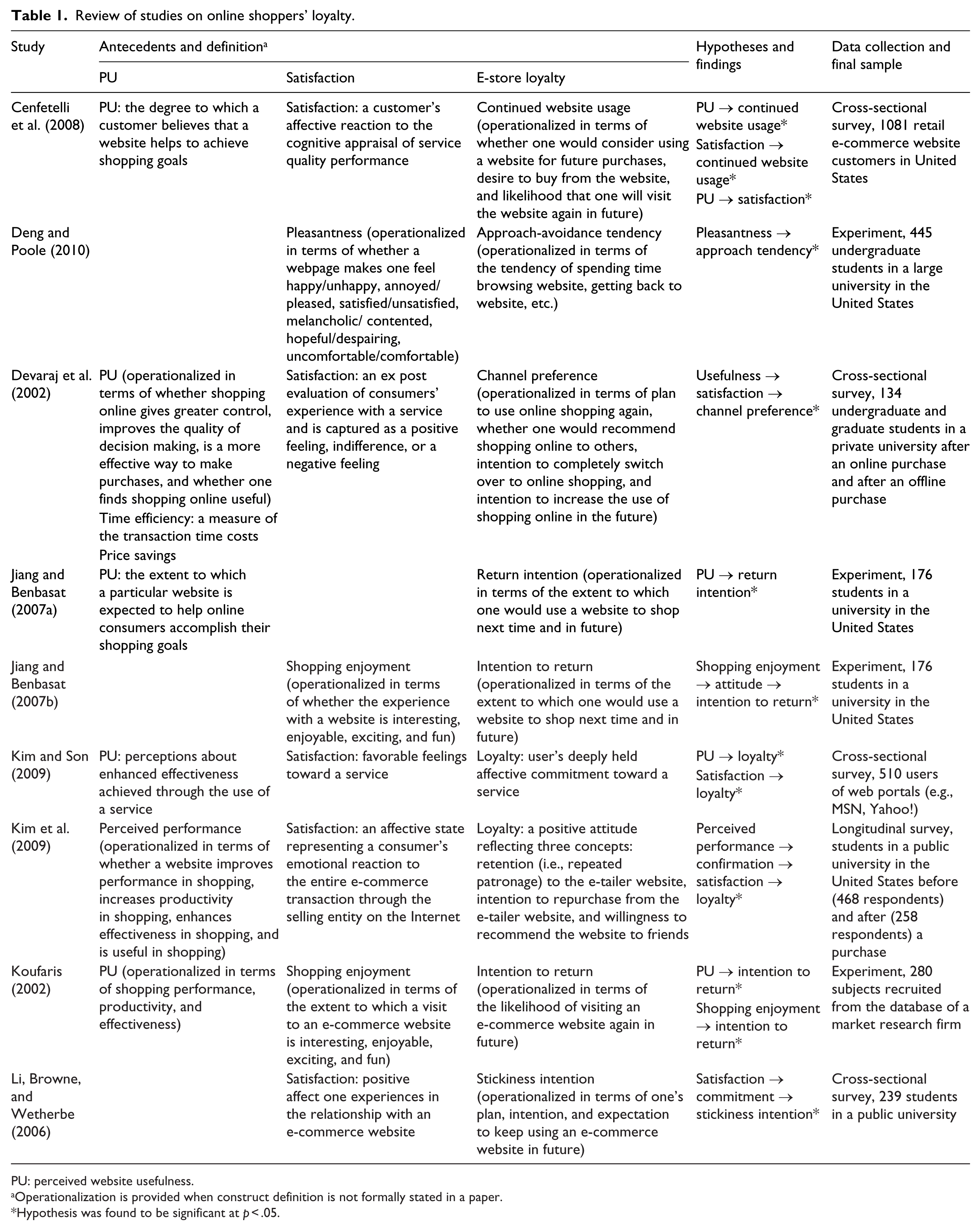
This study focuses on the development of customer loyalty toward an online store over multiple purchases through its website, which is different from the development of loyalty as a single durable product is being consumed over time (e.g., car). Most longitudinal studies on loyalty have focused on the latter. Our review of studies on online shoppers’ loyalty (see the last column of Table 1) shows that most studies relied on data collected before and/or after a single purchase. Only one study collected data on two purchases, but one of them is an offline purchase since the study focused on e-commerce channel preference (Devaraj et al., 2002). Studying loyalty over multiple online purchases allows the examination of changes and their effects and can potentially offer new insights.
Review of studies on online shoppers’ loyalty.
PU: perceived website usefulness.
Operationalization is provided when construct definition is not formally stated in a paper.
Hypothesis was found to be significant at p < .05.
PU and satisfaction are two strong antecedents of online shoppers’ loyalty, as found in many studies (see Table 1). Prior studies have identified these antecedents based on between-individual analyses. Since the development of loyalty is essentially a process of within-individual change (i.e., from new to loyal customer), it remains necessary to study within-individual changes in the antecedents and their impacts directly. By using multi-purchase data in this study, we were able to avoid making inferences about the within-individual development of loyalty from between-individual analyses.
Information processing–based and experiential perspectives of customer evaluation
Customer loyalty is developed within an individual over purchases as a function of psychological evaluative processes (Jacoby & Kyner, 1973; Toufaily et al., 2012), which can be understood from both the information-processing and experiential perspectives (Holbrook & Hirschman, 1982). The information-processing perspective views a customer as a goal-directed “logical thinker” who focuses on tangible benefits, utilitarian functions, and objective features. The secondary processes of “searching for information, retrieving memory cues, weighing evidence, and arriving at carefully considered judgmental evaluations” are employed (Holbrook & Hirschman, 1982, p. 135). These processes are secondary in that they reflect one’s mental processing function due to socialization. In contrast, the experiential perspective views customers as engaging in a flow of feelings based on subjective characteristics and sensory cues, seeking fun, arousal, and enjoyment. The primary process of thinking that “hearkens back to the way a baby pursues immediate pleasure or gratification” (Holbrook & Hirschman, 1982, p. 135) is employed. Holbrook and Hirschman (1982) emphasized that both information-processing and experiential perspectives capture important aspects of consumption and neglecting one of them limits our understanding of consumer behavior.
The information-processing perspective and experiential perspective of customer evaluation are useful for understanding the conceptual distinction between PU and satisfaction. PU is the degree to which a customer believes that a website helps achieve shopping goals. Being similar to value, PU comprises utilitarian facets such as convenience, price, information, and security (Childers, Carr, Peck, & Carson, 2002; Khalifa & Liu, 2007; Kim et al., 2009). Satisfaction is an immediate affective reaction to the appraisal of a specific e-store (Cenfetelli et al., 2008). Satisfaction is distinct from PU in that “even if an individual is dissatisfied with a website, she may continue to use it because she finds it useful” (Cenfetelli et al., 2008, p. 168). While the evaluation of PU focuses on the instrumental, utilitarian aspects of a website, satisfaction is driven by the affective appraisal of an experience. PU captures the instrumentality of using an e-commerce website, while satisfaction is a more transient, experience-specific affective evaluation of “whether a consumption experience was as pleasurable as expected” (Bhattacherjee, 2001, p. 354).
Hypothesis development
This study aims to understand differential changes in PU and satisfaction over time as multiple purchases are made, and differential effects of the changes on e-store loyalty. As mentioned earlier, PU is essentially an information processing–based evaluation, while satisfaction is an experiential evaluation. Accordingly, we hypothesize that PU has a stronger effect on loyalty intention in the initial purchase. Subsequently, PU changes less over purchases compared to satisfaction (i.e., PU is more stable), while change in satisfaction has a stronger effect on loyalty than change in PU. These three hypotheses are justified next.
Comparing effects of PU and satisfaction in the initial purchase
PU is an evaluation of the utilitarian aspects of e-stores, assessing attainment of goals such as shopping productivity and effectiveness (Childers et al., 2002). Similarly, Kim et al. (2009) conceptualized PU in terms of whether a website improves productivity, effectiveness, and performance in shopping. Employing a belief elicitation process, Khalifa and Liu (2007) found that key aspects of an e-commerce website’s PU include transaction efficiency, convenience, security, cost savings, and after-sale services.
Accordingly, PU is an information processing–based evaluation, which is cognitively oriented, relying on knowledge structures “that are accessible to introspection and therefore form the substance of conscious thought patterns” (Holbrook & Hirschman, 1982, p. 136). The criteria used in evaluation are primarily utilitarian in nature where one asks how well a purchase achieves its intended purpose or function (Holbrook & Hirschman, 1982). Since utilitarian criteria are more tangible and are evaluated through conscious thought processes, the resultant evaluations are well constructed and more justifiable.
Unlike PU, satisfaction captures emotions and feelings related to a purchase (Holbrook & Hirschman, 1982). In consumer research, satisfaction has been defined as an affective state reflecting the emotional reaction to a purchase experience (Spreng, MacKenzie, & Olshavsky, 1996), and “a post-consumption evaluative judgment with the evaluative aspect of that judgment varying along the hedonic (pleasantness) continuum” (Mano & Oliver, 1993, p. 454). A review on definitions of consumer satisfaction establishes that it is “a summary affective response of varying intensity” (Giese & Cote, 2000, p. 15). Similarly, in e-commerce research, satisfaction is conceptualized as an affective state (e.g., Cenfetelli et al., 2008; Kim et al., 2009; Li et al., 2006), feelings (Devaraj et al., 2002), pleasantness (Deng & Poole, 2010), and enjoyment (Jiang & Benbasat, 2007b; Koufaris, 2002) and is operationalized with emotion-laden adjectives such as “fun” and “interesting” (see Table 1).
Satisfaction is essentially an experiential evaluation, which focuses on cognitive processes that are more subconscious and private in nature (Holbrook & Hirschman, 1982), involving a variety of mental events such as subconscious thoughts, unconscious processes, imagery, and even fantasies (Fiore & Kim, 2007). Purchases are evaluated positively by virtue of the enjoyable experience they provide (Holbrook & Hirschman, 1982). The bases of evaluations are imagery and sensory elements of a purchase experience rather than instrumental gains. Emotions and feelings are therefore of particular relevance to the experiential view (Holbrook & Hirschman, 1982). Experiential evaluations may also be influenced by elements peripheral to a purchase, such as mood, atmosphere, and social influence (Verhoef et al., 2009). Experiential evaluations are more holistic in that to provide customers with a satisfactory purchase experience, it is necessary for an e-store’s website to orchestrate all the “clues” that people detect in the purchase process (Verhoef et al., 2009).
Based on the conceptual differences between information processing–based and experiential evaluations, the effect of satisfaction in the initial purchase is likely to be weaker than the effect of PU because the very lack of experience with an e-store limits customers’ ability to fully discern various aspects of purchasing from the e-store and make confident experiential evaluations. The lack of confidence should reduce customers’ reliance on satisfaction to determine their initial intention to repurchase and preference for an e-store. PU is expected to have a stronger effect on loyalty intention in the initial purchase because it is evaluated based on tangible aspects of an e-store that are readily observable, even in initial interactions with the e-store (see Figure 1).
H1. Initial PU has a stronger effect on initial loyalty than initial satisfaction.
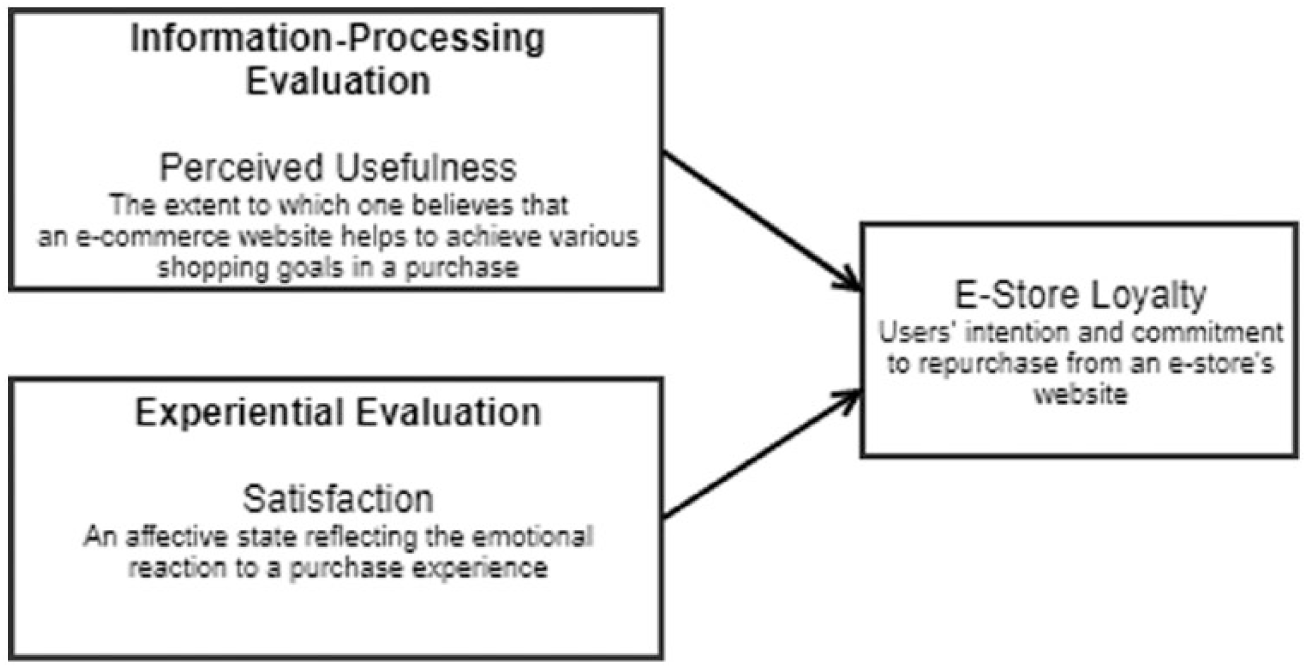
Conceptual relationships between purchase evaluations and e-store loyalty.
Comparing change in PU and satisfaction over multiple purchases
Being an information processing–based evaluation, PU is likely to resist persuasion and persist over time (Fazio, 2007). This is because information-processing evaluations are based on conscious thought processes where cognitive effort is explicitly expended to consider specific aspects of a website. Petty, Haugtvedt, and Smith (1995) explained that the elaboration of information increases the strength of an evaluation because thinking about an object triggers the acquisition of knowledge and increases structural consistency among elements of the evaluation, such that they form a coherent overall assessment of the object. The more one thinks about an object, the more accessible the thoughts upon which an evaluation is based will become. This accessibility increases the likelihood that the evaluation will guide future behavior. One also becomes more certain and confident of his or her evaluation and this increases the likelihood that one will defend (resistance) or rely on it over time (persistence). As long as the criteria remain diagnostic and information feeding into evaluations remains unchanged, future evaluations are likely to remain unchanged (Holbrook & Hirschman, 1982).
Unlike PU, the bases of satisfaction evaluation are more latent and fuzzy and it is more difficult to reconstruct experiential evaluations. Due to the lack of clear and reliable anchors for evaluation, experiential evaluations are likely to be less stable than information processing–based evaluations (Holbrook & Hirschman, 1982) over purchases. Accordingly, we expect the experiential evaluation of satisfaction to change more than the information processing–based evaluation of PU over purchases. In line with this, e-commerce researchers have suggested that, being related to emotion, satisfaction may be less lasting and have less stability compared to attitudes such as PU (e.g., Cenfetelli et al., 2008). However, there is yet any study comparing the change in PU with change in satisfaction.
H2: Change in PU over purchases is less than change in satisfaction.
Comparing effects of change in PU and change in satisfaction
The conceptual differences between information processing–based and experiential-based evaluations suggest that change in satisfaction has a stronger effect on loyalty than change in PU. As discussed earlier, PU is more firmly established in the initial purchase and changes less in subsequent purchases since its evaluation relies on more observable, tangible, and accessible aspects of an e-store’s website. In subsequent purchases, customers are likely to divert attention to better ascertain their experiential satisfaction and reduce cognitive dissonance. Holbrook and Hirschman (1982) highlighted that learning is an important aspect of the experiential perspective. The effect of satisfaction is expected to strengthen as more purchases are made and customers learn about an e-store and update their experiential evaluations. As the accuracy of experiential evaluations increases and customers gain confidence in their evaluations, they are likely to rely more on satisfaction in determining whether to repurchase and commit to an e-store (i.e., form loyalty). In support, Brunner, Stocklin, and Opwis (2008) found that the positive effect of satisfaction on loyalty is more pronounced for experienced customers in offline shopping. Our study extends the understanding of satisfaction over purchases by comparing it with the information processing–based evaluation of PU:
H3. Within-individual change in satisfaction has a stronger effect on change in loyalty than change in PU.
Research method
Data collection
Data for testing the hypotheses were collected through a four-wave panel survey. We needed data on initial purchases from an e-store, as well as data on subsequent purchases to understand changes in PU and satisfaction. Since a complete list of shoppers who had made their first purchase from an unfamiliar e-store was not available, we recruited participants (i.e., access potential online shoppers) by posting invitations on discussion forums of major e-commerce websites in Taiwan, such as PCHome, Yahoo! Shopping, PayEasy, and MomoShop. Together, these online marketplaces accounted for about 30% share of the fragmented online retail market in Taiwan (Euromonitor International, 2017). The invitation asked those who had recently made a first purchase from an unfamiliar e-store to participate in the study and to respond to questions about their PU, satisfaction, and loyalty based on the first purchase. They were then asked to return to the survey if they made more purchases from the same e-store. Weekly reminders were sent to ask those who made more purchases since the last survey to answer questions about subsequent purchases. Each participant was identified by their email address. As an incentive, all participants were eligible for a lucky draw with smart phones and tablet computers as prizes.
A total of 711 individuals responded to the survey about first purchase (T1). Among them, 302 completed the survey about second purchase (T2) and 244 completed the survey about the third (T3) purchase. The final sample size is 213. To assess whether sample attritions was due to non-random effects that could potentially result in biased estimates, we compared the means of key constructs in the attrition sample with those in the remaining sample (Lohse, Bellman, & Johnson, 2000). The result indicated that the attrition is unlikely to lead to biased estimates (Winer, 1983).
Survey instrument
Scales validated in prior studies of online shopping or consumer behavior were adapted for use in this study as much as possible (see Table 2). For example, we used Khalifa and Liu’s (2007) PU scale, which measures the quality of after-sale services, efficiency of transaction processing, security of website, convenience of shopping, and cost savings along Likert scales anchored between “strongly disagree” and “strongly agree” (see Table 2).
Survey instrument.

All items were measured with seven-point Likert scale except for those measuring satisfaction.
Data analysis
The panel data were analyzed with second-order latent growth modeling (LGM; Chan, 1998), an approach that allowed us to measure changes in latent variables and assess the effect of multiple latent variables in a single structural model.
Demographic analysis
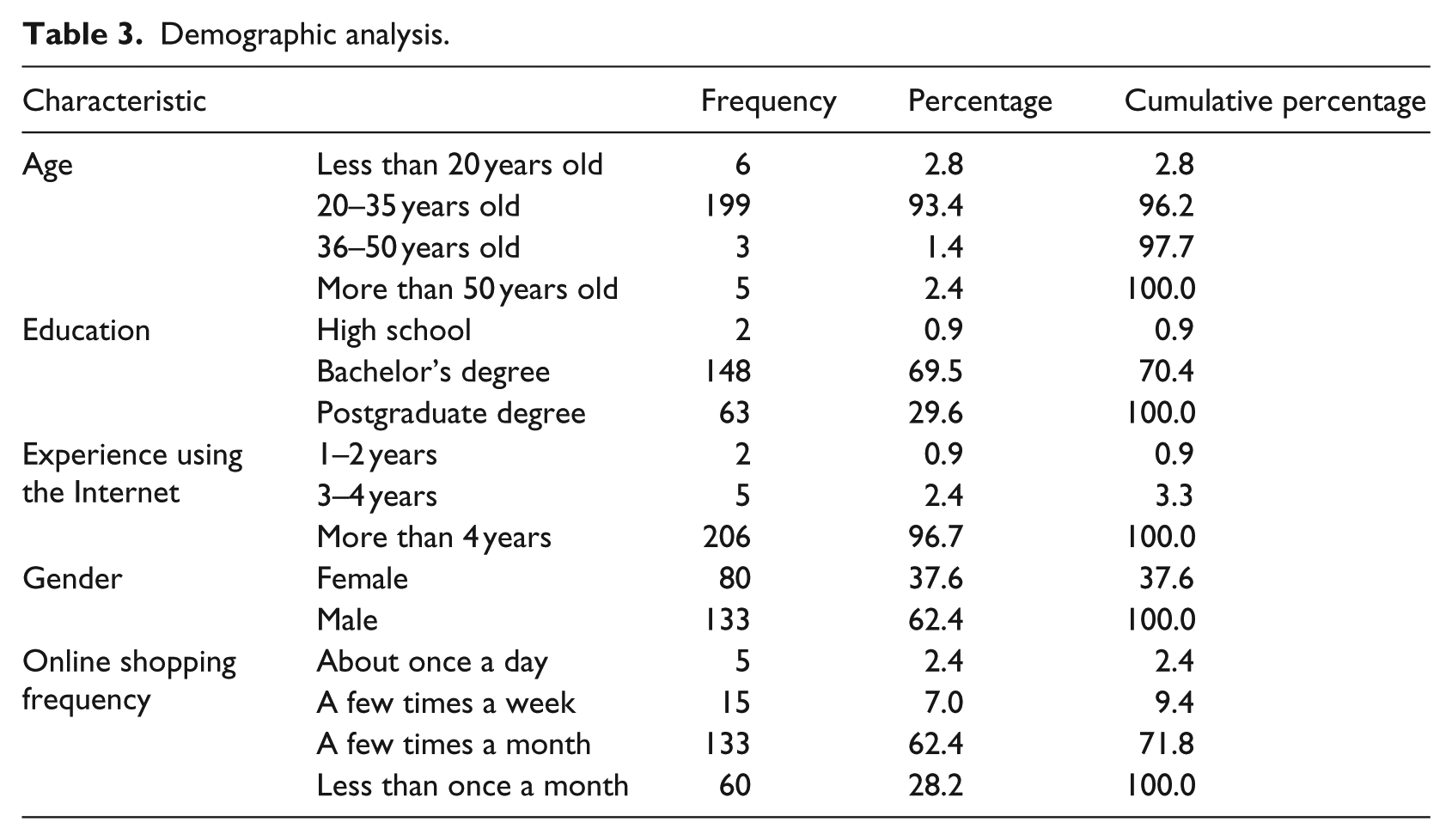
Most of the respondents in our sample aged between 20 and 35 years (93.4%; see Table 3) and had more than 4 years of experience using the Internet (96.7%). About 62% were men and 71.8% shopped online for several times a month.
Demographic analysis.
Assessment of survey instrument
Prior to testing the hypotheses, we assessed the reliability and validity of the survey instrument. Reliability was assessed with Cronbach’s alpha and all scales had satisfactory scores well above the recommended value of 0.70 (see Table 4). Convergent and discriminant validity were assessed using average variance extracted and exploratory factor analysis with direct oblimin rotation. All square roots of average variance extracted were higher than the corresponding correlations among constructs. We also observed that all items loading were close to or greater than 0.70 and cross loadings were less than 0.35 for all constructs in all purchases. These indicated adequate convergent and discriminant validity.
Reliability and correlation among constructs.
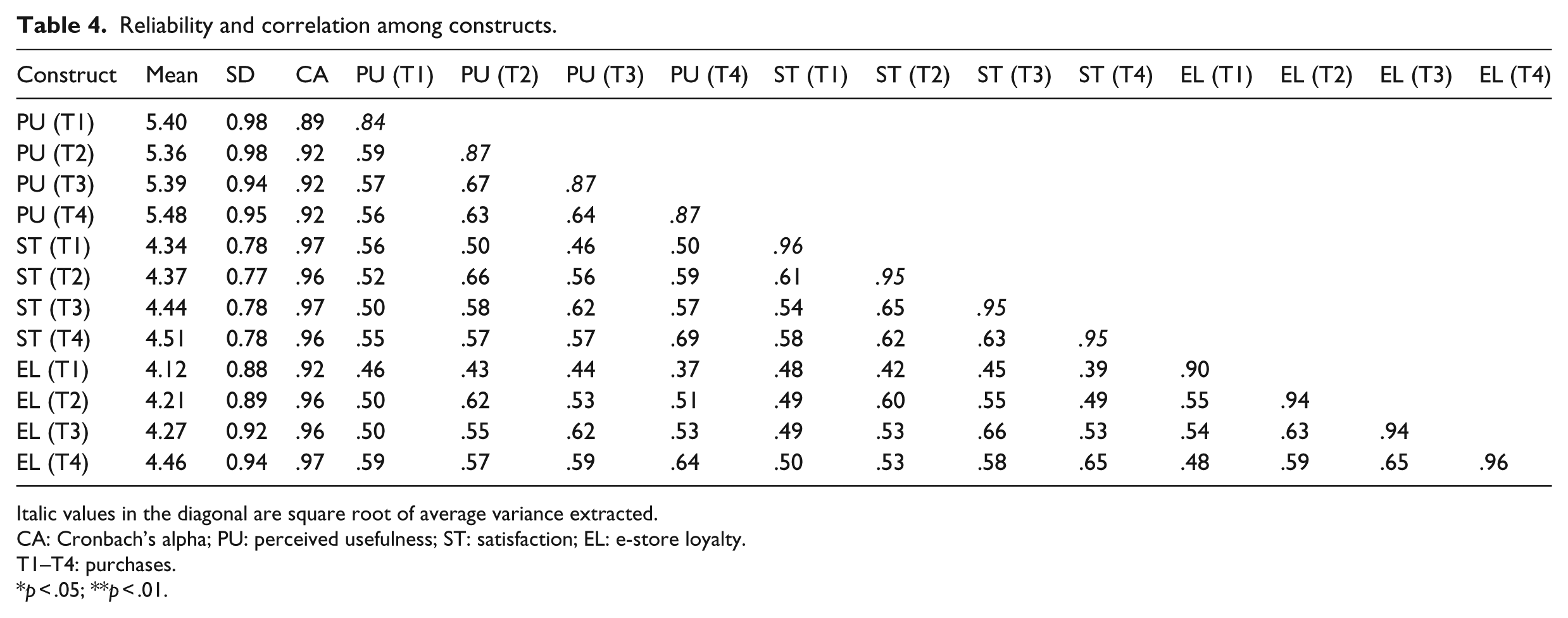
Italic values in the diagonal are square root of average variance extracted.
CA: Cronbach’s alpha; PU: perceived usefulness; ST: satisfaction; EL: e-store loyalty.
T1–T4: purchases.
p < .05; **p < .01.
Second-order LGM
We followed the three-step approach recommended by Chan (1998) to conduct LGM. The first step involved assessing measurement invariance to establish that the same latent constructs were measured in different purchases and with same precision. This ensured that difference between purchases could be interpreted unambiguously as a change within an individual. The second step identified the nature and magnitude of change in constructs. We assessed a no-growth model, a linear growth model, and a free-form model for each construct to determine the trajectories of change in PU, satisfaction, and e-store loyalty. Hypothesis H2 (i.e., relative change in PU and satisfaction) was tested in this step. In the third step, we assessed a multivariate model to examine the longitudinal effects of change in PU and satisfaction (i.e., test H1 and H3).
To assess measurement invariance, we compared two models, M1 and M2, following Chan (1998). Model M1 freely estimated factor loadings, error variances, factor means, and factor variances and the adequate model fit indicated that the factor structure of all constructs were similar over time and there was configural invariance (see Table 5). Model M2 was nested in M1 in that factor loadings were constrained to be equal across purchases. We found that there was no noteworthy deterioration in model fit as indicated by the insignificant change in chi-square, supporting metric invariance. Overall, there was sufficient measurement invariance in our data and the more parsimonious and constrained model M2 was used in following analyses.
Test of measurement invariance.
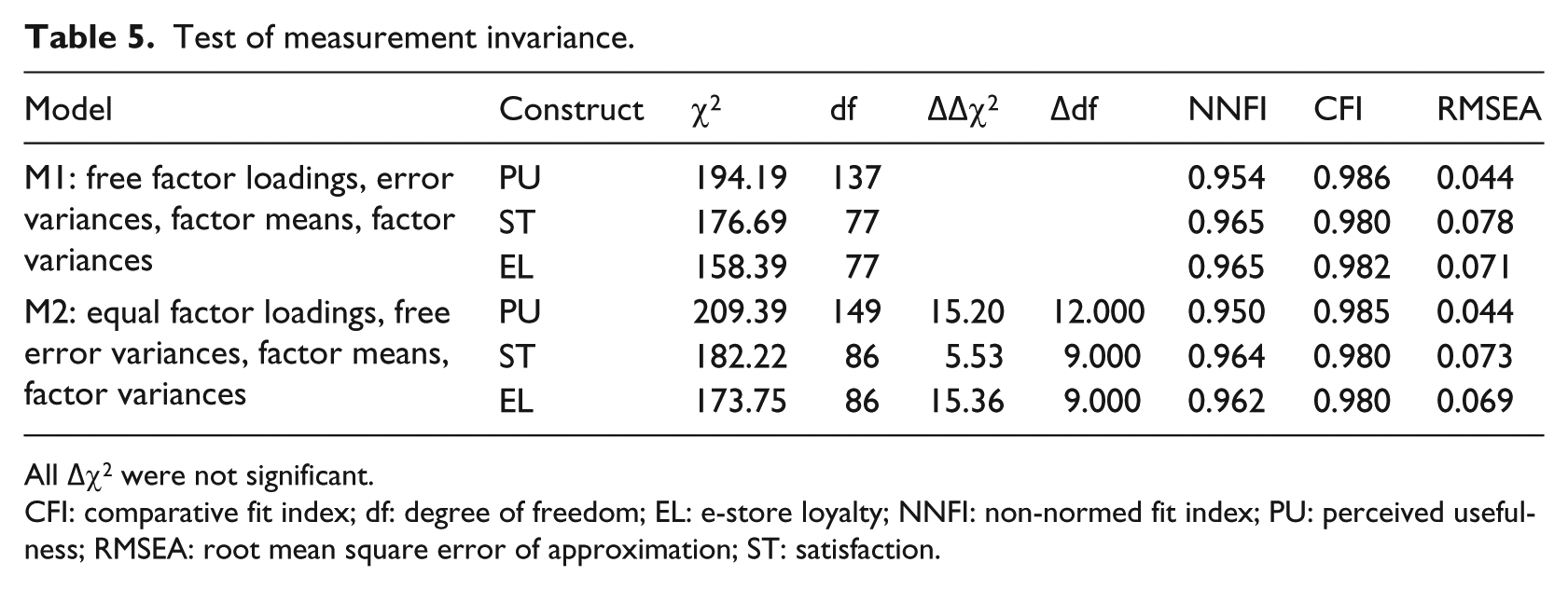
All Δχ2 were not significant.
CFI: comparative fit index; df: degree of freedom; EL: e-store loyalty; NNFI: non-normed fit index; PU: perceived usefulness; RMSEA: root mean square error of approximation; ST: satisfaction.
Test of hypotheses about change
In LGM, a trajectory of change is described by intercept and slope. Intercept represents the level of a variable at the initial time it is measured (i.e., first purchase in our study). Slope indicates the rate at which a variable changes over time (i.e., from first through fourth purchase in our study). Following Serva, Kher, and Laurenceau (2011), we tested three models of change. The no-change model, which is nested within the linear model, which in turn is nested within the free-form model, were compared by assessing change in chi-square. The results indicated that PU, satisfaction, and e-store loyalty were adequately represented by the linear model of change, with the no-change and free-form models having worse or insignificant improvement in model fit.
We analyzed the nature of change in constructs. There were significant within-individual changes in satisfaction and loyalty over the four purchases, as indicated by the significant slope mean. As hypothesized in H2, the change in PU over purchases (slope mean = 0.09, p > .05) is less than the change in satisfaction (slope mean = 0.14, p < .01). There were also significant between-individual differences in the level of PU, satisfaction, and loyalty in the first purchase and the trajectory of change in loyalty.
Test of hypotheses about effects of change
To test hypotheses H1 and H3, a multivariate LGM was assessed. We controlled for the effect of individuals’ age, gender, education, experience with the Internet, and habit of online shopping. Habit was measured with the scale validated by Khalifa and Liu (2007), while the other control variables were measured as shown in Table 3. These control variables explained some of the between-individual differences in the initial level of and change (i.e., intercept and slope) in PU and satisfaction. We found that highly educated individuals had higher initial PU (β = .11, p < .05); older customers had higher initial satisfaction (β = .11, p < .05) but less change in satisfaction over purchases (β = −.14, p < .01); habitual online shoppers had higher initial PU (β = .32, p < .001) and initial satisfaction (β = .33, p < .001); individuals with more Internet experience had less change in PU (β = −.17, p < .001) and satisfaction (β = −0.11, p < .05). None of the control variables had significant effect on initial loyalty and change in loyalty over purchases.
The effects of initial and change in PU and satisfaction are shown in Figure 2. In the first purchase, high PU and satisfaction leads to high initial repurchase intention and preference for a website (i.e., initial loyalty). As hypothesized in H1, initial PU (β = .71, p < .001) had a much stronger effect on initial loyalty compared with initial satisfaction (β = .23, p < .05; d = 0.48, p < .05). We also found that within-individual increase in PU and satisfaction over purchases both lead to increasing loyalty. Compared to the change in PU, change in satisfaction has a much stronger effect (β = .90, p < .001 vs β = .52, p < .001; d = 0.38, p < .05), providing support for hypothesis H3.
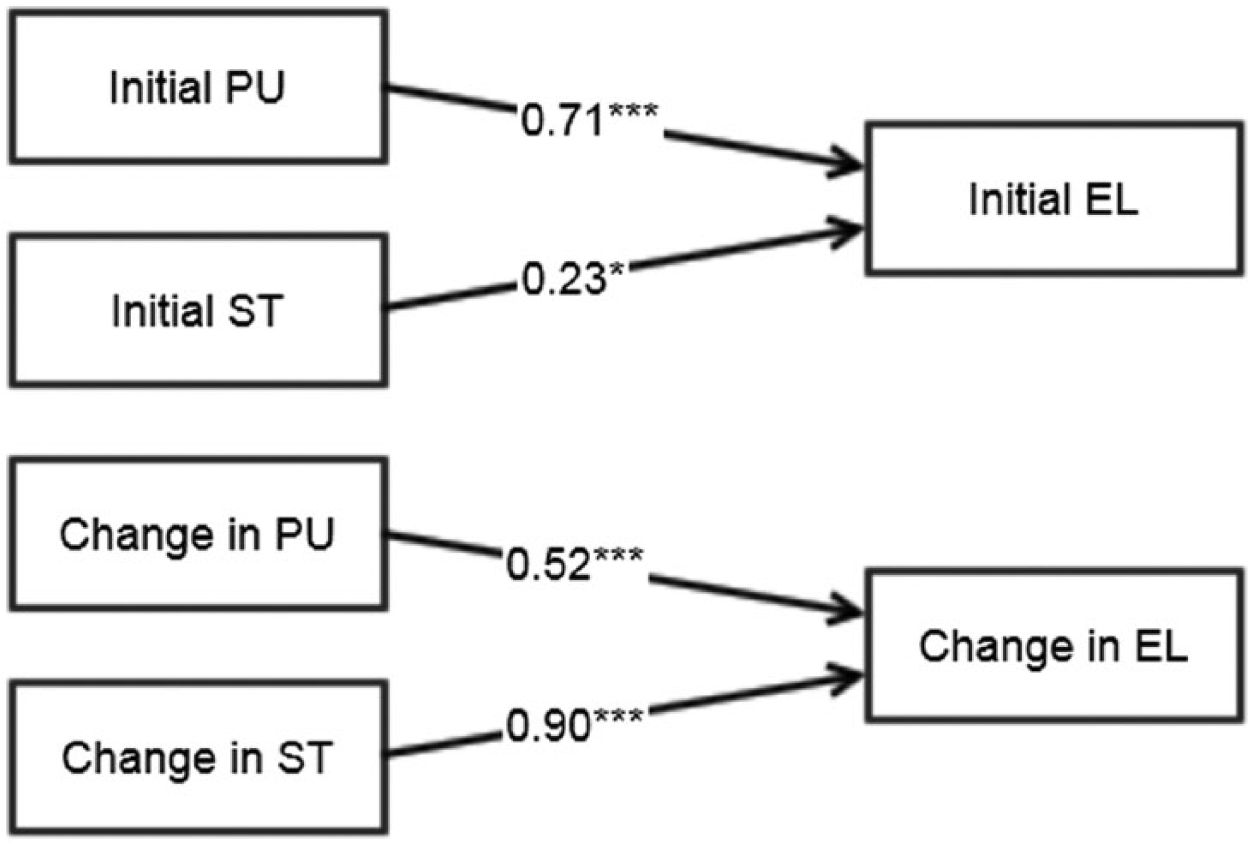
Results of latent growth modeling.
Discussion
This study proposed that PU and satisfaction change differently over multiple purchases, and that the changes affect e-store loyalty differently. Understanding changes in PU and satisfaction is important because loyalty develops incrementally, rather than based on a single purchase. Findings from a four-wave panel survey indicate that PU, an information processing–based evaluation, has a stronger effect on loyalty than satisfaction in the initial (i.e., first) purchase. In subsequent purchases, PU changes less than satisfaction (an experiential evaluation), and change in satisfaction affects loyalty more strongly than change in PU. In the data analysis, we also observed that individuals differ significantly in their initial levels of and change in PU and satisfaction depending on their age, education, experience with the Internet, and habit of online shopping. The implications of these findings for research and practice are discussed next.
Implications for research
This study contributes to research in several ways and indicates directions for further research. First, the findings enrich our understanding of online shoppers’ loyalty by clarifying how its development is affected by changes in PU and satisfaction over multiple purchases. Examining multiple purchases and changes over time has provided new insights—change in satisfaction matters more than change in PU in the development of loyalty, even though PU has a stronger effect in the initial purchase. This has been masked in cross-sectional studies. Understanding the changes and their effects extends our conceptual understanding of e-store loyalty, PU, and satisfaction with a more dynamic perspective. To the best of our knowledge, this is one of the earliest studies to theoretically and empirically compare changes in PU and satisfaction related to loyalty.
Second, the finding that satisfaction changes more over purchases than PU could also help to explain some inconsistencies observed in e-commerce research on loyalty, where PU was sometimes observed to have a stronger effect than satisfaction in some studies (e.g., Wen, Prybutok, & Xu, 2011) but weaker in other studies (e.g., Cenfetelli et al., 2008). Future research should account for the differential changes in PU and satisfaction directly by collecting longitudinal data or specifying whether the focus is on the initial purchase or subsequent purchases. At a broader level, our finding contests the implicit assumption adopted in cross-sectional studies, that antecedents of loyalty are static.
Third, our findings indicate the need for further research to move from traditional static models of online shoppers’ loyalty to temporal models focusing on understanding its development over multiple purchases. In our data analysis, we observed that loyalty changes significantly over purchases. This supports the conceptual belief that loyalty develops gradually over purchases and highlights the need to deepen our understanding by examining how its longitudinal development is affected by changes in its antecedents. There is opportunity to investigate longitudinal effects of other antecedents of loyalty, such as trust (Chiu, Chang, Cheng, & Fang, 2009). In this study, we demonstrate one of the few four-wave study design and analysis to understand the temporal development of loyalty based on changes in its antecedents and pave the way for further studies of this type.
Fourth, this study also contributes to the referent theoretical perspectives of information processing–based and experiential customer evaluations. These two perspectives highlight the conceptual differences between two types of customer evaluations in terms of consciousness, confidence of evaluation, and memory, and suggest that different evaluations are held and processed differently by customers as they gain experience with a store over purchases. Our study adds to these perspectives by specifying two different, yet related aspects of change for empirical testing: (1) differential changes in evaluation and (2) differential effects of the changes.
Limitations and suggestions for future research
The findings of this study should be interpreted in light of its limitations, which could be addressed in further research. First, there was considerable attrition in our sample. Although attrition analysis indicated that the attrition is unlikely to bias estimates, a larger sample would enhance the generalizability of findings. Second, the hypothesis comparing change in PU and change in satisfaction was tested with data over four purchases. While this is significantly more than that in previous studies, extending data collection over more purchases could further ascertain the extent of changes and rule out the possibility that PU changes significantly, albeit very slowly, over a larger number of purchases than that measured in this study. Third, this study focuses on perceived usefulness and satisfaction as two important antecedents of loyalty that have been shown to jointly account for more than half of the variance in loyalty. As an early longitudinal study on loyalty, we chose to limit the number of variables to keep the length of the panel survey manageable for participants. Further research could study and compare other antecedents, such as trust (Chiu et al., 2009) and social presence (Cyr, Hassanein, Head, & Ivanov, 2007; Yang & Peterson, 2004), to enrich our understanding and management of the longitudinal development of online shoppers’ loyalty.
Other than improving upon the limitations of this study, an interesting avenue for future research is to compare and theorize changes in different types of customers. We observed in our analysis of control variables that older customers and those with more Internet experience change less in satisfaction over purchases (i.e., there are between-individual differences in within-individual change). This suggests an opportunity to enrich the conceptual development of online shoppers’ loyalty further by accounting for customer characteristics. The findings are likely to be valuable to practice for developing targeted strategies for attracting and retaining different groups of customers. For instance, our observation suggests that focusing on ensuring the satisfaction of older customers in the initial or early purchases is likely to generate greater return than targeting other groups, as their satisfaction changes less over purchases and their loyalty intention is therefore likely to remain strong in future purchases. Conceptually, this could be explained in terms of older adults’ resistance to change (e.g., routine seeking, cognitive rigidity) or inertia in learning new technology features that compare the offerings of different e-stores.
Practical implications
The results suggest an empirically supported, longitudinal approach to initiate and nurture e-store loyalty in practice. E-stores should focus on ensuring that the usefulness of their website is clear to new customers, since loyalty intention in the initial purchase is more strongly affected by PU. It is especially important to provide efficient transaction processing (e.g., fast retrieval of information, ordering, payment processing, and scheduling delivery), website security, and convenience, as indicated by our analysis of item loading significance. Along with a reasonable level of satisfaction with the initial purchase, these should lead to a strong repurchase intention. For returning customers, the focus should be on increasing their satisfaction (while maintaining PU), based on our findings that the development of (i.e., change in) loyalty is more strongly affected by change in satisfaction. It would be useful to measure customers’ satisfaction after each purchase so that any decline in satisfaction can be identified and remedied timely. Understanding the differential changes and their differential effects on the development of loyalty helps e-stores channel their resources and attention to the most salient aspect of customer evaluation at the right time.
We also observed, in the analysis of control variables, that highly educated individuals and habitual online shoppers tend to have higher initial PU and therefore stronger repurchase intention. This suggests that e-stores could target them as much as appropriate. For example, e-stores could advertise in websites or online communities that highly educated and habitual shoppers are known to visit.
Conclusion
For e-stores’ survival, fostering loyalty is as important as attracting new customers. The development of loyalty is essentially a within-individual phenomenon that occurs over multiple purchases. We have explained and shown how two key antecedents of loyalty change differently over purchases and how they affect the development of loyalty differently. These longitudinal differences and effects are indispensable pieces of the loyalty puzzle and teasing them out provides us with opportunities to advance the theoretical development and practical management of online shoppers’ loyalty.
Footnotes
Funding
The author(s) received no financial support for the research, authorship, and/or publication of this article.