



Abstract
Internationalization seeks an understanding of the nature of the culture of the countries and is eventually influenced by affinity toward country and soft power (ideological and cultural influence). This research analyzed the influence of affinity toward country and soft power on the internationalization of cultural products. A survey was conducted with 478 Portuguese respondents of 22 cities about Brazilian cultural products, and data were analyzed by structural equations modeling. The results showed that soft power influenced positively the internationalization of cultural products and affinity toward country, and the latter also influenced positively internationalization. In addition to the methodological contribution due to the self-reporting approach used to analyze the internationalization of cultural products, this study contributes to identify the relationship between the constructs of internationalization of cultural products, affinity toward country, and soft power, in this way, the theoretical field related to international marketing and business, especially in a perspective focused on the consumption of cultural products.
Introduction
An association of products with cultural products and services of countries represents an ideological and cultural influence through soft power (Nye, 2004, 2011). Research has tried to point out the importance of the construction of the brand image, affecting, therefore, the intentions of consumer spending, even if indirectly (Diamantopoulos, Schlegelmilch, & Palihawadana, 2011), emphasizing the cognitive aspects to the detriment of the affective aspects of the image of the countries (K. Roth & Diamantopoulos, 2009) and the lack of market segmentation (Roth and Diamantopoulos, 2010).
Research on the internationalization of cultural products seeks to understand the nature of culture through differences in habits, customs, languages, and ways of thinking (Cavusgil, Knight, & Riesenberger, 2010)—the different national and international markets where cultural goods and services are born, circulated, and consumed; cultural affinities that generate and motivate international trade (Nunn, 2007); and the emergence of markets through cultural international trade (Spolaore & Wacziarg, 2013).
A theoretical gap is addressed regarding the influence of the soft power on the internationalization of cultural products, having the affinity toward country as influencing variable.
Based on the consumption of cultural products prism, from an international perspective, this research focused on the influence of soft power and affinity toward country on the internationalization of cultural products. Data were collected by survey with 478 Portuguese respondents about Brazilian cultural products. Data were analyzed by structural equation modeling (SEM) based in covariance. As results, soft power and affinity toward country influenced positively the internationalization of cultural products.
This article is as structured as follows: next section is about theory and hypotheses, followed by sections on method, results, and, finally, discussion and conclusion.
Theory and hypotheses
Soft power conceives the power that one country exerts over another through a social legitimation, from attractiveness to other agents of places, events, and cultural products of the influencing country (Nye, 2004, 2011). Soft power research seeks the cultural and ideological influence that countries exercise through their public policies, values, and cultural dimension (McClory, 2012; Nye, 2004, 2011). Because one dimension is affinity, the attachment (beliefs and values) of consumers to a particular country (Oberecker, Riefler, & Diamantopoulos, 2008) causes in consumers an attraction through the attributes of products and services (Hartz, Watson, & Noyes, 2005), and there is coherence between the aspects of soft power and affinity with countries.
Consumers, who have a favorable attitude toward products and services from countries of origin other than their own, show a greater tendency to prefer foreign products (Jaffe & Nebenzahl, 2006). For Meuleman, Lubbers, and Verkuyten (2018), in less diversified cultural markets, other influences of socialization may also play an important role in the consumption of domestic cultural products. For Grinshpun (2014), the relevance of a foreign commodity in the local context is determined by the interactions, binary and complex, culturally created: global-local and foreign-native.
Thus, the theoretical model includes the relationship between soft power, affinity toward country, and internationalization of cultural products. Figure 1 presents the proposed model for this research. The following hypotheses will be developed.
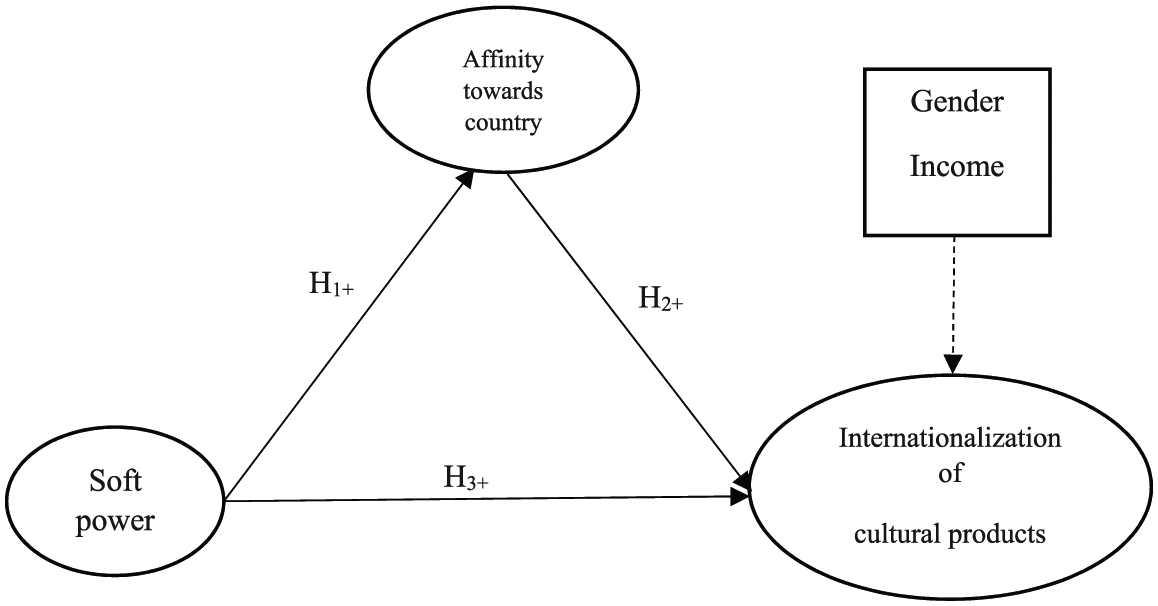
Theoretical research model.
Soft power and affinity toward countries
Affinity toward country is evidenced by culture, arts, history (Oberecker et al., 2008), gastronomy, family and its ancestors, travel, and politics of the countries (Peng-Er, 2004). According to Nye (2004, 2011) and McClory (2012), the cultural dimension of soft power includes aspects related to education, language, literature, music, arts, cinema/television, sports, gastronomy, history, and lifestyle. Thus, there may be a plausible relationship between the aspects that measure the soft power of countries and the aspects that measure the affinity with a given country.
Research about cultural affinity suggests a development of a feeling of sympathy and/or attachment (Oberecker et al., 2008) toward a particular foreign culture; hence, one can legitimize an ideological and cultural influence of one particular country over another (Nye, 2004, 2011). This influence involves experiences that represent a culture relative to the scenarios, media, and brands (Jaffe & Nebenzahl, 2006). The accessibility of foreign cultures, through globalization, allows people a connection through imagination, integrating them as aspects representative of their multicultural identities (Douglas & Craig, 2006). Therefore, the first hypothesis is formulated:
H1: Soft power has a positive effect on the affinity toward country.
Affinity toward country and internationalization
Consumer affinity may influence consumer willingness to buy and pay for products from certain countries (Oberecker & Diamantopoulos, 2011). Considering that one of the aspects related to internationalization revolves around the individual consumption level (Khan, Bamber, & Quazi, 2012), it becomes possible to link the affinity toward countries and the internationalization of their products. Consumers prefer more familiar options, therefore, by which they have more affinity for situations of risk in consumption (known brands vs. new brands), as there may be familiarity on the part of the consumer with certain countries (Oberecker & Diamantopoulos, 2011), from an interaction between the general attributes of the countries, general attributes of the products, and the specific attributes of the product of a brand (Pisharodi & Parameswaran, 2002).
Internationalization, according to Cavusgil et al. (2010), goes back to the culture of social groups, regarding differences in habits, customs, language, and ways of thinking. This view leads to a possible understanding of the knowledge level of consumers regarding the products and services of particular countries (Khan et al., 2012) and, consequently, a possible affinity aimed at these countries. The emotional dimension, which requires an emotional response not only to the country but also to the inhabitants of the country in question (K. Roth & Diamantopoulos, 2009), can clearly be understood from the concept of affinity and, consequently, this emotional dimension can also clarify the concept of internationalization of cultural products, as the process of globalization of culture includes images that represent the popular international memories disseminated by the cultural industry (Kraidy, 2002). Thus, the second hypothesis is formulated:
H2: Affinity toward countries has a positive effect on the internationalization of cultural products.
Soft power and internationalization
Culture is increasingly deterritorialized and is not necessarily limited to specific locations because of an internationalization process and the interconnection of cultures across the globe (Hermans & Kempen, 1998). This interconnection of cultures, according to Pieterse (2009), stems from a greater cultural hybridization. Therefore, new cultural formats would be created by combining different cultural aspects, for example, Asiatic rap (Rowe & Schelling, 1991). It is observed that a possible cultural hybridization through the cultural and ideological aspects of soft power (Nye, 2004, 2011) can reduce the cultural distance between countries (distance of power, reduction of uncertainty at the individual level, masculinity/femininity, and individualism) through the purchase or sale of cultural products or services (Kogut & Singh, 1988).
Contacts between people of different cultures exteriorize a public interest and a cultural policy aimed at long-term profitable investment for the countries. This contact can influence the internationalization of cultural products, through the understanding of values, beliefs, habits, customs, language, and ways of thinking of the social groups of each country (Cavusgil et al., 2010). One can suggest an influence of soft power, starting with its cultural and ideological aspects (McClory, 2012; Nye, 2004, 2011), in the internationalization of cultural products by means of exporting these products (Garcia, 2012).
This influence would be stronger by means of the aspects related to the characteristics of the products; the psychological aspects of consumers (psychological identity, symbolic status, and the state of psychological satisfaction) and aspects related to the life objectives of the individuals (social identity, self-recognition; Khan et al., 2012). In this way, exposure to cultural products considered as global, for example, music from other countries, can generate a familiarity and a preference, consequently, a greater ideological and cultural influence through a greater internationalization of these products (McClory, 2012; Nye, 2004, 2011). Therefore, the last hypothesis is formulated:
H3: Soft power has a positive effect on the internationalization of cultural products.
Method
Sample
This research was quantitative and data were collected by survey (direct personal interview) with a nonprobabilistic sample of Portuguese respondents. Before collection of the total sample, a pretest was performed with 50 respondents to analyze the consistency of the measurement scales. Pretest was conducted in the city of Coimbra (Portugal), in September 2015. Scales were consistent, and the questionnaires were reapplied in October 2015 to 478 respondents born in 22 different cities in Portugal.
Regarding sample sizing, an estimation of the minimum size required was carried out using G-Power® software, Version 3.1.9.2. Based on the desired statistical power parameters to the number of predictors, this sample size was significant for the effect size f2 (0.15), α = .05, and confidence interval of 0.95 (Cohen, 1988; Hair, Hult, Ringle, & Sarstedt, 2014).
To verify the model specification through the endogenous constructs analyzed (Rigdon, 2012), the effect sizes (f2 and q2) and predictive relevance (Q2) were evaluated. The f2 is calculated as follows (Hair et al., 2014)

The Q2 values with an omission distance (OD) of 5 to 10 are usually the most suggested forms of analysis for most surveys (Hair, Sarstedt, Ringle, & Mena, 2012). However, as there are 478 observations in the database, an OD distance of 5 can be chosen. The values Q2 and q2 estimated by the blindfolding procedure represent a measure of how well the path model can predict the values initially observed and the relative impact of predictive relevance, respectively. The formula for the calculation is

For this study, we use the definition of Van Eijck (2001), as cultural products are positioned in the cultural field and consumers of culture in the social field. In view of this, cultural tastes were analyzed, according to the social status of each group, identifying two large groups of consumers (clusters): omnivores, which like different types of cultural products, and the univores, which have a restricted taste. We used the linearization method, using Pseudo Maximum Likelihood(PML) estimation, with only cluster identifiers appearing to provide both robust estimates of parameters and of standard errors under conditions when two-stage sampling is used with very few strata, given the simulation results (Stapleton, 2009).
Statistical model
Data were analyzed with SEM based in covariance. The reliability of the measurement scales was given by composite reliability, Cronbach’s alpha, and average variance extracted (AVE; Hair et al., 2012; Hair et al., 2014) The parameters accepted in the literature are as follows: composite reliability and Cronbach’s alpha with levels above .7 and AVE with levels above .5 (Chin, 2000; Hair et al., 2012). The analysis criteria were the coefficients of each path, convergent validity, discriminant validity, and statistical significance.
Measurement scales
Seven-point Likert-type scales measured all constructs, where 1 corresponded to “totally disagree” and 7 to “totally agree.” Soft power was based on the concepts of Nye (2004, 2011) and McClory (2012) and used the scale of Nes, Yelkur, and Silkoset (2014). Affinity toward country was measured with a scale validated by Oberecker and Diamantopoulos (2011). These authors used an adaptive approach to the individual feelings of each respondent. As this perspective meets the objectives of this study, the same affinity scale was used.
The dependent variable internationalization of cultural products was measured with a scale used by Khan et al. (2012). Because internationalization presents a possible connection with the different degrees of relationships and conducting business, for example, purchase and/or sale of products and services (foreign trade), Khan et al.’s (2012) scale was used to understand the consumption level of respondents in relation to the Brazilian cultural products. This scale was used to avoid possible endogeneity problems between constructs (McIntosh, Edwards, & Antonakis, 2014). For this purpose, the classification of cultural products presented by Ministry of Culture (MinC, 2011) was used. All the scales are shown in Appendix 1.
To reduce the bias, we ran the common method bias technique with MacKenzie and Podsakoff’s (2012). The following procedure was adopted: (a) individual explanation to the interviewees that although some questions could invariably seem similar, each was unique and important, and (b) explanation of the importance of careful reading of each item before indicating the response.
Results
A predominance of male respondents (62.3%) was observed. Predominance of individuals until 25 years old (47.9%), respondents with a bachelor’s degree (46.0%), with family income between €500 and €1,999 (52.5%), and the most representative occupation was student (57.4%) were observed. Regarding the educational level of the parents of the respondents, it was noticed that the most predominant level education was a bachelor’s degree (23.6%), and parents of those surveyed are employed workers (38.5%). These data are important because of the cultural capital that is related to the occupation and education of the parents.
In the initial analysis, the items of the scales used in the study that presented a low factor score were taken from the analysis, considering that the maintenance of these items led to the achievement of low goodness of fit (GoF).
All the AVE constructs were higher than .5 and Cronbach’s alpha values were higher than .7, which demonstrates that scales are reliable. Table 1 presents the performance indices of the analyzed constructs.
Performance indices of the analyzed constructs.

Source: Research data (2016).
AVE: average variance extracted.
Square roots (quadratic values) of the AVEs were higher than the correlation coefficient between the latent variables. These results demonstrate adequate discriminant validity, in accordance with Table 2.
Discriminant validity for the constructs.
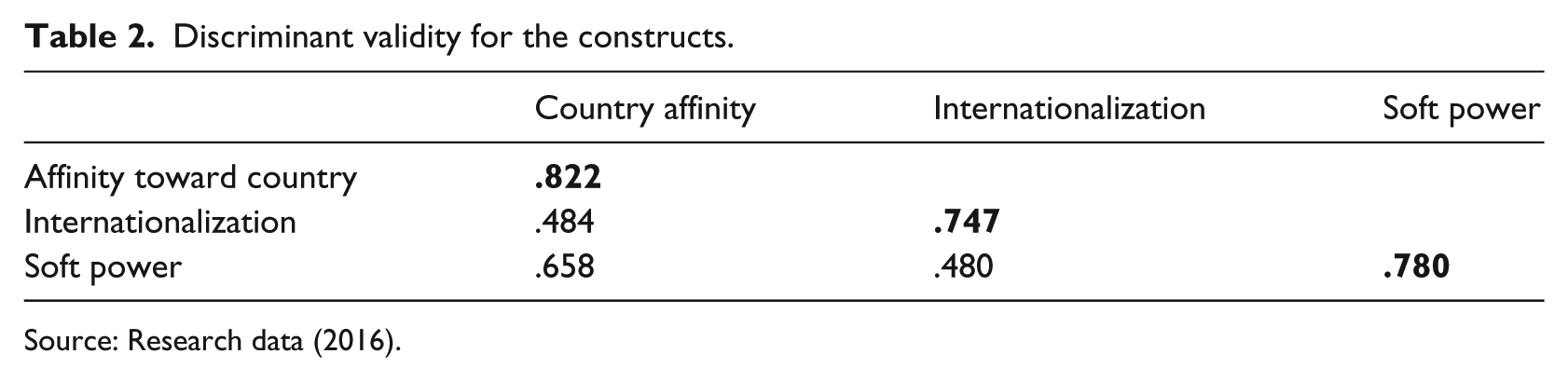
Source: Research data (2016).
To verify the specification of the model through the endogenous constructs, effect sizes (f 2 and q2), and predictive relevance (Q2) were evaluated. Table 3 presents the results for indices f 2, q2, and Q2 (Cohen, 1998).
Indices f 2 and q2 for the analyzed constructs.
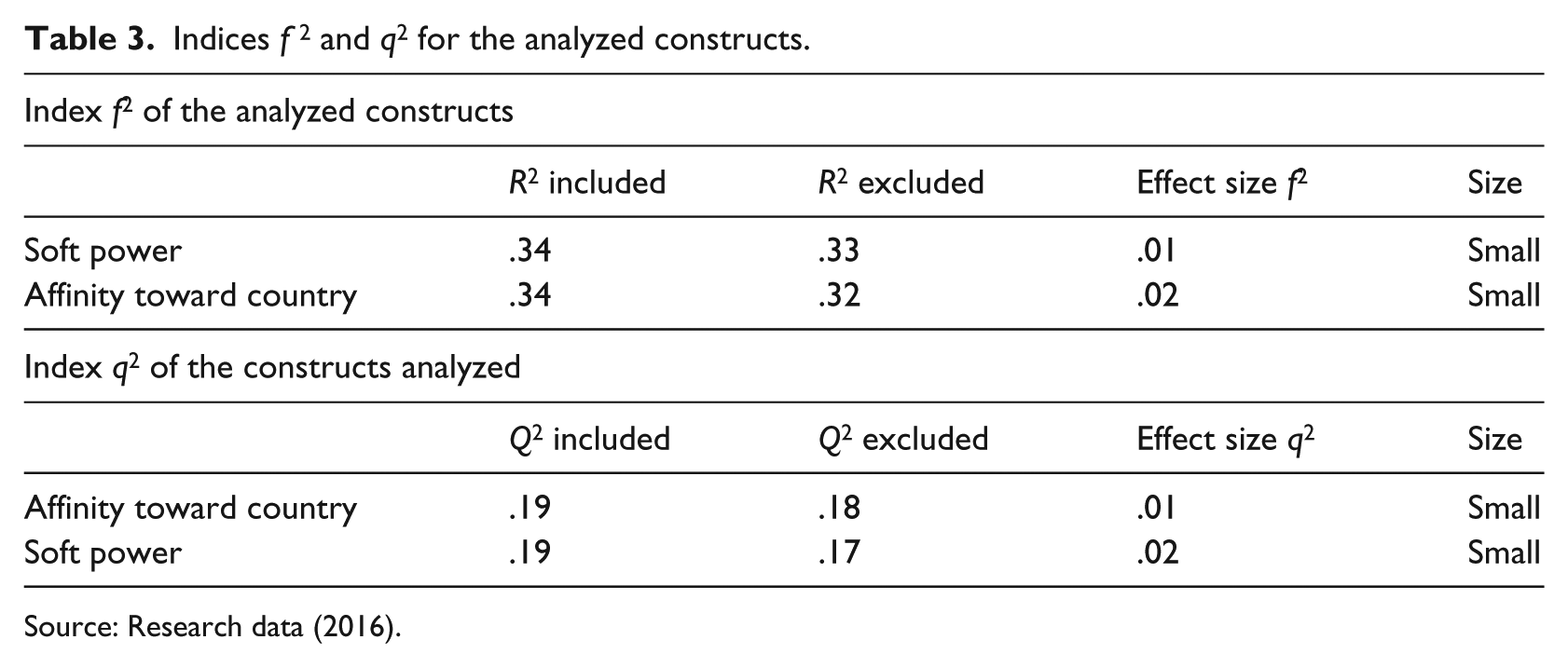
Source: Research data (2016).
GoF model was evaluated, which indicates how much the model reproduces the covariance matrix between the indicator items, that is, the estimated and observed covariance matrices (Hair et al., 2014). Thus, the reported values, χ2/Gl = 2.94, GoF index (GFI) = .924; normed fit index (NFI) = .930; relative fit index (RFI) = .914; incremental fit index (IFI) = .955; comparative fit index (CFI) = .955; Tucker–Lewis index (TLI) = .945; PCFI = .776; root mean square error of approximation (RMSEA) = .060, revealed that the model presents good level of adjustment, as all meet the limits recommended in the literature, that is, χ2/Gl obtained is less than 5; the RMSEA is less than .08; the values of GFI, NFI, RFI, IFI, CFI, and TLI are sufficiently below .90; and the Parsimony Comparative Fit Index(PCFI) value is between .06 and .80 (Hair et al., 2014). All the indicators are reported in Appendix 2.
Regardless of the effect of the control variables gender, income, and age, it was noticed that soft power exerted a positive influence on the affinity with the country (β = .70; p < .001); this result confirms H1. The affinity in relation to Brazil on the part of the Portuguese consumers has a positive and significant effect (β = .21; p < .001) on internationalization of Brazilian cultural products, confirming H2. The existence of a direct and positive relationship between soft power and the internationalization of cultural products (β = .42; p < .001) was also noted, thus corroborating H3. Regarding the control variables used, it was noted that age presented a statistical significance (p < .001; Hair et al., 2014).
The PRATIO adjustment parsimony index = .813 of the proposed model is considered satisfactory because it presents a higher value of .06, as reported in the literature (Ribas & Vieira, 2011). Lower values (including for ECVI, LO 90, HI 90, and MECVI) were observed for the hypothetical model when compared with the saturated and independent models, Akaike information criterion (AIC), Browne–Cudeck criterion (BCC), Bayesian information criterion (BIC), and the consistent Akaike information criterion (CAIC). We conclude that the theoretical model presented the best fit. The estimates of the regression weights demonstrated critical ratios higher than 1.96 (CR > 1.96) and statistical significance level higher than 5% (p < .05), so among the indicators of the constructs a systematic and statistically significant covariance was noted. Result of the structural model is shown in Figure 2.

Result of the proposed structural model.
Discussion
Internationalization of Brazilian cultural products perceived by Portuguese consumers is influenced by affinity toward country and soft power. These results indicate that the dimensions which make up the construct affinity toward country (sympathy and attachment; Oberecker & Diamantopoulos, 2011) were determinants for the relation between cultural and ideological influence (soft power; Nye, 2004, 2011) and the internationalization of Brazilian cultural products, through the knowledge level and consumption level of this type of product (Khan et al., 2012). It is worth mentioning that the identity aspects (Nercolini, 2006) related to openness, trust, and identification with Brazilians and positive aspects in experiences with Brazilians were more significant for Brazilian soft power. For the Portuguese consumer, Brazil is an affinity country for which these consumers demonstrated positive feelings, through specific actions of behavior, having a cultural and ideological influence exerted by Brazil in Portugal as an antecedent factor (Nye, 2004, 2011). This implication, relative to the affinity with Brazil, corroborates the research of Oberecker et al. (2008) and Verlegh (2007).
Therefore, this study is in line with the vision of Moya and Jain (2013), because these authors affirm that there is a gap between what countries communicate and what is actually understood by the people. In this specific case, this gap did not exist.
The collective opinion evidenced by the legitimacy of this specific social group, generating in this way a cultural influence (soft power) of Brazil in Portugal, was a source of information and association, with respect to Brazil and its cultural products (Mossberg & Kleppe, 2005). This information and association generated from the affinity toward country can be seen as an influencing factor in the relationship between Brazilian soft power and the internationalization of cultural products.
The internationalization of Brazilian cultural products was, more specifically, by the levels of knowledge and consumption aimed at Brazilian music and products related to it. This internationalization may represent an approximation between the cultures of the two countries (Brazil and Portugal), according to Spolaore and Wacziarg (2013). In view of this, Brazilian cultural characteristics evidenced by the Brazilian music exported to that country can be seen as an important symbolic association with respect to the internationalization of the Brazilian cultural products.
The openness and adaptability, the image that the Brazilians spread around the world, and the perception that the conviviality with Brazilians provides the Portuguese consumer positive experiences, a possible cultural and ideological influence in relation to Portugal, were the factors demonstrated. These values related to Brazil have caused an affinity for cultural products and services, in particular, the music and products that make up the productive chain of this cultural product.
Conclusion
Considering that the objective of this study was to understand the influence of soft power, and affinity toward country on the internationalization of cultural products, it was noticed that the ideological and cultural influence related to soft power was significant for the affinity in relation to Brazil; because the result of SEM is based in covariance, we noticed that soft power influenced 70% in affinity toward country and 42% in the internationalization of cultural products. Continuing, one has that the affinity toward country influenced in 21% in the internationalization of cultural products. Therefore, the general objective of the research has been fulfilled in its totality.
Affinity toward country can be seen as a two-dimensional construct: sympathy and attachment. This sympathy and attachment to Brazil (Oberecker & Diamantopoulos, 2011) and the image of Brazil (Pisharodi & Parameswaran, 2002) suffered a cultural influence through soft power, according to the scale validated in the study. Future research may benefit from this approach to understand, based on other geographic and social contexts, how countries culturally and ideologically influence other countries (Nye, 2004, 2011), with which they conduct business, in the international field.
Regardless of gender, age, and sex, utilized as control variables in the study, a clear relationship between the constructs analyzed was noted. Therefore, the influence of soft power on the affinity in relation to Brazil and the internationalization of Brazilian cultural products have been confirmed. Likewise, the influence proposed for the relationship between soft power and the internationalization of cultural products has also been confirmed.
For the Portuguese consumers surveyed, Brazil can culturally and ideologically influence other countries (soft power) by means of music. Therefore, in a managerial perspective, for businesses in this sector, this influence may be a comparative advantage in relation to other countries. In this sense, associating the affinity with Brazilian music can generate a differentiation from the advantages geared to the superior characteristics of Brazil (music), which give them unique benefits in global competition, by means of natural resources or through deliberate national policies, for example, the launch of six new publications of Programa Brasil de Todas as Telas for 2014 (MinC, 2014), the national culture plan (MinC, 2011). These examples are justified as, through public policies, music literature (songbooks) and music contained in Brazilian films or in soap operas exported to other countries can be internationalized. Thus, the values of the Brazilian cultural products, especially Brazilian music, emphasizing aspects aimed at versatility and musical flexibility, make this kind of cultural product have a mobility between several musical communities around the world, through digital musicality, generating new markets for the Brazilian cultural products (Partti, 2014).
The absence of other countries in the sample, for example, Angola, Mozambique, among others of the Portuguese language, which are known to suffer cultural influences from Brazil, can be perceived as a limitation of research, as these countries could provide greater information about the image of Brazil abroad. From the present research, future study opportunities emerge, namely, (a) to replicate the present research with a sample of data from other countries, as in this work there was no opportunity to use this type of data and (b) to seek a deepening of research focused on the concept of soft power, as this construct is not yet totally consolidated in the existing international business literature.
Footnotes
Appendix 1
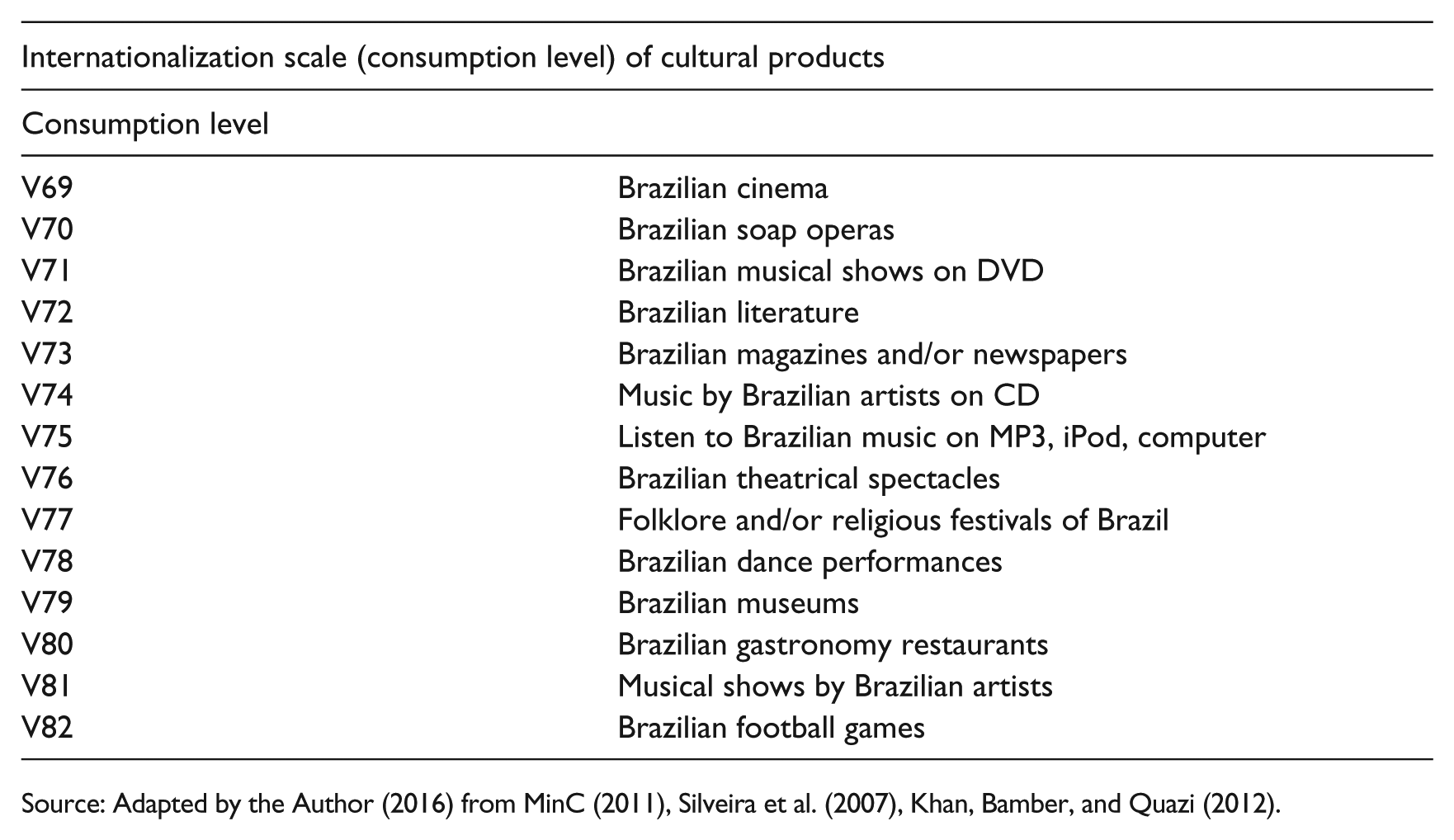
| Internationalization scale (consumption level) of cultural products |
|
|---|---|
| Consumption level | |
| V69 | Brazilian cinema |
| V70 | Brazilian soap operas |
| V71 | Brazilian musical shows on DVD |
| V72 | Brazilian literature |
| V73 | Brazilian magazines and/or newspapers |
| V74 | Music by Brazilian artists on CD |
| V75 | Listen to Brazilian music on MP3, iPod, computer |
| V76 | Brazilian theatrical spectacles |
| V77 | Folklore and/or religious festivals of Brazil |
| V78 | Brazilian dance performances |
| V79 | Brazilian museums |
| V80 | Brazilian gastronomy restaurants |
| V81 | Musical shows by Brazilian artists |
| V82 | Brazilian football games |
Source: Adapted by the Author (2016) from MinC (2011), Silveira et al. (2007), Khan, Bamber, and Quazi (2012).
Appendix 2
Execution time summary.

| Minimization | .031 |
| Miscellaneous | .815 |
| Bootstrap | .000 |
| Total | .846 |
Funding
The author(s) disclosed receipt of the following financial support for the research, authorship, and/or publication of this article: This work was supported by Coordination of Superior Level Staff Improvement (Coordenação de Aperfeiçoamento de Pessoal de Nível Superior - CAPES) (Grant 6220-15-0).
