



Abstract
Sales managers often struggle to create effective combinations of promotion framing and promotion reward timing. However, whether gain-framing (vs. loss-reduction framing) promotions are better suited to be combined with immediate or delayed promotions remains an open question. In three studies, we show that the gain (vs. loss-reduction) framing of promotion information activates a high (vs. low) construal level, which leads to a higher preference for delayed (vs. immediate) promotions. We also find that time perception moderates the proposed effect. Specifically, consumers with time-overestimating (vs. time-underestimating) perception are more likely to choose immediate (delayed) promotions when they are at a low (high) construal level. Our findings provide insights for marketers and retailers that consumers would like to wait for a higher reward in a longer horizon under the gain promotion frame, while they prefer an immediate reward even if the benefit is much lower under the loss-reduction promotion frame.
Keywords
Introduction
Sales promotions serve as an essential link between enterprises and consumers in the realm of marketing activities. Our study reveals a powerful connection between the framing of promotion information as gain versus loss-reduction. Specifically, we demonstrate that the gain framing activates a higher construal level compared to the loss-reduction framing. This heightened construal level, in turn, results in a distinct preference for delayed promotions over immediate ones. Uncovering this relationship not only contributes to a deeper understanding of decision-making processes but also provides valuable insights for marketers and policymakers seeking to optimize promotion strategies.
Based on the timing of promotion rewards, promotion programs can be categorized into immediate promotions and delayed promotions (Soman, 1998; Zhang et al., 2000); the former (e.g., instant savings, credits, a gift with purchase) provides consumers with instant returns when purchasing, while the latter (e.g., mail-in rebates, cash rewards, coupons) offers delayed returns after consumers finish purchasing. This classification has been widely recognized (Cheema & Patrick, 2008; Kim, 2013), and both promotions are ubiquitous. For example, approximately 90% of shoppers used coupons in America and the digital coupon redemption value is projected to reach $91 billion by 2022 (Milena, 2023). Based on the presentation of promotion information, promotion frameworks generally take two forms: the gain frame and the loss-reduction frame (Koo & Suk, 2020). The gain frame emphasizes the benefits that consumers can obtain from a promotion, while the loss-reduction frame emphasizes that the costs can be reduced through a promotion (Ramanathan & Dhar, 2010). There is a large body of literature that focuses on either promotion programs based on reward timing or those based on savings message framing (Song, 2022); however, little is known about how to identify effective combinations of different promotion frameworks with the appropriate reward timing.
Promotion messages framed as gains prime a promotion focus, whereas promotions with a loss-reduction frame prime a prevention focus (Cheng et al., 2013). As another independent prime of regulatory focus, an immediate coupon expiration (vs. future expiration) cue also primes a prevention focus (vs. promotion focus) (Ramanathan & Dhar, 2010). From the perspective of regulatory fit, gain (vs. loss-reduction) framing naturally fits with a future (vs. immediate) expiration coupon cue (Higgins, 1998). Yet, there has been no examination of effectiveness of combinations of different types of savings message framing and different timings of reward promotion programs. We extended this stream of research by intestigating the effect of promotion framing on consumer preferences for immediate versus delayed promotions. Additionally, instead of a coupon expiration cue, we extended the scope of prior research to focus on the immediate versus delayed realization of promotions.
We propose that gain-framing promotions elicit a higher construal level, which in turn increase the preference for delayed promotions; in contrast, loss-reduction-framing promotions are associated with a lower construal level and are better suited to be combined with immediate promotions (Koo & Suk, 2020). We also propose that time perception serves as an important moderator of the proposed effect (Khalil et al., 2021).
Theory and hypotheses
Consumer preferences for sales promotions under different frameworks
The framing effect, which was first proposed by Tversky and Kahneman (1981), refers to different descriptions of the same decision-making task that can affect an individual’s decision preference (Martino et al., 2006; Ochoa & Revilla, 2023). Originating from psychology, the framing effect has been applied in education, medicine and other fields. Previous studies have shown that promotion framing can affect consumers’ choice preference, perceived value, purchase intention and behavior (Gamliel, 2010; Kramer & Min Kim, 2007; Shen, 2014). Facing promotion information, consumers often ‘frame’ it to identify whether it is a positive information framework under which they can ‘gain profits’ or a negative information framework under which they can ‘reduce losses’, and take corresponding attitudes and choices (Li et al., 2007).
According to regulatory focus theory, promotions with a loss-reduction frame prime a prevention focus (Higgins, 1998; Ramanathan & Dhar, 2010). Neurophysiological studies indicate that a prevention-focused information frame prompts individuals to dwell more on negative outcomes (Amodio et al., 2004; Davidson & Irwin, 1999), enhancing sensitivity to loss information and focusing on loss aversion (Xu et al., 2009). In this situation, consumers emphasize security, diminishing the impact of expectancy (Shah & Higgins, 1997). Consequently, consumers may perceive waiting as increasing the cost of time (Mell et al., 2021). Then, temporally proximal choice becomes more appealing (Mogilner et al., 2008), and consumers are inclined to put relatively greater emphasis on proximate than distant events (Pennington & Roese, 2003), and hence prefer an immediate promotion. Therefore, when a promotion frame is described in terms of a loss, consumers will be more likely to choose an immediate promotion. In contrast, when a promotion frame is described in terms of a gain, a promotion focus will be primed (Higgins, 1998; Ramanathan & Dhar, 2010). A promotion-focused frame may activate positive emotions (Xu et al., 2009), leading individuals to penalize delays less compared to those in loss-reduction scenarios. Consequently, consumers prioritize the benefits offered by the promotion, making them more inclined to select a delayed promotion with higher returns. Hence, the following hypothesis is proposed:
Consumers prefer a delayed promotion (vs. an immediate promotion) under a gain (vs. loss) frame.
The mediating effect of construal level
Construal level theory emphasizes the importance of people’s perception and understanding of the environment; at its core, people’s reactions to things depend on their mental representation of things, and construal level is divided into high and low levels (Liberman & Trope, 1998; Trope & Liberman, 2003). A high construal level is characterized by super ordination, abstraction, decontextualization and desirability, representing the ‘why’ aspect of mental representation. In contrast, a low construal level is characterized by subordination, concreteness, contextualization and feasibility, reflecting the ‘how’ aspect of mental representation (Liberman & Trope, 1998). For example, people who construe about an event or action of ‘participating in a promotion activity’ at a high level and with an abstract frame of mind would find the message ‘buying your favorite goods’ more meaningful than the message ‘three steps to get the coupons’.
The relationship between regulatory focus and construal level has been well established by prior studies (Lee et al., 2010; Park & Morton, 2015; White et al., 2011). For example, Lee et al. (2010) indicated that promotion-focused individuals are more likely to construe information at abstract, high levels, whereas those with a prevention focus are more likely to construe information at concrete, low levels. In this light, it can be expected that gain-framed promotion information induces a high construal level, whereas loss-reduction framed promotion information elicits a low construal level.
According to construal level theory, the differences in construal level among individuals will result in different cognitions and behaviors (Kim et al., 2021; Trope & Liberman, 2003). Based on existing research, the information conveyed by time or by money corresponds to different construal levels (Cheema & Patrick, 2008; Koo & Suk, 2020). In the process of choosing immediate and delayed promotions, consumers weigh the differences in time (instant vs. future) and money (less vs. more savings) between the two promotion types (Lin et al., 2015; Soman, 1998). On the one hand, consumers usually associate time with ‘feasibility’ (Cheema & Patrick, 2008; Youn & Kim, 2019), and this association emphasizes how the benefits brought by promotional activities are obtained. Specifically, ‘time’ information emphasizes the time, effort, risk and uncertainty that need to be involved in the process of participating in promotional activities (Kim, 2013). However, on the other hand, ‘money’ information reflects the core interests in promotional activities, emphasizing the goal and reflecting information related to ‘desirability’ (Jha et al., 2019; Trope et al., 2007; Yao & Chen, 2014). To conclude, in promotion participating context, high-level construal increases focus on the core benefits of promotion activities (money), thus consumers prefer delayed promotions; whereas low-level construal increases focus on the costs and uncertainty (time) associated with participating and purchasing, thus consumers prefer immediate promotions.
Past literature suggests that the construal level is an important mediating variable that affects consumer’s promotion information processing and decision-making preference (Amaral, 2021). Therefore, when a sales promotion is described in terms of a gain-framed message, i.e., when individuals have a high construal level, consumers will be more likely to choose delayed promotions. In contrast, when a sales promotion is described in terms of a loss-reduction framed message, i.e., when individuals have a low construal level, they are more likely to choose immediate promotions. Hence, we propose the following hypothesis:
Construal level mediates the effect of the promotion framework on consumers’ preference for delayed (immediate) promotions.
The moderating effect of time perception
Consumers’ time perception refers to people’s subjective feelings and judgments with regard to a change in time (Takahashi et al., 2008). Based on the difference in individuals’ perception of time, previous studies have divided people into individuals who overestimate time, i.e., those whose subjective perception of a delay in time will be longer, and individuals who underestimate time, i.e., those whose subjective perception of a delay in time will be shorter (Grondin, 2010; Namboodiri et al., 2014).
Previous studies have shown that an individual’s time perception has an impact on his or her intertemporal choice. When consumers are at a low construal level, they will pay more attention to ‘time’ information; thus, they will be more likely to choose immediate promotions. In this situation, for time-overestimating individuals who are more sensitive to delays in time, the subjective value of the delayed return will decrease (Wittmann & Paulus, 2008). As a result, the negative effect of the ‘time’ information of delayed promotions will be strengthened, and therefore, such individuals will be less likely to choose delayed promotions.
Similarly, when consumers are at a high construal level, and then, consumers will pay more attention to ‘money’ information and, therefore, be more likely to choose delayed promotions (Liberman & Trope, 1998; Ramanathan & Dhar, 2010; White et al., 2011). In this situation, time-underestimating individuals will be inclined to ignore the risks and costs associated with earnings (Wittmann & Paulus, 2008). That is, the negative effect of the ‘time’ information of delayed promotions will be less important than obtaining more earnings, and therefore, the willingness to choose delayed but larger promotions will increase. Therefore, we propose the following hypothesis:
Time perception moderates the relationship between construal level and consumer preferences. Specifically, time-overestimating (time-underestimating) individuals are more likely to choose immediate (delayed) promotions when they are at a low (high) construal level. Based on the related theories and hypotheses, we propose the model shown in Figure 1. Next, we test all of the hypotheses through three experiments.
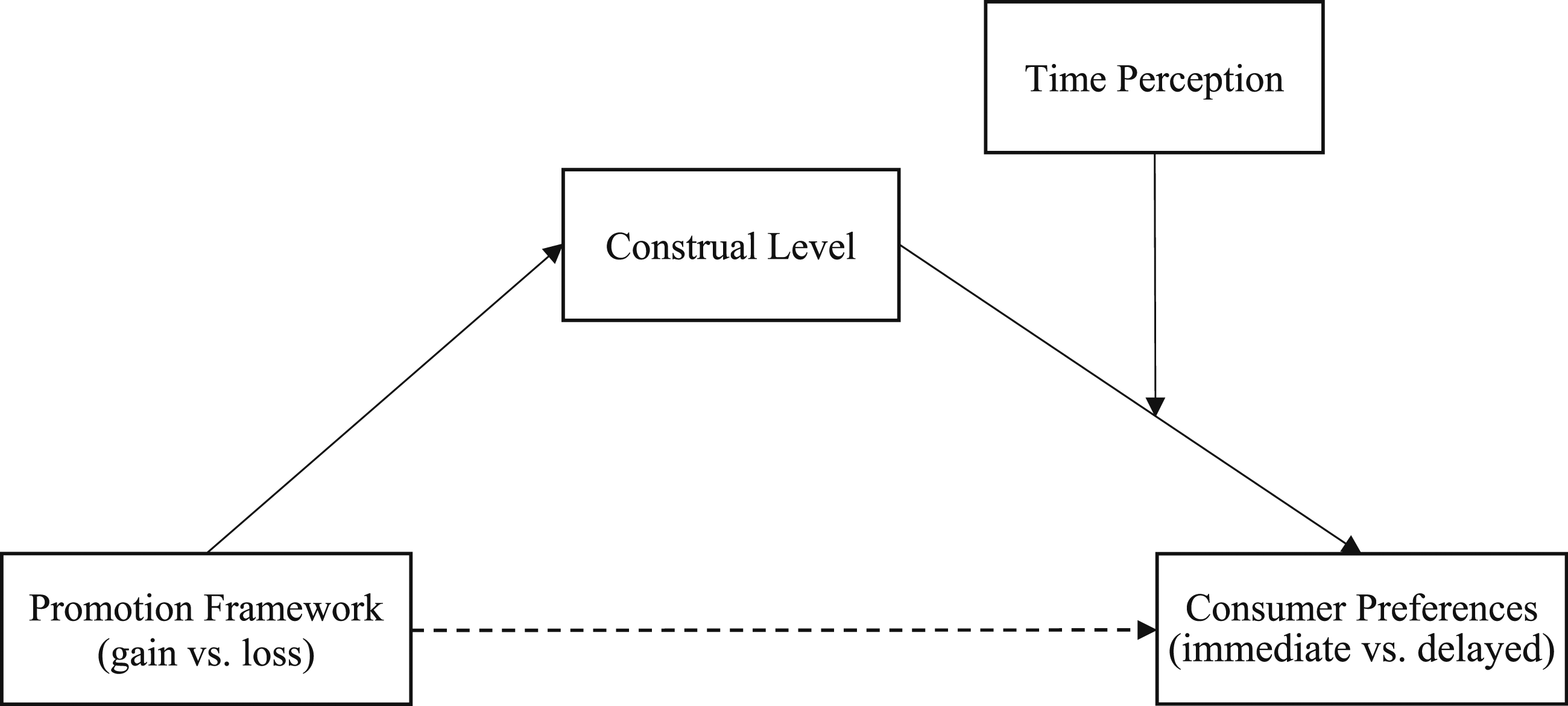
A conceptual model.
Study 1
The purpose of Study 1 is to provide evidence for our proposed effect of promotion framing on consumer preferences for immediate and delayed promotions. In addition, this study tests the mediating role of construal level. Moreover, consumers differ in their ways of dealing with risks (Lion et al., 2002; Meertens & Lion, 2008). According to prospect theory, when individuals face an expected return, they prefer to avoid risk, but when they face the option of an expected loss, they prefer to seek risk (Gamliel, 2010). Consequently, consumers exhibit varying risk propensities when encountering different promotional activities. Specifically, positive framing of promotion information emphasizes the benefits or gains, thus may activate a lower risk propensity; while negative framing emphasizes risks or losses, thus may activate a higher risk propensity. Furthermore, individuals’ risk propensity will affect their preference for immediate and delayed promotions (Kim, 2013). When consumers are prone to minimize risks (i.e., low risk propensity), the immediate promotions are expected to be relative more attractive. Conversely, when consumers are prone to take risks (i.e., high risk propensity), they may find delayed promotions to be relative more attractive. In essence, high (low) risk-taking consumers may prefer a delayed (immediate) promotion. In summary, consumers’ risk propensity is likely to play a mediating role between the promotion framework and consumer preferences. Therefore, we take risk propensity into account and rule out this alternative explanation in our model.
Method
We conducted a pilot test to select the promotional products and promotion levels. First, with regard to determining promotional products, previous studies have mainly focused on fast-moving consumer goods (FMCGs) (Kim, 2013; Palazon & Delgado-Ballester, 2011). Considering that most subjects are university students, we selected coffee with a high mention rate and utilization rate as the promotional product to conduct follow-up research (Hardesty & Bearden, 2003). Second, to determine the coffee discount level under the immediate promotion, we drew on the studies of Chou and Lien (2012) and set it at 10%. Sixty-seven university undergraduates participated in the pilot test. Based on the results, we chose to use coffee (30 RMB/cup) as the stimulus product and the promotional discount of 3 RMB for the immediate promotion and 6 RMB off for the delayed promotion.
In the main study of Study 1, one hundred and eighteen university undergraduates (53.4% females, 63.6% 18–25 years old) participated in exchange for monetary compensation. The participants were randomly assigned to a 2-cell (gain frame vs. loss-reduction frame), between-subjects design. The procedures were as follows:
Promotion framework manipulation
Based on the relevant research of Kramer and Min Kim (2007) and Ramanathan and Dhar (2010), this paper selected a widely used price promotion, a discount, and then described the promotion content in detail under a gain or loss-reduction frame. The participants were asked to imagine that they were in a coffee shop and that a promotion was taking place. Specifically, under the gain-framing condition, the participants read the promotion ‘You will receive a 3 RMB coupon on a cup of coffee’, whereas under the loss-reduction-framing condition, they read ‘You will save 3 RMB on a cup of coffee’. In the questionnaire, based on Lowe (2010), we measured consumers’ perception of the benefits and losses of a promotional activity using a seven-point scale: (1) ‘I think the promotion gave me extra profits’; and (2) ‘I think the promotion has reduced the expense’.
Measurement of construal level
After the promotion framework manipulation, the participants answered questions measuring their construal level. We adapted and revised the construal level scale by Labroo and Patrick (2009). Specifically, the participants were asked to rate two items: (1) ‘The promotion can provide me with a more favorable price for a cup of coffee’; and (2) ‘To participate in the promotion activity is to choose the coffee I want and make a purchase’. The former contains information about why someone should participate in the promotion, while the latter contains information about how to participate. The participants rated the two items on a seven-point scale (1 = completely disagree, 7 = completely agree; item 2 is reverse coded).
Measurement of risk propensity
The participants also reported their risk propensity. Following Meertens and Lion (2008), we measured consumer’s general risk propensity with two items: (1) ‘When buying coffee, I generally like to take risks’; and (2) ‘When buying coffee, I do not take risks’ (1 = completely disagree, 7 = completely agree; item 2 is reverse coded).
Preference for immediate versus delayed promotions
Based on the research of Kim (2013), we selected the most representative promotion tools with regard to immediate and delayed promotions: an immediate discount and a delayed discount, respectively. We asked the participants to indicate their preference between an immediate versus a delayed promotion within the same framework. For example, the participants under the gain-framing condition chose between immediately ‘receiving a 3 RMB coupon when you buy a cup of coffee’ (immediate promotion) and ‘when you buy a cup of coffee, you will receive a 6 RMB coupon for your next purchase’ (delayed promotion). In contrast, the participants under the loss-reduction-framing condition chose from ‘saving 3 RMB when you buy a cup of coffee’ (immediate promotion) or ‘saving 6 RMB on the next purchase when you buy a cup of coffee’ (delayed promotion).
Contextual factors of decision-making can affect an individual’s intertemporal choice (Peters & Büchel, 2011). Thus, this paper controls variables such as product involvement and personal emotion (Kim, 2013). Finally, the participants reported their demographic information such as their gender, age, and educational level.
Results
Manipulation check
We tested whether the participants could perceive the difference between the two promotion frameworks. The results show that for item 1, the score of the participants under the gain-framing condition is significantly higher than the score of those under the loss-reduction-framing condition (Mgain = 4.52, Mloss-reduction = 3.60, p = .003). Similarly, the results show that for item 2, the score of the participants under the loss-reduction-framing condition is significantly higher than that of those under the gain-framing condition (Mgain = 4.91, Mloss-reduction = 5.88, p = .002), indicating that the manipulation was successful.
Then, we tested whether there is a significant difference in perceptions of immediate and delayed promotions. The results show that Mimmediate promotion = 1.75, Mdelayed promotion = 6.45, p = .000, indicating that the subjects could obviously perceive the difference between the two promotion types, which means that the manipulation was successful.
Consumer preferences for sales promotions under different frameworks
The results show that the main effect of the promotion framework is significant (immediate promotion choice perception: gain-framing condition = 43% vs. loss-reduction-framing condition = 65%, χ2 = 5.697, p = .017, Consumer preferences for promotions under the gain frame or the loss-reduction frame (study 1).
Th effect of the promotion framework on construal level and the effect of construal level on consumer preferences
We created an index for construal level by averaging the scores of the two items measuring construal level. A higher score indicates that an individual was at a higher construal level. One-way ANOVA revealed significant differences in the construal level between participants under the gain and loss-reduction frameworks (Mgain = 4.72, SD = 1.117 vs. Mloss-reduction = 4.06, SD = 1.146; F (1,116) = 9.943, p = .002,
The mediating effect of construal level
We conducted an analysis using Model 4 (Hayes, 2013) to test the mediating effect of construal level and selected bootstrapping with 5,000 samples and a 95% CI. Our results show a significant indirect effect (b = −0.2482, BE = 0.1695, 95% CI: −0.6636, −0.0182) and a non-significant direct effect (b = −0.6893, SE = 0.4122, 95% CI: −1.4972, 0.1186), suggesting that construal level does indeed fully mediate the effects of promotion framing on consumer preferences for immediate (vs. delayed) promotions. Therefore, H2 is supported.
The mediating effect of risk propensity
The result shows that risk propensity does not mediate the proposed effect (b = −0.0329, BE = 0.1018, 95% CI: −0.2340, 0.1923). Therefore, the mediating role of risk propensity is ruled out.
The alternative explanation of regulatory fit
We conducted another experiment to help rule out the alternative explanation of regulatory fit (see Appendix to get the experiment details). Participants were presented with definitions of prevention-oriented and promotion-oriented promotions and asked to rate the immediate and delayed promotion on a 7-point scale (Sun et al., 2019; Wang & Lee, 2006). The results showed that, when the timing framing is integrated with gain or loss-reduction framing, participants perceived both immediate and delayed promotions to be more promotion-oriented than prevention-oriented. Thus, our results ruled out the regulatory fit effect.
Study 2
Study 2 aims to replicate the results and to test the mediating role of construal level. Specifically, we use ‘a gift with purchase’ and ‘cash back’ to represent the gain and loss-reduction frames, respectively (Li et al., 2007; Shen, 2014).
Method
We first conducted a pilot test to select the promotional products, promotion levels and the appropriate gift with purchase. Regarding the selection of promotional products, we drew on the research of scholars such as Prendergast and Thompson (2008) and selected smartphones as the promotional product. Based on the research of Alba et al. (1999) and other scholars as well as the actual sales discount of smartphones in the market, we selected a smartphone with a medium-level value (priced at 2,000 RMB) as the stimulus and set the discount level as 100 RMB. The pilot test was also necessary to choose the appropriate promotional gifts as the incentive of the gift promotion. Based on the research of Palazon and Delgado-Ballester (2011), we selected five popular gifts with a smartphone for testing (a smartphone screen protector, Bluetooth speaker, smartphone stand, mobile power bank, and smartphone case) and then asked the participants to choose which gift would be equivalent to an immediate 100 RMB cash back and which gift would be equivalent to 150 RMB cash back to be received when they receive the smartphone.
One hundred and eight undergraduates from a large public university participated in the pilot test. Based on the results, we chose to use 100 RMB cash back for the immediate cash back amount and 150 RMB for the delayed cash back amount. In addition, we chose a portable power device and Bluetooth speaker as promotional gifts as the immediate and delayed gifts with purchase, respectively.
In the main study of Study 2, one hundred and nine undergraduates (51.4% females, 55% 18–25 years old) from a large public university participated in exchange for monetary compensation. The participants were randomly assigned in a two-level (gain frame vs. loss-reduction frame) between-subjects design. The procedures were as follows:
Promotion framework manipulation
Based on the research of Shen (2014) and Lowe (2010), this paper used a gift with purchase and cash back promotion to represent the gain frame and the loss-reduction frame, respectively. The participants were asked to imagine that they were purchasing a smartphone in an online store. Specifically, under the gain-framing condition, they read the promotion ‘you will receive a portable power bank as a gift for your 2,000 RMB phone purchase’. In contrast, under the loss-reduction-framing condition, the participants read ‘you will receive 100 RMB cash back when you purchase the 2,000 RMB smartphone, which will make your final price only 1,900 RMB’.
Measurement of construal level
The measurement of construal level was similar to that in Study 1. First, two descriptions of phone promotions were determined: (1) ‘The promotion can provide me with a more favorable price for a phone’; and (2) ‘To participate in the promotion activity is to choose the phone I want and make a purchase’. Then, the participants rated the two items on a seven-point scale.
Preference for immediate versus delayed promotions
The manipulation of promotion types was based on the research of Kim (2013), and ‘immediate cash back’ and ‘cash back after receiving the phone’ were selected as the immediate and delayed promotions, respectively. The subjects were required to make a choice in a given situation. We asked the participants to indicate their preference between an immediate versus a delayed promotion within the same framework. For example, the participants under the gain-framing condition chose from ‘immediately receiving a smartphone power bank when buying a smartphone with a price of 2,000 RMB’ (immediate promotion) or ‘receiving a Bluetooth speaker after buying a 2,000 RMB smartphone and receiving the product’ (delayed promotion). In contrast, the participants in the loss-reduction-framing condition chose from ‘immediately receiving cash back in the amount of 100 RMB when buying a smartphone with a price of 2,000 RMB’ (immediate promotion) or ‘receiving a cash back of RMB 150 after buying the 2,000 RMB smartphone and receiving the product’ (delayed promotion). Other variables were measured in the same way as in Study 1.
Results
Manipulation check
The results show that for item 1, the score of the subjects under the gain frame is significantly higher than the score of those under the loss-reduction frame (Mgain = 5.40, Mloss-reduction = 4.61, p = .007). Similarly, the results show that for item 2, the score of the subjects under the loss frame is significantly higher than the score of those under the gain frame (Mgain = 4.62, Mloss-reduction = 5.36, p = .014), indicating that the manipulation was successful. Moreover, the results show that Mimmediate promotion = 1.97, Mdelayed promotion = 6.06, p < .001, indicating that the subjects could obviously perceive the difference between the two promotion types. Therefore, the manipulation was successful.
Consumer preferences for sales promotions under different frameworks
The results show that the main effect of the promotion framework is significant (immediate promotion choice perception: gain-framing condition = 43% vs. loss-reduction-framing condition = 64%, χ2 = 4.785, p = .029, Consumer preferences for promotions under the gain frame or the loss-reduction frame (study 2).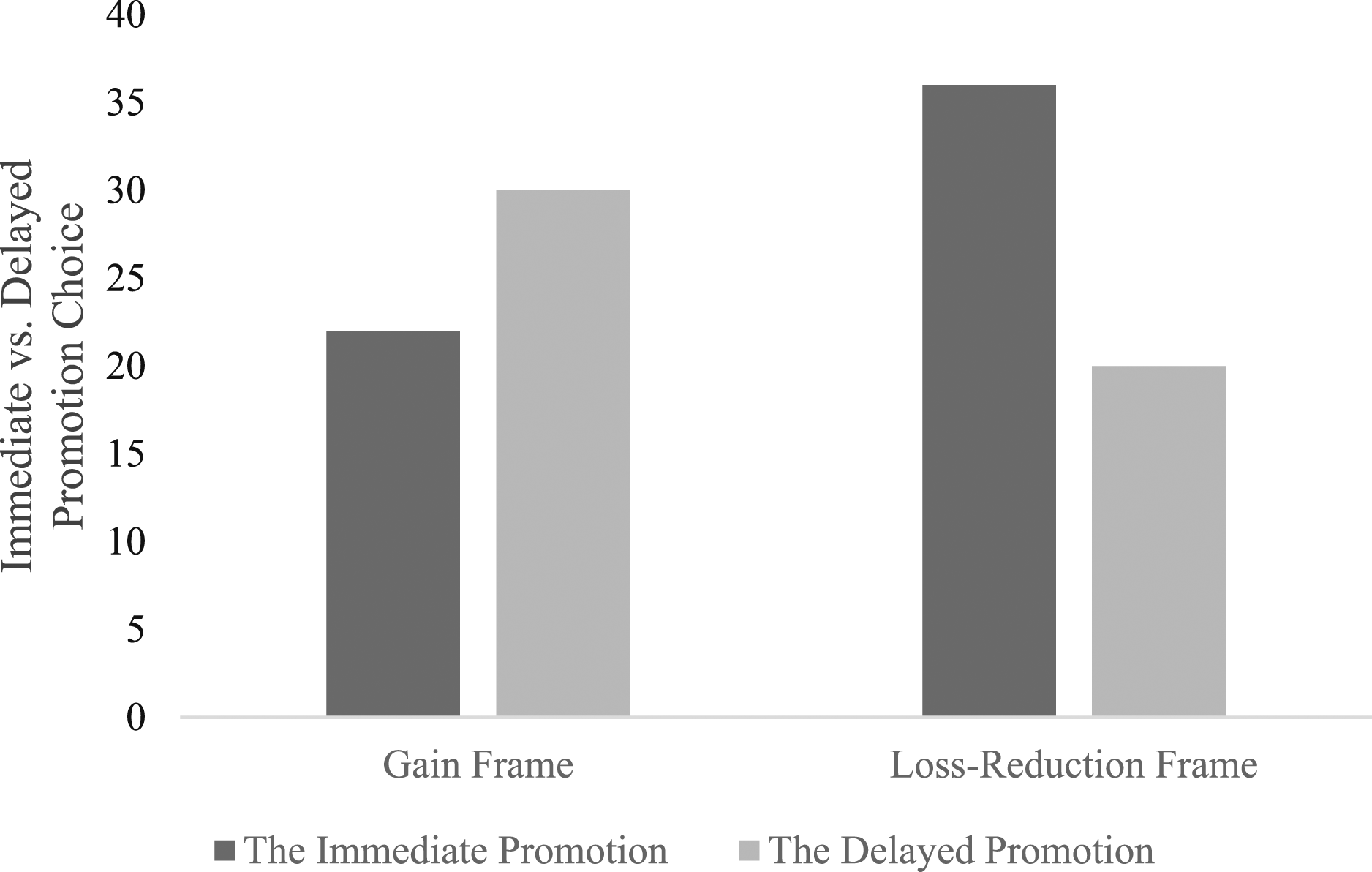
The mediating effect of construal level
We conducted the same analysis using Hayes’ Model 4 as in Study 1. The results indicate a significant indirect effect (b = −0.3015, BE = 0.1761, 95% CI: −0.7398, −0.0463) and a non-significant direct effect (b = −0.6516, SE = 0.4176, 95% CI: −1.4700, 0.1669), suggesting that construal level does indeed fully mediate the effects of promotion framing on consumer preferences for immediate (vs. delayed) promotions. Thus, H2 is again supported.
Study 3
The objective of Study 3 is to examine the moderating role of time perception in the effect of promotion framing on consumer preferences for immediate and delayed promotions. In addition, we used a different product, i.e., shampoo instead of coffee, to test the proposed effect.
Method
A total of 161 undergraduates from a large public university (48.4% females, 42.2% 18–25 years old) participated in the study in exchange for monetary compensation. They were randomly assigned in a 2 (promotion framing: gain vs. loss-reduction) × 2 (time perception: overestimating vs. underestimating) between-subjects design.
First, the participants completed a time reproduction task (either time overestimating or time underestimating).
Time reproduction task
We used the time reproduction task of Siu et al. (2014) to measure the accuracy of time perception. The participants performed the task on a lab computer, and the task was designed in E-prime. The task consisted of small trials of different time length: 2 s, 4 s, 8 s, and 16 s. In each trial, the operation process included three steps (see Figure 4): (1) when ‘+’ appears in the middle of the screen, it indicates that the experiment is about to start. (2) After ‘+’ disappears, a number of seconds (e.g., ‘2S’) in black appears in the middle of the screen, and the amount of time that the number appears is equal to the actual time length of the number shown. Then, ‘*’ appears in the center of the screen and indicates the end of the time. (3) After ‘*’ disappears, ‘2S’ in yellow appears in the center of the screen again. At the moment that the yellow number appears, the participants need to start estimating/counting 2 seconds by themselves and press ‘enter’ when they think that 2 seconds is up. The computer records the actual time that the participants estimated. To help the participants become familiar with the task, they need to complete 8 test trials and then proceed to the formal test. The formal experiment consisted of 24 trials, in which each time length was presented 6 times, all in a random order. Time reproduction task procedure.
Promotion framework manipulation
The participants then completed an ostensibly unrelated survey. They were then randomly assigned to one of the promotion framework manipulations: either a gain frame or a loss-reduction frame. We used a different product, i.e., shampoo (50 RMB/bottle), which is a more utilitarian product than coffee, as the discounted product. The manipulation of the promotion framework in Study 3 was similar to that in Study 1.
Measurement of construal level
The measurement of construal level was similar to that in Study 1. Two items describing the shampoo promotion were determined: (1) ‘The promotion can provide me with a more favorable price for a bottle of shampoo’; and (2) ‘To participate in the promotion activity is to choose the shampoo I want and make a purchase’. Then, the participants rated the two items.
Preference for immediate versus delayed promotions
We asked the participants to indicate their preference for an immediate versus a delayed promotion within the same framework. For example, the participants under the gain-framing condition chose from ‘immediately receiving a 5 RMB coupon when you buy a bottle of shampoo’ (immediate promotion) or ‘receiving a 15 RMB coupon for your next purchase when you buy a bottle of shampoo’ (delayed promotion). In contrast, the participants under the loss-reduction-framing condition chose from ‘saving 5 RMB when you buy a bottle of shampoo’ (immediate promotion) or ‘saving 15 RMB for your next purchase when you buy a bottle of shampoo’ (delayed promotion). The discount level of the shampoo under the immediate and delayed promotions was determined in a pilot test.
Results
Time perception
Descriptive statistics of time perception under different time tasks.

Manipulation check
The same manipulation checks as in Study 1 shows that the participants under the gain-framing condition reported higher scores for item 1 compared to those under the loss-reduction-framing condition (Mgain = 5.27, Mloss-reduction = 4.75, p = .030). Similarly, for item 2, the score of the participants under the loss-reduction-framing condition is significantly higher (Mgain = 4.24, Mloss-reduction = 4.96, p = .002). Moreover, the results show that the participants clearly perceived the difference between the two promotion types (Mimmediate promotion = 3.19, Mdelayed promotion = 5.44, p = .000). Therefore, the manipulation was also successful.
Consumer preferences for sales promotions under different frameworks
The results show that the main effect of the promotion framework is significant (immediate promotion choice perception: gain-framing condition = 44% vs. loss-reduction-framing condition = 62%, χ2 = 9.389, p = .022, Consumer preferences for promotions under the gain frame or the loss-reduction frame (study 3).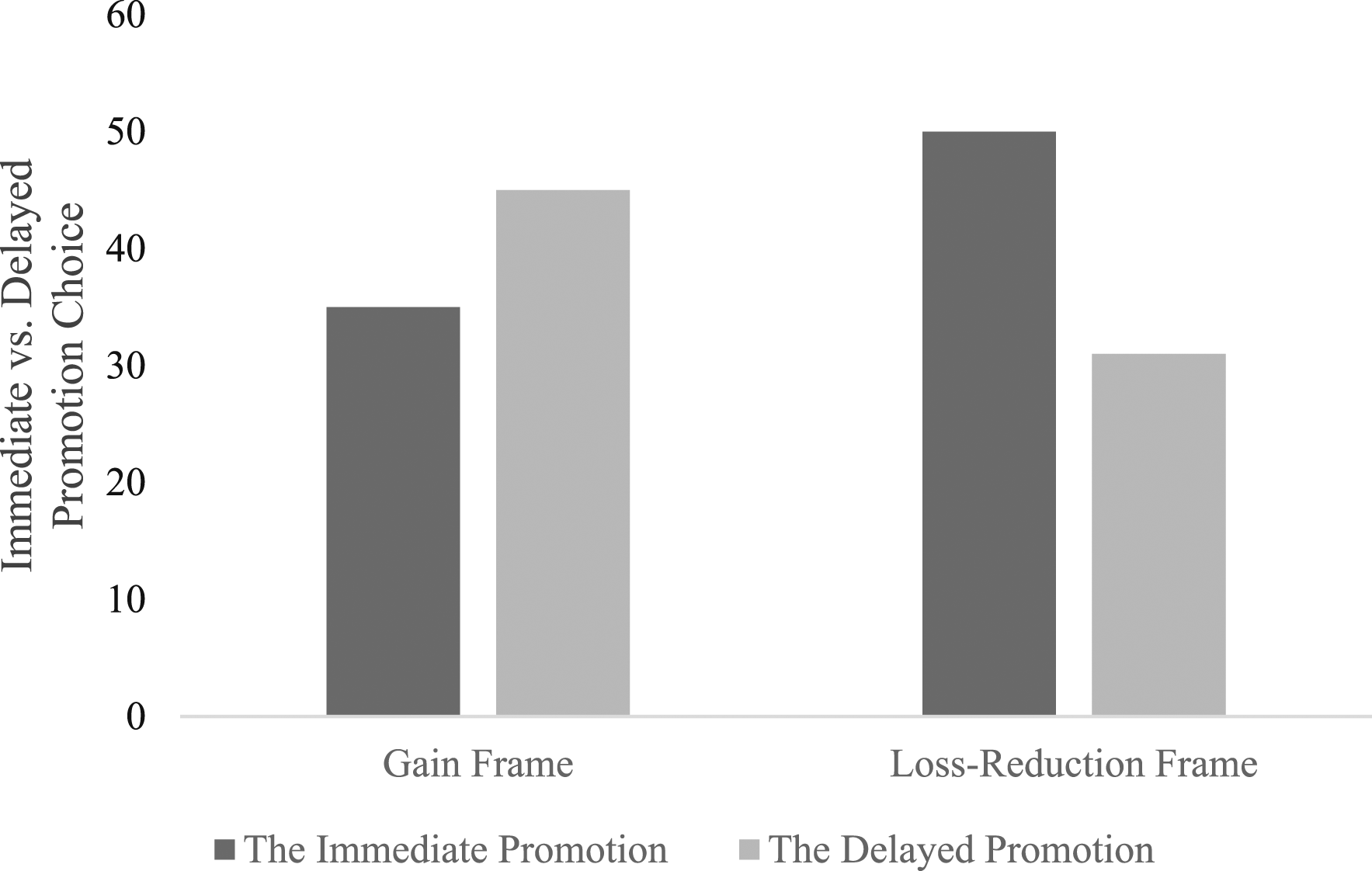
The mediating effect of construal level
An analysis using Hayes’ Model 4 was conducted to test the mediating effect of construal level. The results revealed a significant indirect effect (b = −0.4766, BE = 0.1834, 95% CI: −0.9007, −0.1902) and a non-significant direct effect (b = −0.3240, SE = 0.3541, 95% CI: −1.0181, 0.3701), suggesting that construal level fully mediated the effect of promotion framing on consumer preferences for immediate (vs. delayed) promotions. Thus, H2 is again supported.
The moderating effect of time perception
Firstly, we ran Model 1 on the relationship between construal level and consumer preferences for immediate versus delayed promotions with time perception as the moderator. The results show that consumers’ time perception has a significant moderating effect on the relationship between construal level and consumers’ promotion preference (p = .045, β = 0.9302, 95% CI: 0.0194, 1.8410). Thus, H3 is supported.
Then, we also ran Model 14 with time perception as the moderator and construal level as the mediator. The results show that time perception has a significant moderating effect on the mediating effect of construal level between the promotion framework and consumers’ promotion preference (p = .048, β = 0.9241, 95% CI: 0.0086, 1.8397). The index of the moderated mediating effect is significant (index = 0.6640, SE = 0.5705, 95% CI: 0.0155, 1.8624). Specifically, the mediating effect of construal level is stronger for participants who overestimate time (β = −1.3781, SE = 0.4015, 95% CI: −2.1650, −0.5911) and weaker for participant who underestimate time (β = −0.4539, SE = 0.2534, 95% CI: −0.9506, 0.0428). This result indicates that compared with the time-underestimating group, construal level has a stronger mediating effect between the promotion framework and consumer preferences in the time-overestimating group.
Conclusion and general discussion
Conclusion
Studies 1 and 2 show that consumers prefer delayed promotions under the gain frame, while they prefer immediate promotions under the loss-reduction frame; additionally, construal level plays a full mediating role between the promotion framework and consumer preferences for promotion types. At the same time, Study 1 excludes the mediating effect of risk propensity. Study 3 also show that the mediating effect of construal level between the promotion framework and consumer preferences is moderated by time perception.
Implications
Theoretical implications
First, in the previous literature on immediate and delayed promotions, most studies are mainly from an economic perspective, including the impact on sales volume, profits, repeat purchases and so on. However, there is little research on consumer preferences for the two types of promotions under different promotion framings. Therefore, this paper, which is based on the characteristics of promotional activities, studies the influence on consumer preferences for promotion types. This study adds an important application of the promotion framework and enriches the theoretical basis of immediate and delayed promotions.
Second, according to the research of Trope and Liberman (2003), the difference in an individual’s construal level will affect his or her behavioral preference and decision-making. Therefore, based on construal level theory, this paper examines the potential mediating mechanism of the relationship between the promotion framework and promotion preference. In doing so, it provides a new perspective for research on consumer promotion preferences and helps us better understand the internal psychological construction of consumer preferences for promotional activities.
Third, this research provides novel insights on the moderating role of time perception. Previous studies have shown that individual differences in time perception will indeed affect individual trade-offs between time and money in intertemporal selection, leading to different choice behavior tendencies (Suo et al., 2014; Wittmann & Paulus, 2008). Therefore, this paper creatively applies the time perception difference to the promotion field, and combines it with the construal level theory to enrich the research related to immediate and delayed promotion.
Managerial implications
First, unveiling how promotion frameworks influence consumers’ immediate and delayed preference for promotional activities carries substantial managerial implications for businesses. For instance, this research offers actionable insights for retailers aiming to optimize seasonal or event-based promotions. By highlighting a ‘loss-reduction’ framework to attract consumers seeking immediate benefits or a ‘gain’ framework to entice those valuing long-term advantages, retailers can tailor their promotional strategies. Moreover, major online retailers like Amazon employ similar strategies by showcasing limited-time discounts (‘loss-reduction’) or long-term rewards (‘gain’). This strategic alignment with consumers’ preferences enhances customer engagement and loyalty, translating into improved sales and sustained customer relationships.
Second, an understanding of how construal level mediates between promotion frameworks and consumer preferences empowers businesses to craft tailored, psychologically resonant promotional campaigns. Because construal level can be activated, merchants can change consumers’ perception of psychological distance through situational settings and then improve or reduce their construal level to guide consumers to choose delayed or immediate promotions, respectively. Similarly, businesses can frame promotions with vivid details for immediate gain seekers and abstract, future-oriented benefits for long-term-oriented consumers, and ultimately increase the effectiveness of promotional activities.
Third, consumer’s time perception should be considered in promotion activities. Leveraging consumer data analytics, businesses can craft more precise promotional strategies aligned with consumer time perceptions. On the one hand, tailoring the duration and timing of promotional activities is crucial. For instance, shorter promotional periods might be more effective for individuals with high time perception (overestimation), reducing their perceived waiting time. Conversely, those with low time perception (underestimation) might benefit from extended promotional periods due to their quicker perception of time. On the other hand, marketers can modulate promotion frequency and cyclicity aligning with distinct time perceptions. For example, increasing the frequency of brief promotions might attract those with high time perception, while longer, less frequent promotions might resonate better with those perceiving time more swiftly. Moreover, the discount level of product price should also be well considered as ‘time’ and ‘money’ are highly associated in promotion activities.
Limitations and future research
There are also some limitations in this paper. First, the subjects of all experiments in this paper are university students, limited by money and resources. Non-student samples can be used in the future. Second, the measurement of time perception only focuses on the two levels of overestimation and underestimation, and there may be better methods worth exploring. Third, the price discounts in all the experiments are set at a normal level, and different discount levels may affect consumer perception and preferences in the promotion programs. Finally, all our experiments are in the laboratory, and conducting field experiments may make the research results more convincing.
Footnotes
Declaration of conflicting interests
The author(s) declared no potential conflicts of interest with respect to the research, authorship, and/or publication of this article.
Funding
The author(s) disclosed receipt of the following financial support for the research, authorship, and/or publication of this article: This work was supported by the Chinese Fundamental Research Funds for the Central Universities [grant numbers: 20720201020; 2072021062]; the Fujian Provincial Federation of Social Sciences (福建省哲学社会科学规划项目成果), [grant number: FJ2021B162].

Data availability statement
The data that support the findings of this study are available from the corresponding author upon reasonable request.