



Abstract
This qualitative study aimed to see whether the Markers of Assimilation of Problematic Experiences in Dementia (MAPED) scale could be applied to couples. It aimed to explore the interactions between couples and how this affected the levels of assimilation. Semi-structured interviews were conducted with four heterosexual couples. The results suggested that MAPED can be usefully applied to couples. It highlighted the oscillating process which couples undergo as they process a dementia diagnosis. This supports the notion that making sense of a dementia diagnosis is not static, but a fluctuating and ever changing process. The strategies couples employed either facilitated or prevented the expression and integration of the Problematic Voice. The study highlights the importance of supporting couples together during a dementia diagnosis.
Introduction
“We just cope, we’re a couple so we cope” “I decided the group that we would do was the group of two”
In recent years, dementia care has shifted from a person-centred (Kitwood, 1997) to a relationship-centred approach (Nolan, Davies, Brown, Keady, & Nolan, 2004; Whitlach, 2001). This shift highlights the fact that dementia is not only experienced by the person, but also impacts on their wider relationships, in particular with the caregiver or partner. Thus, the relationship-centred approach stresses the importance of supporting the relationships that the person with dementia is involved in. In order to support people with dementia, the impact on the couple and how they adjust following a diagnosis needs to be better understood. We shall refer to this dyad as a ‘couple’ throughout this paper.
Despite this shift, research often continues to explore the impact of dementia from either the person’s perspective (O’Connor et al., 2007) or more commonly, from that of their partner or ‘carer’ (Gillies, 2012; Kaplan, 2001). However, as Prakke (2011) highlighted in her review, couples are rarely spoken to in unison. Arguably, in order to understand the experience of the couple, research needs to include both parties (Daniels, Lamson, & Hodgson, 2007), and to frame them not just as individuals but within the context of a relationship (Hyden & Nillson, 2015).
Couples and dementia
John Keady and colleagues have provided some of the most detailed studies which explored the experience of couples (e.g. Keady, 1999; Keady & Nolan, 2003). Keady (1999) identified that a key aim for both the partner and person with dementia was to try and ensure that the person with dementia stayed actively involved in the world. Within this framework, the emphasis on the “us identity” is characteristic not just of the period since the diagnosis of dementia, but also throughout the marriage or relationship (Davies, 2011). Keady and Nolan (2003) referred to the attempt to keep alive the existence of an ‘us identity’ as couples jointly ‘working’. This work could be characterised as falling into four different types: together; alone; separately; and apart. They suggested that couples employed different strategies at different times in order to cope. When couples ‘worked together’ it was thought to be the most successful coping mechanism for managing dementia as they could share the problem (Keady, 1999).
The couples' previous relationship dynamics have been argued to affect how they ‘worked’ both before and after a dementia diagnosis (Keady & Nolan, 2003). The influence of the prior marital relationship on the couples' adjustment to dementia has also been identified elsewhere (e.g. Daniels et al., 2007; Davies, 2011; Keady, 1999; Keady & Nolan, 2003; Molyneaux, Butchard, Simpson, & Murray, 2011). Davies (2011) argued that the couple impacted the dementia rather than dementia impacting on the couple. Davies further added that the couple’s commitment to the relationship prior to the cognitive changes affected how they coped with the dementia. Similarly, the quality of the pre-morbid relationship has also been found to be linked to the levels of resilience following a dementia diagnosis (Daniels et al., 2007; Davies, 2011).
As couples adjust to a diagnosis of dementia, they create a shared sense of identity (Davies, 2011). Therefore couples might use externalising language when referring to the dementia (Molyneaux et al., 2011) or define it as a problem to be overcome together (Robinson, Clare, & Evans, 2005), or begin to do more things together (Hellstrom, Nolan, & Lundh, 2005; Molyneaux et al., 2011; Robinson et al., 2005). However, although couples often reported positive changes from increasingly spending more time together, both members tend to report feeling trapped and wanting more time alone. This sense of being trapped was experienced differently depending on the person’s position in the relationship: the partner tended to feel responsible for the person with dementia and feared a disaster, while the person with dementia was aware of this and felt as if they were a burden (Molyneaux et al., 2011).
A common theme in the research was that couples often fluctuated between acknowledging and grieving for the changes and trying to focus on what remained in the relationship. Thus the expression of difficulties related to the dementia was sometimes explicitly shared but often it had an affective undertone (Davies, 2011; Molyneaux et al., 2011; Robinson et al., 2005), which might include sadness and loss about those changes that had taken place and a fear for the future (Daniels et al., 2007). Robinson, Clare, and Evans (2005) proposed a model which suggested that couples moved between acknowledging the difficulties and recognising resilience and coping strategies. This “oscillating ambivalence” might involve couples shifting between letting go of what had been lost and holding on to what remained for the person with dementia (Merrick, Camic, & Shaughnessy, 2013).
The Assimilation Model and dementia
The Assimilation Model (Stiles et al., 1990) was developed from psychotherapy process research to explore how change occurs during the therapeutic process. The model adopts a post-modernist standpoint, arguing that the ‘self’ is not a single entity, but rather is constituted of multiple, ever changing aspects. The self is represented in discursive terms in which a variety of ‘voices’ express different elements of thoughts, feelings or memories. Most experiences in a person’s life are assimilated into the self in an unproblematic way, and are accommodated into the different voices that make up the community of selves. However, occasionally an event may be experienced which is too difficult to be easily assimilated – often because the significance of the event is too traumatic and cannot be articulated within the existing self-voices or narratives (Honos-Webb, Stiles, Greenberg, & Goldman, 1998; Honos-Webb, Surko, Stiles, & Greenberg, 1999).
When this occurs, a discontinuity can be created within self-identity, and tension becomes apparent between two, different voices: the ‘Dominant’ and the ‘Problematic’ Voice. The Dominant Voice (DV) is the one most often heard and can sometimes be understood as an apparently logical, reasoning, unemotional voice and the one most resistant to change (Cheston, 2013). By contrast, the ‘Problematic Voice’ or PV represents the voice of concern, unease or uncertainty. It is often the voice that expresses the fear of a threat or that something is not quite right, and the PV may be the way that uncertainty, loss or sadness come to be articulated.
The Assimilation Model, then, provides a trans-theoretical model of the psychotherapeutic process. It proposes that in successful psychotherapy the resolution of difficult, problematic or threatening experiences occurs through a dialogue between these voices, which results in the problematic experience or voice being integrated into the community of voices (Honos-Webb, Stiles, & Greenberg, 2003).
A marker-based method was developed to try and measure a client’s level of assimilation (Honos-Webb et al., 2003). This process of therapeutic change is operationalised in eight levels, which can be conceptualised in terms of three overlapping stages (Cheston, 2013). In the first stage, the PV is initially pushed away or “warded off” (level 0), but then begins to be articulated, often in the form of unwanted thoughts (level 1) that tend to cause distress or discomfort. If this process of articulation continues, then the PV becomes more formed and the person may be able to articulate a vague awareness (level 2) of the nature of the problematic experience. In this emergence stage, then, the DV is more clearly articulated and may often dismiss the PV or resist it from being expressed. For instance, Lishman, Cheston, and Smithson (2016) described one man who had recently received a diagnosis of dementia and who repeatedly referred to his determination not to raise the “white flag” or surrender, and yet was never able to put a name to what it was that he was fighting (his dementia). Where the PV cannot be openly articulated, then it may instead be expressed indirectly through behavioural signs of distress or externalised through projection.
In the second stage, the nature of the problem is clarified (level 3), and the person develops insight (level 4) into the reason why the experience was so problematic for them. During the early periods of this stage, the person may be unclear about how to respond to the difficulties. However, as both the PV and the DV are articulated, the person begins to find some emotional distance from the problem and becomes able to stand back from their difficulties.
In the final stage of therapeutic change, the problem is worked through (level 5) and solutions or partial solutions can be identified (level 6), until the final phase of mastery (level 7) in which the initial problematic material is entirely integrated into the self.
The Assimilation Model has begun to be applied to understanding how people ‘make sense’ of dementia (Betts & Cheston, 2011; Cheston, 2013; Lishman et al., 2016). Within this conceptualisation, a diagnosis of dementia can be understood as representing a significant existential threat to the self that has the potential to compromise many areas of psychological and social functioning. Consequently, it can be challenging for people to assimilate the diagnosis into existing self-constructs. Thus research indicates that people often display a wide range of reactions to their diagnosis, from denying any difficulties, to grief, catastrophising and trying to find ways to cope positively (Aminzadeh, Byszewski, Molnar, & Eisner, 2007; Derksen, Vernooid-Dassen, Gillissen, Olde-Rikkert, & Scheltens, 2006).
Lishman et al. (2016) adapted the Honos-Webb, Stiles, and Greenberg’s (2003) marker-based method specifically to people with dementia. This adaptation was referred to as the Markers of Assimilation of Problematic Experiences in Dementia scale (MAPED) (see Lishman et al., 2016 for a detailed explanation of the development of MAPED). Lishman et al. (2016) explored the assimilation process for six people with dementia before and after receiving a diagnosis. Their findings suggested increased levels of assimilation post-diagnosis for some participants and also showed that people oscillated between using different voices during the interview.
Lishman et al.’s study looked specifically at the discourse of people who had received the diagnosis of dementia, but the participants were given the option of allowing their partner to be present during the interview. Although both the person affected by dementia and their spouse participated in all of the interviews – often at the direct invitation of the person with dementia – this interaction between the couple was not explored. Indeed, there is no research which has, to our knowledge, applied the Assimilation Model to couples with a diagnosis of dementia, and it is this gap that the current research will seek to fulfil. The study had the following aims:
To see if the MAPED scale can be used to understand a couple’s joint experience of a dementia diagnosis. To explore the nature of the couple's interactions as they discuss the dementia diagnosis.
Method
Study design
A qualitative method was chosen that used the MAPED scale as a means of analysis. Data was collected through a one-off semi-structured interview with couples, where one person had a diagnosis of dementia. Approval for the study was given by NHS ethics and local research governance. 1 Feedback on the methodology was gained from two members of the Service Receiver and Carer Consultative Group at Plymouth University.
Participants
Couples were recruited through two NHS Memory clinics in the South-West of England. The inclusion and exclusion criteria were that:
Inclusion criteria
One participant in the couple had been given a diagnosis of Alzheimer’s and/or vascular dementia not less than one month before and not more than one year previously. Participants had lived as a couple for at least 2 years. Both participants had, on a least one occasion, expressed the view that the cognitive problems are more than just the effects of old age. Participants had sufficient language abilities to take part in the interviews. Participants had the capacity to consent (as assessed by a mental health practitioner who was involved in their care) to take part in the study. Person with dementia had a recent score of 18 or above on the Mini-Mental State Examination (Folstein, Folstein, & McHugh, 1975).
Exclusion criteria
Participants with a diagnosis of fronto-temporal dementia. Participants with any significant pre-morbid mental health difficulties (e.g. a diagnosis of psychosis). Participants who were deemed to be emotionally vulnerable, physically frail, experiencing significant distress or experiencing difficult family circumstances that would make participation inadvisable.
Four heterosexual couples took part in the study, all of whom identified themselves as White British. Qualitative research aims to look in-depth at a person’s experience and in order to do this sufficiently it is recommended using fewer participants, but in greater depth (Reid, Flowers, & Larkin, 2005). The sample number was generated based on previous research (Lishman et al., 2016; Molyneaux et al., 2011).
Details of participants.
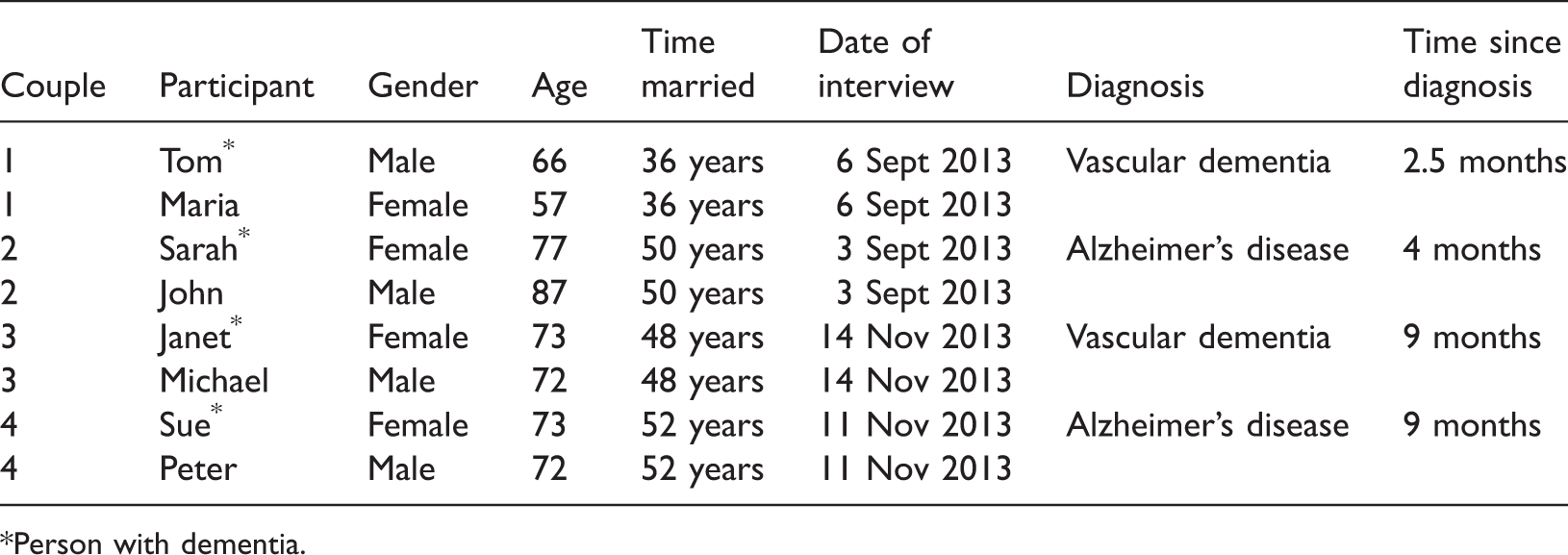
Person with dementia.
Data collection
The person with dementia and their partner were interviewed together in their home. The interview process was split into two parts. Firstly, couples were asked to have a conversation (with prompts) for 10 minutes about their understanding of any cognitive difficulties or changes they had noticed as a couple as a result. The prompts were devised by the researcher based on common themes found in previous literature (Merrick et al., 2013; Robinson et al., 2005). These were loss, cognitive changes, coping and adjusting. The aim of this was to gather information about the couples’ understanding about the cognitive difficulties without being influenced by the researcher (KS). The prompts asked open ended questions such as:
What changes did you notice? What did you say to each other about these? What do you understand caused these changes? Did you have the same view about what caused any changes?
Secondly, the researcher conducted a semi-structured interview which aimed to explore the couples' experience of the assessment process, understanding of the diagnosis and ways that they have coped. As described above, this was based on previous literature and themes that emerged from it. The questions were designed to be open-ended and the researcher would prompt each member of the couple to answer them, and any disagreements were also explored. Examples of the questions asked included:
How has the (insert word that couple uses, e.g. dementia, memory, forgetfulness) affected your lives? Can you tell me about what difficulties you first noticed?
Adopting the approach used by Lishman et al. (2016) the word ‘dementia’ was initially not used to ensure the researcher did not lead the interview. It was only introduced at a later stage in the interview if participants had not themselves used the term. This allowed the researcher to see if participants chose to introduce this term independently. In total, interviews lasted between 76 and 96 minutes. Each interview was transcribed orthographically.
Data analysis
The data was analysed qualitatively using the MAPED scale.
2
The guidelines for assimilation analysis provided in the original tool (Honos-Webb et al., 1999) were followed throughout. Training for the first author was provided by the second author, who was the co-author of the original adaption of MAPED (Lishman et al., 2016). This analysis involved the following steps:
Reading and re-reading the transcripts so that the researcher became familiar with them. Initial notes of anything which appeared relevant were recorded. The researcher identified the themes that would be used to select the passages in the transcript. The themes were chosen based on the findings from previous literature (Robinson et al., 2005) and were: anything that related to dementia; memory; cognitive changes; relationships; and loss. The researcher extracted all passages that contained a speech marker that related to any of these themes. A speech marker is an identifiable event in discourse that indicates an important clinical phenomenon. A passage was defined as an interchange between participants that included one or more speech markers, and included discussion of a single theme. The passages were rated using MAPED. Time points at which each code occurred were recorded. The first author rated all of the four transcripts, with the second author rating two of the four transcripts independently to ensure consistency. Discrepancies between the two raters were discussed in a resolution meeting, with those markers being re-analysed together. Where the researchers could not reach agreement or where one of them felt there was not enough data to code, these passages were excluded. In all other cases, agreement about the appropriate marker was reached. From the first two transcripts that were analysed 162 passages were initially selected. As part of the training 11 of these extracts were coded together in a meeting by the first and second authors. Following this, the first and second authors blindly marked the transcripts. From this, 29 extracts (18%) were excluded. For the remaining extracts, there was agreement about 49 (30%) while for 73 extracts (45%) there was initial disagreement about the markers. These disagreements were resolved though discussion, which identified slightly different interpretations around what constituted a level 3 or a 4 marker and what constituted a level 0 or 1 marker. As there was now a higher level of consistency between the two raters, the third and fourth transcripts were initially analysed by the first author, with the second author independently rating half of these to ensure consistency. After all transcripts had been analysed, the first author reviewed the first transcript to ensure that it was consistent with the interpretation adopted later on. As a result, four of the initial codes were changed. Using the time points and markers, the codes were plotted on a graph so that the process of assimilation could be displayed visually. The graphs were analysed qualitatively noting any changes in assimilation and differences and similarities between couples. Significant interactions or changes in levels of markers were identified, and traced back to the original transcripts so that their significance could be established.
Results
Throughout all the interviews, all couples fluctuated in their levels of assimilation. These fluctuations were mediated by varying factors which were unique to each couple. Firstly, the assimilation levels for each couple will be discussed, followed by analysis of the interview, looking specifically at the role of the DV and PV and the interactions within the couple. Next to each extract the time at which the conversation occurred during the interview and the assimilation level are provided in brackets.
Levels of assimilation
Number of codes classified at each stage of assimilation.

As shown in Table 2 and Figures 1–4, the assimilation levels for each couple fluctuated throughout the interview. Couples oscillated between the three categories: emergence (levels 0–2), problem clarification and gaining perspective (levels 3 & 4), and working through (levels 5–7).
Tom and Maria
Figure 1 illustrates the assimilation level and time point for each extract from the interview with Tom and Maria.
A graph showing the assimilation level and time point for each extract from the interview with Tom* and Maria. *Person with dementia.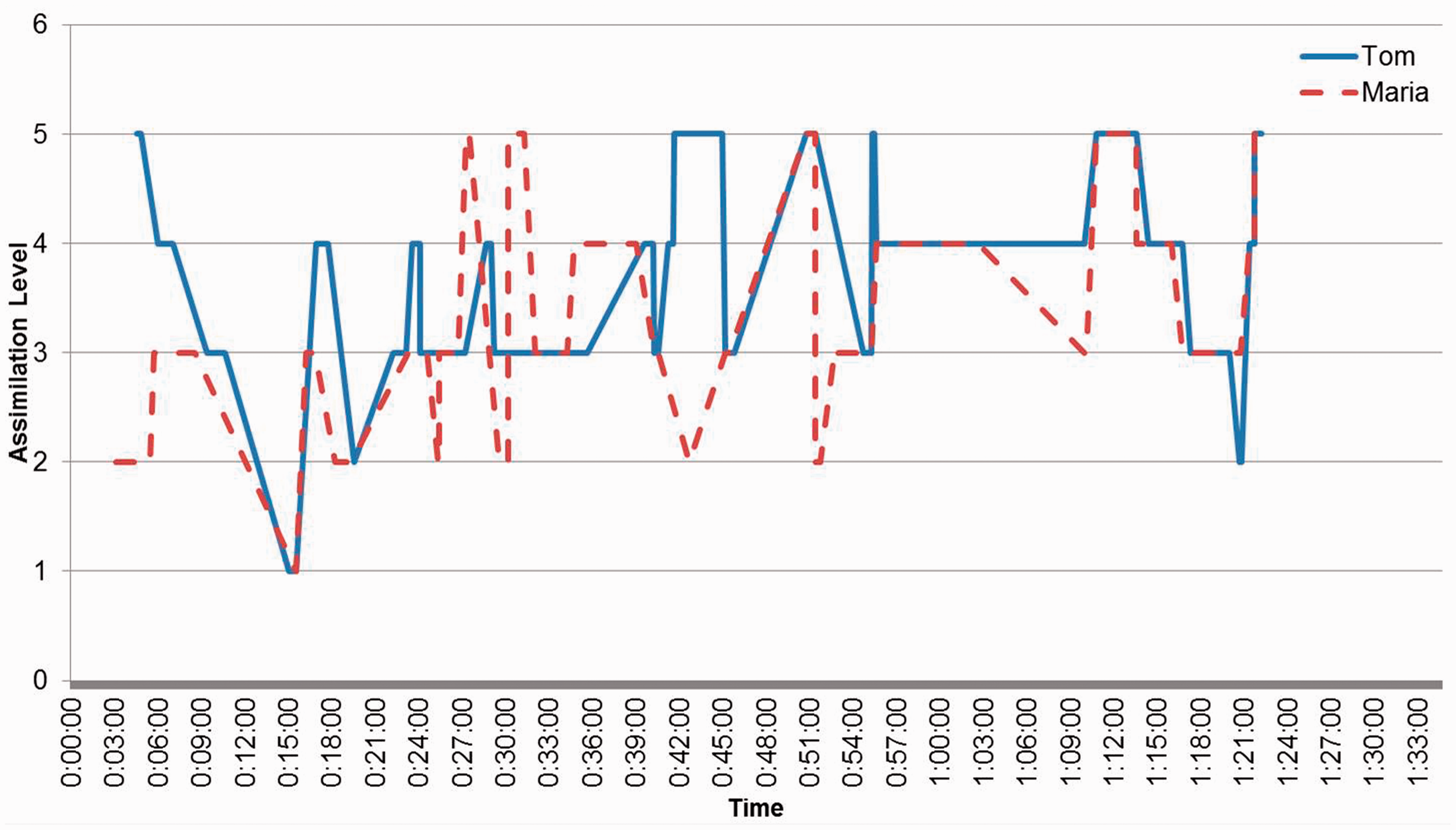
Initially, Tom fluctuated between problem clarification (level 3) and gaining perspective (level 4), indicating an ability to share his fears about dementia without feeling overwhelmed: T/M1: “Tom: but I mean, physically could I mean ah, I think that’s the biggest worry I think anybody with mental health has that physically your body could go on longer than your brain … and then you cease to be you … you’re just a function … just a function and that’s what I don’t want.”(41:13; level 4) T/M2: “Maria: see I’m finding this incredibly difficult (pause) talking about (starts to cry) … it’s just you know you just can’t believe that it’s happening at this age.”(29:35; level 2) T/M3: “Maria: has he got a disease or has he got dementia, and I still don’t know the difference between the two. Researcher: that’s what we talked about … Maria: Yea, but I still don’t really know. Tom: I’ve got dementia, vascular dementia. (level 4) Maria: I still don’t really know though, me I still need to have it, I need to sort of read it again and take it all in.” (6:13; level 3) T/M5: “Maria: I don’t know how I’m going to be travelling cos we’ve not been away since all the diagnosis so I think I might be a little bit protective because of foreign places and I don’t know how it’s going to be.” (73:37; level, 4)
The previous impact of their relationship may have influenced how they responded to the dementia. As can be seen in T/M5 and 6. Maria and Tom reported that they had always coped differently: T/M 5: “Tom: well you like to talk about it Maria: I talk about it then, he shuts up Tom: yeah Researcher: okay so that’s what it Maria: it’s always been like that Tom: but that’s always been.” (61:19) T/M6: “Maria: yea, cause we don’t discuss it at all, so how erm, I don’t know how you think or feel?” (22:07)
Sarah and John
Figure 2 illustrates the assimilation level and time point for each extract from the interview with Sarah and John.
A graph showing the assimilation level and time point for each extract from the interview with Sarah* and John. *Person with dementia.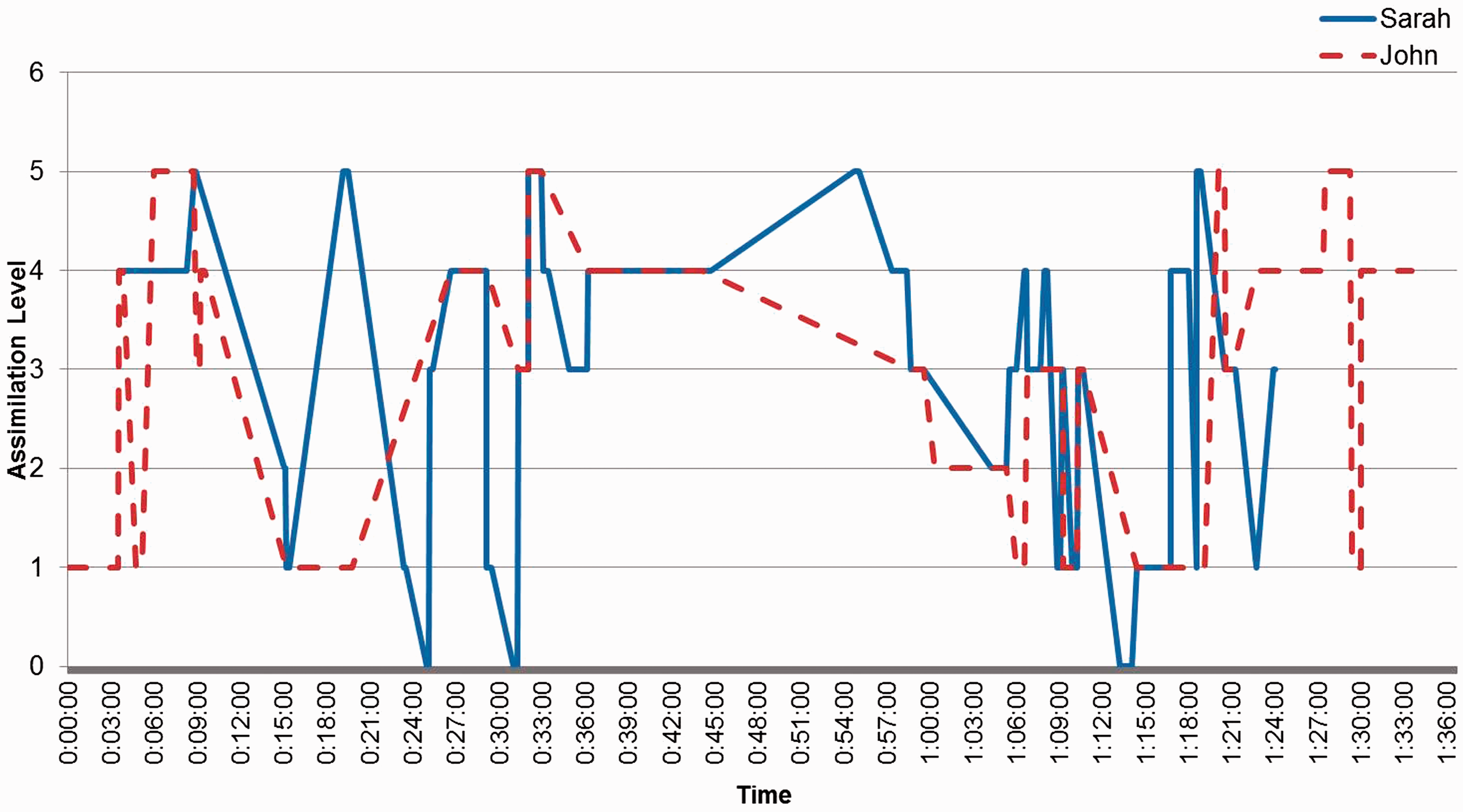
In comparison with the other couples who were interviewed, a greater proportion of the markers in the interview with John and Sarah were rated as being in the emergence stages (35%, levels 0–2). John’s repeated statement of a DV prevented PV from being articulated. For instance, extract S/J1 illustrates how, as Sarah begins to acknowledge the dementia, John attempted to minimise their problems by attributing it to a virus. Similarly in S/J2, Sarah shares a strategy she had developed to manage the memory problem and John attempted to normalise their difficulties. S/J1: “Sarah: but by the time they came and talked to us it was pretty much established. (level 3) John: I think, Sarah, I think our conversations were influenced by the fact that you were not well in other directions. Sarah: yes I think that. John: and I think you must realise you were, we were both quite ill.” (69:22; level 1) S/J2: “Sarah: oh I do, I say look if you want me to remember something would you please let John know. Because he’s my memory and I’m pretty hopeless at this, and they all say, that’s fine! They all know that. (level 5) John: but I’m sure … lots of families are like that my love.” (78:36; level 1)
At other points during their conversation the couple switched roles so that Sarah’s DV prevented the expression of John’s PV. In extract S/J 3, John was curious about their difficulties, suggesting that the PV was gaining a presence. However, Sarah’s DV overshadowed and prevented John’s PV from being more fully articulated. Thus the couple moved back to a lower level of assimilation. S/J3: “John: well I think as I said it’s difficult to say how much better you are or is it because, a, we’re getting used to the situation. Sarah: no no no. I am far, far better. John: you are I think you are personally you are. Sarah: completely, confidence.”(15:13; level 1) S/J 4: “Sarah: Well, I don’t wanna to go to groups … I don’t sing in choirs and I don’t go for walks with lots of people, I’m not that sort of person it’s not for me and then he knew perfectly well that I’d be better if I was going to have advice, I’d want it privately, and that I can cope with easily.” (36:07; level 3)
Janet and Michael
Figure 3 illustrates the assimilation level and time point for each extract from the interview with Janet and Michael.
A graph showing the assimilation level and time point for each extract from the interview with Janet* and Michael. *Person with dementia.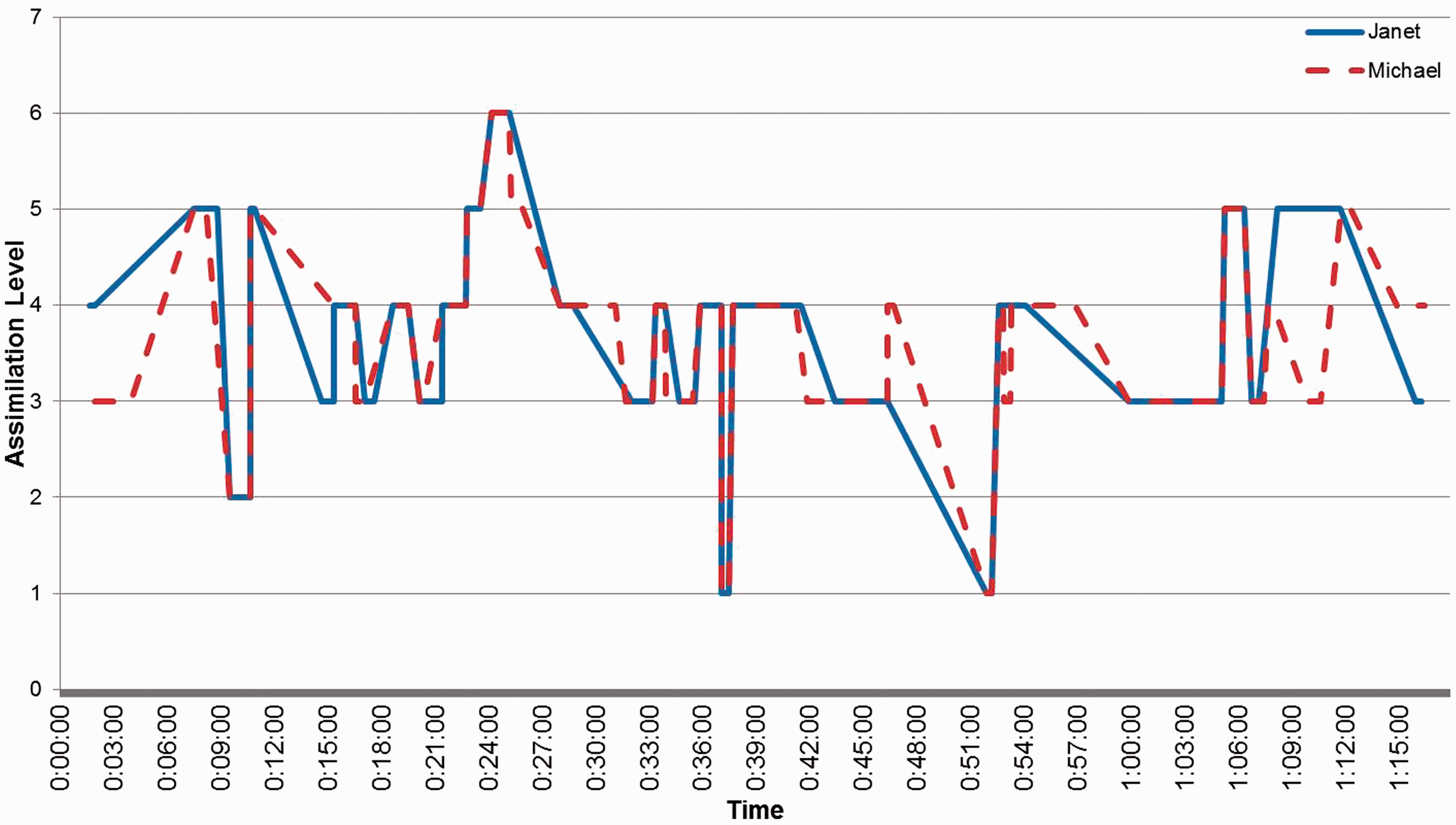
For Janet and Michael the majority of their markers were rated at levels 3 and 4, problem clarification and gaining perspective (76.19%). Janet and Michael were able to look back and discuss how initially Janet had tried to hide her difficulties. In retrospect it seemed to them that although both knew there were difficulties, they had chosen not to discuss it. In the extract below, Janet and Michael not only talked in the past tense about first noticing changes but also used humour suggesting some distance from the difficulties, indicative of a level 4 marker: J/M 1: “Michael: and then I’d say Eastenders or something and you’d say oh yeah, and I’d knew you hadn’t got a clue. Janet: (laughs) no, I thought you’d thought that I knew then (laughs). Michael: no, no I knew you was having me on (laughs). Janet: (laughs) oh dear (laughs) alright then (laughs).” (18:38; level 4) J/M 2: “Janet: … but I think, I keep on having to ask you these things, and I think I should be able to think these things myself, but I can’t, but then I have to ask you all the time … sometimes you think, oh I wish I could remember that.” (15:20; level 4) J/M 3: “Michael: I can’t. It’s, it’s a case where the only thing I miss is being able to share a memory, you know … ” (41:52; level 3) J/M 4: “Michael: no, I think we both cope with... Janet: both cope with Michael: a bit of humour and a bit of messing about... Janet: yeah (52:35; level 4) J/M5: “Janet: you can’t block it out like it’s not happening, cause it is so Michael: yeah Janet: so why be miserable about it.” (36:35; level 4)
Sue and Peter
Figure 4 illustrates the assimilation level and time point for each extract from the interview with Sue and Peter.
A graph showing the assimilation level and time point for each extract from the interview with Sue* and Peter. *Person with dementia.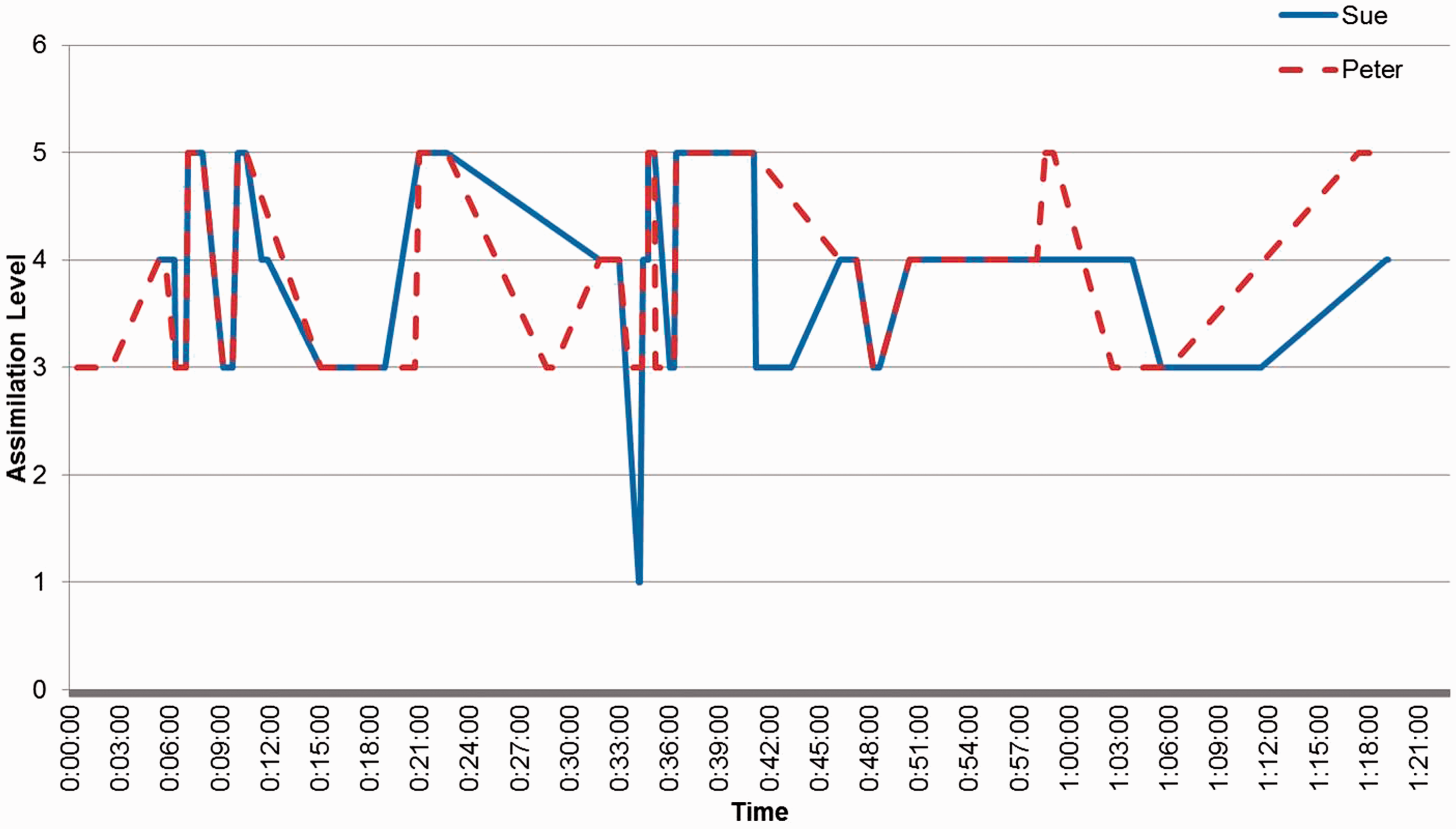
The markers for Sue and Peter generally fluctuated between problem clarification and insight (74.41%) and developing strategies (level 5, 23%). In a similar way to Janet and Michael, the couple acknowledged how initially they had warded off the PV when one of them had started to express it. Thus, first Sue acknowledged she “wouldn’t accept” something was wrong while later Peter thought Sue was “being silly”. S/P1: “Peter: (reading off the prompt card) and what did you say to each other? Well you wouldn’t accept it would you? Sue: course I didn’t!” (16:51; level 3) S/P2: “Peter: we didn’t have the same view because you immediately, Sue: I did Peter: straight away Sue: yeah Peter: didn’t you Sue: yeah Peter: that’s erm and I said you were just being silly.” (17:43; level 3) S/P3: “Peter: erm I sort of keep a check on the dates and everything when, when the when the next lot is due and all this, this sort of thing... Researcher: mhmm Peter: make sure that she takes it every night and every morning... Sue: yes Peter: erm Sue: I sometimes actually can’t, I don’t, I can’t remember whether I’ve taken a tablet so I have to … Peter: well there’s a date on each tablet anyway isn’t there Sue: yes a Sunday, Monday … ” (36:27; level 5)
Summary of analysis
The MAPED scale has previously only been applied to people with dementia. This study aimed to see whether it would be possible for it to not only be applied to the person with dementia but also to the spouse. It was found to be possible to identify extracts and rate assimilation levels for both the person with dementia and their spouse. This suggests that MAPED can be applied to couples when making sense of a dementia diagnosis.
The study highlights how couples fluctuated in their levels of assimilation while processing a diagnosis. Couples displayed several different ways of responding to the emotional threat of dementia: regulating each other’s thoughts and feelings by expressing the DV, using shared experiences to empathise with each other, and using the acknowledgement of dementia to put practical steps in place. These different approaches were reflected in the different ratings of markers of assimilation. For example, Sarah and John’s alternating use of the DV served to defend against the PV and to minimise the expression of affect, and was reflected in the higher proportion of emergence phase markers. In contrast both Janet and Michael’s and Sue and Peter’s use of shared experiences was reflected in the couples' higher levels of assimilation.
Discussion
This study aimed to explore couples’ experiences of a dementia diagnosis, using the Markers of Assimilation of Problematic Experiences in Dementia (MAPED) scale. The study had two aims, and these are discussed in more detail below.
Applying the MAPED scale to couples
The Assimilation Model has not previously, to our knowledge, been used to rate the accounts of couples, and the first aim of the study was to see whether MAPED could be used to understand the couples’ joint experience of a dementia diagnosis. The study found that MAPED could be used to rate the responses of both the person with dementia and their partner. By identifying markers of assimilation that occur during a couple’s conversation, it allows us look in detail at their interactions and at what promotes these changes in how people talk about dementia together. Thus the avoidance of problematic material associated with dementia has previously been seen as either an individual process or as the product of group interactions (Watkins, Cheston, Jones, & Gilliard, 2006). However, by analysing Sarah and John’s interview using the MAPED scale, it enabled us to see that the process through which Sarah avoided engaging with the problematic elements of dementia was part of a social interaction with her husband – as she approached this material, he withdrew from it and vice versa. In this sense, a person’s awareness of dementia is not only a fluid process, but one which is socially mediated.
The study had similar findings to Lishman et al. (2016) who interviewed people diagnosed with dementia before and after a diagnosis. Lishman et al. (2016) found that the majority of markers (44%) were at level 3, problem clarification. In this study, couples’ markers were mainly coded at level 3 (33.87%) or 4 (32.66%). Lishman et al. (2016) interviewed people before and six weeks after a dementia diagnosis. By contrast in this study, participants were interviewed at least 10 weeks after the diagnosis, and it may be that this extra time enabled them to have more time to process the diagnosis and thus they were more likely to be rated at a slightly higher level of assimilation. However, the similarities between this study and Lishman et al. (2016) help validate the idea that this tool can be applied to understanding how couples respond to dementia.
Fluctuations in assimilation: the oscillating process
It was evident that all couples’ assimilation levels fluctuated throughout the interview. This suggests that ‘making sense’ of a dementia diagnosis is a joint activity for the couple, and it further highlights that this process is not static but dynamic and fluid. This is consistent with the work by Robinson et al. (2005) who argued that couples oscillated between acknowledging the difficulties and looking for ways to adjust. Similarly, Merrick et al. (2013) found that couples shifted their conversation between letting go of what was lost and holding onto what remained. However, this study adds to the existing literature as it explores the interactional strategies that couples use while they are making sense of a dementia diagnosis.
The couples’ interactions
This study found that, within each of the four couples who were interviewed, both members of the couple impacted each other’s assimilation level through their conversation, but this process was different for each couple. The varying strategies employed through conversation were: regulating each other’s thoughts and feelings by preventing articulation of the PV; the empathic use of shared experiences to facilitate the integration of the PV and DV; and acknowledging the dementia to enable the development of practical strategies. This is consistent with previous studies (e.g. Davies, 2011; Keady & Nolan, 2003) which found that couples actively attempted to keep an ‘us identity’ not only when receiving a diagnosis but throughout their whole relationship. For example, in this study, Sarah and John’s strategy of preventing the articulation of the PV appeared to be an active attempt to maintain their couple identity.
The use of the strategy ‘working’ as proposed by Keady and Nolan (2003) can also be seen in this study. For instance, Tom and Maria appeared to work together, using their conversation to share their perspectives and to listen to each other. This sharing of experiences facilitated the articulation of the problematic aspects of the diagnosis which, in turn, resulted in them both reaching higher levels of assimilation. In contrast, Sarah and John’s ‘working’ strategy was to prevent articulation of a PV by repeated assertions of a dominant position – this gave the appearance of protecting themselves against distress associated with the emergence of the PV. It could be argued that they were ‘working separately’, with both trying to protect one another by minimising the significance of the diagnosis. However, this resulted in them finding it hard to discuss the diagnosis and thus resulting in lower assimilation levels. The appearance of different forms of ‘working together’ suggests that dementia services should be offering therapeutic work to not only individuals but couples.
Limitations and future research
This study is the first to apply the MAPED scale to couples, where one person has a diagnosis of dementia. The study used a small sample of couples and only explored the experiences of white, heterosexual couples and as such further research is needed to explore couples from same sex relationships, from different ethnic backgrounds and different ages. Although not directly explored in this study, the role of gender appeared to play an important role in the interviews. For instance the men in the relationship tended to lead the conversations. A more detailed exploration of the role of gender during such conversations would give further insight into this.
A major limitation of the study is that only couples who had already acknowledged their diagnosis were included. Also, only those who were willing to talk about the difficulties would have consented to take part in the study. It is likely that these couples were more likely to produce markers at a higher level of assimilation. Therefore, the study’s findings may be skewed and not reflect couples who are still ‘warding off’ the diagnosis.
Conclusion and clinical implications
The study highlights the way in which couples working together is reflected in complex patterns of dialogue, that impact on their levels of assimilation and ultimately their ability to ‘make sense’ of a dementia diagnosis. This has a number of implications for the services offered in health and social care. In particular, it highlights the need to address the person with dementia and their partner “not just as individuals but as part of a couple” (Hyden & Nillson, 2013, p. 15). Thus, post-diagnostic support services should aim to also offer therapeutic work to the couple jointly rather than providing support separately to the ‘person with dementia’ and the ‘carer’.
Footnotes
Acknowledgements
We would firstly like to thank all the couples who so eloquently shared their experiences with the first author. She experienced them as brave and inspirational and felt honoured to have heard their stories. This research is in loving memory of the first authors late grandparents who so courageously battled dementia as a couple.
Declaration of Conflicting Interests
The author(s) declared no potential conflicts of interest with respect to the research, authorship, and/or publication of this article.
Funding
The author(s) received no financial support for the research, authorship, and/or publication of this article.