




Abstract
A purposive sample of African American Senior Companions (N = 23) participated in a 5-day, 20-hour psychoeducational training designed to address the unique cultural needs of African American dementia caregivers. Previous studies have not utilized lay caregiver volunteers such as Senior Companions in dementia research in the United States. Pre- and post-tests were administered to determine whether African American Senior Companions increased their knowledge of Alzheimer’s disease after participating in the Senior Companion Program Plus. Results from both the quantitative and qualitative data suggest that participants improved their understanding of Alzheimer’s disease. Findings from the Senior Companion Program Plus pilot warrant further study for its potential as cost effective, culturally tailored training for Senior Companions who serve persons with dementia and their family caregivers.
Background
Alzheimer’s disease is one of the most challenging chronic health conditions in the United States (Alzheimer’s Association, 2016). Considerable disparities exist in the prevalence of Alzheimer’s disease among minority populations as African Americans are two times more likely to develop late-onset Alzheimer’s disease than older whites (Alzheimer’s Association, 2016). Despite the greater incidence of Alzheimer’s disease among African Americans, it remains unknown whether existing dementia caregiver interventions are useful or accessible to this population (Gitlin, Marx, Stanley, & Hodgson, 2015). Previous research has shown that Alzheimer’s disease-related stigmas and myths within the African American community have precipitated misunderstanding about the disease process, potentially causing confusion and increased stress and burden among family caregivers (Cox, 1999; Cox & Monk, 1996; Green et al., 2002). Psychosocial interventions for African American Alzheimer’s disease caregivers have shown promise in decreasing caregiver burden (Dang et al., 2008), however, there is limited research related to the development and evaluation of rigorous socioculturally informed interventions for African American or other diverse Alzheimer’s disease caregiver populations (Nápoles, Chadiha, Eversley, & Moreno-John, 2010). This study, titled the Senior Companion Program Plus, differs from typical caregiver interventions by providing Alzheimer’s disease training to Senior Companions, who are lay providers of respite to low-income, African American persons with dementia and their family caregivers.
The Senior Companion Program is one of three National Senior Service Corps programs funded by the Corporation for National and Community Service in the United States. The Senior Companion Program places older adults in the homes of frail older adults to serve as companions and provide respite to family caregivers. In exchange for their volunteer service, income eligible Senior Companions may receive a stipend of $2.65 an hour (Texas Senior Corp, 2016). Senior Companions most frequently provide services such as assistance with activities of daily living, transportation, and socialization (Corporation for National and Community Service, 2016). Research suggests that Senior Companion Programs are beneficial for both Senior Companions and their clients, through companionship, independence, reduced anxiety, giving, and rewards (Butler, 2006).
The purpose of this project was to augment the usual training of the Senior Companions to include a component specific to Alzheimer’s disease. The aim of the Senior Companion Program Plus, was to design and implement a Senior Companion training that is culturally tailored for African Americans in order to increase knowledge of Alzheimer’s disease. The Senior Companion Program Plus program was adapted from a pilot intervention study conducted by Morano and King (2010) of African American dementia caregivers in order to focus on the specific cultural strengths of a population that may be particularly affected by disadvantages such as poverty, discrimination, and barriers to health care services and supports. However, the Senior Companion Program Plus is innovative in that it engaged the Senior Companions as partners in the design and development of the training in order to create a culturally tailored program.
Before training commenced, the research team held focus groups with the Senior Companions about the content of the training to elicit feedback related to culture and the unique needs of African American dementia caregivers. Data from the focus groups informed the development of the Senior Companion Program Plus, which included 20 hours of face-to-face training with Senior Companions covering nine modules. The training included both didactic and participatory teaching methods (e.g., role playing). The nine modules focused on (1) facts about diagnosis and treatment of Alzheimer’s disease or dementia with the intent to providing information about Alzheimer’s disease or dementia by separating the facts from the myths about the disease; (2) home care and home safety to cover the importance of being proactive in creating a safe environment for a person with Alzheimer’s disease or dementia as well as information about ways to manage personal care, especially bathing and toileting; (3) management of problematic behaviors to assist with behavior management techniques; (4) communication skills with health care professionals to focus on how to make effective and correct communications with physicians and other health professionals; (5) communication skills with family members to focus on how to make effective communications with older adults who have Alzheimer’s disease or dementia and their family members; (6) information about community based support services to present information about the types of community-based programs available and how to access them; (7) coping skills to emotional consequences associated with caregiving and to maintain useful supports; (8) coping with expectations and relying on familial and cultural beliefs and traditions, related to caring for older adults with Alzheimer’s disease or dementia; and (9) finding purpose in caregiving by strengthening spiritual components and other aspects of providing care that these caregivers use to enhance meaning.
Methods
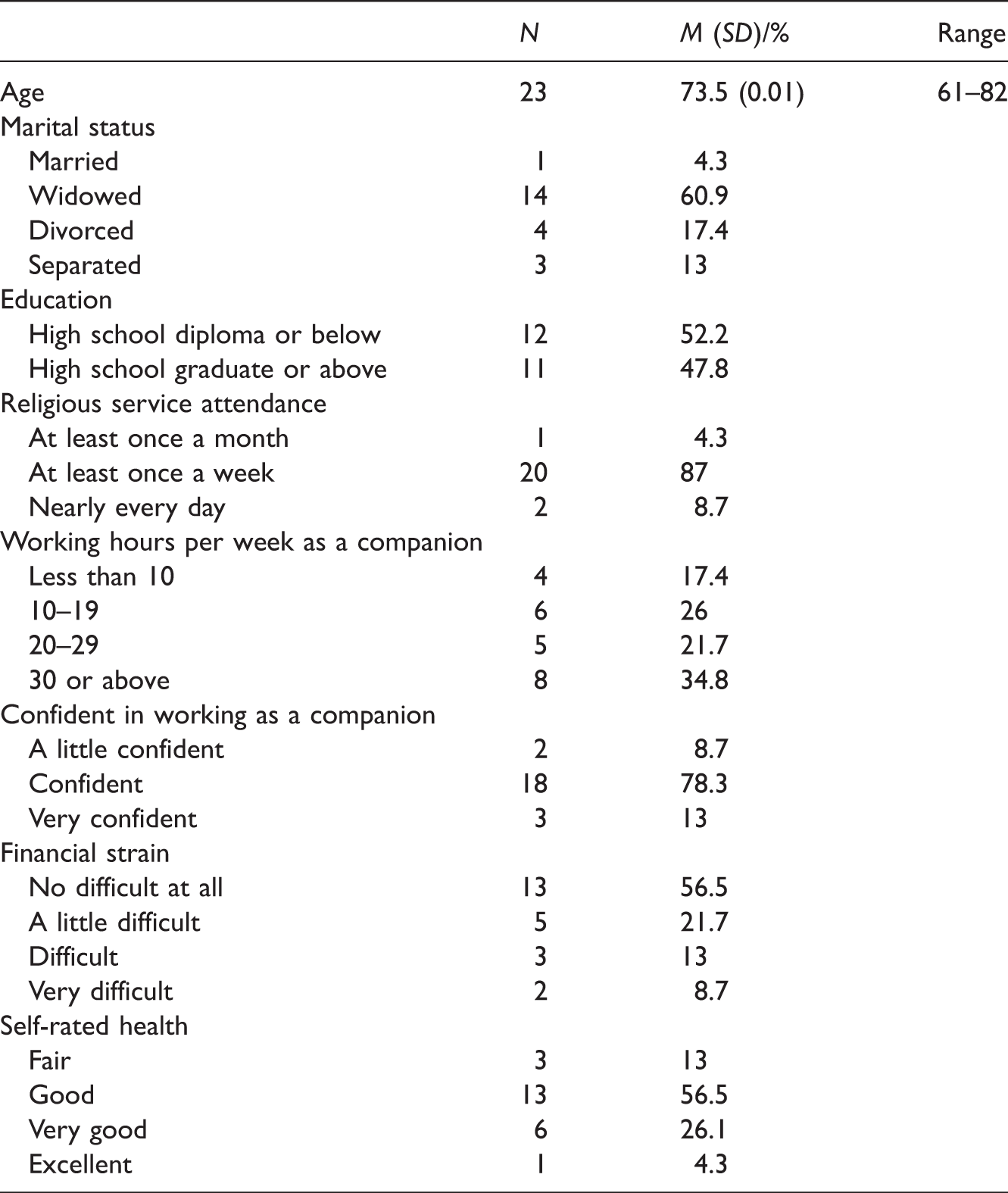
Participants
Sample characteristics (n = 23).
Measures
Before the first training session of the Senior Companion Program Plus, Senior Companions completed the Knowledge of Alzheimer’s disease/dementia scale (KAD). The Knowledge of Alzheimer’s disease/dementia scale (Roberts & Connell, 2000) was used to assess attitudes and beliefs regarding Alzheimer’s disease/dementia including: (1) epidemiology and etiology of Alzheimer’s disease; (2) perceived effectiveness of different forms of currently available treatments; (3) beliefs regarding the perceived threat of Alzheimer’s disease for oneself; and (4) how respondents learned about the disease. Results have shown good reliability and validity of this scale in assessing attitudes and beliefs regarding Alzheimer’s disease/dementia among different ethnic minority dementia caregivers (Gary, Jimenez, Cucciare, Tong, & Gallagher-Thompson, 2009). Senior Companions were also asked open ended qualitative questions after the training to discuss what they had learned about Alzheimer’s disease from the Senior Companion Program Plus.
Results
Based upon the qualitative data from Senior Companion Program Plus, participants reported an increased understanding of Alzheimer’s disease. One Senior Companion stated that she “learned a lot about Alzheimer’s disease because I really didn’t understand it [Alzheimer’s disease].” Another Senior Companion shared that as a result of the Senior Companion Program Plus, she was “more knowledgeable about the disease [Alzheimer’s disease].” Senior Companion Program Plus participants also learned that dementia is a disease. As one Senior Companion explained, “it [Alzheimer’s disease] really has a medical term and a medical reason as to how it happens and why it happens.”
Percentage of respondents correctly answering true-false knowledge items about Alzheimer’s disease.
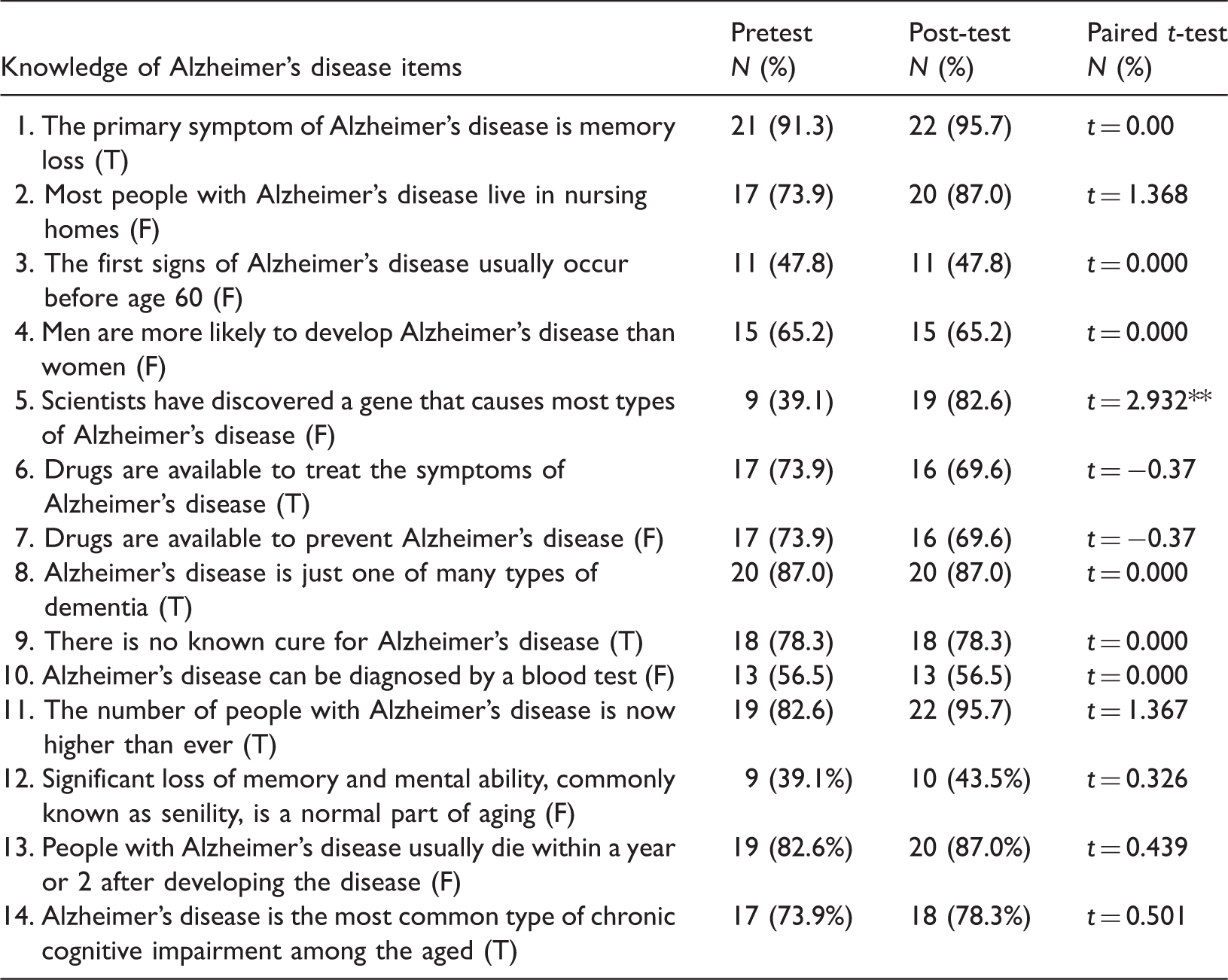
As depicted in Table 2, after the Senior Companion Program Plus, the scores of knowledge of dementia in post-test indicated that overall knowledge of Alzheimer’s disease was relatively high, with correct responses given by over two-thirds of the sample for 10 of the 14 items. Eighty percent or more of the overall sample correctly answered 6 of the 14 items and were aware that: (1) memory loss is the primary symptom of Alzheimer’s disease, (2) most people with Alzheimer’s disease do not live in nursing homes, (3) scientists have not discovered a gene that causes most types of Alzheimer’s disease, (4) Alzheimer’s disease is just one of many types of dementia, (5) there is no known cure for Alzheimer’s disease, (6) the number of people with Alzheimer’s disease is higher than ever, and (7) people with Alzheimer’s disease usually do not die soon after diagnosis.
Results in Table 2 also showed that participants improved their understanding about Alzheimer’s disease in some areas. For 3 of the 14 items, significant improvements in the percentage of correct responses in posttest were observed. After completing the Senior Companion Program Plus, the respondents were more likely to believe in three items (1) most people with Alzheimer’s disease do not live in nursing homes, (2) the number of people with Alzheimer’s disease is now higher than ever, and (3) a gene that causes most types of Alzheimer’s disease has not been discovered by scientists. However, only improvement on the last item (origins of Alzheimer’s disease) was statistically significant at posttest (t = 2.93, p < .001).
Difference in knowledge of Alzheimer’s (KAD) disease/dementia between pre- and post-tests.

Discussion
In order to design optimal health services and education programs for Alzheimer’s disease, it is important to understand cultural differences in perceptions of the disease (Roberts et al., 2003). One of the main goals of the Senior Companion Program Plus was to dispel myths about Alzheimer’s disease and provide psychoeducation related to the needs of African American dementia caregivers. Although not all study findings were statistically significant, the participants in the Senior Companion Program Plus did report improved understanding of Alzheimer’s disease and shared with agency staff their overall satisfaction with the training. Limitations of this study were the small sample size in one U.S. city, use of a single measure, and a nonrandomized control design. In spite of the study limitations, the data suggest that the Senior Companion Program Plus is a promising training for Senior Companions in order to increase their knowledge of Alzheimer’s disease. The Senior Companion Program Plus is also sustainable for agencies given that it augments an already existing program. Overall, findings from the Senior Companion Program Plus pilot warrant further study for its potential as cost effective, culturally tailored intervention for African American dementia caregivers served by Senior Companions.
Footnotes
Acknowledgement
The authors thank The Senior Source, Inc. for collaborating on this research study.
Declaration of Conflicting Interests
The author(s) declared no potential conflicts of interest with respect to the research, authorship, and/or publication of this article.
Funding
The author(s) disclosed receipt of the following financial support for the research, authorship, and/or publication of this article: This study was funded by a University of Texas at Arlington School of Social Work Innovative Community Academic Partnership grant.