




Abstract
Young adults’ concerns and coping strategies related to their face-to-face interactions with their grandparents/great-grandparents with dementia were explored through the lens of a solidarity-conflict conceptual framework. Participants indicated concerns about their inability to maintain the relational connection, not knowing what to say or how to behave, their lack of perspective-taking skills and emotion-regulation strategies, interacting with an ever-changing other, as well as concerns about other co-participants in the interaction. Participants’ coping strategies were driven by two interaction motives: maintaining solidarity (e.g., desire to maintain and improve the interaction with the grandparent by seeking the other’s company, loving the other, and maintaining the other’s personhood) and dealing with conflict (e.g., dealing with self-focused concerns about lack of skills and knowledge by engaging in substitute avenues for communication and down-regulating negative affect). Implications for improving interactions between young adults and their grandparents/great-grandparents with dementia are discussed.
Most work on the dynamics of interactions among family members and a person with dementia focuses on the impact of dementia on the family network, the burden of care, and the stigma placed on the family and informal caregivers (e.g., Orel & Dupuy, 2002; Savundranayagam, Montgomery, & Kosloski, 2010; Werner, Goldstein, & Buchbinder, 2010). Although that body of research has merit in identifying positive and negative impacts of caregiving on both the caregiver and the person with dementia, little research has investigated how social interactions among family members preserve the personhood of the individual with dementia and facilitate the wellbeing of all interacting participants, particularly grandchildren and great-grandchildren. In fact, despite an increasing number of grandparents and great-grandparents diagnosed with dementia (Hebert, Weuve, Scherr, & Evans, 2013), the relationship between grandchildren and grandparents who have dementia has received little scientific attention, with the exception of a few studies (Attar-Schwartz, Tan, & Buchanan, 1999; Celdran, Triado, & Villar, 2011; Celdran, Triado, & Villar, 2012; Celdran, Triado, & Villar, 2014). Moreover, we were unable to locate any work on the relationship between great-grandparents experiencing dementia and their great-grandchildren.
For instance, Celdran et al. (2011) asked adolescent participants to report on the emotions they experienced relating to their grandparent with dementia, their perceptions of their current relationship with their grandparent, and any changes that had occurred in this relationship. The results revealed that the grandchildren most frequently reported negative emotions such as loss, sadness, or nostalgia; fear that relatives (including themselves) may acquire the illness in the future; and guilt over lack of time spent together or reacting inappropriately. Positive emotions included satisfaction for helping the primary caregiver. The grandchildren also reported strong desire to maintain contact, despite the perceived changes due to dementia. In fact, after a dementia diagnosis, some grandchildren perceived an improvement in their relationship and desired close physical and psychological contact. Taken together, these findings suggest that the interactions between adolescents and grandparents diagnosed with dementia are complex and may involve both avoidance and approach motives, which may lead to different interaction patterns and concerns. Similar approach and avoidance motives were documented in another study by Celdran et al. (2014).
Theoretical framework
Our study advanced this previous work by investigating the nature of interactions among young adults and their grandparents/great-grandparents, the concerns related to these interactions, as well as the coping strategies utilized by the young adults. Bengtson’s solidarity-conflict model (Bengtson, Giarusso, Mabry, & Silverstein, 2002) was adopted as the theoretical lens guiding our study. Although this model did not specifically address dementia, it provides important conceptualizations of the nature of intergenerational interactions between young adults and their grandparents/great-grandparents with dementia. In this model, the concept of solidarity is used as a common metric for assessing intergenerational relationships and is conceptualized as “the ties that bind families together” (Bengtson et al., 2002, p. 572). Longer shared lives between generations increase the strength and resilience of intergenerational solidarity (Bengtson, Elder, & Putney, 2006). The grandchild–grandparent relationship is one of the most important relationships for young adults (Brussoni & Boon, 1998) as the increasing life expectancy of Americans has enabled grandparents and grandchildren to establish and maintain a closer and longer-lasting relationship (Kemp, 2005; Mansson, Myers, & Turner, 2010; Ruiz & Silverstein, 2007). Young adults’ solidarity with their grandparents often translates into friendships characterized by interpersonal trust, shared confidences, and personal choice and into distinct close relationships that are centered on unconditioned love, mutual support, respect, and obligation (Kemp, 2005). Other studies have documented similar evidence of intergenerational solidarity, indicating that grandchildren and grandparents maintain regular and meaningful contact, whether in person, by telephone, or through correspondence (Even-Zohar, 2011; Hardwood, 2000; Hardwood & Lin, 2000). Alternatively, conflict is conceptualized by Bengtson and his collaborators as forces acting against solidarity, ranging from stressful aspects of family life such as divorce and competing demands due to adult children’s own family roles (Silverstein & Bengtson, 1997) to macro-level variables such as sociocultural changes affecting family life and relationships (Bengtson et al., 2002, 2006; Lowenstein, 2007). The grandparent’s level of functioning can be a source of conflict, affecting the strength of intergenerational solidarity (Boon & Shaw, 2007; Even-Zohar, 2011).
The goals of the study
The aforementioned findings (e.g., Celdran et al., 2011, 2014) suggest that young adults experience strong solidarity with their grandparent with dementia despite the grandparent’s reduced ability to engage with their grandchildren, which can create interpersonal difficulties and conflict (Even-Zohar, 2011; Graneheim, Isaksson, Ljung, & Jansson, 2005). The current study explored these putative dual motivations in young adults’ relationships with their grandparents/great-grandparents with dementia (solidarity-versus-conflict). Exploring these dual dynamics is beneficial given the well-documented importance of grandparents in the lives of grandchildren (Attar-Schwartz et al., 1999). Grandparents play a significant role in transmitting moral values, instilling social relationship skills, and preserving family history by telling family stories (Waldrop et al., 1999; Werner, Buchbinder, Lowenstein, & Livni, 2005). Conversely, grandchildren often function as agents to maintain the grandparent's identity (Celdran et al., 2014). In the context of progressive memory loss, grandchildren may act as social reference points that anchor the grandparent’s social and family memory, facilitating further communication and providing the grandparent with a sense of continuity (Fruhauf & Orel, 2008; Howard & Singleton, 2001; Orel & Dupuy, 2002).
In addition, our study adds to previous literature because prior studies of grandparent-grandchild relationships have often focused on the grandparent’s perspective and only a few studies directly elicited the perspective of the grandchildren of persons with dementia (Celdran et al., 2011, 2012, 2014; Kemp, 2005). Another benefit of this study is exploring the interaction concerns reported by the young adults and their ways of coping with these concerns. To our knowledge, prior work has focused on caregiving grandchildren dealing with the difficulties of providing care for a relative with dementia (e.g., Fruhauf & Orel, 2008), and not on interactions in a non-caregiving context. Moreover, no prior work has explored these interactions in the context of opposing motives to maintain the relationship (i.e., solidarity) and simultaneously cope with the changes in the grandparent with dementia and his/her life context (i.e., dealing with conflict). To our knowledge, our work is the first to test the solidarity-conflict model in the context of studying the concerns and coping strategies used by grandchildren of grandparents with dementia. Moreover, we studied these coping strategies as reactions to grandchildren/great-grandchildren’s interaction concerns affecting social interaction dynamics among all co-participants. Thus, the research questions that guided this study were: (1) What are the young adults’ concerns in their interactions with their grandparents/great-grandparents with dementia?; (2) What are the coping strategies used to deal with these interaction concerns; and (3) Are these concerns and coping strategies triggered by solidarity and conflict motives inherent in the relationship between young adults and their grandparents/great-grandparents with dementia?
Methods
Participants
We recruited 29 college students from a mid-size Midwest university (USA) who reported having a family member who had been diagnosed with dementia at least two years ago. Because we focused exclusively on the social interactions of the participants with a grandparent or great-grandparent with dementia, we did not include data from participants who spoke about other relatives (N = 7). The resulting data set was from 14 participants who participated in the focus group interviews and from the eight who completed the questionnaire. The study was approved by the authors’ university Institutional Review Board.
During the focus group sessions, the gender of the participant was recorded; there were two men and 12 women. The focus group participants’ family members with dementia included: grandmothers (n = 5), grandfathers (n = 6), great-grandmothers (n = 3), and great-grandfathers (n = 1; one participant had more than one grandparent with dementia). Demographic data were collected from the participants who completed the questionnaire (N = 8; Mage = 18.38, SD = 0.52; 6 women and 2 men; all were European Americans). For participants who completed the questionnaire, family members with dementia included: grandmothers (n = 1), grandfathers (n = 3), and great-grandmothers (n = 4).
Data collection
Focus groups consisted of 4–5 participants each. We implemented focus groups by carefully designing a series of discussion questions to explore young adults’ interaction concerns and coping strategies in a permissive, non-threatening way. The focus groups consisted of guided discussions that addressed the questions found in Appendix 1. The focus groups were conducted by the first two authors and lasted from 45 to 60 minutes. Participants used pseudonyms of their choice and all of the discussions were audio recorded for transcription. After consenting to participate, participants were informed that the study was designed to learn about their experiences, feelings, and knowledge related to interactions with a family member diagnosed with dementia. The intent of our focus groups was to promote spontaneous discussion among the group members and self-disclosure in an environment in which participants felt respected, comfortable, and free to give their opinions without being judged (Krueger & Casey, 2015). Specific instructions were given to the participants that emphasized the non-judgmental quality of the focus group discussions.
To obtain additional information, a second data collection method was used (group questionnaire administration), in which we converted the discussion topics used in focus groups to detailed questions regarding similar areas of interest. A separate sample of participants completed this questionnaire in small groups. A copy of the questionnaire is available by request from the authors. The written questionnaire answers were analyzed along with the focus group transcripts.
Data analysis
The data analysis was based on interpretative phenomenological analysis (IPA) method developed by Smith (1996) and used by Clare in research on experiences of people with dementia and their partners (Clare, 2003). IPA explores lived experiences and how people assign meaning to make sense of their experiences. This method is not only descriptive, as its goal is to describe participants’ subjective experience, but also interpretative, because it acknowledges the researcher’s role in creating a thematic account (Quinn & Clare, 2008). Because IPA proposes that there is a direct and indirect link between people’s verbal responses and their underlying thoughts and feelings (Smith, 1996), using this method allowed us to identify grandchildren/great-grandchildren’s key interaction concerns, the classification of coping strategies, and the development of a valid interpretation of the interaction motives (i.e., solidarity versus conflict).
In the first step, each interview transcript and open-ended answer from the questionnaires were analyzed by identifying the relevant themes and grouping the themes into larger-order clusters. In the second step, a list of themes covering all participants’ transcripts from the focus groups and open-ended answers from the questionnaires was compiled and organized hierarchically. In the third step, the transcripts and open-ended answers were re-read to ensure that all themes had been identified and a comprehensive of list of relevant extracts for each theme was compiled. In the fourth step, the data and themes were reviewed by a fourth researcher (the third author, who has experience using IPA and is a dementia specialist) to provide a validity check of the analysis and an interpretation of participants’ narratives and to ensure the appropriateness of the themes and extracts (minor changes to the summary list of themes resulted). Further checks on validity were provided through discussion with dementia specialists, care workers, and family members of persons with dementia.
Results
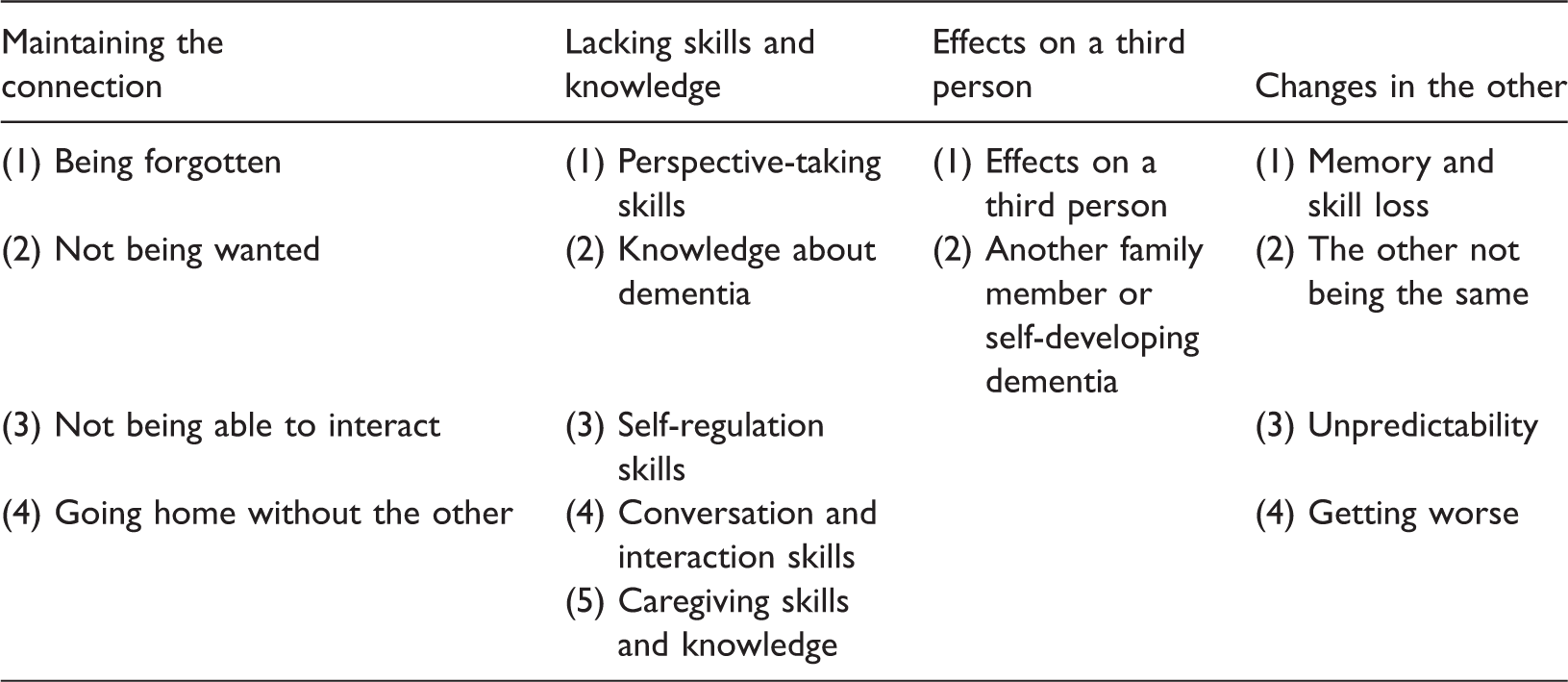
Interaction concerns.
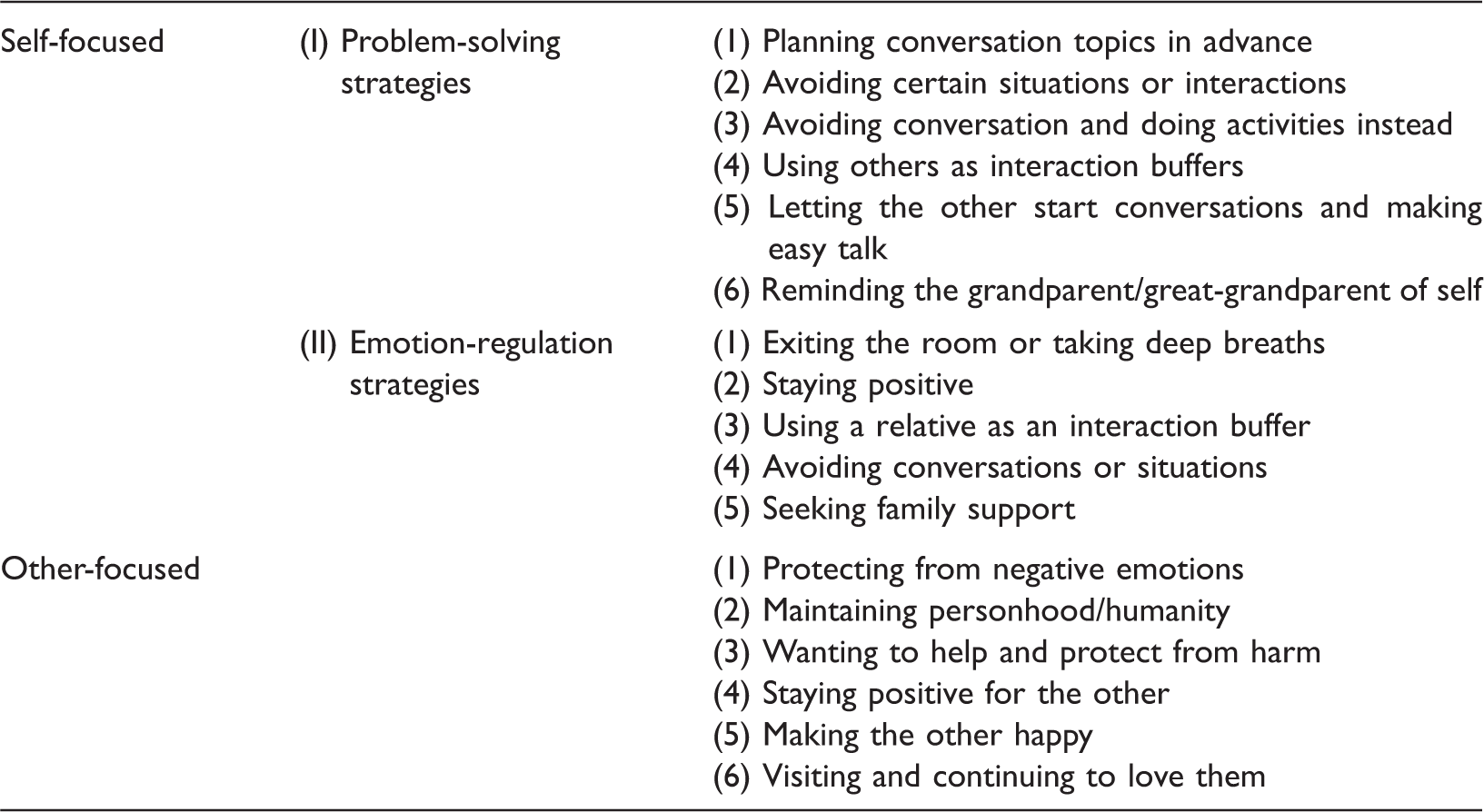
Interaction coping strategies.
Interaction concerns
Concerns about maintaining the connection
Many participants expressed concern that their grandparent/great-grandparent would forget them: “I fear he could forget us forever and not become lucid again” (Granddaughter/grandfather) and “I have the fear that she will completely forget who I am and I do not want that because she is part of my life still” (Great-grandson/great-grandmother). Other participants expressed the concern that their grandparents/great-grandparents would not be able to remember their shared experiences, their childhoods, or their identity.
Participants worried about the other not wanting to interact with them anymore, as some find that their grandparent/great-grandparents do not want to be touched anymore, or have changed the way they interact: “At first when I’d see him he would always want to greet with a hug and, as it went on, he didn’t like being touched at all” (Granddaughter/grandfather).
Concerns about not being able to interact or concerns about not being in the other’s life anymore were also potent. When asked about potential concerns, one granddaughter replied, “as it progressively got worse, it’s not being able to interact with him anymore; because for me my grandfather has been a huge influence and a great part of my life, really. And for me it’s devastating if I can’t interact with him anymore.” Another participant expressed a similar concern, “for me it hurt to avoid him; my grandfather was with me for a lot of hard stuff—to avoid him is very difficult to me—I still want to be part of his life and it's hard to figure out how to do that” (Granddaughter/grandfather).
Some participants also expressed concerns about leaving the nursing home without the grandparent/great-grandparent and coping with the sadness and anger expressed by the person they left behind: “…she always gets sad when we leave and sometimes we have to sneak out because she’ll put up a fit if we leave. And it’s just sad” (Great-granddaughter/great-grandmother).
Concerns about lacking skills and knowledge
Participants reported concerns about lacking perspective-taking skills and lacking knowledge about what the other person is feeling, thinking, and perceiving the world sensorially. Some mentioned wanting “some type of simulation to mimic what it’s like for a person with dementia on a day to day basis” (Granddaughter/grandfather) and “a way to understand what they are going through because we cannot relate so it's hard to put into perspective and how can we help them” (Granddaughter/grandmother). Another participant said she would like to know “how to detect what mindset they’re in. Like is she talking to me from her twelve year old memories or from most recent times?” (Great-granddaughter/great-grandmother). Many participants also mentioned lacking knowledge about dementia, such as how the brain functions or how it affects memory.
Participants were also concerned about lacking self-regulation skills such as patience or knowing how to deal with one’s own frustration: “I would like to learn how to not get so frustrated when they can’t remember me or ask the same questions over and over again. (…) I’m just concerned that it will get to a point where I won’t know what to do anymore or how to interact” (Great-granddaughter/great-grandmother). Others mentioned lacking conversation or interaction scripts, wanting to know what topics to talk about or avoid, and being nervous because they did not know how to talk to the grandparent/great-grandparent. These concerns all stemmed from a desire to avoid making the grandparent upset or uncomfortable. Other participants wanted to know what exactly to say to their grandparent so that the conversation would not make the other frustrated over not remembering information or “bring[ing] back bad memories.” Others wanted to know how to make their grandparent remember them: “I always feel helpless because I try and try and want a way for her to remember” (Great-grandson/great-grandmother). A heightened self-focus was evident, as many of these concerns reflect an underlying fear of one’s own interactional incompetence. These grandchildren/great-grandchildren appear to be nervous, fearful, and painfully concerned that they would say or do something that would upset or hurt their grandparent/great-grandparent. The magnitude of this fear is illustrated in this report: “I’m always scared to talk with him because I don’t want to upset him in any way” (Granddaughter/grandfather).
Another concern pertained to lack of knowledge and skills about caring for the grandparent: “It keeps getting worse and worse and you don’t know what to do, like what do you do about it? Are you gonna put them in a nursing home or are you gonna learn to deal with it?” (Great-granddaughter/great-grandmother). Sometimes this concern reflected the fact that the relationship between grandchildren and their grandparents was preserved through other relationships between the grandparent and the parent, or through the relationship among three generations (great-grandparents, grandparents, and parents). Sometimes participants expressed frustration that other family members do not do enough to care for their relative with dementia.
Concerns about the effects on a third person
Participants often described how the interactions with the grandparent/great-grandparent became geared towards helping another family member, such as keeping the mood upbeat for the sake of the spouse of the person with dementia. Others described their concerns about how dementia has taken a toll on the caregiver and the impact that could have, in the future, on the people they love “I fear for my mom and what will happen to her when her mother’s gone” (Granddaughter/grandmother). These concerns reveal that all players in the interaction are affected and that interaction influences are reciprocal and complex.
Some participants expressed concerns about themselves or a family member developing dementia, and about how they would deal with this potential experience: “Maybe my grandma will get it or maybe my dad will get it, you don't know how it is going to be passed down the generations. I could get it… but we don’t know yet… It's kind of scary” (Great-granddaughter/great-grandmother).
Concerns about changes in the other
Concerns about other’s loss of memory and skills (e.g., not understanding that his/her son or sister has died or not understanding basic knowledge) were linked to concerns about the other getting worse. Participants reported struggling to interact with their grandparent/great-grandparent who seemed to be situated in the past: “He brings up the past a lot. Like his memory kind of dates back so I don't know how to communicate with that. But it’s always a struggle. (…) Like he’ll date back to when I was like five and even then I don’t remember much so I don’t really know how to communicate with” (Granddaughter/grandfather).
Participants feared that the other was not the same anymore (“you know the same person’s still there, but like, not fully”; Granddaughter/grandfather), often bringing up comparisons between how the person used to be (“the life of the party”) and how she/he is now (“very quiet and not talking anymore; She used to love to color… now she just sits there and stares”; Granddaughter/grandmother). Participants struggled to normalize their relationship by continuing doing what they had been doing before: talking about their lives, school, weather, etc. Some participants reported being heartbroken and devastated by the changes in the other: “I’m always happy to see her and my heart breaks for her every time. She’s still my grandma but she’s not really the same” (Granddaughter/grandmother).
The perceived changes in the grandparent led to fears about the other’s unpredictability, such as concerns that the other would become angry and agitated, or concerns about how to prepare oneself for the changes (“I don’t know if there really is a way to prepare yourself for this because everyone is different. You just kind of have to learn from being with them… You can't predict how they are going to turn out or how they’re gonna act with this [dementia]”; Great-Granddaughter/great-grandmother). These concerns are not present-bound but rather temporally dependent, as participants expressed concerns about the inevitability of future changes as well (e.g., getting worse, unable to communicate).
How do grandchildren cope with these interaction concerns?
There were two interwoven strategies participants reported using to deal with their interaction concerns (see Table 2): coping with the changed interaction and wanting to protect the other’s welfare. The first strategy occurred in response to concerns about one’s own interaction abilities and skills, while the second strategy was driven by an other-focused concern for the grandparent/great-grandparent that materialized in maintaining face-to-face contact and relational presence.
Self-focused coping strategies
Problem-solving strategies
The concerns about not knowing how to interact with the grandparent/great-grandparent triggered a series of problem-focused coping strategies. Some participants reported planning conversation topics in advance in order to avoid upsetting the other: “when you talk about it with your family and you kind of have to agree on a few things here in what we can say to him and what we can’t say to him, it helps because it’s not easy to always talk to your grandparent about good things instead of, you know, bad things” (Granddaughter/grandfather).
Other participants avoided conversations or interactions altogether to either escape the awkwardness of the situation or to avoid upsetting the grandparent: “Some people try to avoid the situation… just to avoid the awkwardness and feeling bad (…) because you don’t want to put them in a situation where they can’t remember something or it hurts you so bad to see them like that, that avoiding them or not seeing them is your way of coping with what’s going on with them” (Great-granddaughter/great-grandmother). Other participants mentioned not asking questions that they knew the grandparent/great-grandparent could not answer. Another strategy to avoid engaging in conversations or having to answer repetitive questions was to redirect the grandparent to non-verbal activities, such as watching TV, doing puzzles, etc.
One of the most commonly used strategies was using other people as interaction buffers. These buffers were relatives from a generation closer to the grandparent with dementia—whom the grandparent knew well—and were perceived as having high relational competence. Concerns about saying or doing something that may upset the grandparent/great-grandparent were strong motives for using interaction buffers: “I’m always scared to talk with him because I don’t want to upset him in any way. I overcome this by following the conversation that one of my relatives has, and I just butt in” (Granddaughter/grandfather). In our participants’ view, these buffers have various roles, such as ensuring that the person with dementia does not get upset, keeping the conversation going, calming the person, and handling difficult situations. Participants actively used this strategy, and some openly admitted that not being good at making conversations was a reason for letting others talk with the grandparent/great-grandparent.
When participants chose to engage in interactions, the type of interaction they chose was also motivated by a concern to keep the interaction smooth. Participants reported asking more questions (instead of having the elder ask questions, often in a repetitive fashion), speaking more fluently and properly, letting the other talk about the past, and going along with whatever the grandparent/great-grandparent said: “You’d start out with the basic questions, like how are you and how have you been doing and stuff but because the questions would keep coming back over again like then they would say something about their past and then I would just kind of go along with that and have them explain stuff they had been through” (Granddaughter/grandmother). Some participants used a coping strategy centered around reminding the grandparent of themselves by creating bulletin boards with family members’ photos, repeatedly introducing themselves, or presenting themselves in a historical context to trigger memories: “I’m the grandchild who did this and that” (Grandson/grandfather).
Emotion-regulation strategies
Some participants mentioned exiting the room to avoid getting too frustrated or losing patience; others mentioned remaining in the room with the relative but taking deep breaths to down-regulate their negative affect (frustration, distress, or discomfort): “There was a time where I think it was like the 10th time where he asked me the same question and I had to like physically get up and leave because I was getting really frustrated (…) So I try to cooperate like as best as I can but I just have moments where I have to leave and calm down and then go back” (Granddaughter/grandfather). As illustrated in this quote, these emotion-regulation strategies were coupled with cognitive appraisals to stop the negative affect from occurring (e.g., telling oneself that it is not the grandparent/great-grandparent’s fault for not understanding or remembering).
Other strategies included using others as interaction buffers to reduce one’s own distress, talking to family members about their feelings, and avoiding the interaction altogether: “I am sad, and a lot of times I don’t go because it’s hard to see anybody in a stage like that. It’s hard seeing someone you know not even know themselves” (Granddaughter/grandmother).
Other-focused strategies
The aforementioned self-focused coping strategies occurred in tandem with a desire to protect and enhance the welfare of the grandparent/great-grandparent, which capitalized on grandchildren’s strong approach motivation (see Table 2).
The desire to protect the grandparent/great-grandparent from negative emotions, distress, stress, or embarrassment took various forms such as avoiding certain discussion topics, having easy conversations, making the other comfortable, not correcting the grandparent/great-grandparent when he/she was wrong or confused, pretending to be the person the other thinks they are, or worrying about triggering negative mood in the other. For instance, one young woman reported that when her great-grandmother is confused about who she is, she just goes along with it because she does not “want to confuse her more and her not be able to enjoy our visit.” The focus on the grandparent/great-grandparent’s welfare is transparent in these narratives.
Other reported behaviors were motivated by a desire to maintain the grandparents’ humanity and personhood. Participants reported making external attributions for the grandparent’s behavior: “you have to understand it’s not their fault and they aren’t acting this way on purpose” (Great-granddaughter/great-grandmother). Another way of maintaining the other’s personhood is evidenced by the “tell me about it” narratives—grandchildren invite their grandparents to recount the past and in the process to reaffirm who they were and still are: “When she talks about the past and you’re like ‘oh yeah, tell me about it’ just to get her talking about how it was for her to grow up. It’s interesting” (Great-granddaughter/great-grandmother).
There was a strong desire to protect the grandparent from harm by using many subterfuges to do so, such as hiding the car keys due to concerns related to driving ability or becoming frustrated when they perceive other family members not helping the grandparent. Another young woman’s desire to help her grandmother is evident, “I just want to do my best to help her because it’s an awful thing to happen to someone and whenever I talk to her, I just think, I just want to help her as much as I can.”
Masking emotions and keeping a positive attitude are not only self-focused coping strategies, but also strategies used to protect the welfare of the grandparent: “You kind of have to keep a good attitude for them to have them stay positive even though they don’t really know what they’re going through but like keeping them positive on it” (Granddaughter/grandfather).
Grandchildren reported engaging their grandparents in many activities to make them happy, such as taking them places (e.g., to church), or visiting them: “She lights up whenever she has visitors. (…) I am joyful because it brightens her day to know we care and want to visit” (Great-grandson/great-grandmother).
The last other-focused strategy involved maintaining a psychological connection as well as a physical, full-dimensional connection with the grandparent/great-grandparent—evidence of strong intergenerational solidarity: “they are still your family, which means never give up on loving them” (Granddaughter/grandfather) and “it’s important to always be strong and continue loving them” (Great-grandson/great-grandmother). Maintaining a full-dimensional connection meant engaging in face-to-face interactions and expressing their love for their grandparent: “Loving her is how I cope. Giving her lots of attention. Some people don’t see their family member with dementia because they want to remember her happy and old memories but to me that is like letting them go and not caring for them” (Granddaughter/grandmother).
Discussion
The current study explored the nature of concerns young adults experience during their face-to-face interactions with grandparents/great-grandparents diagnosed with dementia, and their ways of coping with these concerns through the lens of a solidarity-versus-conflict conceptual framework (Bengtson et al., 2002). Participants reported concerns about not being able to maintain the connection with the grandparent, not knowing what to say or how to behave in the presence of a changed grandparent/great-grandparent, lacking perspective-taking and emotion-regulation skills, interacting with an ever changing other, and concerns about the other co-participants in the interaction. Two interaction motives drove participants’ coping strategies: maintaining solidarity (e.g., motivation to maintain the relationship and help the grandparent/great-grandparent) and dealing with conflict (e.g., dealing with self-focused concerns such as lack of skills and knowledge or other-focused concerns about the grandparent’s worsening situation).
Some of these concerns had been documented in previous studies. For instance, the concerns about the family member not remembering the participant and the relative “being the same but different” have been discovered in studies by Celdran et al. (2014) and Hayes, Zimmerman, and Boylstein (2010). Worries about the grandparent’s health and wellbeing have also been documented by Boon, Shaw, and MacKinnon (2008) and Fruhauf and Orel (2008). Similarly, Fruhauf, Jarrott, and Allen (2006) found that grandchildren worry about their parents and other caregivers of relatives with dementia. However, no study has systematically explored these interaction concerns between grandparents with dementia and their young adult grandchildren. Moreover, to our knowledge, no prior work has conceptualized these interaction concerns in terms of dual motives to change interaction dynamics to maintain solidarity with the person with dementia while coping with own interaction concerns. We found that these interaction concerns have multiple functions, ranging from shielding the self from attributions of interactional incompetence to protecting the welfare of the grandparent/great-grandparent and continuing the face-to-face interaction with the other person.
Specifically, participants attempted to deal with their interaction concerns in two ways. The first set of coping strategies involved finding substitute ways of interacting with the grandparent and using emotion-regulation strategies to reduce negative affect. These strategies reflect an other-focused concern about potentially hurting the grandparent with dementia and a self-focused desire to maintain the relationship with a grandparent/great-grandparent who can remember them and who can be a proactive interaction partner. Taylor (2008) argued that it is unrealistic to expect the person with dementia to remember his or her family members. This expectation may also be harmful to the relationship because it focuses the interaction on achieving the goal of reviving memories of the self in the person with dementia (a self-focused interaction concern our participants reported), as opposed to the interaction being other-focused and facilitating the other person’s wellbeing.
The reported substitute ways of interaction have the goal of alleviating some of the interaction concerns arising from changed relationship parameters due to dementia—a documented stressor and source of conflict (Boon & Shaw, 2007; Even-Zohar, 2011). However, because of the self-focused nature of these substitute forms of interaction, the interaction becomes awkward and less meaningful. Wicklund (2008) argues that substitute forms of interaction occur when there is a strong approach motivation to interact with certain others, but people are concerned about their own interactional competence. Our participants also expressed strong concerns about lacking perspective-taking skills and self-regulation skills, which may have also pushed participants to rely on substitute strategies. These substitute strategies, in turn, may affect the person with dementia negatively. Clare (2003) found that people with dementia often feel inadequate or nervous and, as a result, feel sidelined because of their partners’ well-intentioned attempts at helping them.
The other-focused strategies involve participants capitalizing on the strength of their solidarity with the grandparent and their strong desire to maintain and improve their face-to-face interaction with the grandparent by seeking the other’s company, loving the other, and maintaining and celebrating the other’s humanity and personhood. These strategies resulted in more positive affect than the first strategy, as reflected by the tone of the narratives. These findings are consistent with prior work on intergenerational affective solidarity (Even-Zohar, 2011; Kemp, 2005; Silverstein & Bengtson, 1997). When the grandchildren’s strong approach motivation towards the grandparent facilitated a strong desire for face-to-face interaction undeterred by self-focused interaction concerns, both interacting participants can benefit, especially the grandparent/great-grandparent with dementia. Grandchildren/great-grandchildren act as agents to re-affirm identity because they are motivated to protect the welfare of the grandparent. On the other hand, grandparents/great-grandparents continue to be a significant factor in the lives of grandchildren/great-grandchildren, because the face-to-face interaction allows for mutual influence.
The “tell me about it” narratives used by grandchildren/great-grandchildren are a powerful way of maintaining a meaningful face-to-face interaction as well as situating both co-participants in the context of that particular family’s history (Hyden, 2011). Other studies have documented the importance of grandparents’ storytelling (Werner et al., 2005). However, it is important to pay attention to what factors prompt the grandparent to engage in talking about the past. Letting the grandparent talk about the past can be a coping strategy to avoid meaningful interaction (i.e., because grandchildren are afraid of saying the wrong thing, they just “go along” and listen when the grandparent talks about the past) as opposed to actively engaging in a conversation with the grandparent about the grandparent’s past. A two-way social interaction allows for input from all co-participants, and grandchildren who are actively engaged in the interaction can provide meaningful input as they can explain what the grandparent might have forgotten and how they perceive the grandparent (Clare, 2003).
Limitations, future research, and implications
Our study was conducted in a particular cultural context—the culture of grandparent–grandchildren relationships in the Northern Midwest part of the United States. This made our study a natural laboratory for examining the interactions concerns grand/great-grandchildren may have, in the context of a strong motivation to maintain the connection with the grandparent/great-grandparent. However, future research should explore the interaction concerns and coping strategies used by grandchildren/great-grandchildren from different cultural contexts.
Future work needs to pay attention to the interaction concerns of the grandchildren, as these concerns can lead to different forms of interactions. From a practical perspective, reducing grandchildren’s self-focused interaction concerns (i.e., concerns about saying the wrong thing and inadvertently hurting the grandparent and the concern that the grandparent does not remember them) should lead to more meaningful interactions in which focus switches from the grandchild’s interaction competence to the grandparent’s wellbeing. Research on relational mindfulness, in particular, can inform the development of practices aimed at improving the relationship between grandchildren and grandparents/great-grandparents with dementia. Relational mindfulness can involve less formal relational practices such as eye gazing and synchronized breathing or brief, verbal exchanges that emphasize non-reactive and present-moment awareness of self and others (Falb & Paragament, 2012). Relational mindfulness is relevant to grandchild–grandparent interactions due to its facilitation of relationship-enhancing characteristics, including warmth, empathy, acceptance, and perspective taking (Beckerman & Sarracco, 2011; Cohen & Miller, 2009; Falb & Paragament, 2012). Another strategy designed to improve grandchildren’s communication and social skills is for them to engage in joint activities with their grandparents with dementia. These activities involve initial interaction/communication scripts, such as baking together (Hyden, 2014; Majlesi & Ekstrom, 2016), from which impromptu communication and interaction can emerge. This method works because cognitive resources necessitated by these tasks are shared by all participants in the interaction context, easing the anxiety of all co-participants (Hyden, 2014). A third strategy involves having grandchildren write to grandparents and receiving replies from the grandparents. Engaging in writing can help persons with dementia reclaim their personal and social identity (Ryan, Bannister, & Anas, 2009), whereas receiving information from the grandparent in a written format could reduce fear of own interaction incompetence and enhance perspective taking and solidarity with the grandparent. This last strategy can be paired with a strategy of staging causal conversations with the grandparents or other persons with dementia in the context of Memory Cafes (McFadden & McFadden, 2011; Mok & Muller, 2014), which could allow young adults to practice intergenerational interactional and communication skills.
Moreover, it is important to explore how grandchildren/great-grandchildren’s interaction concerns are affecting their grandparents/great-grandparents. We hinted that self-focused interaction concerns could have negative effects on the relationship as a whole, but also on the grandparent/great-grandparent and the other family members, but future work should further explore this idea. Our research is the first step in identifying the interaction concerns of the grandchildren and great-grandchildren of persons with dementia, and the ways they deal with these concerns. Given the well-documented importance of social relationships in shaping the experience of Alzheimer’s disease (MacRae, 2011), future work could further illuminate how these interaction motives maintain the personhood of the grandparent/great-grandparent with dementia and facilitate the wellbeing of all the interacting participants.
Footnotes
Declaration of Conflicting Interests
The author(s) declared no potential conflicts of interest with respect to the research, authorship, and/or publication of this article.
Funding
The author(s) disclosed receipt of the following financial support for the research, authorship, and/or publication of this article: The first author received funding for this work from the University of Wisconsin Oshkosh Faculty Development Board, FDR 943.
 ), which aims to create a “dementia-friendly community” in northeast Wisconsin. She has been a Time Slips trainer for many years and she collaborates with arts and cultural museums offering programs for persons with dementia.