




Abstract
A new and innovative pedagogical approach that administers hands-on visual arts activities to persons with dementia based on the field of Visual Arts Education is reported in this paper. The aims of this approach are to enhance cognition and improve quality of life. These aims were explored in a small qualitative study with eight individuals with moderate dementia, and the results are published as a thesis. In this paper, we summarize and report the results of this small qualitative study and expand upon the rationale for the Visual Arts Education pedagogical approach that has shown promise for enhancing cognitive processes and improving quality of life for persons with dementia.
Introduction
Research in various related fields contributes to the theoretical foundation for the Visual Arts Education pedagogical approach. Although persons living with dementia experience certain areas of cognitive deficit, leading professionals argue that there are many areas of strength and abilities they may retain. These areas may be accessed with approaches that emphasize their strengths and abilities and not their areas of loss (MacPherson, Bird, Anderson, Davis, & Blair, 2009). Hands-on learning experiences in the visual arts are known to engage and stimulate multiple cognitive functions and processes as well as other multimodal domains, for instance, affective, perceptual, and physical (Jensen, 2001; Steiner, 2001; Sylwester, 1998). Painting, for example, requires the use of not only multiple thinking processes but also fine motor skills such as hand–eye coordination and the use of emotional sensitivity inherent in each personality (Eisner, 1958, 2002). Some of the unique and varied cognitive, affective, perceptual, and physical domains involved in creating works of art include: attention, focus and concentration, flexible thinking, image formation, problem-solving, visual-spatial perception, feelings, emotions, aesthetic sensibility, language, hand–eye coordination, manual dexterity, rhythm and movement, sensations, imagination, inspiration, and intuition (Arnheim, 1969; Eisner, 2002; Gardner, 1999; Richards, 2003; Steiner, 2001). In addition, the incorporation of novelty, challenge, and increasing complexity as components of visual arts activities may enhance the process of learning and is supported by current findings on learning and the brain from the fields of neurology, cognitive neuroscience, aging, Alzheimer’s disease, and dementia. For instance, longitudinal and short-term studies on aging, Alzheimer’s disease, and dementia suggest that multimodal activities that incorporate principles of novelty, challenge, and complexity may help mitigate cognitive decline (Fissler, Küster, Schlee, & Kolassa, 2013). The totality of this research indicates that our Visual Arts Education approach may enhance learning through the visual arts and improve cognition and quality of life for persons with dementia.
Method
Visual Arts Education activities
Seven visual arts activities make up the Visual Arts Education pedagogical approach: hat decoration, collage, embossing, painting, ceramics (part 1 and part 2), photography, and printmaking. Eight participants with moderate dementia who resided in a nursing facility were administered these seven different activities once per week for eight weeks with sessions lasting about 90 minutes (Tietyen, 2012). The period of eight weeks was selected to allow sufficient time to impact the various functions of learning through the visual arts (Lowenfeld, 1982; Ocvirk, 1968).
The specific order of activities from first (hat decoration) to last (printmaking) was designed to gradually increase the novelty, challenge, and complexity of each activity. For instance, hats are known and worn by most people (less novel), but most people have had less experience with printmaking (most novel). Hat decoration required two steps, and the use of simple motor skills (least challenging and complex), while printmaking is a more difficult concept that demands greater hand–eye coordination, more thoughtful selections, more decisions, handling of different materials, and greater focus and concentration (most challenging and complex). By gradually increasing the amount of novelty, challenge, and complexity, the aim was to create opportunities for participants to engage fully in learning and at the same time, prepare them to meet new challenges with a greater likelihood of success.
Test instruments
The Quality of Life-AD, Rosenberg Self-Esteem Scale, Smiley Face Mood Instrument, Systematic Observation by the researcher, Participant Assessment Survey, and Arts Session Evaluation (completed by the test administrator) were the test instruments used to collect data on cognitive processes and quality of life.
Results
Quality of Life-AD (self-report)
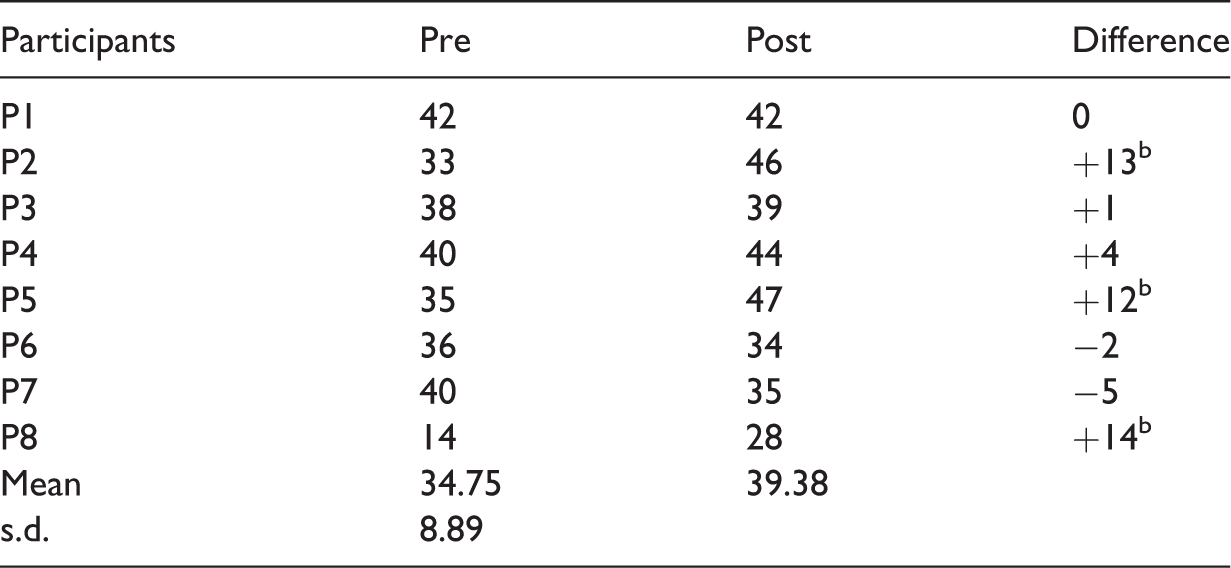
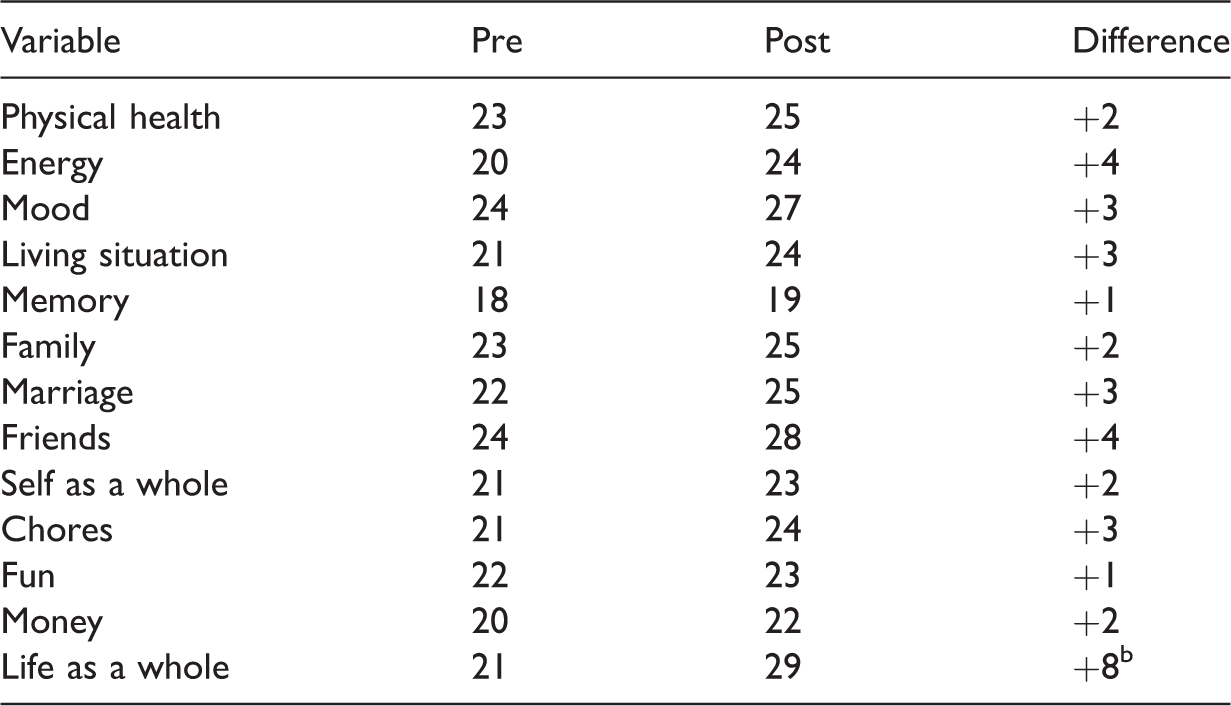
The Quality of Life-AD (Logsdon, 2002) was administered before and after the eight weeks of Visual Arts Education activities and measured 13 variables of quality of life. Table 1 indicates five out of eight participants had increased the quality of life, one remained the same, and two had slight decreases. Table 2 shows increases in all variables of quality of life with the largest increase in “life as a whole.”
Quality of Life-AD a pre- and post-test total score by participant (Tietyen, 2012, p. 52).
s.d.: standard deviation.
“Quality of Life-AD” (Logsdon, 2002).
Scored higher than one standard deviation at post-test.
Quality of Life-AD a pre- and post total group score by variable (Tietyen, 2012, p. 54).
“Quality of Life-AD” (Logsdon, 2002).
Highest variable increase.
Rosenberg Self-Esteem Scale (self-report)
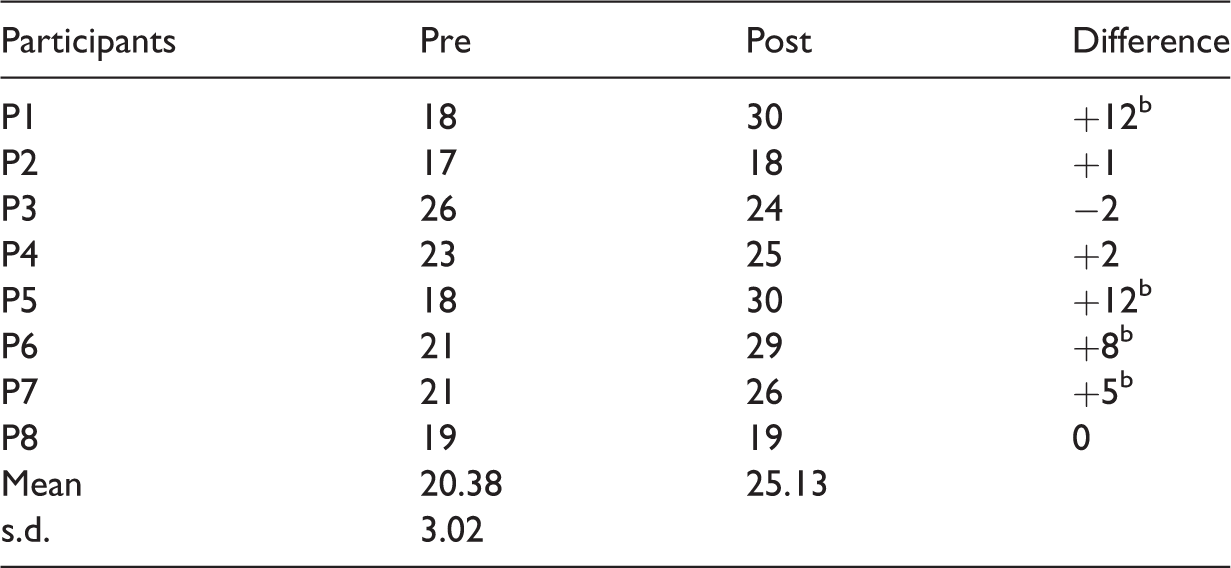
The Rosenberg Self-Esteem Scale was administered before and after the eight weeks of activities. The Rosenberg Self-Esteem Scale measures 10 items related to self-esteem (Rosenberg, 1979). Table 3 indicates improvement for six of the eight participants, one showed no improvement and the other showed decline.
Rosenberg self-esteem scale a pre- and post-test by participant (Tietyen, 2012, p. 59).
“Rosenberg Self-Esteem Scale” (Rosenberg, 1979).
Scored higher than one standard deviation at post-test.
Smiley-Face Mood Assessment (self-report)
The Smiley-Face Mood Assessment was used to determine each participant’s mood before and after each art activity. The results indicated that five out of the eight activities improved in mood (Tietyen, 2012, p. 61).
Systematic observation
Systematic observation of the participants by the researcher indicated five areas of improved cognitive performance and four other improved domains outlined as follows (Tietyen, 2012, pp. 44–51).
Cognitive performance
Other domains
Surveys completed by the test administrator
Results from the Participant Assessment Survey indicated that all eight participants (either frequently or a few times) improved their mood and behavior, demonstrated happiness and contentment, showed interest, and increased socialization and that no participants became agitated, fell asleep, or left before the end of the activities. The Art Session Evaluation indicated that all of the activities encouraged high degrees of socialization, and most of them were highly creative and interesting. In addition, self-esteem was largely improved (Tietyen, 2012, pp. 55–56).
Discussion
This study suggests that the Visual Arts Education pedagogical approach is effective in enhancing quality of life for persons living with dementia by improving their development of cognitive skills and processes, mood and self-esteem, and the ability to execute different types of fine motor skills. Of these impacted domains, attention, focus and concentration, self-esteem, increases in energy and perceptions of “life as a whole,” and the increased engagement with fine motor skills may be highlighted as being of particular benefit for persons with dementia. For instance, the ability to pay attention, focus, and concentrate may help persons with dementia to engage more fully in daily tasks which may involve planning a course of action, keeping a train of thought, or following directions. Improvements in self-esteem may have an empowering effect resulting in greater confidence to complete tasks and may generate greater positivity or enthusiasm. Increased energy and perceptions of a better “life as a whole” may provide the necessary impetus to participate more fully in learning experiences in general. Improvement of fine motor skills, including better hand–eye coordination or increased manual abilities may benefit persons with dementia so that they may remain more independent and perform daily tasks with improved dexterity.
In addition to these broad benefits, the pedagogical approach involving increases in novelty, challenge, and complexity seemed effective in enhancing the learning processes so that the participants were able to meet challenges successfully. The use of increasing novelty appeared to generate enthusiasm and keep the participants engaged in learning. In addition, there were no signs of frustration (indicative of too much challenge) or boredom (indicative of too little challenge). Instead, as the activities progressed from week to week, there was only greater evidence of improvements in cognitive skills, enhancements in mood and self-esteem, more verbal communication and social interaction, and enhancements in fine motor skills. These seemingly cumulative effects across different domains may have also been amplified by the variety of different types of challenges and the multimodal stimulation offered by the activities. As art educator, Jensen (2001) argues “The arts enhance the process of learning. The systems they nourish, which include our integrated sensory, attentional, cognitive, emotional, and motor capacities, are, in fact, the driving forces behind all other learning” (p. 2). It is therefore possible that the combined effect of several weeks of learning across multiple domains led to a greater facility for learning in general. This may explain why the more difficult challenges, such as in the last activity of printmaking were met with greater ease.
These findings also suggest that persons with dementia may be able to learn, engage with different cognitive processes, emotions and fine motor skills in ways that are not commonly made available by their regular daily activities. This idea is supported by a number of leading professionals who have suggested that persons with dementia have a greater capacity for learning, including complex and integrated learning experiences, than what is commonly perceived (MacPherson et al., 2009; Power, 2014). It appears that the participants in this study were capable of engaging in complex and integrated learning and had many strengths and abilities that were stimulated and engaged by the Visual Arts Education pedagogical approach.
In summary, although this was a small qualitative and exploratory study, the results suggest that the Visual Arts Education pedagogical approach was beneficial for improving quality of life for the participants across multiple domains including cognitive, affective, physical, and social. In addition, increasing the novelty, challenge, and complexity of the activities seemed to provide a way to enhance learning experiences so that interest was maintained, and challenges were met successfully. While further research is necessary, these preliminary results indicate that this approach has potential to impact cognition and quality of life in broad ways and to promote complex and integrated learning experiences that may also build upon the strengths and abilities that persons with dementia retain.
Limitations of the study
Sample size, lack of randomization, and not having a control group are limitations of this study. However, the intent of this study was to explore the range of quality of life domains that may have been impacted by the Visual Arts Education pedagogical approach and not to produce generalizable results. Despite these limitations, the findings indicate that the Visual Arts Education pedagogical approach holds promise for enhancing cognitive processes and improving quality of life for persons with dementia.
Conclusion
We presented a new and innovative pedagogical approach. It consists of hands-on visual arts activities based on the field of Visual Arts Education, aimed at enhancing cognitive and other multimodal domains and the strengths, skills, and abilities that persons with dementia may retain. The effects of this new approach were explored with a small qualitative study, and the results suggest improvements across multiple domains including cognitive, affective, physical, and social. In addition, the Visual Arts Education pedagogical approach incorporating increasing novelty, challenge, and complexity seemed to be effective in maintaining interest and in presenting challenges in a way that certain levels of success were achieved. This study, therefore, provides a starting point for future research to assess the therapeutic potential of this new approach to visual arts activities and quality of life for persons with dementia.
Footnotes
Declaration of Conflicting Interests
The author(s) declared no potential conflicts of interest with respect to the research, authorship, and/or publication of this article.
Funding
The author(s) received no financial support for the research, authorship, and/or publication of this article.