




Abstract
This study examined the use of various iPad Apps to conduct group cognitive exercises for clients with mild or early stage dementia of Alzheimer’s type. A list of free non-dementia-specific Apps suitable for group sessions was compiled. The procedures in choosing these Apps and determining the most successful ones for group exercises were discussed. Based on participants’ and professionals’ responses to the use of these Apps, the results would render practitioners useful guidelines in replicating and running technology-based training for individuals with dementia.
Introduction
As a result of the expanding range of choices and higher degree of accessibility of Applications (Apps), technology-based therapy for individuals with dementia or post-stroke aphasia has become a trend in the past decade (Holland, 2014; Kong, Law, Yeung, Lau, Tao, & Nan, 2016). Earlier reports, such as Alm, Astell, Ellis, Dye, Gowans, & Campbell (2004), have collectively suggested that the memory skills and everyday activity functioning of persons with acquired communication disorders can be facilitated by clinical training supplemented by carefully selected Apps. This conclusion validated the use of Apps that are not specifically developed for cognitive or language rehabilitation to support implementation of traditional therapy sessions.
Various studies have reported the positive effects in using Apps on tablet devices to conduct language or cognitive exercises on clients with acquired communication disorders (see review in Kong, 2015). For example, Leng, Yeo, George, and Barr (2014) have demonstrated that individuals with dementia showed positive changes of behaviors when they were engaged in group activities involving the use of iPad, as compared to traditional activities. In addition, Szabo and Dittelman (2014) suggested that the high-technology interface when one uses mobile technology, such as smartphones or tablet devices, could arouse users’ interest and curiosity. The fact that most of these Apps and tablet programs could empower patients to take control of their own process of rehabilitation as well as pace of conducting home practice (Kiran, Des Roches, Balachandran, & Ascenso, 2014) further makes it a popular (and effective) component of daily training.
In fact, the above-mentioned beneficial effects can also be found in neurologically unimpaired elderly. Chan, Haber, Drew, and Park (2014) reported the use of extensive iPad training involving a broad range of Apps among English-speaking older adults and its subsequent outcomes of the participants’ improved cognition for social engagement and facilitated executive function for everyday activities (such as banking). Interestingly, it has also been suggested that administering simple brain-training games on an iPad can detect subtle cognitive impairments (Tartaglione, Derleth, Yu, & Ioannou, 2014). In other words, it appears that implemented of Apps in the management of neurologically impaired population is not solely limited to the rehabilitation or process, but also the evaluation aspects of cognitive deficits.
Kong (2015) has recently reported a study to systematically compile a list of iTunes Apps suitable for usage with mild or early stage dementia. Procedures in determining the salient features of these Apps, all of which were either lite versions or free Apps for public to download, in relation to the participants’ strength and weaknesses were discussed. Moreover, the author used the selected Apps to conduct individual cognitive exercises and has led to the conclusion that iPad was a viable tool to supplement traditional clinical interventions for clients with dementia.
Aim
The purpose of this study is to extend Kong’s (2105) work by exploring the use of iPad Apps to conduct group cognitive exercises in a clinical setting for clients with early stage dementia. The procedures in choosing Apps through the iTunes market suitable for use with the dementia population were reported. The processes in evaluating each App, based on its potential capability to be implemented in group clinical settings and feedback from professionals and participants, were also given. A final list of Apps adopted to provide cognitively stimulating group therapy was compiled. Finally, suggestions for instructional applications in using these Apps on iPad during group therapy sessions were presented for potential replication.
Method
Participants
Fifteen individuals (eight men and seven women) with Alzheimer’s Disease, as reflected by results of the Montreal Cognitive Assessment (MoCA), with an average score of 15.33 (S.D.=1.05), participated. The participants were between 50 and 86 years and had educational statuses between high school graduate and doctorate degree. None of them demonstrated significant executive dysfunction. All participants were aware of their memory impairment and provided consent to participate in the study. They met two times per week and were provided with cognitive stimulation and light physical exercise in a social milieu.
App selection and use
The steps of app selection in this study largely followed the framework described in Kong (2015). First, the iTunes market was accessed through an iPad device to search for suitable Apps using terms “dementia,” “Alzheimer’s,” “cognitive,” “brain fitness,” “brain age,” “word games,” “language,” “attention,” “puzzles,” and “memory.” A total of 43 Apps that were free or had a ‘lite’ version in the iTunes market were downloaded (Table 1). These Apps were evaluated by professionals as mentally stimulating that could potentially encourage engagement in a group setting.
Apps Considered in Current Study Listed in Alphabetical Order (n=43)
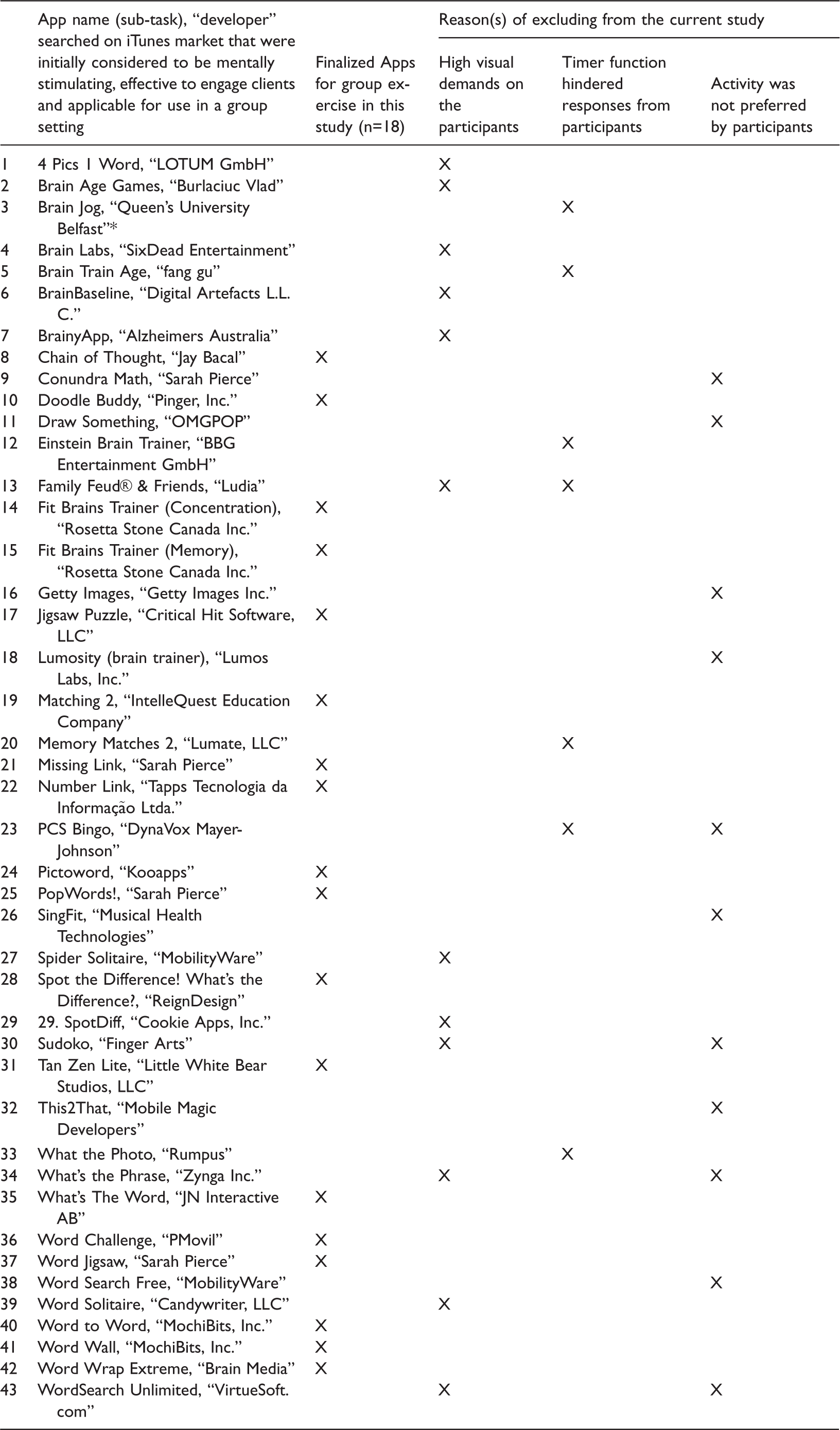
Note: *: At the time this manuscript was being prepared, the app has been removed from the App Store.
The next stage involved the use a questionnaire (similar to Kong, 2015) to determine the clients’ preferences of activities they wish to participate in. Prior to working with the iPad device, each participant was interviewed for approximately five minutes to obtain a brief history of knowledge or experience in using technology as well as information about activities (s)he would like to join in a communication group. Based on participants’ concerns about the visual demands and speed of providing responses of these Apps, the original list of 43 Apps was then reduced to 36. Specifically, Apps that were visually too distracting and/or with timer functions that were considered to be too short for participants to respond were removed from the list. The number of Apps was then further reduced to 18 in the final list.
In the final stage, the 18 Apps were implemented in two group settings, four small groups of three to six participants and a large group of all 15 participants. The small groups were assembled with consideration for members’ cognitive strengths and preferences. Thirty-minute group sessions were conducted for all groups once a week for three weeks. Each app was displayed by projecting the iPad screen on an adjacent wall. This increased the screen size and reduced the visual demand. After testing each app, the participants were asked to evaluate each app through a scoring system of 0 to 10, with 10 being the most enjoyable experience with perceived benefit on engaging participation of a communication group. The professionals also provided reviews on each app based on their observation of the running of the activities, including participants’ responses, interaction, and engagement level in the group as well as effective strategies for clinical implementation.
Results
Table 1 displays more detailed information about the perceived limitations of Apps not selected for use in the current study. Based on the professionals’ reflection, a strategy effective for small group implementation was to establish with participants the activity goal for each app. To facilitate smooth running of an activity, the practitioners might provide examples, reiterate the instructions, or provide reminders during the app implementation. The large group setting proved to be more challenging, but some useful strategies included verbally presenting materials to reduce visual demand and displaying the app on an Apple TV or projector to increase screen size. It was also observed that the large group setting limited low-functioning clients’ ability to participate. It is recommended that groups be arranged based on current functioning level to reduce frustration of clients. Additional implementation strategies or observations were recorded for each app in the final list (Table 2).
Finalized Apps Used (n=18) with Participants’ Rating and practitioners’ Review.

Note: *: range of 0 to 10, with 10 being the most enjoyable with the highest degree of perceived benefit by participants; **: + and - indicates practitioners’ positive and negative perception, respectively, of app implementation.
Discussion
The present study is one of the pioneer reports in the literature that have discussed the innovative use of everyday Apps to conduct communication group for individuals with dementia. Our results extended findings of some previous investigations on application of technology-based training to dementia (Kong, 2015; Leng et al., 2014): clinical use of iPad Apps continued to demonstrate as a viable supplement to conventional behavioral training. This is especially the case when it came to arousing attention and engaging individuals with dementia during daily clinical practice. Consistent with the report in Lopez-Samaniego, Garcia-Zapirain, and Mendez-Zorrilla (2014) for which mathematical and memorization exercises were completed using iPad for individuals with mild-moderate cognitive impairments in Spain, this ‘game playing’ (instead of standard rehabilitation) approach of conducting exercises and users’ accurate responses during the training promotes their overall interest, satisfaction level, and willingness to participate.
Practitioners who use Android or other non-Apple products may also download some of the Apps described in this study from the Google Play platform. Given that the choice of Apps, whether they are free or not, is constantly expanding in the market, professionals are encouraged to explore additional Apps that are suitable for their clients. With reference to the experience reported by the clinical professionals in this study, consideration of participants’ premorbid demographic characteristics, such as their occupations, hobbies, or education status, when selecting relevant Apps/activities should enhance their engagement level into the exercises. In additional, use of Apps that are designed and dedicated to the dementia population or that can address the limitations in memory skills, processing speed, and/or attention associated with dementia can facilitate the use of technology-based exercises to enhance everyday communication in this population.
Footnotes
Acknowledgments
The author is grateful to the participants for their participation in the study and Ms. Peggy Bargmann, Director of the Brain Fitness Club at the First United Methodist Church of Winter Park, for her assistance in the present investigation.
Declaration of Conflicting Interests
The author declared the following potential conflicts of interest with respect to the research, authorship, and/or publication of this article: The author reports no declarations of interest. Part of the results of this study was presented in The 2013 American Speech-Language-Hearing Association (ASHA) Convention held in Chicago, IL, USA.
Funding
The author disclosed receipt of the following financial support for the research, authorship, and/or publication of this article: The research reported in this article was funded in part by the Learning Institute for Elders at the University of Central Florida, Inc (LIFE@UCF) through the 2012-13 Competitive Grant and 2013-14 Competitive Grant awarded to the author.