



Abstract
Background
In studies involving people with dementia, researchers have historically defaulted to seeking consent from a proxy, the assumption being that people with dementia are unable to provide their own informed consent. This choice denies people with dementia a voice in the consent process, thus disregarding their autonomy and agency. Recently, other options for improving the consent process have been explored.
Objective
This study aimed to determine whether nursing home residents with dementia could demonstrate an ability to provide their own informed consent as determined by the Evaluation to Sign Consent instrument.
Methods
As part of a larger study on the quality of life of nursing home residents, the Evaluation to Sign Consent was administered to 392 people diagnosed with dementia. Data on demographic variables, such as gender and age, as well as level of cognitive impairment, were also collected.
Results
Just over one-fifth (22%) of the residents with dementia were judged as having the capacity to provide their own informed consent to participate in this specific research project. Consistent with existing literature, capacity to consent was significantly, and negatively, associated with cognitive impairment.
Conclusion
This study demonstrates that assuming all people diagnosed with dementia are unable to provide informed consent for research on the basis of cognitive test scores, or on clinical assessment alone, potentially denies them the autonomy to make a decision that they may be capable of making. Research involving people with mild-to-moderate dementia needs to consider evaluating whether potential participants have the capacity to provide their own consent.
Introduction
One key tenet of ethical conduct of human research is the ability of people to be able to provide informed consent (Ioannidis, 2013; Karlawish, 2003), a requirement outlined in documents considered cornerstones of ethical research around the globe (National Commission for the Protection of Human Subjects of Biomedical and Behavioral Research, 1979; US Department of Health and Human Services, 1949; World Medical Association, 2013). The Declaration of Helsinki was adopted by the World Medical Association (2013), which represents medical associations from more than 100 countries; consequently, protocols regarding informed consent are required for almost all forms of research oversighted by Institutional Review Boards (IRBs), Human Research Ethics Committees (HRECs) and Research Ethics Committees (RECs) in all signatory countries (National Health and Medical Research Council, Australian Research Council, & Australian Vice-Chancellors' Committee, 2007). People living with dementia should be included rather than excluded in studies that would benefit them or others (Hougham, 2005). However, issues about inclusion and how best to navigate the informed consent process raise important ethical and methodological challenges in dementia research (Kim, 2011).
The core requirement for informed consent for research participation is capacity; that is, whether an individual can provide their own informed consent to take part in the research or whether consent must be obtained from a proxy (surrogate) who holds the legal authority to make decisions on behalf of the person. Providing informed consent for research participation is a complex process for any potential participant. It is more complex for people living with dementia, most of whom will eventually lack the capacity for the thinking and reasoning required for decision-making. However, particularly in the early stages of the condition, many people with dementia have sufficient capacity to express their wishes, discuss the intended research and choose whether or not to provide informed consent (Hougham, 2005).
Background
In dementia research, particularly in the residential care setting, researchers have historically defaulted to seeking informed consent from a proxy, the assumption being that all potential participants are not able to provide their own informed consent because of their dementia diagnosis, stage of disease or other evidence of cognitive decline (Hubbard, Downs, & Tester, 2003; Jongsma & van de Vathorst, 2015; Kim et al., 2013). However, this assumption denies people with dementia a voice in the process, thus disregarding their autonomy and agency. In terms of the four principles of ethical research (research merit and integrity, justice, beneficence, respect for human beings) (National Commission for the Protection of Human Subjects of Biomedical and Behavioral Research, 1979), this assumption violates the principles of justice, beneficence and respect for personhood, thus placing the research merit and integrity in question (Taylor, DeMers, Vig, & Borson, 2012). Opting for proxy consent also assumes integrity on the part of the proxy to accurately reflect the wishes of the person with dementia (Slaughter, Cole, Jennings, & Reimer, 2007).
Researchers frequently choose to avoid the issue of evaluating capacity by excluding from participation all individuals with a diagnosis of dementia or with a cognitive score below a certain threshold. Extensive evidence shows that people with dementia with Mini-mental State Examination (MMSE) (Folstein, Folstein, & McHugh, 1975) scores of less than 10 out of 30 are unable to provide informed consent (Hougham, 2005; Slaughter et al., 2007); some researchers use this threshold to determine whether proxy consent is required. While this position may be based on a rational view of the evidence, it silences the voices of some people with dementia by denying them an opportunity to contribute to the decision to participate in research, unless they had previously let their proxy know their wishes about research participation.
Specific guidance about the informed consent process for researchers working with people with dementia is limited. None of the Declaration of Helsinki (World Medical Association, 2013), the EU’s Ethics for Researchers document (European Commission, 2013), the US Federal Policy for the Protection of Human Subjects (Department of Health and Human Services, 2009) or Australia’s National Statement on Ethical Conduct in Human Research (National Health and Medical Research Council et al., 2007) prescribe specific procedures for determining decisional capacity of potential participants. Thus it is not surprising that there is a lack of clarity and agreement between HRECs and IRBs in this area (Slaughter et al., 2007). The US National Institutes of Health (2009) produced a detailed document in 2009 describing possible methods for determining consent capacity, but did not advocate a specific technique. It did note, however, an increasing trend toward assessing capacity in relation to the specific research study in question, rather than broader decisional capacity. Similar to other authors (Batchelor-Aselage, Amelia, Zapka, Mueller, & Beck, 2014; Slaughter et al., 2007), Hellstrom, Nolan, Nordenfelt, and Lundh (2007) suggested that informed consent and assent should be situation-specific and highly dependent on relationships developed between researchers and participants, arguing that all potential participants should be “regarded as competent until demonstrated otherwise” (p. 611).
Sturman (2005) conceptualised capacity as a continuum, and broadly defined it as “resources that a patient or participant can rely upon to provide informed consent” (p. 955). This definition supports the argument for alternate, more nuanced approaches to the determination of capacity and the process of obtaining informed consent. For example, Dewing (2007) suggested a method embedded in person centred care principles, sensitive and skilled communication and ongoing critical reflection by the researcher to ensure that the central question – “Is this person consenting?”, remains paramount not only at the beginning of a project but throughout it. In addition, Kim (2011) argued that there is “no clear dividing line between capacity and incapacity” (p. 3), with wide variation in judgements of capacity even by very experienced psychiatrists.
Appelbaum and Roth (1982) described a hierarchy of four functional abilities underlying capacity to provide informed consent, specifically (a) evidencing a choice to participate in research, (b) factual understanding of the research, (c) rational manipulation of the information provided, and (d) appreciation of the nature of the situation. Based on these precepts, one method to determine whether a potential participant has sufficient capacity is for the principal investigator or other clinician or researcher to make a clinical judgement; however, if the researcher does not have a clinical background, no such judgement can be reliably made. Clinical judgements are subjective, because they are based on observation, intuition, past experiences and clinical knowledge (Simpson, 2010). Their subjective nature renders elimination of bias difficult as the researcher or clinician may unconsciously minimise potential risks due to a vested interest in the participant being able to provide informed consent.
To maximise the reliability and validity of capacity assessment, many researchers have chosen to use instruments in addition to clinical judgment or have been expected to do so by some ethics committees. While there is currently no gold standard for capacity assessment in research involving people with dementia (National Institutes of Health, 2009; Resnick et al., 2007), there are some well-regarded instruments used to evaluate capacity in this population. One of the most widely used with participants with dementia is the MacArthur Competence Assessment Tool-Clinical Research (MacCAT-CR) (Applebaum & Grisso, 2001), a 21-item structured interview which yields inadequate, partial or adequate scores for the separate domains of understanding, reasoning, appreciation and expression choice. It can be customised so that questions relate directly to a specific study. However, questions have been raised as to whether the MacCAT-CR is overly stringent for use in the dementia population (Sturman, 2005); particularly given the potential burden of test fatigue resulting from a 15–30 minute structured interview. A shorter five-item measure of capacity developed for the research context is the Evaluation to Sign Consent (ESC) (Resnick et al., 2007) focused on the ability to understand facts relevant to participation in a specific study (Resnick et al., 2007; Sturman, 2005).
Scope of this paper
In an Australian descriptive exploratory study of quality of life of people with dementia in long-term care, potential participants were given the opportunity to demonstrate their ability to provide their own informed consent to participate using the ESC (Beattie et al., 2015). This paper discusses the evaluation of individuals to provide their own consent using the ESC. The primary research question addressed was what proportion of nursing home (NH) residents with dementia in this study had the capacity to provide their own informed consent. As a secondary question, potential factors associated with capacity were explored.
Materials and methods
As described in the larger study protocol paper (Beattie et al., 2015), the research design was descriptive and cross-sectional in nature. Ethical approval was obtained from the ethics committees of Queensland University of Technology, Griffith University, University of New South Wales, University of Tasmania and Curtin University and any NH provider organization that had their own ethics committee.
Sample
Participants were drawn from a sample of 53 NHs in Australia. As documented in a methodological paper (Fielding, Beattie, O'Reilly, McMaster, & the AusQoL Group, 2016), a three-stage stratified random sampling design ensured that all NHs in all states/territories (except the Northern Territory), organizational types (non-profit, profit, and government/community) and geographic types (capital city, smaller cities close to capital cities and more distant cities/towns) were included. The final sample was representative of all NHs in Australia with 25 or more beds that were not in remote geographic areas. Although the high-care/low-care terminology is no longer used in Australia, most NHs, including those in the study sample, contain a mixture of care types. In each participating NH, 5–15 residents with a recorded diagnosis of dementia and aged over 65 years were invited to participate via their legally authorised representatives (LARs) (usually a spouse or adult child).
Procedure
Once the LAR provided consent, they were asked if the researchers could assess the person with dementia for their ability to provide their own informed consent to participate. The resulting resident ESC interviews were conducted by a trained researcher in a quiet location. After a brief conversation to establish rapport, the resident was given the participant information form (PIF) to read and was encouraged to ask any questions they had about it with the research assistant. They were then asked whether they would like to participate and the ESC was administered if they provided assent. If the resident was then assessed as having capacity to consent based on the agreement between their answers on the ESC and the information in the PIF, he/she was given the opportunity to sign the informed consent form. Potential participants who had the capacity to consent but who did not want to participate in the research were not enrolled in the study, despite consent having been received from the LAR.
Measures
Capacity to consent was assessed by the ESC. Potential participants first had the study explained to them, then they were asked to: (a) identify two potential risks to taking part in the study; (b) outline what was expected of them; (c) explain what to do if they no longer wanted to participate; and (d) explain what to do if they experienced discomfort. All answers had to be correct for a person to be deemed as having capacity to consent to study participation. The psychometric properties of the ESC are sound (Resnick et al., 2007) (person-reliability = 0.64 (reliability of correct classification), item-reliability = 0.81 (reliability of item difficulty) inter-rater reliability (r = 0.81), with agreement in 90% of cases. In terms of validity, the ESC is unidimensional, focused on understanding of the research; item mapping indicated that the difficulty of items was spread along the continuum, ensuring good discrimination between participants of all levels.
The MMSE (Folstein et al., 1975) was used to assess level of cognitive impairment, as it is widely used internationally in clinical practice and research, allows comparison between studies and is easy to administer and score. MMSE results were divided into four categories: Unable to Complete (respondent not able to complete exam or is deemed untestable by rate), severe (0–10), moderate (10–20) and mild (21–30) impairment on a possible maximum of 30 points. Demographic data were collected by chart review and included: age, gender, education, whether English was spoken at home, whether born in Australia or not, years residing in the NH, and dementia type. Education, and when English was spoken at home, might be expected to be positively related to capacity to provide consent, whereas age, years residing in NH and level of cognitive impairment might be negatively related. No a priori expectations existed as to the relationships between capacity and gender, Australian birth or type of dementia.
Statistical analysis
Capacity to consent, level of cognitive impairment and the categorical demographic variables were expressed in percentages, while age and years in NH were described by means and standard deviations, before being divided into categories for later analyses. To understand whether any demographic variables or level of cognitive impairment were related to capacity to consent, bivariate analyses with the Chi square (χ2) statistic were undertaken. In addition, a logistic regression was used to analyse which, if any, of the demographic and impairment variables demonstrated an independent effect on capacity to consent.
Results
Originally 450 proxies consented to the person with dementia they spoke for participating in the research. Most LARs (n = 407, 90%) gave permission for the person with dementia to be evaluated for capacity to consent. Of those residents whose proxies agreed to permit us to approach them for capacity assessment, five residents refused to be assessed on the ESC. A further 10 whose ESC results indicated they had capacity to consent then stated that they did not wish to participate in the research, despite their proxy’s prior consent for participation in the study. These last 10 were excluded from the study altogether, finally reducing the numbers enrolled and reported on to 392 residents with ESC results (See Figure 1 for participant flow through the assent/consent process).
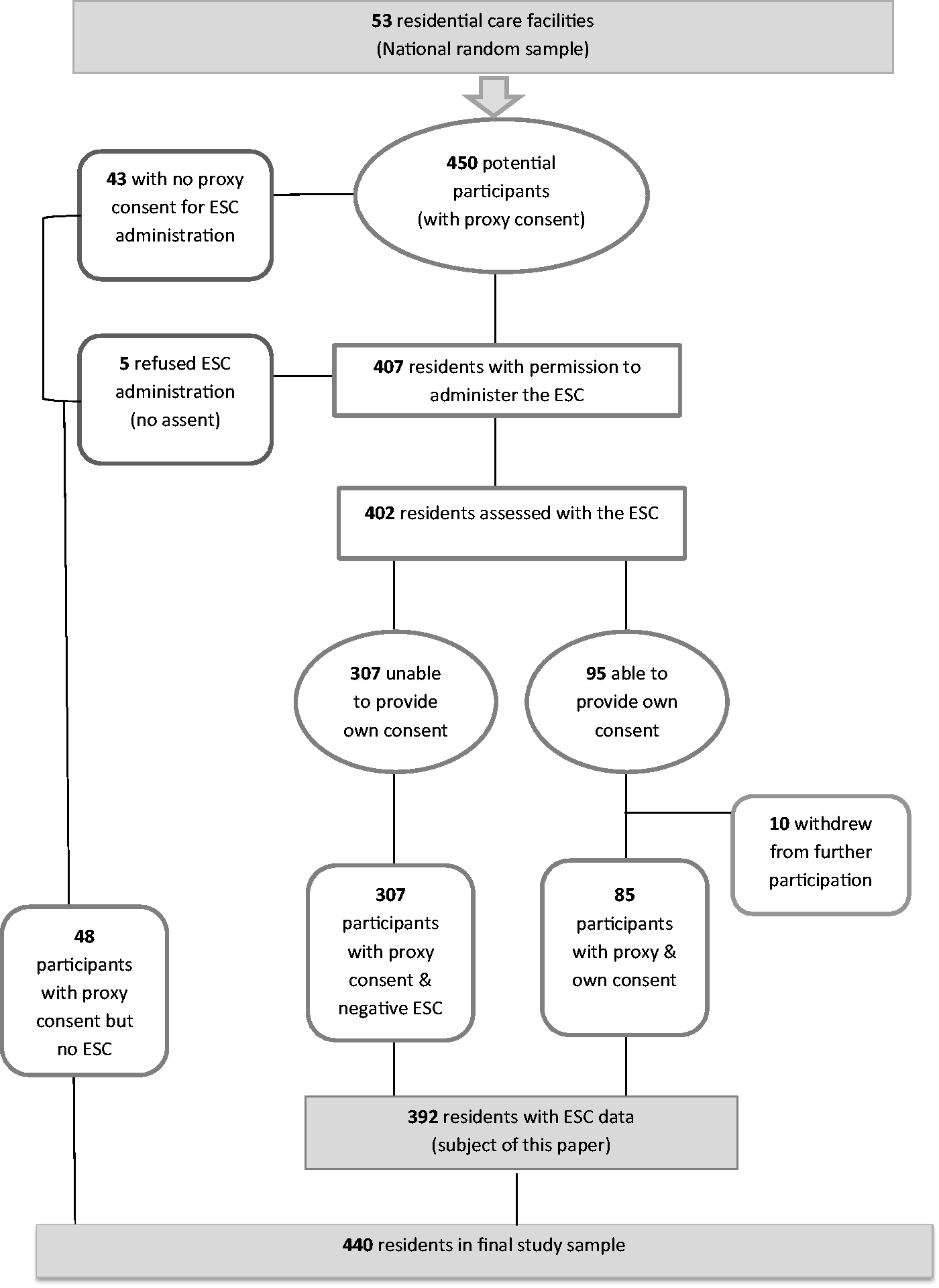
Flow of participants through the consent process.
Resident characteristics
The characteristics of the sample are listed in Table 1. In terms of gender (81% female), age (mean = 86) and years in the NH (mean = 2.8), the sample is reasonably reflective of the national long-term care population (Australian Institute of Health and Welfare, 2012; Australian Institute of Health and Welfare, 2017). The vast majority (91%) spoke English as their preferred language and two-thirds (67%) were born in Australia. Scores on the MMSE were only available for 378 participants because 14 were unwilling to complete the MMSE. Of those tested, one-third (34%) were deemed “unable to complete”, 18% were severely impaired, 38% were moderately impaired and 11% were mildly impaired (see Table 1).
Participant characteristics and capacity to consent (overall N = 392).

Capacity to consent
Of the 392 participants administered the ESC, 22% (n = 85) were judged as able to provide their own informed consent to participate. The Chi-square analyses demonstrated that only level of cognitive impairment (MMSE category) and years in the NH were significantly, and negatively, associated with the ability to provide informed consent (see Table 2). That is, greater impairment and/or more years in the NH were associated with less likelihood of having the capacity to consent. All demographic and impairment variables were then entered into a logistic regression with the dichotomous dependent variable being ability to provide consent or not. In this model, only level of cognitive impairment was found to have a unique significant contribution. Given this, the bivariate analysis between the two was considered to capture the relationship, and the data for the regression has not been reported. Instead the relationship between level of cognitive impairment and capacity to consent is illustrated in Figure 2, which displays the clear trend of capacity to consent increasing with better cognitive status, with a dramatic increase (from 35% to 71%) between the moderate (MMSE 11–20) and mild (MMSE 21+) categories.
Bivariate analyses: Relationships with capacity to consent.


Capacity to provide consent by MMSE category (N = 370).
Discussion
Most of the proxies (90%) gave permission for us to approach the person with dementia to determine their capacity to consent and were prepared to accept their consent decision. These actions demonstrate the proxies’ support of the involvement of the person with dementia in the consent process and their commitment to maintaining the dignity and personhood of the person with dementia. The answer to the primary research question was that a small, but significant proportion of people living with dementia (22%) were assessed as having the capacity to provide their own informed consent. The research team, and importantly, the person’s proxy, would not have known this had we not undertaken a formal evaluation process. Ten of the people assessed on the ESC did not consent to the research (although their proxies had given consent); they were removed from the study. Both the evidence of capacity to consent and the choice of some to not consent confirm that this evaluation process helped to protect the autonomy and personhood of the residents living with dementia.
In terms of the secondary research question, level of cognitive impairment, as measured by the MMSE, was highly predictive of capacity to provide informed consent. However, none of the demographic variables (age, education, language used at home or country of birth) were related to capacity. Years in the NH were related to capacity to consent, but this variable was highly related to cognitive impairment as cognition normally declines over time. Even with high MMSE scores (21–30), capacity to provide informed consent cannot be assumed; just under three-quarters of participants with only mild impairment demonstrated capacity. Thus, these findings suggest that the most accurate means of determining capacity is to assess it directly, via assessments such as the ESC.
Limitations
This study was limited to people living with dementia in NHs in Australia that were not small (i.e. contained at least 25 beds) and were not in remote geographic areas or the Northern Territory. While this selection only excluded a very small proportion of Australian NH places (3%) and the resulting sample was found to be representative of all Australian NHs with at least 25 beds (Fielding, et al., 2016), it was still not totally inclusive of all possible NHs. A second study limitation was the restrictions imposed by a limited budget and data collection window, combined with a large desired sample size. The consent procedures we used required extra time and cost – our team decided to maximise the opportunity for potential participants to provide their own informed consent, taking into consideration the evidence about the impact of dementia on decisional capacity and our need to meet recruitment targets. A more extended and individualised evaluation of capacity, while desirable, would have been cost-prohibitive.
Most dementia researchers report the exclusive use of proxy informed consent on the basis that even mild cognitive impairment can impact decisional capacity (Jefferson et al., 2008; Kim, Caine, Currier, Leibovici, & Ryan, 2001). Other factors behind this decision besides any empirical evidence about decisional capacity could include the pressure to meet recruitment targets in a timely and cost-effective manner while abiding by institutional ethics requirements to ensure the protection of the person with dementia. When blanket proxy consent is used to recruit people with dementia across the spectrum of cognitive impairment, it is likely that some higher functioning participants would be able to provide their own informed consent but were not offered the option to do so. In this circumstance the rights of the person with dementia are arguably diminished.
The way any prospective research participant is approached by the recruiter influences their perception of the respect the researcher has for them, their willingness to participate and how they discuss their research experience with others. As Sessums, Zembrzuska, and Jackson (2011) noted, in determining capacity for decision making, it is not the final decision that is important but the process that the person experiences in making that decision. How best to respect the dignity and autonomy of the person with dementia who may have diminished capacity is an important consideration to be weighed in deciding how informed consent will be obtained in any study (Dewing, 2007). Assessing capacity is itself somewhat taxing to potential participants and indiscriminately using assessments on all participants might introduce unnecessary burden. Researchers must remain aware of this potential burden for people with dementia, while also considering the need to help them “to be involved in the informed consent process as much as they are able” (Beattie, 2009). In selecting the ESC as the assessment tool we were mindful that it assesses only one aspect of decisional capacity – understanding – but it is brief and simple to administer, thus minimising burden.
The longer MacCAT-CR assessment (Applebaum & Grisso, 2001) adds an evaluation of participants’ appreciation, reasoning and capacity to evidence a choice. However, a study (Moser et al., 2002) that compared participants on ESC and MacCAT-CR scores found that those participants who were judged unable to provide informed consent on the ESC were the same participants who fell below the recommended threshold to determine understanding on the MacCAT-CR, thus suggesting the shorter ESC may be a more practical and equally effective capacity measure to use in dementia research, especially in low or negligible risk studies as is the case in our study.
The opportunity for people to provide their own informed consent is important to consider depending on the population under investigation, the complexity and risk level of the research and what is expected once enrolled. Researchers need to find the balance between the dignity and respect inherent in supporting the participation of people with dementia in their own consent process and ensuring the person with dementia is not overly burdened or stressed by the process. Due consideration needs to be given to the additional time and expense involved in capacity assessment for research participation in this population. From our experience, this was a minimal additional investment because the numbers involved were relatively small. However, we estimate that obtaining proxy consent plus person with dementia consent increased training time for researchers and doubled the time spent on the consent process from approximately 15–20 minutes for proxies only to up to 45 minutes for residents with dementia. It also occasionally involved repeated visits to the potential participant, additional site visits, calls to proxies, or problem solving with project staff about individuals. These factors must be considered from the outset when planning a research budget and recruitment strategies, and weighed alongside the benefits for both parties.
Recommendations
This study added to the understanding of the informed consent process for research participation for people living with dementia. Capacity to consent is a complex process, yet it is not wholly captured by the level of cognitive impairment of a person with dementia which is consistent with existing international literature. More than one-fifth of our sample demonstrated that they had sufficient capacity to understand the research and provide their own informed consent, an opportunity that would have been denied them had we not included capacity assessment in our protocol. Therefore, if researchers are sincere in their wish to acknowledge the personhood and autonomy of people with dementia, judicious use of measures of capacity should be incorporated into the informed consent process.
Footnotes
Authors’ Contributions
EB, MOR and DF conceived the project within the larger project and participated in writing and revising the final manuscript, MM performed the data manipulation and analysis and participated in writing and revising the manuscript, WM conceived the larger project and participated in revising the manuscript and EF supervised the sampling and quantitative design of the larger project and participated in the statistical analysis of this project and in the writing and revising of the final manuscript.
Acknowledgements
The authors would like to thank the facilities, staff, residents and families who generously gave their time to participate in this research. We gratefully acknowledge the intellectual generosity and support of Professor Sheryl Zimmerman, Mary Lily Kenan Flagler Bingham Distinguished Professor in the University of North Carolina’s School of Social Work, Chapel Hill, North Carolina, USA and Professor Emerita Rhonda Nay of La Trobe University during the conceptualization phase of this study. The AusQoL group (Professor Elizabeth Beattie; Professor Lynn Chenoweth of University of New South Wales, Sydney; Associate Professor Deirdre Fetherstonhaugh; Dr Elaine Fielding; Associate Professor Barbara Horner of Curtin University, Perth, Western Australia; Professor Wendy Moyle; Dr Maria O’Reilly and Professor Andrew Robinson of University of Tasmania, Hobart) conceived the larger project, supervised its data collection and entry. The following research staff were also involved in project co-ordination, data collection and/or data entry and cleaning: Dr Dominique Bird, Dr Beatriz Cuesta-Briand, Ms Chanel Burke, Ms Sara Franklin, Ms Lina Karlsson, Ms Joanna Lee, Dr Jane O’Brien, Ms Ash Osbourne, Dr Laura Tarzia, Ms Laura Tierney and Ms Leonie Tinsley.
Declaration of Conflicting Interests
The author(s) declared no potential conflicts of interest with respect to the research, authorship, and/or publication of this article.
Funding
The author(s) disclosed receipt of the following financial support for the research, authorship, and/or publication of this article: The authors acknowledge funding support of the Dementia Collaborative Research Centre: Carers and Consumers, sited at the School of Nursing, Queensland University of Technology, and a part of the Dementia Initiative of the Commonwealth of Australia. Additional support was provided by the Aged Care Accreditation & Standards Agency.