



Abstract
Background
A considerable number of the persons living with dementia rely on family members for care and assistance when performing activities of daily living. As a result, caregivers may be at increased risk for mental health problems such as depression, anxiety and caregiver burden. This study examined if and how spiritual coping and stigma-related family stress impacted the associations between the patient activities of daily living impairment and caregiver mental health.
Methods
Using a longitudinal design, 664 caregivers were assessed at baseline for spiritual coping strategies and family stigma stress, along with patients’ instrumental activities of daily living and cognitive functioning. After 12 months, caregivers were assessed for depressive and anxiety symptoms, caregiver burden, and quality of life (physical and mental). Sequential mediation of spiritual coping strategies and stigma-related family stress on the relationship between patient instrumental activities of daily living and caregiver mental health outcomes was examined using the PROCESS macro statistical method.
Results
Participants had been caring for someone with dementia for an average of 46.4 (SD, 16.9) months and 63% of caregivers were female. There were significant indirect associations between patient instrumental activities of daily living and caregiver anxiety, depression, caregiving burden, and the mental health component of quality of life. Spiritual coping and stigma-related stress mediated these associations (–0.54<b<–0.02). Overall, 26%, 41%, 49%, and 59% of the variances of caregiving burden, anxiety, depression, and mental functioning, respectively, were explained using the sequential mediation models.
Conclusions
Spiritual coping and stigma-related stress appear to mediate the relationship between the patient instrumental activities of daily living impairment and caregiver psychological health. These factors should be considered when addressing mental health problems experienced by caregivers.
Introduction
Dementia is a major neurocognitive condition that involves a deterioration of mental functioning and commonly occurs among persons in later life (Budson & Kowall, 2011). With a growing number of older adults in the population, the prevalence of this condition is increasing globally. According to a recent report, more than 35 million people worldwide suffer from this condition and the number is expected to double every 20 years, so that by 2050 the number of persons with dementia will reach nearly115 million (Prince et al., 2013). Dementia is common in both developed and developing countries. Based on the Alzheimer Society in Britain, nearly 850,000 people were diagnosed with dementia and in the United States about 9% of people over age 65 years were diagnosed with the condition in 2012 (Alzheimer’s Society (UK), 2018; Langa et al., 2017). With regard to developing countries, a prevalence rate of 10% was found among those age 60 years or older in Singapore and at least 50,000 persons with dementia have been reported in Saudi Arabia (Alkhunizan, Alkhenizan, & Basudan, 2018; Subramaniam et al., 2015). There is no official information regarding the number of persons with dementia in Iran; however based on recent estimates, over 500,000 people may have the condition in this country (Sharifi et al., 2016).
Many persons with dementia experience multiple symptoms such as lack of concentration, hallucinations, depression, anxiety, and behavioral reactions including agitation, aggression, and repetitive actions, as well as socially inappropriate behaviors (Budson & Kowall, 2011). Psychological, mental, and behavioral disturbance is an indication that persons with dementia will require ongoing need for support and care by others. The majority of persons with dementia are cared for by family members, and sometimes by adult children and their spouses (Ying et al., 2018). These caregivers usually engage in difficult tasks that affect their physical and mental health, and spend considerable time providing care that interferes with other enjoyable activities and social relationships (Kovaleva, Spangler, Clevenger, & Hepburn, 2018). Thus, caregivers may develop psychological, emotional, social, and physical problems that may negatively affect their health over time (Abreu, Rodrigues, Sequeira, Pires, & Sanhudo, 2018).
Several studies have found that compared to non-caregivers, caregivers experience higher levels of distress, anxiety, sleep disorders and depression as well as more psychosomatic disorders such as hypertension, cardiovascular disorders, and obesity (Gallagher-Thompson et al., 2006; Haley et al., 1995; Rowe, McCrae, Campbell, Benito, & Cheng, 2008). Caregivers are also prescribed more psychotropic medications than those in the general population (Camargos et al., 2012). Therefore, it is clear that caregivers experience more psychological and physical health problems that may interfere with their ability to provide care to persons with dementia. This in turn may increase the cost of healthcare for both caregivers and those they care for, with the result that the persons with dementia will need to be cared for by the formal state-supported healthcare system (Zhu et al., 2015).
Caregiver burden is considered as an important indicator of caregiver health and has been defined as the pressure that caregivers typically experience from their caregiving duties. This typically includes physical, mental, financial and social stresses that may adversely affect health-related quality of life (HRQoL) (LoboPrabhu, Molinari, & Lomax, 2006). Identifying factors that may help to relieve caregiving burden will assist health professionals and policy makers in designing and funding effective interventions as well as education programs in this regard.
To date, many factors have been reported to influence health conditions of caregivers. For example, in a study of caregivers of persons with dementia with heavy basic and instrumental activities of daily living (ADL) needs, a greater feeling of burden and higher levels of depressive symptoms and other comorbidities were found (Dawood, 2016). Likewise, persons with dementia with serious behavioral problems and advanced cognitive impairment have also been associated with more mental health problems in the caregivers (Armstrong, Gitlin, Parisi, Roth, & Gross, 2018). Finally, caregivers of persons with dementia experience greater psychological and physical health problems than caregivers of persons with other types of chronic conditions (Pinquart & Sorensen, 2003).
A factor that may differentiate caregivers of persons with dementia from other caregivers may be the social stigmatization of persons with dementia due to their neurological condition (Budson & Kowall, 2011). Stigma related to cognitive conditions such as dementia and Alzheimer not only deprive persons of adequate treatment and care, but also increase the stress on caregivers because they alone are responsible for the behavior of persons with dementia (Weisman de Mamani, Weintraub, Maura, Martinez de Andino, & Brown, 2017). This may cause others to shun family members of the persons with dementia (Werner, Goldstein, & Buchbinder, 2010). This pressure on caregivers due to social stigmatization may adversely affect the care they deliver to persons with dementia, since caregivers may change how they treat persons with dementia to avoid such stigmatization (Chang, Su, & Lin, 2016; Weisman de Mamani et al., 2017). Although there are several studies on the effects of stigma related to persons with cognitive impairment, the impact of social stigmatization on the caregivers of persons with dementia is relatively unknown, especially in Iran and other parts of the Middle East.
Another factor that may influence the health status of caregivers is the use of spirituality as a coping strategy. Spiritual coping (SC) may help caregivers deal better with stressful situations through mobilization of religious beliefs and practices (Glueckauf et al., 2009). The literature indicates a growing number of studies that confirm associations between SC and better health outcomes in caregivers (Vitorino, Marins, et al., 2018; Yeh & Bull, 2009). Research also indicates that those who do not use this coping strategy may be at higher risk for negative outcomes such as depression, anxiety, and impaired HRQoL (Spatuzzi et al., 2018; Vitorino, Lopes-Junior, et al., 2018). A review has reported a high level of spiritual/religious coping in caregivers of those with chronic illnesses (Clark & Diamond, 2010). In addition, studies have found better adaptation (Odbehr, Hauge, Danbolt, & Kvigne, 2017), lower levels of caregiving burden (Rathier, Davis, Papandonatos, Grover, & Tremont, 2015), and less use of mental health services among spiritual or religious caregivers (Lekhak, Yolpant, Zauszniewski, & Bhatta, 2014).
Although many studies have examined determinants of burden and health in caregivers, there are few studies that have examined the mediation effects of such factors. Identifying such mediators may help to improve their adjustment to the caregiving role and may help to guide the health care system to intervene more effectively when caregiver burden is high (Cohen & Eisdorfer, 2011). The mediation effects of self-efficacy, situational control, distressing behaviors, and role captivity on caregiver outcomes have been examined previously (Atienza, Collins, & King, 2001; Givens, Mezzacappa, Heeren, Yaffe, & Fredman, 2014; Zhang, Guo, Edwards, Yates, & Li, 2014). However, little attention has been paid to mediators of the relationship between the functioning of the cared for person (assessed by ability to perform ADL), caregiver burden, and caregiver mental health. As a result, we sought to examine if and how factors such as family stigma stress and SC might influence these relationships in caregivers of persons with dementia.
Methods
Participants
This was a longitudinal study of persons with dementia referred to Iran Alzheimer’s Association (IAA) to receive routine care in Tehran and Qazvin cities. The IAA provides care services such as informational support and access to physicians for periodic medical checkups. Persons with dementia and their caregivers were recruited to participate between January 2017 and January 2018. A trained nurse interviewed caregivers of persons with dementia and encouraged them to participate in the study, after presenting the study goals and conditions. However, the nurse explained that participation was completely voluntary and did not place any pressure on participants to engage in the study. Eligibility for the study included being the primary caregiver of an old person with medically confirmed dementia, ability to read and write in Persian, and willingness to participate in the study. Persons with dementia who had been inpatients or lived in residential care homes were excluded. Participants were excluded if the death of persons with dementia occurred during the study. Ethical approval for conducting the study was obtained from the ethics committee of Qazvin University of Medical Sciences. All participants (both caregivers and persons with dementia when able) gave their written informed consent before the study began. When a person with dementia did not have the cognitive capacity to participate and was unable to consent, and the caregiver wanted to participate, then only the caregiver provided informed consent.
Measures
Zarit Burden Interview (ZBI)
The ZBI is a measure of caregivers’ concerns regarding physical, mental, social and financial aspects of caregiving. The measure contains 22 items rated on a five-point Likert scale, ranging from 0=‘never’ to 4=‘nearly always,’ with higher scores indicating greater burden. A total score can be calculated and ranges from 0 to 88 (Zarit, Orr, & Zarit, 1985). The ZBI has shown invariance across gender and education subgroups of caregivers of persons with dementia (Lin, Ku, & Pakpour, 2017; Lin, Wang, Pai, & Ku, 2017). The Persian version of the ZBI has been found to be valid and reliable with Cronbach's alpha 0.77 and a test–retest correlation of 0.78 (Rajabi-Mashhadi et al., 2015).
Spiritual Coping Strategies (SCS) scale
The SCS scale is a 20-item measured used to assess SC strategies in two dimensions, and includes both religious and non-religious types of coping. All items are rated 0–3 scale (from 0 = ‘never used’ to 3=‘often used’), with higher scores indicating greater use of SC. The total score is calculated by summing answers to all 20 items and ranges from 0 to 60 (Baldacchino & Buhagiar, 2003). The SCS has been translated into several languages including Persian, and the Persian version has a factor structure similar to that of the original (GFI = 0.923, CFI = 0.948) and solid internal reliability (Cronbach's alpha = 0.87) (Saffari, Koenig, Ghanizadeh, Pakpour, & Baldacchino, 2014).
Lawton Instrumental Activities of Daily Living scale
The IADL scale is a measure of functional status among older adults. It contains eight items with higher scores indicating better functioning (Lawton & Brody, 1969). The Persian version of the IADL was found to have excellent validity and reliability for use in persons with dementia with acceptable internal consistency between items and the total score (r’s ranging from 0.43 to 0.61) (Hassani Mehraban, Soltanmohamadi, Akbarfahimi, & Taghizadeh, 2014). The IADL scale score of the persons with dementia was the primary independent variable in this study.
Short Form 12 (SF-12)
The SF-12 contains 12 items derived from the SF-36 that assess HRQoL. All scores are linearly transformed into a 0–100 scale, with 100 indicating the best possible state of health. All items are weighted and summed into two summary scores consisting of physical (PCS) and mental (MCS) health components (Ware, Kosinski, & Keller, 1996). The Persian version of the SF-12 was found to be highly valid and reliable for use in Iranian populations with a similar factor structure as that of the original (GFI: 0.96; RMSEA: 0.079) (Pakpour et al., 2011).
Mini Mental State Examination (MMSE)
The MMSE was used to assess the cognitive functioning of the persons with dementia. This test contains 20 items assessing in five dimension of cognitive functioning including orientation, attention, calculation, language, and recall. Total score is calculated by summing the responses resulting in a range from 0 to 30 with higher scores indicating better cognitive functioning (Pangman, Sloan, & Guse, 2000). The Persian version of the MMSE has been shown to successfully differentiate between persons with Alzheimer and healthy controls with a sensitivity and specificity of 98% and 100%, respectively (Ansari, Naghdi, Hasson, Valizadeh, & Jalaie, 2010).
Hospital Anxiety and Depression Scale (HADS)
The HADS is a 14-item scale used to measure the anxiety (seven items) and depression (seven items). All items are rated on a four-point Likert scale (0–3) with higher scores indicating higher levels of anxiety or depression (Zigmond & Snaith, 1983). The Persian version of the HADS has acceptable psychometric properties and construct validity determined by both factor analysis and Rasch model (Lin & Pakpour, 2017).
Family Stigma Stress Scale (FSSS)
The FSSS was recently developed to measure the stigma stress experienced by family caregivers of people with mental illness. It contains eight items each rated on four-point Likert scale (1–4) with higher scores indicating higher levels of stigma stress. A total score can be calculated by summing responses resulting in a range from 8 to 32 (Chang et al., 2017). The Persian version of the FSSS has been found to have strong validity and reliability (CFI: 0.94 for factor analysis and 0.88 for Cronbach’s α) (Saffari, Pakpour, & Lin, 2018).
Procedure
After checking for eligibility and obtaining informed consent, caregivers were invited to attend a group session at IAA to explain the purpose of the study and complete baseline measures (i.e. IADL for persons with dementia, MMSE for persons with dementia, and caregiver SCS and FSSS) as well as provide socio-demographic information. Three trained assistants collected the data. Twelve months later, the same caregivers (n = 584) completed the SF-12, ZBI and HADS at IAA. No incentive or financial support was provided for participation.
Data analysis
The data were analyzed using SPSS version 23 (SPSS, Chicago, Illinois, USA). Descriptive statistics were carried out to compute means and standard deviations as well as internal consistency. Bivariate Pearson’s correlations were used to measure the relationships among study variables.
We then tested whether the relationship between patient IADL and caregiver ZBI, anxiety, depression, and mental functioning was sequentially mediated by SCS and FSSS, controlling for age, gender and hours per week of care, using Model 6 of the PROCESS macro (Hayes, 2013). This approach uses ordinary least-squares regression and a bootstrap method. In this model, a bias-corrected bootstrap 95% confidence interval (CI) is generated for the indirect effects based on 10,000 bootstrap samples and produces a completely standardized (CS) effect as the effect size measure. The indirect effect is considered significant if the CI does not include zero. We used serial mediation analysis to determine the effects of mediators in the models. The goal was to determine how mediators (SCS and FSSS) linked the independent variable (i.e. IADL) to dependent variables (e.g. HADS, SF-12 and ZBI). Missing data were minimal (<3%) and complete cases were used to handle the missing data.
Results
Of 823 participants approached, 129 (16.7%) did not meet the inclusion criteria and 36 (4.4%) did not agree to participate in the study, resulting in 664 participants who completed baseline assessments. Table 1 presents the baseline characteristics of persons with dementia and their caregivers. The majority of caregivers were female (63.0%) and children of persons with dementia (57.7%). Mean duration of illness was 51.3 (SD = 14.8) months and mean duration of caregiving was 46.4 (SD = 16.9) months. The majority of caregivers did not report any comorbidity (66.1%), although 62.0% of persons with dementia had two or more comorbidities. Correlations between all study variables were in the hypothesized directions and are presented in Table 2. Bivariate analyses indicated that both SCS and FSSS correlated significantly with caregiver anxiety, depression, ZBI, IADL, and MCS (p < 0.01). There were no significant correlation found between the two mediators (SCS and FSSS) and PCS (r’s ranging from –0.01 to 0.03, p > 0.05).
Participants’ characteristics (n at baseline = 664, n at follow up: 584).

MMSE: Mini Mental State Examination; ZBI: Zarit Burden Interview; FSSS: Family Stigma Stress Scale.
Zero-order correlations for spiritual coping strategies, anxiety, depression, functional status, family stigma stress and quality of life.
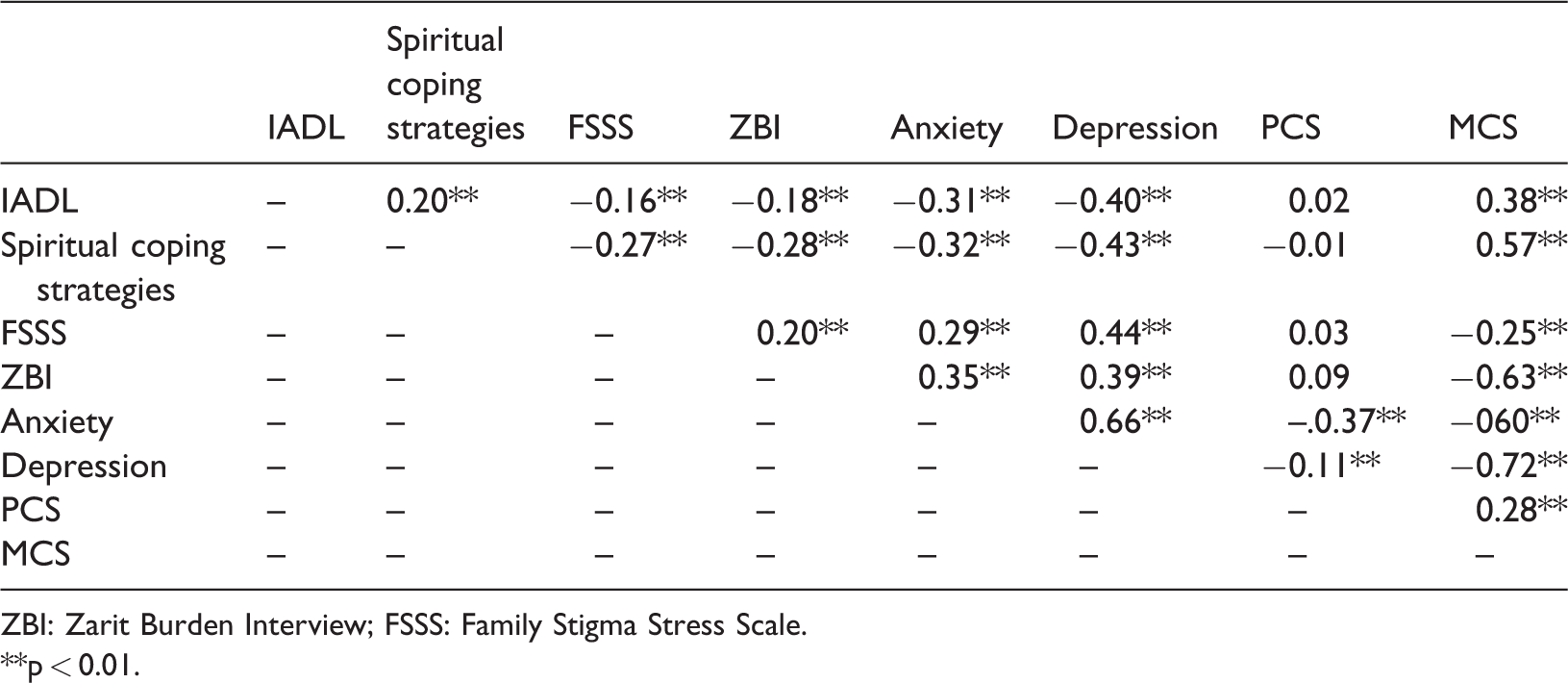
ZBI: Zarit Burden Interview; FSSS: Family Stigma Stress Scale.
**p < 0.01.
The results of the serial mediation analyses are displayed in Figure 1 and Table 3. As predicted, there was a significant indirect path from patient IADL to caregiver ZBI through SCS (b = –0.54, 95% CI [–0.84, –0.30], CS = –0.08). The indirect path from patient IADL to caregiver ZBI through both SCS and FSSS was also significant (b = –0.07, 95% CI [–0.15, –0.03], CS = –0.05). This model explained 26% of the variance (adjusted R-squared) in ZBI. To ensure that the order of mediation in the models could not be substituted, the model was also tested with mediators reversed. The results did not show an indirect path from patient IADL to caregiver ZBI through FSSS and SCS (b = –0.001, 95% CI [–0.013, 0.01], CS = –0.001).
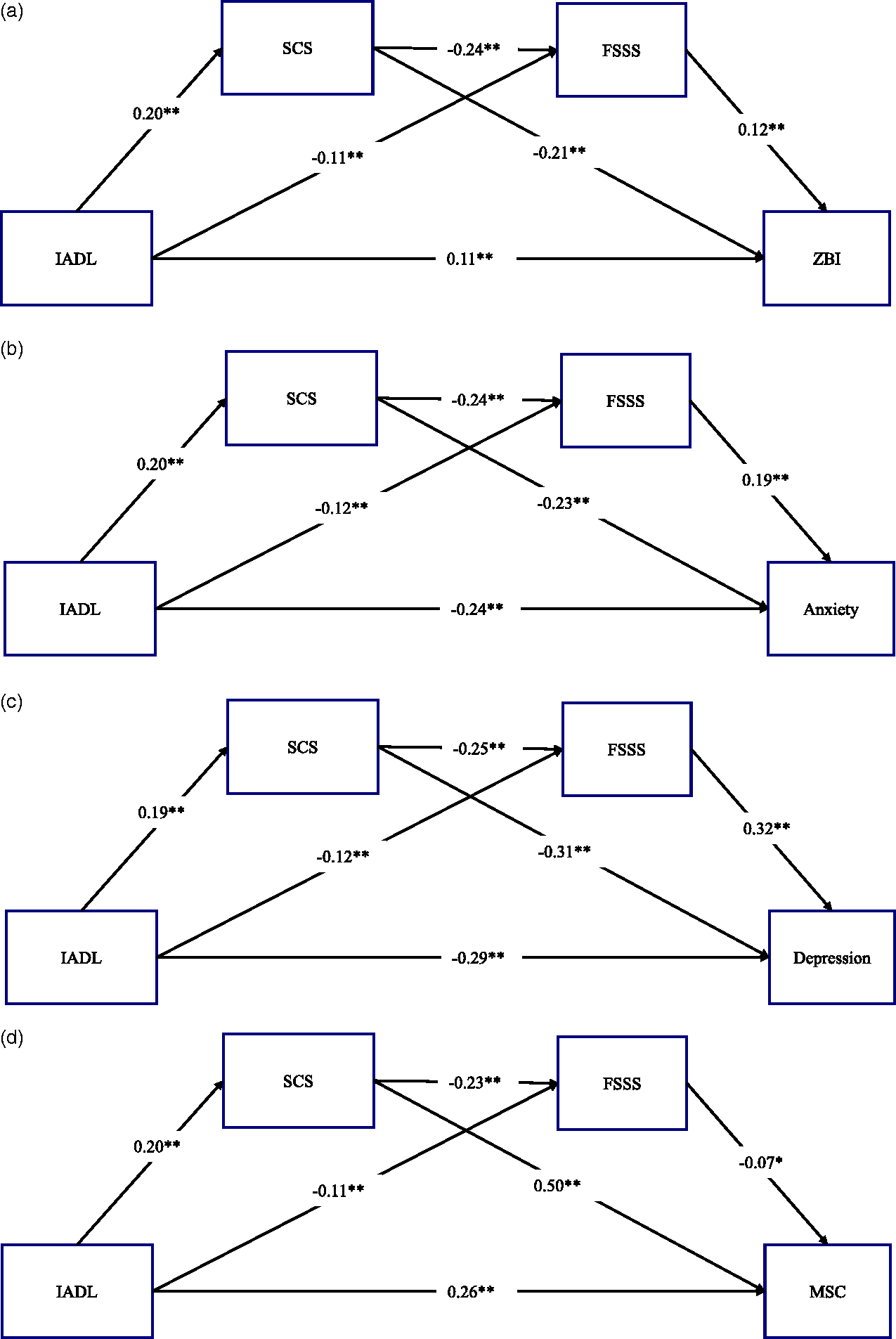
(a) Serial multiple mediation model with spiritual coping and family stigma stress as proposed mediators of the effect of functional status on caregiver’s burden. **p<0.001, controlling for age, sex and hours per week of care. (b) Serial multiple mediation model with spiritual coping and family stigma stress as proposed mediators of the effect of functional status on caregiver anxiety. **p<0.001, controlling for age, sex and hours per week of care. (c) The serial multiple mediation model with spiritual coping scale family stigma stress as proposed mediators of the effect of functional status on caregiver’s depression. **p<0.001, controlling for age, sex and hours per week of care. (d) The serial multiple mediation model with spiritual coping scale family stigma stress as proposed mediators of the effect of functional status on caregiver’s mental functioning. **p<0.001, controlling for age, sex and hours per week of care.
Models of the effect of patient’s activities of daily livings on caregiving burden and mental health with mediators of spiritual coping strategies and family stigma stress.
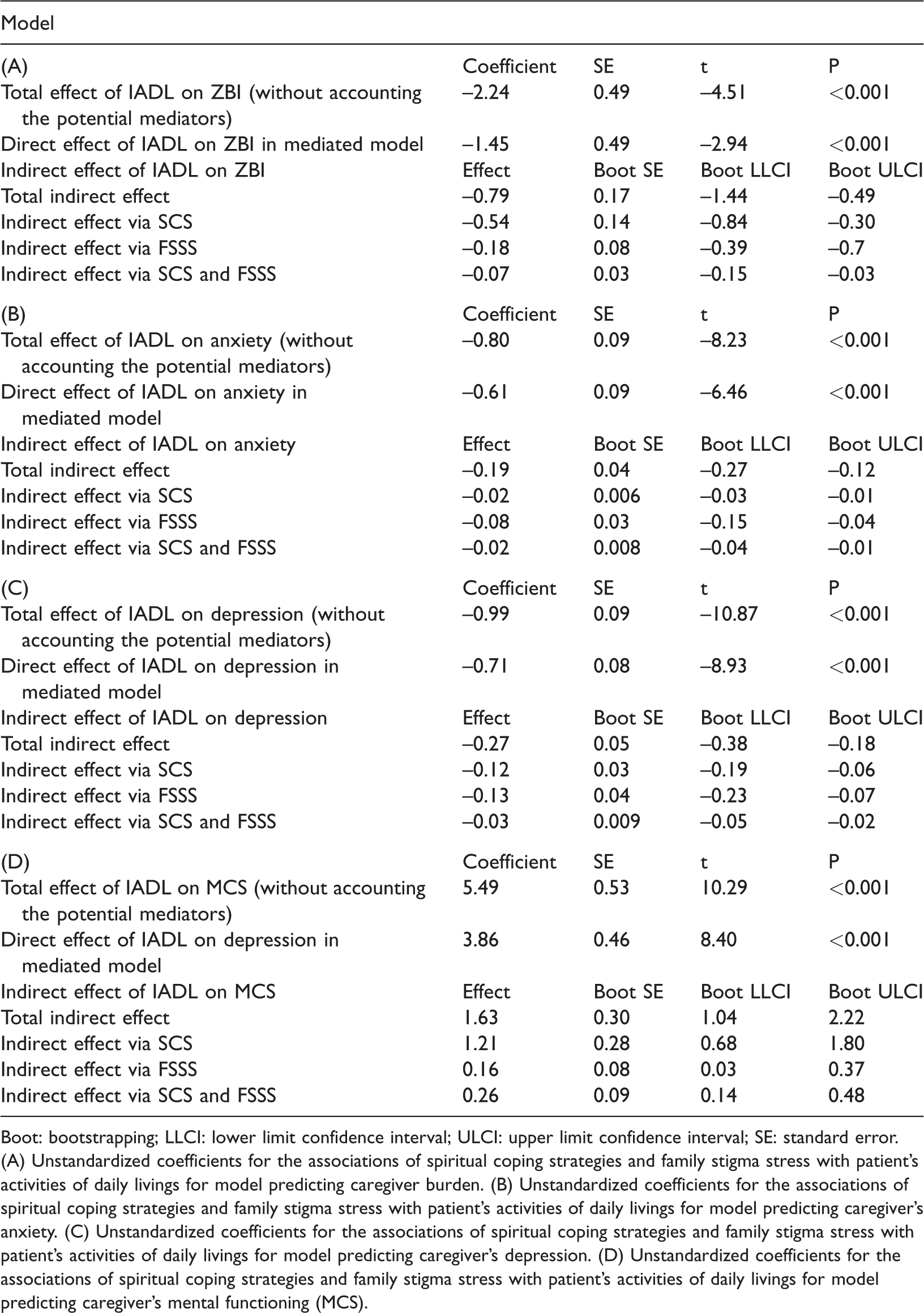
Boot: bootstrapping; LLCI: lower limit confidence interval; ULCI: upper limit confidence interval; SE: standard error.
(A) Unstandardized coefficients for the associations of spiritual coping strategies and family stigma stress with patient’s activities of daily livings for model predicting caregiver burden. (B) Unstandardized coefficients for the associations of spiritual coping strategies and family stigma stress with patient’s activities of daily livings for model predicting caregiver’s anxiety. (C) Unstandardized coefficients for the associations of spiritual coping strategies and family stigma stress with patient’s activities of daily livings for model predicting caregiver’s depression. (D) Unstandardized coefficients for the associations of spiritual coping strategies and family stigma stress with patient’s activities of daily livings for model predicting caregiver’s mental functioning (MCS).
In the next model (Table 3, Model B, Figure 1(b)), the indirect effect of IADL to anxiety through SCS and FSSS was examined. There was a mediation effect of SCS and FSSS on anxiety (b = –0.02, 95% CI [–0.04, 0.01], CS = –0.05). The model explained 41% of the variance in anxiety. Reversing the order of the mediators resulted in non-significant mediation (b = –0.0009, 95% CI [–0.003, 0.01], CS = –0.0001).
In the third model (Table 3, Model C, Figure 1(c)), the sequential mediation of SCS and FSSS in the relationship between IADL and depression was tested. Results indicated that the association between IADL and depression was sequentially mediated by SCS and FSSS (b = –0.03, 95% CI [–0.05, 0.02], CS = –0.07). This model explained 49% of the variance in depression. The model was then tested again after the order of mediators was reversed. The results did not yield a statistically significant mediation for FSSS and SCS in the relationship between patient IADL and caregiver depression (b = –0.0013, 95% CI [–0.008, 0.019], CS = –0.0001).
The final model examined SCS and FSSS as sequential mediators of the relationship between IADL and the mental health component of QOL (assessed by MCS). The overall model was significant and explained 52% of the variance in MCS. The indirect influence of IADL on MCS was significant via SCS and FSSS (b = 0.26, 95% CI [0.14, 0.48], CS = 0.14). The results after reversing the order of mediators (i.e. FSSS to SCS) indicated that FSSS and SCS did not have an indirect effect on the relationship between IADL and MCS (b = 0.007, 95% CI [–0.011, 0.018], CS = 0.0003).
Discussion
This study explored the associations between the functional status (IADL) of persons with dementia as an independent risk factor for the development of caregiver burden, psychological distress, and quality of life, specifically the mental health component. In particular, we examined the indirect effects of IADL of persons with dementia on health outcomes in caregivers via mediators such as SC and family stigma related stress. We found these mediators played a considerable role in the indirect associations between patient IADL and caregiver mental health outcomes. The sequential order of the mediators was also found to be important, with SC as the primary mediator.
Several studies have sought to identify associations between ADL of persons with dementia and caregiver outcomes such as quality of life, psychological distress, and caregiver burdens. For example, a study of 234 caregivers of persons with dementia found that ADL impairment was strongly correlated with caregiver burden, depression, and sense of captivity (Fauth, Femia, & Zarit, 2016). Likewise, in a study conducted in Korea, greater ADL impairment in persons with dementia predicted higher depressive symptoms in family caregivers (Lee et al., 2017). In a cohort study with a 2-year follow up, 181 spousal caregivers without clinical anxiety or depression were assessed at baseline. At the end of the follow-up period, nearly 60% of subjects indicated some level of significant depression or anxiety, and this was related to severity of patient ADL impairment (Joling et al., 2015). Increases in caregiver burden and psychological symptoms overtime have been associated with severity of IADL impairment in other studies as well (Dawood, 2016; Razani et al., 2014). However, few studies have sought to identify mediators of the relationship between the physical functioning of persons with dementia and caregiver burden, psychological distress, and quality of life (Liu & Huang, 2018; McLennon, Habermann, & Rice, 2011). To our knowledge, this is the first study with a longitudinal design to examine the mediation effects of SC and family stigma-related stress on the mental health of caregivers. In a study examining mediation effect of coping strategies on the correlation between care-recipient nursing care level and caregiver mental well-being, researchers determined that quality of life may be mediated by coping strategies; caregivers with better coping strategies had higher levels of quality of life and lower psychological strain. In contrast, those who used dysfunctional coping methods scored higher on depressive symptoms (Roche, Croot, MacCann, Cramer, & Diehl-Schmid, 2015). D'Onofrio et al. performed a causal mediation analysis to investigate the relationship between functional impairment and neuropsychiatric symptoms in caregivers of persons with dementia. They found that the clinical dementia rating was a significant mediator of the relationship between patient ADL impairment and caregiver agitation or aggression (D'Onofrio et al., 2012).
In the current study, the roles of SC and family stigma stress as mediators of the relationship between patient ADLs and caregiver psychological outcomes were examined. The choice of these two mediators was based on two theoretical paradigms: (1) the use of SC when dealing with difficult situations (e.g. severe ADL impairment in persons with dementia) may reduce the negative impact that such situations have on the mental health of caregivers, and (2) family members of those with severe physical impairments (here, the inability to conduct IADLs) may experience higher levels of stress due to their stigmatization by others. Our findings are consistent with these two underlying theoretical paradigms.
In a study conducted by Glueckauf et al. that examined spiritual counseling for rural caregivers of persons with dementia, this intervention produced a reduction in the caregiving difficulties and improvement in depression (Glueckauf et al., 2009). The mediating role of anger in the association between spiritual meaning and depression has also been investigated, where the authors found that SC may help caregivers to find caregiving as meaningful and in this way reduce the stress related to dealing with behavioral problems in persons with dementia (Marquez-Gonzalez, Lopez, Romero-Moreno, & Losada, 2012).
With regard to the role of stigmatization in the development of caregiver stress, a recent study reported that expressed emotions by the caregivers may partially mediate the link between stigma and HRQoL. The investigators also found that greater stigma among caregivers was strongly associated with emotional overload and poor HRQoL (Weisman de Mamani et al., 2017). These findings together with our findings indicate that perception of social stigma by caregivers should be considered a serious problem that may adversely affect caregiver mental health. In the psychometric evaluation of the Affiliate Stigma Scale, developers found that a specific part of the scale was related to behavioral problems in persons with dementia. This may help to explain why we found that ADL impairments in persons with dementia were associated with greater stigmatization in caregivers leading to greater mental distress. The relationships between scores on this scale in that study and caregiving burden, depression and anxiety were also all significant (Chang et al., 2016).
One important finding in the present study was the sequential order of the mediators examined. Among the models tested in this analysis, only those where SC was positioned before stigma-related stress showed significant indirect effects. To our knowledge, this is the first time that these mediators have been sequentially examined between patient ADL impairment and caregiver mental health. These findings indicate that there is a directional association between these two mediators, such that SC may reduce family stigma-related stress, which may then improve the psychological health of caregivers. This finding is consistent with previous studies reporting that spirituality may reduce the stress of difficult life situations (Lekhak et al., 2014; Philips & Lazenby, 2013).
Limitations
Several limitations affect the generalizability of the results reported here. First, participants were a convenience sample of persons with dementia and their caregivers referred to the Iranian Alzheimer’s Association. Therefore, our findings may not generalize to those who might not have been referred, since these individuals may be different in terms of severity of functional impairment, need for caregiver assistance, and use of healthcare services. Second, baseline measures of caregiver mental health were not assessed or controlled for in the analyses. Third, to definitively determine a causal relationship between study variables, an experimental design is needed. Therefore, the directional effects of the mediators assessed in this study cannot be established. Finally, there are other psychological variables such as self-esteem, self-concept, and self-efficacy that our mediators may indirectly impact as well, although due to considerations of time and study budget, we omitted these outcomes.
Conclusion
Spiritual coping and stigma-related stress were found to mediate the relationship between IADL impairment of persons with dementia and the mental health and quality of life of their caregivers. Based on these results (particularly if replicated in future studies), health professionals and healthcare policy makers should consider including these mediators in programs developed to improve the mental health of family members caring for persons with dementia. We also found that SC preceded the reduction in stigma-related stress in their mediating role between IADL impairment of persons with dementia and a reduction in caregiver anxiety, depression, caregiver burden, and poor quality of life. Intervention studies are needed to determine the causal direction of these associations. In addition, future studies should consider measuring a wider range of both caregiver characteristics and those of persons with dementia to provide a more comprehensive picture of how the physical functioning of persons with dementia affects the mental health of caregivers through SC and family stigmatization. Nevertheless, sufficient information is now available to support the inclusion of SC strategies in the education of family caregivers to help them deal with the stress of caregiving in Iran.
Footnotes
Acknowledgements
We express appreciation to the Iranian Alzheimer’s Association (IAA) chief manager and administrative personnel who supported our data collection.
Declaration of conflicting interests
The author(s) declared no potential conflicts of interest with respect to the research, authorship, and/or publication of this article.
Funding
The author(s) disclosed receipt of the following financial support for the research, authorship, and/or publication of this article: The authors would also like to thank the research deputy of Qazvin University of Medical Sciences for financial and technical support.