




Abstract

Summary
Younger people living with dementia have been actively engaged in challenging society’s attitude to dementia. Despite their increased visibility though, there are substantial obstacles for younger people living with dementia in receiving a timely and accurate diagnosis and gaining access to appropriate support. Keith Oliver has been an active member of the Patient and Public Involvement Forum for the Angela Project, an Alzheimer’s Society funded project aimed at improving accuracy of diagnosis and post-diagnostic support for younger people living with dementia. In this article, Keith shares his experience of receiving a diagnosis of dementia and how he has since been involved in research projects, highlighting the benefits of Patient and Public Involvement for both the person living with dementia, as well as for the research group. Keith concludes by encouraging better Patient and Public Involvement practice in all projects, emphasising the benefits to all those involved in research.
Background
Whilst the most important risk factor for developing dementia is age (Launer et al., 1999), some individuals develop the symptoms of dementia during their working life, and before the age of 65. This is most commonly referred to as young onset dementia (YOD), and it is estimated that there are 42,325 people living with YOD in the UK, with these figures expected to rise to 50,401 by 2025 (Alzheimer’s Society, 2014; Carter, Oyebode, & Koopmans, 2018).
Younger people living with dementia have been active in challenging society’s attitude to dementia. Despite their increased visibility, there are significant challenges for younger people living with dementia in receiving a timely and accurate diagnosis and gaining access to appropriate support (Carter et al., 2018).
Evidence demonstrates that people living with YOD can experience substantial delays in diagnosis (Svanberg, Spector, & Stott, 2011; van Vliet et al., 2013), and lack in age- and needs-appropriate post-diagnostic support (Allen, Oyebode, & Allen, 2009; Rodda & Carter, 2016) – these factors can have severe impact on the lives of those living with YOD and their families. The Angela Project, funded by the Alzheimer’s Society, aims to address these issues by:
Providing guidance for improving the accuracy of clinical diagnosis in YOD and; Providing guidance that will enable commissioners and service providers to facilitate improvements in post-diagnostic care and support (see Figure 1 for a summary; see Stamou et al., 2018).
The Angela Project team has actively and consistently sought to include the ‘voice’ of the younger person with dementia and informal carers in their study design from its conception through to data collection and analysis and has achieved this through The Angela Project’s Public and Patient Involvement bi-annual forum. Co-designing and co-researching together with people with dementia has been integral to the project. In particular, ensuring that each member’s comments and contributions are valued is a key priority to the research team. Whilst the format of co-researching with the Patient and Public Involvement group has depended on group members’ personal abilities, all aspects of The CO-researcher INvolvement and Engagement in Dementia Model (COINED) apart from collecting data, have been adopted throughout our Patient and Public Involvement forum meetings and communication (Swarbrick, Doors, Scottish Dementia Working Group EDUCATE, Davis, & Keady, 2019).
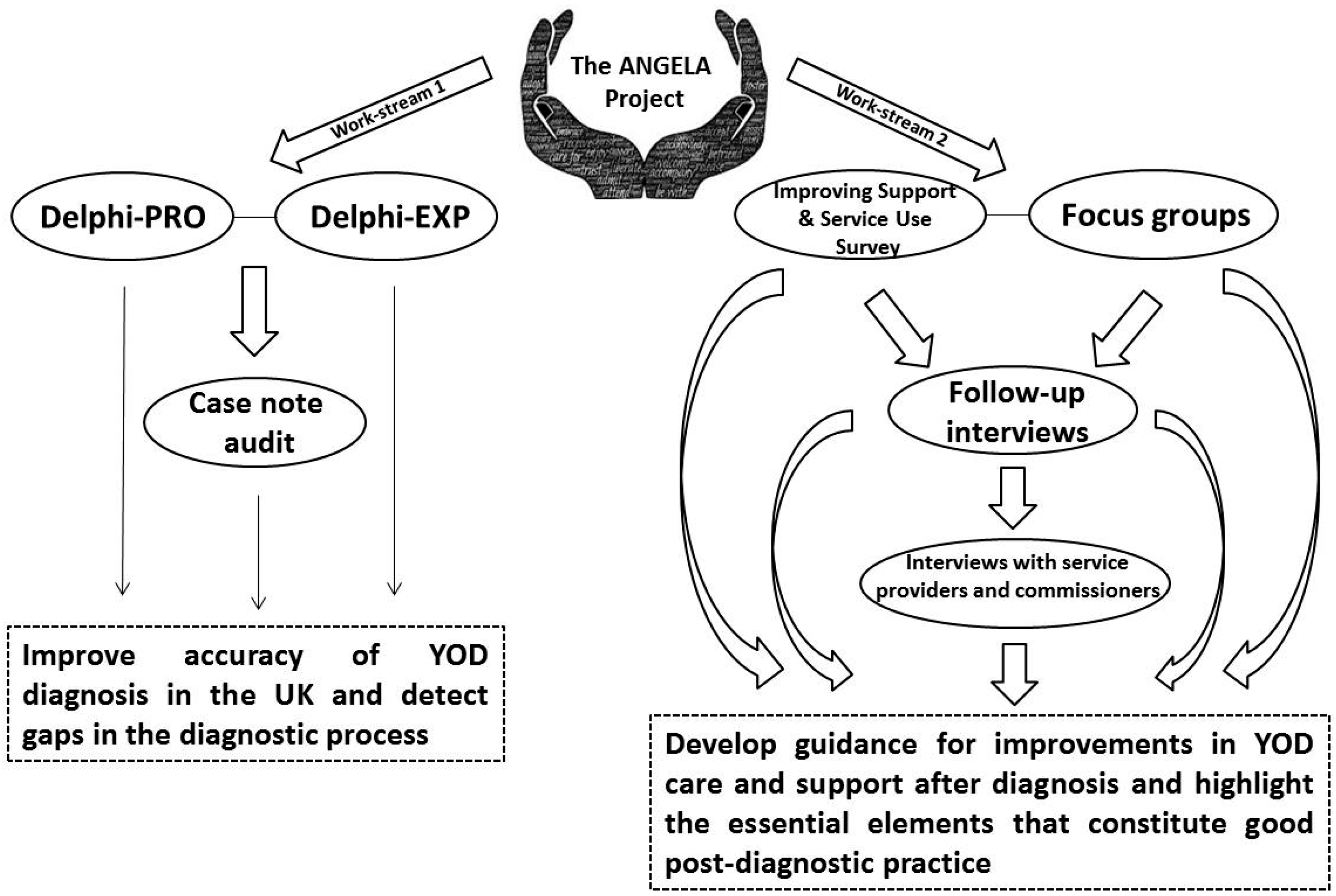
Flowchart reproduced from Stamou et al. (2018), presenting the research activities of the two work-streams of the Angela Project.
We have all been inspired by our Public and Patient Involvement Forum members in steering dementia care within the UK. At the same time as supporting the Angela Project as a Patient and Public Involvement Forum member, Keith Oliver, has helped re-write the dementia ‘we statements’ (Dementia Action Alliance, 2017). At the 2018 Alzheimer’s Disease International conference in Chicago, Keith used them as focus for a presentation titled “We have the right to know about and decide if we want to be involved in research that looks at cause, cure and care for dementia.”
The Angela Project Patient and Public Involvement Forum invited Keith, a retired head teacher who is living with YOD, to share his experiences of living with dementia, his involvement in the Angela Project, and insights for Patient and Public Involvement in future dementia projects.
About me
For 33 years, I worked as a primary school teacher and head teacher in Canterbury, Kent (UK). My career came to a close with a diagnosis of Alzheimer’s disease in April 2011. I was aged 55. My mother was living with Alzheimer’s disease at that time and was in her late seventies, which is where I thought Alzheimer’s was placed. I had never met anyone who was diagnosed with dementia and in their fifties.
Whilst the number of people living with younger onset compared to later onset is small, the impact that dementia has on younger people is immensely significant. Compared with older adults, younger people with dementia may still be in full-time work when diagnosed, have young children who require financial support, and may not have access to age-appropriate services to support them and their families post-diagnosis.
There is an estimated 42,000 people living with YOD (this refers to anyone below the age of 65) in the UK. I would actually suggest that this is smaller than reality; and as the 65 years threshold becomes arbitrary due to rising retirement age, the numbers are going to grow significantly. I remember thinking soon after diagnosis that my useful life was over. During that period shortly after my diagnosis I did nothing, other than sitting around and watching television. I received no help or advice from professionals, other than two short meetings which bought together eight couples living with YOD. These sessions introduced me to other people with YOD for the very first time – before which I thought I was alone. The group then was a springboard with third sector support to establish a monthly Dementia Café, which my wife and I attended for five years.
Involvement and experiences
From early 2017, I was delighted to be involved in the Patient and Public Involvement forum for the Angela Project, a three-year Alzheimer’s Society funded project aimed at improving the accuracy of clinical diagnosis and post-diagnostic support for younger people living with dementia. To improve clinical diagnosis, the research team reviewed the existing research evidence and using a Delphi approach, gathered the opinions of clinical experts in diagnosing dementia in younger people, as well as the views of younger people and their supporters on their experiences of the diagnostic process to develop a gold standard for diagnosis of YOD. Subsequently, the team audited a sample of clinical case notes from younger people diagnosed with dementia to ascertain how they compare to the gold standard that had been developed.
To inform improved post-diagnostic support, the team has also conducted a national survey, interviews and focus groups of younger people living with dementia and family supporters. Here, the team was specifically interested in collecting data on service use and satisfaction, family support, and examples of good practice of post-diagnostic care and support from younger people living with dementia and their families. The team will also be interviewing providers and commissioners of onset dementia services across the UK, to ascertain what the barriers are to delivering good young onset-specific services, and what would help them provide improved services (see Stamou et al., 2018 for the study protocol). Ultimately, the intention is to produce clinical guidelines, which will improve accuracy of diagnosis, and which will inform appropriate post-diagnostic care.
What motivates me to be involved in this research project?
Although I felt well supported both professionally and by my wife during my diagnosis, I know too well this is not always the case for others. I was lucky, because the neurologist accurately and speedily identified the link between my scans, tests, our conversations and my lived behaviour that enabled him to be open and direct in explaining his suggested diagnosis, and then to relatively rapidly refer me to the memory clinic. The clinical psychologist, her assistant and the consultant psychiatrist worked closely together over a three-month period in taking my investigation further with a wide range of in depth assessments all of which I tried hard to score highly on, but which resulted in being placed in at times the lowest 5% centile. All the assessments were marked and explained to me as we proceeded. By using my case study within a research project, I feel that others can benefit from my experience.
Once the diagnosis was confirmed at the Memory Clinic on New Year’s Eve 2010 then the positive picture for me begins to be less clearly focused. There was a three-month gap when I was offered nothing after the confirmed diagnosis. No care plan was generated, which in my view should have been and which could usefully have picked up on what was an excellent report to conclude the diagnostic period. This remained a largely wasted resource until two or three years later. I was offered no Cognitive Stimulation Therapy or similar support, and a dreadful three months of not knowing what to do created a vacuum, largely filled by myself beginning to discover what having dementia may entail and ways to begin to live with it as well as possible.
I think it took me over a year to regain some equilibrium and begin to move forward after the diagnosis. There was a distinct lack of post-diagnostic support, beyond the two afternoons of a living well course and my monthly meetings. These began four months after diagnosis with a consultant psychologist who wished to begin a collaboration of professional and service user within our mental health trust. He encouraged me to read about dementia and visit more websites, one of which was the Alzheimer’s Society, and it was there that I discovered their research network which I joined as a volunteer in 2012.
For me, research must address a need, and clearly the Angela Project sought to do so. The Angela Project focuses on the need for improvements to the diagnostic process and post-diagnostic support for those living with YOD, by focusing on experiences of the processes by people living with YOD.
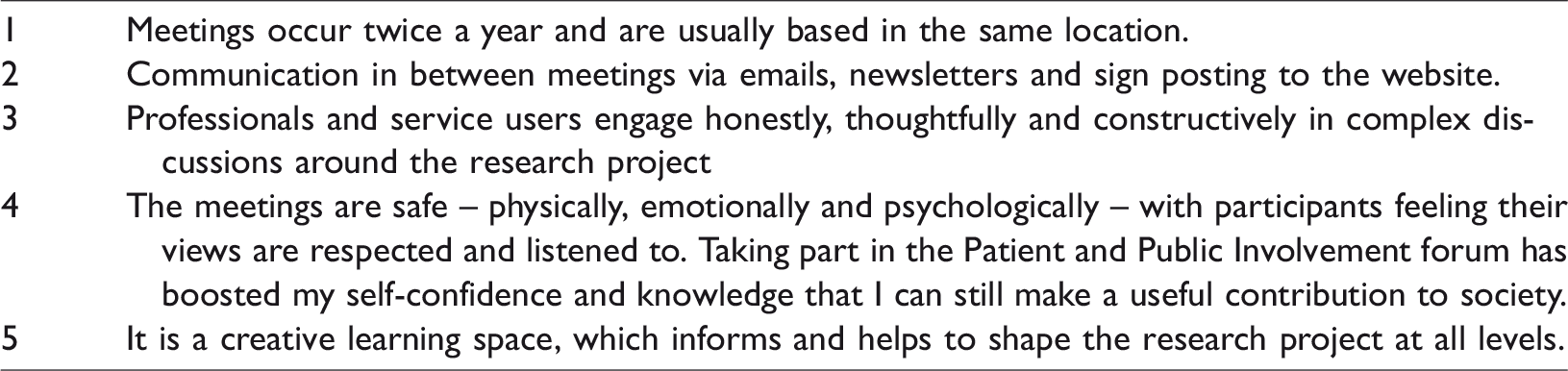
Although I am an enthusiastic member of the Alzheimer’s Society Research Network, and have served on the Care, Public Services and Public Health Grant advisory panel and board, I do not take on deeper involvement in funded projects unless I feel a passionate interest in the subject. With the Angela Project, I was attracted by the research project’s aims and objectives, the joint expectations of the research team and mine, and the location which, being in London, was accessible to me and my wife as my supporter. Public and Patient Involvement for the Angela Project is a very positive experience for all involved and I would like to highlight some aspects which I feel contribute to making the meetings positive and enjoyable (see Table 1):
Aspects of the Angela Project PPI Meeting which I feel contribute to making the meetings positive and enjoyable.
During the design stages, myself and the other Patient and Public Involvement forum members gave feedback on initial drafts of questionnaires, surveys, and also the interview schedules. We provided the team with valuable insights into which aspects of the study are well formulated, and those which may require further refinement. In these cases, we gave suggestions on our preferences and what we felt would work best. This provides the research team with that reassurance and confidence that what they have produced works well when working with people affected by dementia. As a consequence of our input, the research team has made significant changes in aspects of the project design and many suggestions were incorporated into a new methodology.
What I get out of being a Patient and Public Involvement forum member in the Angela Project?
It has been immensely rewarding being a Patient and Public Involvement forum member of this project and I feel privileged to witness its development from the beginning. I have great respect for the researchers, some of whom I knew prior to the project and some I have met since. I feel well informed and like fellow lay members feel treated on a par with professionals in the group. After a life time of professional public service, the Angela Project enables me to feel that I am retaining that element of my personhood, something which I feared dementia would rob me of when I was diagnosed.
Using my experience of the Angela Project to reflect upon my broader involvements in dementia research, I have become more discerning in where I focus my energy, time and commitment. All projects are now for me measured against this one and another brilliant project (IDEAL based at Exeter University) for which I serve on the Advisory Group. Both these projects understand the value of genuine Patient and Public Involvement and ensure the voice of the lived experience is heard loud and clear alongside the professional.
Advice for people living with dementia considering supporting future projects
The research community needs more people living with dementia to step forward, so I would 100% recommend that those interested take the next step and find out more about the UK-based Join Dementia Research (see: https://www.joindementiaresearch.nihr.ac.uk/), and look at the websites of the Alzheimer’s Society (see: https://www.alzheimers.org.uk/) and Alzheimer’s Research UK (see: https://www.alzheimersresearchuk.org/). Following this, I would suggest exploring whether the Alzheimer’s Society Research Network is something you would wish to join (see: https://www.alzheimers.org.uk/research/play-your-part-research/our-research-network-volunteers).
Advice for dementia researchers
Although becoming less significant there is still a sense in some areas that Patient and Public Involvement is a necessary chore and a bolt on. This is fundamentally wrong. Patient and Public Involvement must be at the centre of all dementia projects, and our partnership and engagement needs encouragement and support for it to be effective. If it is effective, then the Angela Project goes some way to show just how powerful a positive aspect it can be to a project.
I would like to finish by emphasizing one of the dementia “we” statements that I had the privilege of using as a basis for my presentation at the ADI conference in 2018: ‘We have the right to know about and decide if we want to be involved in research that looks at cause, cure and care for dementia and be supported to take part’ (Dementia Action Alliance, 2017). I look forward to the day when projects have Patient and Public Involvement on the first page not the last of their proposal and the project is co-produced by professionals and those living with dementia.
Conclusion
Without question, dementia research is on an upward trajectory, but compared to other significant health issues this is from a low starting point. This does, though, give us opportunity as well as challenge and I hope that by reading this article it will steer readers to want to find out more about the Angela Project and to consider how they too can help encourage better Patient and Public Involvement practice in all projects. The potential benefits to all are clear and if realised, will make tomorrow better than today for everyone living with dementia and helping to care for us either professionally or within our home lives.
Footnotes
Acknowledgements
We would like to thank Lucy Jobbins and Shelby Fitzgerald for supporting Keith Oliver when writing the article. We would also like to thank Dementia UK who have helped us host the Patient and Public Involvement meetings for the Angela Project and the Alzheimer’s Society for funding this project.
Declaration of Conflicting Interests
The author(s) declared no potential conflicts of interest with respect to the research, authorship, and/or publication of this article.
Funding
The author(s) received no financial support for the research, authorship, and/or publication of this article.