



Abstract
The purpose of this study is to describe and discuss the art experience of persons with dementia taking part in guided museum tours at a Norwegian art museum. The analysis is based on semi-structured open-ended interviews with participants and researcher field notes. The results demonstrate the capacity and willingness of persons with dementia to reach out and connect on a personal level with the artworks. We identified four experiential dimensions: (1) a new way of seeing, (2) being lifted out of everyday life, (3) activating emotional and bodily responses and (4) connecting art and life. Our findings draw attention to the existential dimensions of the art experience and show that dementia-friendly programmes can offer individuals with dementia a way to stay connected both to themselves and to the wider community through active participation in a cultural discourse. This is the first research study conducted in this emerging field in a Norwegian context.
Introduction
There is growing recognition of the role art museums might play in fostering health and well-being for persons with dementia. Research suggests that art museum programmes may potentially improve a range of health-related outcomes such as episodic memory and verbal fluency (Eekelaar et al., 2012), enhanced memory (Camic et al., 2014), improvements in subjective well-being (Johnson et al., 2015), self-rated quality of life (Schall et al., 2018), sustained engagement (Hazzan et al., 2016; MacPherson et al., 2009) and attentiveness (McGuigan et al., 2015). Studies that favour a predominantly qualitative approach to access the subjective experience in art museums of participants with dementia highlight the positive opportunities for social connectedness, boosting their self-esteem (Flatt et al., 2015) and strengthening their personhood (Burnside et al., 2017; McGuigan et al., 2015). The studies above are small in scale and do not report changes over time, but as argued by MacPherson et al. (2009), the programmes might be considered worthwhile due to their ‘in-the-moment’ benefits in terms of the well-being of persons with dementia.
There is a debate in the literature regarding the strengths and limitations of the different methodological frameworks used in assessing arts-based activities for persons with dementia, but research aiming at objective measurements using standardised scales seems to be the dominant approach. As noted in an article by Bellass et al. (2018), this might be a consequence of the push towards strengthening the evidence for the effectiveness of arts-based activities on health.
de Medeiros and Basting (2013), however, argue that objective measures and standardised scales from the health research discourse might not be the best approach for evaluating arts-based activities. They argue that we need to rethink how we evaluate arts-based activities since the strengths of these activities are that they can boost confidence, strengthen the personality and open up for transformative experiences. Processes such as these, they claim, are difficult to measure with standardised scales (de Medeiros & Basting, 2013). Gray et al. (2018) add to this by claiming that the focus on health-related outcomes has meant that the ‘assessment of artistic quality, aesthetic experience, cultural contributions, process, social impact and economic value appear rare in the arts and dementia literature’ (p. 776).
The present study adds to this latter strand of the literature by describing and discussing the art experience of persons with dementia taking part in an art appreciation programme at an art museum in Norway. The term ‘art experience’ in this context is understood as the participant’s engagement with the artworks. The study’s research question is: How do persons with dementia experience visual art in an art appreciation programme at a local museum?
The National Museum in Oslo launched a monthly art discussion programme for persons with dementia in 2010. The KODE Art Museums and Composer Homes in Bergen launched its programme in 2015. This study examines the programme at KODE. This is the first research study in this field in Norway. The current study is an addition to the growing body of literature that highlights the potential creative capacity of persons with dementia. The project is conducted in a Norwegian context, but the art experiences of persons with dementia taking part in a museum programme is equally relevant to researchers and practitioners in other countries.
Theoretical framework
Our perspective on dementia takes its bearings from researchers who look at dementia not just as a medical condition, but as a complex condition where the individual experience of living with dementia is embedded in a web of interdependencies with other people and the wider political and cultural context in which the individual lives (Bartlett & O’Connor, 2007; Basting, 2009; Hughes, 2001, 2009; Hydén et al., 2014; Kitwood, 1997; Kontos et al., 2016; Sabat, 2002; Sabat et al., 2004; Zeilig, 2014, 2015). Viewing dementia as a complex condition means thinking about it not just as a disease of the brain, but also as a relational, cultural and social phenomenon, that shapes how it is to live with dementia. We agree with Julian Hughes (2014), who argues that a primary focus on cognitive abilities risks losing sight of the broad view of what it is to be human. Hughes represents a strand of research challenging the dominant narrative of dementia, according to which dementia is understood solely as a biomedical illness. Hughes and others argue that this narrow focus contributes to thinking of a dementia as a disease that erodes a person’s sense of self and personhood (Kitwood, 1997; Sabat, 2002; Whitehouse & George, 2008), leaving the body as an ‘empty shell’ (Hydén & Antelius, 2017, p. 7). In this tragedy myth, the person is fated to the status of what the philosopher Hilde Lindemann calls a ‘nonperson’ (Lindemann, 2014, p. 18). Such negative perceptions fuels conceptions of a person with dementia as ‘doomed’, or ‘socially dead’ (Dupuis et al., 2016, p. 358) and ‘fading away’ (Whitehouse & George, 2008, p. 22). We think it is important to challenge this way of thinking because it influences how we interact with and care for persons with dementia. It increases the risk of aggravating their living conditions (Hughes, 2014, p. 10; Kitwood, 1997; Sabat, 2002; Whitehouse & George, 2008, p. 20).
In recent years, several researchers have especially highlighted the need to understand dementia in relation to the concept of citizenship (Bartlett, 2016; Bartlett & O’Conner, 2007; Kontos et al., 2016). While citizenship is a concept that is mainly associated with political, social and civil rights, and the involvement of individuals in the shaping of laws (Stevenson, 2001), the literature on citizenship and dementia, however, is more inclined to address a social model of citizenship (Bartlett & O’Conner, 2010). Of particular interest to this study is the notion of cultural citizenship. In his understanding of cultural citizenship, Hensbroek (2010) emphasises the need for citizens to have access to the meaning-making processes in the society and be co-producers and co-authors of the cultural contexts in which they participate (p. 322).
A need for a cultural citizenship ties into Hughes’ argument that a person with dementia should be thought of as a situated embodied agent, a person who acts and interacts in a cultural and historical context in which he or she is embedded (Hughes, 2001, 2009). Hence his or her verbal and nonverbal expressions should not only be understood in relation to the dementia illness. They are a consequence of the person’s previous experiences and interactions with people, places and the artefacts in the present situation. Thus, to understand the art experience of persons with dementia in an art museum, it is important to take into account the museum space, the artworks, the pedagogical practice and the relational dynamics between the people in the museum. Due to the limited scope of this article, it is not possible to address all of these aspects. Herein, we primarily focus on how the participants engage with the artworks.
In our analysis of the persons with dementia’s engagement with the art, we draw on ideas from philosopher John Armstrong’s work on art appreciation. In his book Move Closer (Armstrong, 2000), Armstrong promotes a personal approach to art appreciation, in which the viewer’s private and individual responses are foregrounded as an important resource to gain meaningful engagement with art. By emphasising both the affective and subjective experiences, Armstrong proposes a view of art, in which there is not merely one inherent meaning to a work of art, but multiple meanings depending on the context and the viewer.
Programmes for persons with dementia in art museums
In recent years, there has been a shift in many museums around the world towards a more inclusive and participatory museum practice (Blokland, 2018; Dysthe et al., 2013; Ghaith & Gabr, 2018; Hooper-Greenhill, 2000; Simon, 2010). Yet, even though the move towards more inclusive museum practices has been on the agenda for several years in many countries, arts-based programmes for people with dementia are relatively new (Schall et al., 2018). To the best of our knowledge, the art access programme for persons with dementia at the Museum of Modern Art (MoMA), which was launched in 2007, was the first programme of its kind to be directed specifically at persons with dementia (Rosenberg, 2009). Since then, an increasing number of museums worldwide now offer similar programmes. The structure and delivery of the programmes are often only briefly mentioned in the research literature in this field, but several reference the programme structure developed by MoMA (see e.g. Burnside et al., 2017; Hazzan et al., 2016).
The art programme at KODE Art Museums and Composer Homes
A number of museums in Norway are expanding their role in society by developing programmes for persons with dementia (Folge, 2011). The National Museum in Oslo was the first art museum in Norway to offer guided tours especially for persons with dementia in 2010. The initial idea for a programme specifically towards persons with dementia at KODE Art Museum and Composer Homes (KODE) came from the project group Art and Dementia at The Dignity Centre (2015–16), a collaboration with VID Specialized University. The project group proposed to art educator Siri Breistein and KODE to develop a participatory art programme for persons with dementia living at home. The rationale behind this was that the existing programme for seniors at the museum did not include this particular audience group. The dementia-friendly programme launched in 2015.
In front of each artwork, the art educators would invite the participants to look at the art in silence for a minute. They were told to use their eyes and scan the surface of the painting. The questions asked by the art educators were typically open questions like ‘What do you see?’, ‘What do you think is going on?’ and ‘If you were there, what sounds would you hear?’. These are questions with no preconceived answers. The educators encouraged participants to use their imagination and share the first thoughts and the associations that came to mind. They were reminded on several occasions that there are few right and wrong answers when it comes to art, and that everybody perceives art differently. A guided tour lasts 1 hour and is followed by a social gathering with coffee and biscuits.
Many persons with dementia struggle with loss and grief and fear social rejection (Desai et al., 2016). To create a safe space for the participants, where they could feel free to share their ideas and opinions was therefore a high priority for the art educators.
The programme is still running once a month. Today, it is part of ‘KODE Open’, a series of customised programmes and offers at the museum aiming to reach new audience groups.
The artworks
The artworks in this study are oil paintings from the end of 18th century and beginning of 19th century by the Norwegian artist Edvard Munch (1863–1944). The topic of the guided tours was ‘Feelings and Edvard Munch’. In many of the chosen paintings, ambiguous characters are engaged in an activity. The viewer is confronted with a frozen moment within several possible larger stories.
Method
Recruiting participants
We adopted a purposive sampling strategy (Patton, 2015) and invited one volunteer organisation and two day-care facilities to take part. The first author visited the two day-care facilities to explain the project to the staff. Persons living at home, with preserved language ability and who qualified to receive dementia care services were invited. We did not collect information about medication or MMSE scores, since this was not considered relevant to the aim and objectives of the study. Potential participants were selected by the management at the facilities and by the volunteer group leader. They were told that the programme was not directed at people with prior experience in art. As a result, the participants comprised both of people with experience in art and of people who had never been to an art museum. Participation in the research was not required for taking part in the art programme. The entrance to the museum was free of charge.
Data construction
The data set comprises 25 interviews with 22 persons with dementia or dementia-related symptoms, 1 the majority of the person with a diagnosis had early onset Alzheimer. In addition, we interviewed four care workers, four volunteers and one of the art educators. The data set also includes field notes by the first author (descriptions of interactions, body language, dialogues and other relevant details) and one of the art educator’s written reflections on her own practice (intentions and reflections on the delivery of the programme and interpersonal relations). The field notes were used as background information prior to the interviews. They were also used in the analysis to expand on the themes constructed from the interviews with the participants with dementia.
The data set used in this article is an extract from a larger data corpus from an ethnographic case study between 2015 and 2019. Braun and Clarke (2006) describe two ways of choosing the data set within a larger corpus. The data set may consist of many, or all, of the data within the data corpus, or the data set may be identified by a particular analytic interest or topic. The latter approach was adopted in this study. Our main interest in this article is to learn more about how the persons with dementia engage with the artwork in the programme. The data set therefore comprises a selection of the interviews that are relevant to this interest. The views and opinions of the participants with dementia are our primary interest.
Individual semi-structured open ended interviews were conducted between 2015 and 2017. The participants with dementia were encouraged to ask questions and suggest other topics to talk about during the interview. Each interview was tape-recorded and lasted between 10 and 40 minutes. The files were transcribed verbatim by the authors resulting in 134 pages of single-line text. The interviews were conducted by the authors of this article and took place within 1 to 2 hours after the museum visit in familiar surroundings at the day-care facility. The interview data were collected from five different museum tours, which occurred between 2015 and 2017. Each interview started with a short summary of the museum tour while looking at photocopies of the artworks from the art museum.
The aim of the photo elicitation was to help the interviewees recall the experience in a non-intrusive way (Harper, 2002). It also helped the interviewer to adopt a conversational style and language use that most likely could help the participant with dementia to share his or her experience in the following areas: thoughts and feelings about the experience in the art museum, views and opinions on the paintings and art in general, thoughts about the delivery of the programme and the value of the group experience. While looking at the photocopies of the art, the interviewer adopted a conversational style similar to the one used by the art educators in the art museum. The length of the interview and the time spent talking about the different topics were guided by the stories told by the participants and their ability to verbally share their experience about their visit to the museum.
The care workers and volunteers mainly shared their thoughts about the art programme, the experience of those with dementia and their opinions about the value of the programme and the role of the arts in dementia care in general. The art educator talked primarily about the intention behind and the delivery of the programme.
Analysis
A thematic analysis was chosen to locate patterns of meaning within the empiric material. Braun and Clarke (2006) discriminate between a theoretical and an inductive approach to thematic analysis. Another differentiation Braun and Clarke (2006) make is between a semantic and latent approach to the coding process. Whereas a semantic approach does not look for any meaning beyond what the participants have said, a latent approach aims at identifying ideas and concepts underlying the utterances. We have adopted a semantic, theoretical approach in our analysis.
The analysis centred on several close readings of the transcripts, field notes and the art educator’s reflections. Notes and ideas were written down in a log throughout the whole analysis. Codes like ‘makes me happy’, ‘as a child’, ‘I was inside the picture’, ‘I feel it in my body’, and ‘I know that life’ were created from the interviews with the participants with dementia. From the transcripts of the interviews with the care worker and volunteers, we created codes like ‘they remember’, ‘it was like being at school’, ‘they could be themselves’, ‘I was surprised about their skills’. From the interviews with the participants with dementia, we constructed themes from the coded transcripts. Our main interest in this study is the views and opinions of the persons with dementia. The coded data material from the interviews with the care workers and volunteers, as well as the field notes and reflective notes by the art educator were not clustered in themes, but further analysed in relation to the themes constructed of the transcripts of the interviews with the persons with dementia.
The thematic approach described by Braun and Clarke (2006) is a flexible approach that allows the researcher to determine themes in a number of ways. The prevalence of a theme in this study was constructed based on how it related to the research question, not on quantifiable measures.
A potentially problematic issue with a thematic approach is the risk of losing the unity of the individual interviews. A method described in Brooks et al. (2015) to balance this is to create case summaries for each interview. The first author wrote case summaries aimed at capturing the wholeness of what was said and the context in which it was said. This allowed the voice of the person with dementia to be foregrounded during the analysis.
Strengths and limitations
There is an ongoing effort to include the voices of persons with dementia in research that concerns their own lives (Desai et al., 2016; Hydén & Antelius, 2017; Keady et al., 2017; Zeilig, Killick, & Fox, 2014). The challenge is to find the most appropriate method for each study.
Our decision to use semi-structured open-ended interviews came after conferring with the care workers. Most of the participants did recall the museum visit and shared their opinions about what they had experienced. Even though some of the participants did say directly or indirectly that they did not remember being in the museum, on several occasions the participants repeated sentences they had said in front of the artworks in the museum or referenced the museum visit in other ways, like highlighting a point made by the art educator and pointing to a detail in the painting that was much discussed in the art museum. A few times, it was unclear to the authors if the most frail of the participants, who did not seem to engage in the same way as most others, primarily talked about the photocopy of the paintings as such, and not related to the visit to the art museum.
This says something about the limitations of traditional qualitative interviews. As noted by Phillipson & Hammond (2018), semi-structured interviews with individuals living with dementia have limitations due to their reliance on abstraction, recall and verbal reporting. At the same time, it points towards the benefits of using images as a support in communication with persons with dementia. Also, assuming that persons with dementia cannot take part in an interview can be disparaging and condescending. As noted by Whitehouse & George (2008), no two illness courses are the same (p. 4). Persons with dementia are often being underestimated, assumed to have fewer abilities than they actually possess. Each interview was adapted to the person we talked to, and we paid special attention to nonverbal expressions of discomfort.
In this article, we narrow our attention on the participants who seemed to us to find joy and meaning in the encounters with the art. This might give an unbalanced impression of the overall delivery of the programme.
Ethics
The Norwegian Center for Research Data assessed the project. All the participants received tailored information about the project before informed written consent was obtained from all participants. All the participants’ names in this article are pseudonyms, and we have not included information that could indirectly or directly identify the participants.
Findings
Summarising the overall experience
The research question we posed to the material was: How do persons with dementia experience visual art in an art appreciation programme at a local museum? Before presenting our main results, we would like to contextualise our findings by highlighting a few points regarding the participants’ overall experiences. The participants were generally very attentive. Most of them looked at the art educator and the artworks throughout. They participated by responding to prompts, asking questions, talking to other participants about the art and making humorous remarks. Even though this study was not aimed at measuring possible health benefits, the participants may have improved their mood and general well-being. As in previous research, enjoyment (Burnside et al., 2017) and cognitive stimulation (Flatt et al., 2015) were also expressed by the participants in our study. Sandra, who participated twice, said: ‘Quite frankly, it makes you happy. I have been there twice. I would very much like to go again’. Regine said: ‘I was thinking to myself, I like these things, even though my head is like it is at the moment, it is invigorating’.
One woman appeared more interested in the frames than in the paintings, and one seemed to be asleep during parts of the tour. One of our respondents responded negatively to the art educator at the start of the tour. As the group were taking their seats in front of the first painting, she was reluctant to sit down. She turned her body away from the art educator and did not participate in the conversation. In the interview afterwards, she said that she was furious at the beginning of the tour. She explained:
[The art educator] apparently thought we were a little bit … that she had to talk to us like children […] But … she [the art educator] got better […] She was actually very good […]
Through the process of thematic analysis, we constructed four dimensions that relate to how the participants experienced and interacted with the artworks in the museum and in the interviews. This should not be considered a representation of the overall data set. Our main interest has been to focus our lens on the interaction with the artworks.
Dimension 1: ‘A new way of seeing’: New learning experiences about art and the self
An encounter with an artwork can be an invitation to see and experience both self and art in new ways. This topic concerns expressions relating to experiences of learning and growth.
I like to learn new things even though I am old.
Most people judge a painting by [saying] it looks nice or not, if they like it or not. That’s the most common way of judging a painting, but when we were at the museum with you, it was as if we were inside the pictures. You have to get very close and just look at it. Looking at all the little details you don’t see. You need to get inside the picture, somehow. I started understanding a bit more. Now I’m already interested in other things as well. To see other … see things with different eyes. When we see it with different eyes, when we are already there, it is already a little bit better.
It was quite frankly a fantastic experience … I’ve never seen or talked about things like this before.
I’ve never thought I could take part in anything like this. Nobody has told to me that I could just look at a painting … and see things … Never even heard about it. It didn’t even occur to us that this [the art museum] could be a place for us to be. We were too low … Art, you know, was for the highbrow people and people with money. Previously I was a bit intimidated. If I saw a big painting, I never thought it could have anything to do with me.
He has become more open after the illness occurred. He has never been into this [art] at all. Never reflected on these kinds of things. I’m fascinated, very fascinated by what the illness can do to people.
Dimension 2: Lifted out of the everyday: Forgetting oneself
A work of art is a complex construction that lends itself to a variety of experiences of affect and meaning. This topic is related to expressions relating to feelings of being immersed in the art, and to this being an experience that is different from everyday life.
Torstein, a participant and former teacher with a long-standing interest in art, enjoyed taking part in the conversations about art at the museum because, as he explained, ‘It lifts you out of the everyday’. Another participant, Mari, engaged with the art in a way that seemed to be related to this feeling of being lifted out of her everyday experience:
I felt as if the Alzheimer’s wasn’t there anymore. It wasn’t a thing for me when we were at the art museum. It felt good. I felt it in my body … this is great. I know that the Alzheimer’s will return, but right there, if someone had told me that I had Alzheimer’s, I probably would have thought they were joking with me. I would have said: Alzheimer’s? I don’t know where it is. I don’t have it anymore.
Dimension 3: Activating emotional and bodily responses
Art and emotions are closely related. Many of the participants expressed emotional and bodily responses to the artworks. Sometimes, but not always, these responses were related to prompts made by the art educator: What do you think it feels like being there? What type of smell do you think is in this room? What would you hear if you were in this garden?
John, a participant, felt like crying in front of Munch’s painting. He was surprised by his own emotional response to the artworks.
I was actually very touched by him [Edvard Munch]. It was strange, really. Is it possible, I thought? I almost cried […] that I could get so much out of a painting […]
I have been in a situation like that with a neighbour. That was the first time I saw a dead person. I feel it in my body. It is death.
Because the small things in life do not matter anymore.
Ved dødssengen (At the deathbed), Edvard, Munch, 1895 (oil and tempera on canvas).
The participant Regine’s bodily experience was not directly related to the artworks, but when talking about the overall experience, she said something important about how the experience was embodied. In the following extract, she talks about how an experience may last as a lingering sensation in the body.
I have a nice feeling in my body after the thing we have been to. You see, I can feel it. It’s like, it is not something that annoyed me, for example, it’s been something … I can’t tell you now what it was, but suddenly it might return to me, but you see, I do not feel any irritation. I’ve had a good time […] If I had not liked it, I would have felt it, and I would have said it to you. I have a nice feeling in my body without remembering what we did.
Dimension 4: Connecting art and life
This topic relates to how several of the participants intertwined the artworks with their own lives. Both in the museum and especially in the interviews, the conversations about the artworks were sometimes more related to the pictures in the inner world of the participants than to the artworks themselves. – “Who could this be?” the museum educator asks, pointing at the woman in the blue dress in the painting “Women on the jetty” (Figure 2) by Edvard Munch. Sommernatt. Inger på stranden (Summer night. Inger on the beach), Edvard, Munch, 1889 (oil on canvas). – “It’s me,” Britt replies. “I had a dress like that, but mine was a different blue.”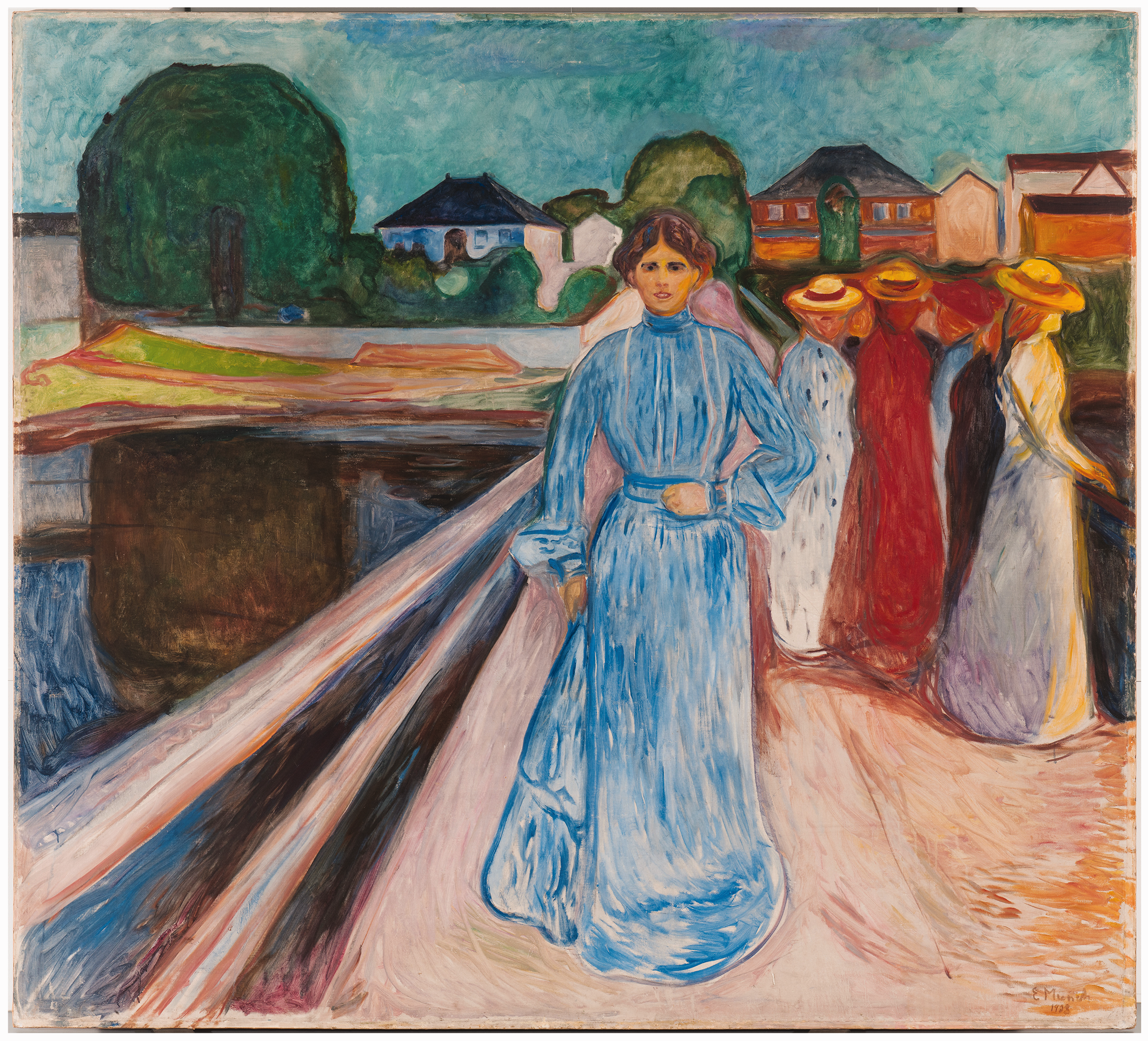
Regine also evoked some of her life experiences in dialogue with the artworks. The historic motif in the artworks played an important role in her storytelling. In the interview, Regine pointed her finger at the ‘Women on the jetty’ (Figure 2) painting by Edvard Munch, one of the photocopies of the artworks we had just seen in the museum:
I recognise this … that life, or the way they are. I am not as old as they are. […] My mother and grandmother, they had dresses like that. Not my mother in her everyday life, but my grandmother had long dresses like that.
This could have been taken in my childhood […] It could not have been my father standing there because he was at sea. But it could have been my uncle holding my hand. And there is a person laying down, playing … yes, this is all natural to me. From my childhood … I didn’t see my father until I was five years old […] He was [at sea] during the whole war. When he came home, I was five. We both had trouble getting to know each other, but eventually we became very good friends […] The war is in between there. I remember the war […]
It was like that … death … We realised that from early on. You see, we knew that … so it is … I am not afraid of death, not at my age. I can die anytime. I mean, I have lived a whole life. I’ve accomplished everything really. If someone is going to die it will be me. Not my children or grandchildren or anything like that. I’m okay with that, that next time is my turn if … at least I hope it will be me and not any of the others.
[…] you can discover things [in a painting] that are … that you … recognise, to put it like that, from life, really. I am the youngest brother of [several siblings] […] My […] siblings are all dead […] You might say that it makes me see the dark side of life. It’s like I have the others behind me in a way. That they are … inside me in a way […] I’m not a Christian, but it is like there is something there after all […] I think the paintings also carry these types of things, because they depict the darkness, even though Munch also had more uplifting paintings […] It’s really about seeing things in a painting that you did not think about before it hits you in a painting.
Søndag i Åsgårdstrand (Sunday in Åsgårdstrand), 1891 (oil on canvas).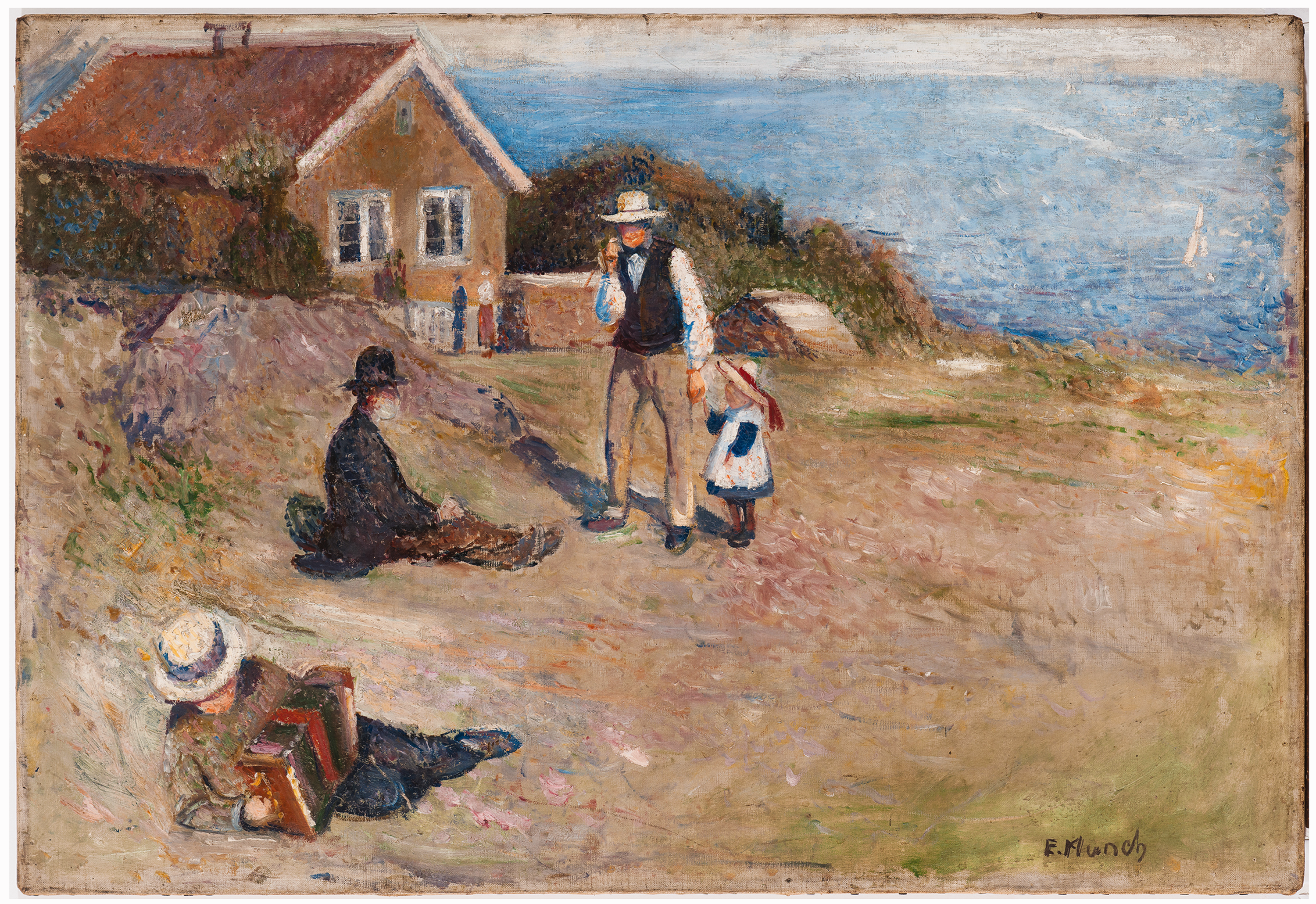
Discussion: An intimate connection
The purpose of this study was to learn more about the characteristics of the art experience for individuals with dementia who took part in a dementia-friendly guided tour at an art museum. Through four experiential dimensions: (1) a new way of seeing, (2) being lifted out of everyday life, (3) activating emotional and bodily responses and (4) connecting art and life, we found that several of the persons with dementia had the capacity and willingness to reach out and connect on a personal level with the artworks. We have termed this connection an ‘intimate connection’, since the four dimensions all underscore a close engagement between the participants and the art.
Our immediate emotional response and personal attraction to an artwork are important resources to gain a meaningful engagement with art, according to the philosopher John Armstrong (2000, pp. 6–7). Our associative mind is a major native resource we bring with us when we visit a gallery or a museum, that can foster this connection, he claims. If we allow it, our private associations can provide us access to an artwork by connecting the external source (the painting) to lived experiences. For Regine, her associations took her back in time to a place she knew. It was as if the artwork provided her with a direct channel to her own life – a mise-en-scène from her previous life as a child, holding hands with her uncle. What she saw was retold as a situation she herself had been in. People in her own life or issues that concerned her were revitalised. Mari imagined what it would be like to lay on the grass field in the painting ‘Sunday at Åsgårdstrand’ (Figure 3). Her associations seemed to activate her imagination, and led her into a feeling of a place she would like to be, whereas her response to the painting ‘House in Moonlight’ (Figure 4) was quite the opposite. ‘Do I dare go in?’ she asked, before saying that she would probably ask someone to hold her hand before going into the dark. Hus i måneskinn (House in moonlight), Edvard, Munch, 1893–1895 (oil on canvas).
Armstrong relates our associative mind to the concept of reverie, the state of giving ourselves up to the flow of consciousness. Reverie is difficult to do on purpose, but it offers, Armstrong writes, a route through which to make the picture personal. Reverie cannot be forced. But the open-minded, free associative way of talking about the artworks seemed to be the participants’ most immediate and accessible response to the artworks. This might be due to what the poet and researcher John Killick describes as ‘the recovery of innocence of response’ or the development of a degree of disinhibition (Killick, 2016, p. 180) that many with dementia experiences. In social situations, disinhibition can cause awkward situations and misunderstandings, but in front of an artwork, it can be a strength rather than a weakness. The spontaneous personal associations many of the participants shared in front of the artworks seemed to provide many with an anchor they could think and feel with. Drawing on Rousseau, Armstrong (2000) claims that reverie returns us to ourselves. It helps us remember what is important to us; it helps us remember who we are (p. 70).
One challenge with free association and reverie, Armstrong writes, is that it can take us away from the art itself. To really appreciate art, we need to ‘grasp the quality of the objects’, he claims (Armstrong, 2000, p. 79). Finding the right timing and balance between inviting the participants to share their personal associations and opinions of the art and providing contextual information about the artwork was at the core of the museum educator’s practice.
As Regine’s case exemplifies, it can be hard to express in words what it is that resonates with us in the encounter with an artwork. An art experience activates bodily reactions and emotions that must be seen as vital aspects of the self. Often a meeting with an artwork is more noticeable as a feeling or a lingering sensation than as a thought. In Regine’s case, the art experience lingered in her body as an echo when it was out of reach from her mind. This underscores the complexity of the art experience and the need to understand a meeting with an artwork is a situated embodied encounter (Hughes, 2001, 2009).
The importance of incorporating the body into our understanding of the value of art in relation to persons with dementia has been the focus of several studies by Pia Kontos and colleagues (Kontos et al., 2016; Kontos et al., 2017; Kontos & Martin, 2013). The findings in our studies, together with the aforementioned research, might give an indication that a stronger emphasis on the embodied dimensions of the art experience for persons with dementia in a museum setting could be explored further in both practice and research.
In this study, we have focused our attention on the possibilities and remaining abilities of persons with dementia to engage in meaningful conversations about art, in a non-intrusive and supportive environment. This does not mean that all participants engaged with the art in the way described in the results section, nor did we expect this to happen. Regardless of whether a person has dementia, a visit to an art museum might not turn out as expected, or it is not the right day for it. Our general impression is nevertheless that most participants enjoyed the experience and participated in the conversation about the art more than we expected. Several of the care workers also expressed surprise by the level of engagement and skills demonstrated by the participants.
Concluding thoughts: Towards a cultural citizenship?
This analysis has led us to consider the valuable opportunities that an inclusive museum practice creates in supporting the cultural citizenship for persons with dementia living at home. Bartlett & O’Connor (2010) argue for the importance of the social dimension of citizenship in relation to persons with dementia. They stress the need for persons with dementia ‘to have opportunities to grow and participate in life to the fullest extent possible’ (2010, p. 37). Miller & Kontos (2016) emphasise in their understanding of citizenship, the relationships between persons with dementia and institutional policies, structures and practices, which they refer to as ‘relational citizenship’. We argue that a dementia-friendly guided art museum tour where persons with dementia can encounter art and engage in an open-minded discussion about the artworks, provides opportunities for persons with dementia to practice their cultural citizenship. While the concept of cultural citizenship often relates to cultural diversity and minority rights (see e.g. Kymlicka & Norman, 2000), it can also be about access to cultural resources, like an art museum, and opportunities to take part in meaning-making processes in the cultural sphere (Hensbroek, 2010). In line with this, we argue that the participants’ engagement with the art in the museum supports their cultural citizenship. As Jens exclaimed: ‘I had never thought that this could be something for me.’ Yet, he was given the opportunity to participate.
In conversation with a painting, persons with dementia’s lives and personal resources can be reinvigorated through other people’s artistic expressions. It can be a place where they can expand on the resources they have, and they can grow and learn about themselves and art in a period of their life where they are experiencing cognitive decline. Persons with dementia experience much change. Many of these changes are related to a distressing loss of their cognitive and physical abilities that disrupt their daily life. However, at certain moments in the development of the illness, these changes may also create a space for new experiences and new achievements.
The dementia-friendly art museum programme is a space where the participants can experience a new way of seeing and be lifted out of their everyday lives by activating emotional and bodily responses through connecting their lives to art. Participation in the community is dependent on the frameworks that we establish as a society. A dementia-friendly museum programme can offer individuals with dementia a way in which to stay connected both to themselves and to the wider community through active participation in the cultural discourse.
Footnotes
Acknowledgements
The authors would like to thank KODE Art museums and Composer homes, The Dignity Centre, and all the participants in the study.
Declaration of conflicting interests
The author(s) declared no potential conflicts of interest with respect to the research, authorship, and/or publication of this article.
Funding
The author(s) received financial support for the research, authorship, and/or publication of this article: This work is supported by VID Specialized University.
