



Abstract
Before Erikson proposed the life stages, Confucius concluded an autobiographic review of his entire life in about 500 BC. Confucius’ life stages may be closer to the life experiences of Chinese older adults. Therefore, the purpose of this study was to examine the effect of the life review program on cognitive ability, life satisfaction, meaning of life, and ego integrity. The experiment was based on a single-group time-series design with a four-time test across 21 weeks. The evoking materials were horticultural activities held in seven weekly sessions. The innovative life review program was in accordance with a combination of Confucius’ and Erikson’s life stages. Nine participants completed all sessions. There was a significant positive effect of time on participants’ cognitive ability and meaning of life after the program. A combination of Confucius’ and Erikson’s life stages can be more advantageous for Chinese older adults than only Erikson’s life stage.
Introduction
Reminiscence therapy has been a common strategy and intervention in long-term facilities for older adults who have experienced cognitive decline, depression, anxiety, and fear of death due to the advancement of their diseases (Syed Elias et al., 2015). It is an easy and common program in long-term care facilities that targets psychological benefits to older adults, improving life satisfaction (Wu & Koo, 2015), meaning of life (Chippendale & Boltz, 2015), integrity (Moral et al., 2015), cognitive functions (Duan et al., 2018), and mental health (Shellman, 2016).
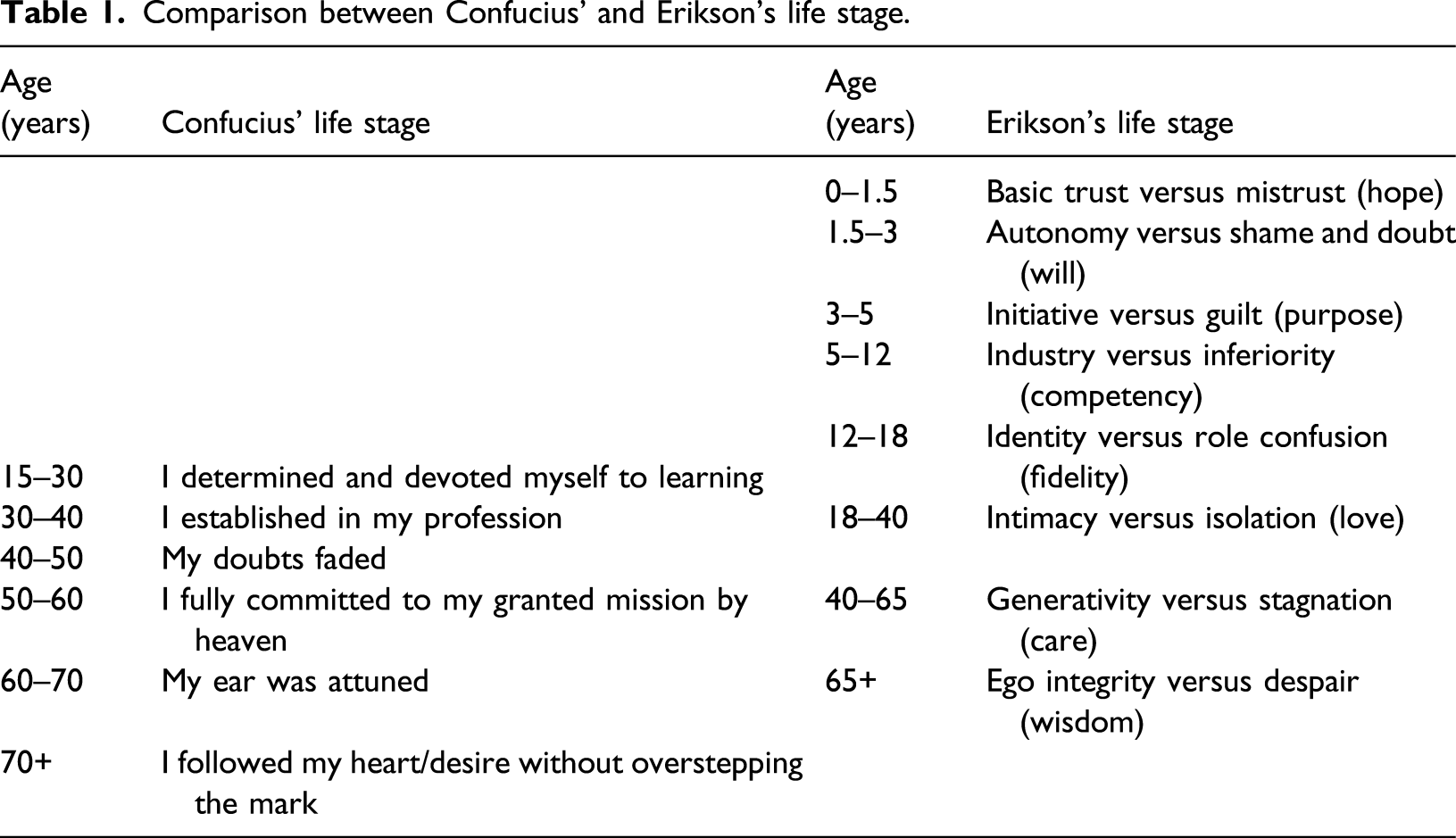
Erikson proposed a developmental theory that outlines eight life stages of psychosocial development during which strengths are created that are “necessary for a mutual involvement in an ever-increasing social radius, from infancy to adulthood and into old age” (Erikson et al., 1994). However, 2000 years before Erikson, Chinese teacher, politician, and philosopher Confucius concluded an autobiographic review of his life at the late stage, as follows: “At the age of 15, I was determined and devoted myself to learning; at 30, I established in my profession; at 40, my doubts faded; at 50, I fully committed myself to my mission, granted by Heaven; at 60, my ear was attuned; at 70, I followed my heart/desire without overstepping the mark.” (Sun, 2008, p.563, p.563)
Comparison between Confucius’ and Erikson’s life stage.
Purpose
Therefore, the purpose of this study was to examine the effect of the Horticultural Life Review Program (HLRP), which is a new reminiscence approach, on cognitive ability, life satisfaction, meaning of life, and ego integrity. Since the participants are Chinese older adults, the life review program is based on the life stages of both Confucius and Erikson to guide the participants to evaluate their life experience. The evoking materials comprise horticultural activities that recall memory. We hoped that the HLRP could be influential and thus promoted as a widespread technique for the benefit of the mental well-being of older adults.
Methods
Participants and setting
Participants were recruited from a day care center in southern Taiwan, which is open 5 days a week for the older adults in need (over 65 years). All participants signed the consent and agreement form before the experiment.
Intervention
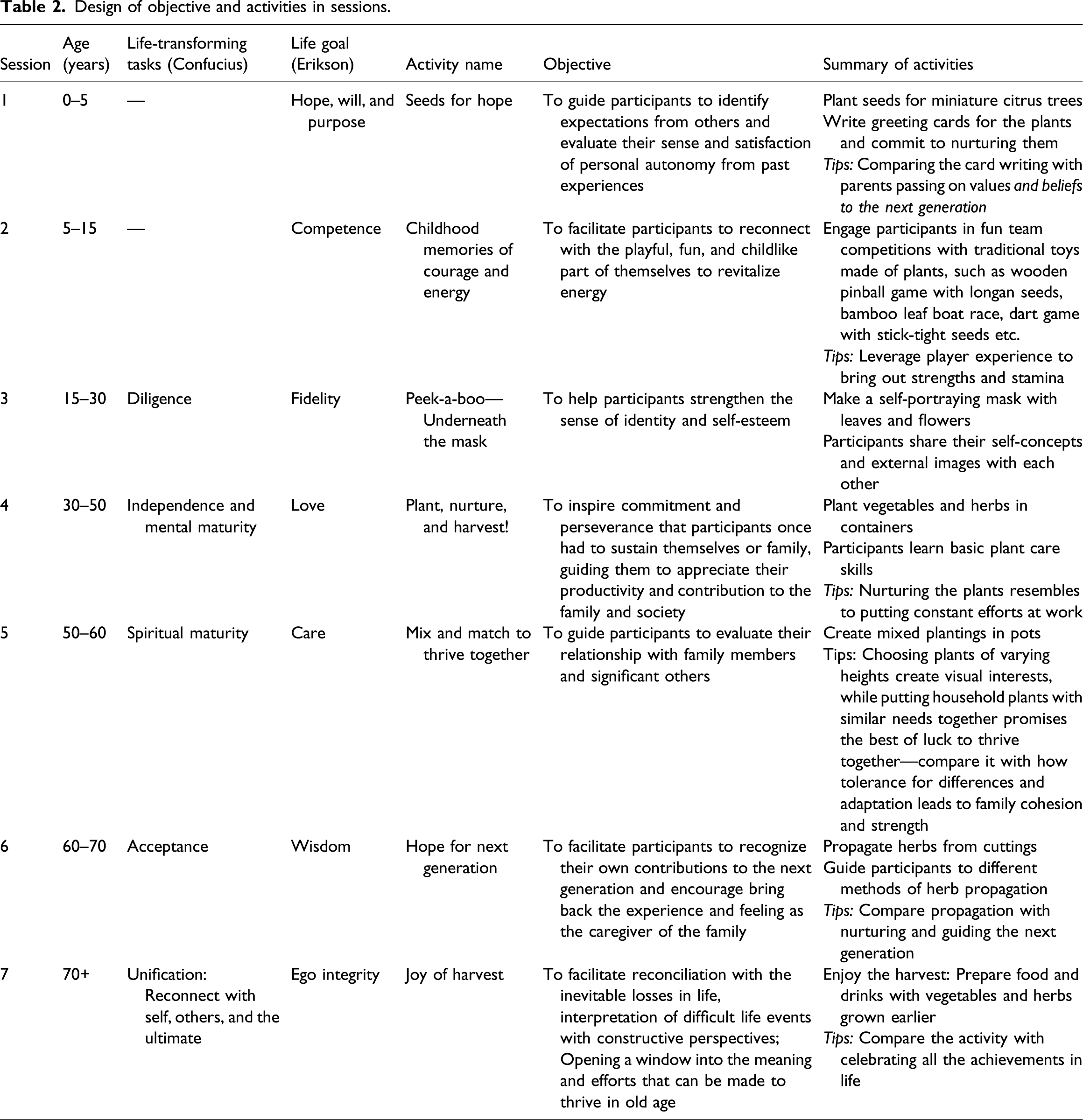
The intervention was designed as a life review program with horticultural activity (Whear et al., 2014). The themes of each session were based on the life stages from Confucius and Erickson’s theories. The first session was to talk about hope, will, and purpose, and the leader guided participants in identifying expectations from important others during their childhood using the metaphor of a seed-planting activity. The second session was to remind participants of the competency they enjoyed in their school age, and the leader facilitated participants reconnecting with the playful, fun, and childlike part of themselves to revitalize energy by playing with the toys made by plant. The third session was to confirm the diligence and fidelity of the young adult age, and the leader helped participants strengthen their sense of identity and self-esteem by making a self-portrayal plant mask. The fourth session was to discuss the meaning of independence, mental maturity, and love of middle adulthood, and the leader inspired participants to talk about the value of the self in the family and society by growing vegetables and herbs. The fifth session was to arouse spiritual maturity and a caring spirit, and the leader guided participants in evaluating their relationships with family members and significant others by creating a mixed plant pot. The sixth session emphasized acceptance of their current situation, and the leader facilitated participants recognizing their own contributions to the next generation through herb propagation. The final session was to unify self-identification for the second time, the group reviewed the former sessions, and the leader helped each participant value their own life’s worth.
Design of objective and activities in sessions.
Research design and data collection
Single-group time-series design was used in the experiment. Data were collected in four phases for 21 weeks (every 7 weeks) by two trained graduate students. The first phase aimed at understanding the participants’ cognitive and psychosocial properties at the initial stage (the first week), while the second phase aimed at collecting the cognitive and psychosocial properties before the intervention (the eighth week). The intervention was held between the eighth and the 14th week. The third phase aimed at collecting the cognitive and psychosocial properties immediately after the intervention (the 14th week). The final phase comprised the follow-up test (the 21st week).
Measurement and data analysis
The following four structural questionnaires were used: (1) Mini-mental Status Examination (MMSE) and Loewenstein Occupational Therapy Cognitive Assessment (LOTCA) to measure participants’ cognitive abilities, (2) Ego Integrity Scale, (3) Life Satisfaction Scale (LSS), and (4) Meaning of Life Scale (MOL). The Friedman test, a nonparametric alternative to the one-way ANOVA with repeated measures, was used to analyze data by phases.
Results
Demographic characteristics
The average age is 79.00 ± 6.16 years. 7 (77.78%) participants were female. 7 (77.78%) participants were widowed. 4 (44.44%) participants were not educated before. 2 (22.22%) participants admitted to the day care center for 3 years, 3 (33.33%) participants admitted for 2 years, and 4 (44.44%) participants admitted for less than 1 year. In health status, 3 (33.33%) participants were diagnosed with mild physical dysfunction, 5 (55.56%) participants were diagnosed with mild dementia, and 1 (11.11%) participant was diagnosed with moderate dementia.
Cognitive ability and psychosocial properties
Comparison of psychosocial properties in 4 phases by the Friedman test.
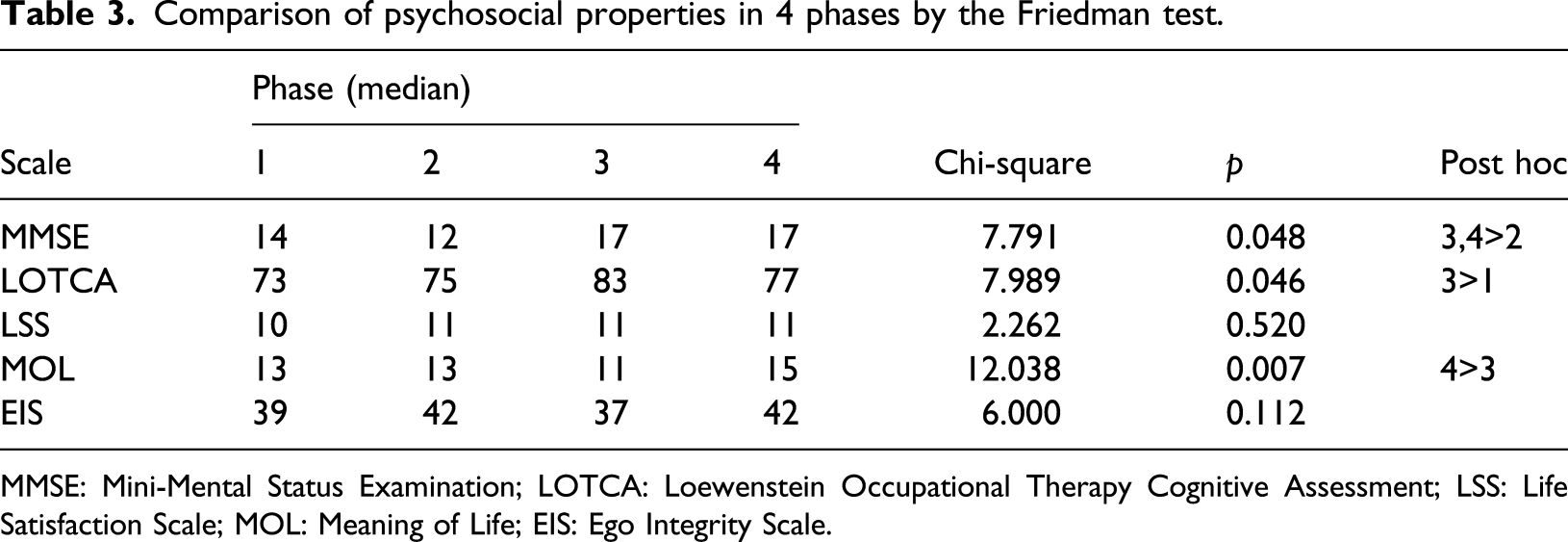
MMSE: Mini-Mental Status Examination; LOTCA: Loewenstein Occupational Therapy Cognitive Assessment; LSS: Life Satisfaction Scale; MOL: Meaning of Life; EIS: Ego Integrity Scale.
Discussion
The results revealed that the participants’ cognitive abilities improved after the intervention of HLRP. The MMSE and LOTCA scores increased significantly after the intervention. The LSS, MLS, and EIS scores decreased immediately after the intervention and increased in the follow-up test. According to the previous qualitative research design of reminiscence therapy, the possible reason for this score variation could be that the participants need more time to rebuild self-concept, reconsider their past experiences, integrate their opinions, and evaluate themselves (Lin & Li, 2013).
Participants joined the HLRP program to review their life stages according to the life stages of Confucius and Erikson. In order to achieve the objective of each session, they brought memories of learning, work, profession, awards, doubts, granted missions, and desires. Through the horticultural activity, the growing plants reflected their life experiences as a metaphor from youth to old age. The HRLP helps older adults to know and integrate themselves better and brings more psychological benefits. In addition, the HRLP constituted by the combination of the life stages of Confucius and Erikson may have more advantages for the Chinese older adults than only constituted by Erikson’s life stage. First, Confucius’ life stages begin at 15 years of age. It is easier for older adults to remember the experiences of adolescence than to bring the memories of infancy and early childhood. Second, because of cultural differences, the Chinese are required to study and work hard in their lives. Confucius’ life stages are similar to their real life experiences, which can be noted in statements such as “I was determined and devoted myself to learning” and “I established in my profession.” Third, participants mentioned many of their children and grandchildren. The appraisal of their life stages is essentially based on the success or failure of their descendants rather than in their own achievements. Confucius indicated that the relationship with beloved others led to self-integrity in later life.
Conclusion
Reminiscence therapy could be designed differently, according to participants’ individual backgrounds, hobbies, needs, and past experiences. The program planner should set an objective that can be accomplished in each session. During the innovation HLRP intervention, the ability, mood, and health of the older adult should be monitored to control the progress of each session. There were no studies demonstrating a negative influence of reminiscence and horticulture for older adults. In this study, the life stages were important themes, especially regarding a combination of Confucius’ and Erikson’s life stages for the Chinese older adults with dementia.
Footnotes
Declaration of Conflicting Interests
The authors declared no potential conflicts of interest with respect to the research, authorship, and/or publication of this article.
Funding
The authors disclosed receipt of the following financial support for the research, authorship, and/or publication of this article: This work was supported by the Ministry of Science and Technology, Taiwan, under Grant [NSC-102-2410-H-003-096].
Institutional Review Board (IRB) Name and Institution
The research ethic was approved by the National Taiwan University Research Ethics Committee (NTU-REC 201301HS018).
