



Abstract
Introduction
Life story books in dementia are used as a part of person-centred care. Whilst the current literature demonstrates associations between completing life story books and increased well-being, little is known about the process and how it is experienced by individuals living with dementia. Life stories are often created with a loved one, such as a partner or spouse; however, further research is required to explore experiences of life story work as a shared endeavour. Furthermore, the use of technology to create life stories is growing, with little known about how digital elements are experienced. This study aimed to understand these gaps by exploring the shared experiences of individuals with dementia and their partner/spouse creating a digital life story book.
Design and Methods
Four couples participated in the six-week creation of their digital life story book. Following this, qualitative data relating to couples’ experiences were collected via semi-structured interviews.
Findings
Thematic analysis was used to interpret data and identified four superordinate themes relating to the shared experiences of creating their digital life story book: ‘Creating a life story book is a huge undertaking’, ‘Looking back and looking forward: The emotional journey’, ‘Whose story is it and who does it belong to?’ and ‘Challenges of using technology to build the life story book’.
Conclusions
Overall, this study demonstrated that creating a digital life story was a positive experience that can support couples’ well-being, but we should not underestimate the time it will take and range of emotions experienced. The experience of using technology varied, emphasising that we must be mindful of individual preferences before considering a digital approach.
Introduction
Reminiscence and dementia
Reminiscence interventions in dementia focus on the process of thinking and telling others about one’s past experiences (Cappeliez et al., 2005). For individuals with dementia, the connection between past and present life events can become fractured as cognitive impairment can challenge the ways in which a life story is structured and communicated (Kindell et al., 2014). Life story work is an autobiographical approach that allows people to reminisce and share their life experiences (McKeown et al., 2006). The information may be recorded and displayed in a life story book complete with photographs, text and other relevant memorabilia (Pietrukowicz & Johnson, 1991). Life story work typically involves working alongside a person and also often their family and/or caregivers, to find out more about their past and use that information to inform their care (McKeown et al., 2006).
Autobiographical memory relates not only to the retrieval of past memories but also to the concept of the self (Brewer, 1986) and has been viewed as fundamental for the experience of personhood (Conway & Pleydell-Pearce, 2000). The concept of personhood has been broadly defined as having agency, autonomy and identity (Higgs & Gilleard, 2015). Kitwood (1997) recognised that autobiographical knowledge is an essential part of identity and personhood meaning the cognitive impairments relating to autobiographical memory can therefore threaten personhood. Enabling people to sustain their personal narratives is a core part of maintaining personhood in dementia care.
Life story work and quality of life
Research demonstrates that life story work in dementia can be an enjoyable activity for those involved (Clarke et al., 2003), can help carers improve understanding of an individual’s life in the context of their past (Murphy, 2000), improves relationships between care staff, patients and their families (Hansebo & Kihlgren, 2000) and enables others able to see the person living with dementia as a person rather than solely the dementia (McKeown et al., 2010).
Current research suggests links between life story interventions and increased quality of life and aspects of well-being in dementia (Haight et al., 2006; Subramaniam & Woods, 2016; Subramaniam et al., 2014). However, intervention studies have measured different outcomes in relation to quality of life and well-being, and the outcomes most meaningful for both people with dementia and their care partners remain unclear. Moreover, research has yet to establish how specific experiences of creating a life story contribute to enhanced well-being in dementia (see Subramaniam & Woods, 2012). Further exploratory research into life story work is needed to build a contextualised understanding of its impact. For example, Gridley et al. (2016) found that, in a care home setting, life story work appeared to be particularly beneficial in supporting identity as well as reaffirming preserved skills for people with dementia. However, experiences of creating a life story book in a community context, and earlier in the dementia journey, are yet to be explored in detail.
Digital life story work
As we are living in a digital world, recent attention has been paid to creating life stories using everyday technologies, such as laptops and tablet computers. It has been argued that digital technology, including music and sound recordings, offers the potential to trigger autobiographical memories in ways that differ from a traditional pen-and-paper static format (Subramaniam & Woods, 2016). Individuals living with dementia have also reflected that using a tablet may capture their life story more easily than on paper (Upton et al., 2011), and a recent review suggested that using everyday technology has the potential to facilitate reminiscence but that more research exploring the specific experiences of using technology for reminiscence and life story work is required (Sweeney, 2019). In addition, commercial organisations now provide online platforms for digital life story creation. Whilst the evidence base relating to digital life story books in dementia is scarce, there have been preliminary findings to suggest the use of technology in the context of reminiscence and life story work can be used to help increase well-being.
Technologically-based reminiscence approaches that have been investigated include multimedia interventions where staff teams and family members worked with families to create a multimedia biography that included videos and photos to tell their story (Damianakis et al., 2010). This intervention appeared to increase joy, but also created moments of sadness, when reminiscing with loved ones. Individuals with dementia were involved in the selection of reminiscence material but did not use the digital elements to create their story; research assistants compiled the materials and then presented the story to the person. This highlights the importance of further understanding how actively co-creating a life story using a digital approach with a loved one is experienced.
A further study used a mobile application that encouraged users to match images and songs to promote reminiscence conversations (Hamel et al., 2016). Family members generally rated the intervention more positively than staff on dimensions of well-being, including social engagement. Similarly, O’Philbin et al. (2018) found that individuals living with dementia expressed a desire to complete a digital life story book in a one-to-one setting, with a loved one, and with the aim of producing something that allowed them to share memories with others. This research reinforces the importance of understanding the experiences of co-creating a life story book digitally alongside another person.
Couples’ life story work
Indeed, most people will complete their life story book alongside another person usually a family member or paid carer. A study by Subramaniam et al. (2014) found that including a family member in the process of creating a life story book improved quality of life more than those who had engaged in a life story intervention without a family member. As such, considering couplehood is also essential to understand the individual in the context of their relationships, with an emphasis that care approaches should enrich both the experiences of those living with dementia and their partners (Hellström et al., 2005).
Growing evidence indicates the importance of a dyadic life story approach in dementia care, but there is a need to further explore these approaches, particularly as the ways in which life story work is carried out can vary (Ingersoll-Dayton et al., 2019). Subramaniam & Woods (2012) report that the inclusion of family members in reminiscence groups with people living with dementia improves relationships between people with dementia and their family carers, illustrating the importance of life story creation as a shared process that capitalises on the resilience of a dyad (also see Ingersoll-Dayton et al., 2013; Scherrer et al., 2014). Such findings highlight that dyadic life story approaches which could be an important intervention to consider when focusing on enhancing well-being. However, from these studies, it is still unclear what specific couple experiences were important when co-constructing their life story together. Direct experiences of life story work in relation to interpersonal and social context are important to explore further (Woods et al., 2008).
In summary, whilst previous research has suggested that creating a life story book can be associated with increases in well-being, further exploratory research is required to understand and contextualise the psychosocial processes associated with well-being when co-creating a life story book with a loved one, in a dyadic context. This would help understand what specific aspects of life story work should be focused on and could help inform which approach is important for well-being. Further to this, recent growth in the use of digital life story books highlights the need to understand how digital life story books are experienced by people living with dementia and how they influence subjective well-being.
Based on these gaps in the literature, the current study aimed to explore and understand shared experiences of creating a digital life story book for individuals living with dementia in the community and their spouse/partner. The study aimed to answer the following questions:
How do couples experience co-creating a digital life story book?
Does co-creating a digital life story book support couples’ well-being, and if so, what experiences support couples’ well-being?
Method
Design
This study took a qualitative design, where data were collected from semi-structured interviews, following participation in a 6-week intervention study requiring couples to create their digital life story book. The study was informed by a constructivist grounded theory (Charmaz, 2006) epistemological position which influenced data collection and analysis. This assumes that there is no objective truth to discover (Guba & Lincoln, 1994), and that categories and themes are constructed by the researcher interacting with the qualitative data, rather than emerging solely from the data (Charmaz, 2006). As a result, it is understood that the researchers’ personal, philosophical and theoretical understandings will influence the research process, including data analysis (Willig, 2013). Therefore, researcher reflexivity is essential as it allows the researcher to consider their own influence on the research process through introspection and reflection (Finlay, 2002). Specifically, Charmaz (2017) suggested that it is important to develop methodological self-consciousness around the researcher’s assumptions as this can help researcher reflexivity. As a result of this, the primary researcher [LS] kept a reflective journal throughout the research journey to reflect upon personal experiences and assumptions that influenced the appraisal of data, and the process as a whole.
The primary researcher assumed that each life story is constructed differently, and as a result, each understanding of what well-being means will be different to couples and also to the individuals within them. It was assumed that the results from this study will capture a subjective truth, which can help understand what processes and experiences of creating a digital life story in dementia influence a sense of well-being. It was also assumed that people are able to live well with dementia, and that individuals living with dementia are able to experience positive feelings, such as enjoyment.
The primary researcher also reflected on their experiences of dementia and reminiscence, both at a personal and professional level, considering how they would influence the research. The researcher reflected on their own experiences of reminiscence, and had created their own life story book for themselves as part of a project unrelated to the current study, which influenced feelings of enjoyment. The primary researcher, a white British female psychologist, had previously ran reminiscence groups within a care home for people living with dementia and has worked professionally in a behaviour that challenges assessment unit for individuals living with dementia whereby life story work was often part of intervention planning. Thus, the researcher held the assumption that reminiscence can be a positive process for individuals living with dementia. These assumptions acknowledge and are reviewed through a process of reflection and supervision and by remaining grounded in the data.
Sample
Inclusion criteria and rationale.

MCI: mild cognitive impairment.
Exclusion criteria and rationale.
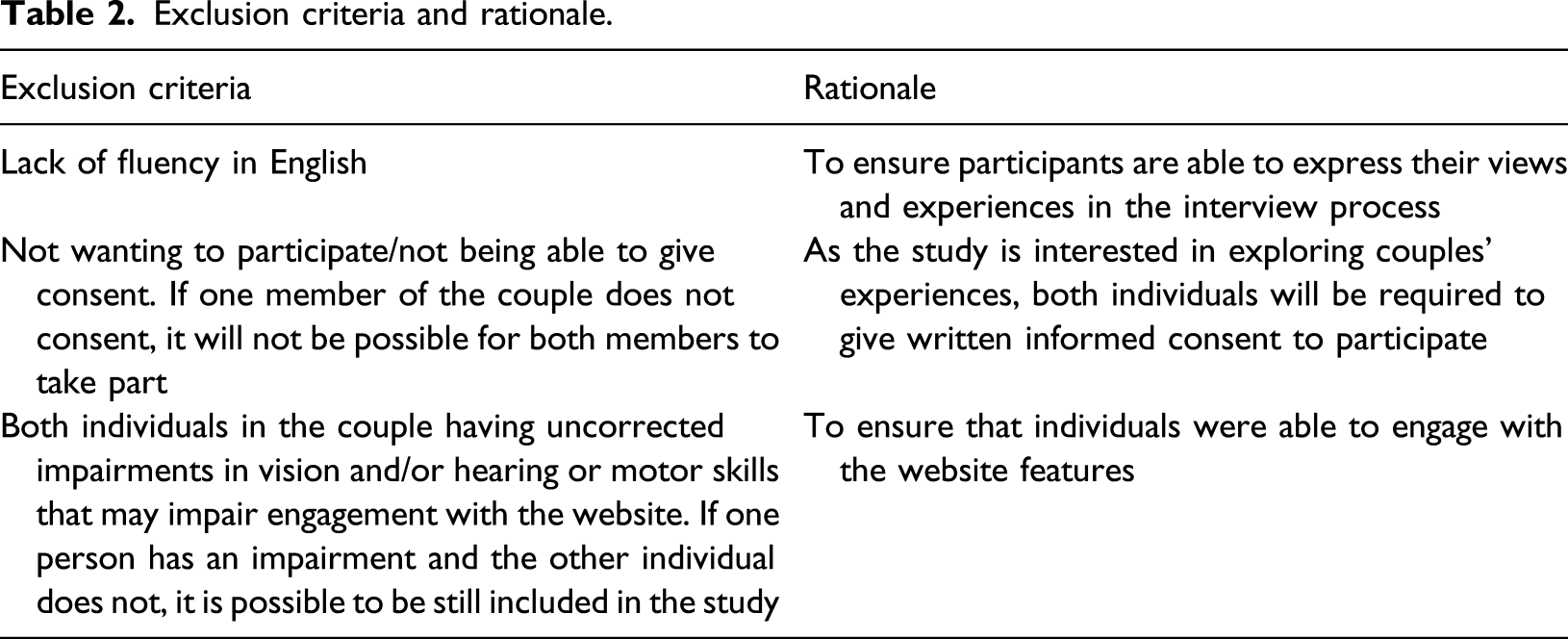
Five couples were recruited. An additional five couples initially showed interest in the life story book when approached through the JDR database, but did not consent to participate due to feeling too busy to engage fully with the intervention (n = 8) or feeling family stress, for example, moving house was a barrier (n = 2). Another couple who declined an invitation to participate stated a wish to focus on pharmacological research in dementia (e.g. drug trials) and did not want to participate in psychosocial research.
Demographics of recruited participants.

Procedure
Ethical Approval
The study was reviewed and approved by Yorkshire and the Humber Leeds East Research Ethics Committee (REC reference: 18/YH/0141). The possibility of life story work bringing up upsetting memories was explained in the information sheet given to participants to ensure individuals who are able to give informed consent and consider the possible consequences of creating a life story book.
Materials
The digital life stories were completed using Book of You, a community interest company who provide a resource for creating a digital life story for individuals living with dementia (www.bookofyou.co.uk). The book can be accessed online via a laptop, tablet or smartphone. All the books are private and password-protected. Individuals have the opportunity to put words, pictures, film and music in their book. There is no limit to the amount of content individuals are able to create. Users are also given a user guide, including a telephone support number to get into contact with Book of You directly. For the purpose of the research, there was free access for research participants indefinitely.
Six-week study
Potential participants who received information about the study through NHS and community organisations contacted the primary researcher by email or telephone to discuss the research, or if recruited through the JDR database, the primary researcher contacted participants by email or telephone. If interested, the primary researcher met each couple at either a community centre or the participants’ home to explain the research, assess capacity to consent and gain written informed consent. Once participants had consented to participate in the research, the primary researcher met them either at their home or a community venue to provide them with their login to the digital story book tool (Book of You). At this meeting, the primary researcher showed them how to use the tool and answered any questions. Participants were told they could create their life story book however they wished and the only instruction given was that they were asked to work on their digital life story book at least once a week together for 6 weeks. Six weeks was chosen as it has been used in previous life story work research (Subramaniam et al., 2014) and reflected the timescale in which Book of You typically works in the community.
Of the couples recruited, two couples requested additional support with technology to put their story together. The researcher asked couples about their support preferences at the start of the 6-week study and also reviewed this via telephone at week 3 of the intervention via telephone.
The level of support was matched to the couples’ requests and was coordinated by the primary researcher. This help included proactive (e.g. planned meetings) and reactive (e.g. if a couple had an issue) strategies that focused on adding photographs, text, video and music to the life story book. The support was either in person or via telephone. For example, one couple wanted a reminder of how to add a page and help adding their photos to their computer in person but then preferred to put their story together without further assistance, and one couple wanted the researcher to actively create their digital life story together with the primary researcher with a planned meeting each week for 6 weeks. The purpose of this was mainly assistance with the digital elements, but during this, stories were discussed and shared with the primary researcher alongside putting the story together digitally. One couple felt comfortable in using the technology without help. The other two couples explained that their children would offer support with technology.
Whilst the study itself was 6 weeks, the individuals could keep their login to their digital life story book indefinitely and could add to their story after the study had finished. Three couples had access to technology (a laptop and a tablet), and two couples used tablets provided by the research team as they did not have access to these in their home and preferred to use a tablet over their desktop computer.
Interview
After 6 weeks, a semi-structured interview between the primary researcher and the couple took place, exploring their experiences of creating their digital life story book together. Topics included what their life story means to them, what aspects they enjoyed/did not enjoy about creating the life story and their experiences of using technology. The semi-structured interviews were conducted in either the participants’ home or a community centre, and lasted from 38 to 58 minutes. The interviews were recorded on an encrypted laptop.
Analysis
A fundamental aspect of developing a theory using constructivist grounded theory is data saturation (Charmaz, 2006). The recruitment of five couples meant that the breadth of available data could not be adequately assessed to have reached saturation. Therefore, a thematic analysis was used to analyse data derived from semi-structured interviews to answer the research questions, and this led to the identification of superordinate and subordinate themes (Braun & Clarke, 2006). The process was guided by constructivist grounded theory (Charmaz, 2006), as a constant comparative method guided analysis. An inductive method was chosen, meaning themes emerged from interactions with the data rather than pre-existing codes derived from other theoretical constructs (Patton, 1990). The primary researcher transcribed and completed initial coding for each interview before completing the next interview to allow for constant comparison. This also allowed the primary researcher to adapt interview questions based on the initial coding of transcripts. Data analysis was an iterative process in which the researcher went back and forth to revisit codes, constantly comparing them to the overarching themes and refining them on this basis. The process of conducting a thematic analysis in this study is depicted below.
The first phase of conducting a thematic analysis is to become familiar with the data. This included the primary researcher transcribing the interviews in order to conduct a thematic analysis. Interviews were transcribed immediately after taking place to allow for constant comparison. Transcripts were read and reread to become familiar and immersed in the data.
Once familiar with the transcript, initial codes were assigned to the data by the primary researcher representing the most basic element. For example, ‘those were stressful periods in our life’ was coded as ‘difficulties faced as a couple’. The coded transcripts were reviewed by the research team together to ensure the codes reflected the data, and that there was agreement that the codes captured experience. An inductive approach was taken, and coding emerged from interactions with the data rather than being theory driven. As thematic analysis was informed by constructivist grounded theory, analysis ran in parallel to data collection.
Once the initial codes had been generated, the codes were sorted into potential themes by the primary researcher in the first instance. This involved collating initial codes and the illustrative quotes. As mentioned above, initial themes and subthemes were discussed with the research team at multiple meetings to ensure the themes reflected relationships between codes. An initial thematic map was created by the primary researcher to visually represent data and was shared with the team. Through regular discussions, the codes, quotes and themes were reviewed and reinterpreted to guide future interview schedules. The initial thematic map helped the research team consider on what topics to focus future interviews around, including asking couples about the role of time, the challenges of using technology, the variety of emotions experienced and the importance of telling their story.
As new data were collected, the themes were refined and revised. The research team was guided by two questions. The first involving reviewing at the level of coded data extracts (e.g. “Do the data extracts for each theme form a coherent pattern?”) and the second in relation to the entire data set (e.g. “Does the thematic map reflect the meanings evident in the data set as a whole?”)
The final step is to define and name the themes, identifying a story that the theme tells us and how it links to other themes. In this step, a revised thematic map was created by the primary researcher and was shared with the research team. Through further discussion and collaboration, this eventually became the analysis included below. For example, one of the early themes ‘time’ became part of a wider theme that eventually became the final theme of ‘creating a life story is a huge undertaking’.
Findings
Four couples (n = 8) worked on their life story book for 6 weeks and participated in the subsequent interview. Jeffrey and Catherine withdrew from the study after week 3 due to ill health. Therefore, no data were available from this couple in the final analysis.
Summary of superordinate and subordinate themes emerging from thematic analysis.

Superordinate theme 1: Creating a life story together is a huge undertaking
Whilst it was seen as valuable, what was involved in the creation of a digital life story book was initially underestimated by participants, especially when participants compared it to reminiscence in conversations. As a result, participants found it hard to find time to create their life story book when leading an active life.
Reminiscence is a part of everyday conversation versus finding the time for their life story book
Couples explained that reminiscence is a natural part of their conversations together:
Bernard: “You might not be aware but you are doing it [reminiscing] all the time… Both Anne and I talk about our life over the years quite a lot…I remember bits about Anne and she remembers bits about me…Our conversations often start with “Do you remember this?”” - spouse
Indeed, during the interviews, couples demonstrated the ease with which they naturally reminisce and share memories together:
Poppy: “We’ve also been to [place]…that was a highlight”- spouse
Bill: “I remember the big plateau…I can remember that…I remember we went in a bus” – person living with dementia
When comparing conversations to the creation of the book, participants reflected on how it required a lot of time and planning, such as reviewing and selecting photographs and time to reflect on memories:
Jimmy: “It might have been thinking about it for a few days then going forward with it…” – person living with dementia
Another couple spoke about how slowing down to reminisce took a lot of energy and time when leading a busy life and found reminiscence in conversations easier to engage in:
Interviewer: “Is that something you both found? Just the time and energy it took?”
Anne: “Yes it took a lot” – person living with dementia
Bernard: “Yes, I think that it was more time consuming. I mean just speaking to you now we’ve covered a lot of ground……we can’t do six weeks solidly…we’ve got other things” - spouse
The impact of dementia also influenced how long it took to build the book, and participants explained that the process cannot be rushed:
Anne: “Yes that’s it…we didn’t want to [rush]” – person living with dementia
Bernard: “I think also this is the Alzheimer’s quite frankly…and the concentration…it does tire her…” - spouse
The life story intervention was described as being different to other interventions in dementia care that promote engagement in activities, such as physical exercise, as it focused on slowing down to reflect. Therefore, when participants had active lives, it was difficult to find the time to create their book. Poppy and Bill spoke about how they tried to create their book on a quiet day and found it enjoyable to stop and reminisce but were unable to focus on it recently as they were busier than usual.
Doreen and Jimmy also explained that stopping and ‘sitting back’ to create a protective space for their reminiscing as part of the life story book project was a positive contrast to reminiscing in conversation only. The act of slowing down gave them a space to take an observing perspective on their everyday reminiscence conversations in a world where they are ‘always trying to keep busy’.
Life story books structure reminiscence
Although effortful, it appeared that creating a life story formalised reminiscence conversations by creating a structure. For example, the structure of a book and book chapters invited couples to focus their attention on different, meaningful aspects of their lives in turn. One couple explained that talking about memories and sharing them can be more important than writing them down as it can be easier and thus more enjoyable:
Bernard: “You do it unconsciously…you don’t sit down together…it just happens… we could relate it…like the first time we met you…we’d talk about that and bring it up but when you’ve got to put it all down into there…” - spouse
Anne: “You don’t realise no!” – person living with dementia
However, whilst the process required more effort than expected, creating a life story was seen as a valuable way to formalise reminiscence. Participants spoke how it brought a structure back to memories, such as putting ‘time slots back into detail’ as well as the memories themselves becoming more vivid. Some couples valued having someone to help them to ‘structure’ their story, by having another person putting the information into the book, such as their spouse, researcher or family member.
Superordinate theme 2: Looking back and looking forward: The emotional journey
Participants described a range of emotions when reliving past memories. When couples reflected on their strength of overcoming difficulties together, they felt grateful for life in the past and in the present.
Memories of the past affecting the present
When memories were relived in the present moment, enjoyment and gratitude of a shared life together was often experienced. Gratitude appeared to be a broad experience relating to the process of thinking about the couples’ life story. It was evident that reflecting on their lives through this intervention gave couples space to focus on a life well lived, to share an appreciation for past experiences which translated into gratitude in the here and now. The use of inclusive ‘we’ when telling their story emphasised the gratitude the couples had for each other.
Poppy: “It’s all been very pleasant …I wouldn’t have altered any of it…It’s been nice to look back on it” – spouse
Sandra: “It takes you back and how you enjoyed it” – person living with dementia
Participants explained their books had automatically focused on life achievements and spoke with amazement and surprise at all they have achieved, resulting in feelings of pride and accomplishment as well as feeling humbled:
Bernard: “Well we thought wow we’ve achieved a lot…especially from the background we came from…it’s made us feel extremely humble” – spouse
Anne explained that she felt more confident about what she had achieved in her job, suggesting that thinking about achievements has potential to increase self-esteem in the present. The daughter of the couple gave informal feedback to the researcher outside the interview that she had noticed her mother appears more ‘confident’ when speaking about her memories, which was then confirmed by Anne in the interview.
Overcoming difficulties and adversity was also an important focus of reminiscence with couples reflecting on a range of difficulties faced, such as poverty. When difficulties and challenges were spoken about in a narrative of overcoming together it emphasised shared strength and resilience:
Poppy: “We were lucky that we came through it all…” – spouse
Couples reported laughing together when creating their life story books and humour was also present throughout the interview process:
Doreen: “It was a laugh! Do you remember that?” - spouse
Jimmy “[laughing] Oh I recall that! [laughing]” – person living with dementia
However, some participants explained they felt sadness associated with losses in their life, highlighting how important it is to not underestimate the complexity of emotions during life story work. In the interview, their spouse helped to tell the story, suggesting the importance of supporting each other through the shared difficulties in life and in the retelling of those memories:
Robert: “A bit sad that it’s all gone… I said I’ve done it for so many years…it’s time for somebody younger to…” - spouse
Sandra: “To take over yes…” – person living with dementia
Another couple explained that difficult memories are an important part of who they are and they should not be forgotten when writing a life story book. When talking about a traumatic memory in her early years, Anne explained that ‘it was a big part’ of her identity and that it was important to include in the story.
Emotions relating to the process of putting the story together
Participants explained during the interviews that they felt a sense of enjoyment and achievement relating not only to reliving past memories but also to the process of creating the book together:
Jimmy: “We have mission successfully accomplished” – person living with dementia
One couple spoke about how it highlighted to them both what the person with dementia could still do and challenged assumptions:
Doreen: “The thing is you’re still quite capable…what it has done has highlighted to me the fact that he still has loads of memory left” - spouse
A general sense of enjoyment was derived from putting the story into a book, with couples reflecting on the value of making their story together:
Sandra: “It feels good yes…we’ve enjoyed it haven’t we?” – person living with dementia
Whilst focusing on the past and the present was discussed as a key focus of the content of the book, it appeared that the life story was seen as important and encouraged participants to consider the future and what couples would still like to achieve and accomplish:
Jimmy: “I want to encourage others to write their story…developing from your project!” – person living with dementia
Superordinate theme 3: Whose story is it and who does it belong to?
The experience of creating a digital life story brought up questions about inclusion and ownership. Participants reflected that the story was theirs to tell as a couple but that it belonged to many people including their family and the wider community. Others hearing and responding to the story was as important as telling the story.
Our story together
Completing the process as a couple emphasised a sense of unity and identity for participants. Participants explained that it is a shared story belonging to both of them and that it would be difficult to write their stories separately:
Poppy: “Yes [it would be different] …our lives have been together anyway…” - spouse
Jimmy explained their identity as a couple was a focus of their story and described his wife as the ‘bedrock of my life’.
The different roles within a couple were mirrored in the life story process, with each having a role in putting the story together, with one person leading on the digital aspects and the other bringing the memories together. They reflected that working together as a team was one of the enjoyable aspects of creating their life story:
Jimmy: “It’s been a team job.” – person living with dementia
Doreen: “That’s been the good thing about it!” - spouse
Similarly, Poppy explained that often she would encourage Bill to talk about past events to cue his recall:
Bill: “Yeah…and I’ve got a terrible memory anyway [laughs]” – person living with dementia
Poppy: “I jeer him on with it…triggers memories to it” - spouse
The togetherness and shared identity was further evident throughout the interviews in the use of inclusive language, ‘we’ and ‘us’, in the interviews.
Telling our story: Others hearing and responding
The importance of stories being heard by others was important. Whilst stories needed to be written down, they also needed to be shared with other people. Reactions from family members, when sharing stories, made couples view their story differently, suggesting how others hear the story can influence a reappraisal of life events for the couple:
Poppy: “Oh yes because they’re learning as well! They say oh we didn’t know this and that and ask did you really do that? You forget too…we think oh yes of course that happened…” - spouse
A sense of legacy within the family was seen as an important consequence of creating their story:
Jimmy: “I am mindful of the fact…in the process…I’ve been writing this up for…we have one daughter Natalie…it’s information for Natalie to read…and to receive” – person living with dementia
One couple spoke about the importance of sharing stories with care staff and others in the community as a way to informing person-centred care:
Jimmy: “We might be able to use this in our dementia community to give staff an idea or concept so anyone can engage in it and would have information available for their care” – person living with dementia
The same couple noticed positive change in their well-being and attributed this to feeling understood by others in the community when they read their book:
Jimmy: “We always looked at it [the life story] from a community perspective…as an example of how to encourage wellbeing” – person living with dementia
Being truly listened to is significant, with one couple expressing upset that their family members did not share their interest and enthusiasm for their life story, proposing that the life story process does not end when the book is completed:
Robert: “I think it should be important to them [family]…the life we led…they don’t seem too bothered about the life we had” - spouse
The importance of feeling heard by others was evident during the interview as couples told their stories. Responses from the interviewer encouraged further reminiscence and enjoyment:
Doreen: “…That was in one of the [place]”
Jimmy: “Yep”
Interviewer: “That sounds like such an adventurous holiday!”
Doreen: “[laughing] it was!” – person living with dementia and spouse
Superordinate theme 4: Challenges of using technology to build the life story book
All participants spoke about the consequences of using technology to build their life story. Participants reflected on the challenges faced when using technology, but these challenges were viewed differently across couples. Participants spoke about their reasons for using or not using digital aspects in the book, such as music and video, the overall importance of using family photographs and using the Internet when photos were not available.
Challenge of using technology viewed as positively and negatively
Some participants viewed the idea of creating the book digitally as a positive challenge and were motivated to learn something new alongside making their story. Persisting with the technology when faced with difficulties led to a sense of achievement and accomplishment:
Jimmy: “It was a challenge…but I did pick it up and stuck at it” – person living with dementia
Jimmy and Doreen reflected on the benefits that technology provided, such as allowing the flexibility to build upon the story in the future and in connecting with distant family:
Doreen: “His younger sister lives away so we can share it with her” - spouse
It appeared the difficulties encountered in the usability of the technology affected the experience of creating the story, with one couple explaining that they enjoyed it until the technology stopped working and another explaining the process was dominated by frustration when technology failed:
Robert: “I enjoyed the writing when it’s going smooth” – spouse
Bernard: “You can get very frustrated when it doesn’t work” - spouse
Another couple explained that they attempted to use the technology but felt it was too difficult, so were supported by family members:
Poppy: “Well our daughter did most…I left that to her…when you get into your 80s and if you have a good family you let them take charge…and they’re better with the technology than we are…To be honest we weren’t really capable” - spouse
Bill: “Definitely not now” – person living with dementia
One spouse explained he felt the technology was ‘beyond (him)’. As a result, some participants reflected that a traditional pen-and-paper life story may be easier to access when feeling less confident with technology:
Interviewer: “Do you think it would have been easier to do it on paper?”
Sandra: “Paper…yes….”
Interviewer: “Do you think you would have preferred it?”
Sandra: “Yeah…” – person living with dementia
Engagement with digital media
Participants wanted to use more digital media in the book, such as videos and music, but uncertainty in how to access this stopped them from including it:
Jimmy: “I would like to include more music…it’s something to work on I think” – person living with dementia
In contrast, Robert explained that they would not have used music as they were not interested or ‘into that’, indicating that digital aspects of life story need to be thought about in the context of the individual and couples’ preferences.
Photographs appeared to be a fundamental aspect of the story with all participants discussing how the photographs helped cue storytelling and that creating a life story book with the images was more enjoyable than just looking at a photograph:
Jimmy: “You can look an image and say fine but to actually produce something is brilliant” – person living with dementia
Some couples described they were upset at the lack of photos and discussed how the digital aspect of the life story meant they were able to replace lost images to put in their story. For example, photos of previous homes could be found through looking at images online.
Having access to a website was viewed as useful, as it provided the tools to create a life story, and all participants reported they would still like to have a printed copy, indicating that a digital copy would not replace a hard copy.
Discussion
Summary of findings and implications for clinical practice
This study aimed to explore the experiences that couples living with dementia had when creating their digital life story and what experiences influenced a subjective sense of well-being. The results focus on one reality that is co-constructed, and the findings are discussed in the context of previous research, clinical implications and ideas for further investigation.
The first aim was to understand couples’ experiences of co-creating a digital life story book. More generally, the findings suggest that we must not underestimate the experience of creating a life story in terms of time and emotional energy required. Literature often conceptualises life story work as a time-limited and activity-focused intervention or tool (McKeown et al., 2010; Moos & Björn, 2006; Subramaniam et al., 2014; Thompson, 2011).Indeed, we viewed completion of the digital life story tool Book of You as a time-limited and activity-focused intervention in the initial stages of the research. However, this assumption was challenged when couples explained that it was the experience of stopping, slowing down and having protected space to share and relive their story that was most enjoyable in the process of undertaking the life story. Life story work, although intensive, was seen as a different activity to other interventions couples had engaged in; the opportunity to slow down and stop seemed particularly valued in the context of participants’ active and busy lives. The clinical implication of this is that living well with dementia needs a goodness of fit between keeping active, which is frequently encouraged (Alzheimer’s Society, 2016), and opportunities to slow down to engage in reminiscence and life story work, whilst acknowledging additional support may be needed because of the time and effort this requires. This may include a named individual to provide practical and emotional support face to face and via telephone. This support may need to be both proactive and reactive to fit each couples’ needs. For example, a facilitator to help with adding a photo into their life story book and someone to validate feelings around the process of creating a life story book. It was highlighted that every couple is different, and that support needs to be flexible as opposed to fixed.
The current study also aimed to understand the experiences of creating a life story book digitally, expanding on the survey conducted by O’Philbin et al. (2018). The study has given some insight into the direct experiences of creating a digital life story as a couple, which was a gap highlighted in Damianakis et al. (2010). The current study highlights that the use of technology needs to be approached with the individuals’ preferences and needs in mind. Scaffolding and working within the person’s ‘zone of proximal development’ (Vygotsky, 1978) to create a life story book which may ensure that individuals learn how to use the technology at the right level, meaning frustrations around the process are avoided. From this study, it would be important for anyone facilitating life story work to assess what individuals may struggle with, what they would like help with, how they would like help (e.g. email, face to face and phone) and what strengths they already possess to ensure that these are a focus for learning about the digital elements. A recent review by Sweeney (2019) concluded that scaffolding was an important aspect of using everyday technology for effective engagement and enjoyment for individuals living with dementia. Overall, experiences of using technology varied, highlighting that when digital approaches are used, they need to be considered on an individual basis and with the right amount of support and scaffolded learning.
The second aim of the study was to understand what specific experiences support couples’ well-being.
Firstly, the importance of sharing the experience as a couple was one of the key experiences linked to well-being. Enjoyment, happiness and pride were derived by involving spouses in the process of building their life story book.
This finding is similar to previous studies investigating couples’ life story work which identified that couples’ life story work can strengthen identity as a couple through communication with each other through their story (Scherrer et al., 2014).
Whilst previous research predominantly focuses on an individual’s achievements (Gridley et al., 2016; McKeown et al., 2010), this study suggests that enjoyment was specifically associated with achievement relating to building the book together, paralleling shared achievements in life as a couple, which was also the focus of the content of the books.
Previous studies have focused on professionals compiling the story away from the couple (Ingersoll-Dayton et al., 2013; Scherrer et al., 2014), whereas this study highlights that the act of building the book together themselves (e.g. adding chapters and uploading photos) as well as learning how to use the technology itself was an important factor in their reported well-being, linking feelings of achievement and mastery.
Doing things together as a couple is an important aspect of maintaining couple identity and well-being in dementia (Hellström et al., 2005). Experiencing enjoyment and happiness has been described in ‘broaden and build theory’ as important for driving personal growth and flourishing, resulting in psychological resources, such as optimism and resilience, and social resources such as strengthening of existing bonds (Fredrickson, 2001). The production of positive feelings from engaging in life story work can help can motivate engagement in novel thoughts about oneself (e.g. a sense of achieving) and relationships (e.g. appreciation for their spouse). These thoughts about oneself can then provide motivation to build upon existing resources by engagement in new activities (e.g. sharing their life story with the community), that may have not been considered previously, which are essential for well-being.
Overall, the experiences of co-creating a life story book as a couple highlight the importance of ‘doing with’ rather than ‘doing to’ as an important hallmark of person-centred care (Kitwood, 1997) but also that experiencing enjoyment and happiness when engaging in life story work as a couple may possibly facilitate not only personal growth and flourishing, but a shared, collective growth and flourishing.
Secondly, how the story was shared with others outside of the couple was a key experience linked to well-being, as in this study, the experience of well-being was attributed to how others responded to the story, including family members, the community and the interviewer. The importance of sharing the story has been viewed as a fundamental aspect of reminiscence generally (Cappeliez et al., 2005). Active listening (Rogers & Farson, 1957) includes listening for meaning and responding to feelings and has been associated with positive change such as empowerment and shared understanding (Street et al., 2009). Families and care staff must actively listen to the story to increase well-being rather than just simply pay attention (Robertson, 2005) to the story as reactions from others alter how well-being is experienced. The importance of the facilitator as an interested listener was also highlighted in the dyadic life story intervention conducted by Ingersoll-Dayton et al. (2016). Clinically, this suggests that life story work does not finish when a book is ‘complete’, and that we need to ensure others, including care staff, keep the story alive by active listening. For example, sharing how listeners felt when hearing the story to validate feelings and facilitate shared understanding.
Thirdly, how all emotions were made sense in the process of retelling their life story was key aspect of supporting couples’ well-being. Previous research has suggested that describing upsetting memories is one of the biggest challenges of life story work (McKeown et al., 2015). Kaiser and Eley (2017) discuss the challenges of upsetting memories in life story work and suggest that acknowledging upset in life story work is crucial, linking back to the importance and role of active listening. Previous studies investigating couples’ life story identified that whilst revisiting life losses was difficult, the losses were often defining moments, with some couples wanting them to be a part of their life story book (Ingersoll-Dayton et al., 2013; Scherrer et al., 2014). A question about how these losses are incorporated in couples’ life story in a way that does not negatively impact the couple was raised as a challenge in the previous literature. Our findings highlight that an exploration of difficulties was a shared experience for couples and linked to their sense of identity as a couple, meaning it should not be shied away from or seen as a barrier to engaging someone in life story work. The findings from the present study suggest that when difficult emotions were experienced and spoken about in a narrative of overcoming and resilience, positive emotions such as gratitude, which has been seen as a fundamental aspect of well-being (Emmons & Mishra, 2011), also ensued. Therefore, speaking about losses in a narrative that emphasises how much couples have overcome may attempt to minimise the negative impact when speaking about difficult memories.
As mentioned above, gratitude appeared to be a fundamental part of how couples experienced well-being, and future research should therefore investigate the role of gratitude as a framework for life story approaches in dementia. Furthermore, gratitude could be used as an outcome measure of interventions of this nature, particularly as including ‘in the moment’ measures of dyadic life story work was highlighted as a research gap by a recent literature view by Ingersoll-Dayton et al. (2019).
The above findings that relate to couples’ well-being are similar to Seligman’s (2012) model of approaches that cultivate a sense of well-being. These include a particular focus on sharing our well-being with others, engaging in an activity we truly enjoy, not only achievement in life but also in the here and now and positive emotions, such as happiness, pride and gratitude. These factors were seen as important experiences of life story work that led to an overall sense of couples’ well-being.
Strengths and limitations
Despite the richness in data gathered, a clear limitation of the study was the small sample size, meaning there was a lack of breadth of data. Thus, data saturation was unable to be reached. However, thematic analysis has its merits as a flexible and accessible approach that can usefully summarise rich data as well as generating unanticipated insights (Braun & Clarke, 2006), meaning the study was able to provide new insights into what experiences are important for couples’ well-being in digital life story work despite data saturation not being achieved. From this, it may be important for future research to explore experiences in a larger sample size, with the aim of reaching data saturation.
The social graces framework (Burnham, 2012), which includes differences in beliefs based on particular characteristics, would suggest this study lacks diversity in areas such as sexuality, ethnicity, race and geography. All participants identified as white British and were from a small regional area in the North of England, meaning the experiences of couples from other ethnicities and locations were not represented. However, the aim of this research was to explore experience rather than aiming to generalise findings across populations. Furthermore, all couples were in heterosexual relationships. Research has shown that the experience of dementia is different in same-sex couples (McParland & Camic, 2018); understanding the shared experiences of creating a life story in same-sex couples is an important avenue to consider for research in the future. Therefore, based on the above limitations, future research should also aim to include a more diverse sample to further understand how couples from a range of backgrounds experience the process of creating a digital life story book and what other experiences may be important to consider in relation to supporting well-being.
It is possible because of the assumptions held regarding life story work as a positive experience that less positive experiences were overlooked; however, initial researcher assumptions were challenged in that life story work as not simplistic; experiences were not always positive, and conducting life story work can evoke feelings of sadness and loss. Furthermore, the study acknowledges there will be multiple realities co-existing, with no ‘one truth’. There was also a crossover in roles as researcher and facilitator; the primary researcher helped two couples with the digital aspects of their book which could affect the way data analysis was approached, and thus the methodological quality. The primary researcher continued to reflect on their assumptions using a reflective diary to ensure methodological self-consciousness and reflexivity. Literature has highlighted that occupying the space of an ‘insider’ can help participants feel comfortable in the research process (Dwyer & Buckle, 2009), meaning that a crossover in role can act as a potential strength and limitation of the study.
Conclusions
Overall, the present study highlights that we should not underestimate the time and range of emotions experienced by couples when creating a digital life story book. It appears that the experience was positive not only for individuals living with dementia but also their spouses, emphasising the importance of couplehood in creating a life story. Experiences of using technology to create their story was variable, highlighting that an individual’s preferences and comfort in using technology need to be considered before undertaking a digital life story book.
Footnotes
Authors’ Contributions
The primary researcher was supervised by two other researchers who worked professionally with individuals living with dementia both in a research and clinical context. Their role was to supervise data collection and analysis and prepare the final manuscript. Laura Sweeney designed the study, carried out the data collection and analysis and wrote the manuscript. Emma Wolverson and Christopher Clarke supervised the data collection and analysis and assisted in preparing the manuscript.
Declaration of Conflicting Interests
The authors declared no potential conflicts of interest with respect to the research, authorship and/or publication of this article.
Funding
The authors disclosed receipt of the following financial support for the research, authorship, and/or publication of this article: However, Laura Sweeney was funded by the NHS to complete the study as part of a clinical doctorate.
Ethical Approval
The study was reviewed and approved by Yorkshire and the Humber Leeds East Research Ethics Committee (REC reference: 18/YH/0141).
