



Abstract
Background
Narratives of dementia can undermine the ability of people to live well. Positive psychology, concerned with the cultivation of personal strengths, is a model through which people’s capacity to have positive experiences can be researched. This study explored the meanings and experiences of hope, a positive psychological construct found to facilitate well-being, in people with dementia.
Methods
People with dementia submitted poems about the meanings and their experiences of hope through an online platform. The submitted poems (n = 29) underwent thematic analysis.
Findings
There were three main themes: (1) “hope is light in the darkness” encapsulated the meaning ascribed to hope as a resource that spotlights what is still possible, (2) “poetry gives voice to experiences of hope” captured the role of poetry in communicating the otherwise elusive concept of hope, and (3)“peers uphold hope and cast away the darkness” captured that participants’ hope was blocked by stigmatising views held and expressed by others but facilitated through positive social interactions.
Conclusions
People are capable of having hope in the context of dementia, with hope being a uniquely functional strength that supports wellbeing. Health professionals, family and society have a clear role in supporting people with dementia to maintain their hope.
Introduction
While managing the challenges associated with dementia, studies demonstrate that people can have positive experiences and live well (e.g., Cahill et al., 2004; Hickman et al., 2018; Katsuno, 2005; Pearson et al., 2022). Despite this, narratives of dementia remain focused on loss and deficit (Aquilina & Hughes, 2006; Behuniak, 2011; O’Malley et al., 2022). Dehumanising views permeate public discourses where people consider dementia as one of the most burdensome conditions of later life (Ferri et al., 2005). Counter-frames of such hopeless views are relatively absent in news and media (Hakola, 2019; O’Malley et al., 2022; Van Gorp & Vercruysse, 2012). Researchers are preoccupied with prolonging survival and slowing symptom progression, with limited exploration of how to support people to live well with dementia (e.g., Pardo-Moreno et al., 2022; Prince et al., 2013; Yiannopoulou & Papageorgiou, 2020).
These hopeless and stigmatising views are not inconsequential and play a significant role in the well-being of people living with dementia. They have been found to propagate negative self-stereotyping (Moniz-Cook et al., 2006; Scholl & Sabat, 2008), poor self-image, and experiences of discrimination (Naue & Kroll, 2009), which in turn, exacerbates feelings of isolation and reluctance to seek diagnosis, support, and participation in research (Garand et al., 2009; Mitchell et al., 2013; Patterson et al., 2018; Sweeting & Gilhooly, 1997). To improve the care, personal outlooks, and quality of life of people with dementia, it is essential to address this stigma and explore balanced narratives of dementia that capture people’s capacity to live well (Swaffer, 2014).
A framework through which alternative narratives can be explored is positive psychology, as it is concerned with cultivating personal strengths and social environments that foster well-being (Peterson & Seligman, 2004; Seligman & Csikszentmihalyi, 2000). An important concept within positive psychology is hope. Seligman (2002), credited as the founder of positive psychology, proposes that a hopeful outlook is vital for a good quality of life. Hope has been positively associated with reduced levels of depression and anxiety (Feldman & Snyder, 2005), improved quality of life (Duggleby et al., 2021) and better subjective wellbeing after controlling for variance due to self-efficacy and optimism (Magaletta & Oliver, 1999). Hope is also evidenced to be a larger predictor of lower burnout compared to resilience (Pharris et al., 2022), distinguishing it from other positive psychology constructs.
Despite robust findings of its positive influence on wellbeing, scholars and philosophers have struggled to develop a singular description for hope, with as many as 29 different empirical definitions and 32 standardised measures available (Schrank et al., 2008). Non-traditional data collection methods such as poetry have been effective in exploring complex and difficult to define concepts (e.g., Amponsem et al., 2022; Campo, 2003; Shapiro, 2004), with evidence demonstrating that poetry is particularly useful for investigating hope (Bishop & Willis, 2014).
Older adult and terminal health research provide some robust conceptualisations of hope. Older adults are thought to face threats to hope such as depleted energy, hopelessness in others, and impaired cognitive ability (Herth, 1993). However, they are able to adapt to these challenges and have a capacity for both generalised hope e.g., hopes about others and the world, and specified hope, e.g., hopes for the self (DuFault & Martocchio, 1985; Lapierre et al., 1997; Rapkin & Fischer, 1992). For those facing life-limiting conditions, hope is experienced as a resource that changes over time and allows people to affirm life and connect with their environment and those around them (Daneault et al., 2016; Johnson, 2007; Soundy et al., 2014).
While limited and often found serendipitously, there is evidence to suggest that people with dementia can also experience hope (e.g., Cohen, 1991; Cutcliffe & Grant, 2001; MacRae, 2010). There were two studies that explore this topic directly at the point of writing. Wolverson et al. (2010) explored the subjective experience of remaining hopeful in early-stage dementia. Hope was expressed as both an internal and external process that was thought to maintain well-being and self-esteem. Similarly, Cotter et al. (2018) found that hope accounts for 25% of the variance in self-esteem in people with dementia. These studies suggest that hope plays a role in maintaining well-being. However, findings from Wolverson et al. (2010) are limited to early-stage dementia, while findings from Cotter et al. (2018) are quantitative and do not offer an explorative inquiry into the experiences of hope.
Additional work is therefore needed to develop richer conceptualisations of hope in dementia, which can be used to cultivate hope fostering discourses and support people to live well. Exploring hope through poetry provides the opportunity to expand understandings beyond what has been found in previous research using traditional methods, substantiating the need for further study of hope in dementia (Bishop & Willis, 2014). Poetry has also been found to affirm the value, identity, and hope in people with dementia when used as research data (Castro & Clark-McGhee, 2014; Killick, 1999). Thus, the current study aimed to explore shared meanings and experiences of hope by people living with dementia through the analysis of participant-written poems. The following research questions were addressed: (1) what meanings do people living with dementia ascribe to hope and (2) how do people living with dementia experience hope (including facilitators and barriers to hope).
Methods
Design
A qualitative design was used to explore and make sense of the shared meanings and experiences of hope when living with dementia.
Recruitment and participants
The inclusion criteria for participants were a diagnosis of dementia (of any subtype) and the capacity to write a poem in English about hope (with or without support from family/friends). Extensive exclusion criteria were not imposed due to the explorative nature of the study.
Many participants were recruited through online social media platforms. They volunteered their participation in response to adverts placed on Facebook, Instagram, Twitter and The UK Network of Dementia Voices website. Others were recruited through local voluntary dementia groups in and around Hull, UK; activity coordinators for the East Riders, Time and Placers, and the Dementia Advisory Group were asked to inform their members about the research. Interested members were directed to contact the primary researcher or gave verbal consent for their emails to be shared with the researcher.
While there are no standardised guidelines for participant numbers when using poetry as data, 10–50 participants have been recommended for “small projects” (student projects) when using participant-generated text as data. The justification for this alludes to the prevention of an overwhelming amount of data while having enough data to demonstrate patterns of meaning (Braun & Clarke, 2006: p. 50–51). Thus, data collection took place between July 2021 and March 2022 and ended when 31 participants were recruited.
Procedure
Promotional posters and a video were distributed online and among activity coordinators of local voluntary dementia groups to share with their members. The posters and video detailed that participants could ask others to help them participate in the study and that only poems in the following styles would be accepted: • Acrostic poems: where the first letter of each line spells out hope. • Sense poems: where poems are constructed by completing some/all of the following sentences – “hope is…”, hope tastes like...”, “hope sounds like…”, “hope smells like…”, “hope looks like…” and “hope makes me feel...”. • Freestyle poems: poems of any or no specific stylistic choice.
The inclusion criteria for poems were adopted from Bishop and Willis (2014). They highlighted that people may become preoccupied with notions that poetry is a complex art requiring specialist knowledge and may therefore become discouraged from participation in poetry-based research. They found that providing guidelines for two specific poetic styles mitigated this potential barrier, with the addition of freestyle poems encouraging people of mixed abilities to take part in the study. Thus, this guidance was adopted for the current study so that people living with dementia with varying cognitive and literacy abilities were supported to write their poems on hope.
Participants used a link available on the posters and video to submit their poems on an online submission platform (created with Online Surveys). On this platform, participants were prompted to download the participant information sheet, with an easy-read version available. Participants could also download an instruction sheet with further details about how to write poems using the three accepted poetic styles. Participants could submit up to three poems per person. A group of participants could also submit a poem written together. Details of their right to withdrawal, anonymity and data storage were all included in the information sheet. Participants could not submit their poems and demographic information until they confirmed that they had read the information sheet and provided informed consent. Some participants opted to email their poems to the primary researcher after reading the information sheet. These poems were included in the study once participants had signed and returned a consent and demographic data form via email or post. Participants were asked if they would like their poems to be included in an anthology of submitted poems at the end of the research (with or without their names). Their decision did not affect the anonymous inclusion of their poem in the study. Consent was given for 21 of the submitted poems to be included in the anthology: https://www.canva.com/design/DAFBplNp6RU/rXxA7daEkhRTHIjZrQiXkw/view?utm_content=DAFBplNp6RU&utm_campaign=designshare&utm_medium=link&utm_source =publishsharelink.
Data analysis
Submitted poems underwent reflexive thematic analysis (TA) (Braun & Clarke, 2006, 2021), an analytical choice governed by a number of rationales. Reflexive TA provides clear analytical guidelines that are applicable to textual data, such as poetry (Braun & Clarke, 2006). It involves the analysis of patterns across participants, proving a way for shared meaning and experiences of hope to be interpreted (Braun & Clarke, 2006, 2021). Reflective TA is theoretically flexible, making it appropriate for a range of research philosophies. The variation of reflexive TA used in this study was underpinned by ontological realism and epistemological relativism, taking a philosophical framework of critical realism. In line with the explorative nature of the study, an inductive orientation to data was taken. Meanings were explored latently as participants used stylistic poetic techniques to convey underlying meaning, however, the focus of meaning remained semantic where appropriate.
Below are the steps that were taken to analyse the data, as outlined by Braun and Clarke (2021). This was a non-linear, iterative process that facilitated a rigorous analysis. (1) (2) (3) (4) (5) 6.
Researcher reflexivity
The primary researcher engaged in active reflexivity to consider how personal values and experiences interacted with data analysis. This involved a disciplined practice of critically interrogating decisions and the effect this could have on the findings and the epistemological soundness of the research. A research journal, reflective practice groups, poetry and regular supervision with two qualified clinical psychologists and researchers were the main tools used in this endeavour.
Findings
Overview of poems and participant demographics
Overall, 33 poems were submitted, of which four were excluded as they were not written by people living with dementia. Of the 29 poems included, 3 were acrostic, 8 were sense and 18 were freestyle. One of these poems was written by a group of four participants, another one was written by a different group of four participants and two participants submitted three poems each. The remaining 21 poems were written by 21 different participants. That makes a total of 31 participants (22 female and 9 male) included in the study. These participants were between 51 and 70 years old and had been diagnosed with dementia between 2.7 and 7 years. Types of dementia reported were Alzheimer’s, Vascular and Mixed. All participants resided in the UK and lived in their own homes. Other demographic data requested were current/most recent occupation and ethnicity, although an overview of this cannot be provided as they were infrequently reported.
Overview of themes
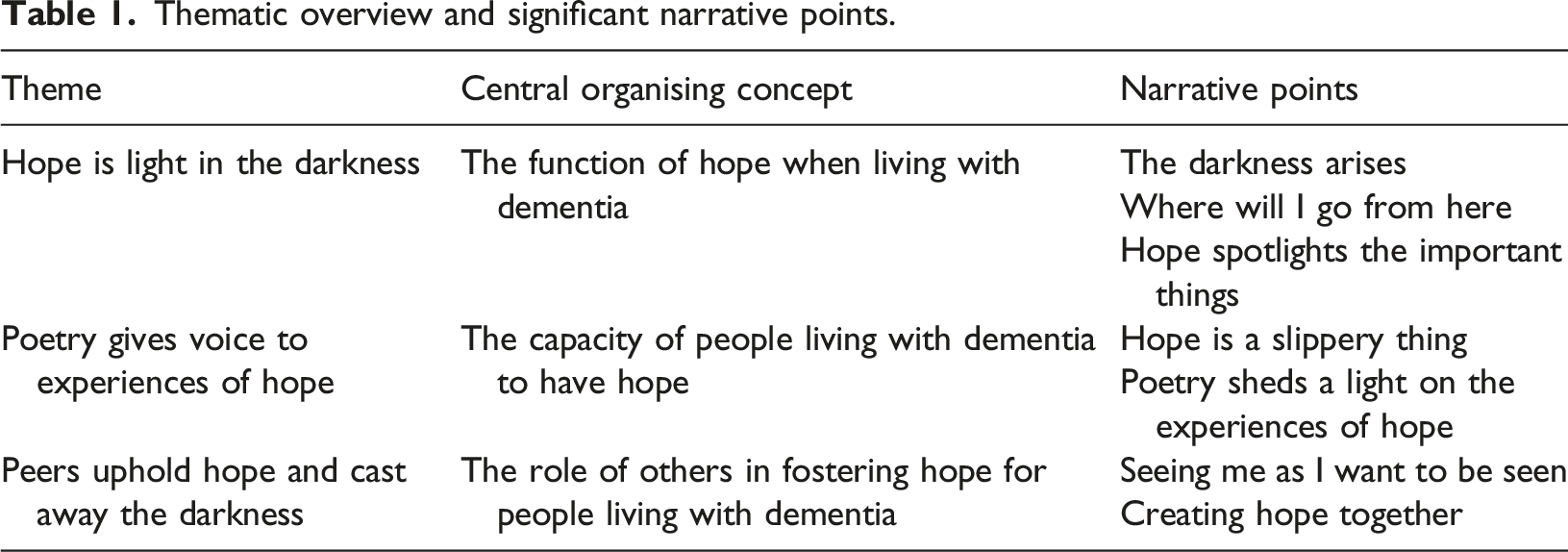
Thematic overview and significant narrative points.
Themes
Theme one: Hope is a light in the darkness
Hope is positioned as a uniquely functional resource (a light) that facilitates coping in the face of challenges that arise when living with dementia (the darkness). Some of the challenges named were the sense of limited time that the terminal and progressive nature of dementia creates, as well as cognitive and physical difficulties. “The darkness arises” as these challenges interfere with established routines and goals, casting a shadow on what is still possible and emphasising a sense of loss and despair.
With an ear that’s failing, and a brain that’s decidedly wonkyThe ear can be fixed The brain can’t
Not knowing how much longer I have to cherish them; to live and love themThey are my memories; they are my thoughts and my every action is for them Until there is nothing more to forget, nothing more to give, nothing more…
With the “darkness” casting a shadow over previous goals, people felt a great sense of uncertainty about their future. Some people’s outlook on what is possible and what they are capable of grows smaller, so much so that life starts to look bleak and meaningless. Some participants began their poems by questioning whether it was even possible to have hope at all, suggesting that being diagnosed with dementia is a barrier to hope.
Perhaps I’ll die suddenly before I’m stuck staring out front Perhaps I’ll manage to end it myself…but when? and how? Perhaps I’ll end up in a really nice care home… Coin toss chance?
Now the "old age" is here…Sadly, our little world is falling apart... Because of one single word: Dementia!
In the face of the darkness and uncertainty, it was hope that many participants longed for. They felt that hope allowed them to both accept and adapt to the challenges of living with dementia, shedding a light on what was important to prioritise. Hope, therefore, did not eradicate the darkness. Instead, it acted as a spotlight that brings to attention what is now possible despite the presence of the darkness. As such, “hope spotlights what is important” based on what can realistically be achieved in the context of dementia.
Hope is what I cling to Hope is an umbrella shielding me from the rain…Hope feels like never losing sight of possibilities
Hoping against the odds that all will be well Believing life is worth livingGetting up each day with enthusiasm
Hope was also conceptualised as a driving force that energises and facilitates active movement towards these newly identified and reprioritised positive possibilities.
Hope gives me strength, gives me a strong vision To continue with life, I’m now on a mission
Without hope, living with dementia is represented as being engulfed in the darkness. In such a case, a person may be stuck in the “where do I go now” position where they are overwhelmed by uncertainty with no clear sense of direction as to what is important or what is possible.
Whatever it is, we hold on to hope Not to fall down, the slippery slope…
Where would I be without this word Hope Living my life without much scope
The relationship between the three narrative points is non-linear, nor are they distinct unitary positions. That is, people can move back and forth between these positions based on their ever-changing daily challenges and the resources available to them to foster their hope.
Yet knowing that, sometimes, I
find my 'me' undone and left
behind.
Lost in thoughtless, meaningless
Visions
Then best retreat.
Stand back!
Review!
Theme two: Poetry gives voice to experiences of hope
Participants alluded to the idea that “hope is a slippery thing” that was difficult to define. They often questioned where hope was felt, how it could be obtained and its existence. This elusive and mysterious air around hope seemed to foster a hopeless discourse around living with dementia, as it was difficult to have hope when hope couldn’t be defined.
Are you in my heartMy memory, my brain?
Where do you go to Will you come back again?
…Or will you disappear again?
I hope you stay
Poetry seemed to play a unique role in allowing people to clearly conceptualise the otherwise elusive nature of their capacity for hope. Poetic devices such as similes, metaphors and imagery provided a way for hope to be conceptualised beyond what is possible with literal language, providing a gateway through which participants could envision and communicate their experience of hope. Through these poetic devices, participants clearly listed experiences of hope and highlighted their capacity for hope. People equated hope to the mindful enjoyment of daily life, nature and food.
Hope tastes of chocolate
Hope smells of Mustique
Hope is in talking and conversations
Hope is Fresh air
Hope is sunshine
Hope is Strawberries….And cream
Hope sounds like singing in the chapel
Hope smells like a field of blooming flowers
Hope looks like the brightest summer day
Hope tastes like the sweetest fruit
Hope is a good night’s sleep
Sounds like peace and quiet Smells like bacon sandwiches
Looks like sunshine
Tastes like a good glass of wine
People also noted that hope is felt in the celebration of daily achievement. Hope is also experienced when people recognise and engage with their personal strengths, capabilities and hobbies such as creativity and travelling, and note that hope spotlights the ways in which they can still engage in and enjoy these personal interests.
Day by day I look for the things I can achieve
Achieve them and notch them up as a success
So I hope for friendship
I hope to paint and write and laugh
Notably, people also make mention of hope residing in future possibilities, as they describe an ability to practice acceptance of the prognostic realities of dementia while hoping for a good quality of life.
I hope for a cure of course, everyone does But it’s probably not coming
So I hope… To live a good life… I hope for the disease to be slow To treat me kindly
Hope for the future went beyond the self, with people highlighting their ability to hold onto hope for a better future for their families and the world. As such, there was so much capacity for hope when living with dementia, both residing in the present and the future, and about the self and others.
HOPE makes me feel like the world is my forever! HOPE gives me hope that 1 day, our world will be as one! I hope xx
Will you give me hope For peace in Ukraine
Theme three: Peers uphold hope and cast away the darkness
This theme highlights that the action of others can either block or foster hope for people with dementia. Some participants expressed that people with dementia are positioned in society as hopeless and incapable of having positive experiences and that these unhelpful narratives acted as barriers to their hope. Participants found it difficult to hold onto hope when others around them continued to be preoccupied with negative outlooks on their lives. These narratives feed the darkness that enters people’s lives when diagnosed with dementia, thus, making it harder to have hope and see “the light in the darkness”.
Do we have a goal? Or we have a wish. Do we have a dream? Or we have a faith. No, we have dementia!
End of story here! Yes?
Some participants used their poems to express their personal realities of living with dementia, challenging these disabling narratives held by others. This spoke to a desire of “seeing me as I want to be seen” as participants expressed a longing for their personhood to be acknowledged and valued.
I want to scream, I’m still me
Me, it’s me inside, it’s just words
Words come out differently and not as they should
Should I stay at home and shy away
Away! Hell no, I’m still for living, still for giving
Giving what I still have left, helping when I can
Can I go on living a life worthwhile, you bet I WILL!
Will I be quiet about my dementia and feel ashamed
Ashamed NO! Not even sad, for I am still ME!
The experience of being diagnosed is presented as a pivotal point at which the size of the shadow dementia casts on life is determined. Some participants highlight that the darkness can be mitigated by health professionals engaging in hope fostering discourses such as orientating toward what is still possible as opposed to being preoccupied with what might be lost when communicating a diagnosis.
One word we don’t hear at diagnosis, one word we so desperately need, sinking into a depth of despair simply because that one word is missing, one word for the life still to be lived, one word offering encouragement, one word that could help us see light, amidst this dark black tunnel, One word that smiles, that brings about relief, one simple word to help us cope, what is that word? It’s HOPE.
Furthermore, hope was seen as something that can be created together. Specifically, positive social interaction is privileged as a catalyst for increasing experiences of hope when living with dementia. Several poems suggested that social gatherings create opportunities for having fun with family members, friends and communities. It affirms people’s capacity to have positive experiences and encourages them to seek out further pleasurable opportunities. A few people also noted that their experiences of positive social interaction include occasions where people gather to seek and share new developments about dementia as this fuelled their hopes for the future. A sense of reciprocity in caring for each other also fostered their hope, both by affirming their own strengths when they can care for their family and feeling hope through displays of love when they are cared for by loved ones.
I find Hope in having a community of people just like myself, Regardless of culture or country; race or religion, who love me as I am – me! What I bring to the table: poems, articles or just a reassuring word We research our common thread and try to understand – Dementia I find happiness in their happiness; courage in their courage I find purpose in this community of people, just like me, just as I am
Peers uphold our hope and cast the darkness away
Hope is the love of my family
Hope is the support of my friends
Discussion
Using poetry as data, the current study explored the meanings and experiences people with dementia attributed to hope. Hope was defined as a personal resource that plays a vital role in managing well-being after a diagnosis of dementia. It did so by orientating people to their personal capabilities and current possibilities in the context of dementia while acting as an energising force that facilitated engagement with pleasant activities. Without hope, life was seen as being full of fear and despair. Participants also highlighted several facilitators and barriers to hope. Facilitators included positive social interactions while barriers included hopeless discourses held by others.
The representation of hope in the current study as a personal resource that supports people with dementia to identify and engage in meaningful activities differs from Snyder’s Hope Theory, a dominant conceptualisation of hope. Snyder’s Hope Theory depicts hope as a cognitive process that requires future goal setting, pathways thinking and a sense of agency (Snyder et al., 1991). When models of hope that are preoccupied with the future and cognitive ability are imposed on a population living with progressive and terminal illnesses, it is argued that this only leaves room for hopeless discourses about people’s capacity to have hope. Participants reported blockages to goal setting, such as the limited outlook of the future as imposed by others, to their pathways thinking, such as cognitive difficulties, and their successful agency, such as functional impairments. However, the current study suggests that by expanding conceptualisations of hope to include a process of adapting to challenges and prioritising what is currently important, discourses of hope become inclusive of people with terminal illnesses whose future is filled with uncertainties, such as people with dementia.
The current study also demonstrates that people with dementia have the capacity for hope and that having hope is important to live well with dementia. A review of 27 studies found that through enjoyment, hope, love, support, facing dementia, growth and transcendence, people with dementia can ascertain positive experiences (Wolverson et al., 2016). The current study demonstrates that hope is not unitary nor separate from the other avenues for positive experiences identified in Wolverson et al. (2016), and is, instead, a multidimensional augmentation of all these. This expansion in previous findings emphasises the need to foster hope for people with dementia, as hope permeates through a large proportion of people’s lives, positively influencing internal processes such as the acceptance of dementia diagnosis, motivation to seek present enjoyment and ability to adapt to the challenges of dementia.
The current study provides some avenues for hope fostering interventions in dementia care. Participants experienced hope by immersing themselves in pleasant activities in the here and now, suggesting that interventions that orient people’s attention to the present can be used to develop and maintain hope. Indeed, there is further evidence for the positive influence that being present-focused has on well-being. Mindfulness interventions, which aim to foster increased awareness of the present moment, have been growing in healthcare (Baer, 2003; Creswell, 2017). Used with people with dementia, mindfulness interventions have been found to improve well-being (Leader et al., 2013), mood (Leader et al., 2013, Kemp et al., 2016) and quality of life (Leader et al., 2013, Churcher Clarke et al., 2017). Churcher Clarke et al. (2017) only found statistically significant improvements in quality of life, and not in anxiety and depression measures post-intervention. However, the reliability of these findings was likely affected by the fact that it was an inadequately powered pilot study. Russell-Williams et al., (2018) provide further evidence for the value of mindfulness interventions, demonstrating that people with dementia, mild cognitive impairment and subjective cognitive decline report improved cognitive functioning, perceived stress, and quality of life after mindfulness-based interventions. The participant base of this study was broader and affects the transferability of these findings to people with dementia. However, overall findings for mindfulness intervention studies support the current study and indicate that engaging people with dementia in mindfulness activities has value, as it has the potential to improve the wellbeing and maintain the hope of people with dementia.
The current study highlights the significant role that others have in maintaining the hope of people with dementia. It demonstrates an ongoing need to challenge stigmatising discourses of dementia, as these act as barriers to hope. Post-diagnostic support would benefit from going beyond a preoccupation with reducing symptoms (Spector, 2004) to include interpersonal hope fostering interventions. Health care professionals can do this by highlighting retained strengths during and post-diagnosis to highlight what people are still capable of in the context of dementia. It would also be beneficial to support carers and family members of people with dementia to maintain their hope, as hope was depicted as a reciprocal experience where others’ hope helped to maintain the hope of people with dementia. Findings from previous research align with these avenues for facilitating hope. For example, positive social interactions were also identified by Wolverson et al. (2010) as being vital for hope. While the findings of Wolverson et al. (2010) were limited to the importance of maintaining personal relationships, this study highlighted that health professionals and society at large also had a role in fostering the hope of people living with dementia.
Poetry was found to be a useful gateway through which people could clearly demonstrate their capacity for hope. As such, poetry can be used to facilitate hope fostering discourses, challenging the hopeless and stigmatising narratives of dementia. This would be particularly useful to implement in healthcare settings as hopelessness in healthcare staff affects the quality of care and clinical outcomes in dementia (Kontos et al., 2020; Spector & Orrell, 2006). There is evidence to suggest that poetry interventions can be used to maintain the personhood of people with dementia in the eyes of those who care for them (Gregory, 2011). In a study evaluating a poetry-writing intervention, poetry was found to improve communication between people with dementia and their professional carers (Gregory, 2011). In addition, Garrie et al. (2016) found that medical students’ attitudes toward people living with dementia significantly improved when they engaged in a poetry writing workshop with people living with dementia. Thus, poetry interventions can be used to improve the quality of care for people with dementia by supporting health professionals to develop balanced narratives of dementia. This would facilitate the challenging of stigmatising and hopeless narratives and influence the provision of hope fostering care practices.
Limitations and future research
Participants rarely provided details of their ethnicity on the demographic data form. As such, there is a lack of understanding of the diversity of recruited participants and whether findings are transferable to a range of ethnic identities. This is an important consideration as one of the main findings was the negative effect that stigma and hopeless discourses held by others had on the capacity for people with dementia to hold onto hope. Research highlights that negative narratives of dementia are heightened within Black and Ethnic Minority Groups, with people from these communities in the UK conceptualising dementia as “a white person’s illness” (Berwald et al., 2016: p. 11). Thus, the experience of hope is likely to be different in Ethnic Minority Groups who face increased stigma and discrimination in health care settings. On the other hand, people in Ethnic Minority Groups may have unique resources, with concerns about help-seeking relating to a perceived risk of compulsory institutionalisation and the desire of families to hold care responsibility (Berwald et al., 2016; Roche et al., 2021). With findings in the current study suggesting that strong family relationships facilitate hope, this is also likely to affect hope experiences. Thus, the explicit exploration of hope and dementia in Ethnic Minority Groups remain highly relevant for future research, which can support culturally sensitive hope fostering discourses in dementia care.
Additional limitations are also related to the sampling issues within this study. This study originally had a Phase Two of the recruitment processes where activity coordinators in care homes were contacted and asked to run poetry writing workshops on hope for their residents with dementia. With the informed consent for their residents, these poems would have then been submitted as part of this study. Phase Two was designed to diversify participants to include those with more moderate to severe dementia. Due to limited staff and pressures on care homes as a result of COVID-19, none of the care homes contacted had the capacity to participate in this research. As such, all participants lived in their own homes and had an average of 5 years since the time of diagnosis. The further losses in independence and increased impairment that people in later life experience may influence the experiences of hope in people with advanced dementia (Erickson, 1977; Moniz-Cook et al., 2006). The findings of this study cannot, therefore, reflect the experience of hope in those with severe dementia in supported living, and explorations of hope in people with advanced dementia remains an important avenue for future research.
Conclusions
The current study took a unique approach to exploring the lived experience of people with dementia, highlighting the value of using poetry to explore complex experiences such as hope. This study demonstrates that people with dementia are capable of hope, and highlights that hope supports people to live well with dementia. Given the protective and adaptive function of hope in the lives of people with dementia, hope fostering interventions are needed to support the development and maintenance of hope in clinical practice. A key finding here is the role that others play in maintaining the hope of people living with dementia. Hope can be supported through valuing the personhood of people with dementia and providing opportunities for engaging in pleasant experiences in the here and now, with specific avenues for support being mindfulness-based and poetry interventions. It would be beneficial for future research to explore how mindfulness-based and poetry interventions affect hope and the overall well-being of people with dementia.
Footnotes
Declaration of conflicting interests
The author(s) declared no potential conflicts of interest with respect to the research, authorship, and/or publication of this article.
Funding
This research received no specific grant from any funding agency in the public, commercial, or not-for-profit sectors.
Ethical approval
Ethical approval was granted by the Faculty of Health Sciences Ethics Committee at the University of Hull (REF FHS340).
