



Abstract
With rates of dementia on the rise and upward trends in multigenerational households, the number of families providing care to persons with dementia is likely to increase. Although caregiver stress in adults has been well-documented, less is known about the impact of dementia family caregiving on adolescents. We conducted a scoping review to assess research on the impact of dementia family caregiving on adolescents. Eight articles representing five studies were identified. Findings suggest that while adolescents developed strategies to cope with the challenges of dementia caregiving, the long-term impact of caregiving on overall well-being has not been well described. Further, research has shown inconsistent findings with studies reporting both improved and strained adolescent relationships. The paucity of research on the impact of dementia family caregiving on the well-being of adolescents is a serious omission given that adolescents are at high-risk for emerging health problems.
Introduction
More than six million Americans aged 65 and older currently live with dementia and this number is expected to rise to more than 12 million by mid-century (Alzheimer’s Association, 2022). The total financial impact of Alzheimer’s disease and related dementias (ADRD) on households and the economy is substantial (El-Hayek et al., 2019); however, there are also intangible costs that are absent from studies estimating the socioeconomic implications of ADRD (Colucci et al., 2014). In 2021, more than 11 million family caregivers provided an estimated 16 billion hours of care to persons with dementia (Alzheimer’s Association, 2022). Of these, more than half of caregivers provided assistance to a parent or in-law with dementia and one-quarter were “sandwich generation” caregivers caring for an aging parent as well as a child (Family Caregiver Alliance, 2016). Compared with caregivers of persons without dementia, caregivers of persons with dementia have a higher level of caregiver burden (Family Caregiver Alliance, 2016; Hvidsten et al., 2020); are more likely to experience depression and anxiety (Hvidsten et al., 2020; Ma et al., 2018); and report more emotional, financial, and physical difficulties (Kasper et al., 2014). In female caregivers with children under age 18, more than half report caregiving for their family member with dementia as more challenging than caring for their children (Alzheimer’s Association, 2022). The most frequent sources of stress reported by caregivers include lack of personal boundaries among persons with dementia, repetitive and aggressive behaviors, and the need for constant care (Unson et al., 2015). Increased caregiver burden is associated with persons with dementia who have greater neuropsychiatric symptoms, lower physical functioning, and inability to drive (Connors et al., 2020; Unson et al., 2015).
Although the stress and poor health outcomes of adult caregivers of persons with dementia have been well documented (Connors et al., 2020; Kim et al., 2012), little is known about the outcomes of adolescents of families caring for persons with dementia. In the literature, the age range of adolescence varies with the beginning of adolescence at 10 years old and the ending age of adolescence varying between 17 and 24 years of age, depending on the authors (Association of Maternal and Child Health Programs, 2021; Christie & Viner, 2005; Sawyer et al., 2018). Although the age ranges differ, developmental stages remain consistent: (1) early adolescence, typically 10–14 years of age, (2) mid-adolescence, typically 15–16 years of age, and (3) late adolescence, which ranges between ending at 19 and 24 years of age (Association of Maternal and Child Health Programs, 2021; Christie & Viner, 2005; Sawyer et al., 2018).
Adolescents are a high-risk group for the emergence of mental health concerns. Globally, the onset of half of all mental health conditions occurs by age fourteen (Kessler et al., 2007), with anxiety and depression being the most prevalent mental health conditions among adolescents (Ghandour et al., 2019). In the United States (US), depression is the fourth leading cause of adolescent disability with the nation seeing a 40% increase in adolescent depression rates between 2009 and 2019 (World Health Organization, 2020). Suicide is the third leading cause of death for adolescents in the US between the ages of fifteen and nineteen (World Health Organization, 2020). These estimates contrast with global trends of mental health where US suicide rates among adolescents are increasing while worldwide adolescent suicide rates have been declining (De Miranda et al., 2020; Odgers & Jensen, 2020). In addition, the SARS-Co-V-2 (COVID-19) pandemic has resulted in increased rates of anxiety, depression, and post-traumatic symptoms in children (Courtney et al., 2020) and may disproportionately affect families caring for persons with dementia (Altieri & Santangelo, 2021). Research has demonstrated the importance of parental support and positive relationships on adolescent mental health and behavior (Aseltine et al., 1998). Family is critically important as peer relationships begin to have more influence during adolescence. However, if the family system is destabilized due to caregiving responsibility, it is possible that adolescent mental health and well-being could be negatively impacted (Aseltine et al., 1998). Given that one in five families in the US live in multigenerational households (Cohn & Passel, 2018), the critical stage of adolescence in psychosocial development and the high risk of emergence of mental health concerns adolescents, the lack of research on the effects of caregiving for persons with dementia among this vulnerable group is a serious omission. The purpose of this scoping review is to highlight this gap and examine critically the existing research on the impact of family caregiving of persons with dementia on adolescent well-being.
Methods
A scoping review was conducted to determine existing research on the impact of dementia family caregiving on adolescents. The specific focus of the review was adolescents ranging in age from 10-24 years who resided with families providing care for an older adult with dementia. The scoping review was guided by Arksey and O'Malley’s (2005) five stage framework: (a) identifying the research question; (b) identifying relevant studies; (c) selecting the studies; (d) recording the data; and (e) summarizing, synthesizing, and reporting results. Additionally, updated recommendations (Tricco et al., 2018; Westphaln et al., 2021) were incorporated.
Identifying the research question
We developed the scoping review protocol to answer this question: What is known about the impact of dementia family caregiving on adolescent well-being? Dementia family caregiving was defined as providing care (regardless of physical location of care recipient) to a family member diagnosed with dementia. For this scoping review, the population included adolescents aged 10–24 years who lived with a family that provided care to a family member with dementia. This age range is consistent with established developmental definitions (Association of Maternal and Child Health Programs, 2021; Christie & Viner, 2005; Sawyer et al., 2018). The concept was well-being, defined broadly as any reference to physical, psychological, or social outcomes. The context included the care of family members with dementia.
Identifying relevant studies
A literature search was performed in December 2021. Relevant publications were identified by searching MEDLINE (via PubMed, 1946 to present), CINAHL (Cumulative Index to Nursing and Allied Health Literature via EBSCOhost, 1981 to present), psycINFO, and SCOPUS. The search strategies were drafted by a clinical librarian and further refined through team discussion. Search terms included: ((“Caregivers"[Mesh] OR caregiver OR caregivers OR caregiving) AND ((“Young Adult"[Mesh] OR “young adult”) OR ((adolescent) OR (“Adolescent"[Mesh]) OR adolescence))) AND ((“Dementia"[Mesh] OR Dementia OR alzheimer’s)). Additionally, a search of the above search terms with (“Grandparents"[Mesh] OR grandparent OR grandparent OR grandmother OR grandfather)) was conducted to ensure all relevant results were obtained. Results were not limited by date of publication but were limited to publication in the English language. In order to be included, articles had to be peer-reviewed and report original research or quality improvement projects. Gray literature was excluded since there is no accepted, gold standard method for conducting rigorous, gray literature searches and little specific guidance available for performing such searches (Paez, 2017). Additionally, abstracts that reported on outcomes that were not related to adolescents were excluded, as this was the population of interest for this review.
Selecting the studies
Initially, 1174 articles resulted from the database searches. The screening process was refined prior to initiation by research team members, and any protocol irregularities were discussed as an entire research team (A.G., J.K., M.P-M., M.U.). The process for selecting articles is reflected in the PRISMA (Page et al., 2021) diagram (Figure 1). After duplicate citations and titles clearly not meeting inclusion criteria were removed, 88 abstracts were screened. Following abstract review, an additional 71 articles were excluded for not being available in English (n = 5) or not meeting inclusion criteria (n = 66). Seventeen articles were eligible for full text review. Two reviewers (J.K., M.U.) crosschecked articles that were eligible for full text review, and disagreements were discussed until consensus was achieved. Following full text review, an additional nine articles were excluded for not being available in English (n = 1), not being focused specifically on adolescents (n = 6), and not being exclusive to dementia caregiving (n = 2). During full text review, it was noted that two researcher groups (Celdrán et al., 2009, 2011; Beach, 1994, 1997; Celdrán et al., 2012) reported on different aspects of their study findings. All of the articles were included as each article focused on different aspects of the studies and were deemed by our research team to include important findings relevant to the objectives of the scoping review. PRISMA Flow Diagram of Record Search and Study Selection.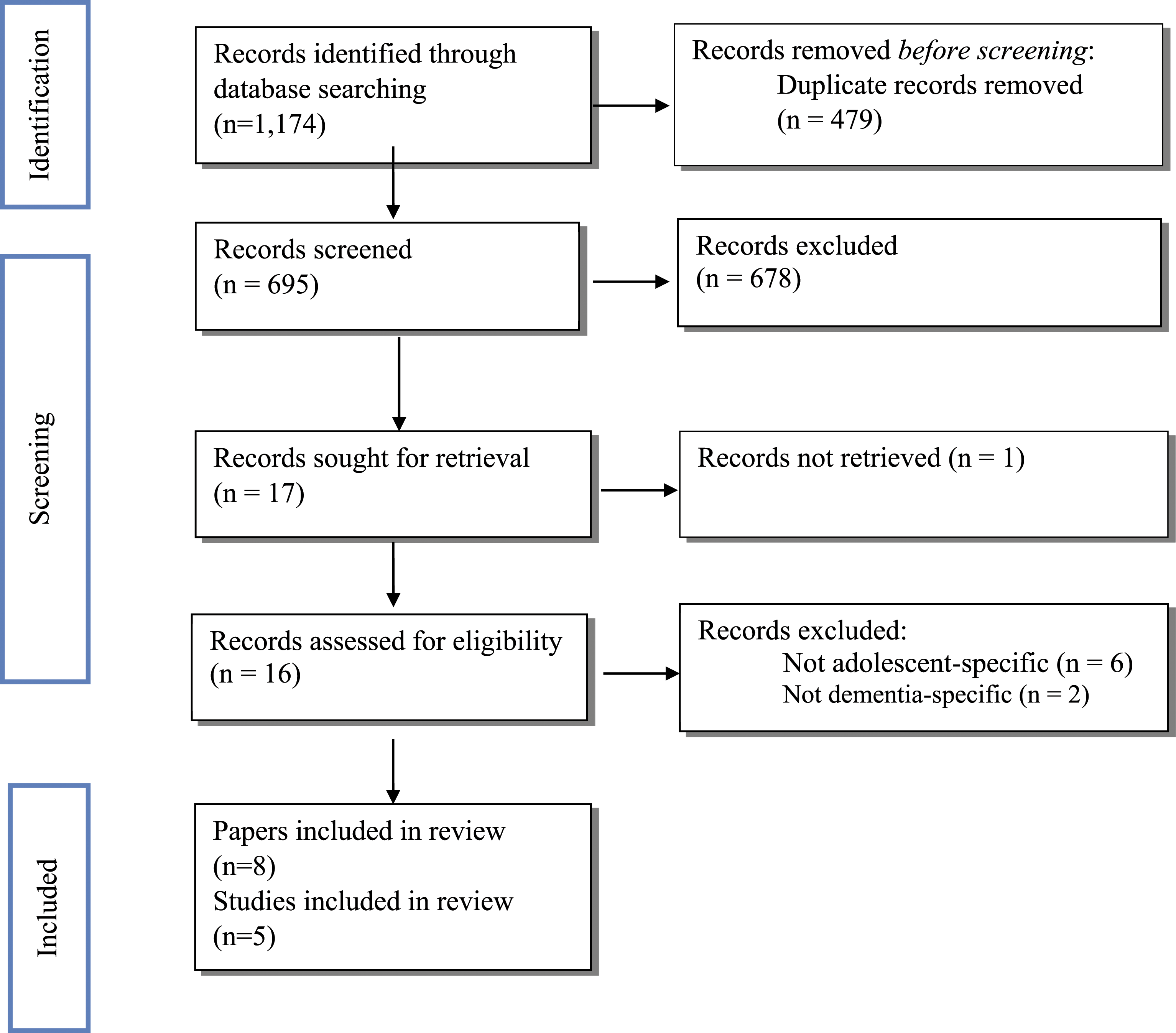
Recording data
An Excel spreadsheet was developed to document extracted study characteristics for all articles and included author, year of publication, study location, study aim or purpose, study population, methodology, outcome measures, and key findings.
Summarizing and synthesizing results
The synthesis included quantitative analysis (e.g., frequency analysis) of the studies’ characteristics and qualitative analysis (i.e., content analysis) of the studies’ findings. The qualitative data were analyzed independently by two authors (J.K., M.U.). The studies were reviewed with content analysis methodology (Lindgren et al., 2020) to categorize and interpret the findings across the varying methodologies of the articles. Full text articles were reviewed and coded by three reviewers (A.G., J.K., M.U.) and agreement was achieved on categorization. The team members identified broad categories for the articles: caregiving experiences and relational impacts. From these broad categories, empirical results of the reviewed studies allowed us to further refine these categories. While these categories are not likely exhaustive of all concepts associated with the impact of dementia family caregiving on adolescents, they provide an overview of available evidence.
Results
Key findings of scoping review articles.

aArticles with same study sample.
bArticles with same study sample.
General characteristics of included studies
The included articles (n = 8) ranged in publication date from 1994-2019. Using Melnyk and Fineout-Overholt’s (2011) hierarchical levels of evidence for literature, all the included articles were level VI (single descriptive or qualitative), with five (63%) of the articles reporting on qualitative analysis. The majority (63%, n = 5) of articles were from the United States, while the remainder originated from Spain.
Adolescent characteristics
There was variability across articles regarding how researchers referred to the population of interest. Most of the articles referred to their study participants as “adolescents” (n = 7); however, one article (Miron et al., 2019) used the term “young adults.” Miron and colleagues’ study (2019) only included participants in the late adolescence developmental stage, whereas the remaining studies’ adolescent participants represented early adolescence through late adolescence. Across all studies, participants ranged in age from 11-22 years. In all of the studies, the majority of adolescent participants identified as female. Although participants identifying as African American, Mexican American, Native American, Pacific Islander, and white were represented in the five articles from the US, the majority of participants was white. Beach’s (1994, 1997) study had the highest proportion of racial minority participants (36%). Adolescents living with their family members with dementia ranged from 20% (Hamill, 2012) to 55% (Beach, 1994, 1997); although two articles (Miron et al., 2019; Szinovacz, 2003) did not include this information.
Characteristics of primary caregivers
Two articles (Hamill, 2012; Szinovacz, 2003) included adolescent/primary caregiver dyads and included characteristics for those primary caregivers. Primary caregivers of the family members with dementia included adolescents’ mothers (Hamill, 2012; Szinovacz, 2003), fathers (Hamill, 2012; Szinovacz, 2003), and grandfathers (Szinovacz, 2003), with mothers representing the majority. The majority of primary caregivers in these two studies were white, married, and had an average age less than 50 years. Szinovacz (2003) also reported a mean of 55.3 hours of caregiving per week by the primary caregiver.
Characteristics of persons with dementia
All of the articles included information about the adolescents’ family members with dementia. In five of the articles (63%), the adolescents were involved in the caregiving of only grandparents. The remaining three articles included grandparents (Beach, 1994, 1997; Szinovacz, 2003), great-grandparents (Miron et al., 2019), parents (Beach, 1994, 1997; Szinovacz, 2003), and aunts/uncles (Beach, 1994, 1997). Across all articles, the mean age of persons with dementia ranged from 69 to 80 years and were mostly female. No racial or ethnic information for the persons with dementia was provided in any of the studies, only the adolescents. Several articles included information specific to the dementia diagnosis, such as the Global Deterioration Scale (Celdrán et al., 2011, 2012); length of time since diagnosis (Hamill, 2012); and ability to perform certain tasks (Szinovacz, 2003).
Caregiving experiences
Caregiving provided by adolescents
Several articles highlighted the experiences of adolescents with day-to-day caregiving. Beach (1994, 1997) found that 82% of adolescent participants said they were instrumental in providing care to their family member with dementia and 64% said they were contributing to that family member’s improved quality of life. Hamill (2012) found that 65.5% of adolescents helped their family members with dementia with instrumental activities of daily living (IADLs) and 55% personally assisted with activities of daily living (ADLs). The most common IADL tasks that adolescents assisted with were housework (48.3%) and meal preparation (34.5%), while providing help with eating (45%) and walking (37.9%) were the most common ADLs (Hamill, 2012). Although not specific to caregiving tasks, Celdrán et al. (2011) reported that more than half (53.2%) of their sample had at least weekly contact with their family member with dementia.
Caregiving outcomes
Adolescents reported both positive and negative outcomes of the caregiving experience. Positive outcomes included satisfaction derived from helping to care for family members with dementia (Celdrán et al., 2011), recognizing importance of family (Celdrán et al., 2009), changes in personal values (Celdrán et al., 2009, 2012), increased knowledge about dementia (Celdrán et al., 2009), and greater empathy for older adults (Beach, 1994, 1997). Negative outcomes included changes in family dynamics (Beach, 1994; Celdrán et al., 2012; Szinovacz, 2003), feelings of jealousy (Beach, 1994; Szinovacz, 2003), fears of future dementia diagnosis (Celdrán et al., 2011), and disruptions in family routines (Celdrán et al., 2012; Szinovacz, 2003). Furthermore, Celdrán et al. (2009) noted adolescents’ reflections about caring for grandparents with dementia led to both optimistic and pessimistic responses about aging and attitudes toward life.
Celdrán et al. (2012) reported that a minority of adolescents in their study perceived that their lives were different from their peers because of family caregiving; this finding was more pronounced in adolescents who cohabitated with the family member with dementia. Specific reasons cited for this difference were changes in family routines and daily-care tasks (Celdrán et al., 2012). In Beach’s (1994) study, participants noted the difficulties experienced with behavior management in a person with dementia, specifically adolescents internalizing and blaming themselves for their family member’s anger, experiencing difficulty predicting family member’s reactions, feeling embarrassed about family member’s inappropriate behaviors in public settings, and being confronted with violent behavior from their family member with dementia.
Adolescent coping strategies
Three articles discussed coping strategies related to the experience of caregiving. Celdrán et al. (2012) highlighted the importance of the socialization of adolescents by their parents regarding values and norms related to caregiving and older adults. The researchers found that adolescents reported that parents served as resources for understanding dementia and coping strategies (Celdrán et al., 2012). In another article (Celdrán et al., 2009), adolescents shared four main categories of advice for other adolescents caring for grandparents with dementia, including accepting grandparents’ illness and behavior, maintaining the relationship with grandparents with dementia, providing direct or indirect care for grandparents with dementia or the primary caregivers, and giving love and affection to grandparents with dementia. To cope with challenges with interacting with family members with dementia, adolescents reported both self-focused coping strategies, such as problem solving and emotional regulation, and other-focused strategies, such as protecting their family member with dementia from negative emotions (Miron et al., 2019).
Relational impacts
Adolescents’ relationships with family members with dementia
Several studies highlighted the impact of family caregiving on adolescents’ relationships with family members with dementia. Celdrán et al. (2011) found that more than half of adolescents reported no change in the relationship with their grandparent with dementia since the onset of dementia; however, 42.1% reported a decrease in frequency of contact and almost 50% reported a decrease in emotional closeness since dementia onset. Some adolescents attributed changes in their relationship to a deterioration in communication and a decrease in shared leisure activities (Celdrán et al., 2012). Some of the concerns adolescents had about interactions with family members with dementia included maintaining their connection, lacking knowledge and skills related to dementia, and dealing with changes in their family members with dementia (Miron et al., 2019). Although Hamill (2012) found adolescents’ levels of affection in their relationships with grandparents with dementia were neutral, adolescents with more affectionate relationships with their grandparents were more likely to engage in caregiving.
Adolescents’ relationships with primary caregivers
Five articles discussed adolescents' relationships with their parents or grandparents who were the primary caregivers for family members with dementia. Adolescents’ levels of affection for their caregiving mothers and fathers were positive (Hamill, 2012). Three studies suggested a better mother-adolescent relationship because of the caregiving situation (Beach, 1994, 1997; Celdrán et al., 2012). When discussing their caregiving mothers, adolescents appreciated their mothers’ positive reinforcement and being involved in caregiving tasks (Beach, 1997). Additionally, adolescents reported providing support to their caregiving mothers who experienced emotional outbursts and burnout, as well as having greater appreciation and respect for them (Beach, 1997). One article (Szinovacz, 2003), however, described a perceived decline by adolescents in their relationship with the primary caregiver. Although positive features of the relationship, such as empathy, bonding, and restraint, were discussed, most adolescents found more negative features, including impatience, lack of attention, arguments, strictness, temper, and fewer joint activities (Szinovacz, 2003).
Adolescent’s relationship with others
Three articles discussed relationships with others, including siblings, peers, and teachers. While some articles reported on increased sibling bonding (Beach, 1994, 1997), Szinovacz (2003) reported on the negative impact on sibling relationships, including fewer joint activities and needing to monitor sibling behavior in front of the family member with dementia. Adolescents also discussed how caregiving circumstances altered their peer relationships (Beach, 1994) and emphasized the importance of having empathetic peers and preparing friends prior to interactions with their family members with dementia (Beach, 1997). Although teachers were mostly unaware of their family caregiving situations, adolescents expressed both ambivalence and appreciation of potential teacher awareness and sensitivity to their situations (Beach, 1994).
Discussion
This scoping review highlights the impact, both positive and negative, on adolescents of family caregiving for persons with dementia. Adolescents reported a range of caregiving experiences impacting their relationships with other family caregivers, the care recipient, and others. While adolescents developed strategies to cope with the challenges of caring for family members with dementia, the long-term impact of caregiving on their overall well-being has not been examined. Additionally, the research that examined relationships between adolescents and both parental caregivers and family members with dementia were mixed with some studies reporting improved relationships while others noting strained relationships. Further, none of the studies examined the academic performance outcomes or long-term impact on peer relationships among adolescent caregivers. Finally, most of the studies in this scoping review were conducted in the 1990’s and do not reflect the varying trends in society and their impact on adolescents, such as the use of social media and virtual learning environments. It is critical to examine the impact of adolescent caregiving of persons with dementia in this current context.
Although older African Americans are twice as likely to develop Alzheimer’s disease as non-Hispanic older whites, they are less likely to receive a diagnosis and are diagnosed in the later stages of the disease (Alzheimer’s Association, 2020). While more than 50% of African American caregivers of family members with dementia also reported caring for a young child and providing more caregiving tasks than their white counterparts underscoring potential disparities by race (National Alliance for Caregiving, 2020), more than half of non-white caregivers say they have experienced discrimination when navigating health care settings for their family member with dementia (Alzheimer’s Association, 2021). However, racial differences in the health outcomes of adolescents in families caring for family members with dementia have not been examined and minority participants were underrepresented in the studies included in this review.
Several implications for practice were identified in the included studies. Most studies identified a positive impact of caregiving on the relationship with parents and siblings and parents served as an important resource for adolescents indicating a potential target for interventions. Additionally, Beach (1994, 1997) described the impact of caregiving on peer relationships and the importance of peer support. Although this experience is relatively unknown, it may be a potential target for intervention for schools and healthcare providers.
This scoping review is limited by the above-named gaps in the literature. In addition, heterogeneity of study types and content made it difficult to categorize the existing literature into distinct themes. While interrater reliability may have been a limitation, the reviewers took steps to minimize this bias by conducting a single review followed by a pairing review of all articles. The exclusion of nine articles for not being available in English (n = 1), not being focused specifically on adolescents (n = 6), and not being exclusive to dementia caregiving (n = 2), limited the scope of the review. Additionally, excluding gray literature in the search process may have limited the comprehensiveness of the search.
Conclusion
Given the growing older adult population globally and in the United States, and the increasing rates of dementia, the number of families providing care to family members with dementia is likely to increase. Further, rates of mental health issues among adolescents in the United States are on the rise (De Miranda et al., 2020; Odgers & Jensen, 2020). Despite these trends, our scoping review underscores the paucity of studies examining the impact of caregiving on adolescent health and well-being. Additionally, the majority of the published studies are more than a decade old and descriptive in nature. Based on the results of this scoping review, additional research is needed to examine the impact of adolescent caregiving in the context of the complexities of contemporary society. Future research should also focus on differences in outcomes of racially underrepresented populations. Finally, educators and healthcare providers should be mindful that adolescents may have a caregiving role and that their responsibilities have a potential impact on physical, psychological, social, and academic outcomes.
Footnotes
Acknowledgements
The authors want to thank Larissa Gordon, MS, MEd, MA, Scholarly Communications Librarian at Thomas Jefferson University, for her contributions to this manuscript.
Declaration of conflicting interests
The author(s) declared no potential conflicts of interest with respect to the research, authorship, and/or publication of this article.
Funding
The author(s) received no financial support for the research, authorship, and/or publication of this article.
