



Abstract
With the continuous development of physical education technology, more modern technologies and diversified teaching concepts are being introduced into football teaching. In response to the issue of interactive football teaching puzzle games, this study designs an interactive technology that integrates Virtual Reality. A technical framework containing multiple information processing modules is constructed, and the Two Stream algorithm is used as the main body of the network framework. Action information collection and analysis are utilized to generate interactive instructions. In the analysis of training speed, the loss value of the research method decreased rapidly and reached its lowest value at the 58th iteration; in the cache data generation test, the research method did not exceed 376Mb of cache data at the 12th minute of operation. When analyzing the accuracy of interactive action recognition, the research method achieved the highest accuracy of around 0.87 in open outdoor and indoor scenes when the action duration reached 1500 ms. The research method has higher interaction quality and efficiency, which can provide technical support for information-based physical education teaching and game interaction, and provide more diversified technical means for football teaching.
Keywords
Introduction
In today’s rapidly developing digital technology, information technology is profoundly reshaping the way people work, study, and live. Education, as the cornerstone of cultivating future social talents, is facing unprecedented opportunities and challenges.1,2 Physical education, as an indispensable part of the education system, is also actively exploring new ways to integrate with modern technology. As the most popular sport worldwide, innovative teaching methods in football are crucial for cultivating football talents and improving the level of football. 3 Traditional football teaching methods are often limited by conditions such as field, equipment, and weather, and the teaching content and form are relatively single, making it difficult to meet the diverse needs of modern education. 4 In recent years, some researchers have begun to try to introduce gamified teaching concepts into football teaching, by designing football teaching puzzle games to enhance the fun and interactivity of teaching. However, existing gamified teaching methods often rely on two-dimensional screens, which cannot provide sufficient immersion and realism, limiting the improvement of teaching effectiveness. Virtual Reality (VR) technology provides users with a brand new learning and experience space by simulating real environments. 5 VR technology has demonstrated its unique value and potential in various fields such as medicine, military, and engineering. Especially in the field of education, the application of VR technology can not only enhance the fun and interactivity of learning but also provide more intuitive and vivid teaching content, helping students better understand and master knowledge. When teaching football, VR technology can simulate a real game environment, allowing players to experience the tension and pressure of the game even on non-match days, thereby improving the efficiency and quality of training. Meanwhile, VR technology can simulate various scenarios in the game, helping players improve their ability to make quick and correct decisions during the game. In this context, this study attempts to innovatively design an interactive design technology for football teaching puzzle games that integrates VR and combines the Two Stream algorithm and human motion recognition to collect interactive information and generate instructions, hoping to provide some technical reference for the sports industry.
This study is conducted from four aspects: the first part reviews and analyzes the current research on game interaction technology and VR technology. The second part elaborates on the technical details of interactive technology in football teaching puzzle games under the background of VR technology research and design. The third part analyzed the performance and practical application effects of the VR interactive technology designed for research. The fourth part summarizes the research content.
Related works
With the rapid development of technology, game interaction technology is constantly updating and iterating, which is reflected in the application of game interaction technology in multiple fields, including education, medicine, and psychology. Some scholars have conducted relevant research on game interaction technology. Scholars such as Le Cleac’h have designed a game interaction technology that combines dynamic games. During the process, quasi Newton root finding algorithm and augmented Lagrangian method are used for constraint and condition solving, and Monte Carlo simulation is used to analyze robustness. The experimental results show that the proposed method has good operational stability. 6 Paraschos and other scholars have designed a game interaction technology that combines difficulty adaptation. Classify dynamic modeling and personalized needs during the process, and interactively adapt to personality traits and actions. The experimental results show that the proposed method can effectively improve the player’s gaming experience. 7 Angiuli and other scholars have designed a game interaction optimization technique based on reinforcement learning. Adjust the learning parameters of mean field games and mean field control problems during the process, and estimate the presentation methods of time and space using a model free approach. The experimental results show that the proposed method can effectively improve the accuracy of game interaction parameters. 8 Tsai and other scholars have designed a game interaction method that combines machine learning. During the process, Shapley values are used for attribute allocation, and key axioms are appropriately sacrificed. By extending linear approximation to higher-order polynomials, the fidelity called interaction index is defined. The experimental results show that the proposed method has good computational efficiency. 9 Liu and other scholars have designed a game interaction technology that combines computational thinking techniques. During the process, interaction is increased through block-based programming environments represented by Scratch, and learning motivation in the programming environment is investigated. The experimental results show that the proposed method has good balance calculation effect. 10
Some scholars have also conducted related research on VR technology. Wang C and other scholars have designed a dynamic teaching assistance technology using VR technology. Simulate the civil engineering process and construction activity progress during the process, and display the physical change status of the task through the application program, providing detailed content between construction teams. The experimental results show that the proposed method has good task interaction effect. 11 Fussell and other scholars have designed a course training method based on Virtual Reality technology. A technology acceptance model was developed during the process, and the model was constructed using confirmatory factor analysis. The experimental results show that the proposed method can effectively improve the quality of education. 12 Creed and other scholars have developed a communication and collaboration tool using VR technology. Collect communication and interaction needs from multiple fields during the process and develop the core theme of the tool to import virtual visual content into the presentation scene. The experimental results show that the proposed method can effectively improve the quality of communication and interaction. 13 Gorman and other scholars have designed a course presentation method that combines VR technology. During the process, VR technology is used to construct classroom scenes and enhance learning depth, teaching content that requires actual movement in a virtual environment. The experimental results show that the proposed method has good learning and teaching quality. 14 Yu conducted research using meta-analysis and systematically summarized the impact of VR technology on educational outcomes. Virtual Reality technology could positively impact learning outcomes in education, improving and promoting learning outcomes at different levels of education around the world. 15
In summary, a large number of scholars have conducted research on game interaction and VR technology, and studies have confirmed the application value of VR technology in game interaction and education. However, there are currently few methods for using VR technology in football teaching. In view of this, this study attempts to propose an interactive technology for football teaching puzzle games that integrates VR, to provide some technical reference for the field of physical education.
Design of interactive technology for football teaching puzzle games under the background of VR technology
Design of VR technology framework for puzzle game interaction
With the popularization of physical education and the continuous development of teaching methods, the teaching methods of football have gradually become diversified. Among them, educational puzzle games have good fun and operability, and they have become a teaching method gradually used by some coaches.16,17 In game design, it is necessary to meet the goals of football teaching, help students master the rules and skills of football, and cultivate their sense of teamwork and responsibility.18,19 The game content needs to be interesting to enhance students’ interest in football and enable them to learn in a relaxed and enjoyable atmosphere. VR technology can provide a more realistic training environment, making players feel as if they are in a real game scene, improving their immersion in training and adaptability to psychological pressure.20–22 Moreover, VR technology can improve game interactivity, allowing users to communicate and collaborate with teammates in a virtual environment, enhancing team collaboration skills. This study is based on VR technology to design a football teaching puzzle game and implement game interaction within the VR technology framework. This study constructs a VR technology framework for puzzle game interaction, as shown in Figure 1. VR technology framework for puzzle game interaction.
In Figure 1, the VR technology framework for puzzle game interaction constructed in this study includes multiple modules. The system first captures the user’s behavioral actions and converts them into data. Secondly, the information calculation module receives these data and analyzes them to understand the user’s behavioral intentions. Based on the analysis results, the information calculation module generates corresponding instructions. The instructions are transmitted through the internal information transmission channel of the device to the module that manages visual data. The football teaching puzzle game content selected by the user is retrieved and matched with the data. The system determines the required output image scene and audio data based on the matching results, and completes the rendering work. The head mounted display device transmits the rendered image to the user’s eyes and outputs corresponding sound effects through audio, providing a multi-sensory interactive experience for the user. The specific interactive process of the puzzle game is shown in Figure 2. Interactive process of puzzle game.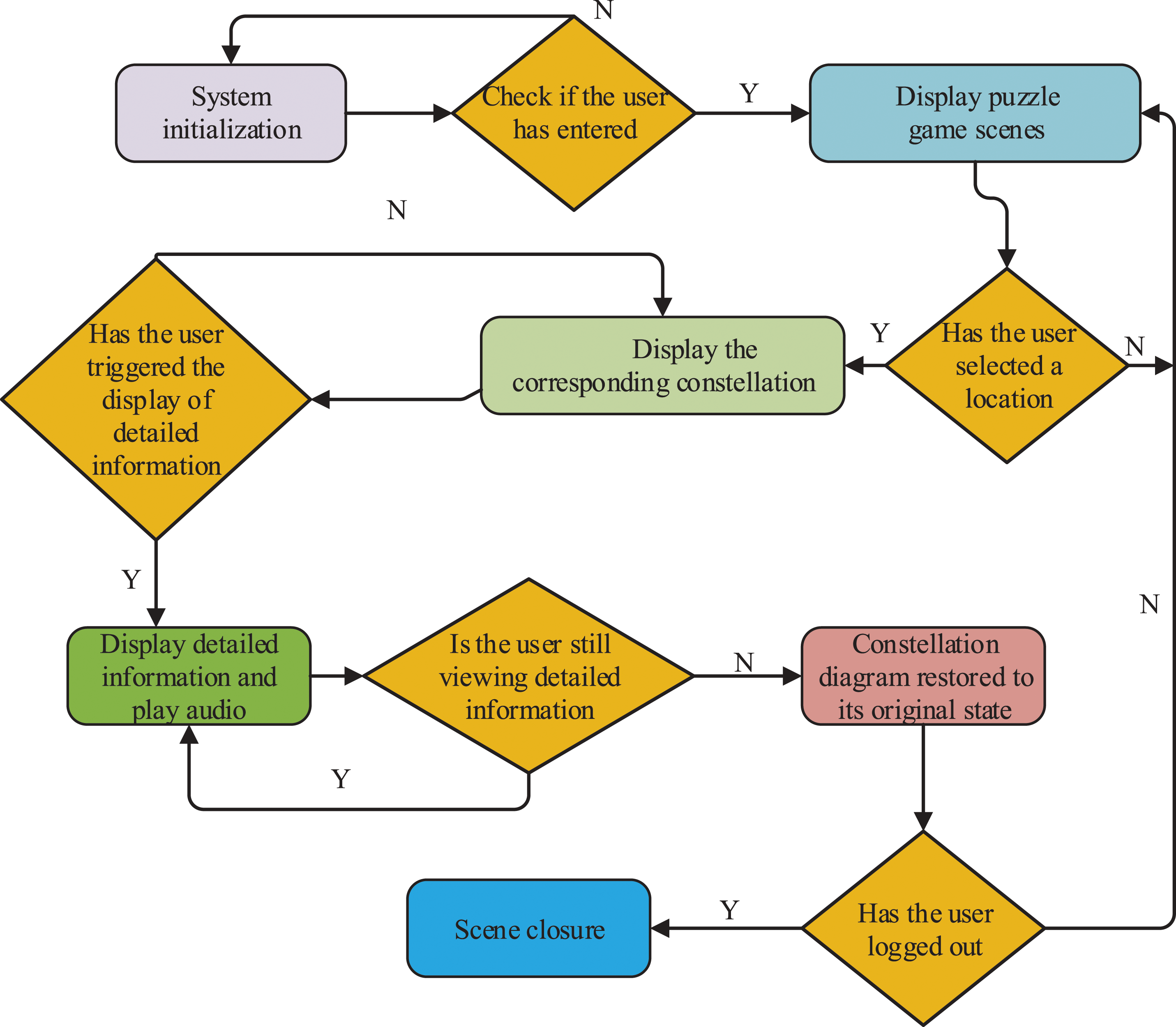
In Figure 2, during the interactive process of a football teaching puzzle game, the VR system executes the interaction flow. After starting the game, the system is initialized and constantly checked for user access. When the user is detected to have entered, the puzzle game scene is displayed. The instructions selected by the user to decrypt the information are collected, and the corresponding decrypted information content is displayed. If the user triggers the display of detailed information, the decrypted information and corresponding football teaching content will be displayed, and the corresponding animation and audio will be played. The user’s viewing status is continuously collected until the puzzle interface is restored to the main interface when the user no longer watches. If the user chooses to exit, the VR scene will be closed.
Construction of interactive data collection network framework for VR football teaching puzzle game
When using VR systems for interactive football teaching puzzle games, it is necessary to collect user interaction information. Due to its particularity, football educational puzzle games involve a large number of human movements. To ensure the integrity of interactive information, this study constructs a network framework for interactive data collection based on human motion capture. The Two Stream algorithm is a deep learning architecture used for video processing and computer vision tasks, particularly in the field of human motion capture, which combines spatial and temporal streams to capture human motion in videos. This study uses the Two Stream algorithm as the main body of the network framework. VR video capture devices can collect motion videos of users during interactions. When recognizing action videos, the video first needs to be converted into a digital image, which is decomposed into pixels and assigned specific coordinates and values to each pixel. Digital images are composed of pixels, each with a determined position and value. Grayscale images are represented by integer grayscale values, while color images are represented by color values. This study describes the colors of images using the three primary colors of red, green, and blue. To reduce hardware pressure, this study optimized the data loading method during motion capture, as shown in Figure 3. Optimize data loading method.
In Figure 3, this study adopts a more efficient data loading method, namely, “read as you go,” which directly uses the entire video file as the training unit. By using a pointer to the beginning of a video file, it is possible to dynamically move the pointer to obtain the desired data frame and achieve online data loading. This method avoids the step of decoding images in traditional methods, thereby simplifying the data preprocessing process. Due to the elimination of decoding steps, data loading becomes faster, thereby improving overall computational efficiency. The three primary colors of red, green, and blue contain a large amount of data, but directly using them to collect image features may result in a huge computational burden on the hardware. Moreover, the three primary color data between adjacent frames are close, making the model prone to overfitting during large-scale calculations. This study incorporates optical flow feature analysis to reduce dependence and computational complexity on the data of the three primary colors of red, green, and blue. The calculation of pixel brightness is shown in equation (1). Dense sampling and sparse sampling processes.



In Figure 4, during dense sampling, each video frame is uniformly sampled, and the resulting sampling results are input into the model. When performing sparse sampling, video frames are first grouped according to a certain number, sampled by the input sampler, and then transmitted to the model. The video frame grouping is shown in equation (4).



Design and implementation method of VR interaction technology based on action information collection
The VR interactive technology designed in this study consists of a backbone network and a time-space domain network. The backbone network includes convolutional kernels, Batch Norm layers, and inserts the Batch Norm layer between the activation layer and Inception structure. To meet the network transmission requirements of interactive football teaching puzzle games, this study establishes convolutional kernel parameters for the time-space domain network as shown in equation (7). Inter frame average fusion.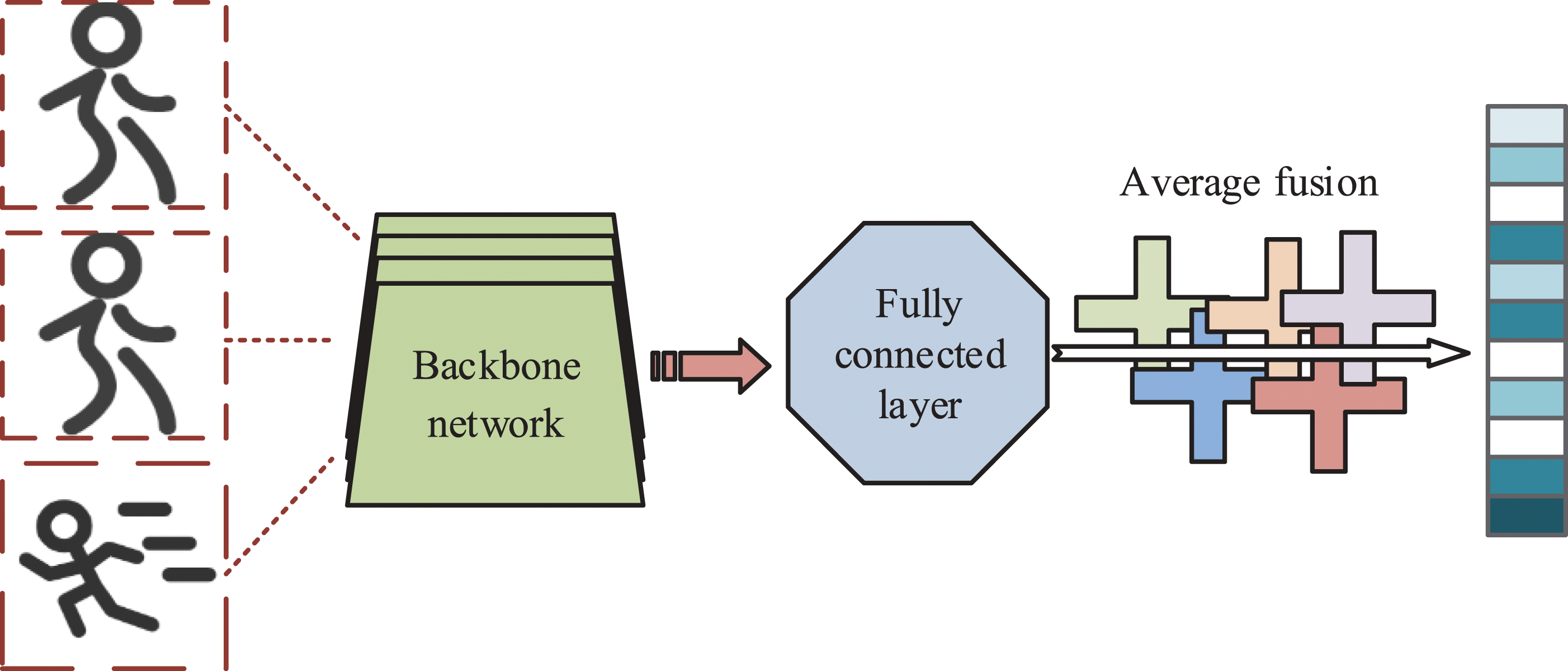

In Figure 5, when performing frame to frame average fusion, the image information of different frames is input into the backbone network. The backbone network organizes the information of picture frames and inputs it into the fully connected layer. Different picture information relationship networks are established and then averaged and fused. After extracting the features of the image information, this study introduces an attention mechanism to transform the image information into recognition results for actions. The encoding decoding structure is used to analyze different picture information, as shown in Figure 6. Attention mechanism encoding decoding structure.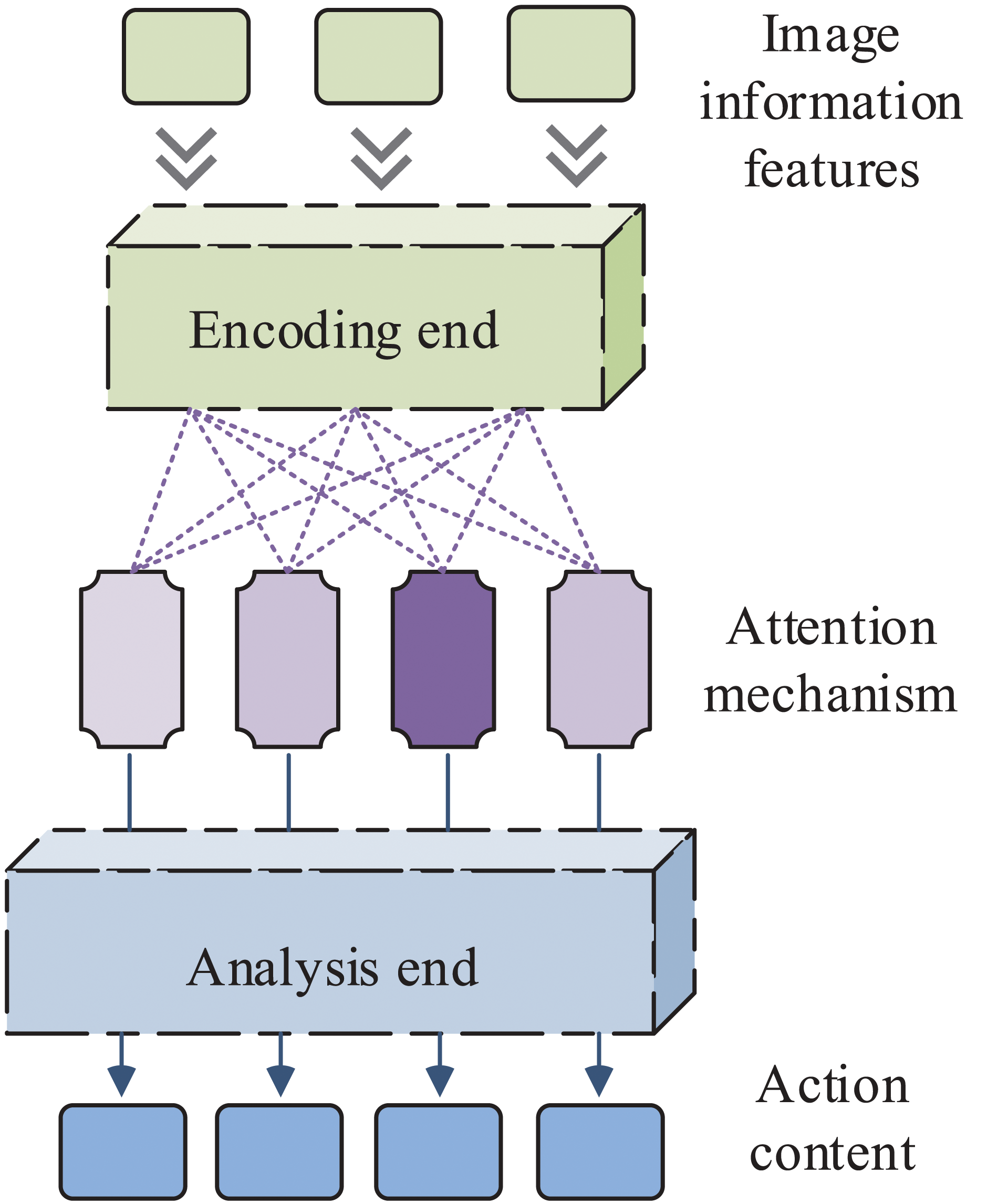
In Figure 6, this study inserts attention mechanism between the encoding and decoding ends. The extracted image information features are first encoded by the encoding end after the input structure and then analyzed by the attention mechanism to determine the action content contained in the image information. The obtained content information is decoded by the decoding end and output. The weight of the result end during the process is shown in equation (8). Operation process of interactive technology in puzzle games.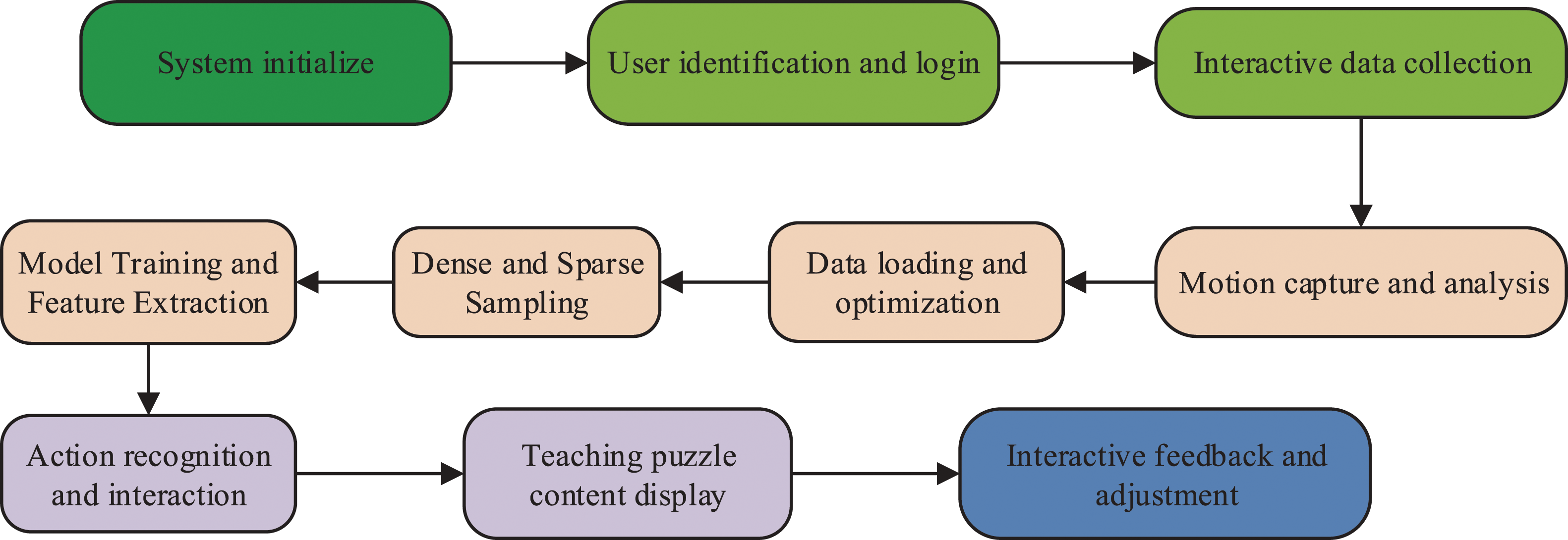






In Figure 7, the interactive technology designed for research is running, where users log in to the system through a VR headset and the system performs identity verification. The Two Stream algorithm is used, and VR videos are captured by devices to collect user action videos. The video conversion is replaced with digital images, and pixel level analysis is performed. Optical flow feature analysis is utilized to reduce dependence on RGB data, and the optical flow values of pixels are calculated and normalized. The data loading method of “read as you go” has been adopted, and online data loading has been implemented. After dense sampling and sparse sampling are performed separately, feature extraction is carried out in the model. The extracted features are used to recognize the interactive actions of the user in the football teaching puzzle game. Based on the user’s action recognition results, the corresponding football teaching content is displayed and real-time feedback is provided, guiding the user to perform correct actions. When the user completes a task or chooses to exit the game, the system saves user data and progress, and closes the VR scene.
Analysis of the effectiveness of interactive technology in football teaching puzzle games under the background of VR technology
Performance testing of interactive technology for football teaching puzzle games under the background of VR technology
Experimental software and hardware environmental parameters.

When conducting analysis, the research method was referred to as VR interaction and compared with recent advanced studies such as Gesture capture and Augmented Reality Interaction.23,24 The training speed of different methods was analyzed, as shown in Figure 8. Training speed analysis. (a) Error, (b) Loss.
In Figure 8, the error and loss values of different methods during training decreased with increasing iteration times. In Figure 8(a), in the error value analysis, the error value of Augmented Reality Interaction decreased rapidly in the first 50 iterations and reached its lowest value at the 149th iteration. The error value of the Gesture capture decreased rapidly between the 30th and 80th iterations and reached its lowest value at the 98th iteration. The error value of VR interaction decreased rapidly and reached its lowest value at the 62nd iteration. In Figure 8(b), in the analysis of loss values, the overall decrease rate of loss values for different methods was relatively close to the case of incorrect values. However, the Gesture capture maintained good training efficiency throughout the entire process, with a relatively balanced rate of error reduction, ultimately reaching its lowest value at the 103rd iteration. The loss value of VR interaction decreased rapidly and reached its lowest value at the 58th iteration. This indicated that the research method had a faster training speed and could provide assurance for faster deployment. The Ucf101 dataset was used to test the processor and graphics card usage of different methods during runtime, as shown in Figure 9. Processor occupancy and graphics card occupancy testing. (a) Processor occupancy, (b) Graphics card occupancy.
In Figure 9, the processor and graphics card usage of different methods fluctuated within a certain range during runtime. In Figure 9(a), in the processor occupancy test, Augmented Reality Interaction had the highest processor occupancy, averaging 87%, with a fluctuation range of about 7%. The minimum processor usage for Gesture capture and VR interaction was relatively close, around 67%, but the maximum processor usage for Gesture capture was even higher, reaching 87%, while VR interaction was only around 83%. In Figure 9(b), in the graphics card occupancy test, the Gesture capture had the highest graphics card occupancy, averaging 86%, with a fluctuation range of around 8%. The average graphics card usage for Augmented Reality Interaction was 78%, with a fluctuation range of around 6%. The graphics card usage of VR interaction fluctuated slightly, with an average of 64% of graphics card usage in 60 seconds. The research method required less hardware load during runtime and relatively lower hardware performance requirements. The amount of cached data generated during runtime was tested, as shown in Figure 10. Cache data generation test. (a) Hmdb, (b) Ucf101.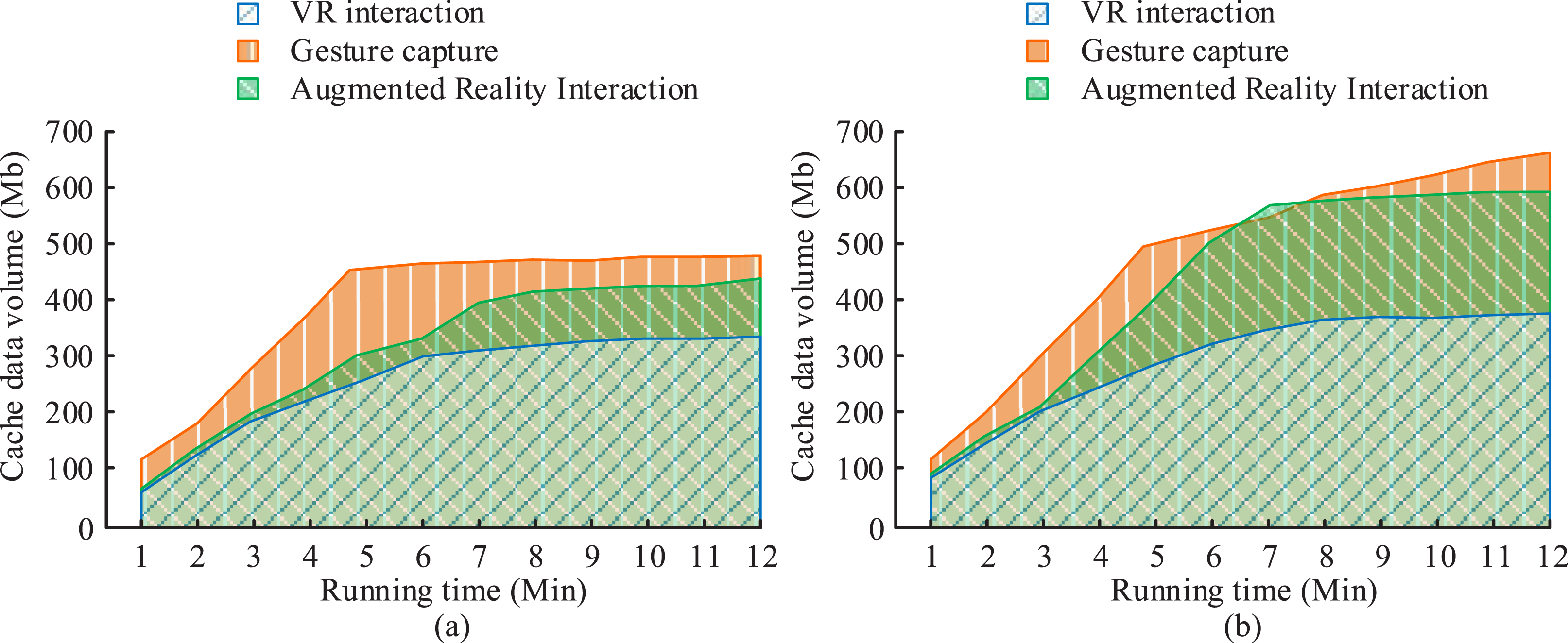
In Figure 10, the amount of cached data generated by different methods increased rapidly in the early stages and gradually stabilized in the later stages. In Figure 10(a), in the Hmdb dataset, the cache data volume of Augmented Reality Interaction did not increase significantly at the 7th minute of operation but reached 436 Mb at the 12th minute. The cache data volume of Gesture capture began to slow down significantly at the 5th minute of operation and reached 482 Mb at the 12th minute. The VR interaction significantly slowed down the growth rate of cached data at the 6th minute, and the cached data at the 12th minute was only 333 Mb. In Figure 10(b), in the Ucf101 dataset, both Gesture capture and VR interaction were significantly affected by the increase in the number of action categories. The cache data volume of Gesture capture reached 662 Mb at the 12th minute of operation. The cache data volume of Augmented Reality Interaction reached 594 Mb at the 12th minute of operation. The VR interaction significantly slowed down the growth rate of cache data at the 8th minute of operation, and the cache data at the 12th minute was only 376 Mb. The research method required less cache data to be generated during runtime, which enabled more efficient and concise completion of interactive tasks. A lower cache data volume meant that the research method consumes less system resources during runtime, which helped improve system stability and response speed, while also reducing hardware requirements.
Analysis of the application effect of interactive technology in football teaching puzzle games under the background of VR technology
To analyze the effectiveness and effects of the interactive technology of the designed football teaching puzzle game in practical scenarios, this study applied the research method in an open outdoor scene and an indoor scene. Select the outdoor artificial turf football field commonly used in football teaching as the application field for open outdoor scenes, and select ordinary decorated indoor rooms as the application field for indoor scenes. In order to ensure the objectivity of the research results and the universality of the experimental results, 20 testers of different heights, body types, and genders were selected for testing in open outdoor and indoor environments. When conducting data indicator analysis, remove abnormal data and calculate the global mean as the test result to ensure the comprehensiveness and scientificity of the experiment as much as possible. The partial action collection results are shown in Figure 11. Action collection results. (a) Open outdoor scene, (b) Indoor scene.
In Figure 11, VR interaction could effectively capture actions in both open outdoor and indoor scenes. In Figure 11(a), in an open outdoor scene, VR interaction accurately determined the body position of users who perform large and fast movements and extracted the user’s body movements based on the collected visual information. In Figure 11(b), VR interaction accurately located the user’s body position in an indoor scene. When the distance between the image capture device and the user was close, resulting in an imbalance in the user’s body proportions in the image, VR interaction still accurately determined the user’s body movements. VR interaction could effectively capture user interaction actions in different scenarios. The recognition accuracy of interactive actions was analyzed, as shown in Figure 12. Accuracy of interactive action recognition. (a) Open outdoor scene, (b) Indoor scene.
In Figure 12, the accuracy of interactive action recognition for different methods was affected by the duration of the action. In Figure 12(a), in an open outdoor scene, the accuracy of interactive action recognition for Gesture capture decreased with increasing action duration, and the recognition accuracy was only around 0.40 when the action duration reached 2500 ms. Augmented Reality Interaction showed an increase in action duration from 500 ms to 1000 ms and then began to decline after exceeding 1000 ms, with the highest recognition accuracy reaching around 0.59. During the process of increasing the action duration from 500 ms to 1500 ms, VR interaction showed an increase, and after exceeding 1500 ms, it began to decrease, with the highest recognition accuracy reaching around 0.87. In Figure 12(b), in indoor scenes, the accuracy of interactive action recognition for Gesture capture increased slightly as the duration of the action increases from 500 ms to 1500 ms and then began to decline after exceeding 1500 ms, with the highest recognition accuracy reaching around 0.65. The changes in the accuracy of interaction action recognition between Augmented Reality Interaction and VR interaction were basically consistent with those in open outdoor scenes. The highest recognition accuracy of Augmented Reality Interaction was around 0.57, and the highest recognition accuracy of VR interaction was around 0.84. The research method could more accurately recognize the user’s actions and provide more accurate interaction results. The time consumption of action recognition using different methods was analyzed, as shown in Figure 13. Time consumption for action recognition.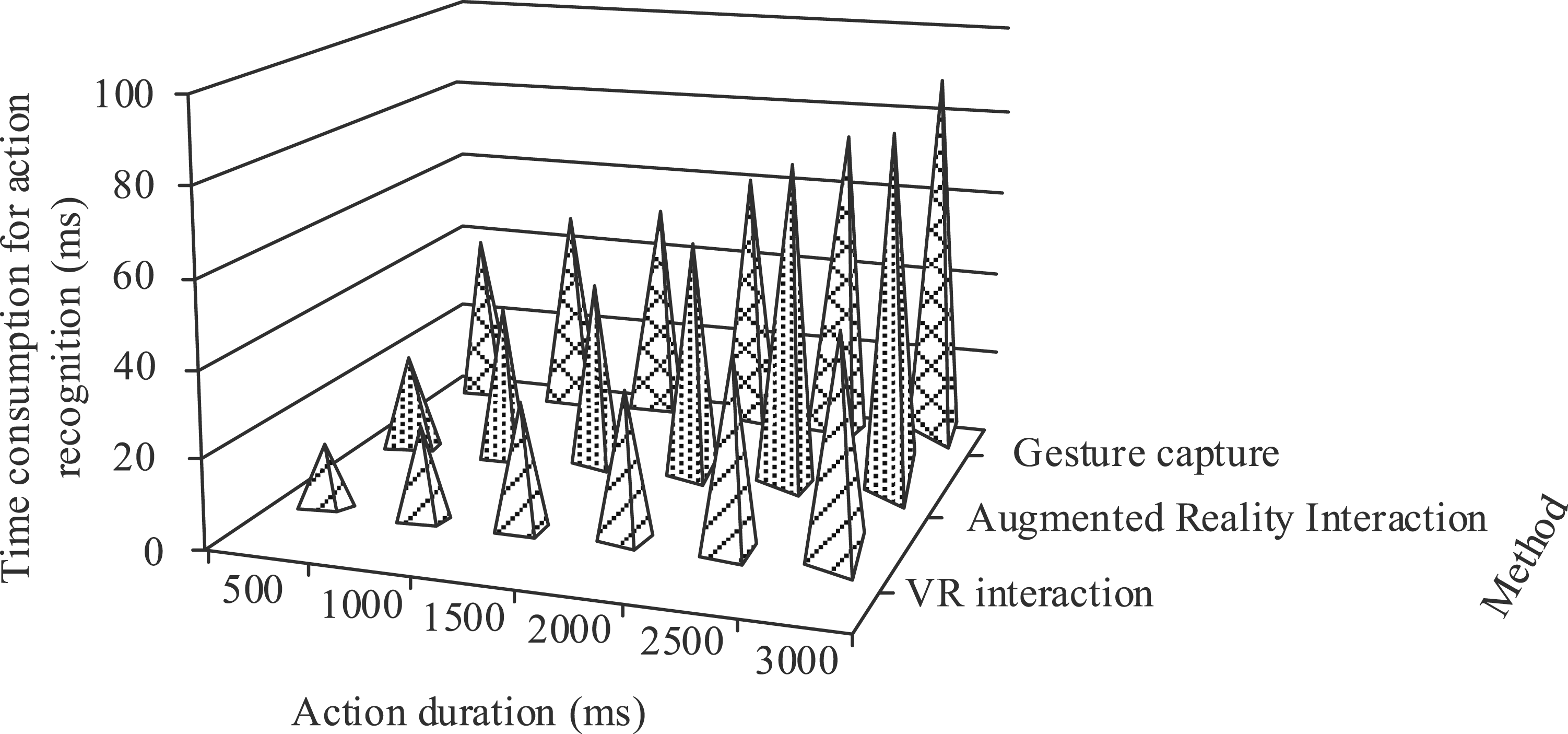
System feedback delay.

In Table 2, there were certain differences in the system feedback delay of the research method for different actions and action design core limbs. Among the 10 actions, 2 actions had a system feedback time delay of over 100 ms, namely, the action with the core limb being the arm for a duration of 1242 ms and the action with the core limb being the foot for a duration of 1397 ms. The system feedback delay for two palm movements with a duration of no more than 1000 ms remained below 90 ms. The research method could maintain the system feedback delay of commonly used body movements in interactive football teaching puzzle games within 200 ms, indicating that the research method could provide users with a good feedback experience during interaction, and could basically ensure that users have a strong sense of instant feedback when using VR devices for interaction.
Conclusion
A research has designed a football teaching puzzle game VR interactive technology that combines action recognition to enrich the means of football teaching. During the process, the user’s behavior and actions are captured through the interactive perception module, and the pointer pointing to the beginning of the video file is used to load online data. The encoding decoding structure is used to analyze different image information. In the processor occupancy and graphics card occupancy tests, the processor occupancy of the research method was only about 83%, and the graphics card occupancy was only about 64%. In action collection and analysis, the research method could effectively collect actions in both open outdoor and indoor scenes; In the analysis of action recognition time consumption, the research method showed that the action recognition time consumption was only 53 ms when the action duration increased to 3000 ms; The research method could maintain the system feedback delay of commonly used body movements during interactive football teaching puzzle games within 200 ms. The research method can ensure high running speed and feedback efficiency in puzzle game interaction, and generate more accurate interaction instructions. However, the research has not yet considered the issues of equipment coordination and security protection when multiple people cooperate. In the future, the characteristics of multiple people using the same scenario meanwhile will be considered to optimize the research method and expand its applicability.
Statements and declarations
Footnotes
Declaration of conflicting interests
The author(s) declared no potential conflicts of interest with respect to the research, authorship, and/or publication of this article.
Funding
The author(s) received no financial support for the research, authorship, and/or publication of this article.