



Abstract
Cultural heritage is a valuable wealth of human civilization, which needs to be effectively protected and inherited. Knowledge graph is a technology capable of representing and reasoning about complex knowledge, which can provide powerful support for the digitization, intelligence and revitalization of cultural heritage. This paper discusses the methods and effects of the development and analysis of the cultural heritage protection and inheritance platform based on knowledge graph, which mainly includes the following aspects: (1) Introducing the concepts, characteristics, and application fields of knowledge graph, and analyzing the roles and values of knowledge graph in the protection and inheritance of cultural heritage; (2) designing the architecture and functions of a cultural heritage protection and inheritance platform based on knowledge graph, which include four modules of knowledge graph construction, query, application, and update, introduced the technical principle and realization method of each module, respectively, and demonstrated the interface and operation flow of the platform; (3) evaluated the effect and performance of the platform, and carried out experimental design and result analysis from four aspects of the construction, query, application, and update of the knowledge graph, which proved the feasibility and validity of the platform; and (4) discussed the platform’s innovation points and advantages of the platform, analyzed the theoretical and practical significance of the platform, pointed out the shortcomings and room for improvement of the platform, and looked forward to the development prospects and application scenarios of the platform. The method and effect of the development and analysis of the platform for the protection and inheritance of cultural heritage based on knowledge graph proposed in this paper provide a new idea and way for the digital protection and inheritance of cultural heritage, as well as a new paradigm and case for the research and application of knowledge graph, which has certain academic value and social significance.
Keywords
Introduction
Cultural heritage refers to the tangible and intangible cultural achievements created by human societies in the course of historical development, which reflect the cultural diversity and creativity of humankind and are an important part of human civilization. Cultural heritage includes two categories, tangible cultural heritage and intangible cultural heritage. Tangible cultural heritage refers to buildings, ruins, cultural relics, landscapes, and so on, which have historical, artistic and scientific values, while intangible cultural heritage refers to languages, scripts, music, dances, dramas, handicrafts, folklore, and so on, which have historical, cultural, and social values. Cultural heritage is the valuable wealth of the Chinese nation and the common heritage of human civilization, and is of great significance in strengthening national self-confidence, promoting cultural exchanges, and advancing social development.
In China’s 5000-year history, countless cultural heritages have been handed down. However, cultural heritage is facing threats and challenges from various aspects, such as natural disasters, human destruction, environmental pollution, tourism development, lack of information, and faulty inheritance, leading to its destruction, loss, decline, and extinction.1,2 Therefore, how to effectively protect and pass on cultural heritage is an urgent problem to be solved. With the development of information technology, digitalization, intelligence and visualization provide new ideas and methods for the protection and inheritance of cultural heritage. Digitization refers to the conversion of data and information of cultural heritage into digital format to achieve long-term preservation, wide dissemination and convenient access to cultural heritage. Intellectualization refers to the use of artificial intelligence, big data, cloud computing, and other technologies to analyze, mine, and reason about the data and information of cultural heritage, so as to realize the knowledge discovery, value mining, and intelligent service of cultural heritage. Visualization refers to the use of virtual reality, augmented reality, three-dimensional reconstruction, and other technologies to graphically, dynamically, and interactively present the data and information of cultural heritage, so as to realize the real reproduction, immersive experience, and emotional resonance of cultural heritage.3,4 The various impact factor percentages are shown in Figure 1. Percentage of various influencing factors.
Knowledge graphs stand as a pioneering technology in the realm of knowledge representation and administration. They ingeniously depict entities, their attributes, and interconnections through a graphical schema, while encoding knowledge within logical frameworks, harnessing inference mechanisms for knowledge derivation and validation, and employing query languages to facilitate knowledge retrieval and practical implementation. Endowed with the attributes of structure, semantic richness, and inherent intelligence, these graphs excel in harmoniously integrating, organizing, and leveraging vast, diverse datasets and knowledge repositories. This capability renders them instrumental in tackling intricate challenges across myriad disciplines. In the domain of cultural heritage, knowledge graph technology harbors immense potential, promising a unified, holistic blueprint, and operational platform for the digital transformation, intellectual enrichment, and visual manifestation of our historical treasures. By seamlessly weaving together disparate threads of information, it paves the way for advanced understanding, preservation, and dissemination of humanity’s cultural legacy, thereby safeguarding our collective memory for posterity.
This paper proposes a knowledge graph-based cultural heritage protection and inheritance platform, which uses knowledge graph technology to organize, represent, and reason about data and knowledge of cultural heritage.5,6 The main contributions and innovations of this paper are as follows: (1) A knowledge graph covering tangible and intangible cultural heritage is constructed, and the concepts, attributes, and relationships of cultural heritage are formally defined and described using ontologies and rules, which realizes the structured and semantic representation of cultural heritage. (2) A query and reasoning system for cultural heritage based on knowledge graph is designed, which utilizes a graph database and reasoning engine for efficient storage and management of the knowledge graph, provides a query language based on SPARQL and a rule language based on SWRL, and realizes intelligent retrieval and reasoning of cultural heritage. (3) Virtual reality, augmented reality, 3D reconstruction, and other technologies are used to present the knowledge graph graphically, dynamically, and interactively, realizing the real reproduction, immersion experience, and emotional resonance of cultural heritage. The main framework of the model is shown in Figure 2.7,8 Main framework of the model.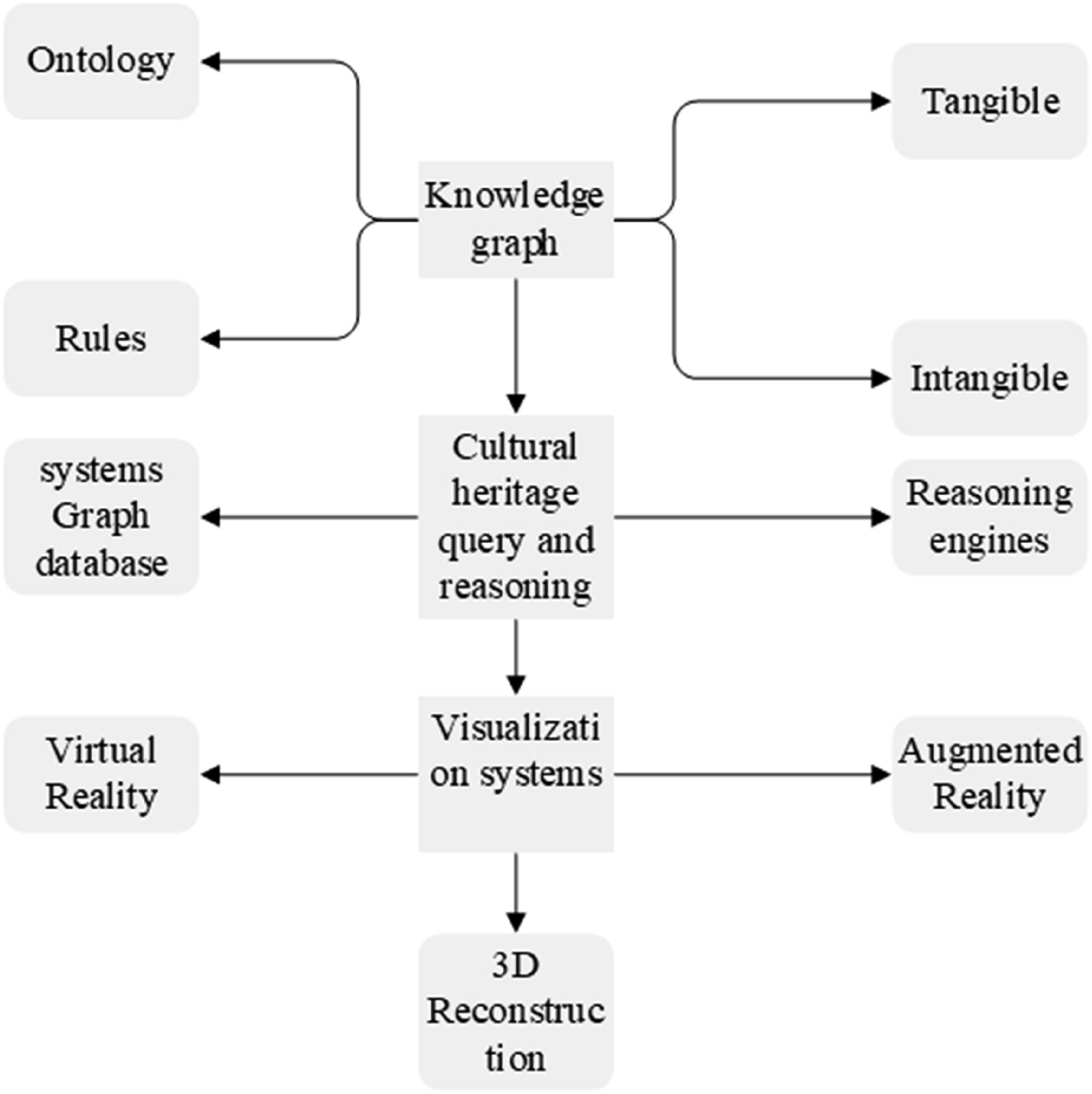
The innovation of this paper is that the paper introduces knowledge graph technology into the field of cultural heritage, and by analyzing the concept and characteristics of knowledge graph and its role and value in cultural heritage protection and inheritance, it puts forward an innovative application model that demonstrates the potential of knowledge graph in promoting the digitization, intellectualization, and revitalization of cultural heritage. A platform for cultural heritage protection and inheritance based on knowledge graph is designed, which contains four core modules: knowledge graph construction, query, application, and update. By elaborating the technical principles and realization methods of each module and showing the platform interface and operation flow, the thesis not only proposes a set of systematic solutions but also verifies the possibility of their realization. Through the experimental design and result analysis, the effect and performance of the platform are evaluated from the four aspects of knowledge graph construction, query, application, and updating, which empirically proves the feasibility and effectiveness of the platform, and provides a reference for quantitative evaluation of similar research.
Literature review
At present, the heat and research literature about cultural heritage protection are gradually rising, and the specific data are shown in Figure 3. Guidi et al.
9
introduced General Secretary Xi Jinping’s important instructions on the protection and inheritance of cultural heritage, as well as the progress and effectiveness of China’s cultural heritage digitization, intelligence, and visualization in recent years, demonstrating the charm and value of Chinese civilization. Heat of cultural heritage preservation and amount of research literature.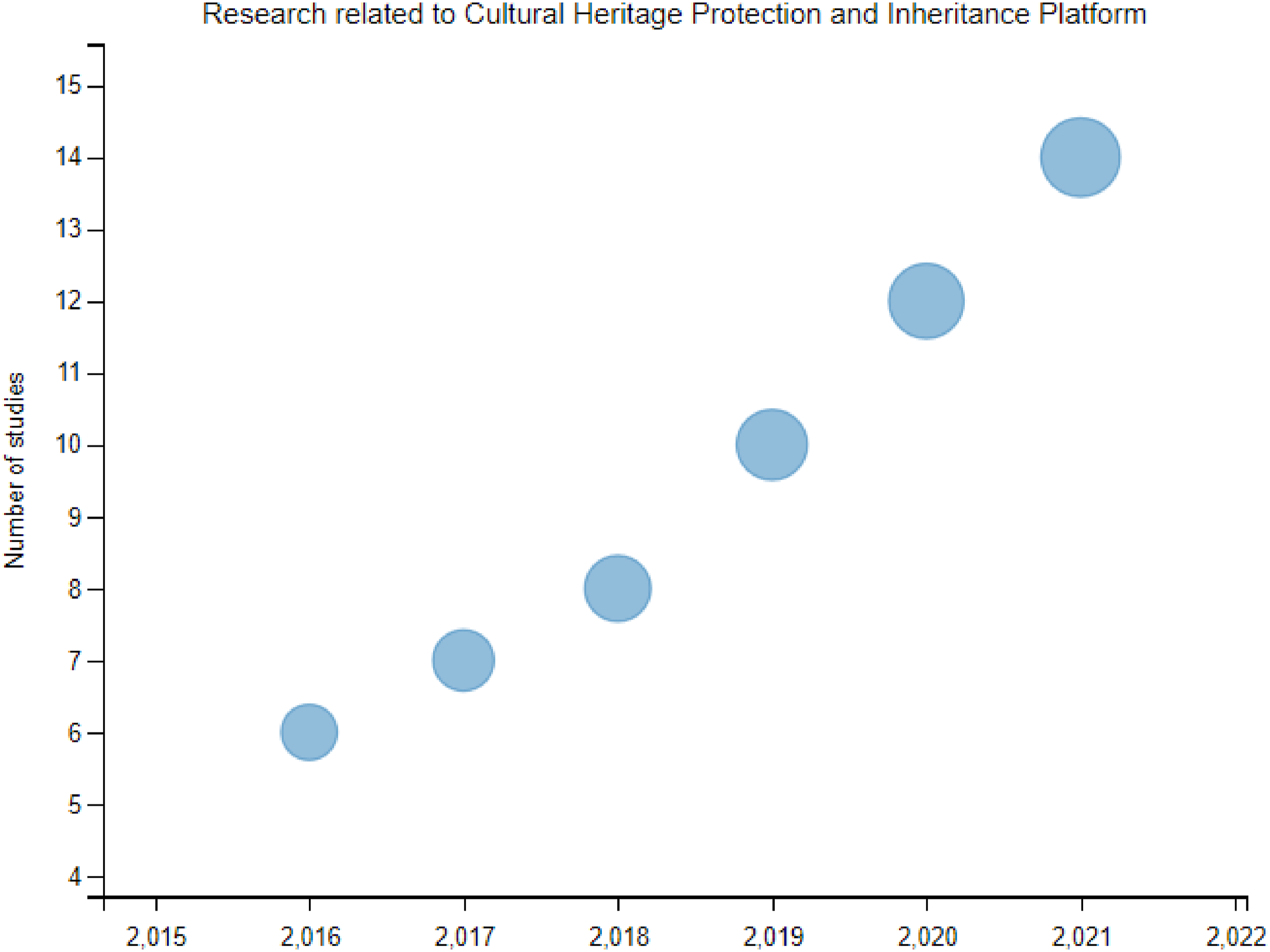
Li et al. 10 introduced 30 cases of digital innovation practice in culture and tourism selected by the Ministry of Culture and Tourism, including cultural heritage scenic spots such as the Xi’an City Wall and the Longmen Grottoes, Li et al., 11 a knowledge service platform for cultural heritage based on knowledge graph is realized, which takes cultural heritage knowledge graph as the core, provides SPARQL-based query language and SWRL-based rule language, realizes the retrieval and reasoning of cultural heritage knowledge, and at the same time makes use of virtual reality, augmented reality, three-dimensional reconstruction, and other technologies to make a graphical, dynamic, and interactive presentation, where real reproduction, immersion experience, and emotional resonance of cultural heritage were realized. The article introduces a knowledge management method of intangible cultural heritage based on Linked Data, including the collection, conversion, storage, and distribution of intangible cultural heritage data, as well as the query and reasoning of intangible cultural heritage knowledge, which realizes the digitization and intelligence of intangible cultural heritage. An innovative achievement of Beijing Normal University is introduced, which is the application of information technology, the establishment of a new cultural heritage protection method, the solution of the key technology of digital protection and inheritance of cultural relics, the realization of accurate modeling and virtual restoration of cultural relics, and the formation of a series of technical standards for the digital protection of cultural resources. It discussed the importance and difficulties of digital protection and inheritance of intangible cultural heritage, put forward the concept and mechanism of digital living inheritance of intangible cultural heritage, and focused on the digital protection of the inheritors, including the digital construction of the information of the inheritors and the digital construction of the knowledge of the inheritors. A research on digital protection and inheritance of cultural heritage based on knowledge mapping is proposed, which utilizes knowledge mapping technology to organize, represent, and reason about the data and knowledge of cultural heritage, realizing the digitization, intelligence, and visualization of cultural heritage, and providing effective support for the protection, inheritance, research, and utilization of cultural heritage. Ren et al. 12 researched the knowledge fusion and application method of ICH knowledge based on knowledge graph, including the acquisition, integration, extension, and utilization of ICH knowledge, realized the cross-domain, cross-lingual, and cross-media fusion of ICH knowledge, as well as the application of ICH knowledge such as visualization, recommendation, and education. Guan et al. 13 researched the method of visualization and display of cultural heritage knowledge based on knowledge graph, including graphical representation, dynamic demonstration, and interactive exploration of cultural heritage knowledge, and made use of virtual reality, augmented reality, three-dimensional reconstruction, and other technologies to carry out multi-dimensional, multi-level, and multi-form visualization and display of cultural heritage knowledge, which improves the dissemination effect and user experience of cultural heritage knowledge. 14 A knowledge service platform for intangible cultural heritage based on knowledge graph is designed and realized, which is based on knowledge graph of intangible cultural heritage and provides functions of querying, reasoning, visualization, recommendation, and education of knowledge of intangible cultural heritage, and provides a new way of thinking and methodology for the protection, inheritance, research, and utilization of intangible cultural heritage.
Platform design and development
The aim of this paper is to design and develop a cultural heritage protection and inheritance platform based on knowledge graph, which is capable of organizing, representing, querying, reasoning, visualizing, and displaying tangible and intangible cultural heritage data and knowledge to realize the digitization, intelligence, and revitalization of cultural heritage. The main contents of the system design include the following aspects 15 :
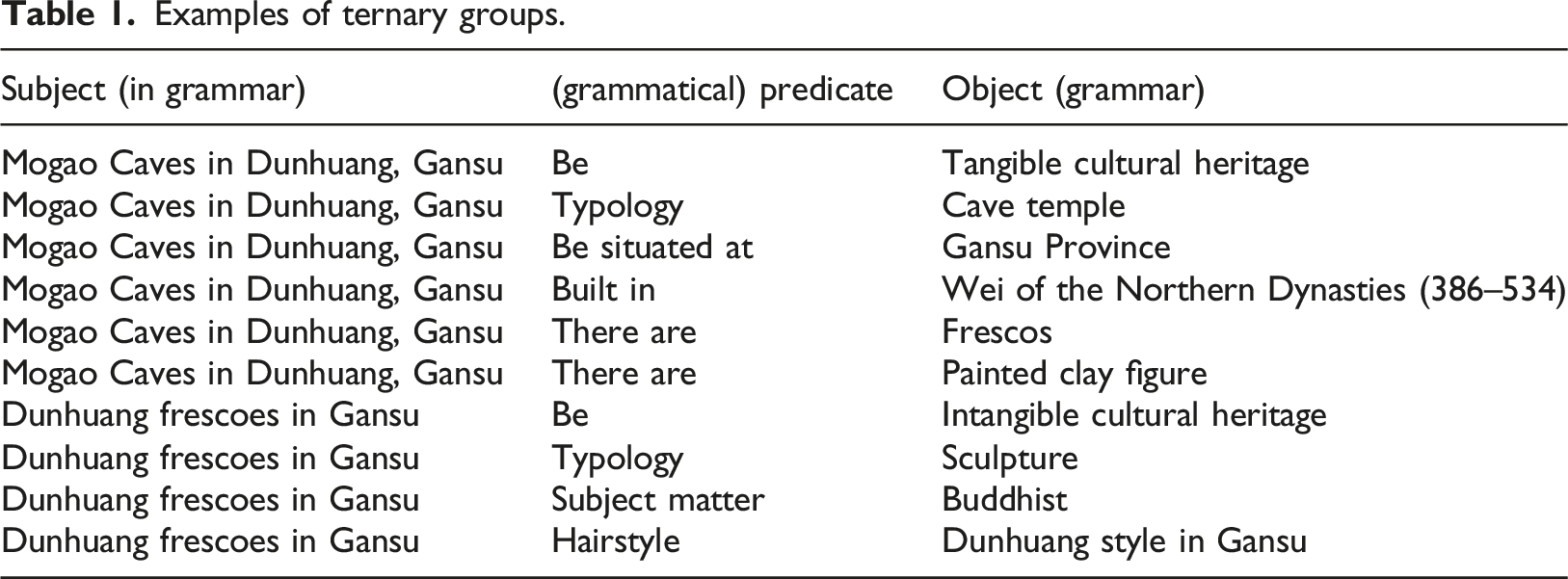
Examples of ternary groups.
Ontologies and rules.

Specific patterns of reasoning.

Platform assessment
Experimental design
The purpose of this paper is to deeply explore and practice the construction method of the cultural heritage protection and inheritance platform based on knowledge graph technology and its effect analysis. In order to comprehensively verify the feasibility and effectiveness of the platform in practical applications, we have carefully designed and implemented experiments in four key areas: first, in Experiment 1, we focus on the assessment of the effect of knowledge graph construction. The industry-recognized accuracy rate, recall rate, and F1 value are used as metrics to quantitatively assess the quality and coverage of the platform’s automatically constructed cultural heritage knowledge graph. We compare the knowledge map automatically generated by the platform with the standard knowledge map manually annotated by experts, and visualize the effectiveness and precision of the platform in the process of constructing the knowledge map by calculating the specific values of each index. Secondly, experiment 2 centers on the evaluation of knowledge graph query effect.25,26 Core indicators such as response time, correct rate, and user satisfaction are selected to comprehensively evaluate the performance of the knowledge graph query service provided by the platform and its user experience. A series of query tasks of varying complexity and diverse types are designed to test the response speed of the platform to query requests, the accuracy of retrieval results, and the real feedback of users, so as to reflect the practicality and friendliness of the platform’s query function. Furthermore, experiment 3 conducted an exhaustive examination of the effect of the actual application scenarios of knowledge graph. Operational data such as click rate, conversion rate, and retention rate are used to judge the attractiveness and intrinsic value of various cultural heritage applications (e.g., personalized recommendation system, intelligent guide service, and online Q&A module) Developed based on the knowledge graph. Statistics on the number of clicks, registration conversions, and the persistent participation of active users in the process of user interaction are used to confirm the effectiveness of the platform’s application innovation and its social impact. Finally, Experiment 4 focuses on the study of the updating and maintenance effect of the knowledge graph. The three dimensions of update time, update frequency and update quality are chosen to examine the platform’s ability to dynamically maintain and real-time update the knowledge graph and its reliability. The platform regularly collects and integrates the latest cultural heritage-related data information and measures the data update speed, cycle regularity, and accuracy of new content, so as to verify the platform’s efficient update capability and robust stability in meeting the challenge of continuous updating of the knowledge graph.31,32
Experimental results
Experimental results.
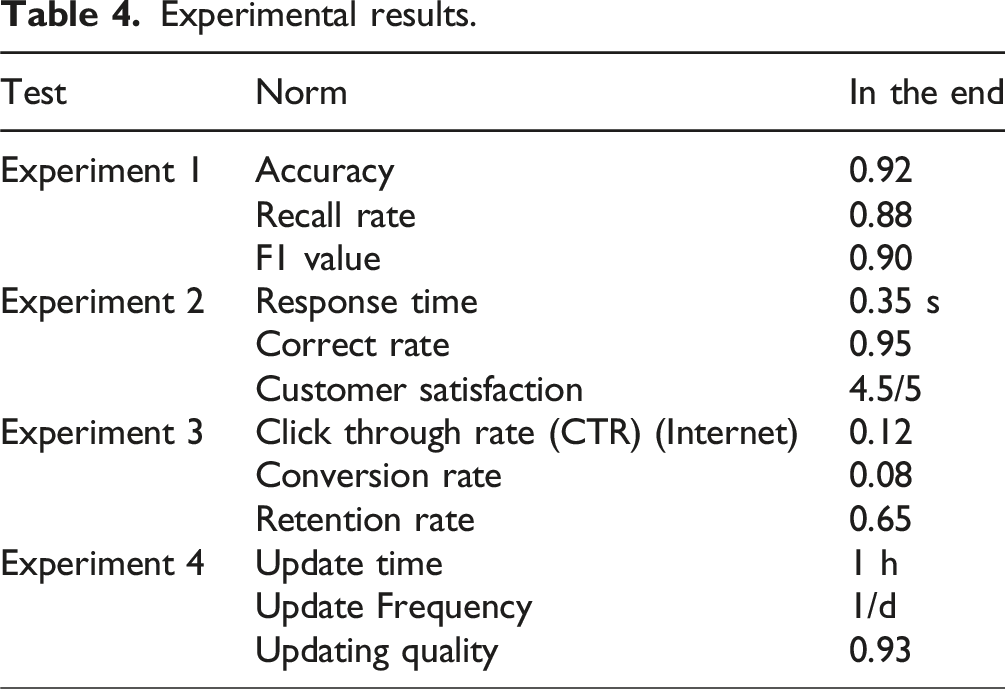
As can be seen from Table 4, the development and analysis of the cultural heritage protection and inheritance platform based on knowledge graph proposed in this paper is more satisfactory.33,34 It can effectively construct, query, apply, and update the knowledge graph of cultural heritage, which provides a strong support for the digital protection and inheritance of cultural heritage. In the following, we will analyze and discuss the results of each experiment in detail. 35
Conclusion
This paper discusses the methods and effects of the development and analysis of the cultural heritage protection and inheritance platform based on knowledge graph, introduces the concepts, characteristics and application fields of knowledge graph, analyzes the role and value of knowledge graph in cultural heritage protection and inheritance, and points out that knowledge graph can provide effective technical support and solutions for the digitization, intellectualization, and revitalization of cultural heritage. This article designs the architecture and functions of a platform for cultural heritage protection and inheritance based on knowledge mapping, including four modules: construction, query, application, and update of knowledge mapping, introduces the technical principles and realization methods of each module respectively, and demonstrates the platform’s interface and operation flow. The article evaluates the effect and performance of the platform, adopting the indicators of accuracy, recall, F1 value, response time, correctness, user satisfaction, click rate, conversion rate, retention rate, update time, update frequency, and update quality, and carries out the experimental design and result analysis from the four aspects of knowledge graph construction, querying, application, and updating, which proves the feasibility and effectiveness of the platform.
The method and effect of the development and analysis of the cultural heritage protection and inheritance platform based on knowledge graph proposed in this paper provide a new idea and way for the digital protection and inheritance of cultural heritage, as well as a new paradigm and case for the research and application of knowledge graph, which has certain academic value and social significance. The research in this paper still has some shortcomings and limitations, such as the scale, quality, diversity, and dynamics of the knowledge graph still need to be improved; the function, performance, stability, and security of the platform still need to be optimized; and the application, promotion, and evaluation of the platform still need to be deepened. Future research can be expanded and improved in the following aspects: expanding the data source and domain scope of the knowledge graph, increasing the type, quantity and dimension of cultural heritage, and improving the coverage and richness of the knowledge graph. Introducing more knowledge representation and reasoning methods, such as ontology, rules, and logic, to improve the expressive and reasoning ability of knowledge graph.
Statements and declarations
Footnotes
Conflicting interests
The author(s) declared no potential conflicts of interest with respect to the research, authorship, and/or publication of this article.
Funding
The author(s) received no financial support for the research, authorship, and/or publication of this article.