



Abstract
To address the uncertainties and complexities inherent in planning and designing tourist attraction facilities—challenges that traditional methods struggle to manage—this study utilizes fuzzy logic (FL) algorithms within artificial intelligence (AI) technology. Focusing on the planning of first aid facilities at tourist attractions, the research develops an FL reasoning system. The system’s performance is evaluated using mean squared error (MSE) and mean absolute error (MAE) as key indicators. Key data features can be extracted by preprocessing operations such as data cleaning and normalization on the collected historical data of tourist attractions, and the fuzzy sets and corresponding membership functions of input and output variables can be determined. A fuzzy rule library can be constructed using historical data and professional knowledge, and a fuzzy inference machine can be used to infer the fuzzy set of input variables based on fuzzy rules to obtain predicted results and perform deblurring transformation to output actual results. The research highlights the significant value of the FL system in optimizing the planning of emergency facilities in tourist attractions. The experiment demonstrated that the system achieved mean squared error (MSE) and mean absolute error (MAE) values of 1.90 and 1.10, respectively. These results underscore the system’s strong applicability and effectiveness, providing a reliable tool for enhancing emergency planning and ensuring safety in high-traffic areas.
Keywords
Introduction
With the booming development of the global tourism industry, the planning and design of tourist attraction facilities play an increasingly important role in improving tourist experience, ensuring tourist safety, and promoting sustainable development of scenic spots.1,2 The strong development potential and market demand of the tourism industry have greatly increased people’s requirements for tourism quality and service levels. Tourists’ needs are no longer limited to basic sightseeing but are more focused on personalization, experience, and safety. As the main carrier of tourism activities, the planning and design of tourist attractions’ facilities are directly related to tourists’ satisfaction and loyalty, which in turn affects the overall image and competitiveness of tourist attractions. The planning and design of tourist attraction facilities is a complex system engineering that involves many fields such as infrastructure construction, transportation route planning, safety and emergency facilities, and ecological environment protection. It requires scientific and reasonable plans to implement the expected goals of facility planning.3,4
In the planning of tourist attraction facilities, infrastructure construction is a fundamental task. The complete infrastructure includes lanes, pedestrian walkways, parking lots, public restrooms, tourist rest areas, and dining and shopping areas. It requires a comprehensive evaluation of multiple factors such as the geographical location, geomorphic features, number of tourists, and changes in peak and off seasons of tourist attractions, in order to provide tourists with a comfortable and convenient travel environment. 5 In addition, the reasonable configuration of safety first aid facilities is also crucial. Tourist attractions, especially natural landscape scenic spots, often face the threat of sudden situations such as geological disasters and tourist distress. The article took natural scenic spots as an example. Scenic spots attract a large number of tourists with their beautiful natural scenery. During peak hours, due to the uneven distribution of emergency stations in scenic spots and the fact that some stations are far away from the main tourist routes, coupled with traffic congestion, it is difficult for emergency vehicles to arrive at the scene quickly. In addition, the first aid equipment is also insufficient. These planning omissions not only seriously affect the lives and safety of tourists but also cause immeasurable damage to the reputation of the scenic spots. Scientific planning and layout of emergency facilities, as well as the establishment of a sound emergency rescue system, are of great significance for ensuring the safety of tourist life and property. 6 Transportation organization and passenger flow guidance are also important aspects that cannot be ignored in the planning of tourist attractions. On the one hand, the reasonable setting of tourist routes within the scenic area can guide tourists to flow in an orderly manner and alleviate local congestion in the scenic area. On the other hand, the improvement of peripheral transportation facilities such as tourist distribution centers and bus transfer stations in scenic areas has a positive effect on alleviating traffic pressure and enhancing the travel experience of tourists. Overall, the planning and design of tourist attraction facilities is a systematic project that needs to fully consider multiple factors such as tourist experience, safety assurance, traffic organization, and ecological protection. Scientific and reasonable planning schemes can be formulated based on the conditions of the scenic area itself, in order to achieve sustainable development of tourist attractions.7,8 In the planning of scenic spot facilities, different types of scenic spots need to adopt targeted special consideration strategies. For natural landscape scenic spots, special attention should be paid to geological disaster risks and tourist hiking route planning; for cultural scenic spots, it is necessary to pay attention to cultural heritage protection. In the face of different types of scenic spots, scientific and effective planning strategies should be adopted to achieve the reasonable configuration of facilities and full guarantee of tourist safety.
FL algorithm, as a specialized tool for handling uncertainty and fuzziness, belongs to an important branch of AI technology in soft computing.9,10 The application of FL algorithm in the planning and design of tourist attraction facilities can demonstrate the unique advantages of FL algorithm. 11 Fuzzy logic algorithms can effectively deal with uncertainties in tourism planning. There are significant uncertainties in various factors affecting the planning of tourist attractions and facilities. By introducing membership functions and fuzzy sets, fuzzy logic allows elements to belong to a certain set to a certain extent, rather than the traditional either-or dichotomy, and can more flexibly deal with these uncertainties and develop planning schemes that are closer to the actual situation. The planning of tourist attractions and facilities is a dynamic process that needs to be constantly adjusted and optimized according to the actual situation. By constructing a decision-making system based on fuzzy rules, the fuzzy logic algorithm can automatically adjust the output when facing new inputs or changes in conditions, thereby achieving dynamic optimization of the planning scheme. The main function of FL algorithm is to use fuzzy sets and fuzzy rules to transform complex and ever-changing practical situations into actionable decision plans. 12 FL algorithms can be used to fuzzify the actual planning data of tourist attractions, and output results based on fuzzy rules, which can provide planners with more comprehensive data analysis. Fuzzy rules can be used to comprehensively consider various factors, such as tourist density, scenic spot danger, and historical accident data, and conduct a comprehensive evaluation from multiple perspectives; FL systems can process data in real-time, dynamically adjust facility planning and design schemes, and improve emergency response capabilities; through scientific facility planning and design, FL algorithms can effectively improve overall tourist satisfaction and enhance the visibility and competitiveness of tourist attractions.
Related work
The planning and design of tourist attraction facilities have played a very important role in improving tourist experience, environmental protection, promoting local economic development, and cultural and educational inheritance. Currently, there have been extensive discussions among researchers. Xiao proposed an improved random walk algorithm for planning reasonable tourist travel routes, using a combination of gray entropy decision model and mobile computing to solve the problem of difficult new route recommendation. 13 Qin optimized the algorithm flow of support vector machine (SVM) using Grey Wolf Optimizer (GWO) algorithm based on big data algorithm. He used the GWO-SVM model to conduct data mining analysis on the planning and development imagery of tourist attractions, and concluded that amusement facilities, various scenic spots, and preferential measures are important ways to improve the tourism experience. 14 Ye studied landscape planning and design based on urban forest park trails. 15 Wu designed a method based on Geographic Information System (GIS) technology to analyze three-dimensional data of urban landforms and establish corresponding models to provide real-time suggestions for urban planning problems. 16 Song et al. proposed an algorithm based on FL and improved ant colony optimization for dynamic path planning of unmanned vehicles. 17 Liu et al. reviewed the location of emergency facilities in transportation networks and summarized and classified the emergency facility site selection models. 18 Although the current algorithm performs well in optimizing tourist routes and scenic spot layouts, the comprehensive consideration of facility planning is still insufficient. The application of the above algorithm is still weak in the planning of safety and first aid facilities in scenic spots.
To solve this problem, this article combines FL algorithm with scenic spot facility planning and determines the planning objectives by analyzing the actual problems of scenic spot emergency facility planning. The evaluation indicators can be determined by analyzing tourist density and mobility, accessibility of transportation roads and vehicles, and the probability of unexpected events. Based on the evaluation indicators, a FL system can be constructed. This article sets the fuzzy set and corresponding membership functions for each evaluation indicator, designs a set of fuzzy rules based on the evaluation indicators, and constructs a fuzzy rule library. FL algorithm can be used to infer the rule base, calculate the fitness level of emergency measures planning for each area of the scenic area, and finally output the optimal emergency measures planning scheme and coverage range based on the inference results. This article compares the fuzzy logic algorithm with the decision tree model, linear regression model, and support vector machine. Experiments show that the fuzzy logic system based on the fuzzy logic algorithm constructed in this paper has better applicability.
Method
Determine planning objectives and evaluation indicators
Determining planning goals is the primary step in all plans, and the planning of emergency facilities for tourist attractions is even more so. For emergency facility planning, the primary planning goal is to improve the emergency response speed within scenic spots and maximize the coverage of emergency facilities. Rapid emergency response speed is one of the important guarantees for tourist safety during tourism. In case of emergencies, timely emergency measures can minimize the personal safety accidents and property losses caused by emergencies. The specific goal of improving emergency response speed is to reduce emergency response time and improve the response efficiency of emergency teams.
Due to the varying density and mobility of tourists in different regions within the scenic spot, the planning of emergency facilities needs to take into account the impact of these factors. The wider the coverage of emergency facilities, the greater the chance for tourists to receive emergency services in case of emergencies. The specific goal of the current coverage of first aid facilities is to achieve full coverage of first aid facilities, ensuring that each area of the attraction has corresponding first aid measures, and covering every tourist of the attraction in all directions without blind spots. Based on factors such as tourist density, foot traffic, and scenic area distribution, the layout of emergency facilities can be reasonably optimized, striving to use the most suitable resources to achieve full coverage of emergency facilities.
The current planning mainly focuses on improving the emergency response speed and achieving full coverage of emergency facilities to maximize the safety of tourists. However, ignoring tourists’ direct feedback on the layout, convenience and perceived quality of emergency facilities may weaken the overall effectiveness of the planning scheme to a certain extent. Therefore, it is necessary to incorporate user experience research into the framework of emergency facility planning, and use scientific and rigorous methods to collect and analyze the actual needs and evaluations of tourists. We can continuously adjust and optimize the layout of emergency facilities and service processes, gradually establish a more efficient, convenient, and humanized emergency service system, and provide tourists with a safer and more comfortable travel environment.
In order to achieve the goals of emergency facility planning, it is necessary to determine evaluation indicators, which are used to measure the effectiveness and implementation effect of the emergency facility planning plan. Three evaluation indicators are set for the emergency facility planning goals: tourist density, accessibility of transportation, and probability of unexpected events. 19 The density of tourists is directly related to the frequency of facility use and the accuracy of demand forecasts; traffic accessibility is an important measure of the convenience of tourists to reach attractions and facilities, affecting the distribution of tourist flow and the tour experience; the probability of emergencies is related to tourist safety and emergency response capabilities and is an indispensable risk assessment dimension in facility planning and design. Through data quantification and comprehensive analysis, these three indicators can provide a scientific and comprehensive decision-making basis for facility planning, ensuring that the planning scheme not only meets the needs of tourists but also takes into account safety and efficiency, and its selection is highly credible and practical. The density of tourists reflects the density of tourist distribution within the scenic spot. Areas with high tourist density are more prone to emergencies and require the deployment of emergency facilities. Specific indicators are calculated by analyzing historical tourist data of scenic spots or conducting field investigations to calculate the average tourist density in each area of the scenic spot. The accessibility of transportation is mainly reflected in the distribution of transportation routes within tourist attractions. It directly affects the arrival time of the first aid team and the efficiency of the use of first aid facilities. The higher the accessibility of transportation, the higher the likelihood of setting up first aid facilities and receiving first aid services in areas. Transportation accessibility can be determined by analyzing the coverage and operating frequency of public transportation within tourist attractions to determine the transportation accessibility of various areas within the tourist attraction. The probability of emergency situations occurring in various areas within tourist attractions is an important reference for the planning of safety first aid facilities. In areas with high incidence of emergencies, it is usually necessary to equip more emergency resources. To evaluate the probability of unexpected events occurring in different areas of the scenic area, multiple factors such as historical accident data, terrain characteristics, and tourist flow can be comprehensively analyzed. In order to further improve the scientificity and practicality of emergency facility planning, environmental factors are considered and incorporated into the evaluation index system. In different seasons and weather conditions, tourists’ activity patterns and emergency needs may change; the environmental and geomorphological characteristics of scenic spots are also important factors affecting the planning of emergency facilities. Comprehensive consideration of various evaluation indicators can more comprehensively and scientifically evaluate the planning effect of emergency facilities in tourist attractions and provide strong support for the scientific and reasonable planning scheme.
The determination of evaluation indicators for the planning of emergency facilities in scenic areas helps to comprehensively evaluate the emergency needs and resource distribution status of each area within the scenic area, thus formulating more scientific and effective emergency rescue plans. By comprehensively considering multiple indicators such as tourist density, transportation accessibility, and the probability of unexpected events, it can gain a more comprehensive understanding of the actual demand for emergency facilities in different areas of the scenic area and optimize the spatial allocation of emergency resources. Reasonable layout of safety and first aid facilities in tourist attractions requires a comprehensive assessment of the distribution of emergency risks within the scenic area, taking into account factors such as the number of tourists and transportation conditions in each region, in order to maximize the satisfaction of the emergency rescue needs of tourists within the scenic area. A scientifically sound evaluation index system can provide reliable decision-making references for the planning of emergency facilities in scenic areas, effectively enhancing the emergency response capabilities of scenic areas in case of emergencies, and maximizing the protection of tourist life and property safety.
Data preprocessing
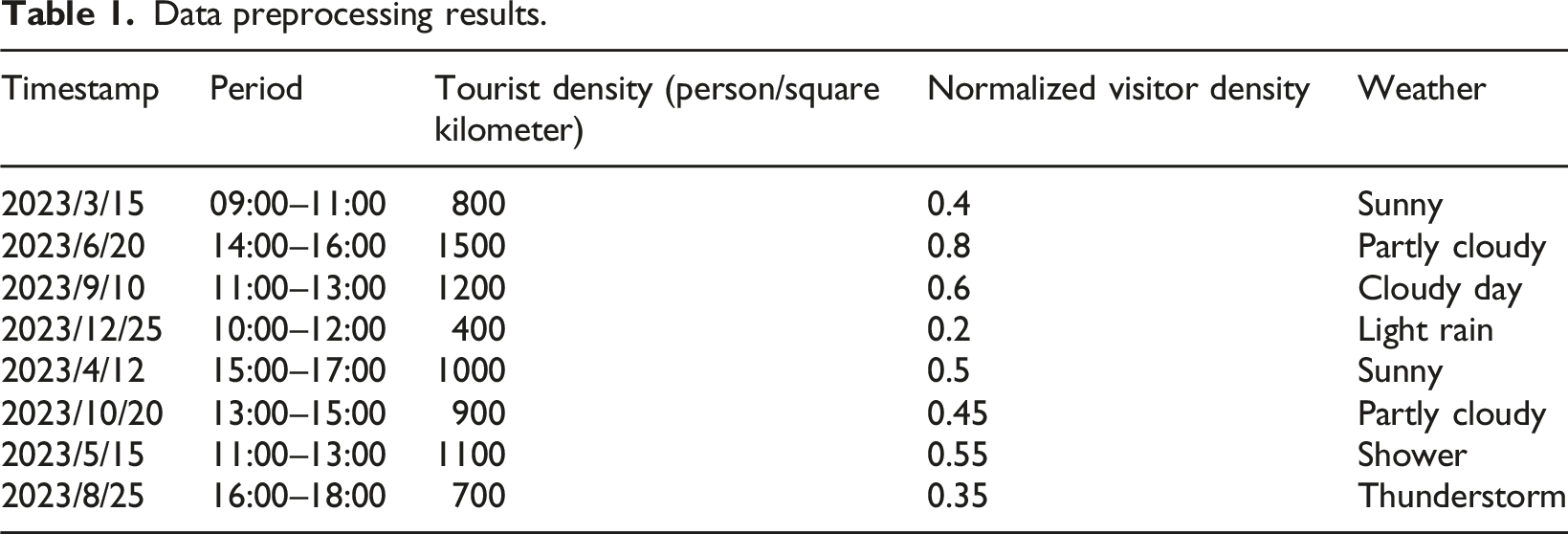
In order to facilitate subsequent FL data analysis, it is necessary to preprocess the collected raw data of scenic spots. Data preprocessing is a crucial step in the data analysis process, with the main purpose of transforming raw data into data suitable for model training and analysis, in order to improve the performance and accuracy of the model. 20 Preprocessing operations can improve data quality, enhance model performance, simplify data structures, and eliminate data biases. The main operations of data preprocessing include data cleaning, data normalization, data transformation, feature engineering, data integration and transformation, and data dimensionality reduction. This article mainly preprocesses tourist data, traffic data, and historical data of scenic spot emergencies.
In the data cleaning stage, for cases where some data values may be missing in the collected dataset, the mean interpolation method is used to fill in the missing data values by using the mean of the data features, reducing data bias,
21
and maintaining the overall trend of the data. The following is a formula:




The standard score method considers eigenvalues with an absolute value greater than a certain threshold as outliers. 22 For the detected outliers, the mean interpolation method is used to process them, and the feature mean is used to replace the outliers.
Due to the presence of multiple different datasets in this study, the measurement units and scales of the features in the datasets are different, which may lead to biases in the distribution of the data and affect the results of FL system analysis. In order to eliminate the differences between data features in different datasets and enable each feature to be applied to training FL systems, data normalization is required. Data normalization is a common data preprocessing technique that maps data to specific ranges through mathematical transformations, making features in different datasets comparable.
23
This article uses maximum minimum normalization to linearly map data between [0, 1], and the specific formula is as follows:

Among them,
Since different data sources generally use different data types, different data types need to be processed in a unified manner. For categorical data, label encoding is used for encoding conversion so that the model can process non-numeric data. For some continuous features with a large distribution range and nonlinear relationships, they are converted into multiple intervals through discretization to simplify the model complexity and improve the model’s prediction ability for specific intervals.
Data preprocessing results.
Determining fuzzy sets and membership functions
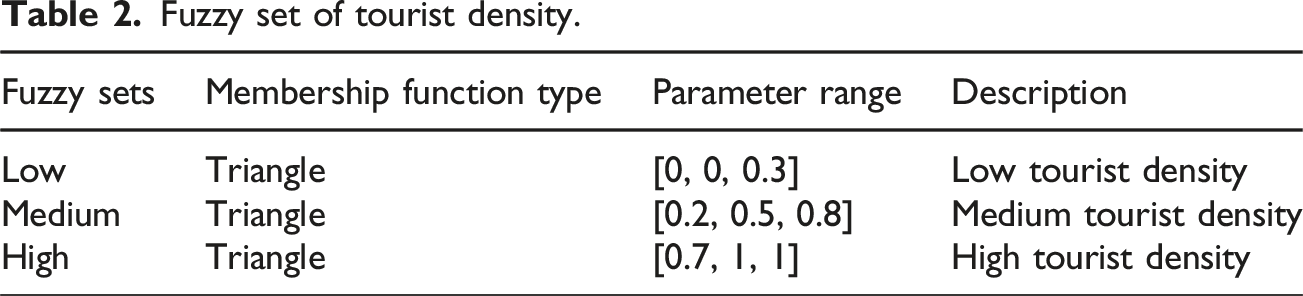
Fuzzy set of tourist density.
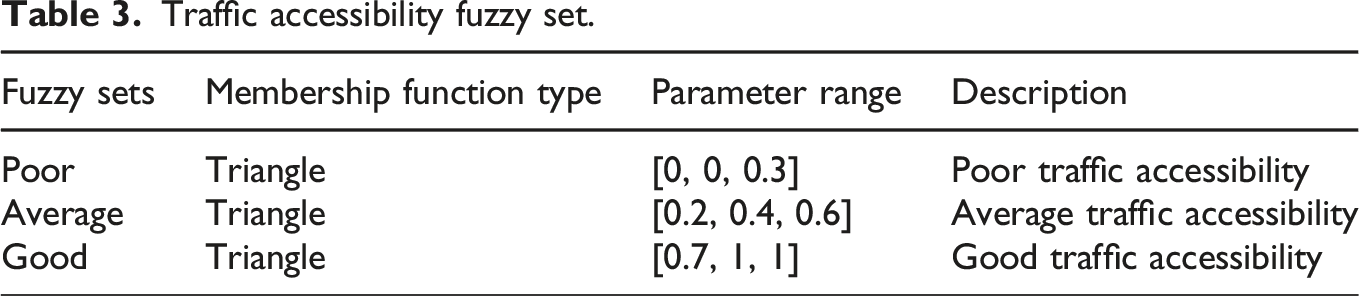
Traffic accessibility fuzzy set.
Fuzzy set of probability of sudden events.
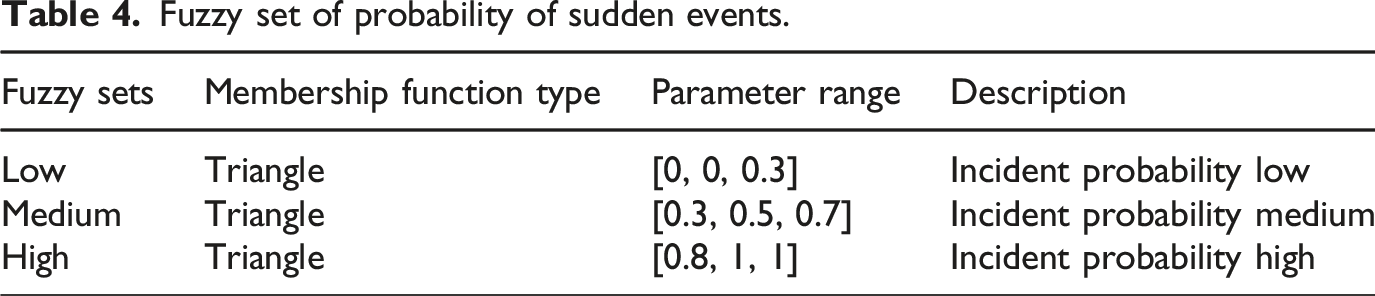
Tables 1–3 show the fuzzy set specific information of the input variables of tourist density, road accessibility, and probability of unexpected events in the system. The fuzzy set of tourist density uses three types: low, medium, and high, and the membership function type is triangular membership function. The fuzzy set of traffic road accessibility uses three types: poor, average, and good, and the membership function type is triangular membership function. The fuzzy set of the probability of unexpected events uses three types: low, medium, and high, and the membership function type is a triangular membership function. In addition to fuzzy partitioning of system input variables, it is also necessary to perform fuzzy partitioning of system output variables. This article aims to explore the planning and design optimization of safety first aid facilities in tourist attractions. To determine the configuration requirements of emergency facilities in each area of the scenic area, this article introduces a comprehensive evaluation index. This indicator considers multiple dimensions such as tourist density, transportation accessibility, and emergency risk. Through quantitative analysis, the priority of emergency facilities construction in each region is calculated, represented by a value between 0 and 1. The article set multiple threshold ranges. When the comprehensive index is lower than 0.3, it is a low priority configuration interval. When the comprehensive index is between 0.3 and 0.5, it is a second priority configuration interval. When the comprehensive evaluation index of a certain area is greater than 0.5, it is recommended to prioritize the configuration of first aid facilities in that area to effectively meet potential emergency rescue needs.
For membership functions, the common ones are triangular membership functions, trapezoidal membership functions, and Gaussian membership functions, which are used to describe the variation of membership degree of fuzzy sets with input variables.
25
The shape of the triangular membership function is a triangle with three parameters: a, b, and c, which represent the three vertices of the triangle. Its specific mathematical expression is: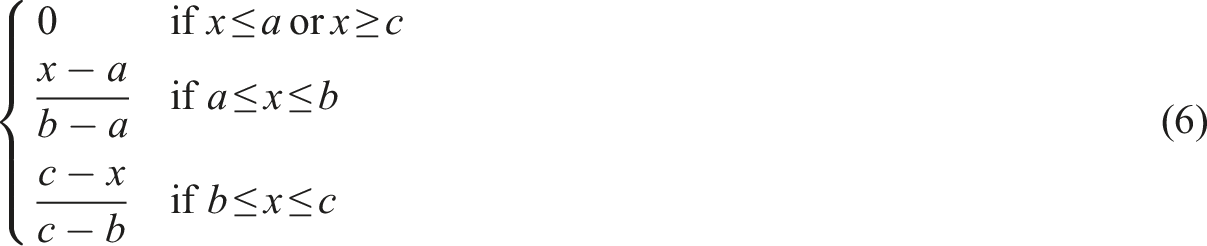
Among them, a is the left endpoint, b is the vertex, with a membership degree of 1, and c is the right endpoint. Triangular membership functions are often used to represent the trend of changes in variables within a certain range, so they can be used to classify low, medium, and high levels.
The trapezoidal membership function is a trapezoid with a flat region of membership degree 1 and four parameters a, b, c, and d. Its mathematical expression is:
The trapezoidal membership function is more suitable for situations where there is a certain regional stability in data changes and the membership degree is 1 within that interval.
The shape of the Gaussian membership function is similar to a bell shaped curve, with two parameters representing the center and standard deviation of the curve, respectively. Its mathematical expression is:
Among them, Graphical representation of membership functions.
The Gaussian membership function and triangular membership function in Figure 1 each have unique graphical characteristics and are suitable for describing different types of fuzzy sets. The Gaussian membership function is suitable for describing continuously changing fuzziness due to its smooth curve, while the triangular membership function is suitable for classification and grading due to its clear boundaries.
This article mainly divides the three input variables of the system, namely tourist density, accessibility of traffic roads, and probability of unexpected events, into fuzzy categories. For each input variable, similar levels of low, medium, and high are used, so using triangular membership functions to classify levels is the most appropriate. The use of fuzzy sets and membership functions in FL systems can effectively analyze the fuzziness issues in the planning and design of emergency facilities in tourist attractions. The defined fuzzy sets and membership functions can be used to formulate fuzzy rules and establish a fuzzy rule library.
Building a fuzzy rule library
The fuzzy rule library is an important component of FL systems. To construct a fuzzy rule library, it is necessary to clarify the fuzzy set and fuzzy variables, and develop reasonable fuzzy rules based on the fuzzy set and input/output variables. 26 Fuzzy rules determine how a FL system determines the fuzzy value of an output variable based on the fuzzy value of the input variable. 27 The following is a detailed flowchart for developing a fuzzy rule library.
Figure 2 shows the basic process of constructing a fuzzy rule library. Firstly, it is necessary to clarify the problem definition, clearly define the problem domain and the problem to be solved, and determine the input and output variables. Then, for each input and output variable, a series of fuzzy sets can be defined to merge and select the appropriate fuzzy set membership function. One or more fuzzy sets can be assigned to each input and output variable to determine the range of values for each variable. Based on data analysis and empirical knowledge, a series of fuzzy rules are formulated to describe the relationship between input variables and output variables. These fuzzy rules are generally expressed in the form of “if… then…” Finally, all fuzzy rules can be combined into a fuzzy rule library, ensuring that the fuzzy rule library is complete, that is, all possible combinations of input variables have corresponding output rules.
28
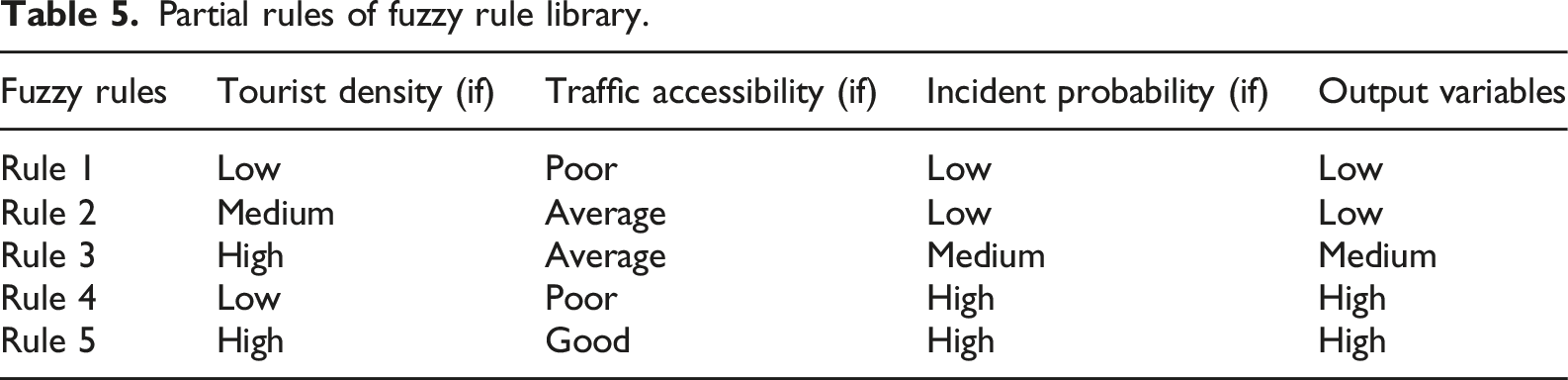
In the planning of emergency facilities, the input variables are tourist density, traffic accessibility and accident rate, and the output variable is the facility configuration priority. Three fuzzy sets of low, medium, and high are defined for each input and output variable. By collecting historical data and professional knowledge of the scenic area, fuzzy rules based on historical data and professional knowledge are formulated, paying attention to the completeness and consistency of the rules, and integrating all the rules into a complete rule base. Table 5 shows some fuzzy rules. Construction process of fuzzy rule library. Partial rules of fuzzy rule library.
Building a FL system
FL system is a computer intelligence system based on FL, which is a very effective method for executing human reasoning under uncertain or fuzzy conditions.29,30 The FL system is mainly composed of input variables, fuzzy generators, fuzzy rule libraries, fuzzy inference machines, and anti fuzzifiers. The specific structure is shown in Figure 3. Fl system structure.
Figure 3 shows the specific structure of the fuzzy logic system. The system is mainly composed of five key components: input variables, fuzzy generator, fuzzy rule base, fuzzy inference engine, and defuzzifier. Each component works together to achieve fuzzy processing and accurate output of information.
The input variable is the initial data source of the system. It is preprocessed to ensure that the variable is suitable for fuzzy logic processing. The fuzzy generator receives the input variable and converts the precise input variable into a fuzzy set by defining a series of fuzzy sets and corresponding membership functions. The fuzzy rule base is the knowledge base of the system and stores fuzzy rules specified based on domain knowledge and data analysis. The fuzzy inference engine receives the fuzzy set from the fuzzy generator and performs inference according to the rules in the rule base. By analyzing and summarizing the fuzzy set of the input variable and combining it with the rules in the rule base, the fuzzy set can infer the fuzzy set of the output variable. The defuzzifier converts the fuzzy set output by the inference engine into an accurate numerical value or decision result. The fuzzy system achieves effective processing and decision output of uncertain and fuzzy information through the collaborative work of various components. 31
User feedback mechanisms can be integrated into fuzzy logic systems to collect user feedback data, and machine learning methods can be used to conduct in-depth analysis of user feedback and extract key information that is instructive for system optimization. The analyzed feedback information can be mapped to specific components of the fuzzy logic system, and the conditions and conclusions of the fuzzy rules can be adjusted based on the feedback information. The shape and parameters of the membership function can be optimized, and the fuzzy inference machine can be improved to enhance inference efficiency and accuracy. The deblurring method can also be adjusted to more accurately convert the fuzzy output result set into a form that is acceptable to actual users. Dynamic adjustment and optimization of fuzzy logic system can be achieved based on the mapping results of user feedback.
In order to further improve the safety of the planning and design of tourist attraction facilities, a risk assessment module is introduced into the constructed fuzzy logic system. Taking advantage of the fuzzy logic algorithm in dealing with fuzziness and uncertainty, combined with the actual situation of tourist attractions, the fuzzy set and corresponding membership function of risk assessment are constructed. With the support of professional knowledge and historical data, a fuzzy rule base for risk assessment is established to achieve accurate quantification and assessment of potential risks of different planning schemes. In the risk assessment process, this module will comprehensively consider natural disaster risks, human factors, and internal system risks, use fuzzy reasoning mechanisms to reason and analyze input variables, and obtain comprehensive risk assessment results to ensure the safety of planning schemes. By introducing the risk assessment module, strong support is provided for the sustainable development of tourist attractions.
Experiment
Data preparation
Partial dataset structure.

Taking the planning of emergency facilities in tourist attractions as the research object, a fuzzy logic reasoning system was constructed to determine the input and output variables, define fuzzy sets and membership functions, and build a fuzzy rule base. Using a fuzzy inference engine, fuzzy reasoning was performed based on the input fuzzy sets and fuzzy rule base to obtain a fuzzy set of output variables. Defuzzification operations were performed to convert the fuzzy results into practically usable numerical values or solutions. Mean square error and mean absolute error were selected as system evaluation indicators to quantitatively evaluate the prediction accuracy and performance of the fuzzy logic system.
System performance evaluation
In this experiment, MSE and MAE were used as performance indicators to evaluate the FL system. MSE was used to evaluate the average squared error between the predicted and actual values of the FL system. The smaller the value of MSE, the smaller the difference between the system’s predicted value and the actual value. The MAE represents the average absolute error between the system’s predicted value and the actual value. The smaller the value, the smaller the difference between the predicted and actual values of the system, and the better the performance of the system. The following are the formulas for MSE and MAE:

Among them,
The following is a comparison between the predicted values and actual values in this system experiment, as shown in Figure 4. Comparison between predicted and actual demand values.
Figure 4 shows the comparison between the predicted and actual values of emergency facility demand obtained from the FL system experiment. The horizontal axis represents the number of experimental samples, and the vertical axis represents the predicted and actual values of emergency facility demand. The predicted values obtained by the FL system in the ten samples are very close to the actual demand values, and the MSE and MAE of the FL system in this experiment are 1.90 and 1.10, respectively. These two performance evaluation indicators are relatively small, indicating that the FL system designed in this article has better performance. For situations where there are errors between the system predicted values and the actual values, the fuzzy logic system can be improved by improving data quality, optimizing fuzzy sets, improving the fuzzy rule base, and improving the fuzzy inference engine. The above methods can effectively reduce the errors of the fuzzy logic system in facility planning and improve the applicability and accuracy of the system.
On the basis of this study, in order to further verify the comprehensive applicability and reliability of the constructed fuzzy logic system in the planning and design of tourist attraction facilities, the performance evaluation of the system under different extreme conditions is added. By adjusting the input variables, special situations such as extreme tourist flow and sudden geological disasters are simulated. The output results of the system under extreme conditions are observed and recorded, and the corresponding error values are calculated and compared with the performance under normal conditions. Through analysis, it is concluded that the fuzzy logic system still has good prediction performance under extreme conditions. The model output results fluctuate slightly compared with normal conditions, but the overall performance is good, which further demonstrates the advantages of the fuzzy logic system in the planning of tourist attraction facilities.
Experimental results
Accuracy is one of the important indicators for measuring the performance of a model or system. In order to evaluate the accuracy advantages of the FL system constructed in this article compared with other models, this article compares the fuzzy logic system with the linear regression model, decision tree model, and support vector machine, and compares the predicted values of each model with the actual demand values. The results are shown in Figure 5. Comparison of predicted demand and actual demand among different models.
Figure 5 shows the comparison between the predicted demand values of different models and the actual demand. The horizontal axis represents the number of experimental samples, and the vertical axis represents the demand for emergency facilities. The predicted values of the ten samples of the FL system constructed in this paper are closest to the actual demand values of emergency facilities compared with other models. FL systems simulate human reasoning processes and output planning results that are closest to humans in experiments, effectively assisting in the planning of tourist attractions and facilities.
Comparison of MSE and MAE of various models.

Table 7 shows the MSE and MAE of FL systems, decision tree models, linear regression models, and support vector machine. The errors are mainly caused by the quality of the collected data set itself, the setting of fuzzy sets and membership functions, the construction of the fuzzy rule base, and the system complexity and overfitting. By analyzing the errors generated by the model and exploring the system optimization space, the prediction accuracy and practical value of the fuzzy logic system in the planning of first aid facilities at tourist attractions can be further improved, providing more scientific and reasonable decision-making support for the planning and design of tourist facilities. Their MSEs are 1.90, 5.40, 16.60, and 2.50, respectively, and their absolute errors are 1.10, 2.20, 4.00, and 1.50. The smaller the mean squared error and MAE of the model, the smaller the difference between the predicted value and the actual demand value. By comparing the MSE and MAE of various models, it can be seen that the accuracy of the FL system in emergency facility planning is better than other models. Therefore, the FL system constructed in this article has good performance in handling complex and variable emergency facility planning.
Conclusions
With the continuous development of AI technology, FL algorithm has shown significant advantages in the planning and design of tourist attraction facilities as a specialized algorithm for dealing with uncertainty and fuzziness problems. The FL algorithm can effectively predict the demand for emergency facilities in various regions of tourist attractions by analyzing data such as tourist density, traffic accessibility, and the probability of unexpected events. This article is based on the FL algorithm and takes the planning of emergency facilities in tourist attractions as the research object to construct a FL system. By preprocessing the collected historical data of tourist attractions, the fuzzy set of input and output variables is determined. It constructs a corresponding fuzzy rule library for experimentation, using MSE and MAE as performance indicators to evaluate the FL system. The experiment shows that the FL system constructed in this article has higher accuracy in emergency facility planning compared to other models and is highly compatible with actual needs. The application of FL system can effectively assist in the planning and design of tourist attraction facilities. However, there are still some factors that have not been considered in this article. FL systems rely more on high-quality data, and accurate and comprehensive data can effectively improve the accuracy of the system’s prediction results. Fuzzy rules require the use of professional knowledge and consideration of all possibilities and corresponding outcomes in the design process, which may lead to increased difficulty in maintaining the system in the future. In the future, the article can consider introducing more datasets and factors that affect events as dataset features to further improve the accuracy of the model. By combining intelligent optimization algorithms, fuzzy rules can be automatically adjusted to improve system performance.
As AI technology continues to evolve, the fuzzy logic (FL) algorithm has proven to be a powerful tool for addressing uncertainties and complexities in the planning and design of tourist attraction facilities. This article demonstrates that the FL algorithm excels in predicting emergency facility needs by analyzing variables such as tourist density, traffic accessibility, and the likelihood of unexpected events. By constructing an FL system and evaluating it with mean squared error (MSE) and mean absolute error (MAE) indicators, the study highlights the system’s high accuracy and practical relevance compared to existing models.
Looking forward, there are several significant areas for future research. One key aspect is the enhancement of the FL system through the integration of more diverse datasets and factors influencing event occurrences. Expanding the dataset to include additional variables can improve the system’s predictive accuracy and robustness. Moreover, while the current system demonstrates high compatibility with real-world needs, it is crucial to address the challenges associated with data quality. The accuracy of the FL system heavily relies on the availability of high-quality, comprehensive data. Future research could focus on developing methods to acquire and incorporate more accurate data to enhance prediction results. Additionally, incorporating intelligent optimization algorithms could facilitate the automatic adjustment of fuzzy rules, thereby refining system performance and reducing maintenance complexity. This approach could also streamline the system’s adaptability to evolving conditions and emerging trends in tourist attractions. Overall, these advancements will not only improve the precision and efficiency of emergency facility planning but also contribute to more resilient and responsive tourist destination management.
Statements and declarations
Footnotes
Conflicting interests
The author(s) declared no potential conflicts of interest with respect to the research, authorship, and/or publication of this article.
Funding
The author(s) received no financial support for the research, authorship, and/or publication of this article.