



Abstract
In the realm of educational data science, the utilization of advanced analytical techniques is increasingly pivotal for optimizing pedagogical methods and implementing early interventions. This study introduces a predictive model employing deep learning technology for the analysis of student learning behavior. The model’s primary objective is to detect potential learning impediments at nascent stages, thereby facilitating timely and effective educational strategies to augment learning outcomes. Despite strides in behavioral prediction, challenges persist due to the dynamic and complex nature of educational data. Addressing these challenges, the proposed model integrates sequence pattern recognition with time-series analysis. The application of the PrefixSpan algorithm initiates the process, identifying sequential patterns in student learning behaviors and elucidating their temporal progression. Subsequently, an advanced ordered funnel analysis algorithm is employed, unveiling directional associations among diverse learning patterns. The final phase involves applying independent component analysis (ICA) to enhance the multi-layer long short-term memory (Multi-LSTM) network’s structure, thus enabling precise predictions of student outcomes in the context of early interventions. The results underscore the efficacy of deep learning in deciphering intricate behavioral patterns and underscore its potential in personalized educational interventions. This comprehensive approach demonstrates the model’s capacity to harness the intricacies of educational data, thereby contributing significantly to the field of personalized education and precise teaching methodologies. The innovative aspect of this study lies in the comprehensive application of the PrefixSpan algorithm, the ordered funnel analysis algorithm, and the Multi-LSTM network architecture. A holistic model for predicting student learning behavior is proposed, coupled with early interventions, which enables educators to better understand student learning conditions and implement effective measures to enhance student learning outcomes.
Keywords
Introduction
The advent of sophisticated educational technologies has ushered in an era where data on student learning behaviors are increasingly recognized as invaluable for educational research.1,2 These data, encapsulating students’ learning habits, provide insights into multifaceted patterns prevalent in the educational process.3–5 In this context, deep learning emerges as a robust tool for data analysis, capable of extracting profound insights from voluminous data related to student learning behaviors. Such insights are imperative for the formulation of personalized teaching strategies and the implementation of early intervention measures.6–8 Nonetheless, the effective prediction of students’ learning outcomes and the timely execution of interventions require an in-depth understanding of the intricacies and dynamics inherent in student behavior.
The prediction of student learning behavior not only facilitates personalized learning experiences but also aids educators in pinpointing potential challenges in pedagogy. This capability enables the prompt adaptation of teaching methods and content to suit evolving educational needs.2,9 Central to enhancing student learning outcomes is the concept of early intervention. Such interventions, by providing requisite support during the learning process, mitigate frustration and thereby augment learning efficiency and performance.10,11 In light of these considerations, the development of a precise model for predicting student learning behavior represents a critical endeavor in the field of educational research.
Prevailing approaches to predicting learning behavior have predominantly concentrated on static data analysis, thereby neglecting the temporal aspects and the dynamic progression of student behavior patterns.12,13 Additionally, conventional analytical methods often struggle to interpret complex data structures, thus limiting their effectiveness in forecasting student learning trajectories and outcomes.14–18 Consequently, it is imperative to develop a predictive model that holistically integrates sequence patterns and dynamic variations.
The objective of this study is to introduce a comprehensive predictive model for student learning behavior, utilizing the capabilities of deep learning technology. The initial phase involves deploying technology based on the PrefixSpan algorithm to discern sequential patterns in student learning behaviors, thereby accurately tracing their temporal development. This is followed by the application of an advanced ordered funnel analysis algorithm, aimed at investigating the directed associations among student learning patterns and uncovering the underlying linkages between different learning behaviors. The final phase amalgamates ICA with the Multi-LSTM network architecture, facilitating the prediction of student learning effectiveness in the context of early intervention. This research not only addresses the deficiencies of existing methodologies but also provides educators and policymakers with a novel perspective. It enables the scientific monitoring, analysis, and intervention of the learning process, ultimately contributing to the enhancement of educational quality and student learning outcomes.
The impact of this study on educational practice is reflected in the insights provided by the model, which guide teachers in targeted early interventions. By analyzing patterns and trends in student learning behavior, teachers can promptly identify potential learning difficulties and implement personalized intervention measures. This enhances student learning outcomes and the quality of education, thereby rendering educational practices more targeted and effective.
Sequence pattern recognition in student learning behavior
In this study, the focus is placed on identifying sequence patterns in student learning behavior utilizing the PrefixSpan algorithm, a technique renowned for its proficiency in sequence pattern mining. The application of the PrefixSpan algorithm is instrumental in handling extensive datasets and extracting frequent patterns, thereby enabling the extraction of valuable insights from substantial educational data. The algorithmic process involves initially utilizing the PrefixSpan algorithm to identify sequential patterns in student learning behavior, capturing the temporal variations in student actions. Subsequently, an enhanced ordered funnel analysis algorithm is employed to explore the directed associations among student learning patterns, revealing the intrinsic connections between different learning behaviors. Finally, the Multi-LSTM network architecture, incorporating ICA, is applied to predict student learning outcomes under early intervention.
The process of mining frequent sequence patterns from student learning behavior data involves initially pinpointing single items that satisfy a predefined support threshold, which are essentially prefixes of length 1. These items constitute the foundation for the construction of more extended sequence patterns. Support is defined as the frequency of occurrence of a specific pattern within the entire dataset, and a pattern is deemed frequent only if it appears at a rate higher than the predetermined minimum support threshold. Practically, this translates to the algorithm assessing the occurrence frequency of each potential behavior (such as reviewing materials or submitting assignments) across all student behavior sequences. Behaviors exceeding the minimum support threshold are then selected as the starting points for the formation of frequent sequences. Figure 1 delineates the prefixes of length 1 and their corresponding projected databases, elucidating the initial step in the pattern mining process. The model structure initially employs the PrefixSpan algorithm to identify sequential patterns of student learning behavior, capturing the temporal dynamics of student actions. Subsequently, an enhanced ordered funnel analysis algorithm is utilized to delve deeper into the directed associations among student learning patterns, unveiling the intrinsic links between various learning behaviors. Finally, through the integration of ICA with the Multi-LSTM network architecture, the model predicts student learning outcomes under early intervention, enabling comprehensive prediction and analysis of student learning behavior. Illustration of length-1 prefixes and their corresponding projected databases.
In the subsequent phase of this study, each identified frequent prefix undergoes analysis within its respective projected database to discern additional frequent patterns. Projected databases are defined as subsets of behavior sequences that encompass a specific prefix, which are subsequently utilized to explore potential behavior patterns succeeding the prefix. During this analysis, the algorithm examines all conceivable behaviors that might be appended to the current prefix in the projected database and evaluates the support of these augmented sequences. Sequences whose support levels surpass the established minimum threshold are classified as frequent and are incorporated into the collection of frequent sequence patterns. This iterative and recursive procedure is perpetuated until the identification of new frequent sequences ceases. Figure 2 illustrates the methodology of iteratively generating prefixes for each projected database, providing a visual representation of this analytical stage. Methodology for iterative generation of prefixes in projected databases.
Specific explanations and definitions were utilized for identifying sequence patterns in student learning behaviors, based on the PrefixSpan algorithm. (a) Recursive mining principle
The recursive mining principle, integral to the PrefixSpan algorithm, was employed for the identification of sequence patterns in student learning behaviors. This principle involves analyzing a sequence pattern, which could be a series of learning activities performed by a student over a period. Such activities may include engaging in video lectures, completing quizzes, and participating in discussions. For a student learning behavior sequence pattern denoted as β with a length m, a set expression is established.

This expression includes all student learning behavior sequences of length m+1 that commence with the prefix x, as illustrated in:

The process of recursive mining initiates with the identification of frequently occurring items, essentially recognizing single behaviors that appear recurrently. Upon identifying these frequent items, they are utilized as prefixes. The algorithm then recursively searches for behavior sequences following each prefix, thereby constructing more extended frequent sequence patterns. This iterative method continues, with each iteration treating the present frequent sequence as a new prefix, until the discovery of further frequent extensions ceases. Consequently, this unveils the hierarchical structure of the complete learning behavior sequence pattern. Figure 3 provides an algorithmic flowchart demonstrating the PrefixSpan process. (b) Projected databases Flowchart of the PrefixSpan algorithm process.

Projected databases are defined as specific subsets of the original database containing sequences with particular prefixes. Upon the algorithm’s identification of a frequent prefix, a corresponding projected database is constituted. This database encompasses only those behavior sequences from the original dataset that proceed following the identified prefix. The employment of projected databases enables the algorithm to concentrate on more compact data subsets for the detection of frequent patterns succeeding a specified prefix. For instance, let β represent a sequence pattern within the student learning behavior sequence database T. The collection of all suffixes relative to x for each sequence in T is delineated as the projected database for the prefix β. (c) Support in projected databases
Support within projected databases is characterized by the occurrence frequency of a specific sequence pattern within a particular projected database. This measure is contextualized against the support metric in the entire original database. The computation of support in projected databases facilitates a more expedient recognition of frequent behavior sequences that succeed a designated prefix. This is because the algorithm is required to consider only those sequences encompassing the prefix. For a given sequence pattern β in the student learning behavior sequence database T, let α denote a student learning behavior sequence prefixed by β.

Subsequently, the quantity of ε
u
that α must fulfill within the projected database is expressed by SUT|β(α): (d) Characteristics of projected databases

The initial step involves the recursive creation of projected databases. This approach is crucial in ensuring that no frequent sequence patterns are overlooked during the step-by-step analysis. Each recursive stage builds upon the frequent patterns identified in the preceding step, thus maintaining the integrity of the mining process. Specifically, when considering sequence patterns in the sequence database T, denoted as β and α where β is a prefix of α, the following relationship is established:

Moreover, when a pattern is identified as frequent within a projected database, it is not only frequent in that specific subset but also across the entire original database. This occurrence stems from the fact that the projected database is derived from the original database based on a particular prefix. Consequently, any pattern that is frequent in this subset also constitutes a frequent pattern in the original database beginning with that prefix. This is exemplified in the case of any sequence b that has the prefix β:

Lastly, considering the nature of projected databases, each contains only the portion of the original database that includes a specific prefix. Therefore, the size of a projected database will never surpass that of the original database. As the recursive process advances, the size of the projected databases generally diminishes, enhancing the efficiency of the algorithm’s execution.
Exploration of directed associativity in student learning patterns
Subsequent to the identification of sequence patterns in student learning behavior, this study employs an advanced ordered funnel analysis algorithm to investigate the degree of directed associativity among learning patterns. This methodology uncovers the dynamic associative pathways and transition rules interlinking various student behaviors. Crucial behavioral transition points and learning bottlenecks are identified, offering targeted data support for educational interventions. Such interventions are instrumental in optimizing the allocation of learning resources, thus facilitating early intervention and personalized teaching approaches, ultimately leading to the enhancement of learning effectiveness and outcomes. Figure 4 delineates the flowchart of the advanced ordered funnel analysis algorithm, providing a visual representation of this analytical procedure. Flowchart of the advanced ordered funnel analysis algorithm.
A database comprising student learning behavior data is systematically assembled. The procedure involves documenting students’ interactions on educational platforms, which includes activities such as viewing instructional videos, engaging in discussions, and submitting assignments. These data constitute time-series information, cataloging the sequence and timestamps of the students’ behaviors. The structure of the behavior database thus compiled is represented by the following expression:

Furthermore, specific student learning behaviors that may potentially occur are articulated in the subsequent expression:

Target sequences for learning behaviors are subsequently established. These sequences serve as benchmarks for funnel analysis, representing idealized or anticipated patterns of student learning behaviors. An example could be the progression of steps from the commencement of a course to the final examination, forming a target sequence. This sequence aids in juxtaposing actual student behavior data against it, thereby facilitating the identification of critical conversion points or areas of attrition. The structure of this target sequence is encapsulated in the following expression:


A designated time window, referred to as s
WIN
, is employed to record the longest sequences of student behaviors that are completed within it, correlating with the predefined target sequence O. This approach involves a comparison of the actual student behavior data against the target sequence. The process incorporates matching and pattern recognition techniques, aimed at identifying patterns within the actual student behavior data that correspond to the target sequence. It is posited that the longest sequence completed by a student within the specified time window is denoted by x1∼x4. Consequently, the sequences accomplished by the student are represented by x1∼x4, x1∼x3, x1∼x2, and x1. The resultant dataset comprises all behavior patterns observed, each aligning with the target sequence to varying extents. This alignment is articulated as follows:


In this component of the methodology, the focus is on determining the conversion rates, defined as the probability of students transitioning from one learning behavior to the next in a predetermined sequence. To ascertain these rates, a discrete analysis of each behavioral node is undertaken, establishing the frequency of student transitions from one node to the subsequent one. The entire student population is denoted by v0. The collective conversion rate expression is formulated as follows:

This collective data on conversion rates provide insights into the fluidity of students’ progression through the learning process, pinpointing stages of high efficiency in conversions and identifying potential areas of concern. The specific conversion rate from behavior xu-1 to x
u
is computed using the expression:

Similarly, the rate of dropout transitioning from behavior xu-1 to x
u
is calculated as:

Employing these calculations, a funnel model is constructed, facilitating the exploration of directed associativity in student learning patterns.
Predicting learning outcomes under early intervention in student learning behavior
In the pursuit of accurately predicting students’ future learning outcomes, this research has developed a predictive model that synergizes ICA with the Multi-LSTM network. The Multi-LSTM model is notably effective in processing and forecasting time-series data, while the ICA is instrumental in isolating pivotal features from intricate student learning behavior data. This integration amplifies computational efficiency and refines algorithmic precision. The ICA comprises two primary steps.
Step 1 involves determining the specific features or data dimensions for inclusion in the ICA. These features are typically aligned with aspects of student interactions, engagement levels, and assessment outcomes. It is posited that a l*v student learning behavior time-series matrix is denoted as A = [a1,a2,…,a
u
…,a
l
]
T
. In this matrix, the vector representing the uth time series is a
u
, where u ranges from 1 to l, and v denotes the length of a
u
. A matrix encompassing overlaid learning behavior noise is designated as Xl*l = [x1,x2,…,x
u
,…x
l
]
T
, while the matrix representing learning behavior data post-noise separation is
T
Tl*v = [t1,t2,…,t
u
,…t
l
]
T
. Utilizing the ICA algorithm, matrix A is articulated as follows:

In the current research, the application of the ICA algorithm to preprocessed data results in the generation of a set of independent components (ICs). Each IC, being a linear combination of original data, offers insights into potential source signals or influencing factors. The restoration matrix, denoted as Q, facilitates the following computational process:

In the matrix Bl*v, vectors b
u
represent the ICs, with Bl*v constituting the matrix of these components. The matrix Tl*v, symbolizing learning behavior data with reduced noise, is reconstructed when Q is set to X−1, based on the formula:

The analysis of the derived ICs is conducted to ascertain the actual learning behaviors or characteristics each component may signify. For example, one component could be related to the distribution of learning time, while another might correlate with assignment submission frequency. The assumption of mutual independence between the components b
u
is made when non-Gaussianity is exhibited by an IC b
u
. A random Gaussian vector with the same covariance matrix as b, labeled as b
GA
, allows for the measurement of b
u
’s Gaussian properties through negentropy calculation:

During Step 2 of the methodology, the focus is placed on distinguishing components indicative of noise, such as elements irrelevant or of minimal impact on the prediction target. These components might originate from errors in data collection, random guesses, or activities unrelated to the target behavior. Noise-related components are excluded from the dataset. Subsequently, through the inverse process of ICA and employing the remaining relevant ICs along with the mixing matrix, a dataset with diminished noise is reconstructed. This refined dataset is expected to more precisely reflect those behavioral characteristics that are critical to student learning effectiveness. Assuming the dataset reconstructed with noise reduction is denoted by A
E
= [a1
E
,a2
E
,…,A
E
l
]
T
, and the mixing matrix by X, where X = [x1, x2,…,x
l
] = Q−1, and considering b
u
as the ICs post-noise filtering, the following relationship is established:

In the proposed methodology employing the Multi-LSTM predictive model based on ICA, the first step involves a comprehensive preprocessing of student learning behavior data.
Data pertaining to various student activities on learning platforms, such as frequency of logins, duration of study sessions, assignment submissions, and forum participation, are meticulously collected and organized. This process includes the essential tasks of outlier removal and imputation of missing values to maintain the reliability of the dataset. A careful selection of features is then conducted, focusing on those that are deemed most indicative of learning effectiveness. These may encompass time-series data and frequency information, among others. To mitigate any potential bias in the model due to variable scales, all features are normalized to a uniform range. This normalization ensures that no single feature unduly influences the model’s weight adjustments due to its scale. Consequently, five distinct data matrices are generated, each corresponding to a specific aspect of student behavior or performance. These matrices include X
KP
, representing behavioral features of l students; X
ZG
, depicting students’ grades; X
ZD
, detailing social interactions; X
CP
, illustrating resource usage; and X
CJ
, capturing feedback from interventions. Each row within these matrices correlates to an individual student, while columns represent the time series of the respective input features.

The behavior feature data matrix, denoted as X OP and of dimensions l*v, encapsulates the behavioral trends of the student cohort. Here, l signifies the total number of students, and v represents the number of days over which learning behaviors are observed. The vector x u embodies the temporal sequence of each student’s learning behavior features for the uth student (where u ranges from 1 to l), and its length is denoted as v, the days of learning behaviors.
The second step encompasses the decomposition of multidimensional feature data into statistically ICs using the ICA algorithm. This decomposition is performed on the preprocessed data, segregating features into components that are statistically independent. Subsequent analysis focuses on discerning which components embody substantial information relevant to learning effectiveness and which represent mere noise. Components identified as noise are meticulously excluded, retaining only those ICs instrumental to predicting learning effectiveness. The IC matrices derived for various aspects of student behavior and performance, including behavior features (Z
OP
), grades (Z
ZG
), social interactions (Z
ZD
), resource usage (Z
SP
), and intervention feedback (Z
CJ
), are denoted as follows:

The third step involves inputting the refined ICs into the Multi-LSTM model for training and predictive analysis. The noise-reduced dataset, reconstructed through the mixing matrix, is converted into a format conducive to long short-term memory (LSTM) modeling. This time-series data is then stratified into distinct sets for training, validation, and testing purposes. The Multi-LSTM model undergoes rigorous training, during which parameters are meticulously adjusted to optimize prediction accuracy. The prediction results for the uth time series within the behavior feature IC matrix Z
OP
are represented by zu_ofs. The comprehensive prediction results pertaining to each behavior feature IC, denoted as Z
O_P
, are expressed as:

In the final phase, the Multi-LSTM model, having undergone rigorous training, is utilized to forecast the future learning behaviors of students. The model operates on the reconstructed dataset, generating predictions for each student’s learning behavior. These predictions are denoted as XO_P = [xO_P_1 ,xO_P_2 ,…,xO_P_u, ..,xO_P_l ]
S
, where xO_P_u represents the predicted learning behavior for an individual student within the reconstructed dataset. The aggregate of these predictions, encompassing the learning behaviors of all students, is expressed as follows:

Subsequent analysis of the model’s predictions provides insights into the correlation between specific learning behaviors and overall learning effectiveness. This analysis is instrumental in the formulation of tailored early intervention strategies, aimed at supporting students, particularly those at risk of underperforming, to enhance their learning behaviors proactively. By doing so, the overall effectiveness of the learning process is improved, aligning with the objectives of personalized education and targeted pedagogical interventions.
Once potential learning difficulties are predicted by the model, educators can take a series of practical steps to address them. These steps include communicating with students and parents, developing personalized learning plans, providing additional support and resources, and, when necessary, guiding students to receive professional counseling or therapy. The model is applied in a real school environment, where it analyzes student learning behavior data to help schools identify potential learning issues and provide personalized early intervention measures. By collecting student learning behavior data and applying the model, schools can more accurately understand students’ learning patterns and behavioral trends, thereby intervening timely and enhancing student learning outcomes, ultimately improving educational quality. The interpretability of the model can be achieved by explaining the function and role of each component within the model. For example, it explains how the PrefixSpan algorithm identifies patterns in student learning behaviors, how the ordered funnel analysis algorithm explores the associations between student learning behaviors, and how the Multi-LSTM network integrates this information to predict student learning outcomes. The prediction results are presented in a straightforward and intuitive manner, enabling non-technical educators to understand and apply them.
Experimental results and analysis
In the conducted research, the PrefixSpan sequence pattern mining algorithm was employed to analyze the sequential behavior of students. Additionally, an improved ordered funnel analysis algorithm was introduced for an in-depth examination of learning patterns. The basic characteristics of the dataset may include information, such as the source of data, type of data (e.g., student behavior data), and scale of the data. The preprocessing methods may involve steps, such as data cleaning, removal of outliers, and feature extraction, to ensure the quality and applicability of the data. Figure 5 presents a comparative analysis of the ordered funnel analysis algorithm before and after enhancement. The findings demonstrate a marked increase in time efficiency with the enhanced algorithm, especially in scenarios with constrained time windows. The original algorithm exhibited a notable reduction in performance when the time window was narrowed, whereas the enhanced algorithm’s performance remained largely stable. This disparity is attributed to the early return mechanism incorporated in the enhanced algorithm. It ceases operation as soon as a student completes a predefined length of a learning behavior sequence, thereby curtailing superfluous computational efforts. In extended time windows, such as 7 days, the probability of students completing the entire sequence is higher, frequently activating the early return feature and subsequently reducing the algorithm’s runtime. In contrast, shorter time windows, like a single day, diminish the likelihood of completing the entire sequence, compelling the original algorithm to scan all behaviors and significantly impairing its temporal efficiency. The ability to rapidly analyze learning behaviors is essential, particularly in online learning environments where analysis windows are exceedingly brief, often spanning hours or minutes. In such contexts, the performance of the original ordered funnel analysis algorithm would be substantially compromised. The optimization of the algorithm not only augments efficiency but also guarantees swift and effective analysis of student learning behavior patterns, even within extremely limited time frames. Comparison results of the ordered funnel analysis algorithm before and after improvement. (a) Time window of seven days. (b) Time window of one day.
Results of ordered funnel analysis based on a time window restriction.

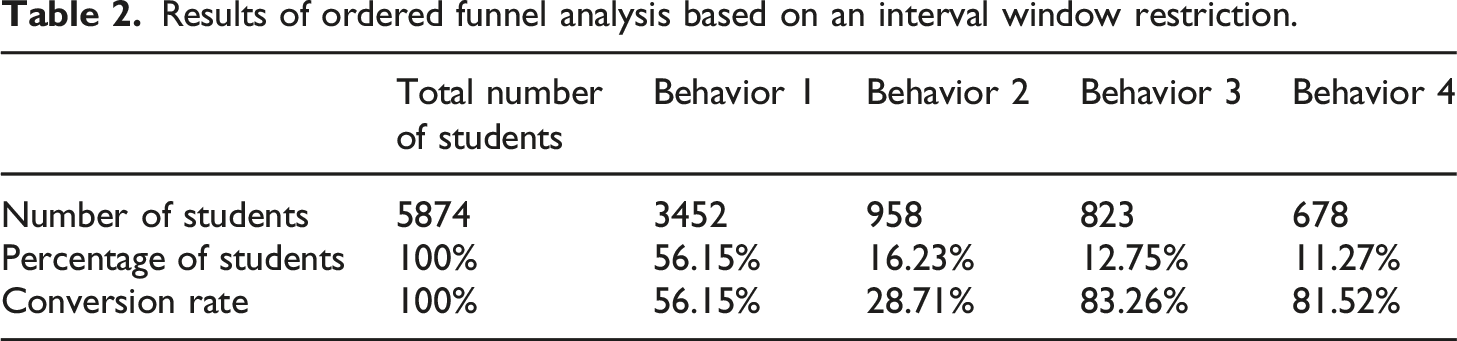
Results of ordered funnel analysis based on an interval window restriction.
Eigenvalues corresponding to ICs.

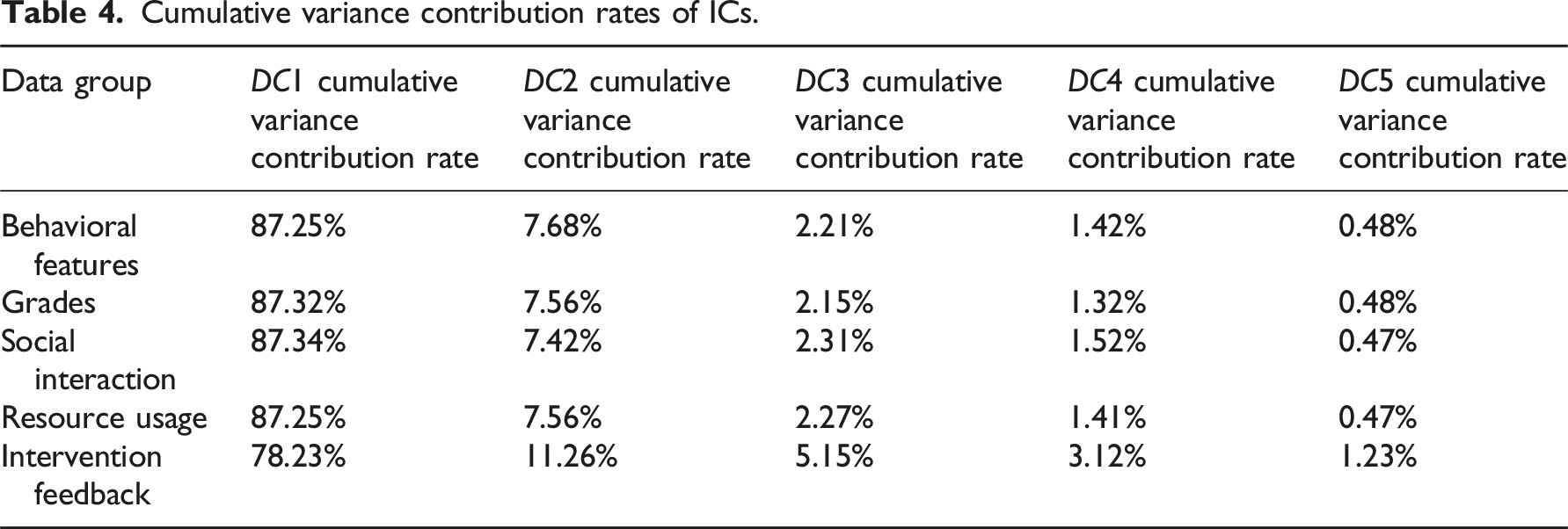
Cumulative variance contribution rates of ICs.
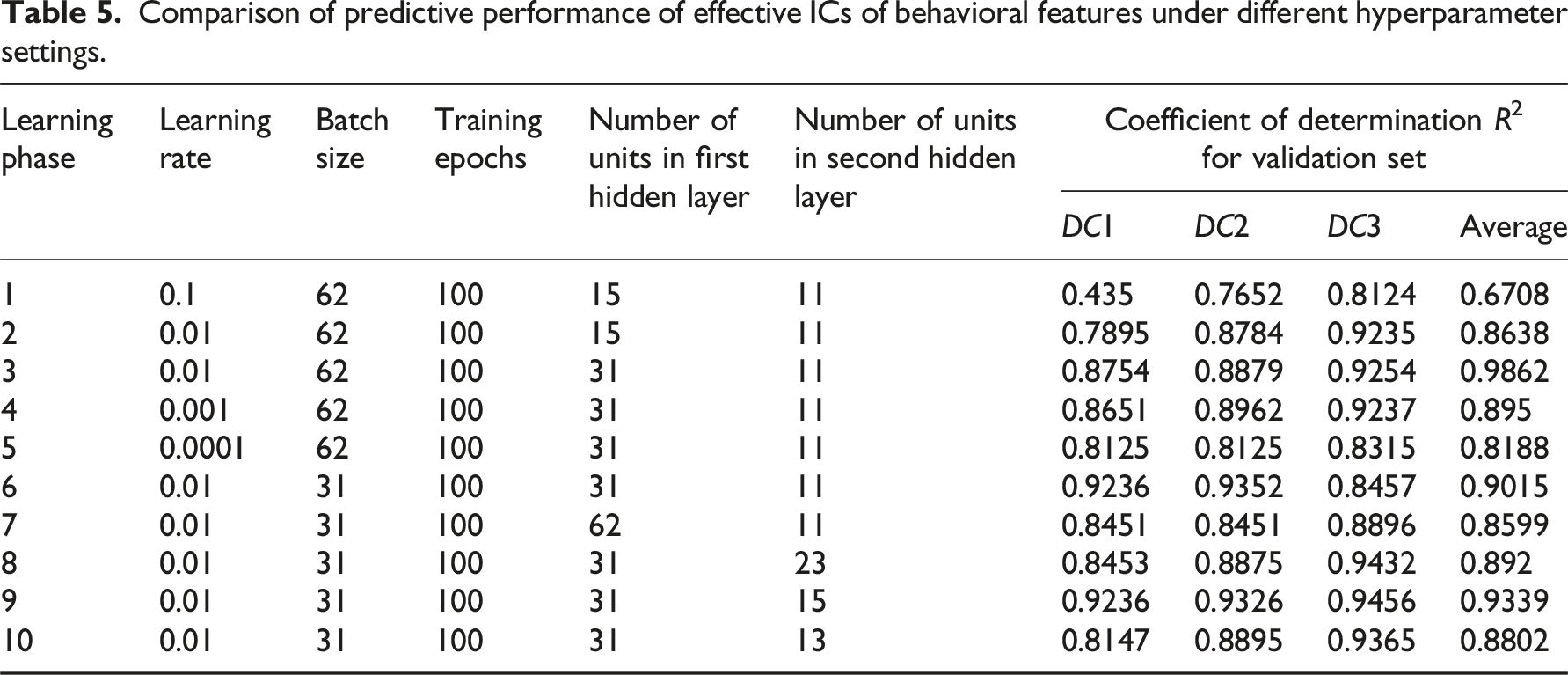
Comparison of predictive performance of effective ICs of behavioral features under different hyperparameter settings.
Compared to other prediction methods, the proposed model excels in its comprehensiveness and precision. By integrating the PrefixSpan algorithm, the ordered funnel analysis algorithm, and the Multi-LSTM network architecture, the model is able to capture patterns and trends in student learning behavior more accurately, providing more reliable prediction results and offering more effective decision support for educators.
Conclusion
In this research, technology based on the PrefixSpan algorithm was initially utilized, leading to the effective identification of sequential patterns in student learning behaviors and the capturing of their temporal evolution. This initial phase laid the groundwork for a comprehensive understanding of student behavior. Subsequently, the study advanced this understanding by employing an enhanced ordered funnel analysis algorithm, which delved into the directed associativity among learning patterns, thereby uncovering intrinsic connections among various student behaviors. This exploration was instrumental in delineating the progression pathways and potential causal links in student behavior. Furthermore, the study incorporated ICA to leverage a Multi-LSTM network architecture, aimed at predicting student learning outcomes. This phase, emphasizing deep learning application, focused on extracting salient features from time-series data to enable accurate predictions.
The paper presented a comparative analysis of the ordered funnel analysis algorithm, both before and after its enhancement, highlighting the augmented efficiency of the refined algorithm in extracting behavioral patterns. This comparison extended to the ordered funnel analysis based on varying time and interval window constraints, thus revealing the adaptability of behavior patterns under different conditions. Additionally, the study provided insights into the eigenvalues and cumulative variance contribution rates of ICs, elucidating the significance of each component within the dataset. Experimental comparisons of the predictive performance of effective ICs of behavioral features under diverse hyperparameter configurations were conducted, affirming the model’s accuracy and stability across various scenarios.
In conclusion, the model proposed in this paper, synthesizing state-of-the-art data mining technologies with deep learning approaches, has proven effective in predicting student learning outcomes and facilitating early intervention. The results of the experiments underscore the importance of selecting suitable algorithms and fine-tuning hyperparameters for enhancing prediction accuracy. The research has not only refined the precision in analyzing student learning behavior but has also laid the foundation for predictive models, thereby opening avenues for tailored educational interventions. This advancement contributes significantly to the progression of personalized and precise education. The limitations of the model include its dependency on data quality and scale, as well as insufficient prediction accuracy in certain scenarios. Future research directions involve improving data collection and processing methods, exploring the applicability of the model in different educational settings and subject areas, and further enhancing the predictive performance and interpretability of the model.
Statements and declarations
Footnotes
Declaration of conflicting interests
The author(s) declared no potential conflicts of interest with respect to the research, authorship, and/or publication of this article.
Funding
The author(s) received no financial support for the research, authorship, and/or publication of this article.