



Abstract
In order to solve the technical problems of coal spontaneous combustion and fire prevention in goaf, gel fire prevention materials in coal mine have been developed. This study introduces an innovative gel-based fire extinguishing material, formulated by integrating two distinct substances, to effectively mitigate the issue of spontaneous coal combustion. Systematic variations in the material compositions and concentrations were employed to observe changes in gelation dynamics, including gelation time and efficacy. Additionally, key technical parameters, notably the rate of dehydration, were meticulously quantified. The findings indicate a significant dependency of gel formation time and dehydration rate on the specific ratios and concentrations of the constituent materials. Optimal gelation performance necessitates precise calibration of these variables. This investigation holds substantial importance in advancing the technology of gel-based fire extinguishing systems for mining applications. The optimum ratio of the two base materials is 5:1, and the optimum concentration is 80%–95% according to 1:1 or 1:2 dilution ratio.
Keywords
Introduction
Coal is the main energy source and an important industrial raw material in China. The coal industry is an important basic industry in China, and the sustainable development of the coal industry is related to the healthy development of the national economy and national energy security. As an important industry in China’s traditional energy sector, the coal industry occupies a pivotal position in China’s national economy. It not only directly affects the daily lives of the Chinese people but also plays a direct role in promoting socio-economic development.1,2 According to data from the National Bureau of Statistics, in 2022, the national raw coal output was 4.56 billion tons, an increase of 10.5% year-on-year, and the growth rate of raw coal production accelerated. Additionally, information from the State-owned Assets Supervision and Administration Commission of the State Council indicates that in 2022, the daily coal output of central enterprises was 2.96 million tons, an increase of 7.6% year-on-year, setting a new historical record. 3 China’s geological conditions of being ‘rich in coal, poor in oil, and low in gas’ determine the strategic position of coal as China’s basic energy source. As the main energy source, important industrial raw material, and important basic industry in China, the sustainable development of coal is crucial for the healthy development of the national economy and national energy security.
With the rapid development of the socio-economy, the demand for coal in our country is also increasing, and the scale of coal mine production is getting larger. With the substantial increase in the speed of coal production and the surge in mining quantities, the accident rate in coal mines has also risen rapidly, causing great losses to the coal mining industry. Among many coal mine accidents, fire is one of the main disasters in mines, among which spontaneous coal combustion fires are extremely serious. 4 56% of coal mines in China have problems with spontaneous combustion, and about 47% of coal mines in China are at risk of spontaneous combustion, accounting for 94% of the total number of fires, of which spontaneous combustion in goaf accounts for 60% of internal fire incidents. 5 Therefore, the prevention of coal spontaneous combustion has increasingly attracted people’s attention.
The existence of fire prevention and extinguishing technology is mainly to ensure safe production in the process of coal resource mining. Therefore, it is necessary to implement safety production work accurately and adopt scientific and reasonable measures to further improve the stability and effectiveness of mine mining. Although many coal mining enterprises have invested sufficient funds and efforts in fire prevention and extinguishing, different degrees of safety accidents still occur. Therefore, targeted analysis of the problems in fire prevention and extinguishing management should be carried out, and scientific and reasonable measures should be formulated to further improve the reliability and safety of coal mine production. In China, spontaneous coal fires account for more than 94% of all mine fires. In northern China, spontaneous coal fires burned 2 billion tons of coal, with economic losses reaching 111.2 billion yuan. In the northwest, northeast, and eastern central regions where spontaneous combustion is serious, about 2 million tons of coal resources are lost every year due to spontaneous combustion of coal. Since the 1950s, technologies such as grouting, sand injection, inert gas injection, foam injection, and three-phase foam injection have been proposed successively, but there are obvious shortcomings. 6 Although these anti-fire technologies have provided great help to coal mine fire control, there is still a need for improvement and innovation. Materials for this study. Among them, gel is a polymer with a three-dimensional structure, which has the characteristics of solidifying water, isolating oxygen, heat resistance, and inhibiting combustion. It can cover the coal body, fill and block the pores of the coal body, has good water retention, and can cool the fire area for a long time at high temperatures. It is widely used.7,8 Based on the above situation, a colloidal fire extinguishing material for mine sealing has been developed. When using this colloidal material to prevent and control spontaneous combustion fires in coal seams, it can simultaneously destroy the three necessary conditions for coal spontaneous combustion, has a higher fire extinguishing efficiency, and a higher success rate in extinguishing fires.
In order to understand the performance parameters of this gel material, many experiments were carried out. This study starts from the experiment, introduces the experimental principle and method, analyzes the obtained experimental data, and finds the best proportion and gel time.
Experimental method
Gel material
Sodium silicate, commonly known as water glass, is a mineral binder with the chemical formula Na2O·nSiO2. Its aqueous solution is also known as water glass. Sodium bicarbonate, with the molecular formula NaHCO3, is an inorganic compound whose aqueous solution is slightly alkaline. It decomposes easily when heated and slowly decomposes in humid air to produce carbon dioxide, starting to decompose around 50°C and completely decomposes at 270°C.
For colloids formed in water through physical or chemical actions from two types of raw materials, the main gel-forming raw material is usually called the base material, and the material that promotes the gelation of the base material is known as the gelling agent or coagulant (hereinafter referred to as material A and material B, with the gelling agent as material A and the base material as material B). The final gel is formed by the base material, gelling agent, and water in a certain proportion to form a solution, which then undergoes gelation. The gel contains water molecules and a part of other substances, with the silica gel acting as a framework to fix the easily flowing water molecules within the silica gel. The gel material can effectively reduce the temperature of coal carbon, and can reduce the temperature of floating coal at the same time, but also can wrap the coal body, isolate the direct contact between air and floating coal, and play a blocking role, to achieve the purpose of fire prevention. The base material and gelling agent are configured into an aqueous solution in a certain ratio. In mine fire prevention, water glass is commonly used as a base material for silica gel, and other materials such as sodium bicarbonate, ammonium bicarbonate, or sodium aluminate can be selected as gelling agents. Additionally, inorganic gels have shortcomings such as cracking, powdering after dehydration, and the possibility of re-ignition after extinguishing the fire.9,10
Gels with ammonium bicarbonate as a coagulant have good fire prevention and extinguishing performance and low cost, but ammonium bicarbonate easily decomposes at low temperatures and has a strong irritating smell – ammonia, which is harmful to the health of miners. Using other coagulants such as sodium aluminate can avoid the production of harmful irritating gases, but the fire prevention and extinguishing performance and stability of the formed gel are slightly worse, and the cost is also higher.
Preparation principle
Inorganic gels are mainly formed by configuring the base material, coagulant, and water into an aqueous solution in a certain proportion, resulting in the gelation to form the gel.
Experimental method
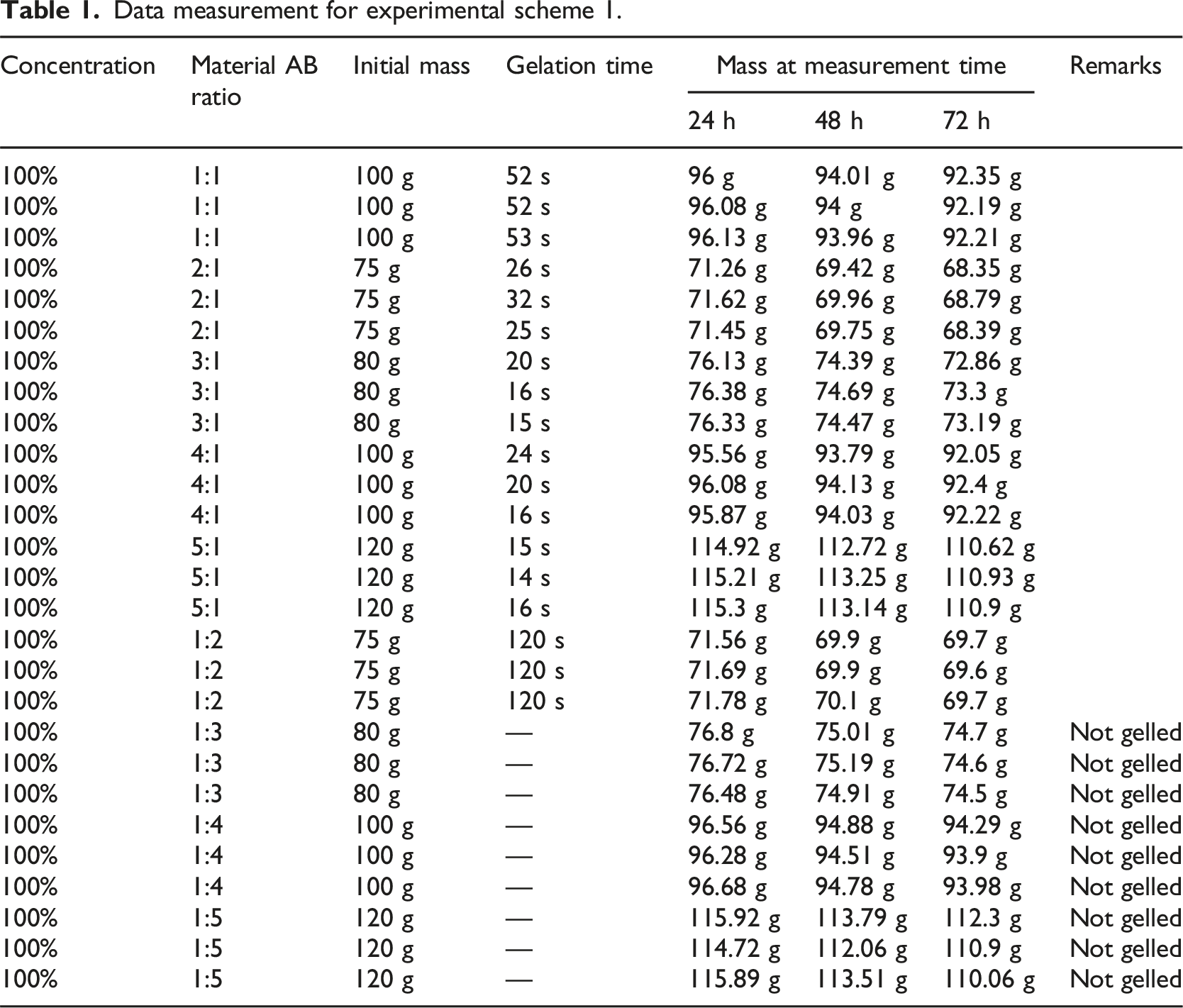
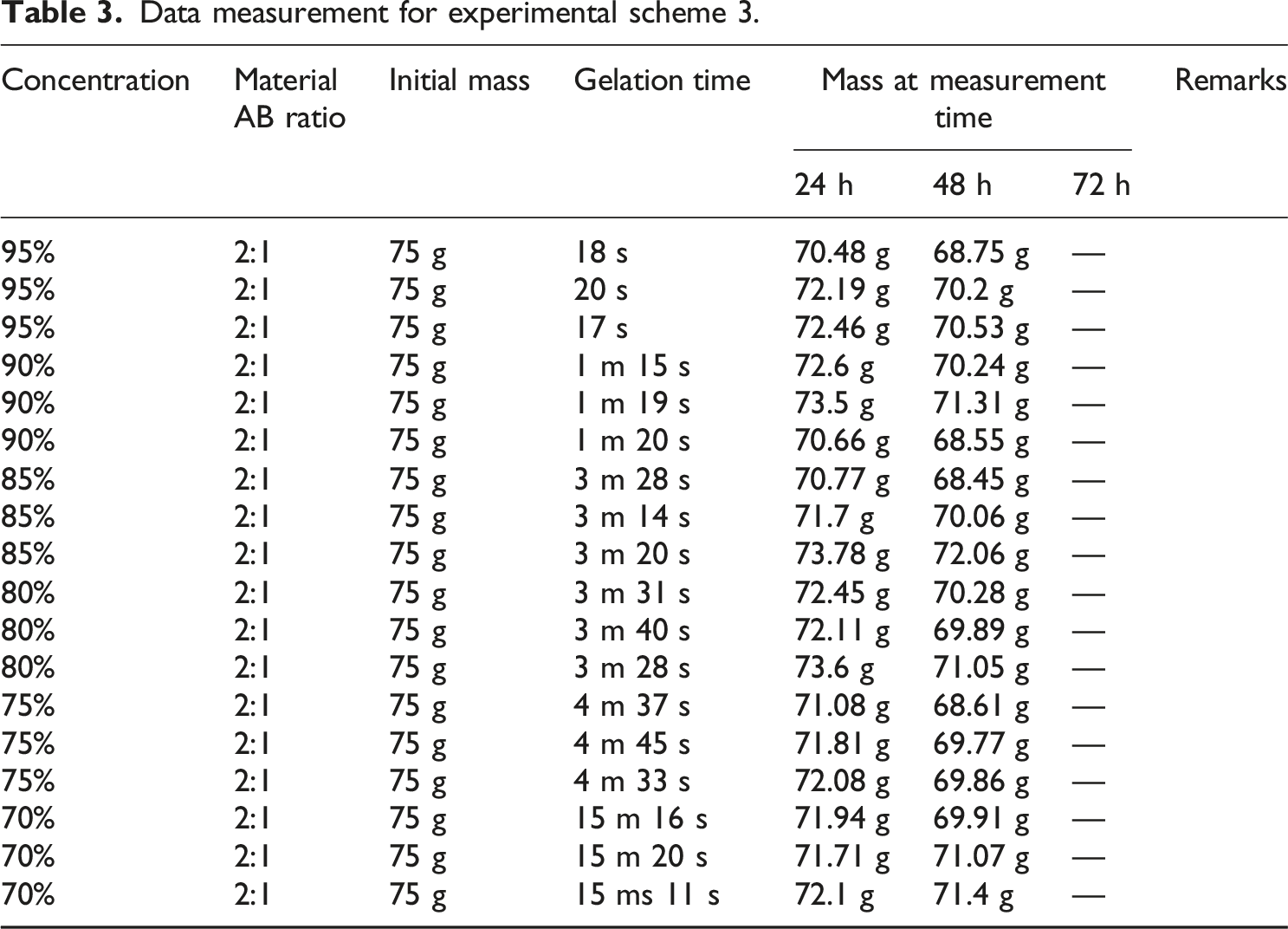
(1) Combine materials A and B (pure solution) in mass ratios of 1:2, 1:3, 1:4, 1:5, 2:1, 3:1, 4:1, and 5:1, the total weight of the deployment is 100 g, stir thoroughly, record the gelation time and original mass after gelation, and measure the mass change at 24 h, 48 h, and 72 h after gelation (Table 1). (2) Dilute materials A and B in a 1:1 ratio to solute proportions of 95%, 90%, 85%, 80%, 75%, 70%, 65%, and 60%, the total weight of the deployment is 100 g, stir thoroughly, record the gelation time and original mass after gelation, and measure the mass change at 24 h, 48 h, and 72 h after gelation (Table 2). (3) Dilute materials A and B in a 2:1 ratio to solute proportions of 95%, 90%, 85%, 80%, 75%, and 70%, the total weight of the deployment is 75 g, stir thoroughly, record the gelation time and original mass after gelation, and measure the mass change at 24 h and 48 h after gelation (Table 3). Data measurement for experimental scheme 1. Data measurement for experimental scheme 2. Data measurement for experimental scheme 3.

Data analysis
Each group in the above experimental scheme was tested three times, and data were recorded. The dehydration rate of the gelled experimental groups was calculated, and the average value was taken. The experimental data are as follows:
Dehydration rate after gelation for group 1.

Dehydration rate after gelation for group 2.

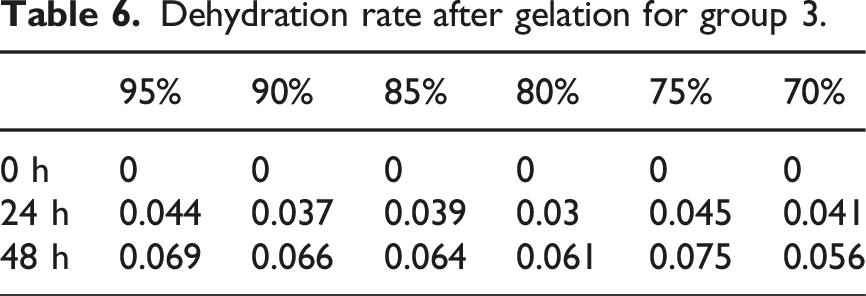
Dehydration rate after gelation for group 3.
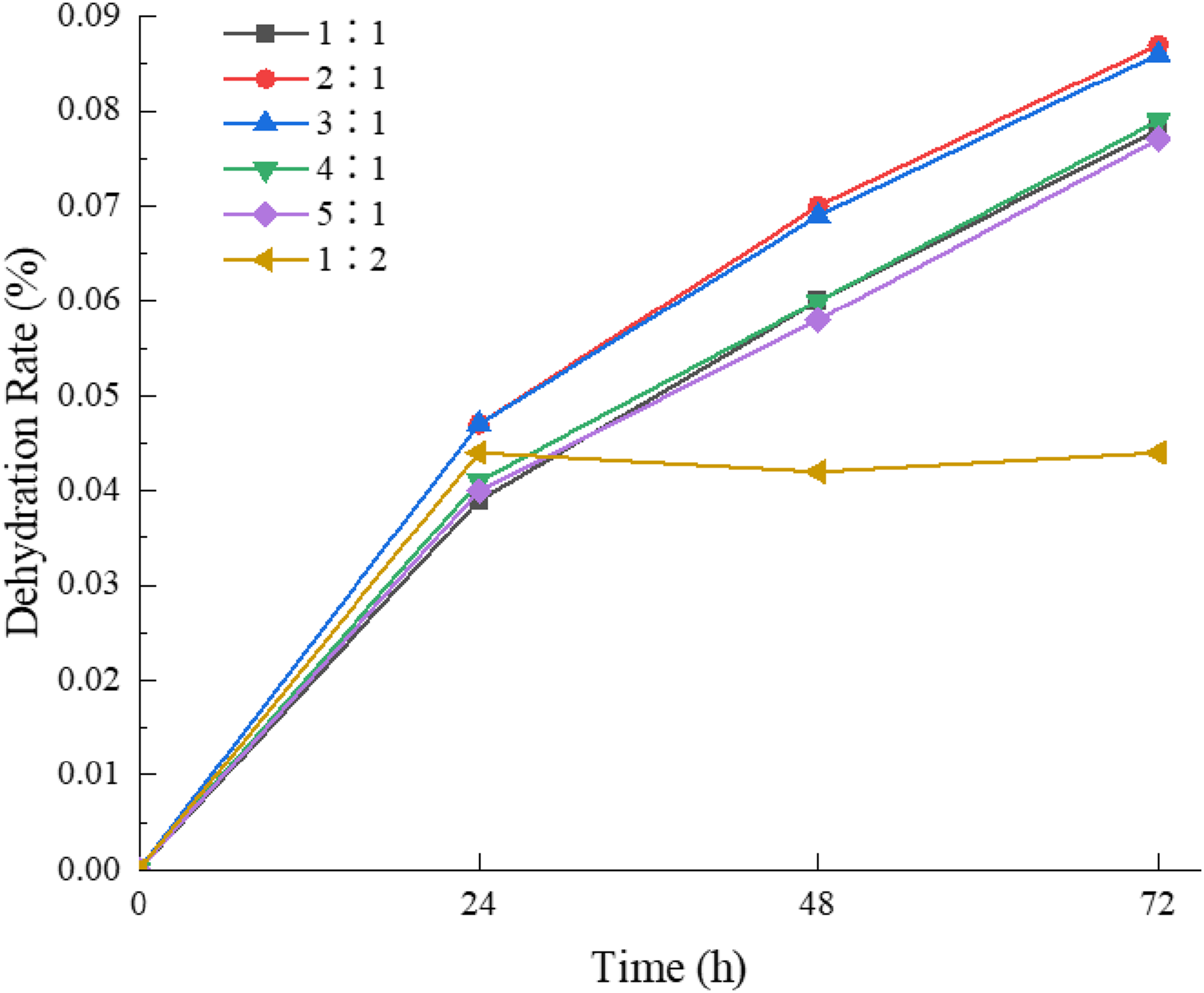
Change in dehydration rate for experimental group 1.

Change in dehydration rate for experimental group 2.
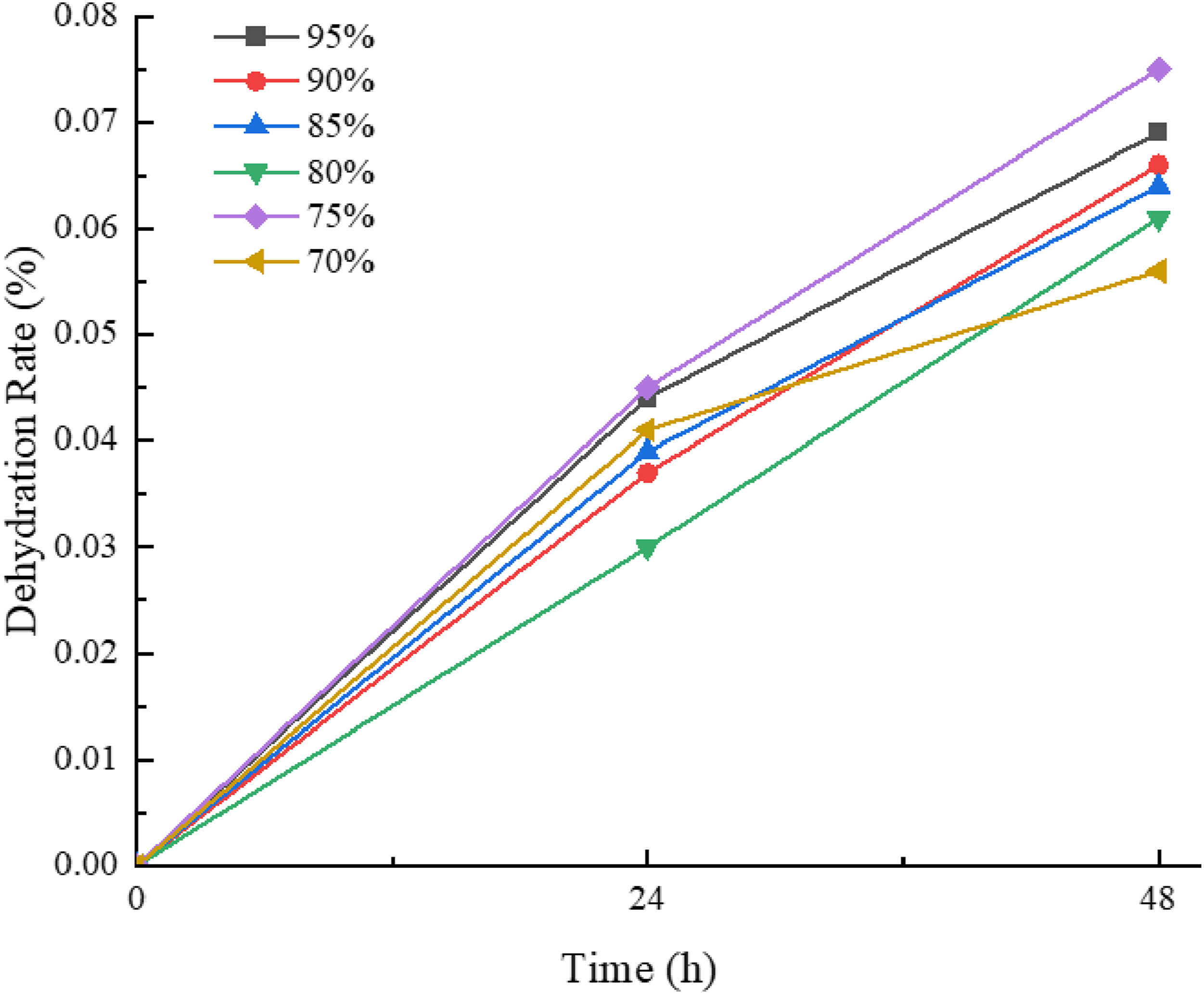
Change in dehydration rate for experimental group 3.
Conclusion
(1) Experiments were conducted to test the proportion of base material and coagulant solutions with different mass fractions, and the gelation time was recorded. Changing the ratio of the two continued the proportioning, and when the proportion of the base material solution was too high, gelation did not occur. The gumming time of the sealing type mineral colloidal fire-fighting material mainly depends on the proportion of coagulant. Therefore, in actual proportioning, the base material solution should not be chosen too high. (2) Experiments on dilution of base material and coagulant solutions were conducted. The less the solute is diluted, the longer the gelation time. If the concentration is too high, dilution does not result in gelation. (3) The formed gel experiences varying degrees of dehydration over time. (4) The gelation time of the formed gel is controllable. It has a stable structure, adjustable viscosity, high toughness, and certain elasticity. The inhibiting effect is obvious, but its water retention is poor. (5) The two base materials selected in this experiment have not been used before, and later researchers can have new references according to the selection of base materials. This study has verified various properties in the laboratory but lacks practical application in coal mines. The gel material has several advantages, such as good economy, low site requirement, and large amount of water consolidation, which is worth popularizing and using, and provides a new idea for mine fire control. (6) However, the gel material, with its small size, needs to prepare a large number of raw materials for the fire suppression of a large area of the goaf site, the cost of fire prevention is high, and the liquid is easy to flow and difficult to accumulate to the height before the gel becomes a gel.
11
In the future, the advantages of the material should be combined with other materials, which can further promote the practical application of gel fire prevention in coal mines.
Statements and declarations
Footnotes
Conflicting interest
The authors declared no potential conflicts of interest with respect to the research, authorship, and/or publication of this article.
Funding
The authors received no financial support for the research, authorship, and/or publication of this article.
