



Abstract
As art education increasingly emphasizes personalized and experiential learning, traditional teaching methods are in need of reform. Immersive teaching modes, by offering highly interactive and personalized learning experiences, can enhance students’ artistic practice abilities and esthetic appreciation. This study aims to construct an immersive teaching mode for art education based on machine learning and to evaluate and adjust its effectiveness. Initially, we developed a set of personalized recommendation strategies using sentiment analysis, knowledge graphs, and learner interaction data to build an art teaching mode tailored to different students’ needs. Subsequently, we employed the k-medoids clustering algorithm and convolutional neural networks (CNN) to comprehensively assess the effectiveness of the immersive teaching mode and optimize the teaching mode using the results of sentiment analysis. Existing research in the personalization and intelligence of art education remains insufficient; the machine learning approach provided in this study better understands students’ needs and feedback, allowing for the personalized customization of teaching content and strategies. The results indicate that this teaching mode effectively improves students' art learning outcomes and satisfaction, offering new insights and tools for the modern development of art education. The innovation of this paper lies in the construction of an immersive teaching model for art education based on sentiment analysis, knowledge graphs, and learner interaction data. This model is evaluated and dynamically adjusted using the k-medoids clustering algorithm and CNN.
Keywords
Introduction
With the growing demand for personalized and experiential learning in the field of art education, immersive teaching modes have gained attention for promoting active student participation and deep experiences.1,2 Traditional art education often focuses on theoretical teaching and practical operation but lacks customized teaching content and strategies for individual student differences.3–6 The introduction of machine learning technology offers a possibility to solve this problem, by intelligently analyzing and processing a large amount of educational data to support the creation of more personalized and interactive art education learning environments.7–9 However, how to accurately construct and evaluate an immersive teaching mode for art education based on machine learning remains a subject urgently to be explored in current research.
The personalization and immersive experience of art education can not only inspire students’ creative potential but are also key to improving artistic accomplishment and esthetic ability. Against this backdrop, exploring recommendation strategies based on machine learning technology is of significant research importance for constructing personalized immersive teaching modes in art education. 10 This can not only promote a deeper understanding and improvement of students’ practical operation abilities in art but also help advance the modernization of art education and provide references for other fields of education.
Although existing studies in the field of art education have adopted machine learning methods, these studies mostly focus on content delivery and student assessment, with less consideration for aspects such as student emotional feedback, personalized adaptation of teaching strategies, and recommendation of interactive learning activities.11–13 Moreover, in evaluating the effectiveness of teaching, existing research often overlooks the nonlinear characteristics and complexity of data, leading to questions about the accuracy and reliability of evaluation results.14–16
Current research on personalized and intelligent art education primarily focuses on leveraging data analysis and artificial intelligence technologies to enhance teaching effectiveness. However, most of these studies are limited to the application of a single technology, such as sentiment analysis or knowledge graphs, and lack a systematic approach that integrates multiple technologies. This paper innovatively combines sentiment analysis, knowledge graphs, and learner interaction data to propose a comprehensive immersive teaching model. This model not only dynamically adapts to individual differences among students but also employs machine learning to evaluate and optimize teaching effectiveness in real-time, significantly enhancing the level of personalization and intelligence in art education. This paper’s research content is divided into two parts: first, we focus on the construction of an art education immersive teaching mode based on recommendation strategies, covering personalized learning content recommendations based on sentiment analysis, teaching strategy recommendations based on knowledge graphs, and learning activity recommendations based on learner interaction, to achieve customized teaching plans for different student groups. Second, we use the k-medoids clustering algorithm and CNN to evaluate the effects of the immersive teaching mode in art education and adjust the teaching mode based on sentiment analysis data. The methodology of this study is novel, not only considering the personalized matching of learning content but also focusing on the intelligent optimization of teaching strategies and in-depth evaluation of teaching effects, providing a comprehensive, sustainable teaching mode framework for the field of art education, with significant theoretical and practical value.
Construction of art education immersive teaching mode based on recommendation strategies
Existing research on personalized teaching often lacks in-depth mining and utilization of student sentiment data, resulting in insufficient precision and effectiveness of recommendation systems. The comprehensive application of machine learning, especially sentiment analysis, knowledge graphs, and learner interaction data, can enhance the personalization and immersion of art education by more accurately interpreting and responding to students’ emotions and behaviors. By using the k-medoids clustering algorithm and CNN, the system can dynamically adjust teaching strategies to ensure that the teaching content and methods are closely aligned with students' actual needs and developmental changes, thereby significantly improving teaching effectiveness.
The art education immersive teaching mode proposed in this paper relies on the comprehensive application of sentiment analysis, knowledge graphs, and learner interaction data. The recommendation system analyzes students’ emotional responses to learning content through sentiment analysis technology and understands the knowledge structure of the art field through knowledge graphs. Combined with learner interaction data, it comprehensively captures students’ learning behaviors and feedback. The system first classifies student data using the k-medoids clustering algorithm to form groups of students with similar performance. Then, based on the characteristics of these groups, the system uses CNN to analyze and evaluate students’ learning outcomes. Finally, it dynamically recommends personalized teaching content and interactive activities that best match students’ interests and needs. The recommendation process includes five main steps: data collection, sentiment analysis, clustering classification, deep learning evaluation, and personalized recommendation. To accurately describe learners’ interests and preferences, the system uses sentiment analysis technology to interpret students’ emotional reactions to learning content and combines this with their behavioral data to fully understand their learning needs. Then, through knowledge graphs and interaction data, these preferences are effectively matched with the characteristics of specific activities, thereby recommending teaching content and activities that best align with students’ interests and needs.
Personalized learning content recommendation based on sentiment analysis
The steps of the personalized learning content recommendation algorithm based on sentiment analysis are as follows: Firstly, the algorithm collects comments from learners on art education platforms, aiming to capture students’ emotional attitudes toward specific art content. Using a BERT model optimized with art education corpus training, it makes high-precision sentiment orientation judgment, ensuring the model can understand the unique emotional expressions and terminology of the art domain. Then, based on the output sentiment classification probability values, the algorithm calculates specific emotion scores, representing the intensity of emotional tendency in the comments. Further, by comparing the similarity of emotion scores, the algorithm identifies neighboring learners with similar emotional reactions for more accurate peer recommendations. The algorithm not only considers the emotional reactions of individual learners but also attempts to enhance the personalization and targeting of recommendations through community effects. The generated prediction scores reflect the learners' potential acceptance of new learning content, serving as the core metric of the recommendation system to recommend art courses with which learners may be interested and emotionally resonate. Such recommendations are based not only on emotional similarity but also integrate the professionalism and depth of art education content, focusing more on the match between emotional resonance and teaching content compared to general recommendation systems.
Mapping rules in this scenario are specially designed to adapt to the characteristics of art education. Positive emotions in the appreciation of art works may manifest as admiration and inspiration, while negative emotions might also be a sensitive response to the depth of artistic expression. Therefore, these emotion scores’ mapping reflects not only intensity but also considers the multidimensional impact of emotions in the context of art education. The specific mapping rules are as follows. (1) If the emotional tendency is positive, when 0.98 ≤ p ≤ 1, the emotion score is 5 points; when 0.95 ≤ p < 0.98, the emotion score is 4 points. (2) If the emotional tendency is neutral, the emotion score is 3 points. (3) If the emotional tendency is negative, when 0.95 ≤ p < 0.98, the emotion score is 2 points; when 0.98 ≤ p ≤ 1, the emotion score is 1 point.
Following the above steps, learners’ emotional scores for personalized learning content can be obtained. The emotional rating of learner i for personalized learning content z is represented by t
iz
, and the emotional rating of learner n for personalized learning content z is represented by t
nz
. The following formula gives the calculation of the similarity of learners’ comment emotional scores.

Based on the calculation results above, a similarity matrix of learners’ emotions can be obtained, further identifying the j learners V j with the closest emotional tendencies to the target learner. Assigning the top-ranked learners’ ratings of personalized learning content to the target learner generates a predictive score for the target learner toward personalized learning content, represented by E iz .
Suitable teaching strategy recommendation based on knowledge graphs
In the immersive teaching mode for art education, this paper utilizes Neo4j to construct a knowledge graph of learning resources domain, efficiently representing and processing complex relationships and networks, which is particularly important for the multidimensional associations among the rich concepts, techniques, styles, and historical backgrounds in art education. With Neo4j, a dynamic, interconnected structure can be created, visualizing entities such as artworks, artists, art movements, technical methods, and educational resources, as well as their relationships. This not only helps students more intuitively understand the knowledge structure of the art field but also allows for the efficient retrieval and recommendation of personalized learning paths and teaching strategies based on students’ learning progress, preferences, and emotional feedback, using the Cypher query language. Different from other recommendation systems, the teaching strategy recommendation method based on knowledge graphs can dynamically adjust the recommendation logic using the relationships of nodes and edges, providing more in-depth and rich teaching content recommendations for art education, thereby achieving truly personalized and immersive learning experiences.
The suitable teaching strategy recommendation system based on knowledge graphs will analyze and utilize the diverse interaction paths between learners and teaching strategies to generate personalized recommendations. This reasoning path embedding method considers the learner’s historical interactions, such as courses watched, evaluated, or participated in discussions, and the art categories these courses belong to. For example, if there is a path in the knowledge graph “user1→(participates in) project1 (uses) tech1←(used by) project2,” this indicates that user1 participated in project1 that used tech1, and project2 also used the same technique. Therefore, the system can infer that user1 may be interested in project2 which uses the same technique.
The TransR model is a knowledge graph embedding method that embeds entities and relationships into different vector spaces to more flexibly represent and capture the complex relationships between entities. Specifically, TransR establishes a mapping matrix between the entity space and the relationship space, allowing each relationship to more accurately represent and reason about entities within its specific relationship space. This enhances the representation capability and reasoning effectiveness of the knowledge graph. In the immersive teaching mode for art education, the key to building an effective suitable teaching strategy recommendation system lies in accurately capturing and representing the complex relationships between teaching resources. Since the knowledge graph in the field of art education usually involves rich many-to-many relationships, such as multiple art styles may influence a series of artworks, or an artist may be proficient in various techniques, the traditional TransE model may encounter difficulties in handling such complex relationships because it is primarily designed for simple one-to-one relationships. In contrast, the TransR model processes these many-to-many relationships by mapping entities and relationships to different vector spaces, allowing each entity to have different representations in multiple related relationships. In the context of art education, this allows the TransR model to capture, for example, the relationships between different art techniques and artworks, or the connection between art theory and creative practice more finely. Figure 1 provides a schematic diagram of the TransR model. Schematic diagram of the transr model.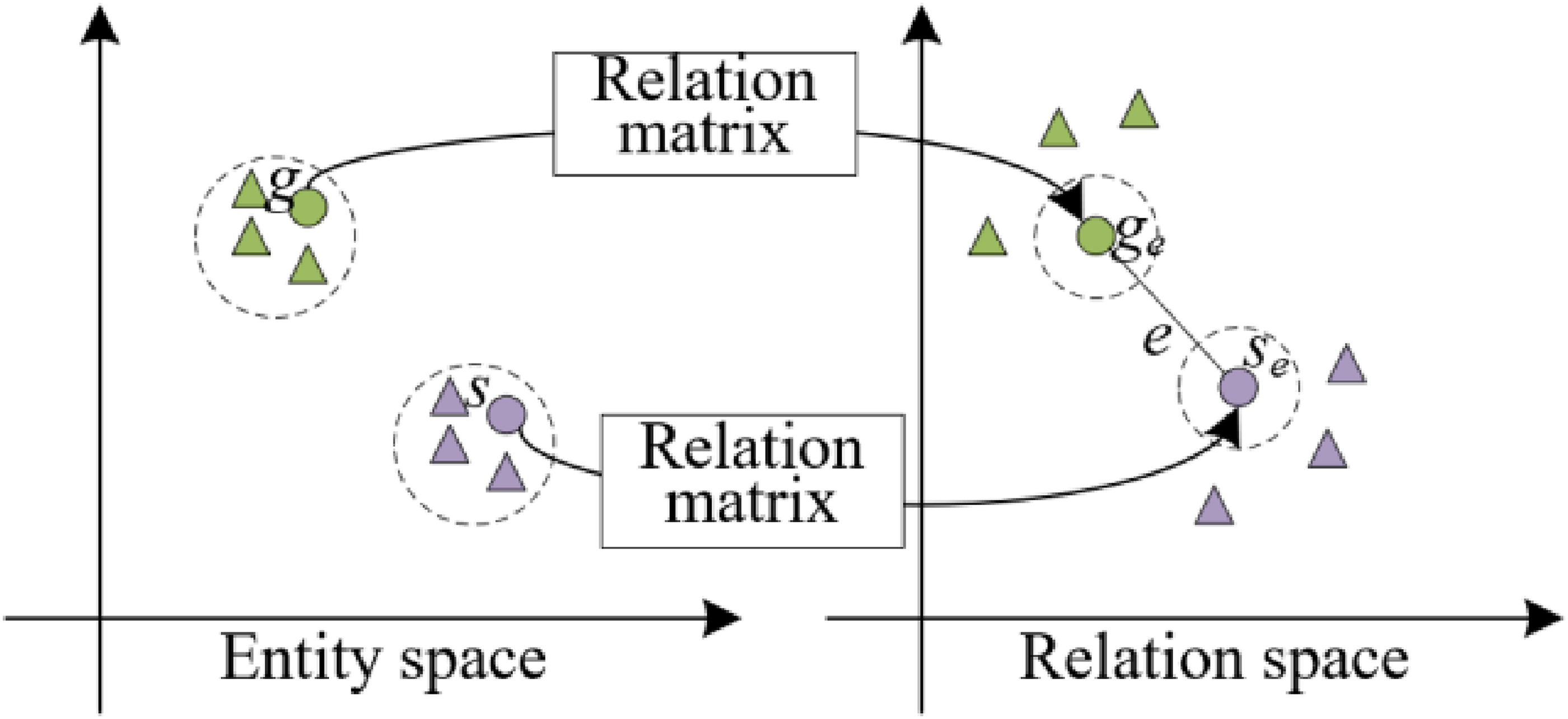
Assuming the relation matrix representation, the head entity is denoted by g, which generates a new vector g
e
through the mapping of the relation matrix L
e
. The tail entity s generates a new vector s
e
through the mapping of L
e
, as shown in the following expressions:


Assuming the entity embedding vector of the lth path from learner i to suitable teaching strategy z is represented by r
UC
. Using the TransR method, the vector representation r
z
of entity z is generated, resulting in the vector representation of the “learner-suitable teaching strategy” entity pair for the lth inference path as shown in the following equation:

This vector representation is inputted into the LSTM model, further obtaining the semantic representation of the “learner-suitable teaching strategy” for the lth inference path as shown in the following equation:

This paper introduces the Self-Attention mechanism into the LSTM model to capture the important content in the semantic representation of the inference path. When there are m entities in the lth inference path of the “learner-suitable teaching strategy” entity pair, the attention weight of the nth iteration of the LSTM is represented by Q
UCv
, resulting in:


Introducing Q
UCv
results in the following final semantic of that path:

Through the max pooling operation to extract the most important features of the vector, the final prediction score J
iz
can be calculated as follows:

Recommendation of interactive learning activities based on learners
In the immersive teaching mode for art education, the key to building a recommendation system for interactive learning activities lies in precisely capturing learners’ interest preferences and providing personalized learning experiences accordingly. To achieve this goal, this paper adopts a learner-based collaborative filtering recommendation algorithm, with the core being the construction of a learner-interactive learning activity rating matrix El*v. In this matrix, learners’ participation and evaluation of different interactive learning activities (such as practical courses, online discussions, and artwork creation guidance) are converted into specific numerical ratings and filled into the corresponding positions in the matrix. Thus, each row represents all activity ratings of a learner, and each column represents the ratings received by a learning activity from all learners. By analyzing this matrix, the recommendation system can identify learner groups with similar preferences and predict current learners’ potentially interested learning activities based on these learners' historical interaction data. Specifically, let the number of learners be represented by l, the number of interactive learning activities by v, and the rating of learner u for interactive learning activity k by e uk .
Different similarity measurement methods can significantly impact tasks such as data clustering, recommendation systems, and information retrieval. For example, Euclidean distance is suitable for measuring the similarity of continuous numerical data, while cosine similarity is more appropriate for evaluating the similarity of text or high-dimensional sparse vectors. Choosing an appropriate similarity measurement method can effectively improve the performance of algorithms and the accuracy of results, thereby better meeting the needs of specific application scenarios. In the recommendation of interactive learning activities based on learners, the calculation of similarity between learners is achieved by comparing the similarity between rows in the learner-interactive learning activity rating matrix. After selecting a target learner, the system extracts this learner’s rating data for different interactive learning activities, then compares it with the ratings of other learners for the same activity. The rating records of learner i (ei1,ei2,…,e
iu
,…,e
iv
) are considered as a rating vector. Assuming interactive learning activities rated by both learners i and n are represented by Zi,n, and the activities rated by learners i and n individually by Z
i
, Z
n
, the average ratings of learners i and n are represented by e¯
i
, e¯
n
, and the ratings of learners i and n for interactive learning activity z by ei,z, en,z. The similarity between target learner i and other learners n is represented by SIM(i,n), resulting in the calculation:

Through these calculations, the system can quantify the similarity between each pair of learners and then use the learner groups with higher similarities as a reference to predict new interactive learning activities that the target learner might be interested in. This forms the basis for personalized recommendations. Assuming the set of the top j learners most similar to the target learner i is represented by N = {N1,N2,…,N
j
}, the rating for interactive learning activities is represented by O
iz
, the similarity in interest preferences between learner i and n is represented by SIM(i,n), the average rating of learners i and n is represented by e¯
i
, e¯
n
, and the rating of learner n for interactive learning activity z is represented by en,z, the specific calculation method is as follows:

Generation of immersive teaching mode in art education
The construction of the immersive teaching mode in art education aims to create a comprehensive, personalized, and highly interactive learning environment, as seen in Figure 2. In the research of this paper, the method to realize this model integrates three core recommendation strategies to ensure the accuracy and practicality of the recommendation results. Combining these three recommendation strategies, the system can provide students with an art education immersive learning environment that is emotion-driven, knowledge-led, and interaction-enhanced. Personalized learning content ensures students’ emotional engagement, suitable teaching strategies ensure learning efficiency and depth, and the recommendation of interactive learning activities strengthens students' practical abilities and creative thinking. These interacting strategies collectively enable students to achieve the best learning outcomes in an immersive environment. The construction process of the immersive teaching mode in art education.
Assuming the fusion ratio coefficients of the three recommendation algorithms’ predicted scores E
iz
, J
iz
, O
iz
are represented by β, α, ϕ, and the bias term coefficient is represented by y, the specific calculation formula for the final predicted score value of the immersive teaching mode in art education is given by the following equation:

The fusion mechanism of three recommendation strategies integrates sentiment analysis, knowledge graphs, and learner interaction data by leveraging their respective strengths to establish a multidimensional recommendation framework. Machine learning algorithms are used to balance and optimize the contributions of different modules, ensuring that the final recommendations meet personalized needs while effectively enhancing student engagement and learning outcomes.
Evaluation and adjustment of the immersive teaching mode in art education based on machine learning
This paper further proposes a method for evaluating and adjusting the effectiveness of the immersive teaching mode in art education based on machine learning, as shown in Figure 3. This method draws inspiration from the architecture of a sports prescription recommendation system designed for university students’ physical health and applies it within the context of art education. Specifically, the system first utilizes the k-medoids clustering algorithm to categorize art education students’ learning behaviors and performance data, gathering students with similar performances. This serves as a basis for evaluating and adjusting the teaching mode. The criteria for classification may include students’ learning progress, skill mastery level, style of creative work, or participation level. Subsequently, the system employs CNN to process and analyze this clustered student data to evaluate the effectiveness of the current immersive teaching mode, such as the frequency of interaction and the innovativeness of the works. The deep learning capability of CNN enables them to identify key features from complex student performance data that affect teaching effectiveness. Finally, by integrating sentiment analysis data, such as emotions and preferences expressed by students in course feedback, the teaching mode is personalized and adjusted to ensure that teaching activities are more closely aligned with students' needs and feelings. This approach more effectively enhances the immersive experience and teaching outcomes in art education. The process of evaluation and adjustment of the immersive teaching mode in art education.
This paper further proposes a method for evaluating and adjusting the effectiveness of the immersive teaching mode in art education based on machine learning, as shown in Figure 3. This method draws inspiration from the architecture of a sports prescription recommendation system designed for university students’ physical health and applies it within the context of art education. Specifically, the system first utilizes the k-medoids clustering algorithm to categorize art education students’ learning behaviors and performance data, gathering students with similar performances. This serves as a basis for evaluating and adjusting the teaching mode. The criteria for classification may include students’ learning progress, skill mastery level, style of creative work, or participation level. Subsequently, the system employs CNN to process and analyze this clustered student data to evaluate the effectiveness of the current immersive teaching mode, such as the frequency of interaction and the innovativeness of the works. The deep learning capability of CNN enables them to identify key features from complex student performance data that affect teaching effectiveness. Finally, by integrating sentiment analysis data, such as emotions and preferences expressed by students in course feedback, the teaching mode is personalized and adjusted to ensure that teaching activities are more closely aligned with students' needs and feelings. This approach more effectively enhances the immersive experience and teaching outcomes in art education.
To address the construction requirements of the immersive teaching mode in art education, this paper employs the k-medoids algorithm for clustering analysis of student data within art education to optimize teaching effectiveness and implement personalized teaching adjustments. The specific steps are as follows: (1) First, collect relevant student data from art education courses, which may include information on students’ learning behaviors, engagement, quality of creative works, and classroom interactions, and organize this data into a matrix form, performing necessary data preprocessing; (2) Use the preprocessed data matrix to calculate the similarity between students, typically using Euclidean distance as the measure of similarity, and store these distances in a distance matrix, while also determining the number of clusters to form; (3) Randomly select data points as the initial centroids of the clusters; (4) Based on the distance matrix, assign each student data point to the cluster represented by the nearest centroid; (5) Within each cluster, recalculate the sum of distances between member points and select a new centroid, that is, the point that minimizes the total distance to the other data points in the cluster; (6) Repeat steps (4) and (5) until the centroids no longer change or a preset number of iterations is reached, then output the final cluster centroids. This method not only identifies different learning characteristics and needs among student groups in art education but also allows for targeted adjustments to the immersive teaching mode based on clustering results, such as adjusting teaching content, methods, and interaction strategies, to improve teaching quality and students' art learning experience.
Furthermore, this paper employs CNN to evaluate the effectiveness of the immersive teaching mode in art education. The input layer data consists of multidimensional behavior and performance data of students in art education, such as students’ engagement, learning progress, creative expression, and skill mastery levels, which are transformed into a comprehensive feature vector. Since CNN models typically involve image data as input, these feature vectors need to be transformed into a form that simulates image data to fit the processing method of the CNN model. However, due to the possibly insufficient dimensions of art education data to directly fit standard CNN input sizes, we might need to use some feature expansion technique to increase the number of features to match, for example, a 28×28 input size. In the CNN model, adjusting the stride of the convolutional layers and using “SAME” padding ensures the spatial dimensions of the feature maps remain unchanged, while applying max pooling reduces the feature dimensions and enhances the model’s generalization ability. The output layer is a multiclass assessment of the effectiveness of the immersive teaching mode in art education, which may correspond to different levels or types of teaching effectiveness.
Finally, this paper utilizes Natural Language Processing (NLP) sentiment analysis strategies to optimize the teaching mode, as shown in Figure 4. The specific method involves collecting physiological data (such as heart rate) and emotional data (such as teaching feedback texts) from students after art activities, and inputting these teaching feedback texts into an NLP sentiment analysis model to predict students’ emotional tendencies. These emotional data, along with physiological data, are stored in a database to assess students' feelings and reactions to the art education experience. After a certain period of teaching activities, based on students’ levels of emotional tendency and engagement, an adjustment ratio for the immersive teaching mode in art education is calculated using a specially designed adjustment formula. This adjustment aims to personalize improvements in teaching content, interaction methods, and art practice activities to better meet students' emotional needs and enhance their art learning experience. Further exploration of learners’ emotional feedback data can involve analyzing students' emotional changes in different contexts. This analysis helps identify key factors influencing learning effectiveness, providing more precise bases for dynamically adjusting teaching models. This ensures that teaching methods and content better meet students’ emotional needs, thereby enhancing teaching effectiveness. The process of adjusting the immersive teaching mode in art education based on NLP.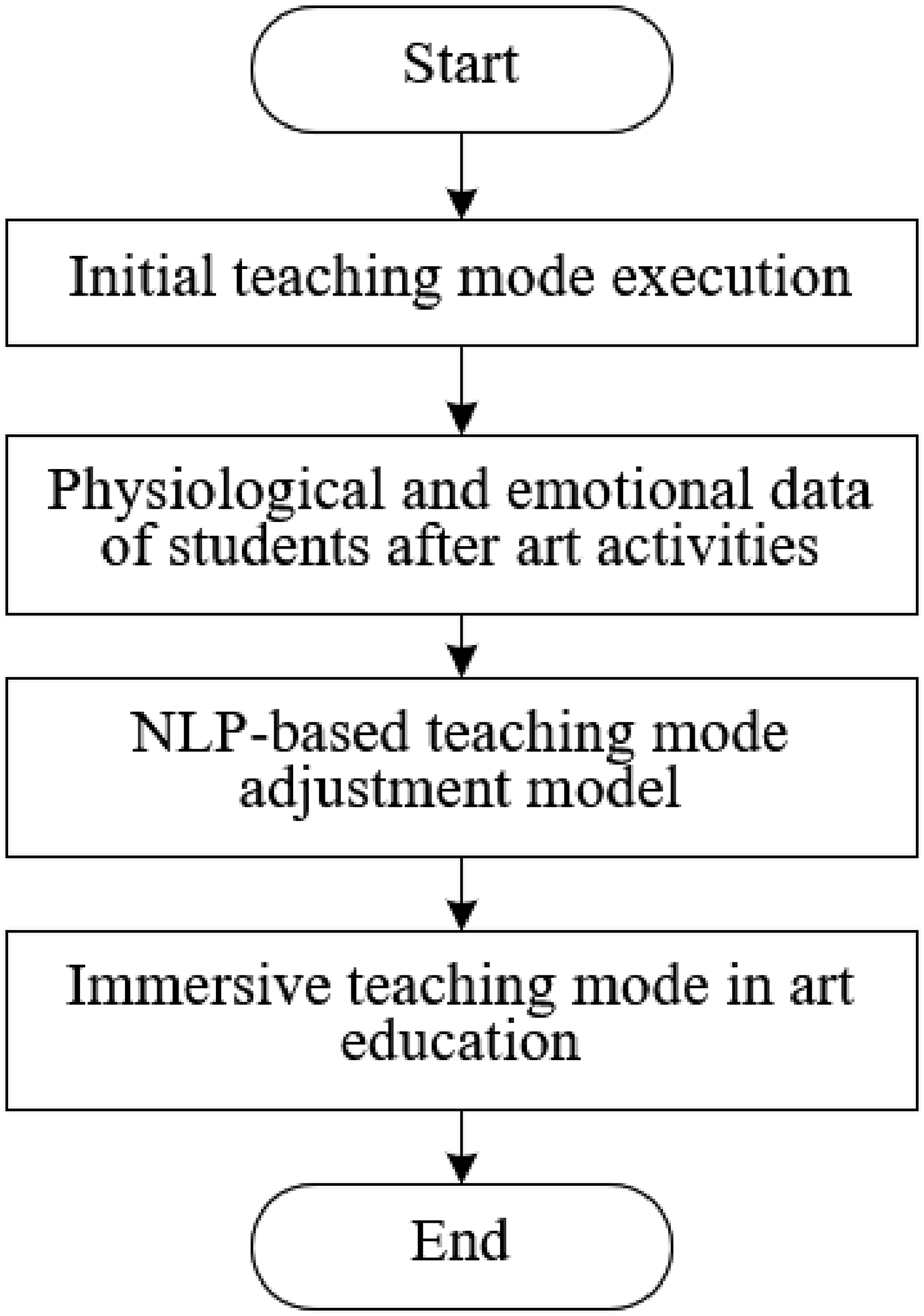
In the immersive teaching mode for art education, the process of assessing students’ engagement levels and the impact of art activities needs to be based on students' performance in art activities, the frequency of participation in interactions, and the depth of emotional investment. For example, their level of engagement can be determined through multidimensional information such as students’ interactive behaviors in class, progress in artwork creation, and their feedback on art activities. This information can be quantified into an engagement indicator A, represented by a range from −1 to 1, where 1 indicates high engagement and positive feedback, 0 indicates medium engagement, and −1 represents low engagement or negative feedback. By collecting and analyzing engagement data over a period (such as 2 weeks), an overall level of engagement in art education can be calculated, helping educators understand the impact of teaching activities and adjust teaching strategies accordingly to optimize students’ art learning experience. Assuming v represents the number of days participated, and a
u
represents the engagement level per day, the calculation formula is:

To measure the impact of teaching effectiveness on students’ emotions, students’ daily emotional feedback data can also be collected. Similar to the method of collecting emotional data from exercise prescription users, NLP sentiment analysis can be applied to process students’ written feedback, classroom discussion records, or descriptive texts of art works, thereby determining students' emotional tendencies. If the analysis shows a negative emotional tendency, the daily emotional data record is −1; if the emotional tendency is positive, it is recorded as 1; if there is no clear emotional tendency, it is recorded as 0. The emotional analysis data from the first week is calculated to get an average score E, the second week’s data to get score T, then E and T are added to obtain a total emotional tendency level B. This overall level is within the range of [-2,2], reflecting the students’ overall emotional response to art education activities. Specifically, assuming the emotional data for the uth day of the first week is represented by e
u
, and for the uth day of the second week by T
u
, the formulas are:



The final result of adjustments to the immersive teaching mode in art education, represented by d (A,B), can be obtained by incorporating A and B into the following equation:

Experimental results and analysis
Experimental results of constructing an immersive teaching mode in art education based on recommendation strategies.

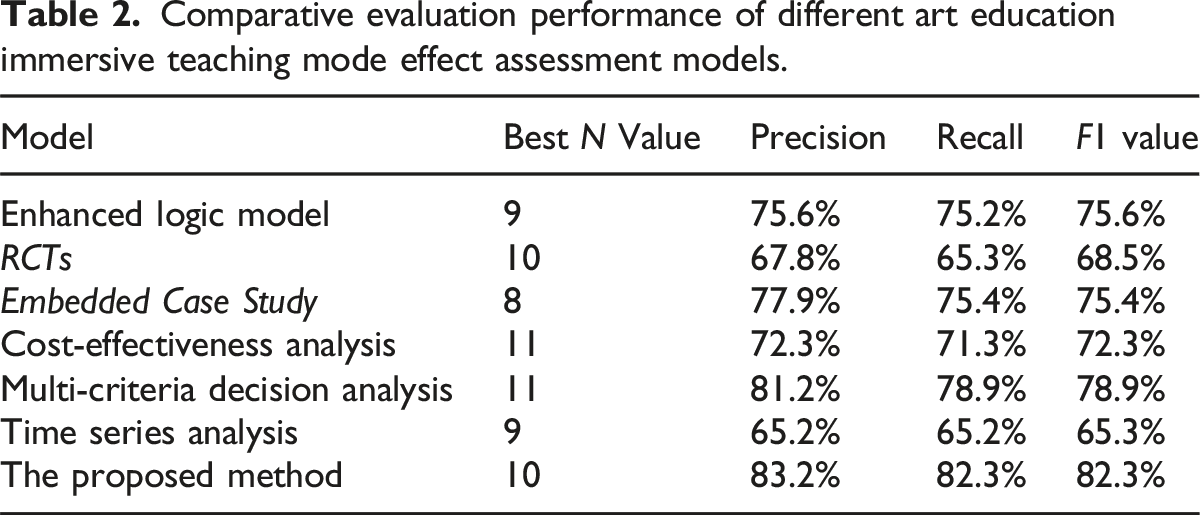
Precision is defined as the ratio of true positive instances to the total number of instances predicted as positive. Recall is defined as the ratio of true positive instances to the total number of actual positive instances. The F1 score is the harmonic mean of precision and recall, used to comprehensively evaluate the performance of a model, particularly in handling imbalanced data. The formulas are as follows: Precision = TP / (TP + FP), Recall = TP / (TP + FN), and F1 Score = 2 * (Precision * Recall) / (Precision + Recall), where TP represents the number of true positive instances, FP represents false positive instances, and FN represents false negative instances.
Comparative evaluation performance of different art education immersive teaching mode effect assessment models.
Adjustments in the immersive teaching mode in art education.
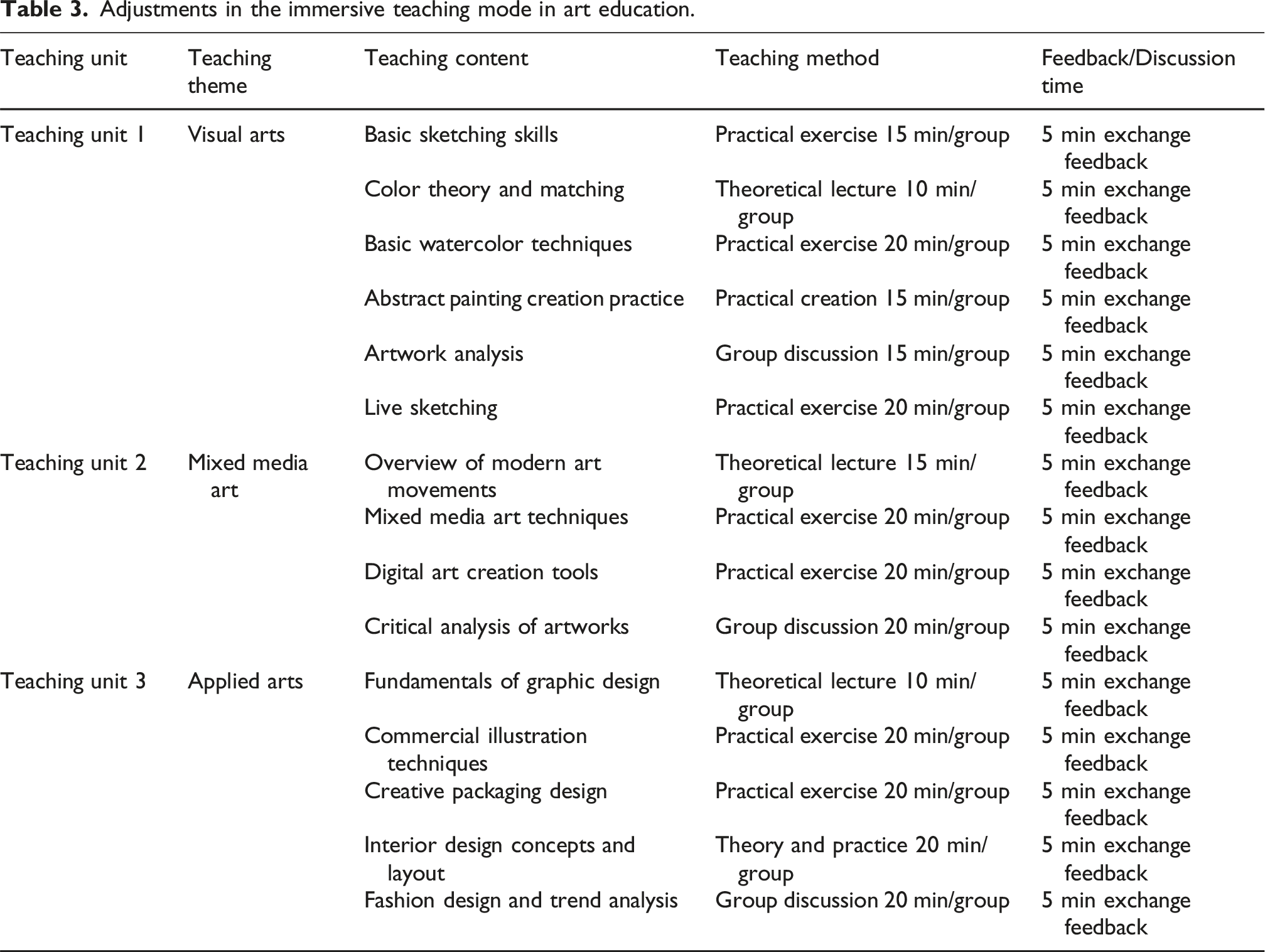
The evaluation metrics encompass creativity development (ZB1), skill mastery (ZB2), emotional engagement (ZB3), critical thinking (ZB4), cultural understanding (ZB5), collaboration ability (ZB7), and self-expression (ZB8). These metrics comprehensively cover the core objectives of art education, ensuring a multidimensional assessment of students’ growth and development. Creativity development and skill mastery gauge students' artistic abilities; emotional engagement and self-expression reflect students’ emotional involvement and expressive capabilities; critical thinking and cultural understanding assess students' ability for critical reasoning and cultural literacy in artistic learning; while collaboration ability showcases students’ performance in team activities. This paper categorizes the immersive teaching mode in art education based on recommendation strategies into four types: personalized project-based learning, situational role-playing and simulation, directed studio method, and customized cultural immersion activities. The evaluation indicators for the effects of the above-mentioned immersive teaching modes in art education can consider various experiences and outcomes of students during the art learning process from multiple dimensions. Figure 5 shows the results of the effect assessment experiments before and after adjustments in the immersive teaching mode in art education. After adjustments, personalized project-based learning showed significant improvements in creativity development (ZB1), skill mastery (ZB2), emotional engagement (ZB3), and critical thinking (ZB4), especially emotional engagement and critical thinking, which shifted from negative evaluations to full score performances, indicating students' deep involvement and progress in these areas. However, scores for cultural understanding (ZB5), collaboration ability (ZB7), and self-expression (ZB8) decreased, suggesting a need to enhance integration of cultural content and opportunities for teamwork during adjustments. The adjustments in situational role-playing and simulation showed improvements in participation (ZB6) and collaboration ability (ZB7), but declines in creativity development (ZB1), skill mastery (ZB2), emotional engagement (ZB3), critical thinking (ZB4), and self-expression (ZB8), indicating the need to strengthen emotional engagement and skill application in this teaching mode. Directed studio method showed good performance after adjustments in creativity development (ZB1), skill mastery (ZB2), cultural understanding (ZB5), participation (ZB6), collaboration ability (ZB7), and self-expression (ZB8), especially in creativity and skill mastery, indicating its effectiveness in promoting learners’ active exploration and skill improvement. Customized cultural immersion activities significantly improved cultural understanding (ZB5), participation (ZB6), collaboration ability (ZB7), and self-expression (ZB8) after adjustments, demonstrating that deep involvement in cultural activities led to better development in these areas. Though there was a decrease in creativity development (ZB1) and skill mastery (ZB2), this might be due to a focus on understanding and experiencing rather than skill training in cultural immersion. Results of the effect assessment experiment before and after adjustments in the immersive teaching mode in art education.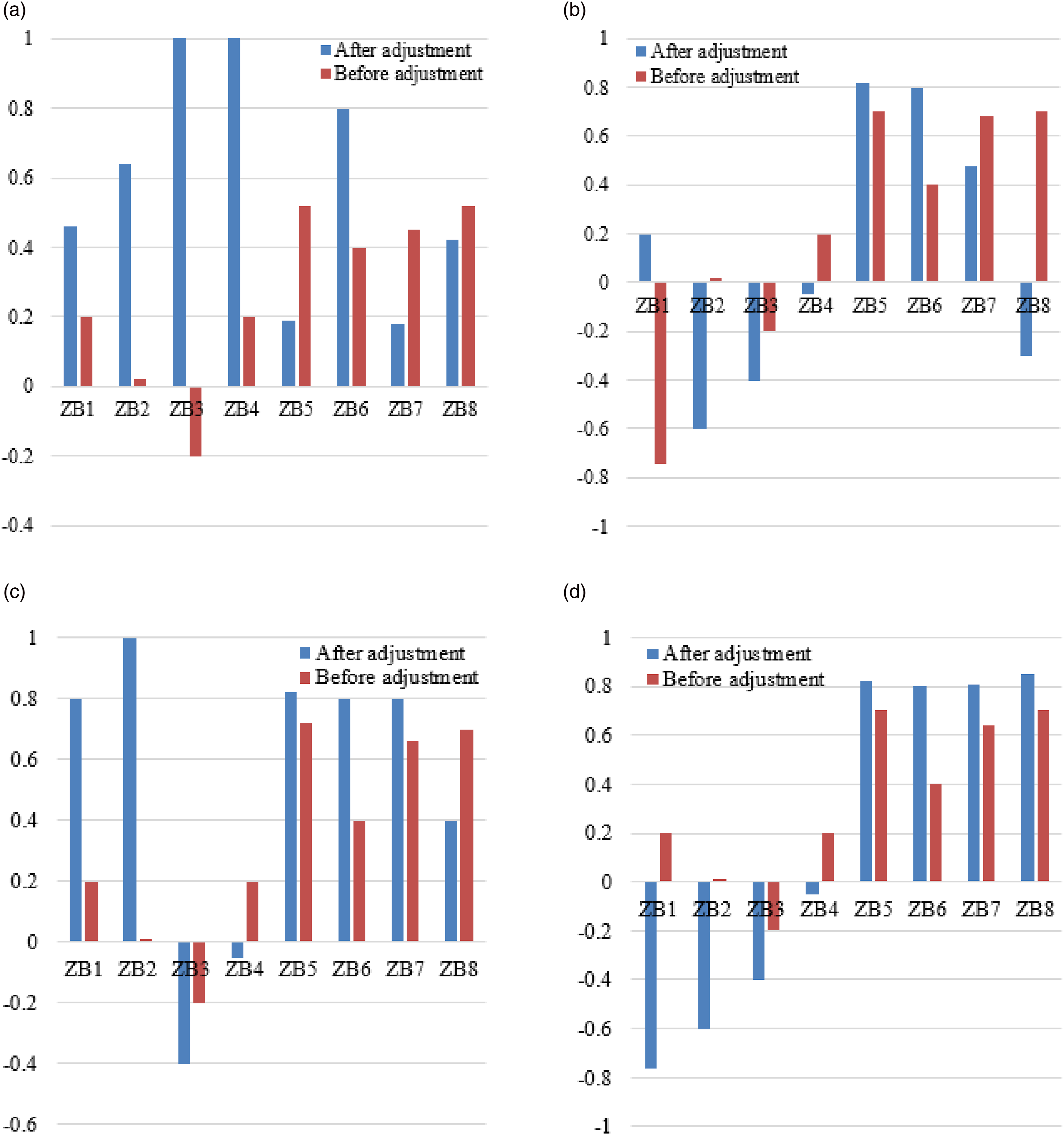
These results demonstrate that the machine learning-based assessment and adjustment method proposed in this paper effectively identified the strengths and weaknesses of four types of art education immersive teaching modes. In personalized project-based learning, the substantial progress in emotional engagement and critical thinking proved the success of the adjustments. However, the decline in cultural understanding and self-expression indicated further improvements and adjustments are needed in these areas. The situational role-playing and simulation method improved students’ performance in collaboration ability but declines in skills and emotional engagement suggest a need to re-balance the teaching approach. Both the directed studio method and customized cultural immersion activities showed positive adjustment results across multiple indicators, especially in participation and collaboration ability, emphasizing these methods' effectiveness in enhancing student engagement and teamwork. Overall, this assessment and adjustment method provides educators with a quantified means to refine and optimize teaching modes, ensuring teaching activities better meet students’ learning needs and enhance their comprehensive abilities in the field of art education.
Changes in scores of different learners before and after adjustments in the immersive teaching mode in art education.

The comprehensive data analysis concludes that the machine learning-based assessment and adjustment method proposed in this study effectively improves the effectiveness of the immersive teaching mode in art education. By analyzing and evaluating the teaching mode using k-medoids clustering algorithms and CNN, and making adjustments based on sentiment analysis data, researchers were able to significantly enhance students’ performance across various assessment indicators. This approach, which combines quantitative data and sentiment analysis, not only improves the overall effectiveness of the teaching mode but also provides educators with a powerful tool to more precisely identify strengths and weaknesses in the teaching process, allowing for targeted teaching strategy adjustments.
Conclusion
This paper’s research work is primarily divided into two main parts, aiming to construct and evaluate an immersive teaching mode for art education. The first part focuses on building a personalized art education teaching mode using recommendation strategies. This includes personalized learning content recommendations based on sentiment analysis to provide personalized learning materials according to students’ emotional states and preferences; teaching strategy recommendations based on knowledge graphs by creating a network of subject knowledge connections; and learning activity recommendations based on learner interactions, customizing suitable collective learning tasks according to different students’ interaction patterns. The second part evaluates the effectiveness of the immersive teaching mode through k-medoids clustering algorithms and CNN and makes real-time adjustments to the teaching mode based on sentiment analysis data to optimize teaching outcomes.
In the broader context of education and technology, this study demonstrates significant potential for integrating multiple technologies to enhance personalized and immersive learning experiences. It not only introduces new teaching models and assessment methods in the field of art education but also provides insights for intelligent and personalized teaching across other educational domains. Furthermore, the multidimensional data analysis and machine learning applications explored in this research are expected to have profound impacts on initiatives such as smart campus development, improving educational equity, and fostering holistic student development. In comparison to other educational models utilizing machine learning, particularly those focusing on personalized recommendations and teaching effectiveness assessment, this study stands out. While some existing research may emphasize traditional content recommendations without fully leveraging sentiment analysis and knowledge graph technologies, this study achieves more precise personalized recommendations and dynamic teaching model adjustments by integrating sentiment analysis, knowledge graphs, and learner interaction data. Additionally, the innovative approach of using k-medoids clustering algorithm and CNN for student data analysis and teaching effectiveness assessment significantly enhances the scientific rigor and practical effectiveness of teaching strategies.
In the performance evaluation comparison, the assessment model incorporating machine learning algorithms showed higher accuracy and reliability. However, the study also has limitations, such as possibly not covering all knowledge points in art education when building the knowledge graph, and the accuracy of sentiment analysis is limited by the current state of sentiment analysis technology. Future research could work on improving the precision of sentiment analysis, expanding the coverage of the knowledge graph, optimizing recommendation algorithms, and further personalizing teaching content. Additionally, exploring the application of this model in a broader educational context and evaluating its adaptability and effectiveness for student groups from different cultural backgrounds could also be valuable.
Statements and declarations
Footnotes
Declaration of conflicting interests
The author(s) declared no potential conflicts of interest with respect to the research, authorship, and/or publication of this article.
Funding
The author(s) received no financial support for the research, authorship, and/or publication of this article.