



Abstract
Personalized learning path (PLP) planning in vocational education faces significant challenges, including static designs and an inability to efficiently process complex state spaces or provide real-time feedback. To address these limitations, this paper introduces the deep Q network (DQN) algorithm, enabling dynamic and intelligent PLP planning that adapts to learners’ evolving needs and enhances learning outcomes. The study begins by extracting multi-dimensional features of learners from historical learning data, personal background information, learning interests, and progress feedback. These features are then integrated with learning modules and goals to construct a comprehensive state space for PLP. Leveraging the DQN algorithm, the model optimizes learning paths through reinforcement learning’s reward mechanism, dynamically adjusting PLPs based on real-time learner feedback and feature changes. The results demonstrate the superiority of the DQN algorithm in achieving personalized learning. On average, the DQN algorithm adjusts each learner’s plan 7.8 times, significantly outperforming traditional methods such as collaborative filtering (CF) and particle swarm optimization (PSO). Compared to CF and PSO, the DQN algorithm increases the average number of plan adjustments by 2.4 and 2.0 times, respectively. This highlights its ability to provide real-time, adaptive solutions tailored to individual learners’ needs. By overcoming the static nature of conventional PLP approaches, the DQN-based model not only improves learning efficiency and engagement but also sets a new benchmark for intelligent educational systems. This research underscores the transformative potential of AI-driven methodologies in vocational education, paving the way for more adaptive, scalable, and effective learning solutions.
Keywords
Introduction
With the rapid development of vocational education, learners’ learning needs are becoming increasingly diversified, and the learning environment is becoming increasingly complex. Learners’ personalized learning path (PLP) needs are also becoming more and more extensive.1–3 Traditional rule-based or heuristic PLP planning methods have shortcomings such as staticity, lack of personalization, and lack of immediate feedback, and it is difficult to adapt to the dynamic changes of learning states. Especially in high-dimensional and massive data environments, its solution efficiency and effect are significantly limited. This limitation affects the accuracy of the learning path and restricts learners’ learning efficiency. With the increasing maturity of deep reinforcement learning (DRL) theory, the deep Q network (DQN) algorithm has made significant progress and has been widely used in actual development.4,5 In vocational education, using DQN for PLP planning, establishing a multi-dimensional state space, and designing a reward mechanism based on learners’ learning outcomes to realize real-time response to learning states and dynamic optimization and high personalization of paths are of great value in promoting the high-quality development of vocational education.
In recent years, PLP planning and optimization have become a research hotspot, and existing research mainly focuses on solving problems related to the rationality and accuracy of learning paths.6,7 Deng Weifeng proposed a dynamic PLP resource recommendation algorithm based on incremental learning, which provided more precise learning resource recommendations by updating learners’ abilities, preferences, and knowledge status in real time. The results showed that the proposed algorithm had a significant effect in optimizing PLP design, could improve the recommendation system’s accuracy, and positively impacted learners’ long-term learning status transformation. 8 Wang Yunan proposed a curriculum design and optimization strategy to comprehensively consider long-term and short-term learning behaviors and improve the accuracy of curriculum design and resource recommendation. By integrating long-term and short-term learning behaviors through big data, he proposed corresponding resource recommendation methods and curriculum design solutions to provide more personalized and precise teaching solutions for vocational education and promote the improvement of education quality. 9 Zhang Hongli proposed four improved algorithms through PLP and long-term learning behavior analysis: adaptive learning path generation algorithm, emotion-driven personalized learning algorithm, interdisciplinary knowledge graph algorithm, and long-term learning action prediction algorithm. Research showed that these innovative methods effectively solved the limitations of the current PLP and provided theoretical and practical support for the intelligent transformation of vocational education. 10 Liang Yanbing used artificial intelligence (AI) to deeply empower students, education management, and PLP planning to achieve precision education. The practical results showed that embedding AI in higher vocational education could effectively solve the problems of students’ diverse learning needs, low enthusiasm for continuous learning, and insufficient systematic assessment and evaluation, thereby improving their academic performance and learning initiative. 11 Cai Zhongqi proposed a new course design and optimization strategy, which used a short text clustering algorithm to optimize course topics and a deep interest network recommendation algorithm combined with a gated recursive unit time series model to plan course content, providing a new perspective on course design and optimization for vocational education departments. 12 Current research provides scientific guidance for personalized learning, but most methods are static and lack dynamic feedback mechanisms, making it difficult to adapt to real-time changes in students’ learning status.
DRL methods represented by DQN bring more possibilities to PLP dynamic feedback and planning. The basic idea of DRL is to use strategy functions or value functions in unknown environments so that intelligent agents can obtain cumulative rewards through trial and error.13,14 Amin Samina used the DRL-based Actor-Critic model and regarded the recommendation as a dynamic and continuous decision-making process. By providing the top N course recommendations and personalized learning paths, the proposed model enriched the students’ experience. Finally, the data set experiment verified that the proposed model was superior to the baseline model and could provide personalized and relevant recommendations for online learning students. 15 Yao Jing applied DRL to personalized search to achieve dynamic analysis. The Markov decision process (MDP) was used to track the sequential interactions between users and search engines, and the real-time feedback from users was used to understand users’ dynamic interests. Finally, it was observed in the experiment that the proposed method could capture user feedback and significantly improve the personalization effect. 16 Zhang Xingli conducted extensive experiments and analyses to study the effectiveness of the DRL algorithm in vocational teaching strategies, skill assessment processes, and classification tasks in a dynamic learning environment. The results showed that DRL improved students’ average skills by 35% to 65%, and the success rate of mastering the target skills reached 75% to 92%. 17 Existing research has improved the intelligence level of PLP planning in dynamic and complex learning environments. However, most of them lack comprehensive exploration of the multi-dimensional features of learners and have not deeply combined the real-time feedback mechanism with dynamic path adjustment.
This paper combines DQN to study the PLP planning and optimization methods of vocational education to improve the precision and comprehensiveness of PLP planning and enhance the learning effect and personalization. The real learning data of a certain platform is used as a sample to verify the PLP planning and optimization effect of the method in this paper. In the path planning comparison, compared with the collaborative filtering (CF) and particle swarm optimization (PSO) algorithms, the average number of plan adjustments of the DQN algorithm in PLP increases by 2.4 and 2.0 times, respectively. In the learning progress comparison, the average progress of each learner with the PLP planning of the DQN algorithm is improved by 13.1% and 8.1% compared with the CF and PSO algorithms, respectively. In the learning effect comparison, the average score of each learner in the learning module with the PLP planning of the DQN algorithm reaches 77.1 points, which is 9.9 points and 5.3 points higher than the CF and PSO algorithms, respectively. In the learning participation comparison, the average learner participation with PLP planning combined with the DQN algorithm reaches 0.74, which is 0.06 and 0.02 higher than that of the CF and PSO algorithms, respectively. In practical applications, the PLP planning and optimization method in vocational education combined with DQN has strong dynamic adaptability and helps to improve learners’ learning outcomes and enthusiasm. This study aims to address the limitations of traditional PLP planning methods, such as static designs and insufficient adaptability, by leveraging the deep Q network (DQN) algorithm to achieve dynamic, real-time optimization of personalized learning paths in vocational education. The research seeks to enhance the precision, comprehensiveness, and personalization of PLP planning, ultimately improving learners’ academic performance, engagement, and overall learning experience.
Personalized learning path planning and optimization methods of vocational education
Learner feature extraction and data preprocessing
In PLP planning, this paper starts from the multi-dimensional characteristics of learners and extracts the features of learners in vocational education learning activities from multiple aspects such as historical learning data, personal background information, learning interests, and learning progress and feedback. The initially collected data is cleaned and standardized. Figure 1 shows the learner feature extraction: Learner feature extraction.
By quantifying each feature, it is converted into numerical data and linked to learner behavior and learning outcomes:
Historical learning data
This section encompasses the learner’s past academic performance, including completed courses, time spent studying, and grades achieved. By gathering this historical data, insights into the learner’s progress across various stages can be obtained, forming a foundational basis for crafting personalized learning paths.18–20 To ensure consistency in data processing, score-related information is standardized, aligning the dimensions of different learning modules within a uniform range. This prevents potential biases in overall path planning caused by disproportionately high or low scores in specific modules.
Personal background information
The learner’s age, gender, educational background, and other demographic details are analyzed to assess their fundamental abilities, preferred learning styles, and potential learning barriers. This personal background information is encoded into numerical formats through simplified transformations, enabling its integration into the model training process and enhancing the system’s adaptability to individual differences.
Learning interests
Learning interests play a pivotal role in PLP planning.21,22 By examining data related to the courses learners enroll in, discussions they participate in, and activities they engage with, their preferences and inclinations can be inferred. Additionally, by correlating this data with the learning modules selected by learners, their interests in each module can be quantified, providing a clearer understanding of their motivations and priorities in the learning process.
Learning feedback
Learning feedback includes learning progress, effect, and participation. Learning progress represents the stage reached by learners in learning. The learning effect is obtained through evaluation. Participation means the initiative and enthusiasm of learners. Learning feedback information can help predict the problems that learners may encounter in the future learning stage and guide path planning.23,24
Figure 2 presents the data preprocessing: Data preprocessing.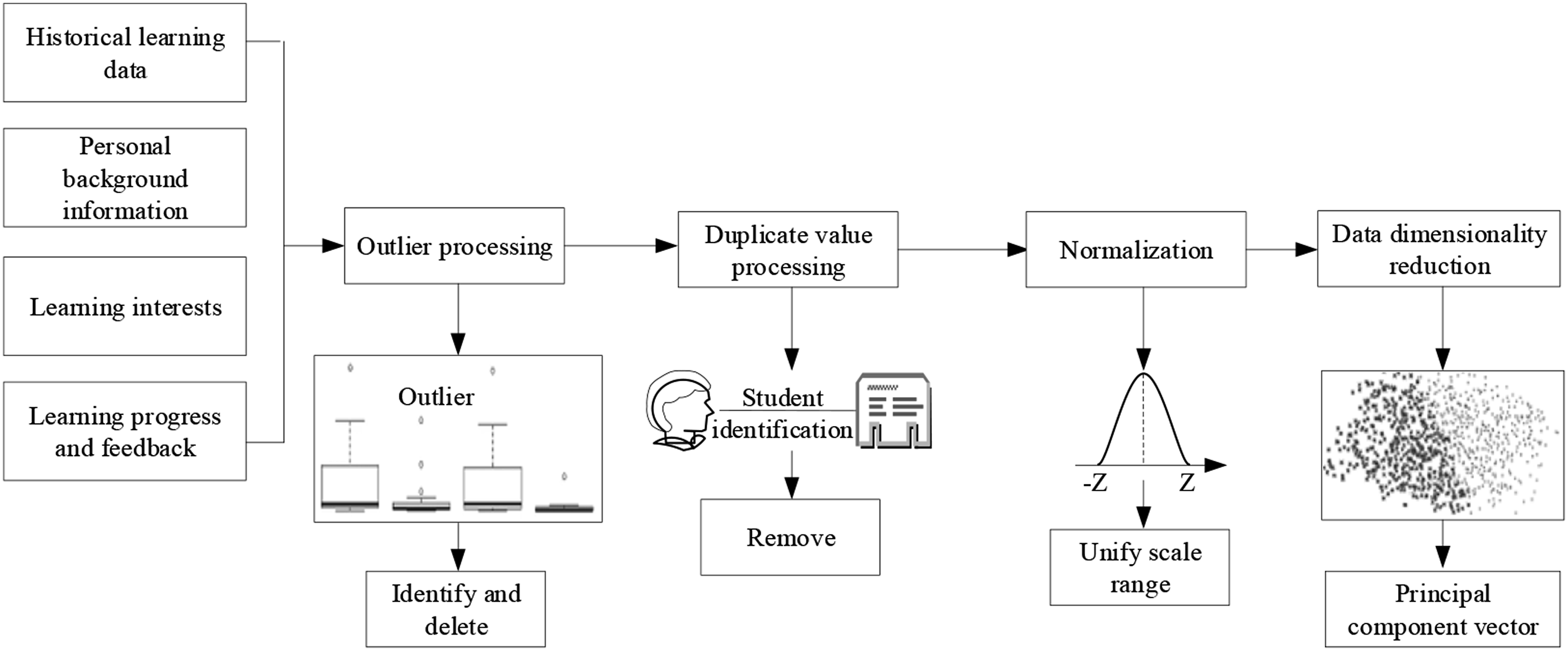
In Figure 2, data cleaning is first performed. For outliers, the box plot method is used to identify and remove outliers in the data. The learner ID is used as the unique identifier for duplicate values to remove duplicate information and avoid redundant feature information. Then, the cleaned data is standardized, and the Z-score method is used to prevent the weight of some features being too large in the learning process for the differences in different attribute dimensions:

Based on the processing of outliers and duplicate values, feature engineering and screening are performed to retain only the important features for path planning. By calculating the covariance matrix, its change trend is analyzed, and the retained principal components are selected based on the variance ratio. Assuming that the data matrix is

Through the eigenvalue decomposition method, the data’s primary information is maintained while reducing the feature dimension.
After preprocessing, the data is merged into a unified feature vector
Learning path state space construction
Based on learner feature extraction and data preprocessing, the learner’s learning module and learning goal elements are analyzed and abstracted into states, and the learning path state space is constructed. As a collection of multiple state variables, the state space reflects the learner’s state and its changes at each stage of learning. Each state represents the learner’s learning status at a certain time. Each state variable can be regarded as a feature point of the learner’s current learning status. The learner’s learning module and learning goal are combined to establish a state space to ensure the accuracy of path planning, as shown in Figure 3: State space construction.
In the process of learning vocational education, learners encounter many learning modules, and each module’s learning goals and contents are different. These learning modules are abstracted into basic state space elements, defined as
Since the state space must reflect the current learning status of learners efficiently and be flexible to adapt to the changing features of learners, this paper implements adjustments based on learners’ learning goals. The learning goal is represented as
On this basis, a complete state vector
To ensure that the state space can reflect the learner’s learning process in real time, the learner’s state is updated in real time. The state value is constantly corrected in the state space based on the dynamic monitoring of the learner’s features. It is assumed that the learner’s state at the

Among them,
A state transition matrix

Among them,
DQN model construction
As a reinforcement learning algorithm rooted in a reward-driven mechanism, the deep Q network (DQN) excels in optimizing learning path selection within complex and dynamic state spaces.25–27 By designing the DQN model architecture, the algorithm integrates learners’ feature data, learning objectives, and state transition information to effectively plan and refine personalized learning paths (PLP). The model is constructed based on the Markov Decision Process (MDP), which abstracts the learner’s educational journey into a dynamic decision-making process, enabling the selection of optimal learning paths accordingly. At its core, the algorithm employs deep neural networks to approximate the Q-value function, addressing the challenges of storing and computing Q-values that arise from the vast size of state-action spaces.28,29 This approach not only enhances computational efficiency but also ensures adaptability in highly intricate learning environments.
Framework design
In the PLP planning process, the learner’s learning module and goal are combined to construct a state space DQN model framework.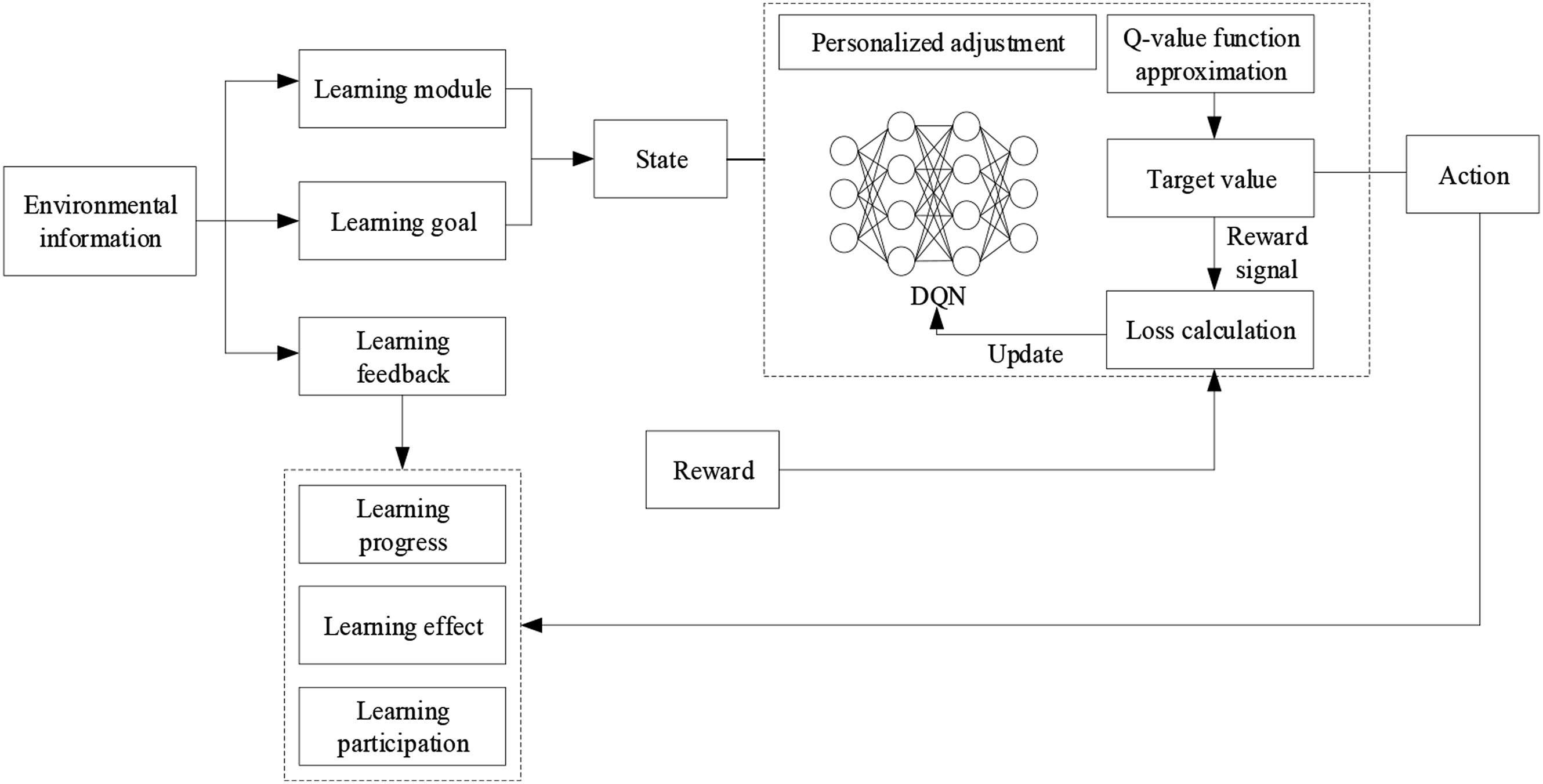
Traditional path planning methods usually rely on pre-determined learning paths and determined module structures. They cannot provide timely feedback on learners’ learning. Such static path planning methods do not well incorporate individual features such as learners’ learning status, interest changes, and knowledge mastery progress, which can easily lead to problems such as waste of learning resources or insufficient knowledge mastery on individual learning paths. These fixed paths cannot develop their potential, especially for learners with strong learning abilities or specific interests.
To address this problem, individualized adjustment is achieved by modifying the Q-value function. The size of the Q-value depends on the learning goal and the current state and on the individual features of the learner. This paper uses a deep neural network to approximate the Q-value. It is assumed that at a certain moment

Reward mechanism design
Feedback information, such as the learner’s learning progress, is used to assist the model in evaluating the quality of the behavior and guiding the optimization of the learning path. In the PLP planning process of vocational education, rewards are designed based on the learner’s learning progress, learning effect, and participation level:

Among them,
Feedback mechanism and path optimization
The learner’s performance and feedback information are transmitted to the DQN model in real time during the training process. By analyzing the learner’s feedback at each stage, the reason for the knowledge bottleneck or lack of learning motivation can be found so that the learning path can be adjusted accordingly to better meet the learner’s actual needs. The learner’s historical behavior data and real-time feedback data are combined in this process. The performance of the optimal path is obtained through comparative analysis. By analyzing the learner’s current learning status in a certain learning module, it can be inferred whether this path is suitable for the learner to make corresponding adjustments to the subsequent learning modules. Specifically, the feedback mechanism modeling is expressed as34,35:

Based on the real-time feedback mechanism, the learner’s learning progress, learning effect, and participation are dynamically monitored in each learning module or task. The calculations of each indicator are expressed as follows:



Using the learning management system, learners’ learning progress, learning effects, and participation are collected in real time. The data is transmitted to the input layer of the model through the interface. Each learning behavior of the learner is converted into a numerical feature vector and used as the state input of the DQN model, as shown in Figure 5: Feedback mechanism.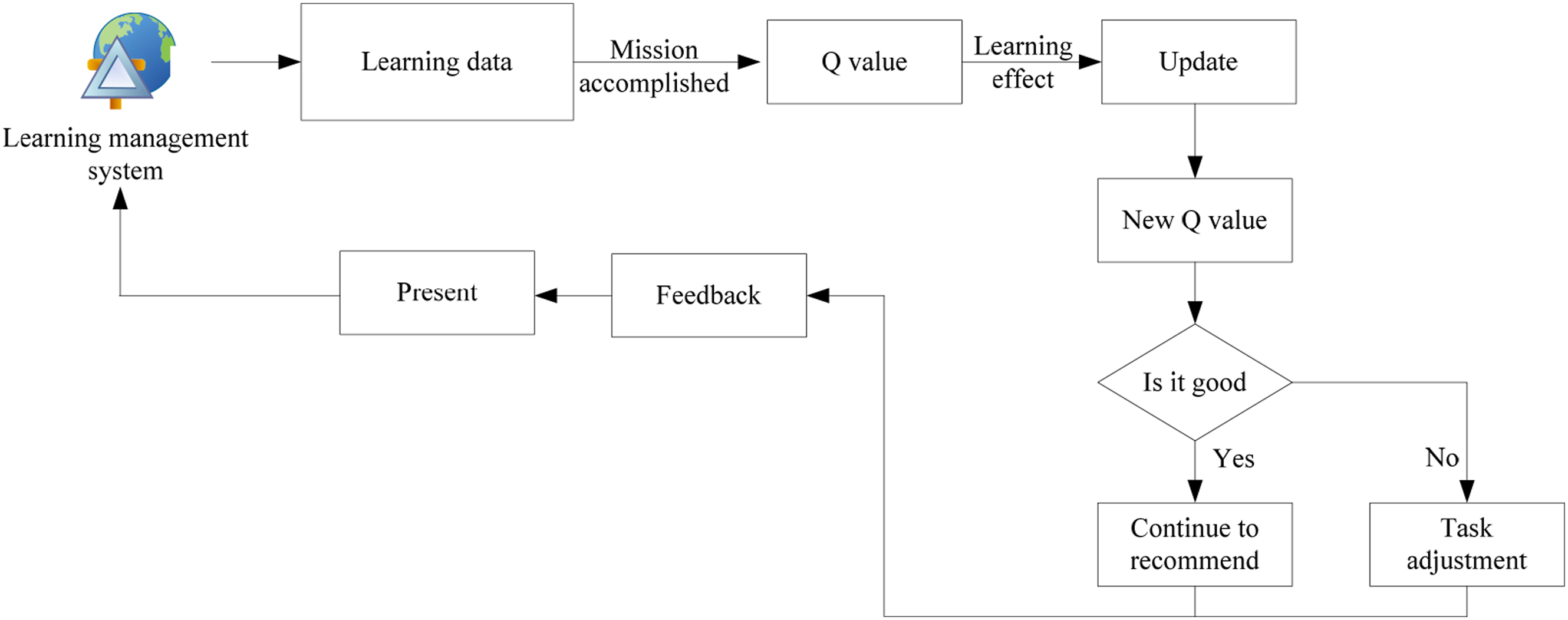
In Figure 5, when a learner completes a specific learning task or reaches a certain stage, the DQN model calculates the Q-value of the current learning path based on the learner’s feedback information, make decisions on the current best behavior (that is, the following learning path), and modify the Q-value function according to the actual learning results. Based on the updated Q-values, the learner’s learning path is optimized to determine the next best course of action. When a learner demonstrates strong performance in a particular module, the system recommends more advanced and challenging content to further stimulate their growth. Conversely, if the learner struggles in a specific area, the difficulty level is adjusted by providing supplementary learning resources or alternative tasks tailored to their needs. The learner’s performance data and subsequent path adjustments are immediately reflected on their personalized learning dashboard. This real-time feedback mechanism enables learners to stay informed about their progress and outcomes, fostering a sense of accomplishment while boosting their motivation and engagement in the learning process.
Experiment on personalized learning path planning and optimization of vocational education
Experimental data
This paper utilizes real learning data from a vocational education platform as a sample to perform experimental analysis, aiming to validate the effectiveness of the DQN-based personalized learning path (PLP) planning and optimization method for vocational education. The dataset encompasses a wide range of information generated during the learning process by diverse learners on the platform, including multi-dimensional features such as historical learning records, personal background, and performance metrics.
Data statistics.

Experimental setup
Algorithm parameter settings.
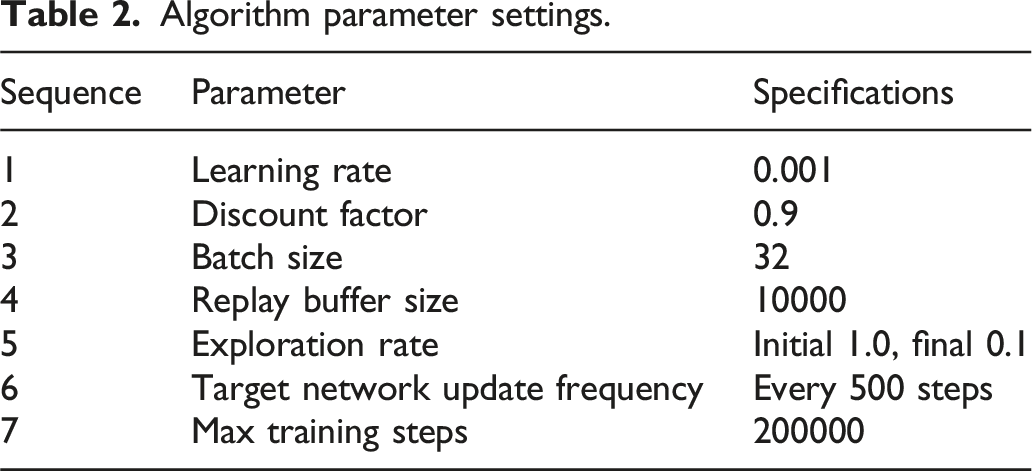
In the experiment, the data samples of 225 learners are randomly divided into 80% training samples and 20% test samples, and the model is tested. First, the DQN model is trained using the training set. During the training process, the learning path is dynamically adjusted based on the learning status and historical data, and the reward mechanism is used to provide feedback on the learning results. On this basis, the Q-value function obtained is used to optimize the learner’s learning path continuously. The DQN algorithm is compared with the widely used CF-based PLP planning method and the PSO-based PLP planning method to ensure the objectivity and fairness of the experimental results. Finally, the performance of different algorithms in various indicators is analyzed by evaluating the path planning results, learner learning progress, learning effect, and participation.
Experimental results
Path planning results
Taking the learners in the test set as the objects, the number of path adjustments is used to measure the flexibility of the model path adjustment and whether it can respond to the learners’ learning status in real time. Figure 6 presents the results: Path planning comparison.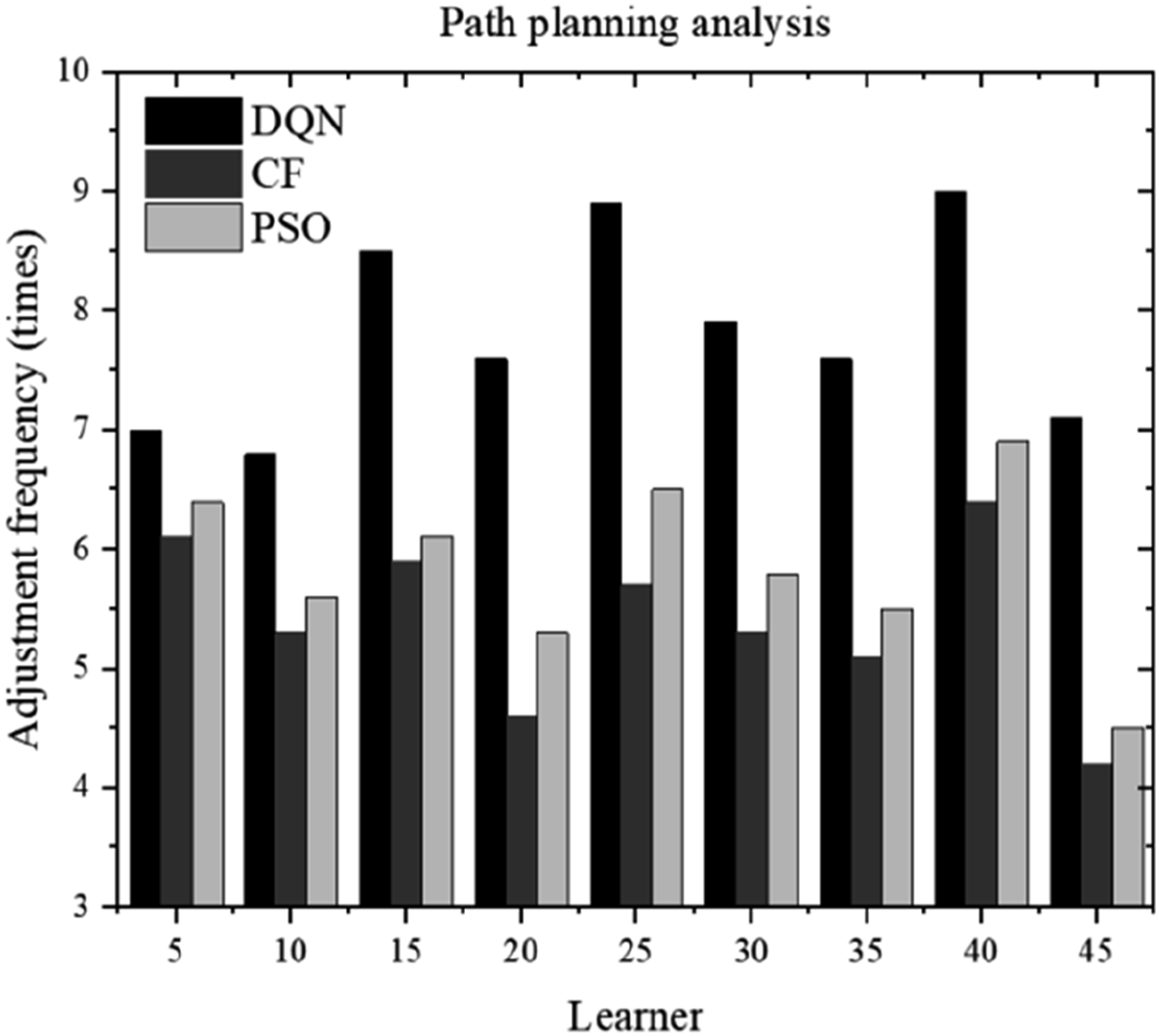
In Figure 6, the effect of PLP planning combined with DQN is significantly better than that of CF and PSO. In the specific result comparison, the DQN algorithm adjusts the planning of each learner an average of 7.8 times. The average number of planning adjustments of CF and PSO for each learner is 5.4 and 5.8 times, respectively. Compared with the CF and PSO algorithms, the average number of planning adjustments of the DQN algorithm in PLP increases by 2.4 and 2.0 times, respectively.
The results demonstrate that the DQN algorithm excels in optimizing learning paths by dynamically adapting to the learner’s evolving progress and characteristics, ensuring both personalization and adaptability. Through reinforcement learning, the algorithm can adjust learning paths in real time based on changes in students’ learning behaviors. By leveraging the reward-based path optimization mechanism, it continuously monitors students’ learning status and makes dynamic adjustments to create a more tailored learning experience. In contrast, while the CF algorithm provides recommendations based on historical behavior, it lacks the ability to incorporate dynamic feedback, resulting in relatively static path adjustments that fail to respond promptly to learners’ changing needs. Similarly, the PSO algorithm, constrained by its particle swarm framework, suffers from slow convergence, limiting its effectiveness in dynamic environments. Overall, the DQN algorithm demonstrates superior adaptive capabilities and dynamic optimization performance compared to these traditional methods.
Learning progress results
Based on the path planning, the learning progress of learners of each algorithm model in the same module is compared to measure the progress of learners with different PLP plans, as shown in Figure 7: Learning progress comparison.
Figure 7 shows significant differences in the learning progress with the PLP planning of different algorithms. From the specific results, the average progress of each learner with the PLP planning combined with the DQN algorithm reaches 76.2%. The average progress of each learner with the PLP planning based on the CF and PSO algorithms is 63.1% and 68.1%, respectively. Compared with the CF and PSO algorithms, the average progress of each learner with the PLP planning of the DQN algorithm increases by 13.1% and 8.1%, respectively. This shows that the DQN algorithm can more precisely combine students’ learning status, historical data, and real-time feedback to improve students’ learning progress.
The advantage of DQN is that it can continuously track learners’ learning progress and can adjust and optimize the learning route in a timely manner according to students’ individual needs. This dynamic adjustment mechanism ensures that the path planning of learners in learning is always adapted to their abilities and progress, thereby improving the learning progress. CF relies on historical data, and there is a certain deviation from the learner’s needs in actual planning. The PSO algorithm is based on the particle swarm algorithm for global optimization, so the degree of personalization of the algorithm is not high. In comparison, the DQN algorithm has a more flexible learning path adjustment mechanism and more effective personalized adaptive capabilities, giving it a more significant advantage in improving the learning process.
Learning effect results
The learning effects of learners with the three methods of DQN, CF, and PSO are further compared to comprehensively evaluate the effects of vocational education PLP planning methods with different algorithm models, as shown in Figure 8: Learning effect comparison.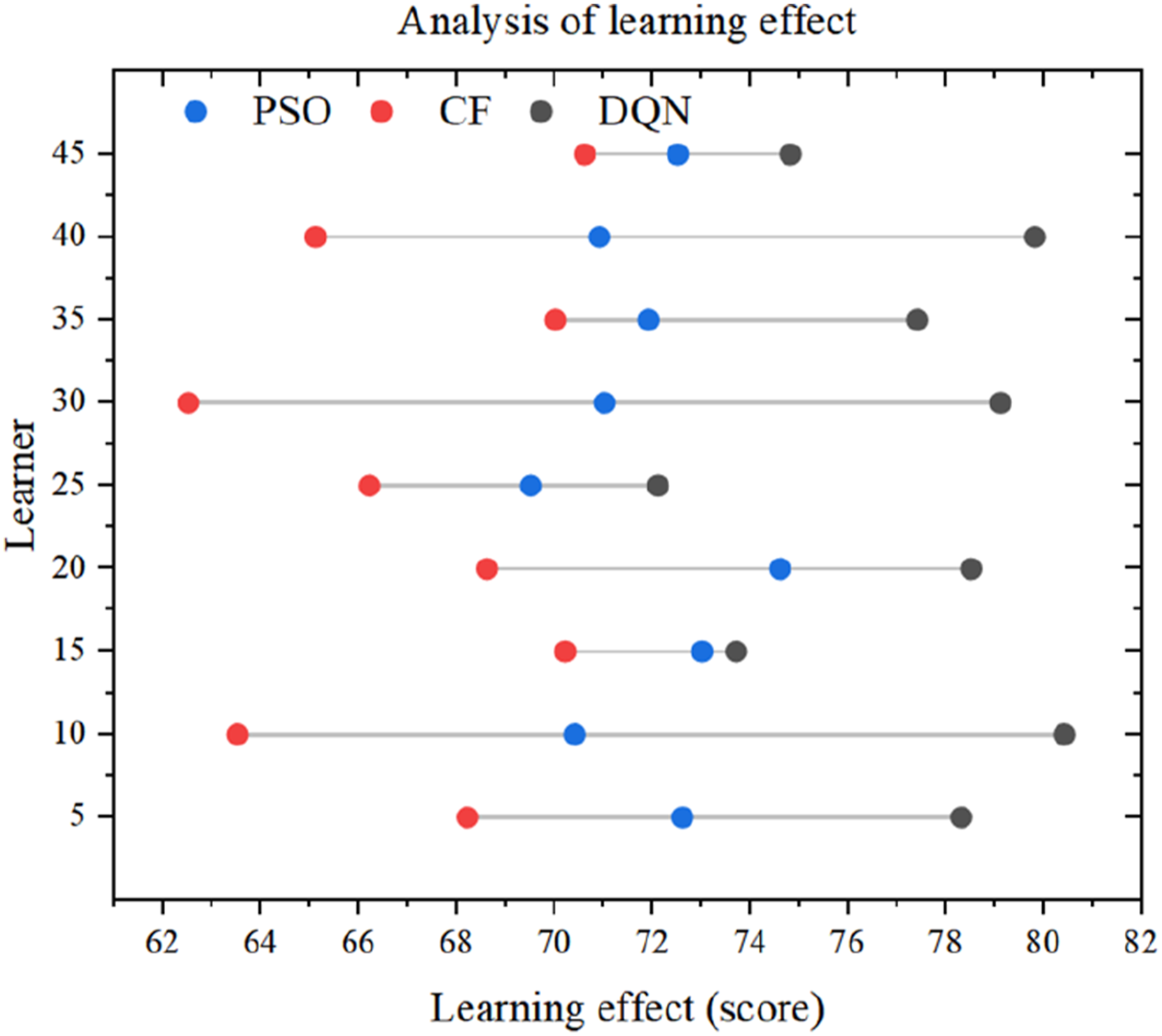
As shown in Figure 8, in comparing learning effects with the CF and PSO algorithms, the learning effects of the PLP planning combined with the DQN algorithm are generally ideal. With the PLP planning of the DQN algorithm, the average score of each learner in the learning module reaches 77.1 points, which is 9.9 points and 5.3 points higher than that of CF and PSO algorithms, respectively. Among them, the average score with the PLP planning of the CF algorithm reaches 67.2 points, and the average score with the PLP planning of the PSO algorithm reaches 71.8 points.
When facing atypical learning patterns and new users, the CF algorithm has problems such as limited recommendation accuracy and inability to adapt to rapidly changing learning needs. The PSO algorithm is prone to local extreme values during the learning process and is difficult to optimize continuously. Compared with the first two methods, DQN overcomes the problem of traditional methods of too single and static planning of learning paths. It can fully consider learners’ real-time feedback, improve the path’s directionality, and achieve more precise improvement of learning results.
Learning participation results
Learning participation is an essential indicator for evaluating learners’ active learning, interaction frequency, and investment in learning content. It has a direct impact on learners’ learning outcomes and motivation. This paper compares learners’ learning participation with different algorithms, as shown in Figure 9. Learning participation comparison.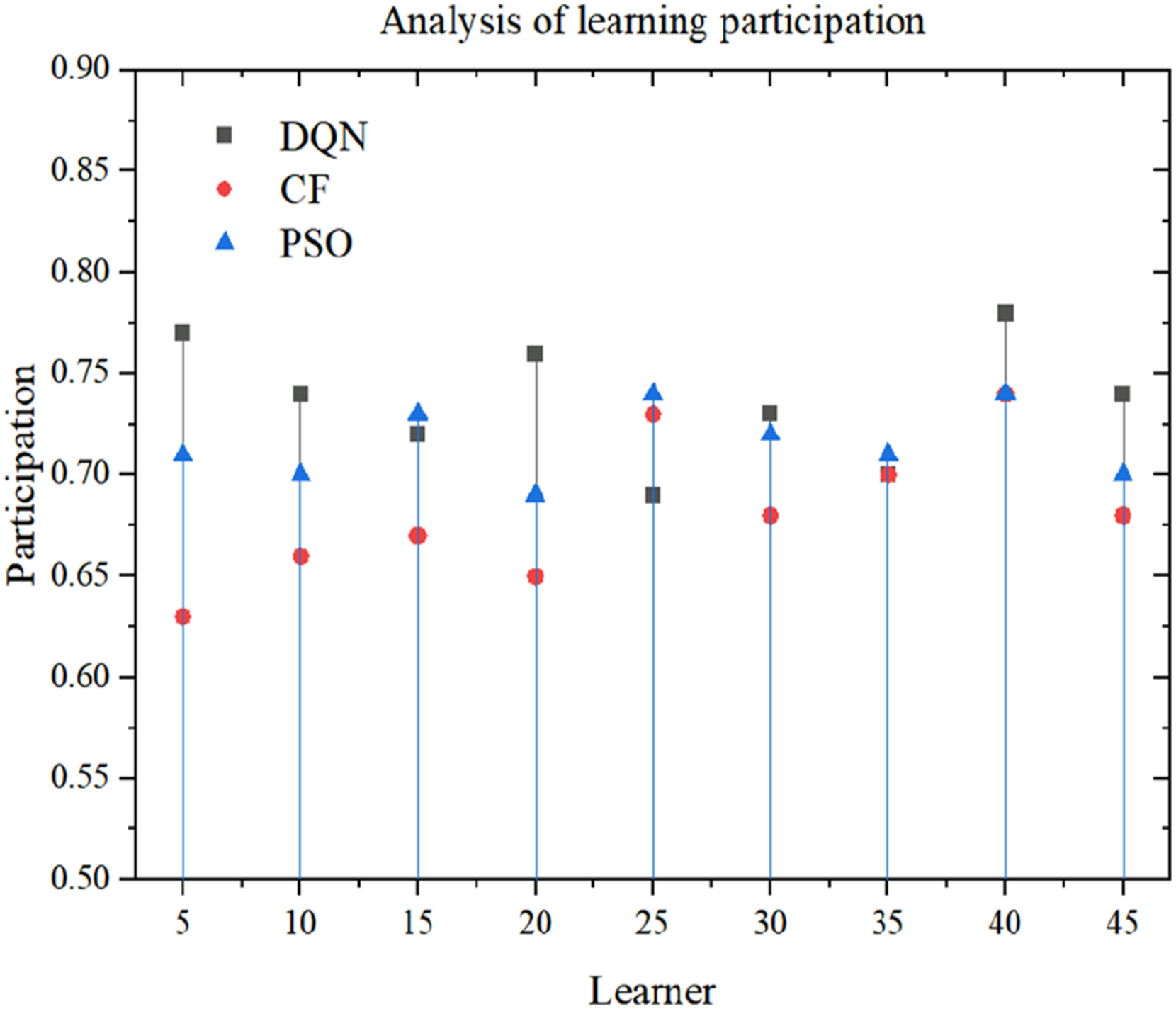
In Figure 9, the average learner participation with PLP planning of the DQN algorithm reaches 0.74. The average learner participation with PLP planning based on the CF and PSO algorithms is 0.68 and 0.72, respectively. Compared with the CF and PSO algorithms, the average learner participation with the PLP planning of the DQN algorithm is increased by 0.06 and 0.02, respectively.
The comparison of participation levels reveals that while the CF and PSO algorithms demonstrate some degree of personalization in path planning, their inability to provide real-time learning feedback significantly limits their impact on student engagement. As a result, these methods struggle to sustain or notably improve participation. In contrast, the DQN algorithm exhibits strong adaptability and optimization capabilities, effectively enhancing learner engagement. By dynamically adjusting personalized learning paths (PLP), it precisely aligns with learners’ needs and progress, integrating their past achievements while anticipating future learning conditions. This approach not only offers more targeted and engaging learning strategies but also boosts students’ motivation and overall participation, fostering a more interactive and effective learning experience.
Conclusion
This paper explores the planning and optimization of personalized learning paths (PLP) in vocational education by integrating the DQN algorithm. Through learner feature extraction and the construction of a state space for learning paths, the DQN model successfully addresses the static limitations of traditional PLP approaches, enabling dynamic and intelligent path planning. Experimental results demonstrate that the DQN algorithm outperforms CF and PSO algorithms in terms of learning progress, learning outcomes, and learner participation. By dynamically adjusting PLPs based on real-time learner feedback and performance, the DQN algorithm not only enhances learning efficiency but also boosts engagement and overall satisfaction.
Despite these advancements, this study has certain limitations that warrant further exploration. For instance, the experimental data is derived from a relatively narrow source, which may limit the generalizability of the findings. Additionally, the study does not thoroughly examine the impact of computational resource constraints or processing time, which are critical considerations for large-scale implementation. Future research could address these gaps by expanding the dataset to include more diverse learning environments and demographics. Furthermore, integrating advanced learning strategies—such as hybrid models combining DQN with other intelligent algorithms like reinforcement learning variants or evolutionary computation—could enhance adaptability and scalability. Such innovations would enable PLP planning in increasingly complex and dynamic educational settings, paving the way for more robust, intelligent, and inclusive educational systems. Ultimately, these efforts will contribute to the broader goal of advancing the intelligent transformation of vocational education.
Statements and declarations
Footnotes
Declaration of conflicting interests
The author(s) declared no potential conflicts of interest with respect to the research, authorship, and/or publication of this article.
Funding
The author(s) received no financial support for the research, authorship, and/or publication of this article.
