



Abstract
To enhance the efficiency and adaptability of path planning in smart elderly care services, this paper proposes a hybrid path optimization model integrating Deep Q-Network (DQN) and Particle Swarm Optimization (PSO). Traditional approaches struggle with dynamic environmental adaptation and multi-objective optimization, often leading to suboptimal routing. To address this, the proposed model employs DQN to establish an autonomous decision-making framework, leveraging reinforcement learning to dynamically optimize path selection based on environmental variations and reward mechanisms. Meanwhile, PSO enhances the global search capability, adjusting particle positions and velocities to mitigate the risk of local optima and improve overall path efficiency. A multi-objective optimization framework is further introduced, incorporating weighted coefficients to balance competing objectives and ensure comprehensive optimization. Additionally, a dynamic environmental adaptation mechanism enables real-time data updates, allowing the system to swiftly respond to sudden environmental changes and continuously refine path selection. Experimental results demonstrate the model’s superior performance, achieving an average path planning time of 52 seconds and a service response time of 17 s. The approach maintains high path accuracy, with a minimal distance deviation of 1.35%, and delivers an optimized objective function value of 0.84. These findings highlight the model’s effectiveness in real-time adaptive path planning, offering a robust and intelligent solution for elderly care mobility and service optimization.
Keywords
Introduction
In the field of smart elderly care, service path optimization is related to efficiency, and it also involves the quality of nursing services and the rational allocation of resources.1,2 Path planning needs to consider multiple factors, such as environmental changes, service needs, and resource scheduling. Path selection in a dynamic environment is particularly important because nursing services need to respond to sudden changes and complex situations.3,4 Combining deep learning with intelligent optimization algorithms can provide smarter and more accurate decision support for nursing service path planning, thereby improving the overall efficiency and sustainability of elderly care services.
In smart elderly care services, the challenges faced by path planning go beyond simple route selection. Current path optimization methods cannot effectively cope with the dynamic changes in the elderly care service environment.5,6 Real-time changes in the elderly’s living environment, sudden health problems, or temporary changes in care needs make static path planning inappropriate.7,8 In this case, path selection that relies on preset algorithms can encounter problems such as inefficiency, waste of resources, and service delays, which seriously affect service quality and the safety of the elderly.9,10
The shortcomings of multi-objective optimization also restrict the comprehensiveness of path planning. The nursing service path involves the shortest route and the lowest cost, and it must also take into account multiple factors such as service time, personnel capabilities, and equipment requirements.11,12 Current methods cannot take into account these diverse objectives and can only optimize one or several of them, ignoring the comprehensive needs in practical applications.13,14 Some path planning models focus on reducing costs and ignore the extension of service time, which in turn affects the timeliness and quality of the overall service.
Poor environmental adaptability is also a key issue in current path planning. Path planning in actual scenarios needs to face highly uncertain and complex environments, and traditional path selection methods do not have a mechanism to cope with sudden environmental changes.15,16 Traffic accidents, temporary weather changes, or sudden health problems of the elderly may make the original path no longer feasible.17,18 These unpredictable factors make the original path planning strategy ineffective and may even cause service delays or safety risks.19,20 At present, there is an urgent need for a path planning model that can cope with dynamic environmental changes, comprehensively consider multi-objective optimization, and has high flexibility to improve the efficiency and quality of elderly care services.
This study develops an advanced intelligent path optimization model for elderly care services, addressing the limitations of existing methods in dynamic environmental adaptability and multi-objective optimization. By integrating Deep Q-Network (DQN) with Particle Swarm Optimization (PSO), the proposed model enhances global optimization capabilities while improving responsiveness to complex and evolving service environments. Unlike traditional path planning models, this approach introduces a multi-objective optimization framework, enabling service path selection to simultaneously balance key factors such as time efficiency, cost-effectiveness, resource allocation, and service quality.
A key innovation of this study is the dynamic environmental adaptation mechanism, which differentiates it from conventional static path planning methods. This mechanism allows real-time adjustments in response to sudden changes, including traffic congestion, adverse weather conditions, or variations in the health status of elderly individuals, ensuring optimal service paths under fluctuating conditions. By enhancing flexibility and real-time adaptability, the model significantly improves the precision and efficiency of elderly care service routing.
The contributions of this research extend beyond algorithmic advancements, offering a transformative impact on the overall performance of smart elderly care systems. By enhancing path selection accuracy and adaptability, the proposed model provides a more intelligent and dynamic solution, effectively bridging the research gap in real-time adaptive service planning. This work not only advances the theoretical foundations of path optimization but also contributes to the development of smarter, more responsive elderly care services.
Related works
Path optimization of smart elderly care services
The research on path optimization of smart elderly care services has gradually attracted attention. Many scholars have proposed different optimization algorithms. Common GA (Genetic Algorithm),21,22 ant colony algorithm,23,24 PSO,25,26 etc., are used to improve the efficiency and accuracy of path planning. Some studies have proposed a method for optimizing the elderly care path based on genetic algorithms, which can effectively solve the local optimal problem of traditional path planning.27,28 Prasad and Ghosh used genetic algorithms to optimize the asset allocation weights for subscribers of India’s defined contribution pension plan and compared them with life cycle and equal weight strategies. The results have important policy significance. 29 Most of these methods ignore the influence of dynamic environmental factors. Path selection is easily restricted by sudden environmental changes, resulting in unstable path planning results. Some studies focus on the combination of reinforcement learning and intelligent algorithms, and propose a path optimization model based on DQN.30,31 Zhou et al. proposed a semi-supervised deep learning framework that combines deep DQN and distance-based reward rules to improve the accuracy of human activity recognition in the medical Internet of Things environment 32 ; this model can achieve dynamic adjustment to a certain extent but still lacks global optimization capabilities. Therefore, existing research generally has the problem that path planning methods are not able to cope with dynamic environmental changes and have not been able to effectively combine multiple optimization methods to comprehensively improve the path selection effect.
Problem of insufficient dynamic environmental changes in path planning
For the problem of insufficient dynamic environmental changes in path planning, some scholars have begun to try to combine multiple optimization algorithms to enhance the adaptability and global optimization capabilities of the path planning model. Some scholars proposed combining PSO with DQN, using PSO to optimize the global search capability of DQN, and achieved good optimization results.33,34 Aoun proposed an improved PSO method combined with deep reinforcement learning, which adjusts the acceleration factor and inertia weight online to avoid premature convergence and improve optimization performance. This method is superior to the traditional PSO method in terms of solution accuracy and convergence speed. 35 Most existing studies focus on single-objective optimization and fail to consider the importance of multi-objective optimization frameworks. Reinforcement learning can acquire dynamic environmental adaptability through training, but it still lacks a rapid response mechanism to deal with sudden environmental changes. This paper proposes a hybrid path optimization model that combines DQN and PSO, introduces a multi-objective optimization framework and a dynamic environmental adaptation mechanism, and comprehensively improves the accuracy and real-time performance of path selection.
Methods
Construction of intelligent decision-making model
Based on DQN, a path selection decision model is designed, and reinforcement learning is used to achieve automatic path optimization. The training agent can adjust its decision according to the reward mechanism when facing different environmental states to ensure the optimality of path selection.
Design of path selection decision model
The path selection decision model is implemented using a reinforcement learning framework, using DQN to optimize path selection. The goal of path selection decision is to train the agent to automatically learn and make the best path selection decision under a given environmental state. In practical applications, the state space represents various factors of the environment, including the current location, feasible paths, and other factors that affect path selection. Each state reflects a specific condition in the path selection problem, including the current geographic location and target location, etc. The agent’s decision is to select an action to represent the path it chooses; each action affects the change of the state, and an immediate reward is obtained based on the selected path, the size of which is related to the quality of the path.
The Q-value function

The decision model optimizes the Q-value function to ensure optimal path selection, enabling the agent to make the most appropriate decisions under varying conditions. Through continuous interaction with the environment, reinforcement learning allows the agent to dynamically adjust its selection strategy based on real-time feedback from actual path performance, ensuring that the Q-value gradually converges toward the optimal solution.
By incorporating a well-structured reward mechanism, the model effectively assesses path selection quality, reinforcing optimal choices while suppressing suboptimal decisions. This adaptive learning approach enhances the model’s ability to respond to dynamic environments, improving both decision accuracy and efficiency. Ultimately, this model provides a robust and intelligent solution for path planning, optimizing performance in complex real-world scenarios.
Reinforcement learning and the training process of path selection
The goal of reinforcement learning in path selection is to continuously improve the quality of path decision through feedback learning. The agent’s decision is based on the current state and corresponding actions, and the immediate reward is used to evaluate the effect of path selection. The agent updates its Q-value function according to the new environment state in each decision. The target network mechanism can be used to accelerate training. The Q-value function is split into two parts: the current network and the target network, which are used for Q-value update and target value calculation, respectively, improving the stability of training to a certain extent.

Q-value function update formula parameter setting.

This training process allows the path selection model to gradually learn and optimize the decision-making strategy to achieve the best decision for path selection. In actual operation, the agent selects the best path for each step based on the Q-value function obtained during the training process and can always make the best decision under various environmental conditions. Only through training can people get long-term reward feedback and gradually adjust the Q-value, so that the path selection strategy can remain optimal when facing different situations. The introduction of reinforcement learning allows path planning to not be limited to static optimization but also to respond flexibly in complex environments. The feedback of each decision can help improve the model, making the path selection decision more intelligent and adaptable.
Figure 1 shows the various links and interactions of the path selection decision process. When the agent enters the current state, it faces multiple possible path choices. Each path choice corresponds to a specific action. The agent can select a path based on these actions and calculate the Q-value of each action. The Q-value represents the quality of the path. The system can evaluate the immediate reward of the agent’s chosen path, and the level of the reward determines the effectiveness of the path selection. The agent uses the mechanism of reinforcement learning to adjust the Q-value according to the reward in order to choose a better path in future decisions. The updated Q-value guides the agent into a new state, and the path selection can be optimized again according to the new environmental state; continuous decision-making and learning can determine the optimal path, optimize path planning, and improve the efficiency and adaptability of smart elderly care services. Path selection decision process.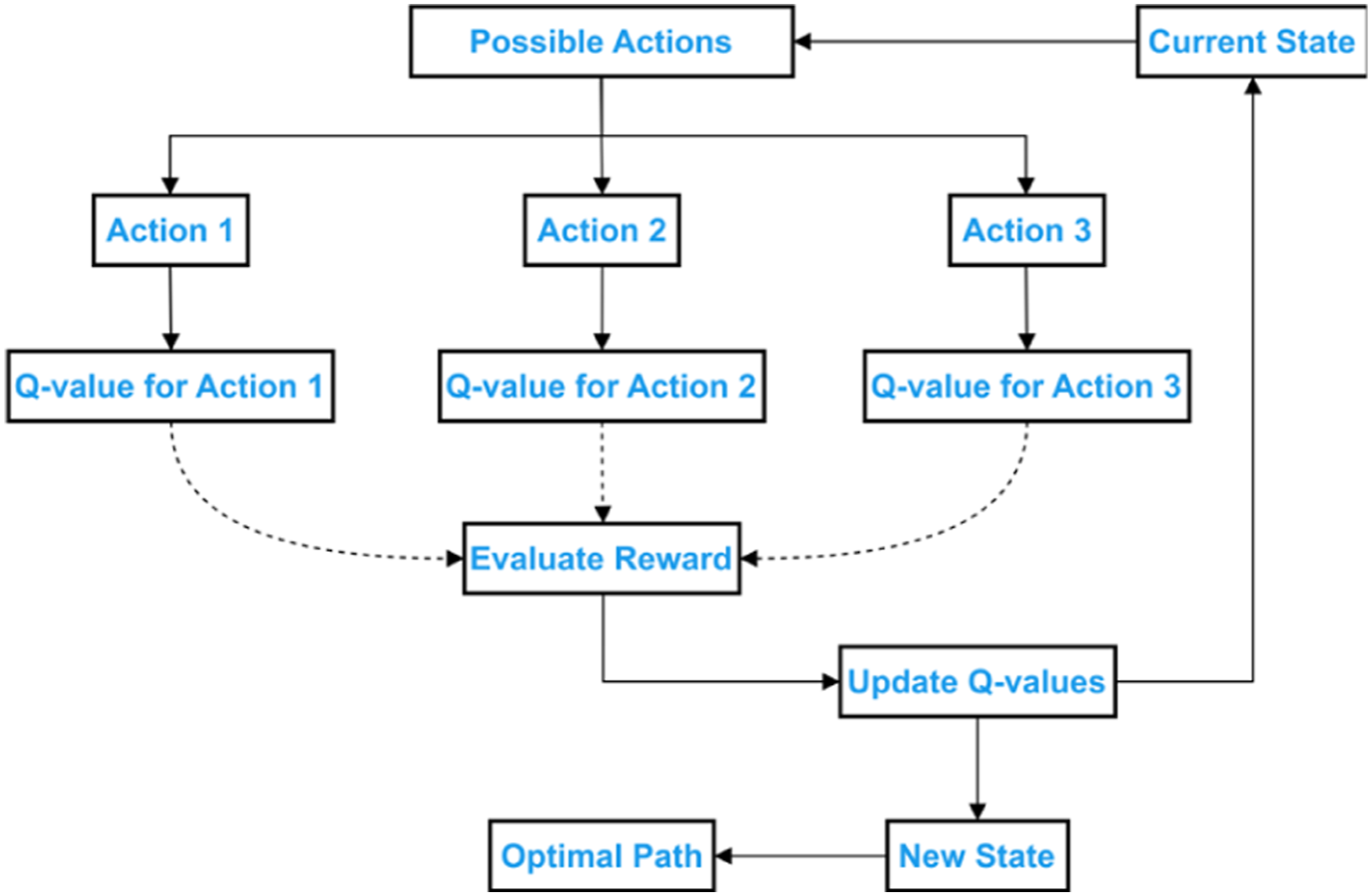
PSO algorithm integration
PSO is combined with the DQN model to optimize the global optimal solution of path selection. By adjusting the position and speed of the particle swarm, the global search capability of path planning is enhanced to avoid the emergence of local optimal solutions.
PSO algorithm and path selection decision integration
The optimization problem of path selection is limited by the local search range and the global nature of the solution in a complex environment. The combination of the PSO algorithm and the path selection decision model is particularly important; PSO can effectively enhance the global search capability of path planning and avoid path selection falling into the local optimal solution. Each particle represents a possible path solution, and the position and speed in the search space indicate the update process of path selection.
The goal of PSO in the integration is to enhance the search capability of the path selection decision model. The role of the path selection decision model is to select the optimal path based on the current environmental state. Relying solely on local decisions may lead to insufficient optimization. PSO is introduced to perform global search. Each particle in the particle swarm is updated according to its historical optimal position, and it can also interact with the global optimal particle in the swarm to explore a wider range and avoid falling into the local optimum.
The particle speed update formula is as follows:
The integration of the path selection decision model with PSO enhances the optimization process by evaluating the fitness value of each path, effectively guiding the search direction of the particles. The fitness of each particle is assessed based on key optimization objectives, such as total travel time and distance, ensuring that the model prioritizes the most efficient routes. As the fitness value of each particle changes, its position is dynamically adjusted to refine the search process.
By leveraging this combined approach, the model effectively mitigates the risk of being trapped in local optima while seeking the global optimal solution. This integration not only enhances the efficiency of path selection but also significantly improves the overall optimization performance, ensuring intelligent, adaptive, and high-precision route planning in dynamic environments.
PSO enhances the global search capability of path planning
PSO plays an outstanding role in path planning. Path planning needs to consider the local decision of the current state and must also find the optimal path in the global scope. The introduction of PSO allows path planning to explore in a larger search space; each update of the particle can adjust its position and speed, and use global search to continuously improve the quality of the path solution.
The goal of path planning is to find an optimal service path. The key to PSO is to use iterative updates to dynamically adjust the position of the particle swarm to avoid falling into the local optimal solution. The particle position update formula is as follows:
In path selection decision-making, the PSO optimization algorithm improves the adaptability of path planning while performing global search. The dynamic adjustment of particle position and velocity enhances the stability and adaptability of path selection. In multiple path selection and complex environments, the search direction can be adjusted adaptively through group intelligence. Path planning can cover a larger solution space and improve the comprehensiveness of path optimization.
Each particle is adjusted according to the current fitness value in each iteration, and the group collaborative update ensures that the path selection gradually approaches the global optimum in a wide search space. PSO plays an important role in path selection, enhancing global search capabilities, avoiding the emergence of local optimal solutions, and achieving a high global optimization effect in path selection; the integrated model has improved accuracy and strong adaptability, and can cope with path planning problems in complex environments to a certain extent.
Implementation of multi-objective optimization strategy
According to the multi-objective requirements in path planning, a multi-objective optimization framework is constructed, and appropriate weight coefficients are set to balance various objectives in the optimization process to achieve comprehensive optimization.
Construction of multi-objective optimization framework
The goal of path planning is not limited to the shortest time or the lowest cost, but a comprehensive consideration of multiple goals. Achieving a balance between these goals requires the construction of a comprehensive multi-objective optimization framework, in which the priority of each goal is adjusted using a weight coefficient. The key to the multi-objective optimization framework is the ability to weigh multiple factors such as time, cost, and service quality during the path planning process to achieve comprehensive optimization.
The weighted summation method is introduced to transform each objective function into a single objective function for optimization. The objective function is constructed as follows:
(
The objective function needs to reasonably select and combine different optimization goals. Time optimization in path planning can be expressed by the total path duration, cost optimization can be measured by the total cost, and service quality is evaluated based on feedback effects. The form of the optimization objective function can be expressed as follows:
Adjustment and optimization of weight coefficients
The choice of weight coefficient directly affects the final effect of path planning, and an adaptive mechanism is used to dynamically adjust the weight. The weight coefficient is updated according to environmental changes, task requirements, and feedback from historical optimization processes to achieve the best balance between the optimization effects of different objectives.
At a certain moment, when the path planning process is more sensitive to time, the value of the weight coefficient can increase relatively. When the focus on cost is low, the value of the weight coefficient can be reduced accordingly. The weight adjustment process follows the following update formula:
This adaptive weight adjustment mechanism ensures the balance between various objectives in the optimization process. In the path planning task, there is a mutually restrictive relationship between objectives such as time, cost, and service quality. Dynamically adjusting the weight coefficient allows the model to effectively handle and give high-quality path planning solutions under different task requirements. The optimization result of the comprehensive objective function can complete the service task in the shortest time, ensure the lowest cost, and provide the highest possible service quality.
In the optimization of the adaptive weight adjustment mechanism, each goal can be reasonably considered and the weight coefficient can be accurately controlled to balance the impact of each goal. This flexible weight adjustment strategy allows the multi-objective optimization framework to be effectively applied in various practical applications, ensuring the accuracy and adaptability of the path selection model.
The multi-objective optimization framework in Figure 2 integrates and optimizes multiple objective functions, showing how to comprehensively consider different factors and balance various objectives in path planning. Different objectives are processed by weighted and aggregated methods, reflecting the efficiency, economy, and customer experience requirements of path selection. The objective function is weighted and summed to form a comprehensive optimization goal, which is then sent to the global optimization step; the global optimization finds the most suitable balance point and the optimal solution among all objectives. The optimized solution is used for path selection to obtain the optimal path that meets the requirements of each objective. The optimal path in practical applications directly affects the service delivery process. The implementation of the multi-objective optimization framework provides a flexible and efficient optimization solution for intelligent elderly care service path planning, which improves the overall quality and efficiency of the service. Multi-objective optimization framework.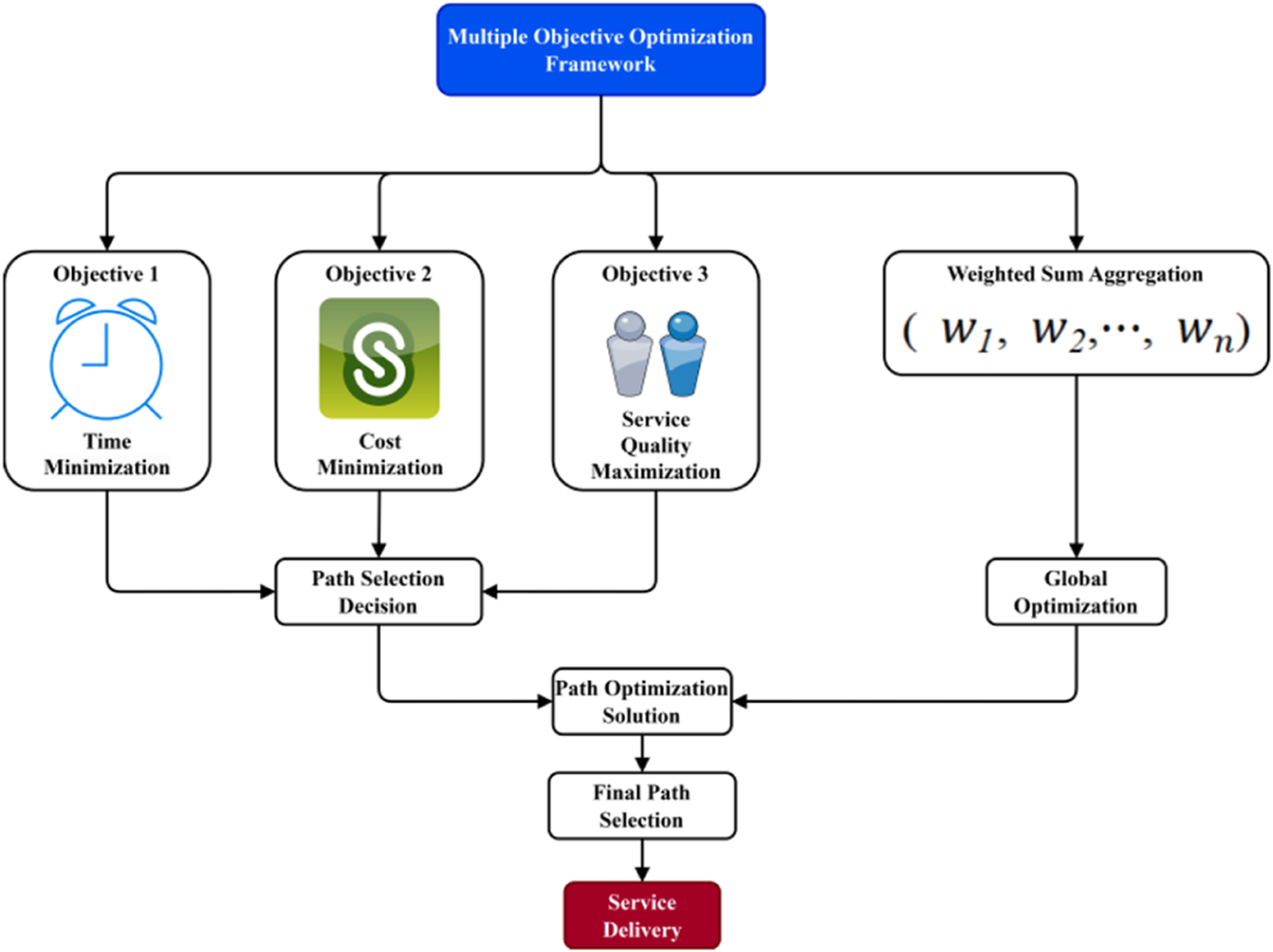
Dynamic environmental adaptation mechanism
Real-time update of environmental data and path selection adjustment
Dynamic adaptability depends on the ability to respond quickly to environmental changes. The study adopts a mechanism to update environmental data in real time to quickly adjust the path selection according to environmental changes. Environmental information such as obstacle locations, traffic conditions, and weather changes in path planning may change, and the original path selection is no longer optimal. This problem is solved by obtaining and updating environmental data in real time, so that the path selection can reflect environmental changes in a timely manner.
In each environmental change, sensors or data acquisition modules are used to obtain the status information of the current environment, and these data are input into the path selection decision model. The path selection model can re-evaluate the feasible path based on the new environmental data and optimize the current path planning strategy. The path selection decision process introduces a real-time update mechanism to quickly respond to environmental changes. The update formula is as follows:
The impact of environmental changes is not only route delays or time increases but may also involve changes in costs, service quality, etc. Therefore, the path planning system needs to adapt to the actual needs of different environments while ensuring the shortest time. After the environmental data is updated in real time, the system not only needs to adjust the path selection but also needs to calculate new optimization indicators such as time and cost based on the updated data to ensure that the service path still meets the multi-objective optimization requirements.
Dynamic path adjustment and optimization
Real-time changes in environmental conditions require that path planning needs to be able to dynamically adjust and provide the best service path in the event of sudden changes.
The benefit of the current path is recalculated using the new environmental information, and dynamic adjustments are made based on the principle of maximizing benefits. The evaluation formula after each path adjustment is as follows:
The fast feedback mechanism makes the path adjustment more efficient. After receiving the change information of the environment, the new paths are quickly calculated. Compared with the benefits of different paths, the fast feedback depends on the efficient computing modules and feedback algorithms. Combining new environmental data with historical path data can quickly identify the possible problems in the current path, adjust them in time, and avoid path errors caused by environmental changes.
Environmental data can be updated in real time and path selection can be adjusted quickly. The dynamic environmental adaptation mechanism enables path planning to remain efficient and stable in an uncertain environment. The introduction of this mechanism greatly improves the adaptability of the path planning model in complex and dynamic environments.
Method effect evaluation
Q-value function approximation effect and target weight adjustment in different scenarios
Figure 3 shows the approximation effect of Q-value function, simulating the value distribution of state-action pairs in a typical reinforcement learning environment. The Q-value shows an exponential decay, which reflects the expected return of the agent under different state-action combinations. The changes in state and action values lead to a significant change trend in the Q-value. The Q-value in the central area is larger, indicating that the state-action pair in this area is considered to be a superior choice. The Q-value of the area away from the center gradually decreases, indicating that the selection effect of these state-action pairs is poor. This change reflects the exploration and utilization mechanism in reinforcement learning. The model tends to select state-action pairs with higher Q-values and gradually optimize the decision-making process. In the reinforcement learning model, the optimization in the state-action space can gradually focus on the optimal path, and the choices that deviate from the optimal path can be gradually eliminated. This change reflects the adaptability of the model to the environment when constantly adjusting and optimizing decisions. The goal is to maximize the Q-value and achieve the optimal strategy. Approximation effect of Q-value function.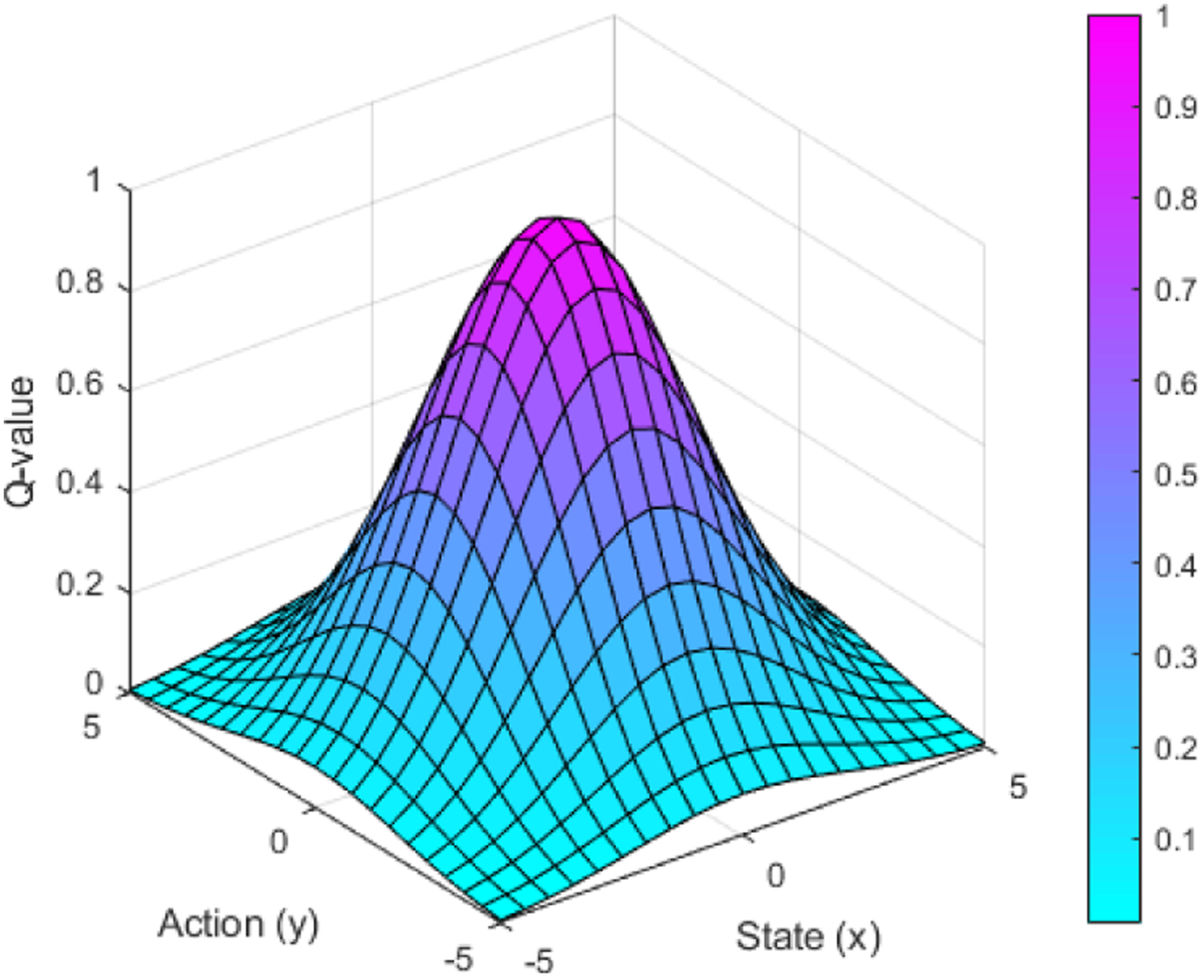
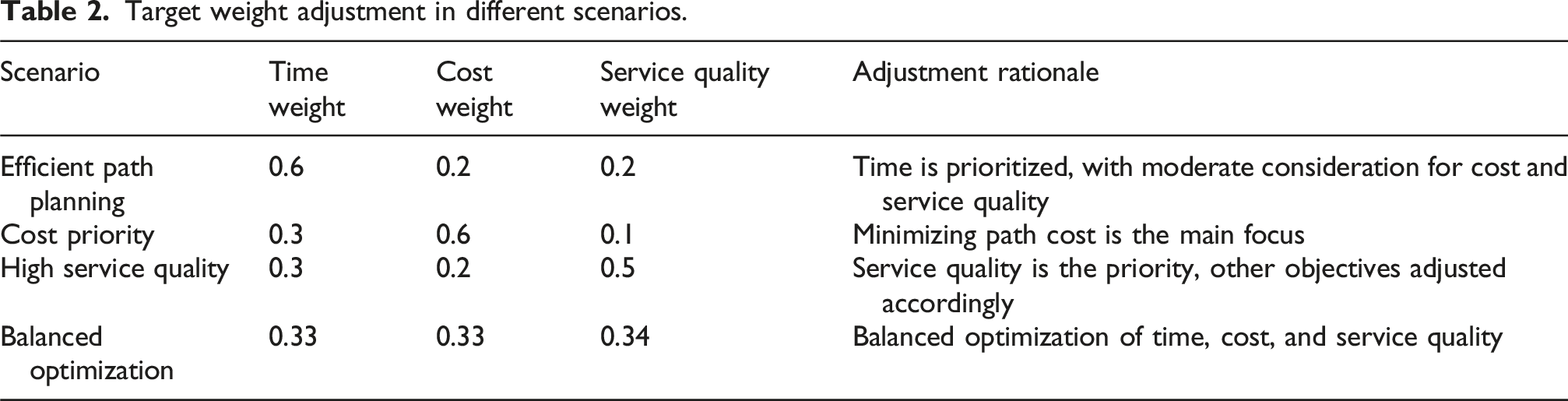
Target weight adjustment in different scenarios.
Evaluation of path planning efficiency
Two quantitative indicators of total time and service response time were used to evaluate path planning efficiency. This paper evaluates the efficiency of the hybrid path optimization model of DQN and PSO. Multiple path planning experiments are conducted under different environmental conditions, and the total time and service response time of each path planning are recorded. Traffic condition changes simulate road congestion or smooth conditions that affect path selection. Weather changes simulate severe weather, affecting the safety and accessibility of the route; emergencies simulate route adjustments caused by accidents, road closures, etc.; equipment failures simulate failures of smart elderly care equipment or nursing systems affecting service routes; changes in personnel demand simulate changes in different time periods or demand volumes affecting service priority and route selection; changes in geographic information simulate changes in the road network caused by the construction of new buildings or facilities. The performance of this model is compared with the currently popular Dijkstra algorithm and genetic algorithm to analyze the differences in time consumption of each model in a dynamic environment. The path optimization method integrated with DQN and PSO is analyzed by comparison to see whether it has obvious efficiency advantages in terms of path selection speed, responsiveness, and handling of complex environmental changes. By statistically analyzing the experimental data, the time consumption of each algorithm in path planning is obtained, which provides a quantitative basis for improving the efficiency of the model. The evaluation helps to verify the actual application effect of the proposed model in dynamic environment adaptability.
Figure 4 compares the path planning efficiency under different environmental conditions. The different types of environmental changes are traffic condition changes, weather changes, emergencies, equipment failures, personnel demand changes, and geographic information changes. From the data in Figure a, it can be observed that the total time of the Dijkstra algorithm and the genetic algorithm is higher, and the hybrid path optimization model of DQN and PSO shows a lower total time, with an average total time of about 52 seconds in different environments, which can handle these changes more effectively. In the environment of emergencies, the total duration of DQN + PSO is 60 s, showing strong adaptability, while Dijkstra and GA are 110 s and 105 s, respectively. The model based on DQN and PSO shows a strong efficiency advantage in a dynamic environment and can quickly complete path planning in a more complex environment. As can be seen from the data in Figure b, the service response time of DQN + PSO is generally lower than that of Dijkstra algorithm and genetic algorithm. DQN + PSO shows a lower service response time, with an average service response time of about 17 s in different environments. In the emergency environment, the service response time of DQN + PSO is 20 s, while that of Dijkstra and GA is 40 s and 38 s, respectively. The overall trend shows that the model combining DQN and PSO not only performs better in total time but also shows stronger advantages in real-time response capability. This means that the model based on DQN and PSO can adapt to dynamic environments more quickly, reduce service delays, and thus improve service quality. Comparison of path planning efficiency under different environmental conditions.
Path planning accuracy evaluation
The key indicator in path planning accuracy evaluation is the deviation between the total distance of path planning and the optimal path distance. The total distance of the path planned by the proposed model under different environmental conditions is calculated and compared with the distance of the theoretical optimal path to quantify the deviation. This paper simulates various environmental conditions, repeats the path planning experiments in each case, obtains the actual path total distance of each path planning, compares this actual path with the optimized optimal path distance, and calculates the deviation value. The Dijkstra algorithm and the genetic algorithm are evaluated and compared, and the path planning is performed in the same environment to obtain the corresponding total distance. The differences in path planning accuracy of each algorithm were calculated, and the improvement effect of the hybrid DQN and PSO models on path planning accuracy was obtained; the evaluation provided a quantitative basis for further verification of the optimization effect.
The data in Figure 5 reflects the accuracy performance of the three path planning algorithms under different environmental changes. The hybrid path optimization model of DQN and PSO showed significant advantages under all test conditions, with an average distance deviation of 1.35% and a low accuracy deviation. The distance deviation of DQN + PSO under changing traffic conditions is only 1.2%, which is much lower than 3.5% and 3.2% of Dijkstra and genetic algorithms, indicating that DQN + PSO can quickly adapt to changes in traffic flow and make more accurate path selection. DQN + PSO also has a relatively low accuracy deviation under environmental changes such as weather changes and equipment failures, indicating that the model is highly sensitive to environmental fluctuations and can optimize path planning and reduce errors. Dijkstra and genetic algorithms perform poorly under these environmental changes, with large distance deviations, and the accuracy error is more obvious in environments such as responding to emergencies and equipment failures. This is because the Dijkstra algorithm and genetic algorithm lack the ability to respond quickly to environmental changes and are prone to large path deviations in unstable environments. DQN + PSO can maintain high path planning accuracy under various environmental conditions with its flexible dynamic adjustment mechanism, while Dijkstra and genetic algorithms show great limitations in dynamic environments. Comparison of path planning accuracy.
Multi-objective optimization effect evaluation
The multi-objective optimization effect evaluation uses the weighted comprehensive objective function value to quantify the optimization effect. During the evaluation process, different weight coefficients are set to weight multiple objectives such as the shortest time, lowest cost, and service quality and calculate the comprehensive objective value in each environment. The weighted comprehensive objective values of the proposed model are compared with those of the Dijkstra algorithm and the genetic algorithm in the same situation to evaluate the performance differences of the three algorithms in multi-objective optimization. The combination of different weights ensures a comprehensive evaluation of the multi-objective optimization capabilities of the model in terms of path selection efficiency, cost optimization, and service quality. The evaluation helps to verify the advantages of the hybrid DQN and PSO model in dealing with complex multi-objective optimization problems.
Figure 6 compares the objective function values of different models. The weighted comprehensive objective function values of the hybrid path optimization model of DQN and PSO under all environmental conditions are higher than those of the Dijkstra algorithm and the genetic algorithm. Under the circumstances of changing traffic conditions, weather changes, emergencies, equipment failures, changes in personnel needs, and changes in geographic information, the objective function value of the DQN + PSO model is relatively high, with an average objective function value of about 0.84. The model has better balance and adaptability in the comprehensive optimization of multiple objectives. In the environment of changing traffic conditions, the weighted comprehensive objective function value of DQN + PSO is 0.85, while that of Dijkstra and GA is 0.70 and 0.75, respectively, which shows the advantage of the hybrid model in optimizing traffic flow objectives. Dijkstra and genetic algorithms have lower weighted comprehensive objective function values under environmental conditions such as emergencies and equipment failures. Their multi-objective optimization performance in dynamic and complex environments is not as good as that of DQN + PSO. It is difficult for existing algorithms to effectively balance various objectives, and the optimization effect is poor. The hybrid path optimization model of DQN and PSO can improve the effect of path planning and provide better solutions for multi-objective optimization, fully demonstrating its advantages in complex environments. Comparison of objective function values.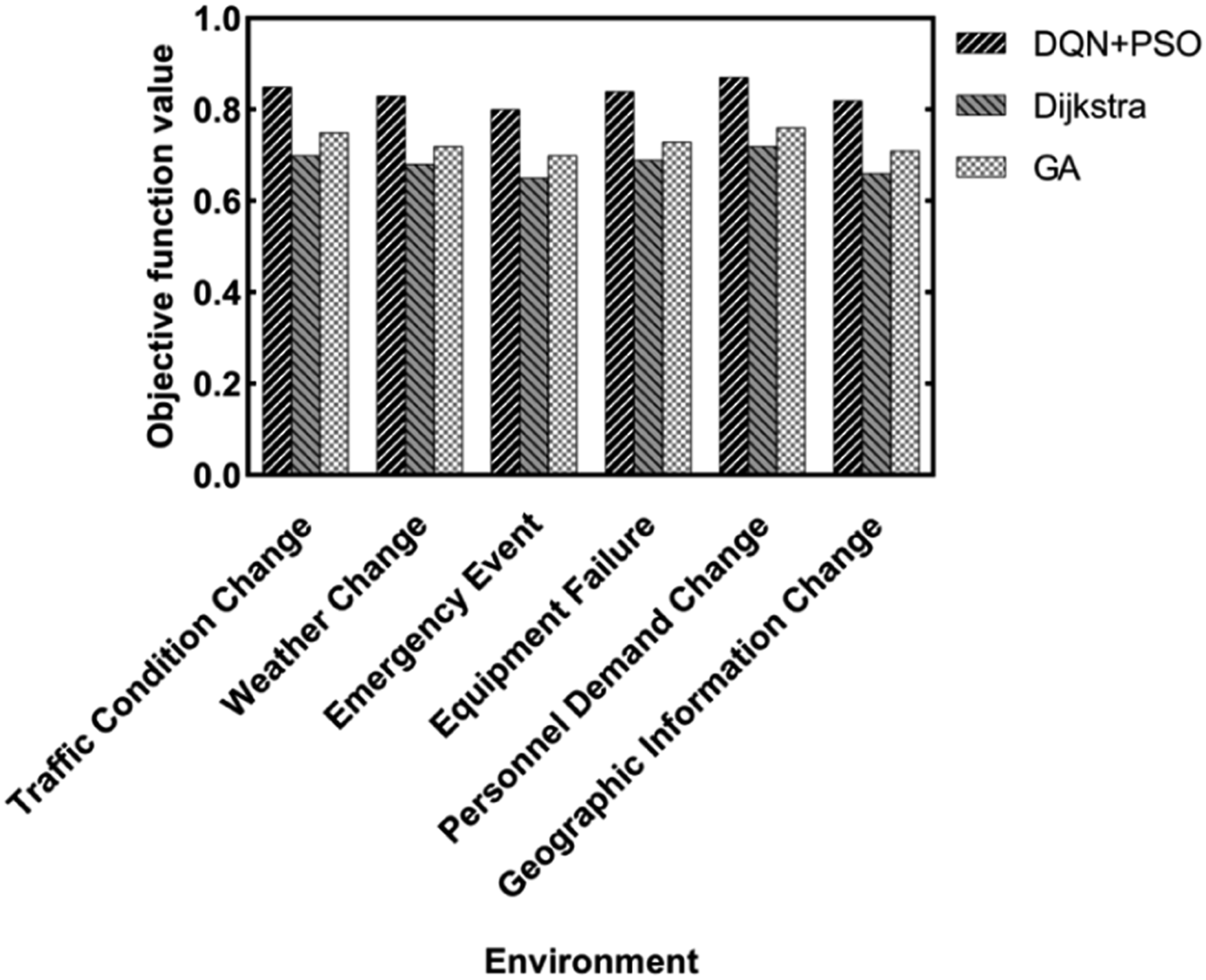
Conclusions
This study presents a hybrid path optimization model integrating Deep Q-Network (DQN) and Particle Swarm Optimization (PSO) to enhance the efficiency and adaptability of path planning in smart elderly care services. By leveraging reinforcement learning and global optimization, the proposed model effectively addresses the challenges posed by dynamic environments, optimizing path selection while minimizing travel time and improving service quality under fluctuating conditions such as traffic congestion, weather changes, and emergencies. Experimental evaluations demonstrate that the hybrid DQN-PSO model outperforms traditional approaches, such as the Dijkstra algorithm and genetic algorithms, in both total travel time and service response time. Notably, the model exhibits superior adaptability in complex scenarios, ensuring both efficiency and accuracy in real-time path planning. Furthermore, the multi-objective optimization framework, evaluated through a weighted objective function, confirms the model’s ability to balance key factors such as time, cost, and service quality, providing a comprehensive optimization solution.
The findings of this research offer valuable insights into the advancement of intelligent elderly care service path planning, demonstrating strong practical applicability. The proposed model serves as an efficient and precise path planning tool for service providers operating in complex and dynamically evolving environments. Future research can focus on extending the model’s applicability to larger-scale and multi-platform scenarios, further validating its robustness and generalization capabilities. Additionally, integrating more real-time sensor data and edge computing strategies could further enhance the model’s responsiveness, making it even more effective in real-world applications. These future directions will contribute to the continued development of intelligent, adaptive, and efficient elderly care service systems.
