



Abstract
In recent years, frequent food safety incidents have resulted in significant losses to both lives and properties, triggering widespread societal concern. To delve into the mechanisms underlying the dissemination of online public opinion during food safety incidents, this research investigated a “Pork with Salted Vegetable” food safety incident in China. The study employed a comprehensive approach, integrating automated text—mining techniques with grounded theory. First, topic modeling was used to identify six dominant concerns (topics) expressed by the public during the relevant time frame, and the key words associated with each topic. Subsequently, grounded theory method was employed to model the dissemination of public opinion toward food safety incidents. The analysis emphasizes the significant roles of four key categories—“public opinion content,” “food safety incident,” “dissemination subject,” and “dissemination channel”—in the process of food safety incident dissemination. The findings offer valuable insights for food crisis governance.
Introduction
Food safety is intimately intertwined with people’s daily lives. 1 Some food additives, used to enhance flavor or appearance have been linked to health issues. For example, unscrupulous vendors used banned chemical dyes to whiten steamed buns, making them more appealing to consumers. Prolonged consumption of these dyed buns could have adverse health effects. Some use of antibiotics in animal husbandry to promote growth and prevent disease can lead to antibiotic-resistant bacteria, which can then be transmitted to humans through the food chain. For example, the 2012 fast-growing chicken scandal, where some chicken farmers in Shandong Province, China, administered banned substances, including antibiotics and growth promoters, to accelerate the growth of their chickens. Some high-level processing in foods can remove nutrients and add unhealthy ingredients. For example, the “gutter oil” incident, where cooking oil that was illegally recycled from waste oil. This oil, which can contain various harmful substances, was then sold as new cooking oil, posing serious health risks to consumers.
The rise of the digital age has revolutionized the way information is shared and opinions are exchanged, enabling citizens to engage in discussions about important issues such as food safety across geographical boundaries and time zones on social media platforms. These discussions often carry emotional tones and unique individual perspectives, catalyzing the formation of online public opinion. 2 If not promptly and effectively managed, such online sentiments can instigate public panic, threaten social stability, and challenge the credibility of the government.3,4 Especially in the domain of food safety, digital platforms have revolutionized both the velocity and scope of information dissemination, effectively transforming how critical data reaches global stakeholders. 5 Consequently, contemporary public cognition of food safety incidents has become fundamentally mediated by social media ecosystems, with algorithmically curated content streams reshaping the dynamics of risk perception and collective response mechanisms. 6 One notable incident that exemplifies the power of online discourse is the “Pork with Salted Vegetable” food safety incident. This incident centered on the popular Chinese dish, Salted Vegetable and Pork. The main issues included substandard preserved vegetables with excessive additives, poor quality pork that might contain drug residues, and unsanitary production environments in some small-scale workshops. These problems greatly worried consumers, eroding their trust in the dish and the food industry.
Two main methods for conducting research on food safety incident-related online public opinion are text mining 7 and grounded theory. 8 One group of scholars utilized text mining methods to quickly understand public opinion out of the large amount of incident related contents. They quantitatively studied public opinion during food crisis use Natural Language Processing, machine learning and other technologies for public opinion sentiment analysis 9 and topic extraction. 6 For example, Li presents a novel approach for text analysis by introducing a structural topic and sentiment-discourse model. 10 Feuerriegel described how a variety of NLP methods, including text classification and topic modeling can be used to analyze the text data. 11 Another group of scholars employed qualitative grounded theory analysis to identify the key elements and conditional combination paths that affect online public opinion dissemination. These studies delve into the construction mechanism of online public opinion, uncovering the internal logic and dynamic process of its dissemination. 8 For example, Zhang conducted an in-depth study on the perception and attitude of Chinese netizens toward the risk of COVID-19 using grounded theory. 12 Lin used the 5W communication model and grounded theory to analyze the hot articles and comments on WeChat, and comprehensively discussed the role of Chinese social workers in epidemic prevention and control and the mechanism behind the formation of online public opinion. 13
Drawing on the Pork with Salted Vegetable case study, this research integrates text mining with grounded theory to conduct a deep analysis of how online public opinion evolves in response to food safety incidents. By first utilizing LDA for topic clustering and TF-IDF to identify key terms within each topic, the study establishes a foundation for implementing the three-stage coding process of grounded theory. Then grounded theory analysis is utilized to construct a model for understanding the dissemination of online public opinion on food safety incidents. Drawing upon the insights into the crisis dissemination, the study presents actionable recommendations for policymakers to formulate effective strategies in response to such incidents in the future.
Methodology
This research integrates text mining with grounded theory to conduct a deep analysis of how online public opinion evolves in response to food safety incidents. First, the TF-IDF algorithm and Latent Dirichlet Allocation (LDA) topic modeling were utilized to extract key phrases from the text. Building upon this foundation, this research utilizes Grounded Theory to study the key elements and combination paths to online public opinion dissemination. This methodological framework culminates in the development of a model that elucidates the dynamics of online public opinion dissemination on food safety incidents.
TF-IDF
TF-IDF (Term Frequency-Inverse Document Frequency) is a pivotal component in text mining, serving as a weighting technique for evaluating the significance of a term within a document or a corpus. The importance of a term escalates with its frequency within a document but diminishes as it recurrently appears across the entire corpus, thereby highlighting principal terms. TF-IDF is utilized in this study to find out significance terms within each topic. The computational formula for TF-IDF is illustrated as equation (1):

LDA topic model
The LDA topic model is a three-layer Bayesian model that includes three levels: document, topic, and word.
14
It converts documents in the word vector space into topics through dimensionality reduction. The specific generation process is shown in Figure 1, where α denotes the prior parameter of the Dirichlet distribution representing the topic distribution of each document, β represents the prior parameter of the Dirichlet distribution representing the distribution of each topic word, θ is the document topic distribution matrix, φ represents the topic word distribution matrix, Zi,j is the topic generated from the topic polynomial θi, and Wi,j is the word generated from the word polynomial φZi,j. LDA model structure diagram.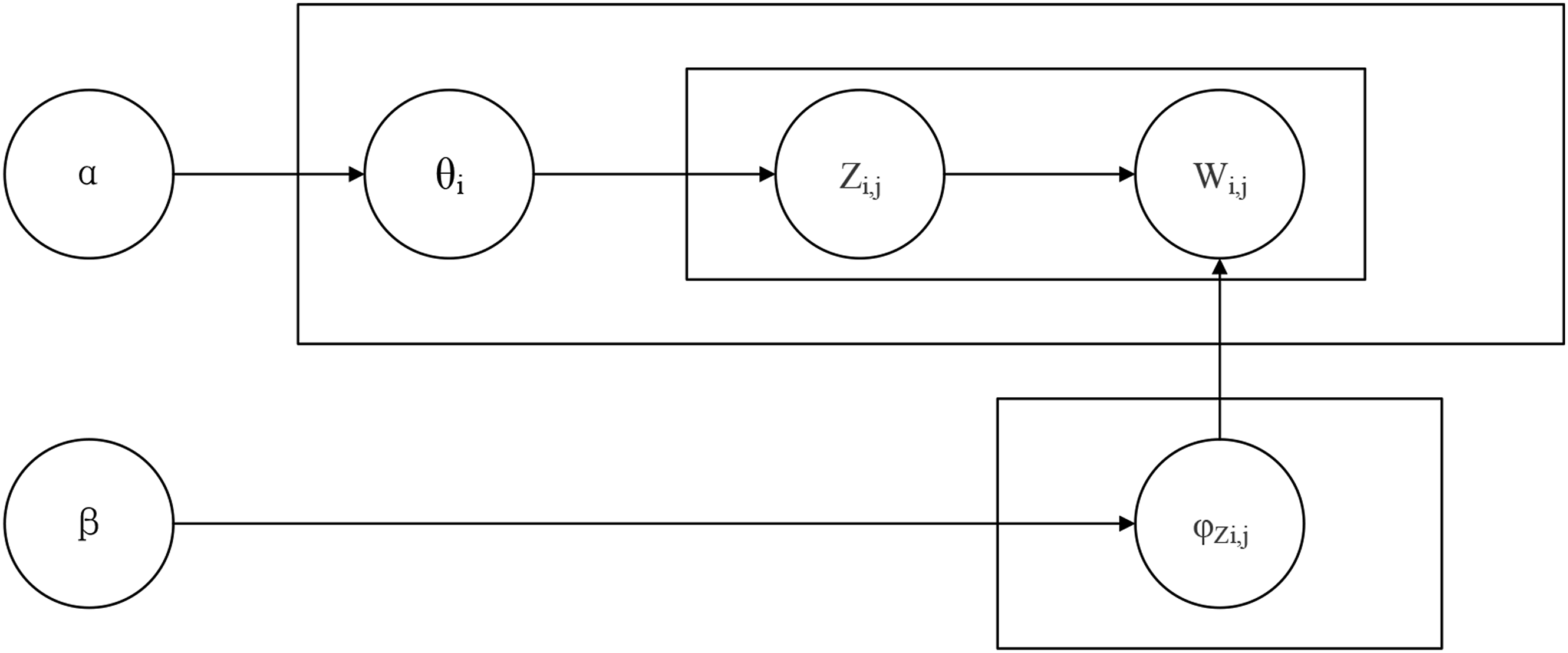
The specific process of document generation is as follows: (1) From α Generate the topic polynomial distribution for generating document i in the Dirichlet distribution of parameters θi, denoted as α. (2) Generate the topic Zi,j corresponding to the j-th word from the topic polynomial θi of the document. (3) Generate word distribution φZi,j corresponding to topic Zi,j in the Dirichlet distribution of the parameter, with parameter β. (4) Generate the final word Wi,j from the polynomial distribution φZi,j of the word. (5) Repeat the above four steps until a complete document is generated.
The number of topics is a crucial parameter in the LDA topic model, typically determined by perplexity in the process of topic extraction. Perplexity is a crucial benchmark for assessing the efficacy of linguistic models. A reduced numerical score translates to a model that encounters lesser ambiguity when confronted with diverse textual inputs, implying an elevated comprehension faculty and precision in forecasting. In LDA topic modeling, this measure of perplexity is mathematically captured by equation (2), offering a quantifiable means to gauge model fit and topic coherence.

When conducting topic clustering analysis, this article chose LDAvis, an interactive visualization system developed based on the Relief formula. The Relief formula is shown in (3)

Grounded theory
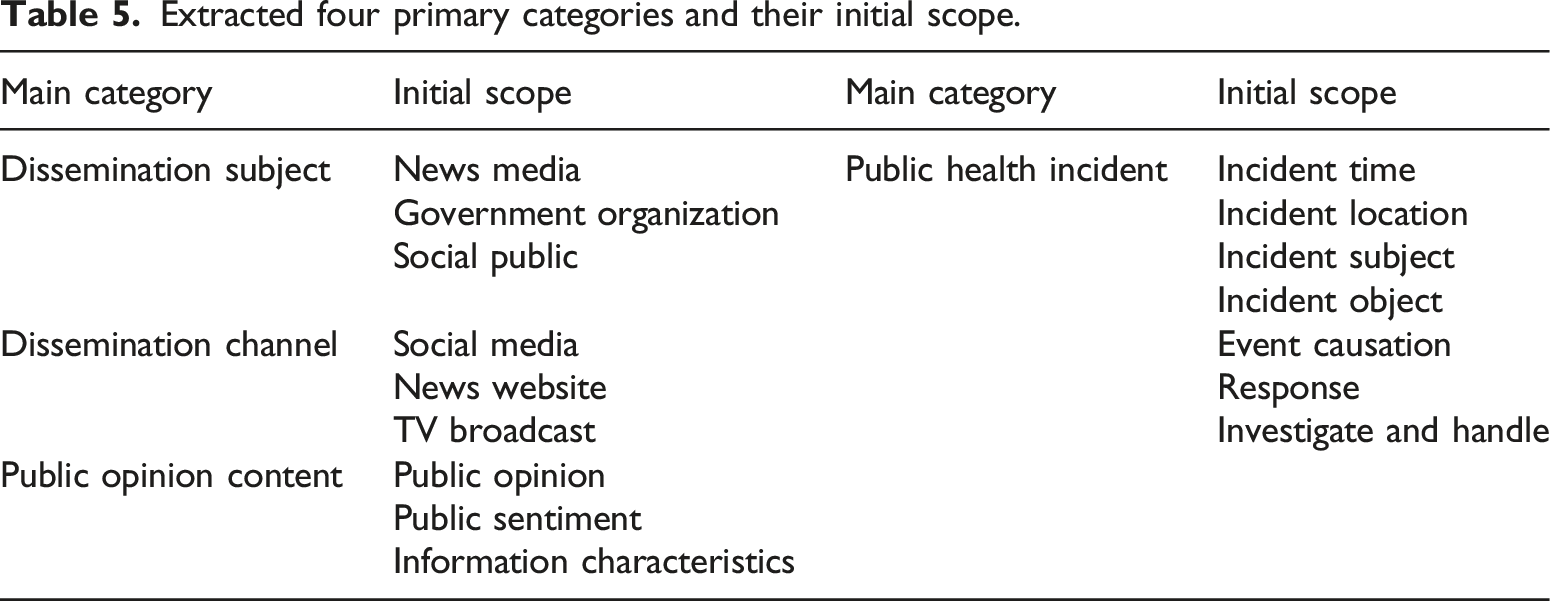
The grounded theory is a qualitative research method proposed by Glaser and Strauss in 1968, aiming to develop substantive theories from the bottom up. It analyzes and extracts raw text data, summarizes the core categories, and through continuous modification and improvement, constructs a social theory. 16 The grounded theory mainly includes four steps: open coding, spindle coding, selective coding, and saturation testing. Open coding is mainly the process of conceptualizing and categorizing the raw text data obtained. The spindle encoding will further summarize the initial categories with the same attributes obtained in open encoding, resulting in a more concise and concise main category. Selective encoding is the integration of the results of spindle encoding, the establishment of models to analyze the relationships between various main categories, and the gradual formation of theories. Saturation testing is the process of collecting new data, encoding it, and observing for the appearance of new categories after the completion of model construction, in order to verify the integrity of the model.
Data sources and preprocessing
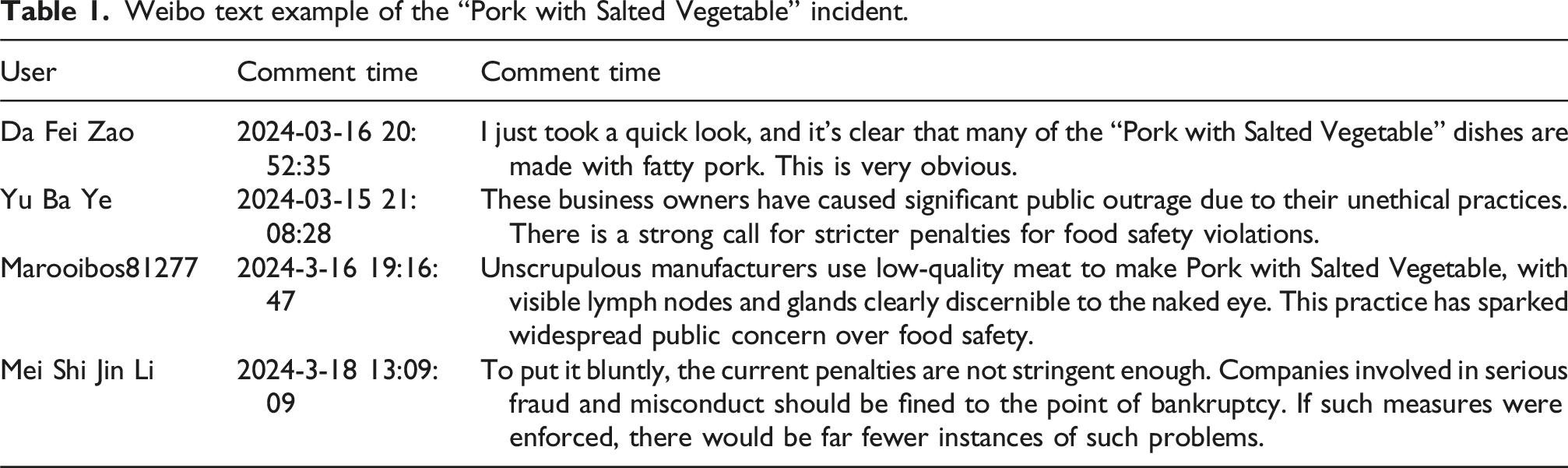
Weibo text example of the “Pork with Salted Vegetable” incident.
Empirical analysis of food safety incidents
Text mining of the food safety incident
The word cloud visually represents the key terms in the context, with more frequently occurring words displayed in larger font sizes. In Figure 2, the word cloud depicts the terms relevant to the food safety incident. This visualization reveals that the term “Pork with Salted Vegetable” is the most commonly mentioned in connection with this event, signifying heightened public concern regarding the “Pork with Salted Vegetable” incident. Furthermore, words like “Food Safety,” “Substandard,” and “Illegal Activities,” indicating that the public is aware of and concerned about the quality and handling of food products. Medias such as “CCTV,” “Weibo,” and “TikTok” are also highlighted, showing their crucial role in disseminating information. Words including “Apology,” “Refund,” and “Action” suggest a call for corporate accountability and remedial measures. Additionally, regulation terms like “Supervision” and “Market Regulation” emphasize demands for stricter oversight and enforcement to prevent future incidents. This visual representation effectively encapsulates the public’s focus and concerns regarding the incident. Moreover, it emphasizes the indispensable requirement for corporations and regulators to engage in open and above-board communication, fostering an environment of trust and security in the food-related domain. Word cloud.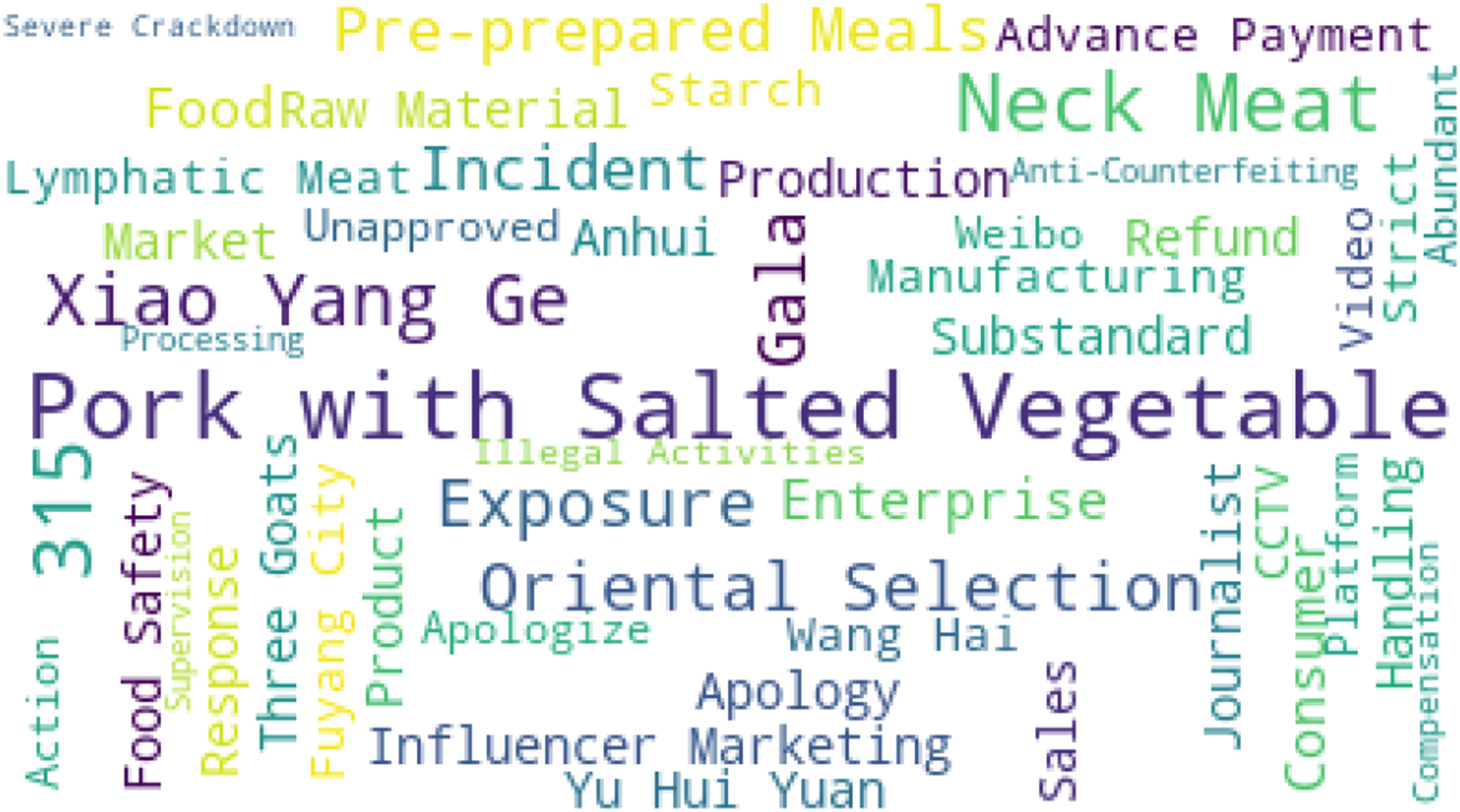
The significance of words in the text can be inferred from the magnitude of TF-IDF values. Figure 3 demonstrates the ranking of the top 10 terms in this research based on their TF-IDF scores post-segmentation. Words like “Pork with Salted Vegetable,” “315,” “Neck Meat,” and “Exposure”, as depicted in Figure 3, highlight the primary areas of interest among the public and major media outlets following the incident. TF-IDF value chart.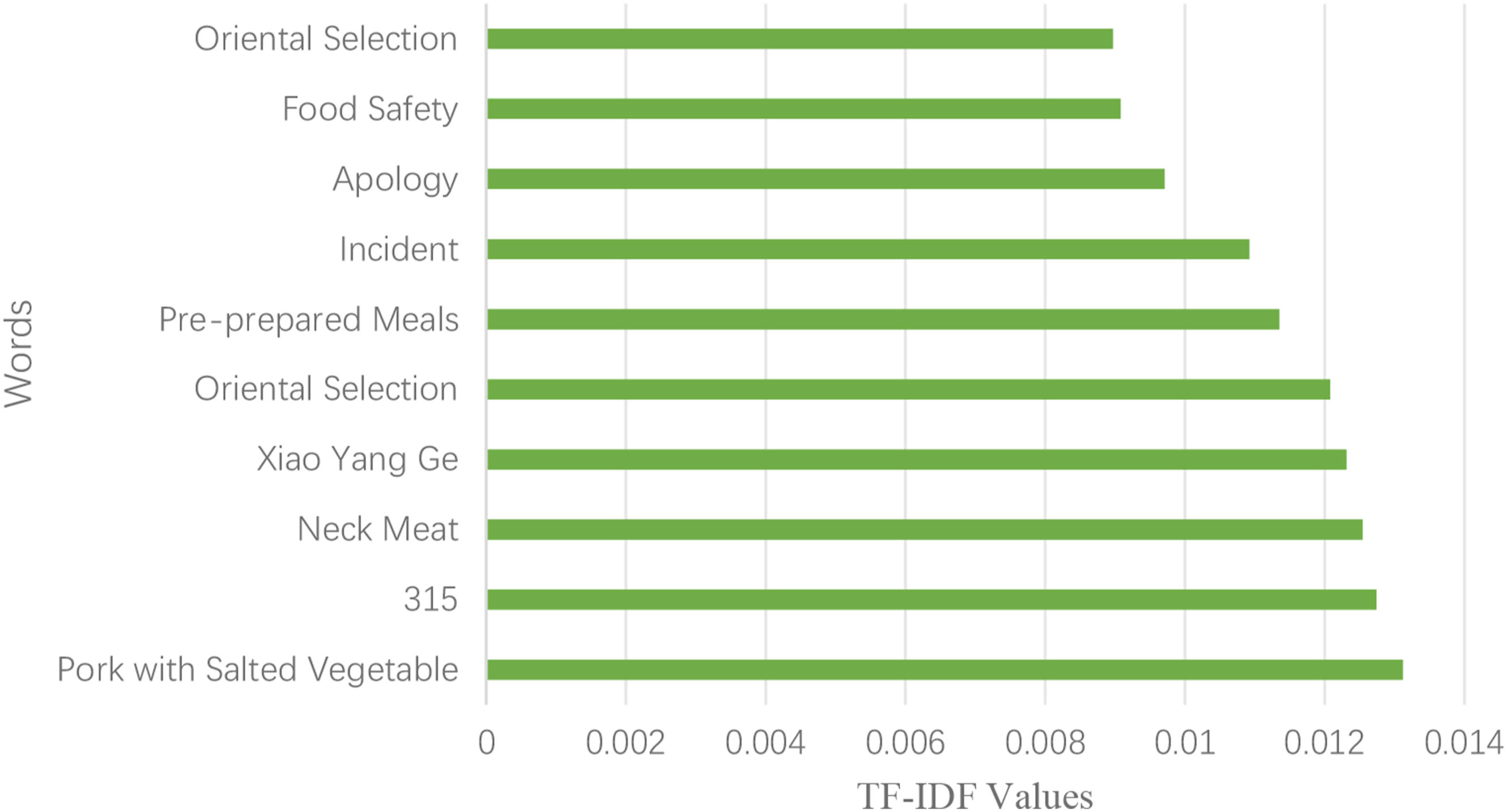
Thematic clustering helps identify the specific areas of interest within the discussions. In evaluating the performance of the model, perplexity serves as a measure of uncertainty within the documents regarding each topic. Lower perplexity values indicate a better performance of the model. The study computed perplexity for each of the 15 topics and generated a topic perplexity curve graph (refer to Figure 4). The graph clearly shows that as the number of topics increases, there is a progressive decline in the level of perplexity. This downward trend implies a growing understanding or less confusion as more topics are introduced. Nevertheless, once the number of topics surpasses six, a reverse pattern emerges, with the perplexity gradually creeping up. To ensure the accuracy and reliability of the analysis outcomes, we made the strategic decision to cap the number of topics at six. This limit is expected to maintain the integrity of our findings and prevent potential misinterpretations that could arise from an overly large number of topics. Topic perplexity graph.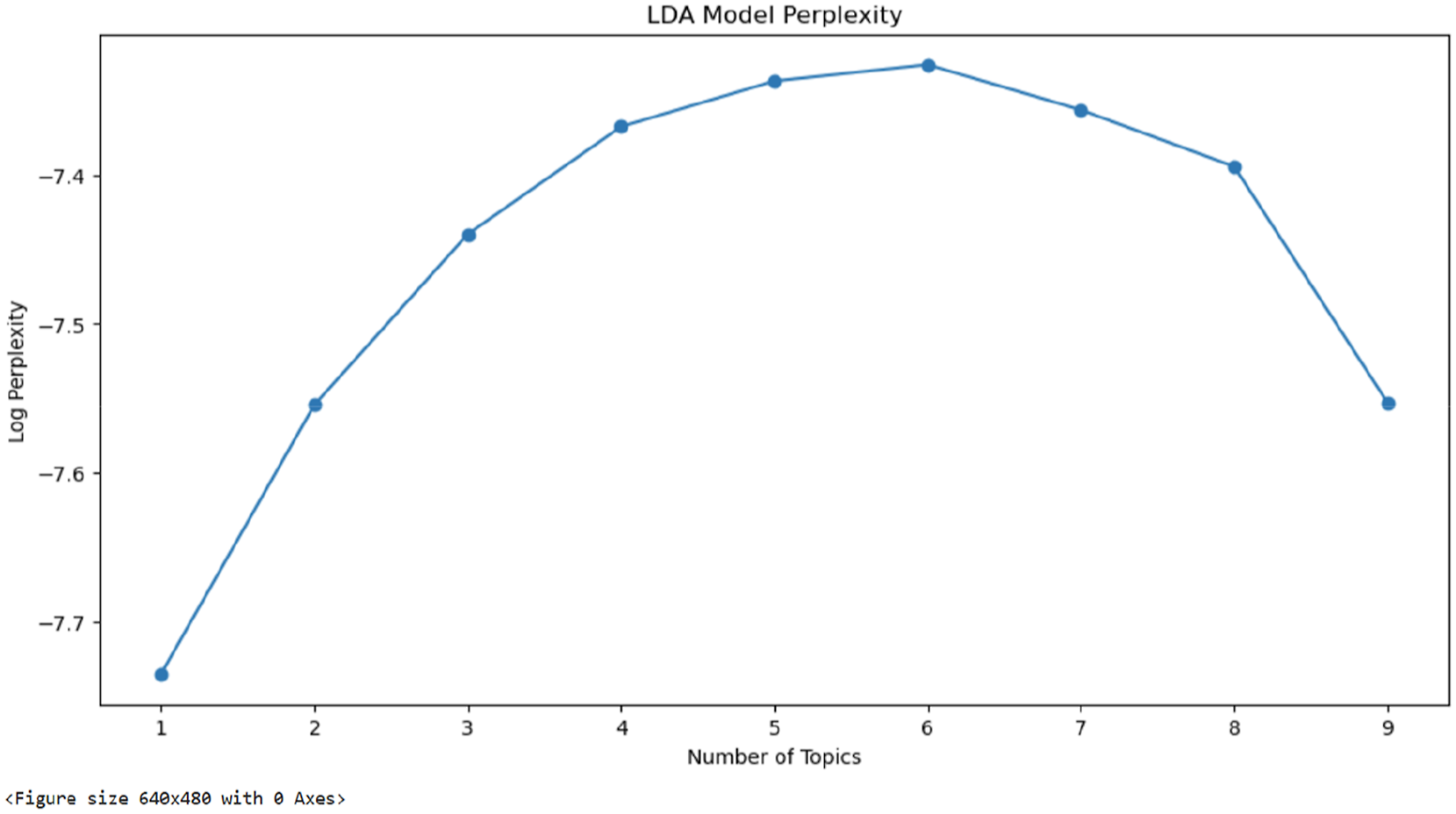
With α and β set at 0.1 and 0.01, respectively, Figure 5 showcases part of the LDA topic clustering results, where each bubble represents a distinct subject. The visualization indicates that the six subject bubbles are well-separated and do not overlap much, suggesting effective topic division by the LDA model. Table 2 presents the top 10 topic terms for each of the six themes. By integrating these with the topic feature words, TF-IDF values, and specific text content for each topic, we can summarize the essence of the six topics as follows: LDAvis visualization graph. Top 10 high TF-IDF valued terms associated with each topic.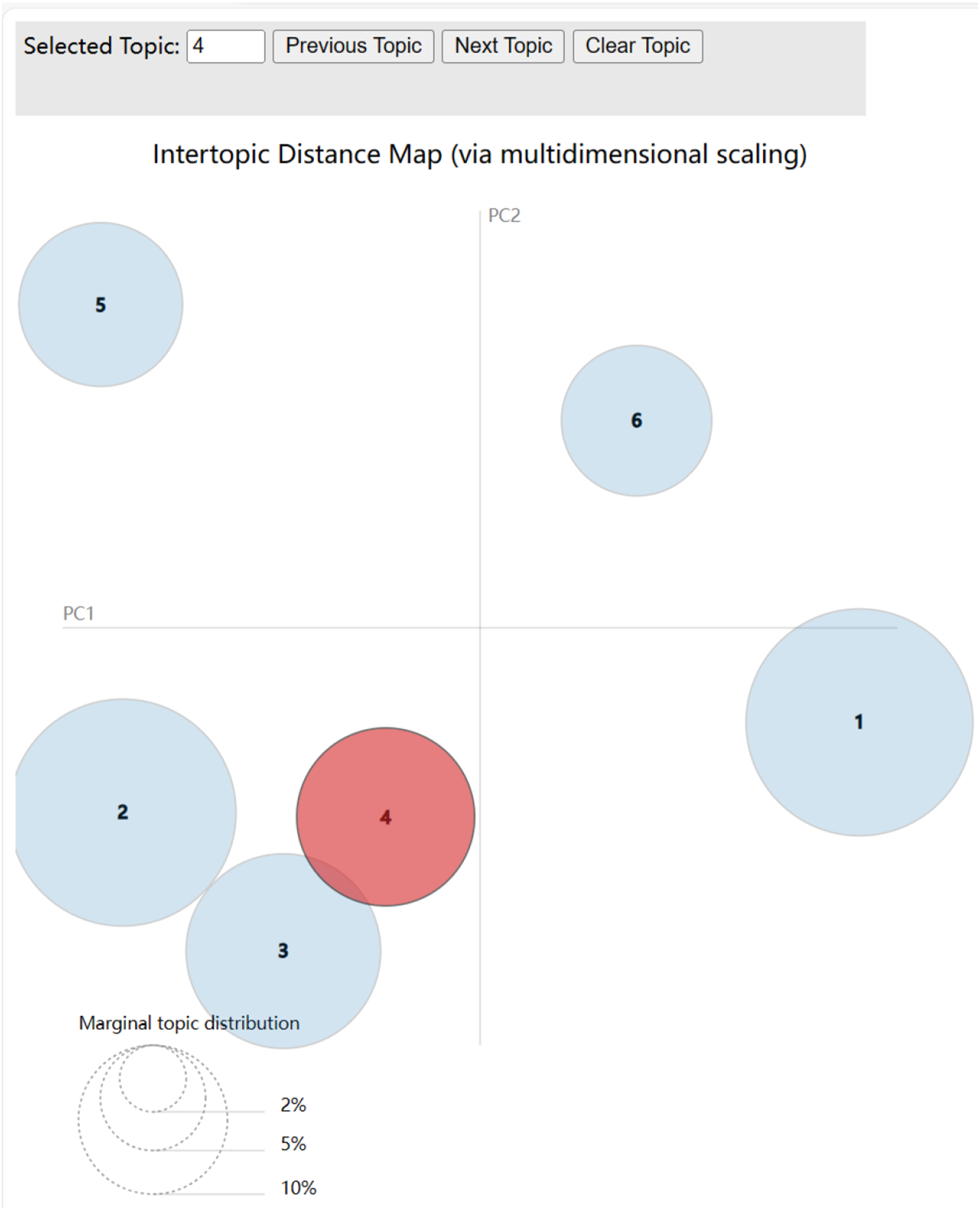

Topic 1: Frequent mentions of terms like “315,” “exposure,” “pork with salted vegetable,” and “pre-prepared meals” reveals the 315 Gala’s exposure of substandard neck meat used in pre-prepared pork with salted vegetable. As an annual event dedicated to safeguarding consumer rights, the 315 Gala has always been committed to unmasking behaviors that infringe upon consumers’ legitimate rights. This year, food safety issues also took center stage, with a particular emphasis on the production process of ready-to-eat preserved vegetable and pork meals. Through meticulous investigations, the gala brought to light the fact that certain companies had been using substandard meat ingredients, which was a blatant violation of food safety regulations.
Topic 2: High-frequency terms such as “Xiao Yangge,” “Oriental Selection,” “pork with salted vegetable,” and “apology” highlight the actions taken by some live-streaming hosts who previously promoted substandard pork with preserved vegetables. In response to social pressure and public outcry, these hosts publicly apologized and promised refunds to regain consumer trust. Notably, renowned host Xiao Yangge recommended the implicated product in his live stream and swiftly issued a public apology, promising full refunds to affected consumers. These proactive measures alleviated some consumer anger but also sparked discussions on regulating the live-streaming sales industry. Platforms like Oriental Selection adopted similar measures to restore consumer confidence.
Topic 3: Frequent mentions of “neck meat,” “lymphatic meat,” “raw materials,” and “CCTV journalists” reveal details of the food safety incident. Secret investigations by CCTV journalists uncovered the use of substandard meat ingredients by some manufacturers, which not only violated food safety standards but also posed potential health risks to consumers, sparking intense online public opinion. The journalists’ in-depth investigation produced extensive video and photo evidence of the inferior meat production and processing. When this evidence was broadcast during the gala, it triggered strong public reactions.
Topic 4: The concentration of terms such as “Fu yang City,” “fine,” “involved parties,” “revoke,” and “sealing off” highlights the regional nature and wide-ranging impact of the incident. The Fu yang City government took swift action, imposing severe penalties on involved enterprises. Multiple companies were heavily fined for using substandard meat, and some had their business licenses revoked and production facilities sealed off. These measures demonstrate the local government’s high regard for food safety issues and the regulators’ determination.
Topic 5: High-frequency terms such as “Wang Hai,” “tenfold compensation for counterfeit goods,” “Food Safety Law,” and “distributors” showcase the active role of renowned consumer advocate Wang Hai in this incident. Wang Hai used social media and live streaming platforms to educate the public about the Food Safety Law and pointed out the violations committed by merchants. He urged consumers to actively seek redress and demand compensation according to the “tenfold compensation for counterfeit goods” rule. This initiative received widespread support from consumers, many of whom successfully obtained compensation.
Topic 6: The frequent emergence of terms such as “action,” “food safety,” “market regulation,” and “crack down” expresses the public’s deep expectation that relevant departments will take immediate and effective actions. The exposure of this food safety incident has drawn attention and discussion on the food safety regulatory system. Consumers hope the government will implement more stringent measures to strengthen supervision over food production, distribution, and sales processes, ensuring that products in the market meet safety standards. Terms like “rights and interests,” “safeguard,” “active,” “market regulation,” and “crack down” further highlight the regulatory agencies’ responsibilities and missions in maintaining market order and protecting consumer rights. Additionally, this calls for joint efforts from all sectors of society to promote higher-quality development in the food industry, providing safer and more reliable food for consumers.
Theoretical analysis of the dissemination mechanism underpinning online public opinion on food safety incidents
In the previous section, we conducted a quantitative extraction and in-depth analysis of the topics that captured the public’s attention during the eruption of online public opinion regarding food safety incidents. This effort has initially unraveled the focal points of public sentiment and the distinct characteristics of topic distribution. However, these results can not reveal the dissemination mechanism of online public opinion on food safety issues. Therefore, in order to understand the logic of online public opinion dissemination in a more systematic way, this section will adopt the qualitative research method, grounded theory, to construct a model of online public opinion dissemination through layer-by-layer coding and analysis. The influencing factors and interactions of public opinion dissemination are discussed in depth.
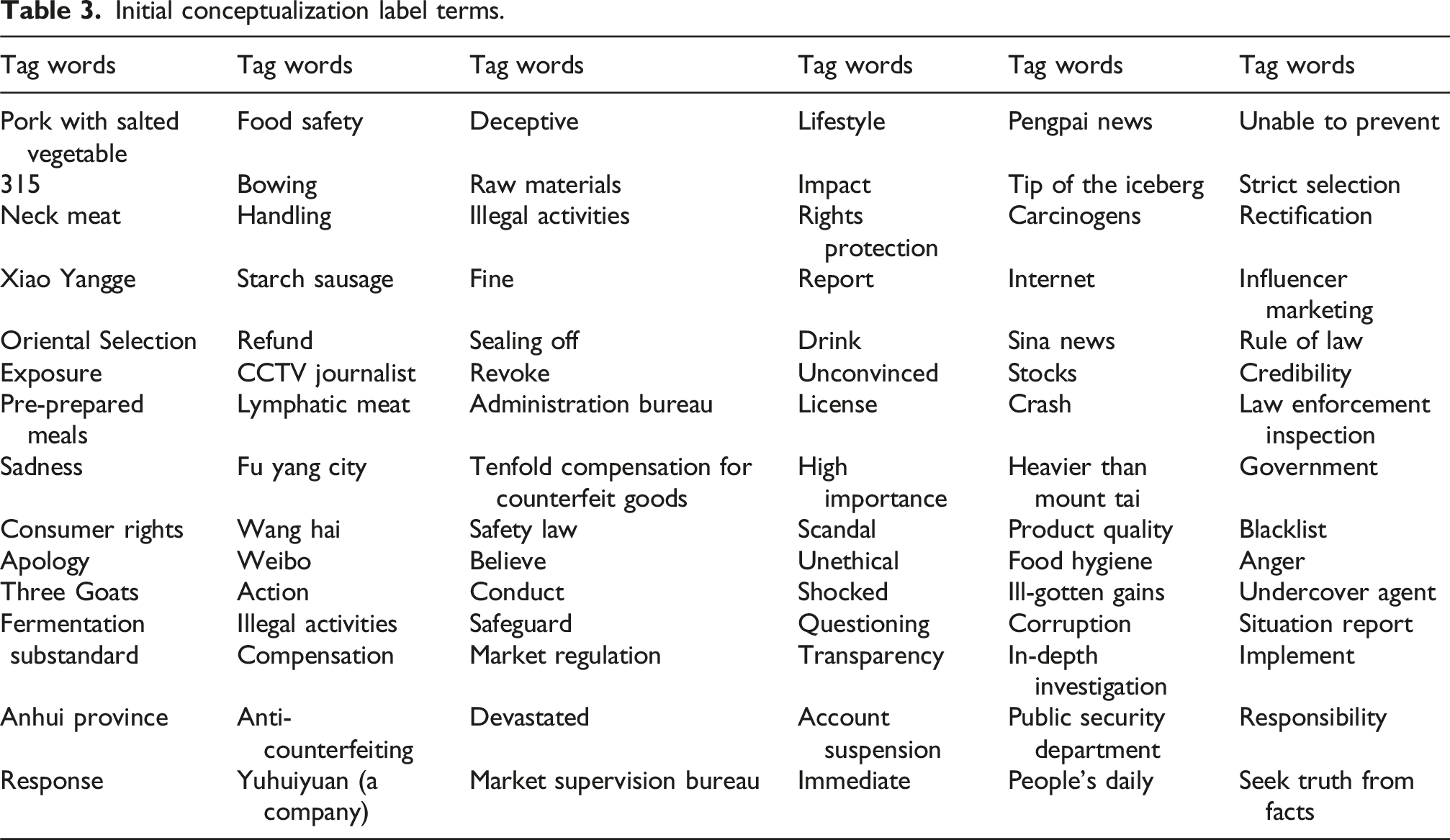
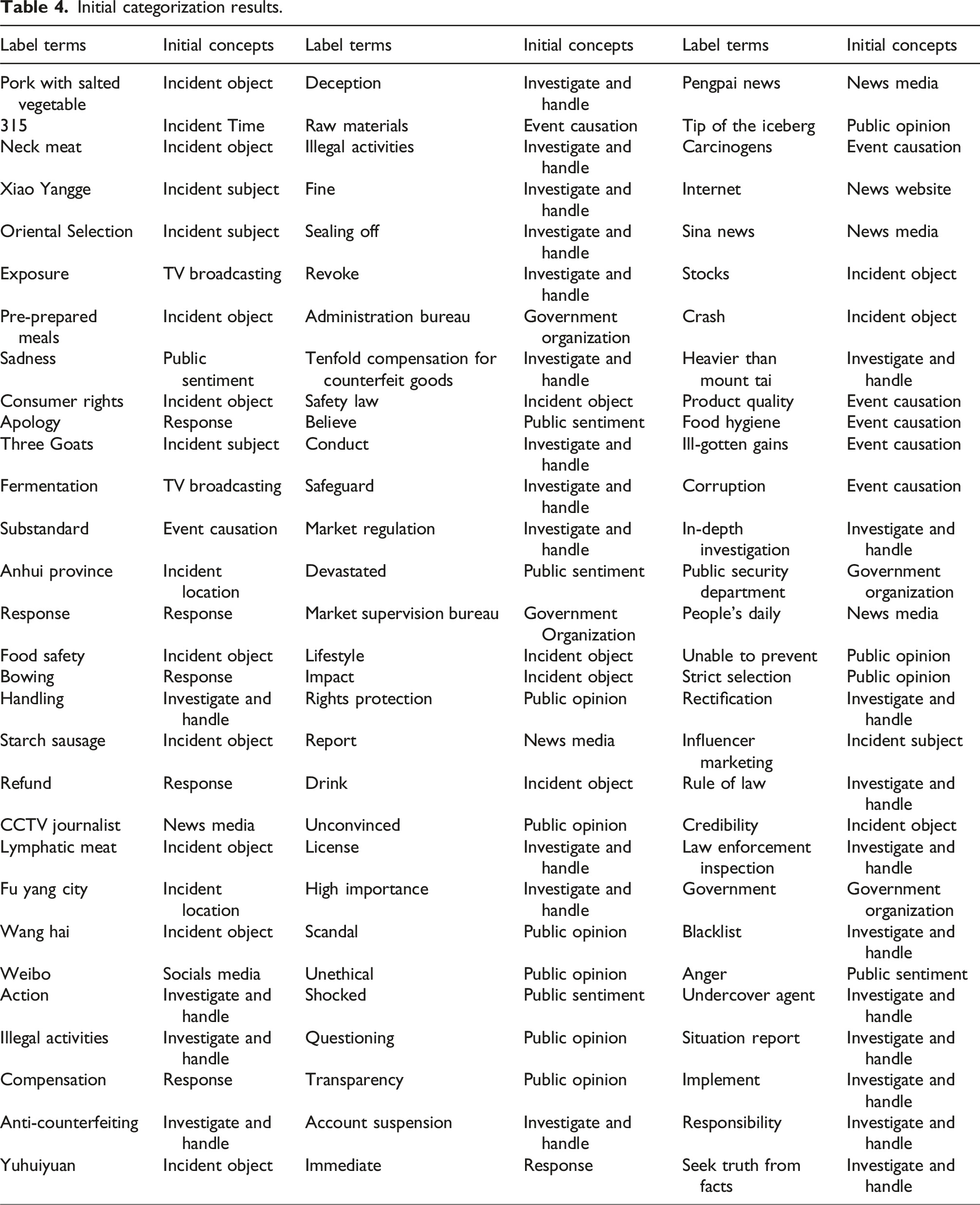
Grounded theory requires researchers to iteratively code and compare data manually until theoretical saturation. However, in this study, its manual, line-by-line coding approach is impractical due to the unprecedented scale and complexity of our dataset, which includes massive, unstructured text corpora. Manual coding of our social media collected dataset is prohibitively time-consuming and logistically unfeasible. To address the limitation of classic grounded theory coding, we adapted classic grounded theory coding principles to the key terms identified within each LDA topic. That is, instead of coding all the text data, this study takes advantage of the high TF-IDF values terms retrieved in the previous section to code only the high TF-IDF values terms. This methodology balances classic grounded theory’s emphasis on emergent theory with the demands of modern, data-driven research.
Open coding
Initial conceptualization label terms.
Initial categorization results.
Axial coding
In grounded theory, open coding generates fragmented codes that describe what exists in the data, but they lack coherence. Axial coding bridges this gap by logically grouping these codes into higher-order categories and establishing causal relationships. Without axial coding, analysis remains descriptive, merely listing phenomena (e.g., “detection fraud” in food safety scandals), whereas axial coding explains how and why such phenomena occur (e.g., linking fraud to institutional trust erosion and panic diffusion).
Extracted four primary categories and their initial scope.
Construction of online public opinion dissemination mechanism for public health incident
In grounded theory, the process of selective coding is the process of model construction. Through a deeper-level analysis of the extraction results of the main categories, the logical relationships between the core category and other main categories are sorted out to form a theoretical model. The roles and interrelationships of each component element in the process of public opinion dissemination are systematically expounded, providing theoretical support for in-depth understanding and effective response to online public opinion on public health events.
In this study, “the dissemination mechanism of online public opinion on the public health incident” is taken as the core category, and it is found that it is intertwined with and mutually influences main categories such as “public opinion content,” “public health incident,” and “dissemination subject.” In public health incidents, the characteristics of the incident itself (such as the incident subject, event causation, and the response) trigger the public’s emotional reactions. The public expresses emotions and disseminates information through the Internet, forming the initial driving force of public opinion. Government departments conduct investigations into the events and carry out management behaviors such as information release, policy formulation, and adjustment of penalties based on the dynamics of public opinion and the situation of the events. The media plays a bridging role in disseminating information, interpreting events, and guiding public opinion. Its report content and public opinion orientation are not only affected by government management and public opinion, but also in turn affect government decision-making and public perception. Based on this, a dissemination mechanism model of online public opinion on public health incidents based on grounded theory is constructed, as shown in Figure 6. Online public opinion dissemination model for food safety incidents.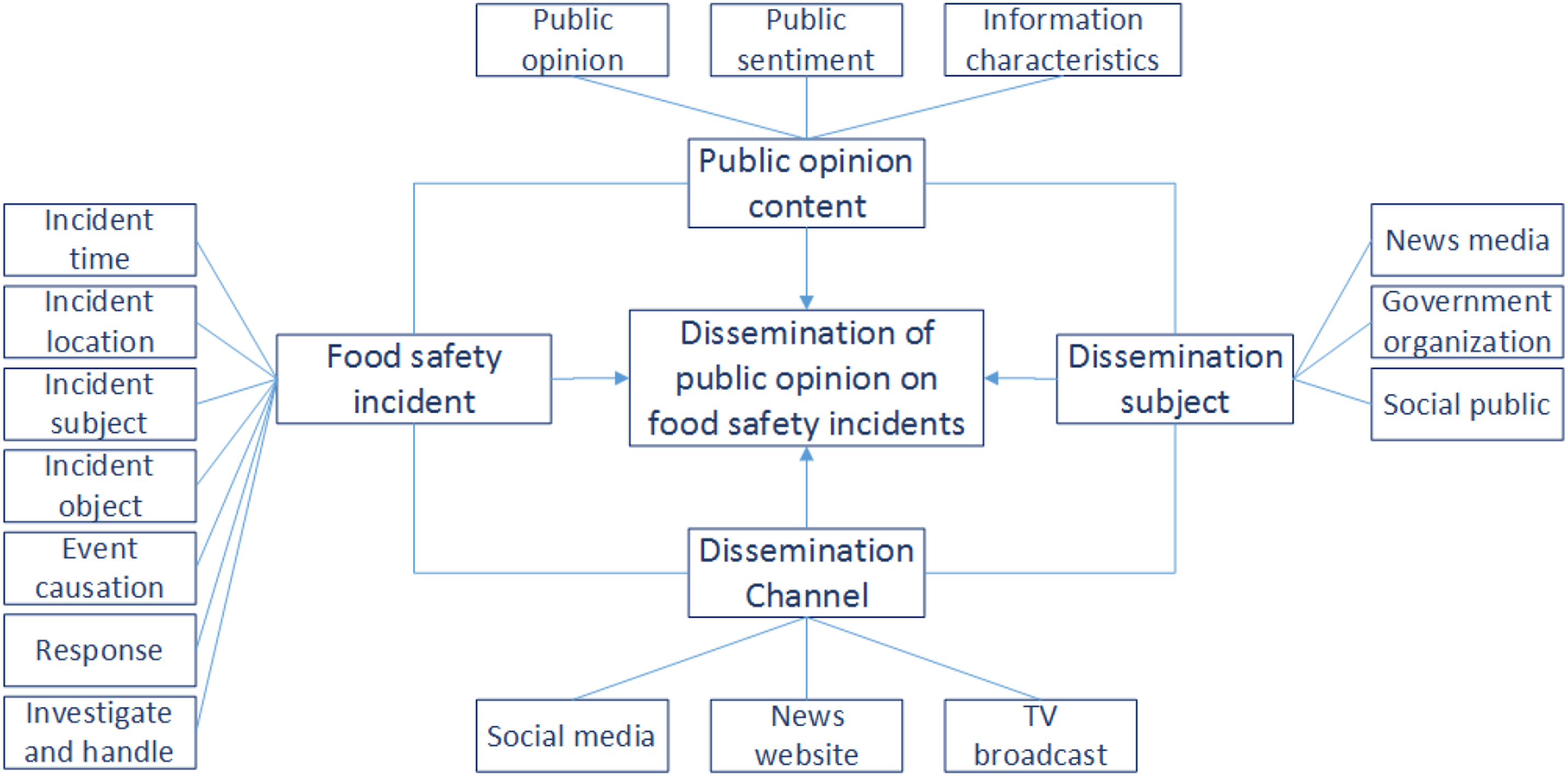
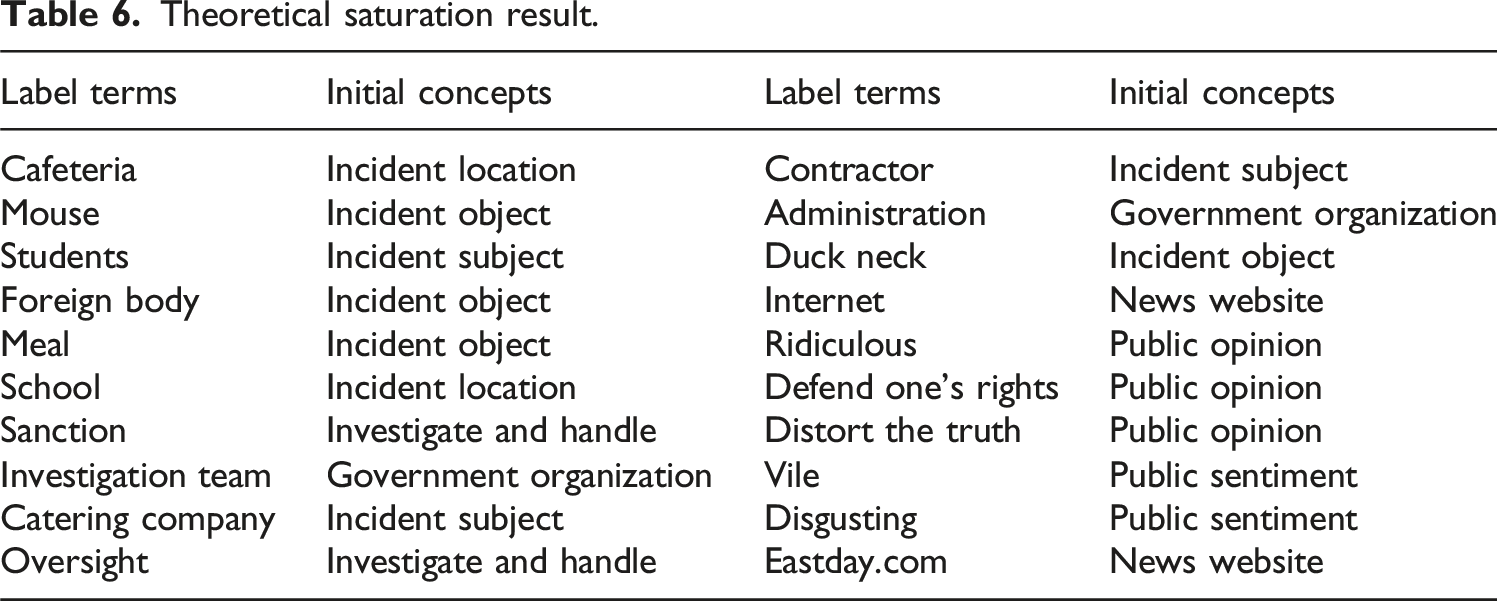
Theoretical saturation is a critical step in grounded theory to determine whether the collected data sufficiently support the construction of the theoretical model. To ensure the integrity and rationality of the model, a saturation test was conducted by continuing to collect and analyze new public opinion text data to verify whether novel concepts or categories emerged. The model was deemed saturated when no significant new concepts or categories arose from additional data, indicating high credibility. To validate data saturation, this study selected the “Rat Head-Duck Neck” food safety incident as a case verification.
Theoretical saturation result.
Model analysis
The following text will discuss the model of online public opinion dissemination pertaining to food safety incidents, along with specific case studies. It will analyze the process of online public opinion dissemination, examining various main categories and offering relevant recommendations.
Main categories of online public opinion in public health incidents
This study has identified “public opinion content,” “public health incident,” “dissemination channel,” and “dissemination subject” as the primary actors in the process of shaping online public opinion.
Beginning with public opinion content, the study emphasizes the significant role played by the vast number of internet users. The emotional tendencies and attention of netizens are crucial factors in influencing public opinion on the network. 17 Public opinions offer diverse content, fueling the exchange and attracting more attention. Public emotions, like anger or concern, act as a driving force, triggering empathy and spurring rapid dissemination. Meanwhile, the authenticity, novelty and simplicity of online public opinion information determine its spread ability, facilitating its wide and quick dissemination. 18 In the 3·15 Gala, once the food safety incident of “pork with salted vegetables” was exposed, the public immediately paid attention to it and launched a heated discussion online, and the online public opinion began to emerge. The number of relevant reports on the 3·15 Gala exposing that the raw material of the braised pork with preserved vegetables was jowl meat. These contents quickly aroused emotions such as anger and disgust among the public. Accompanied by the pressure of public opinion, the Internet celebrity anchors who had previously promoted the problematic braised pork with preserved vegetables took actions such as apologizing and compensating. The relevant contents on this topic attracted the most public attention. The public had different reactions to the apologies of the Internet celebrities. Some of them reacted positively. The live-streaming anchors who promoted the products took the initiative to apologize to consumers and promised to give refunds. Such a responsible attitude won the understanding and recognition of some consumers. On the other hand, some netizens held negative emotions, believing that the anchors knowingly violated the rules and were not worthy of forgiveness. The contents on the harm to health caused by the jowl meat raw material and the details of the production process of the jowl meat aroused strong negative emotions among the public. It reflected the public’s anger, disgust and depression toward the behavior of some manufacturers who ignored relevant laws and regulations, chose inferior jowl meat as raw materials, and seriously damaged the health of consumers.
Moving on to the public health incident, incidents that capture public attention or are directly linked to public safety and interests are crucial in public opinion Dissemination. They usually act as powerful triggers that can quickly capture the public’s attention, leading to a sharp increase in the volume of online discussions. The uncertainty and potential threat of such incidents often arouse strong emotions among the public, such as anxiety and concern, which in turn fuel the rapid spread of related information and opinions. Moreover, the complexity and wide-ranging impact of public health incidents provide a large amount of material for public discussion, enabling the formation of diverse viewpoints and the emergence of various rumors and speculations, thereby further promoting the spread and evolution of online public opinion. For instance, once exposed, the pork with salted vegetable food safety incident immediately seizes the public’s attention, triggering a flood of discussions and expressing strong emotions like anger and disappointment. This not only makes the incident trend on the Internet but also spurs diverse opinions, further fueling the spread of related public opinion. This category in the theoretical framework aligns with empirical studies validating that incident-specific attributes—particularly causation ambiguity, investigative protocols, and resolution transparency—exert significant effects on online public opinion dissemination trajectories. 19
Dissemination channel make up the third group. The “dissemination channel” is the different media platforms that are involved in shaping and disseminating public opinion. They serve as the platform and carrier, enabling the rapid spread of information to a wide range of audiences. Different media have their own characteristics and user groups, which can influence the direction and scope of public opinion dissemination, thus shaping the overall situation of online public opinion. The formation and development of online public opinion depend heavily on these medias.19,20 For instance, in the food safety incident of pork with salted vegetables, dissemination channels quickly spread the details of the incident, allowing the public to learn about it in a timely manner and triggering widespread discussions. Social media, in particular, with its wide reach and fast dissemination speed, has made the incident gain extensive attention, fueling the spread of public opinion and putting pressure on relevant departments to act.
And finally, there are the dissemination subjects. These agencies have the capacity to investigate incidents, provide reassurances, and subtly sway public sentiment, have been identified as a key factor in crisis dissemination frameworks. 8 For example, in the food safety incident of pork with salted vegetables, news media expose the details of the incident, attracting public attention and fueling discussions. The government actively intervenes. It conducts thorough inspections on production and circulation, release official investigation results and regulatory actions, and punishes the enterprises involved to deter similar violations, which can stabilize public sentiment and direct the development of public opinion. Subsequently, the public will evaluate the responses made by relevant departments, thus generating positive or negative feedback on the online public opinion. This feedback mechanism may lead to the emergence of new online public opinions and prompt the public to further expect the government to respond again. This process repeats continuously until the public opinion gradually subsides. The dynamic interaction process reveals the interaction mechanism among the government, media, and the public in the dissemination of online public opinion during public health events. The government guides the direction of public opinion through information release and policy measures, the media influences public perception through reports and comments, and the public promotes the dissemination and development of public opinion through feedback and interaction. The interaction among the three not only affects the direction of public opinion but may also have a profound impact on the final resolution of the event and social governance.
Suggestions for responding to online public opinion in public health emergencies
In order to effectively reduce the harm caused by online public opinion, the following recommendations are proposed based on the previously constructed online public opinion dissemination model and the content presented in the preceding section.
First, there is a need to bolster the control capabilities of major information platforms. Information platforms, particularly Sina Weibo, TikTok, and WeChat, play a pivotal role in the dissemination of public opinion. After a public opinion event, these platforms and relevant authorities should intensify the scrutiny of content generated by netizens and major news outlets, striving to reduce the propagation of rumors and low-quality information while safeguarding the freedom of expression for netizens. With respect to comments that exert a positive influence on public opinion, relevant agencies should fully utilize the reach of new media platforms to promote and propagate them, providing support to the government in steering online public opinion.
The second key initiative involves enhancing the scientific literacy and cognitive skills of Chinese netizens. The formation of online public opinion is significantly impacted by disparities in scientific literacy and cognitive abilities among internet users. Certain netizens, lacking cognitive capacity, can be easily swayed by others and opinion leaders, resulting in erroneous statements that contribute to the shaping and progression of public opinion. Additionally, the abundance of content on popular platforms can lead some internet users to struggle in distinguishing between credible and inaccurate information, precipitating the rapid dissemination of misleading information, leading to the spread of rumors and unfavorable public perceptions. Hence, improving the scientific literacy and cognitive skills of netizens is crucial in shaping internet public opinion and creating a secure online environment.
Third, there is a need to fortify the establishment of China’s online public opinion emergency response system. Continuous enhancement of the emergency response system for unforeseen public health crises is imperative. To instill confidence, the government should swiftly investigate incidents, disclose findings, address concerns raised by internet users, and ensure transparent and accessible information. This ensures the government’s ability to control discourse, prevent the proliferation of false information, guide public opinion, and fortify its authority. Addressing public opinion challenges and ensuring the enforcement of laws also requires the refinement of laws and regulations related to online public opinion. The government should aim to enact specific regulations for the governance of online public opinion and promptly revise existing laws in response to advancements in this domain.
Conclusion
This study investigates an acute food safety incident through the integration of text mining and grounded theory to analyze online public opinion. Initially, employing text mining techniques to identify primary concerns expressed by the public during the incident. Subsequently, thematic words and high TF-IDF value keywords were extracted to underpin grounded theoretical coding. Ultimately, a conceptual framework for modeling the dissemination of online public opinion during food safety incidents was established. This study has identified “public opinion content,” “public health incident,” “dissemination channel,” and “dissemination subject” as the primary actors in the process of shaping online public opinion, and expounds on the roles of these four aspects in the dissemination of online public opinion. Studies can make future research extensions for the four core categories of the conceptual framework. For example, studies could test the universality of this framework across distinct crisis (e.g., slow-onset crises vs acute outbreaks), or distinct platform (e.g., WeChat vs Reddit). Studies could also carry out longitudinal tracking of dissemination subjects’ behavioral shifts as regulatory interventions evolve, offering real-time validation for crisis communication policies. While this study provides critical insights into food safety risk communication, its scope is inherently constrained by the single-case study design focused on a pre-made dishes safety scandal, which may limit the generalizability of the findings to broader food industry contexts and necessitate caution when extrapolating the recommendations to cross-cultural settings or emerging food technologies. Future studies should encompass a broader spectrum of food safety incidents for more comprehensive insights.
Footnotes

Funding
The authors disclosed receipt of the following financial support for the research, authorship, and/or publication of this article: This work was supported by the National Social Science Foundation of China, Grant Number: 20FTQB018; JiangSu Province Social Science Foundation, Grant Number: 20TQB001; The Fundamental Research Funds for the Central Universities, Grant Number: 2019JDZD06.
Conflicting interest
The authors declared no potential conflicts of interest with respect to the research, authorship, and/or publication of this article.